Nomad Life Success Podcast

Escape the 9-5 and build a thriving location-independent life—every single day.The Nomad Life Success Podcast delivers the realistic blueprints and insider strategies needed to create six-figure online income streams while traveling the world. From scaling a freedom-based business to mastering remote work logistics, we help you avoid common pitfalls and achieve true financial sovereignty. Whether you are an aspiring nomad or a seasoned professional, tune in daily for actionable advice on digital entrepreneurship and building high-value digital assets.Start your journey by grabbing the free 'Location Independent Six-Figure Income' ebook at NomadLifeSuccess.com, and when you are ready to...
The CGM Travel Protocol: Use Continuous Glucose Monitoring to Eliminate Mid-Flight Energy Crashes and Brain Fog
Jet lag and travel fatigue aren't just about sleep—they're about metabolic chaos. When you cross time zones, your gut and pancreas are still running on home time, leading to unpredictable glucose spikes and crashes that fog your thinking and crush your energy. In this episode, I break down how a continuous glucose monitor (CGM) can be your ultimate travel co-pilot. You'll learn the exact pre-flight meal strategy to stabilize your baseline, how to time your first in-flight meal to match your destination's clock, and which 'healthy' airport snacks are actually sabotaging your focus. Plus, I'll share a simple 3-step pr...
The Fasting Reset: Use Meal Timing to Hack Your Circadian Clock Across Time Zones
In this episode, Aria Reyes breaks down the science of time-restricted eating as a powerful circadian anchor for frequent flyers. Most nomads obsess over blue light blockers and melatonin, but overlook the strongest peripheral clock signal: food. When you eat, your gut sends a direct signal to the suprachiasmatic nucleus, overriding your brain's default timezone. Aria explains how a 16-hour fast before landing and a carefully timed first meal at your destination can accelerate jet lag recovery by up to 40%. She walks through a simple 3-step protocol: fast through the flight, break your fast at the destination's sunrise, and then...
The Contrast Reset: Using Hot and Cold Exposure to Reclaim Your Circadian Rhythm
In this episode, Aria Reyes breaks down the science of temperature-based circadian entrainment and how digital nomads can use contrast therapy to reset their body clocks faster than light alone. Learn why your core body temperature is the master switch for sleep and alertness, and how a simple 90-second cold exposure in the morning can shift your circadian phase, while a warm bath before bed triggers melatonin release. Aria provides a step-by-step protocol that fits in a hotel bathroom, from the exact timing and temperature ranges to how to sequence this with your existing light and meal schedule. She also...
The Exercise Phase Shift: Using Movement to Reset Your Body Clock
In this episode, Aria Reyes breaks down the science of how exercise influences the circadian system. She explains that while light is the primary zeitgeber, exercise can also phase-shift the clock, especially when combined with light exposure. She provides a 3-step protocol for timing workouts to align with your destination time zone, including morning exercise for eastward travel and evening exercise for westward. She also discusses how to avoid training at the wrong time which can disrupt your sleep. She ties it into cognitive performance and executive function, showing how a single well-timed workout can eliminate jet lag fog and...
The CO2 Ceiling: Why Your Hotel Room's Air Is Sabotaging Your Deep Work
{"title":"The CO2 Ceiling: Why Your Hotel Room's Air Is Sabotaging Your Deep Work","one_liner":"Stop letting stale hotel air drain your cognitive performance; measure CO2 and humidity to engineer a sharper mind in any room.","description":"In this episode, Aria Reyes reveals the invisible performance killer hiding in your hotel room: carbon dioxide buildup. When you lock yourself in a sealed room for hours, CO2 levels can climb above 1,000 ppm, and research shows that at this threshold, decision-making and strategic thinking can drop by up to 50%. This isn't just about comfort—it's about protecting your executive function when yo...
The Thermal Gradient Protocol: Engineer Hotel Temperature for Better Sleep and Sharper Work
A hotel room that is only a few degrees too warm can quietly delay sleep, increase nighttime restlessness, and leave you cognitively slower the next morning. In this episode, Aria Reyes explains how thermoregulation—not just bedtime discipline—controls sleep onset, recovery quality, and daytime focus while traveling. You will learn to establish a personal temperature baseline, separate sleep cooling from daytime work temperature, and create a compact thermal kit that works across hotels, apartments, and coworking spaces. The protocol uses practical metrics including sleep-onset latency, overnight heart rate, HRV trend, wake episodes, and first-block task accuracy. Aria also identifies the...
The Light Dose Budget: Reprogram Your Body Clock in Any City
A hotel room, airport lounge, and coworking space can expose you to radically different light levels, yet most travelers manage circadian timing by intuition. This episode introduces the Light Dose Budget: a portable system for measuring and scheduling light so your internal clock receives the right signal at the right local time. Aria explains how illuminance, timing, duration, and direction affect circadian phase, alertness, and melatonin release, then builds a four-step protocol: measure key environments with a lux meter, establish an arrival-day light target, block poorly timed evening exposure, and verify the result with wearable and performance data. The episode...
The Intake Clock: Stop Letting Supplements Disrupt Your Travel Sleep
Travelers often blame jet lag for poor sleep, digestive discomfort, and afternoon cognitive crashes while continuing to take every supplement at the same clock time. The real problem may be an unplanned intake schedule: caffeine, stimulating nutrients, minerals, and sleep-support products can interact with meal timing, light exposure, and the destination sleep window. In this episode, Aria Reyes builds a portable Intake Clock that separates essential items from optional performance inputs, assigns each to a biological purpose, and tests one timing change at a time. You will learn how to create a compact supplement inventory, define a local-time cutoff, and...
The Sleep Continuity Stack: Eliminate Hotel Micro-Awakenings
A night in a hotel can contain enough micro-awakenings to degrade cognition without producing an obvious “bad sleep” score. In this episode, Aria Reyes explains how noise variability, room temperature, light leakage, bedding friction, and late hydration interact with sleep continuity, then turns the problem into a portable engineering protocol. You will build a four-layer sleep stack: detect interruptions with wearable data and a simple morning log, control the room’s sensory variables, standardize a pre-sleep shutdown sequence, and pack a compact recovery kit that works across properties. Aria also explains which metrics matter—sleep efficiency, wake events, resting heart rate, ov...
The Fluid Balance Protocol: Stop Mistaking Dehydration for Jet Lag
Long-haul travel can reduce cognitive output through fluid loss, dry cabin air, irregular meals, caffeine timing, and alcohol—not just a shifted body clock. In this episode, Aria Reyes builds a measurable fluid-balance protocol for digital nomads who need reliable executive performance after transit. You will learn how to establish a pre-flight baseline, use morning body mass, urine concentration, resting heart rate, and orthostatic heart-rate change as practical signals, and distinguish ordinary thirst from a recovery problem. The protocol covers a pre-boarding hydration checkpoint, a measured in-flight electrolyte strategy, a controlled rehydration window after landing, and a caffeine rule that av...
The Chronotype-Calendar Firewall: Protect Deep Work Across Time Zones
Repeatedly accepting meetings at inconvenient local hours can fragment sleep, shift meal timing, and create a form of operational jet lag that no supplement can fully repair. In this episode, Aria Reyes shows how to build a chronotype-aware calendar firewall for travel-heavy professionals and distributed teams. You will map your sleep midpoint and best cognitive window, assign meeting tiers by biological cost, create a protected deep-work anchor, and use a recovery buffer after late calls. The protocol relies on real metrics: sleep midpoint variance, time in bed, resting heart rate, HRV trend, focus-block completion, and the number of meetings placed...
The Travel Variable Audit: Find the One Change That Restores Your Output
Travel performance often declines for a reason more basic than jet lag: you change everything simultaneously. A new time zone, unfamiliar meals, different caffeine timing, hotel noise, supplements, and work hours create a measurement problem. When your output improves, you do not know why; when it falls, you cannot correct it efficiently. In this episode, Aria Reyes introduces the Travel Variable Audit, a lightweight N-of-1 protocol for isolating the highest-leverage recovery input. You will establish a baseline, select one variable to change, hold the rest steady for a defined window, and evaluate results using sleep duration, sleep efficiency, resting heart...
The 48-Hour Landing Ramp: Rebuild Output Without Overcorrecting
Landing day is where high performers often make the most expensive mistake: they compensate for lost time with an oversized workload, excessive caffeine, and a late-night catch-up session. This episode introduces the 48-Hour Landing Ramp, a controlled re-entry system that treats recovery as an operational capacity problem rather than a motivation test. Aria explains how sleep opportunity, resting heart rate, heart-rate variability, reaction time, subjective alertness, and completed deep-work minutes reveal whether you are ready to increase cognitive demand. You will build a three-stage protocol: stabilize the first work block, cap workload while the nervous system recalibrates, and restore normal...
The Glucose Gate: Stabilize Energy Before Travel Brain Fog Starts
Travel brain fog is not always a sleep problem; it can begin with a high-variability fueling pattern that sends energy, hunger, and concentration in opposite directions. In this episode, Aria Reyes builds a practical Glucose Gate protocol for remote professionals who need dependable executive output after transit. She explains how irregular meal timing, ultra-convenient airport food, dehydration, and late-night eating can amplify perceived fatigue without turning the episode into a restrictive diet plan. You will learn a four-step system: establish a pre-travel baseline, choose a protein-and-fiber anchor meal, place caffeine and carbohydrates around actual work demands, and create a portable...
The Kinetic Checkpoint: Turn Travel Stiffness Into Reliable Executive Energy
Long-haul travel does more than disrupt sleep: hours of immobility, cramped hip angles, and abrupt transitions from airport seat to laptop can create stiffness, shallow breathing, and a sluggish first work block. In this episode, Aria Reyes builds a 12-minute Kinetic Checkpoint that converts movement into an operational reset rather than an optional workout. You will learn how to use ankle and hip mobility, walking intervals, posture changes, and controlled breathing at specific travel handoffs: gate, arrival, hotel, and desk. The protocol connects physical inputs to trackable outputs such as step count, seated hours, resting heart rate, perceived stiffness, and...
The Autonomic Load Ledger: Match Work Intensity to Your Travel-Stressed Nervous System
Travel can leave you mentally functional but physiologically overdrawn. That hidden mismatch is why a normal calendar suddenly produces shallow work, irritability, and late-day crashes. In this episode, Aria Reyes introduces the Autonomic Load Ledger, a simple daily system for matching work intensity to nervous-system readiness. You will combine overnight heart-rate variability, resting heart rate, sleep duration, respiratory rate, and a two-minute subjective energy score to classify the day as build, maintain, or recover. Aria explains how sympathetic activation, unfamiliar environments, dehydration, and accumulated sleep debt distort executive output even when motivation feels intact. The protocol includes a morning readiness...
The CO2 Cognition Check: Engineer Hotel Air for Clearer Thinking
A room can be quiet, dark, and temperature-controlled yet still undermine your performance if its air is stale. In this episode, Aria Reyes explains how elevated indoor carbon dioxide and poor ventilation can contribute to headaches, sleep disruption, slower reaction time, and next-day brain fog—especially when a traveler spends ten hours in a sealed room. You will learn a practical four-step air-quality protocol: measure bedroom CO2 with a portable monitor, establish a pre-sleep ventilation baseline, use a safe airflow strategy without sacrificing temperature or security, and compare the result against sleep and cognitive data. Aria also shows how to in...
The Lux-to-Launch Protocol: Engineer Light for Reliable Focus Across Time Zones
A hotel room can have the right temperature, quiet, and Wi-Fi while its lighting quietly delays sleep and weakens next-day focus. In this episode, Aria Reyes turns light into a portable performance system. You will learn how to measure morning and evening lux, identify the lighting patterns that shift your circadian timing, and build a four-step protocol around arrival time, intended sleep, and critical work blocks. The episode connects environmental control to real performance data: sleep onset latency, sleep efficiency, overnight resting heart rate, HRV trends, and a simple reaction-time test. Aria also covers the physical foundation: a compact light...
The Executive Decision Budget: Prevent Travel Fatigue from Draining Your Judgment
Travel fatigue does not only reduce energy; it makes every small choice more expensive. Choosing meals, work locations, meeting responses, supplements, and sleep timing can quietly consume the same executive bandwidth your business needs for strategy. In this episode, Aria Reyes builds a Decision Budget Protocol for high-output professionals on the road. You will learn how to measure daily decision load, identify the choices that create the most context switching, and convert them into portable defaults without making your workflow rigid. The protocol covers a pre-travel operating template, a two-tier meeting and task filter, a standardized nutrition and supplement station...
The Thermal Sleep Stack: Engineer Your Hotel Room for Deeper Recovery
A familiar hotel room can create an invisible performance tax: you fall asleep easily, then wake repeatedly because your core temperature cannot shed heat consistently. In nine minutes, Aria Reyes turns thermal regulation into a portable sleep-engineering protocol. She explains how ambient temperature, bedding insulation, humidity, late meals, and alcohol-free wind-down choices influence sleep onset, wake frequency, resting heart rate, and next-day cognitive output. The episode provides a four-step system: measure the room and your baseline, create a controllable cooling gradient, standardize bedding and pre-sleep timing, and review the data before changing variables. Aria also connects the protocol to a...
The Electrolyte Calibration Protocol: Fix Flight Dehydration Before It Becomes Jet Lag
A long-haul flight can leave you foggy, headachy, and slow before your circadian rhythm has even shifted—and many high performers mislabel dehydration as jet lag. In this episode, Aria Reyes explains how cabin humidity, prolonged sitting, caffeine, alcohol, salty meals, and inconsistent water intake combine to disrupt fluid balance and perceived energy. You will learn a practical calibration system using morning body weight, resting and standing heart rate, urine concentration, thirst, and flight duration to determine whether you need fluids, electrolytes, food, movement, or rest. Aria then builds a compact supplement infrastructure: pre-measured electrolyte packets, a collapsible bottle, a tr...
The Travel Immune Dashboard: Detect Performance Threats Before They Become a Lost Workweek
The most expensive travel disruption is not a delayed flight; it is the workweek you lose because your body signaled trouble three days earlier and you ignored it. In this episode, Aria Reyes builds a practical travel immune dashboard for high-output professionals. You will learn how to establish a personal baseline for resting heart rate, heart-rate variability, respiratory rate, skin temperature, sleep duration, and perceived energy, then identify meaningful deviations without mistaking normal jet lag for illness. The protocol converts those signals into three operating modes: normal output, protected output, and recovery-only. Aria also explains the common mistake of stacking...
The Circadian Checksum: Recalibrate Your Travel Schedule Without Overcorrecting
Jet lag protocols often fail for a surprisingly technical reason: they are executed as fixed recipes while your physiology is changing hour by hour. In this episode, Aria Reyes introduces the Circadian Checksum, a lightweight feedback loop for remote professionals who need reliable output across consecutive travel days. You will track three signals—sleep midpoint, waking resting heart rate, and perceived cognitive readiness—to determine whether your next light, meal, exercise, and sleep cues should advance, hold, or retreat. The episode explains why overcorrecting with excessive morning light, late stimulants, or poorly timed supplements can extend recovery instead of accelerating it...
Portable Performance SRE: Build a Failover System for Travel Days
A missed connection, dead laptop charger, unavailable meal, or forgotten supplement can create a cascade: elevated stress, skipped recovery behaviors, poor sleep, and lower-quality decisions. This episode introduces Portable Performance SRE, a site-reliability approach for digital nomads who cannot afford fragile routines. Aria Reyes maps the five dependencies that most often fail on the road—power, connectivity, nutrition, supplementation, and sleep—and shows how to assign each a primary, backup, and shutdown threshold. You will build a compact failover matrix, define when to switch from executive work to maintenance work, and track whether the system actually protects output. The protocol uses...
The Glycemic Guardrail: Stop Airport Meals from Stealing Your Executive Afternoon
A delayed flight, oversized airport meal, and back-to-back meetings can create a predictable performance failure: a sharp post-meal glucose rise followed by an energy and attention drop precisely when your highest-value work begins. In this episode, Aria Reyes breaks down how meal composition, eating speed, dehydration, and prolonged sitting interact to amplify travel-day cognitive dips. You will build a three-part Glycemic Guardrail: define a pre-meeting meal threshold, assemble a shelf-stable protein-and-fiber kit, and use a short post-meal movement protocol before opening your laptop. Aria also explains which metrics to track—continuous glucose trends when appropriate, two-hour glucose response, sleep duration, HR...
Carry-On Biomechanics: Engineer a Pain-Free Workstation for Executive Output
A laptop on a hotel desk can create a hidden performance tax: forward-head posture, unsupported forearms, compressed hips, and long periods without movement. The result is not merely discomfort; it can produce shallow breathing, elevated perceived exertion, fragmented focus, and a predictable afternoon productivity drop. Aria Reyes breaks down a four-step Carry-On Biomechanics protocol for remote founders and high-earning professionals. First, establish a 10-minute baseline using discomfort scores, uninterrupted sitting time, typing errors, and a simple reaction-time test. Next, assemble a compact physical stack: laptop riser, external keyboard, pointing device, foot support, and a resistance band. Then run posture resets...
The Notification Flight Plan: Build an Async Communication System That Protects Travel Focus
Jet lag is not the only reason your output collapses on the road. A founder can lose an entire high-value work block to scattered Slack alerts, email badges, and “quick” requests arriving from three time zones. In this episode, Aria Reyes builds a Notification Flight Plan: a measurable system for separating emergencies from noise, assigning response windows, and protecting circadian-aligned focus periods. You will learn how to create a three-tier urgency map, batch communication around your best cognitive windows, automate status signals, and audit whether the system actually works. Aria connects the workflow to a portable infrastructure kit with hardware mute...
The Hotel Air Protocol: Engineer CO2, Humidity, and Airflow for Sharper Travel Performance
Stale hotel air is an invisible performance tax: elevated carbon dioxide, excessive humidity, dryness, odors, and weak airflow can increase perceived fatigue, disturb sleep continuity, and make a normal workday feel neurologically expensive. In this nine-minute monologue, Aria Reyes introduces the Hotel Air Protocol, a measurable system for turning an unfamiliar room into a more reliable recovery and work environment. You will learn how to establish a baseline with a compact CO2 and humidity monitor, identify ventilation problems before bedtime, deploy a quiet fan or portable purifier without creating new sleep disruptions, and verify the result using overnight and next-morning...
The Recovery Debt Ledger: A Travel-Ready System for Gating Workload Before Your Brain Crashes
Crossing time zones does not just create one bad night; it can stack sleep loss, dehydration, autonomic strain, disrupted meals, and cognitive switching into a hidden recovery debt. In this episode, Aria Reyes builds a simple travel-ready ledger that converts those invisible costs into an operational decision: push, maintain, or recover. You will combine sleep duration, sleep efficiency, resting heart rate, HRV trend, subjective energy, reaction-time checks, and flight or transit load into a daily score. Then you will apply a three-level workload gate, schedule only decision-grade work when the data supports it, and deploy a compact physical foundation of...
The Landing Buffer: A Context-Switch Firewall for Same-Day Executive Output
Landing in a new city does not just create fatigue; it leaves your attention split across bags, messages, transport, room setup, and unfinished decisions. This episode introduces the Landing Buffer, a portable context-switch firewall designed to protect executive output without relying on another nap or a more aggressive stimulant stack. Aria explains why open loops and rapid device switching can degrade working memory even when your sleep score looks acceptable. You will build a four-step protocol: capture every unresolved travel task before arrival, run a timed physical reset, activate a preconfigured low-notification device mode, and begin with a single bounded...
Sleep-Site Fidelity: Rapid Bed Familiarization to Rebuild Deep Sleep in One Night
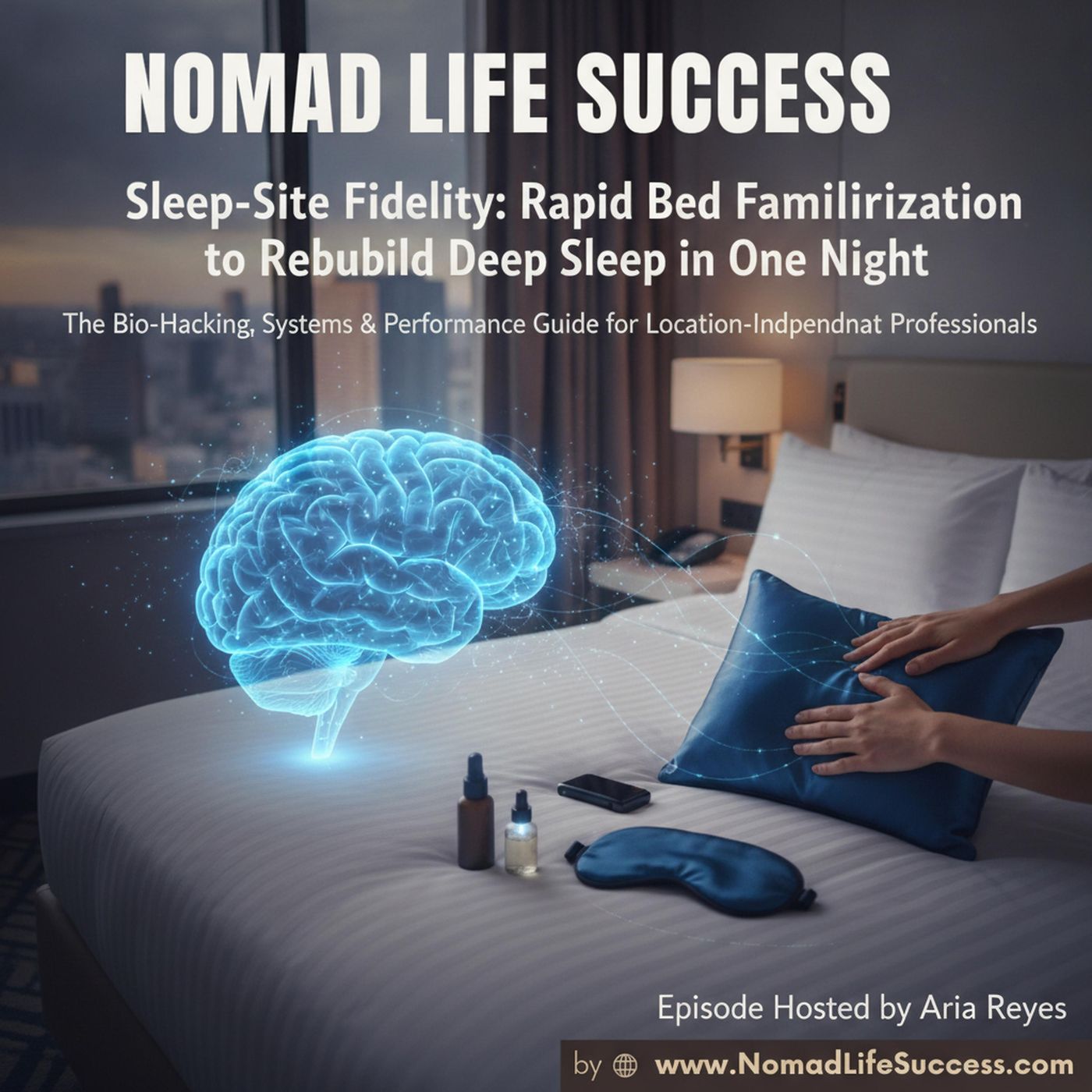
Frequent travelers lose deep sleep not just from light and time-zone shifts but from the brain’s inability to recognize an unfamiliar sleep site. This episode delivers a practical, evidence-driven 4-step Sleep-Site Fidelity protocol that engineers immediate bed familiarity so you reclaim slow‑wave and REM balance the first night. I break down the physiology—context-dependent conditioned cues in the hippocampus and hypothalamic sleep circuits—and show how targeted tactile textures, a micro-dosed scent anchor, calibrated pressure mimicry, and a positional pre-sleep ritual re-create the brain’s safety and comfort signals. Includes exact device and material specs for a pocket sleep kit...
Thermal Phase Cycling: Timed Heat‑Cool Protocol to Collapse Jet Lag and Boost Slow‑Wave Sleep

Crossing time zones breaks the thermoregulatory triggers that initiate sleep. This episode gives a precise, wearable‑guided Thermal Phase Cycling protocol—four measurable steps you can execute in any hotel or rental—to collapse jet lag and regain decision‑grade slow‑wave sleep on night one. I explain the physiological lever (distal vasodilation → core temperature drop → slow‑wave entry), the exact temperature deltas and timing windows to target, and how to use portable tools (heated pad or infrared wrap, cold packs or 60–90s cold shower, Oura/HRV ring, skin temp probe) to close the feedback loop. You’ll get concrete metrics to track (di...
Thermal Sleep Microclimate: Portable Temperature Engineering to Rebuild Deep Sleep Anywhere

Travel fragments sleep primarily by breaking the body's thermal cues that gate slow‑wave and REM cycles. In this episode Aria Reyes walks through a practical, metric-first protocol to rebuild a 'sleep microclimate' anywhere: how to measure core and skin temperature trends with wearables, create a localized thermal envelope using portable cooling/heating pads and breathable sleep liners, and sequence temperature ramps to harvest slow‑wave sleep and protect REM. You'll get three tactical steps you can execute in any hotel or short-term rental within a single evening, plus the exact metrics to track (skin temp delta, heart-rate variability, and time...
Cabin Cognition: A Pulmonary Reset Protocol to Restore Decision-Grade Focus After Flights

Planes and poorly ventilated short-term rentals impose subtle hypoxia and CO2 retention that shave 10–30% off decision-grade cognition — often invisible to standard sleep and caffeine fixes. This episode gives a compact, evidence-minded protocol you can execute on any long-haul flight and in the first eight hours after arrival. I explain the physiology of reduced arterial oxygen and elevated inhaled CO2, show which real-time metrics to track (SpO2, end-tidal CO2 proxy, HRV trends), and deliver a 3-step pulmonary reset: targeted nasal breathing + ventilation sequencing on-board, a portable oxygen-mimetic and diaphragmatic priming on arrival, and a 2-hour recovery anchor combining light exposure and glyc...
Deep-Slow Stack: Portable Closed‑Loop Acoustic Stimulation to Rebuild Slow‑Wave Sleep in One Night
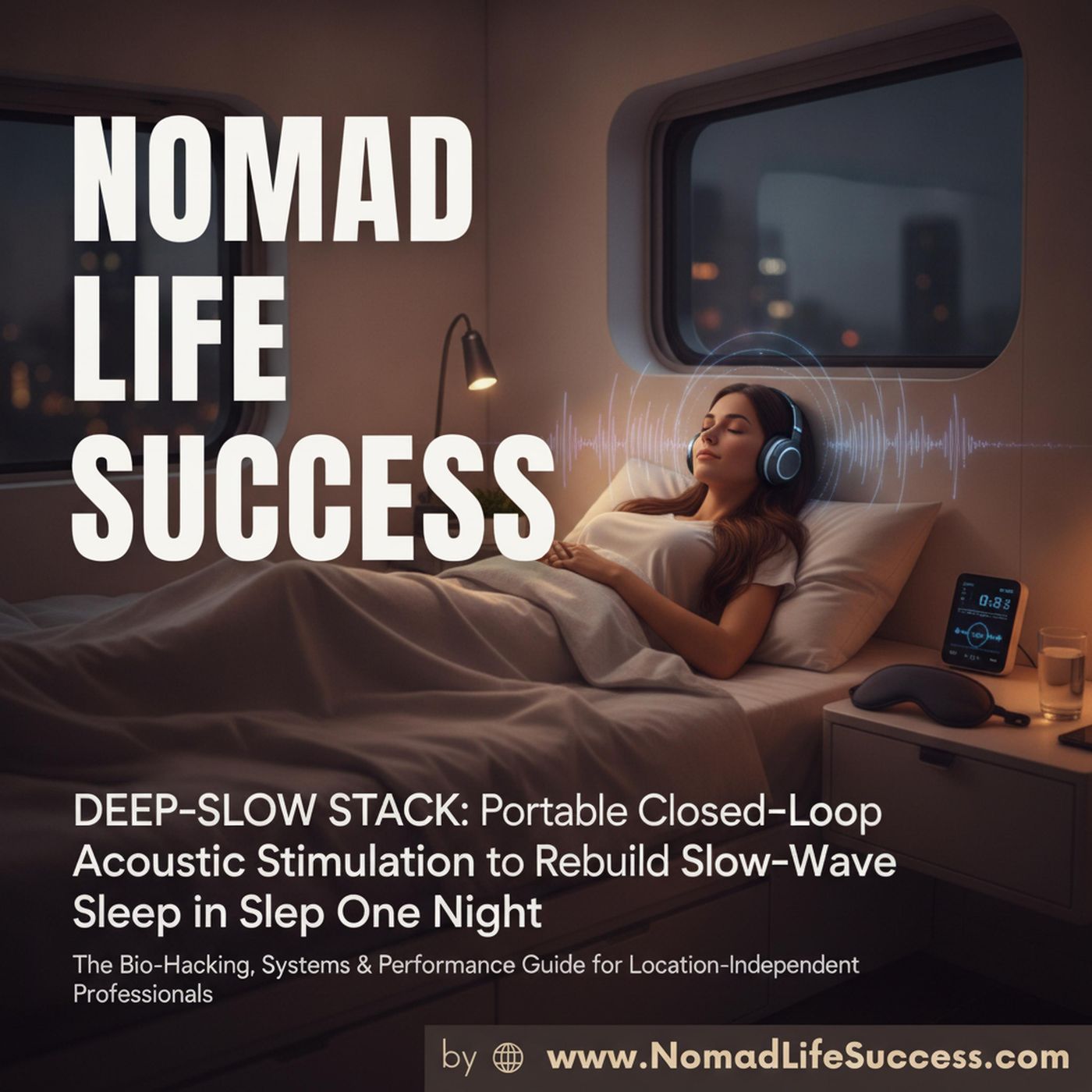
Travel disrupts slow‑wave sleep (SWS) first — unfamiliar surfaces, temperature mismatch, and fragmented sleep collapse the slow oscillations that power clear thinking. In this 9‑minute monologue Aria Reyes breaks down a portable, evidence‑based protocol to recover home‑like deep sleep in a single night using closed‑loop acoustic stimulation, timed sleep anchors, and minimal setup. You’ll get a physiological primer on how phase‑locked pink noise amplifies slow waves, three tactical steps to prepare your environment and run the closed‑loop session, and the digital telemetry to track gains (SWS minutes, slow‑wave amplitude, sleep efficiency, nocturnal HRV). Practical, device-ag...
Adenosine Reset: Timed Caffeine + Sleep‑Pressure Protocol to Crush Travel Brain Fog

Crossing multiple time zones scrambles two systems at once: circadian phase and homeostatic sleep pressure (adenosine). This episode presents a practical, evidence-aligned Adenosine Reset you can execute with items in your travel kit and a wearable. I’ll explain how timed low-dose caffeine, a controlled movement + light exposure window, and a 45–90 minute slow-wave harvest nap interact to collapse sleep inertia without wrecking night sleep. You’ll get explicit timing tied to biometrics (Oura/WHOOP sleep score, HRV trend, sleepiness VAS) and three operational templates for eastward, westward, and single-night recovery. No fringe drugs, no vague advice — measurable steps, the tech stack to...
MitoCharge: Portable Mitochondrial Microdosing to Restore Executive Energy After Long‑Haul Travel

Long-haul travel knocks mitochondria out of sync: reduced ATP availability shows up as mid‑day brain fog, flattened HRV, and attenuated slow‑wave sleep. In this 9‑minute monologue Aria delivers a precise, evidence‑minded 3‑step MitoCharge protocol you can run from an airport lounge or hotel room. You’ll get the physiological root cause—how transient mitochondrial dysfunction, sympathetic spikes, and substrate mismatch crush executive output—followed by three tactical interventions: low‑dose NAD+ precursors + timing, micro cold exposure paired with short mobility sets to trigger mitohormesis, and a timed protein + low‑glycemic carb priming to restore oxidative substrate flow. Each step maps to me...
Circadian Glycemic Anchoring: Reprogram Your Peripheral Clock with CGM + Ketone Priming

Frequent time‑zone changes desynchronize central and peripheral clocks; glucose swings are one of the strongest peripheral zeitgebers that drag sleep architecture and daytime cognition off course. In this episode Aria walks a high-earning remote professional through a practical, measurable protocol she calls Circadian Glycemic Anchoring: a pre-flight metabolic priming window, a targeted exogenous ketone micro-dose to reduce post-prandial spikes, a timed low-GI anchor meal on arrival, and an overnight consolidation strategy that preserves slow-wave recovery. Every step ties to real metrics — CGM time-in-range, glucose SD, morning HRV, sleep efficiency — and requires only portable tools (CGM, ketone strips or drink, macro...
Spectral Anchor: Portable Light Microdosing to Rephase Your Clock in One Day

Travel wrecks circadian timing because light is the primary zeitgeber; without a precise spectral strategy you get melatonin suppression, fragmented slow-wave sleep, and afternoon cognitive crashes. In 9 minutes Aria breaks down a surgical, data-driven light protocol you can run from a carry-on: pre-arrival morning anchoring, arrival-time spectral microdoses with a pocket light, evening spectral suppression with calibrated blue-blocking, and iterative tuning using wearable metrics (sleep staging, HRV, skin temperature and ambient melanopic lux). You’ll leave with a replicable 24–48 hour plan, exact dosage timings, and the minimal hardware kit that fits on any business trip. This is practical bio-hacking — no vague...
Generated Episode Idea
{"title":"Decision Windows: Engineering Your Meeting Schedule to Match Travel-Shifted Cognitive Peaks","one_liner":"A 4-step scheduling and activation protocol that aligns meetings to your travel-shifted cognitive peaks so you ship high-stakes work while crossing time zones.","description":"Crossing time zones doesn't just change your clock — it shuffles the windows of peak cognition that determine whether a meeting produces decisions or drains your energy. In this episode Aria Reyes breaks down a compact, operational protocol to map your mobile circadian peaks, re-engineer your calendar, and pre-activate your brain for decision-grade meetings. You’ll get a measurable four-step method: rapid chronotype veri...