The Art of Adventure
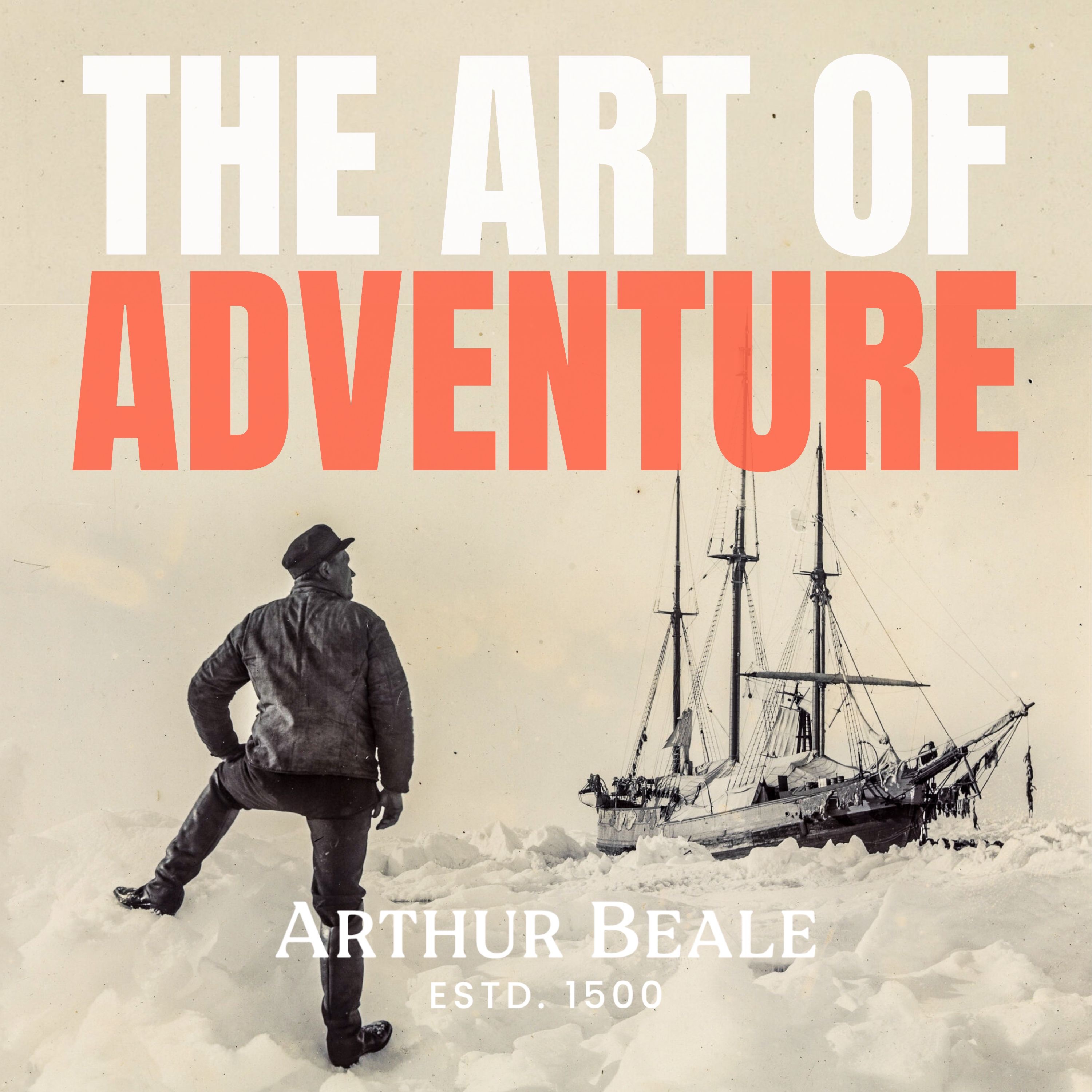
The Art of Adventure is a weekly podcast from Arthur Beale hosted by Hugh Taylor. Each episode dives into one extraordinary journey, from history’s most famous names to overlooked pioneers and modern trailblazers. Along the way, we ask what these stories reveal about the real art of adventure: the preparation, the doubt, the grit, the judgement - and the tiny choices that change everything. New episodes every Wednesday.
Dismasted in the Southern Ocean: Lisa Blair's Solo Record Around Antarctica
Seventy-two days into her attempt to sail solo around Antarctica, more than 1,000 miles from the nearest land, Lisa Blair's mast came down in a storm. She was alone, outside rescue range, in the most hostile stretch of water on the planet. She fought through the night to save the boat and her life - and then, having lost the record she had spent years chasing, she had to decide what to do next.
Lisa joins Hugh to tell the full story - and why she has learned to celebrate the small wins rather than the finish line...
Scott vs. Amundsen: Triumph and Tragedy (Part 2)
March 1912. Roald Amundsen has beaten Scott to the South Pole, outrun the winter ice, and telegraphed his triumph around the world. But back on the ice, Captain Scott and his men are still fighting for their lives — and no one yet knows their fate.
In the conclusion of this two-part series, host Hugh Taylor is joined once more by historian Dr Max Jones - author of The Last Great Quest - to tell the other side of the story. Who was Amundsen, the meticulous Norwegian who made winning look almost easy? Why did Scott's tragic failure eclipse Am...
Scott vs. Amundsen: The Race to The South Pole Begins (Part 1)
June 1910. Captain Robert Falcon Scott sets sail from Cardiff aboard the Terra Nova, convinced he has a clear run at the South Pole. Then a telegram arrives: "Beg leave to inform you Fram proceeding south. Amundsen." The race is on.
In Part 1 of this two-part series, host Hugh Taylor is joined by historian Dr Max Jones - author of The Last Great Quest - to unpick the real story behind the Scott vs Amundsen rivalry. Who was Scott, really? Why was Britain so fixated on the Pole? And how did a bitter falling-out with Shackleton, a secret...
Win a £100 Arthur Beale voucher - What do you want to hear in series 2?
Have your say: https://forms.gle/Xc6USH2ThWqzxRex7
Series 2 is coming. But first - we want to hear from you.
Which adventures should we cover next? Which explorers, expeditions, or untold stories are you dying to hear?
Fill in our short listener survey for your chance to win a £100 Arthur Beale voucher. It takes about a minute.
Have your say: https://forms.gle/Xc6USH2ThWqzxRex7
Entry closes 10PM GMT on 24th June 2025. Winner announced 25th June.
Sailing Solo Around the World Like It's 1968: The Golden Globe Race
In 1968, nine sailors set off on the first solo nonstop race around the world. Only one crossed the finish line. Sir Robin Knox-Johnston returned aboard Suhaili to claim the Sunday Times Golden Globe - while behind him, one competitor faked his positions, another sailed to Tahiti instead of the finish line, and a third pushed his boat so hard it fell apart 1,200 miles from home.
Nearly fifty years later, Australian adventurer Don McIntyre decided to bring the race back. The rules were simple: sail around the world alone, without stopping, using only the technology available in 1968. No...
Gino Watkins: The Greatest Explorer You've Never Heard Of
In 1930, a 24-year-old Cambridge undergraduate named Gino Watkins led fourteen men to the east coast of Greenland on one of the most ambitious Arctic expeditions of the twentieth century. Their mission: to prove that aeroplanes could fly the Atlantic by mapping an unmapped coastline, discovering unknown mountain ranges, and manning a weather station in the middle of the Greenland ice sheet — through winter, in the dark, in winds of 130 miles per hour.
Gino Watkins never lost a man. He discovered the highest mountains in the Arctic, became the first non-Inuit to master the Greenlandic kayak, and is no...
Solo to the North Pole: Pen Hadow
Pen Hadow appears by arrangement with DBA Speakers www.dbaspeakers.com
In 2003, Pen Hadow became the first person to trek solo and without resupply from Canada to the North Geographic Pole - 770 kilometres across shifting sea ice, open water, and temperatures of minus 40. It is a feat that has never been repeated, and almost certainly never will be.
But this is not the story of a single expedition. It is the story of a promise made to a dying father and fifteen years of refusing to give up.
Pen joins Hugh to tell...
The Lost Franklin Expedition: What Really Happened?
In 1845, Sir John Franklin sailed from England with 129 men and two of the Royal Navy's finest ships, HMS Erebus and HMS Terror, to chart the last unmapped stretch of the Northwest Passage. They were expected back within three years. They were never seen again.
What followed became one of the greatest mysteries in the history of exploration. Scattered bones on a frozen island. Inuit testimony of starvation and cannibalism. A hastily scrawled note in the margins of an Admiralty form. And a Victorian public that refused to believe its heroes could have met such an end.
<...Navigating the Grand Canyon Like It's 1869: John Wesley Powell
In 1869, John Wesley Powell set off down the Colorado River with nine men, four wooden boats, and no idea what lay ahead. The Grand Canyon, 300 miles of unmapped canyon, unknown rapids, and sheer rock walls, was the last blank space on the map of the continental United States.
Author John F Ross joins Hugh to tell the full story: how a one-armed Civil War veteran turned geologist became the first person to navigate the entire length of the Grand Canyon, racing against starvation through 360 rapids in boats that were entirely wrong for the job.
From...
Astronaut wanted, no experience necessary: Helen Sharman
Helen Sharman appears by arrangement with DBA Speakers www.dbaspeakers.com
In 1989, Helen Sharman was driving home from work when a radio ad changed her life. Astronaut wanted. No experience necessary. Britain had no space agency, no human spaceflight programme, and no tradition of sending civilians into orbit. Helen was a 26-year-old food technologist from Sheffield with a chemistry degree and no military background. She applied anyway.
Eighteen months later, she was sitting on top of a Soviet rocket - and on 18 May 1991, she became the first British person in space.
Helen joins...
Climbing Mont Blanc like it’s 1838: Lise Wortley
In 1838, Henriette d'Angeville became the first woman to climb Mont Blanc unaided - in a 12-kilogram wool dress, a matching bonnet, and hobnail boots, with 18 bottles of wine and a carrier pigeon tucked into her pack. Her name was largely forgotten until adventurer and filmmaker Lise Wortley decided to find out exactly what that climb felt like by doing it herself, in the same outfit, from the same church in Chamonix, via the original route.
Lise joins Hugh to talk about her project Woman With Altitude, which researches and retraces the overlooked journeys of history's women adventurers...
The Endurance: How to Captain a Ship Like Shackleton
In 1914, Ernest Shackleton set out to make the first land crossing of Antarctica. His ship never reached the continent. Within months, the Endurance was crushed by sea ice, leaving 28 men stranded in one of the most hostile environments on earth, with no hope of rescue.
Historian of polar exploration Henrietta Hammant joins Hugh to unpick the legend of Shackleton: his rivalry with Scott, the 5,000 men who applied for a voyage into the unknown, and the extraordinary 800-nautical-mile lifeboat crossing to South Georgia that should, by any reasonable measure, have failed. But this episode asks a harder question...
Rowing For My Life: A Record Breaking Tale of Endurance
Kathleen Saville was barely out of college when she rowed her first ocean - earning a world record along the way. What began as a wildly ambitious plan between two newlyweds became a test of resilience, navigation and marriage itself.
In this episode, Kathleen recounts building Excalibur by hand, rowing 3,600 miles across the Atlantic, and later attempting a 10,000-mile Pacific crossing, during which her husband was swept overboard and their sextant lost to the sea. Guided only by the stars and their own resolve, they kept rowing.
But this is more than a survival story...
Mallory's Last Climb: What Really Happened on Everest?
On 8th June 1924, George Mallory and Andrew Irvine set out from their high camp on Everest. They were spotted once, two small figures moving through a break in the clouds, and then they were gone. Over a hundred years later, we still don't know if they made it to the top.
Award-winning filmmaker and author Mick Conefrey, whose book Fallen examines Mallory's final expedition, joins Hugh to separate the man from the myth. What really drove Mallory back to Everest a third time? Was the third attempt an act of heroism, or recklessness? And does it matter...
Introducing The Art of Adventure
The Art of Adventure celebrates the people who push into the unknown, past and present, and asks: what is the true art of adventure… and where might it take you?
Brought to you by Arthur Beale. Find out more www.arthurbeale.co.uk