Law School

The Law School of America podcast is designed for listeners who what to expand and enhance their understanding of the American legal system. It provides you with legal principles in small digestible bites to make learning easy. If you're willing to put in the time, The Law School of America podcasts can take you from novice to knowledgeable in a reasonable amount of time.
Law School Midterm Command Center: Full Simulation Day — Timed Midterms, Mixed Subjects, Performance Analytics, and Examination Conditioning
⚖️ MIDTERM CHALLENGE: Can you apply the law when it counts?⚖️
📖 FREE BOOK — Review the material📖
🎮 GAME 1 — Start the challenge🎮
🎯 GAME 2 — Test yourself again🎯
🏁 GAME 3 — Complete the set🏁
🎧 EPISODE SUMMARY 🎧A useful simulation reproduces the real assessment's content, format, resource rules, and clock as closely as practicable. During the test, students answer, flag, recover, and continue. Afterward, they examine coverage, accuracy, application, and execution, using issue grids and cautious multiple-choice analytics. Rule-recall categories, timing records, and physical observations explain what a score alone cannot. The final product is a short, prioritized plan grounded in the student's actual performance under pres...
Midterm Law School Lab: Evidence

🧪 MIDTERM LAB: Can you turn what you’ve learned into exam points?🧪
📖 FREE BOOK — Prepare for the challenge📖
🎮 FREE GAME 1 — Put your knowledge to work🎮
🎯 FREE GAME 2 — Test yourself again🎯
🏁 FREE GAME 3 — Complete the set🏁
🎧 EPISODE SUMMARY 🎧
Name the item and its offered purpose first. Test relevance and unfair prejudice, then specialized exclusions and character rules. For words, identify an assertion, declarant, truth use, any nonhearsay classification, each applicable exception, and every nested layer. Check witness competence and impeachment, privilege, authentication, original-content requirements, and expert reliability independently. In a criminal case, add the confrontation inquiry for testim...
Midterm Law School Lab: Property and Constitutional Law
🧪 MIDTERM LAB: Can you turn what you’ve learned into exam points?🧪
📖 FREE BOOK — Prepare for the challenge📖
🎮 FREE GAME 1 — Put your knowledge to work🎮
🎯 FREE GAME 2 — Test yourself again🎯
🏁 FREE GAME 3 — Complete the set🏁
🎧 EPISODE SUMMARY 🎧
Property analysis begins by naming the interest, its holder, the event that changes it, and the remedy. Possession, easements, covenants, recording, mortgages, and land-use restrictions have distinct creation and priority rules. Constitutional analysis begins by identifying a proper plaintiff, the governmental actor, and a specific source of power. Judicial review, congressional authority, executive action, federalism, preemption, and Dormant Co...
Law School Midterm Command Center: Essay Command — Issue Spotting, Rule Statements, IRAC, Fact Application, Counterarguments, Organization, and Time Management

⚖️ MIDTERM CHALLENGE: Can you apply the law when it counts?⚖️
📖 FREE BOOK — Review the material📖
🎮 GAME 1 — Start the challenge🎮
🎯 GAME 2 — Test yourself again🎯
🏁 GAME 3 — Complete the set🏁
🎧 EPISODE SUMMARY 🎧
A strong essay begins with the call and party map, uses a brief issue checklist, and treats each contested point through a usable rule and concrete application. Descriptive headings make the structure visible. Counterarguments and policy help when connected to the facts and doctrine; case labels never replace explanation. Conclusions should reflect the strength of the analysis. Time, word, and resource limits determine how much to write, while post...
Law School Midterm Command Center: Multiple-Choice Command — Question Anatomy, Distractor Elimination, Rule Precision, Timing, and Error Analysis
⚖️ MIDTERM CHALLENGE: Can you apply the law when it counts?⚖️
📖 FREE BOOK — Review the material📖
🎮 GAME 1 — Start the challenge🎮
🎯 GAME 2 — Test yourself again🎯
🏁 GAME 3 — Complete the set🏁
🎧 EPISODE SUMMARY 🎧
Multiple-choice analysis begins with the call, moves through a provisional rule and the decisive facts, and ends with a comparison of responsive choices. True but irrelevant rules, omitted exceptions, overstated results, altered facts, and premature conclusions are recurring distractors. A two-pass schedule protects time; a concrete reason justifies changing an answer. Confidence codes and an error log turn missed questions into specific rule rewrites, issue triggers, and ne...
Midterm Law School Lab: Criminal Law and Criminal Procedure

🧪 MIDTERM LAB: Can you turn what you’ve learned into exam points?🧪
📖 FREE BOOK — Prepare for the challenge📖
🎮 FREE GAME 1 — Put your knowledge to work🎮
🎯 FREE GAME 2 — Test yourself again🎯
🏁 FREE GAME 3 — Complete the set🏁
🎧 EPISODE SUMMARY 🎧
A criminal analysis begins with the charged offense's elements and proof beyond a reasonable doubt. Match a voluntary act or legally significant omission to the required culpability, test concurrence and causation when a result is charged, and classify homicide through each available murder, manslaughter, and felony-murder path. Analyze each participant's assistance and mental state; keep incomplete crimes distinct from co...
Law School Midterm Command Center: Rule Compression II — Criminal Law, Property, Constitutional Structure, and Evidence
⚖️ MIDTERM CHALLENGE: Can you apply the law when it counts?⚖️
📖 FREE BOOK — Review the material📖
🎮 GAME 1 — Start the challenge🎮
🎯 GAME 2 — Test yourself again🎯
🏁 GAME 3 — Complete the set🏁
🎧 EPISODE SUMMARY 🎧
The Wednesday command center turns four extensive courses into usable decisions. Criminal Law starts with conduct, culpability, and offense grading. Property tracks present possession, future interests, transfer, and priority. Constitutional Structure distinguishes judicial power, enumerated power, executive authority, and federalism limits. Evidence starts with purpose and proceeds through independent admissibility gates. Each outline should help a student recognize the governing issue, explain its exception, and apply it to unfamil...
Midterm Law School Lab: Civil Procedure
🧪 MIDTERM LAB: Can you turn what you’ve learned into exam points?🧪
📖 FREE BOOK — Prepare for the challenge📖
🎮 FREE GAME 1 — Put your knowledge to work🎮
🎯 FREE GAME 2 — Test yourself again🎯
🏁 FREE GAME 3 — Complete the set🏁
🎧 EPISODE SUMMARY 🎧
Civil Procedure exams reward accurate sequencing. Establish the court's authority over the case and parties, test service and venue independently, choose the governing law, then follow the pleadings, motions, amendments, joinder, discovery, adjudication, appeal, and preclusion in the order the facts present them. At each stage, identify the rule's source, actor, deadline, and consequence. The most revealing diagnostic mis...
Law School Midterm Command Center: Rule Compression I — Contracts, Torts, and Civil Procedure
⚖️ MIDTERM CHALLENGE: Can you apply the law when it counts?⚖️
📖 FREE BOOK — Review the material📖
🎮 GAME 1 — Start the challenge🎮
🎯 GAME 2 — Test yourself again🎯
🏁 GAME 3 — Complete the set🏁
🎧 EPISODE SUMMARY 🎧
The full outline stores the course; the attack outline runs the examination. In Contracts, classify the transaction and trace an offer through acceptance and enforcement. In Torts, test intentional wrongs and privileges before moving through duty, breach, two kinds of causation, harm, and defenses. In Civil Procedure, separate the court's power over the case, its power over the defendant, the proper district, and the governing rules for pleading...
Midterm Law School Lab: Contracts and Torts
🧪 MIDTERM LAB: Can you turn what you’ve learned into exam points?🧪
📖 FREE BOOK — Prepare for the challenge📖
🎮 FREE GAME 1 — Put your knowledge to work🎮
🎯 FREE GAME 2 — Test yourself again🎯
🏁 FREE GAME 3 — Complete the set🏁
🎧 EPISODE SUMMARY 🎧
Contracts analysis begins with governing law and moves through formation, enforceability, terms, conditions, performance, breach or excuse, and remedy. Torts analysis identifies the theory and parties, then tests duty, breach, causation, harm, and defenses while screening intentional and strict-liability claims when the course has reached them. The strongest midterm answers use each significant fact to prove or contest a particular element...
Law School Midterm Command Center Triage: Diagnose What You Know, What You Think You Know, and What You Cannot Yet Use
⚖️ MIDTERM CHALLENGE: Can you apply the law when it counts?⚖️
📖 FREE BOOK — Review the material📖
🎮 GAME 1 — Start the challenge🎮
🎯 GAME 2 — Test yourself again🎯
🏁 GAME 3 — Complete the set🏁
🎧 EPISODE SUMMARY 🎧
Midterm preparation begins by defining the course actually examinable and testing what the student can do with it. The coverage map sets the boundaries; green, yellow, and red record demonstrated performance; the professor profile clarifies the expected answer; previous feedback and the error log identify why points are lost; and a closed-book baseline exposes weaknesses before studying hides them. Monday ends with five prioritized repairs and six days of...
Midterm Law School Lab: Midterm Diagnostic and the Law-School Examination Method
🧪 MIDTERM LAB: Can you turn what you’ve learned into exam points?🧪
📖 FREE BOOK — Prepare for the challenge📖
🎮 FREE GAME 1 — Put your knowledge to work🎮
🎯 FREE GAME 2 — Test yourself again🎯
🏁 FREE GAME 3 — Complete the set🏁
🎧 EPISODE SUMMARY 🎧
A strong midterm answer begins with the task and the parties, identifies the controlling issues, states usable rules, and explains how the material facts satisfy or fail each disputed requirement. IRAC and CRAC are ways to expose that reasoning, not rigid scripts. Counterarguments deserve attention when the facts genuinely support them, and conclusions should state the condition on which uncertaint...
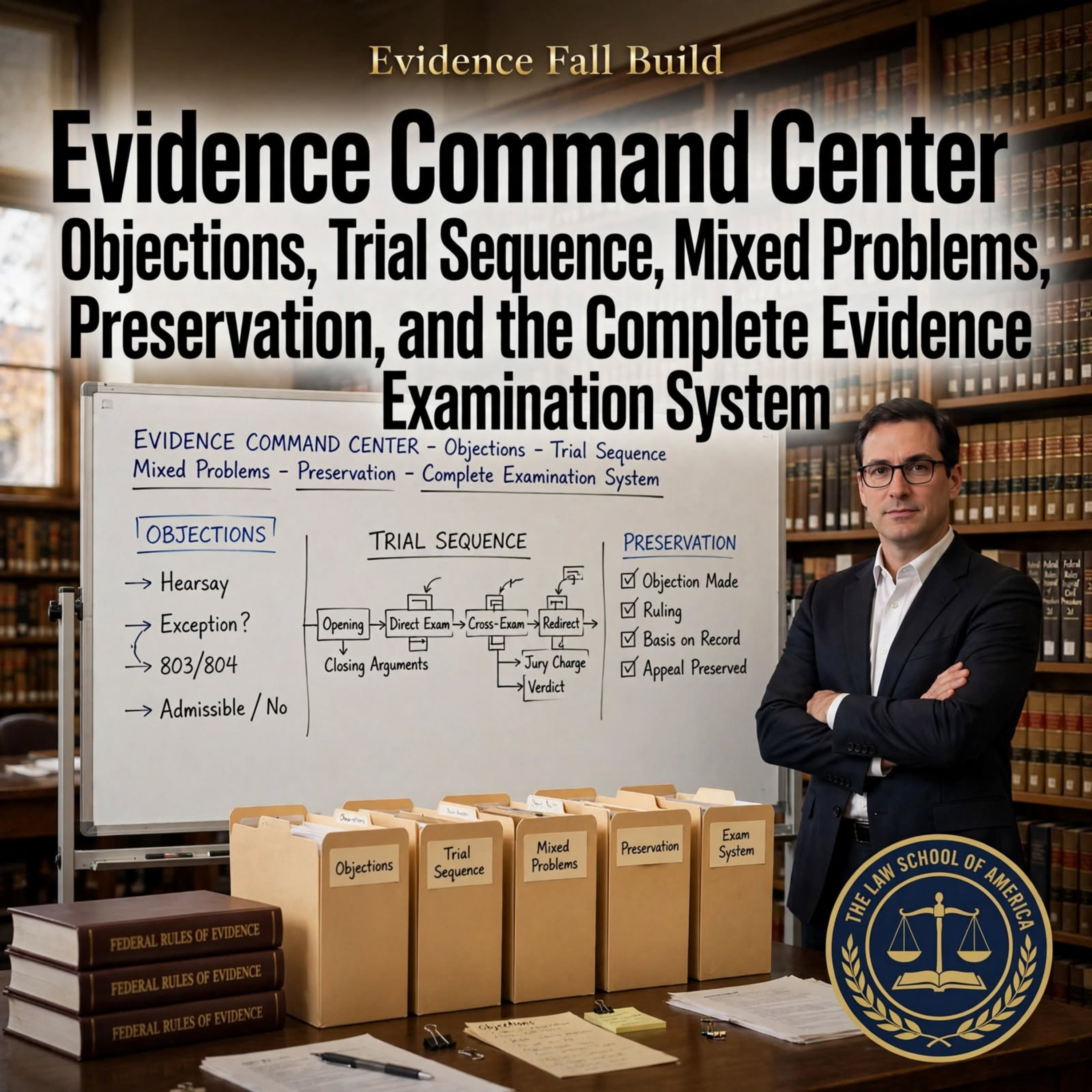
Evidence Fall Build: Evidence Command Center Objections, Trial Sequence, Mixed Problems, Preservation, and the Complete Evidence Examination System
👉Turn this episode into a free Game or Book Chapter.👈
🎧 EPISODE SUMMARY 🎧
Evidence should be approached as an integrated system rather than as a collection of isolated doctrines.
Begin by identifying the evidence and the proponent. Then state the precise purpose for which the evidence is offered.
Apply relevance first. If the evidence is relevant, consider Rule 403 and any specific policy exclusion.
If character or prior-act evidence is involved, identify whether the reasoning depends on propensity and whether an exception or legitimate nonpropensity purpose applies. Distinguish character from habit.
For wit...
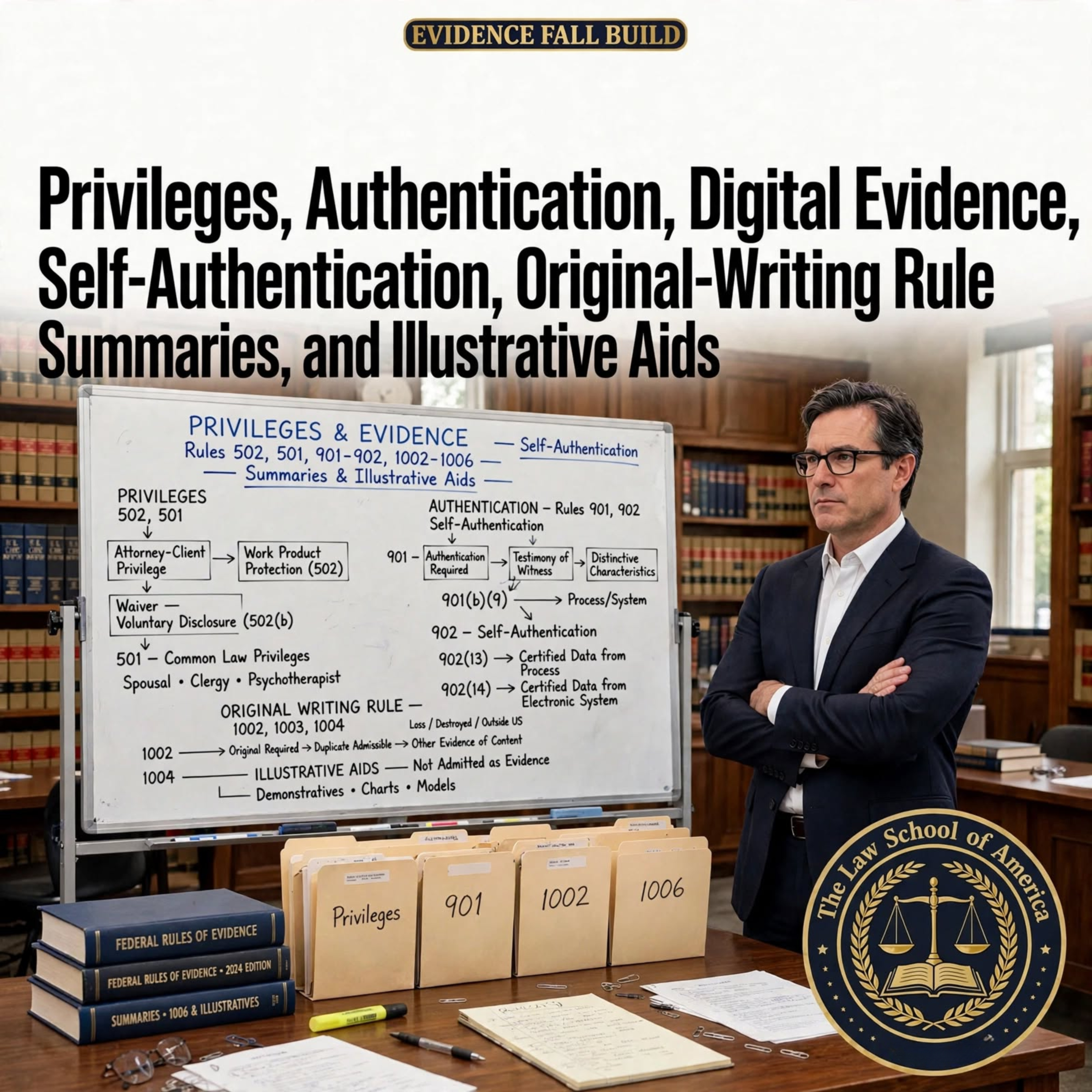
Evidence Fall Build: Privileges, Authentication, Digital Evidence, Self-Authentication, Original-Writing Rule, Summaries, and Illustrative Aids
👉Turn this episode into a free Game or Book Chapter.👈
🎧 EPISODE SUMMARY 🎧
Privilege excludes relevant evidence to protect key relationships and values.
Attorney-client privilege protects confidential communications for legal advice. Confidentiality is essential; necessary third parties do not destroy protection.
Corporate privilege covers communications between counsel and employees regarding job responsibilities when confidentiality is kept.
The crime-fraud exception applies when seeking legal aid for future crimes or fraud, not past wrongdoing.
Privilege is waived by disclosure, lost confidentiality, litigation use, or subject-matter disclosure.
Work product protects mat...
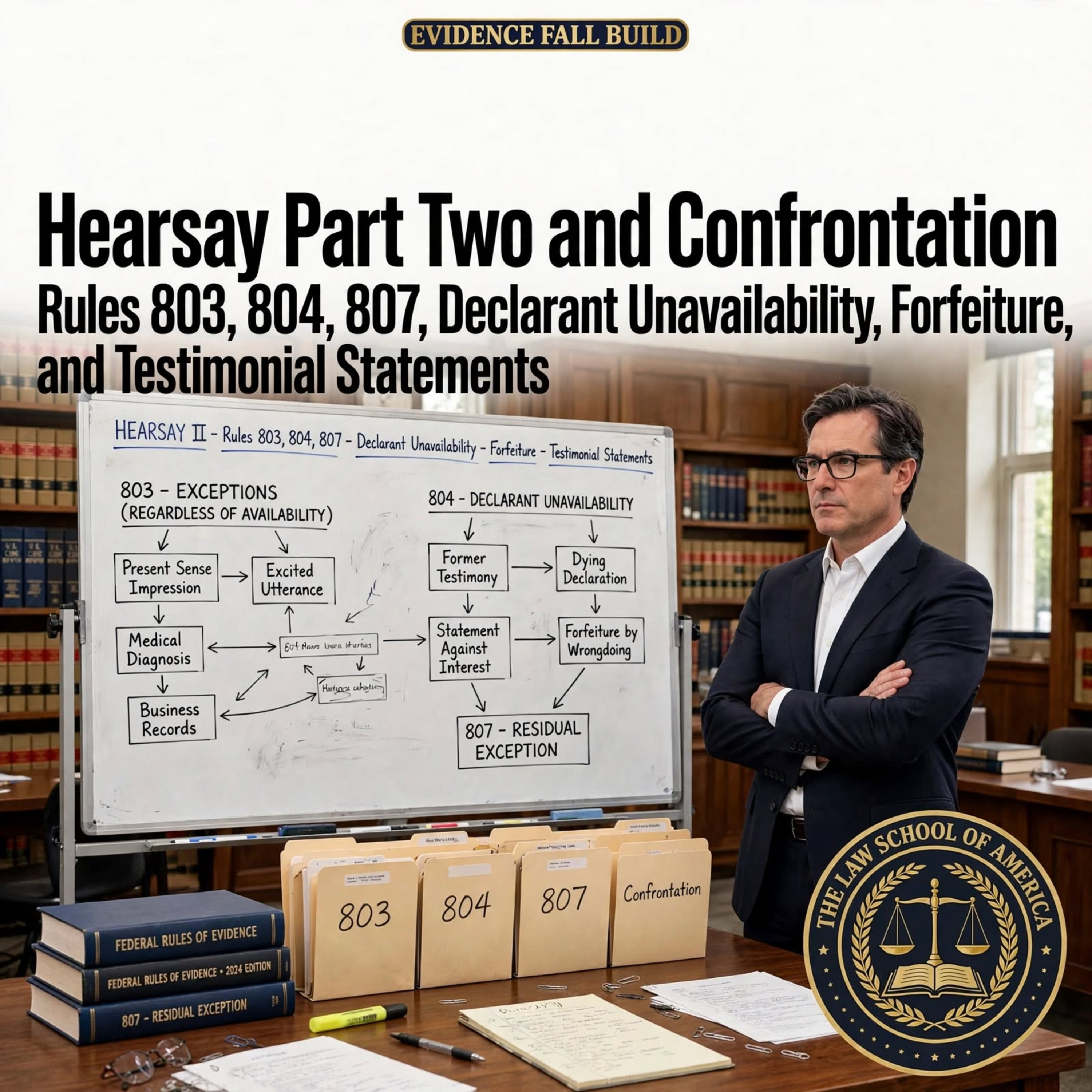
Evidence Fall Build: Hearsay Part Two and Confrontation - Rules 803, 804, 807, Declarant Unavailability, Forfeiture, and Testimonial Statements
👉Turn this episode into a free Game or Book Chapter.👈
🎧 EPISODE SUMMARY 🎧
Hearsay analysis begins with purpose. Out-of-court statements offered to prove the truth of the matter asserted constitute hearsay.
A statement requires a person's oral, written, or intended nonverbal assertion; nonassertive conduct usually does not qualify.
Automated machine data involves reliability or authentication rather than hearsay, though electronic human assertions still require hearsay analysis.
A testifying witness's prior statements remain out-of-court statements, though specific ones qualify as nonhearsay under Rule 801(d)(1).
Statements offered for nontruth purposes—such as effect...
Evidence Fall Build: Hearsay Part One - Definition, Nonhearsay Purposes, Prior Statements, Opposing-Party Statements, and Multiple Hearsay
⚖️ One objection. One ruling. Would you get it right? Put your evidence knowledge to the test—then dig into the rules behind the answer.
🎮 Take the FREE Evidence Game Challenge →
📖 Sharpen Your Knowledge: Read the FREE Book Chapter →
🎧 EPISODE SUMMARY 🎧
Hearsay analysis begins with purpose.
Out-of-court statements are not automatically hearsay. Hearsay requires a statement made outside trial offered to prove the truth of what it asserts.
A statement requires an assertion by a person. Oral assertions, written assertions, and intended nonverbal assertions may qualify. Nonassertive conduct ordinarily does not.<...
Evidence Fall Build: Witnesses and Experts - Competency, Personal Knowledge, Lay Opinion, Expert Reliability, Examination, Impeachment, and Rehabilitation
⚖️ Put your evidence knowledge on trial. You’ve heard the episode—now see what you can do with it.
🎮 Play the FREE Evidence Game →
Think you know the rules? Put your knowledge to the test.
📖 Open Your FREE Book Chapter →
Go beyond the episode. Study the rules at your own pace—and return whenever you need a refresher.
🎧 EPISODE SUMMARY 🎧
The Federal Rules presume witness competency. Capacity, memory, and perception go to weight rather than categorical competency.
Rule 602 requires personal knowledge, barring speculation and secondhand information.
Witnesses testify under...
Evidence Fall Build: Character, Other Acts, Habit, and Policy Exclusions
👉Turn this episode into a free Game or Book Chapter.👈
🎧 EPISODE SUMMARY 🎧
Character evidence is restricted when used to prove propensity—that a person acted consistently with a trait.
However, character is admissible when the trait itself is an essential element of a claim or defense.
Criminal defendants may introduce pertinent character traits, opening the door to prosecution rebuttal. Victims' traits may also be introduced, including peacefulness in homicide cases to rebut first-aggressor claims.
Rule 405 allows proof by reputation or opinion. Specific instances are restricted to cross-examination or when character is a...
Evidence Fall Build: The Evidence Gatekeeping System - Relevance, Rule 403, Preliminary Questions, Conditional Relevance, Judicial Notice, Objections, and Offers of Proof
👉Turn this episode into a free Game or Book Chapter.👈
🎧 EPISODE SUMMARY 🎧
Evidence law begins with gatekeeping.
Rule 401 sets a deliberately low threshold for relevance: evidence is relevant when it has any tendency to make a consequential fact more or less probable than it would be without the evidence. Strong analysis explains the inferential chain connecting the evidence to the consequential proposition.
Direct evidence establishes a fact without an additional inferential step if believed, while circumstantial evidence depends on inference. Neither category is automatically stronger.
Under Rule 402, relevant evidence is generally...
Constitutional Structure: Constitutional Structure Command Center — Interbranch Checks, Federal-State Conflict, Structural Remedies, and the Complete Examination System
📘Turn this episode into a free Game or Exam-Ready Study Plan.📘
👉 OR CLICK HERE TO OPEN TODAY’S FREE STUDY GUIDE 👈
🎧 EPISODE SUMMARY 🎧
Constitutional structure establishes a system of checked power and divided sovereignty:
Horizontal separation of powers allocates authority among Congress, the President, and federal courts. Presidential power is highest when authorized by Congress, in twilight when Congress is silent, and lowest when acting against congressional will.
The administrative state is bounded by the Appointments Clause and presidential removal authority. Principal officers require Senate confirmation; inferior officers ma...
Constitutional Structure: Federalism — The Tenth Amendment, Anti-Commandeering, Preemption, State Sovereign Immunity, the Dormant Commerce Clause, and the Privileges and Immunities Clause
📘Turn this episode into a free Game or Exam-Ready Study Plan.📘
👉 OR CLICK HERE TO OPEN TODAY’S FREE STUDY GUIDE 👈
🎧 EPISODE SUMMARY 🎧
Federalism allocates power vertically between national and state governments.
The 10th Amendment reserves un-delegated powers to states (police power over health, safety, morals), but does not invalidate valid Article I federal laws.
Anti-Commandeering prevents Congress from forcing state legislatures or executives to enact or enforce federal schemes. Congress may regulate private citizens directly or state commercial operations.
Preemption (Article VI) displaces conflicting state la...
Constitutional Structure: Separation of Powers and the Administrative State — Appointments, Removal, Independent Agencies, Delegation, Legislative Control, Impeachment, and the Modern Removal Jurispru
📘Turn this episode into a free Game or Exam-Ready Study Plan.📘
👉 OR CLICK HERE TO OPEN TODAY’S FREE STUDY GUIDE 👈
🎧 EPISODE SUMMARY 🎧
Separation of powers and administrative law govern federal authority and its supervision:
The Appointments Clause regulates federal officers, distinguishing Officers of the United States from mere employees.
Principal officers require presidential nomination and Senate confirmation. Inferior officers may be appointed by the President, Department Heads, or Courts. Congress cannot appoint executive officers.
Under Article II, the President generally holds inherent authority to remove executive...
Constitutional Structure: Presidential Power — Youngstown, Executive Orders, the Take Care Clause, Commander in Chief, Foreign Affairs, Treaties, Executive Privilege, Pardons, and Presidential Immunit
📘Turn this episode into a free Game or Exam-Ready Study Plan.📘
👉 OR CLICK HERE TO OPEN TODAY’S FREE STUDY GUIDE 👈
🎧 EPISODE SUMMARY 🎧
Article II executive power is bounded by separation of powers without inherent emergency authority.
Executive actions require legal basis from the Constitution, federal statutes, or valid congressional delegation.
Justice Jackson’s Youngstown framework evaluates executive authority across three categories:
Category One (Maximum Authority): Action has express or implied congressional approval, combining Article II and delegated Article I powers.
Category Two (Zone of Twilight...
Constitutional Structure: Congressional Power Part Two — Taxing, Spending, Section Five, Legislative Process, Delegation, and the Major Questions Doctrine
📘Turn this episode into a free Game or Exam-Ready Study Plan.📘
👉 OR CLICK HERE TO OPEN TODAY’S FREE STUDY GUIDE 👈
🎧 EPISODE SUMMARY 🎧
Congressional power analysis evaluates substantive authority and procedural validity:
The Taxing Power (Art. I, § 8, Cl. 1) broadly raises revenue. Valid taxes produce some revenue, distinguished from penalties by burden size, scienter, IRS collection, and legality of conduct. It acts as an independent alternative if Commerce Clause authority fails.
The Spending Power allows spending for general welfare under a five-part contractual framework:
Spending must serve the genera...
Constitutional Structure: Congressional Power Part One — Enumerated Powers, Necessary and Proper Clause, Commerce Clause, and the Limits of National Legislative Authority
📘Turn this episode into a free Game or Exam-Ready Study Plan.📘
👉 OR CLICK HERE TO OPEN TODAY’S FREE STUDY GUIDE 👈
🎧 EPISODE SUMMARY 🎧
Congressional power is bounded by enumerated powers under Article I:
Congress lacks a general federal police power. Unlike state legislatures, Congress must trace every act to a specific constitutional authority.
The Necessary and Proper Clause permits laws rationally related to executing enumerated powers (McCulloch), but it is not an independent power source.
The Commerce Clause provides three categories of federal regulatory authority:
Cha...
Constitutional Structure: Federal Judicial Power — Judicial Review, Article III, Standing, Ripeness, Mootness, Political Questions, and Judicial Limits
📘Turn this episode into a free Game or Exam-Ready Study Plan.📘
👉 OR CLICK HERE TO OPEN TODAY’S FREE STUDY GUIDE 👈
🎧 EPISODE SUMMARY 🎧
Article III federal judicial power requires specific Cases and Controversies, establishing justiciability doctrines.
Marbury v. Madison established judicial review over federal acts and executive actions.
Supreme Court review of state court judgments is barred if supported by an adequate and independent state-law ground (AISG). Advisory opinions are strictly prohibited.
Standing requires three elements:
Injury in fact: Concrete, particularized, and actual/imminent;
...Property Fall Build: Mortgages, Foreclosure, Priority, Fixtures, Water Rights, Support, Remedies, and the Complete Property Examination System

📘Turn this episode into a Game or Exam-Ready Study Plan.📘
👉 CLICK HERE TO OPEN YOUR FREE STUDY GUIDE 👈
🎧 EPISODE SUMMARY 🎧
Sunday concludes the Property Fall Build by linking financing, priority, fixtures, water rights, support, remedies, and exam strategy.
A mortgage secures debt with a real property interest.
The borrower is the mortgagor; the lender is the mortgagee. A promissory note creates personal debt, while the mortgage provides security. The mortgage follows the note.
States apply lien, title, or intermediate theories to define legal ownership before default.
Prior to foreclo...
Property Fall Build: Covenants, Equitable Servitudes, Common-Interest Communities, Nuisance, Zoning, and Takings

📘Turn this episode into a Game or Exam-Ready Study Plan.📘
👉 CLICK HERE TO OPEN YOUR FREE STUDY GUIDE 👈
🎧 EPISODE SUMMARY 🎧
Property ownership is shaped by land-use restrictions.
Real covenants bind successors; burdens and benefits are analyzed separately.
Burdens require writing, intent, touch and concern, privity, and notice.
Notice may be actual, record, or inquiry.
Equitable servitudes use injunctions, requiring writing, intent, touch and concern, and notice.
Common schemes bind developments through general plans with notice.
Common-interest communities bind owners through recorded CC&Rs and bylaws.<...
Property Fall Build: Adverse Possession and Easements — Hostile Possession, Tacking, Prescription, Express Grants, Implication, Necessity, Estoppel, Licenses, and Profits
📘Turn this episode into a Game or Exam-Ready Study Plan.📘
👉 CLICK HERE TO OPEN YOUR FREE STUDY GUIDE 👈
🎧 EPISODE SUMMARY 🎧
Property rights can arise through possession, use, necessity, reliance, or prescription without a formal deed.
Adverse possession grants title after actual, open, notorious, exclusive, hostile, and continuous possession for the statutory period.
Actual and continuous possession reflects reasonable land use and does not require constant physical presence. Seasonal use suffices if customary.
Open possession puts owners on notice. Exclusive possession requires owner-like control rather than public use.
Hostility mea...
Property Fall Build: Land Transfers — Land-Sale Contracts, Marketable Title, Equitable Conversion, Deeds, Delivery, Title Covenants, Recording Acts, and Bona Fide Purchasers

📘Turn this episode into a Game or Exam-Ready Study Plan.📘
👉 CLICK HERE TO OPEN YOUR FREE STUDY GUIDE 👈
🎧 EPISODE SUMMARY 🎧
Land transfers follow a sequence from contract to priority dispute.
Contracts must satisfy the Statute of Frauds with a signed writing specifying parties, property, price, and terms. Part performance through possession, payment, or improvements can enforce oral agreements.
Sellers must provide marketable title—title free from litigation risk—by closing. Defects include liens, easements, and title gaps. Curable defects before closing do not justify early buyer rescission.
Equitable conversion m...
Property Fall Build: Landlord-Tenant Law — Leasehold Estates, Rent, Delivery of Possession, Assignment, Sublease, Habitability, Quiet Enjoyment, and Tenant Remedies

📘Turn this episode into a Game or Exam-Ready Study Plan.📘
👉 CLICK HERE TO OPEN YOUR FREE STUDY GUIDE 👈
🎧 EPISODE SUMMARY 🎧
Landlord-tenant law combines traditional Property doctrine with contract principles and modern statutory protections.
The first task is to classify the tenant’s possessory estate. A tenancy for years lasts for a fixed period. A periodic tenancy renews for successive periods. A tenancy at will continues indefinitely subject to termination. A tenancy at sufferance describes a holdover after lawful possession has ended.
The lease must then be analyzed as a contract.
An a...
Property Fall Build: Concurrent Ownership — Tenancy in Common, Joint Tenancy, Tenancy by the Entirety, Cotenant Rights, Severance, Accounting, and Partition

📘Turn this episode into a Game or Exam-Ready Study Plan.📘
👉 CLICK HERE TO OPEN YOUR FREE STUDY GUIDE 👈
🎧 EPISODE SUMMARY 🎧
Concurrent ownership exists when more than one person owns rights in the same property at the same time. The three principal forms are tenancy in common, joint tenancy, and tenancy by the entirety.
A tenancy in common is the modern default. Each cotenant owns a separate fractional interest, possesses an equal right to use the whole property, and has no survivorship right. The interest may ordinarily be transferred during life or at death.
A...
Property Fall Build: Estates and Future Interests — Fee Simple, Defeasible Estates, Life Estates, Waste, Remainders, Executory Interests, and the Rule Against Perpetuities

📘Turn this episode into a Game or Exam-ready Study Plan.📘
👉 CLICK HERE TO OPEN YOUR FREE STUDY GUIDE 👈
🎧 EPISODE SUMMARY 🎧
Estates and future interests are the grammar of Property. The student’s first task is classification. A fee simple absolute is potentially infinite and freely transferable, devisable, and descendible.
A fee simple determinable ends automatically upon the triggering event and is followed by a possibility of reverter.
A fee simple subject to condition subsequent does not end automatically. The grantor must exercise a right of entry.
A fee simple subject t...
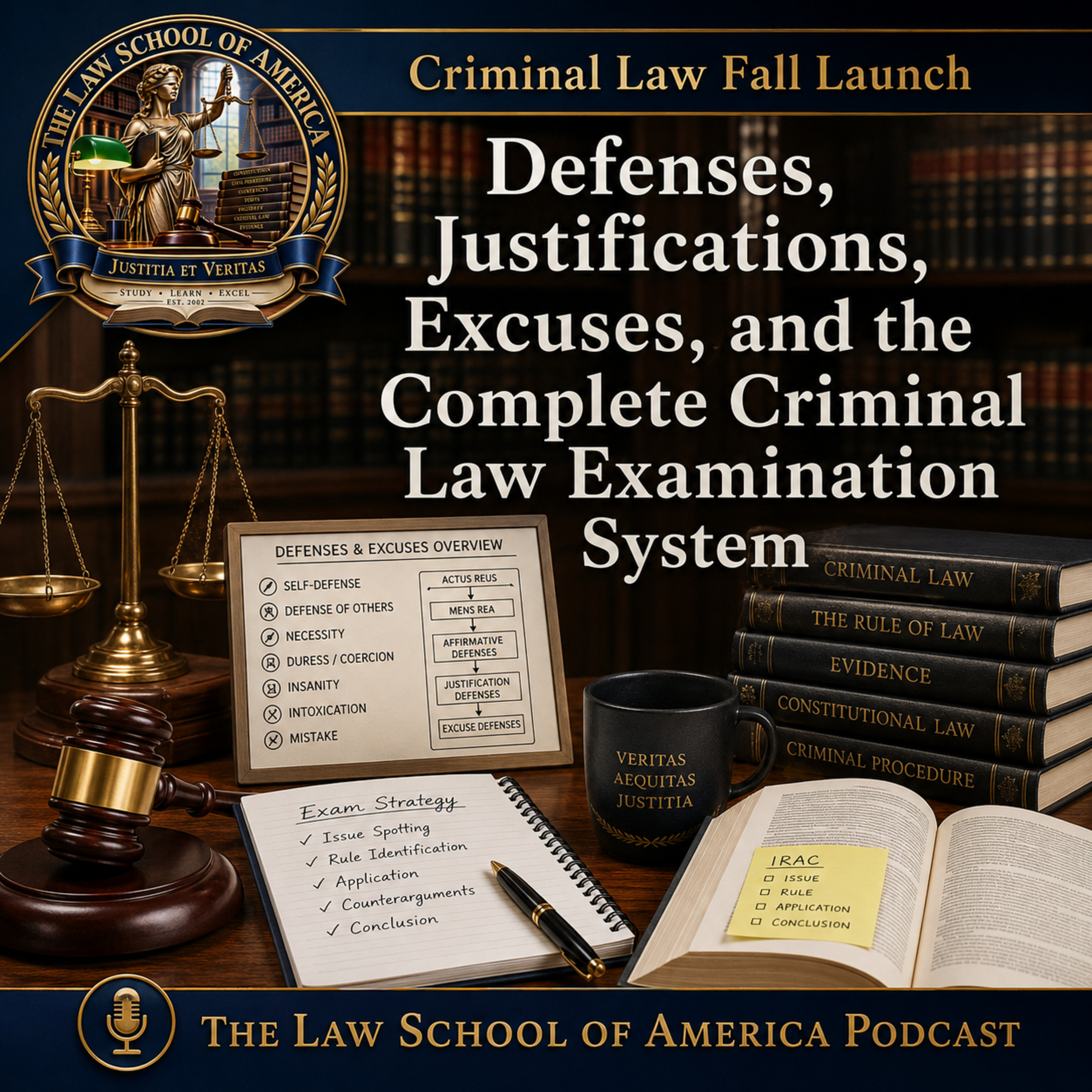
Criminal Law Fall Launch: Defenses, Justifications, Excuses, and the Complete Criminal Law Examination System
📘 FREE COMPANION STUDY GUIDE 📘
👉 CLICK HERE TO OPEN YOUR FREE STUDY GUIDE 👈
Turn this episode into an exam-ready study plan.
🎧 EPISODE SUMMARY 🎧Sunday finishes the Fall Launch by combining defenses with an exam system.
Defenses fall into failure of proof, justification, or excuse.
Self-defense (justification) allows reasonable force against imminent unlawful force.
Key elements:
Unlawful threat & imminence.
Belief & reasonableness.
Proportionality.
Initial aggressor status & retreat.
Deadly force requires imminent death/serious injury. Retreat rules vary (duty to retreat vs. stand-your-ground).
Defense of ot...
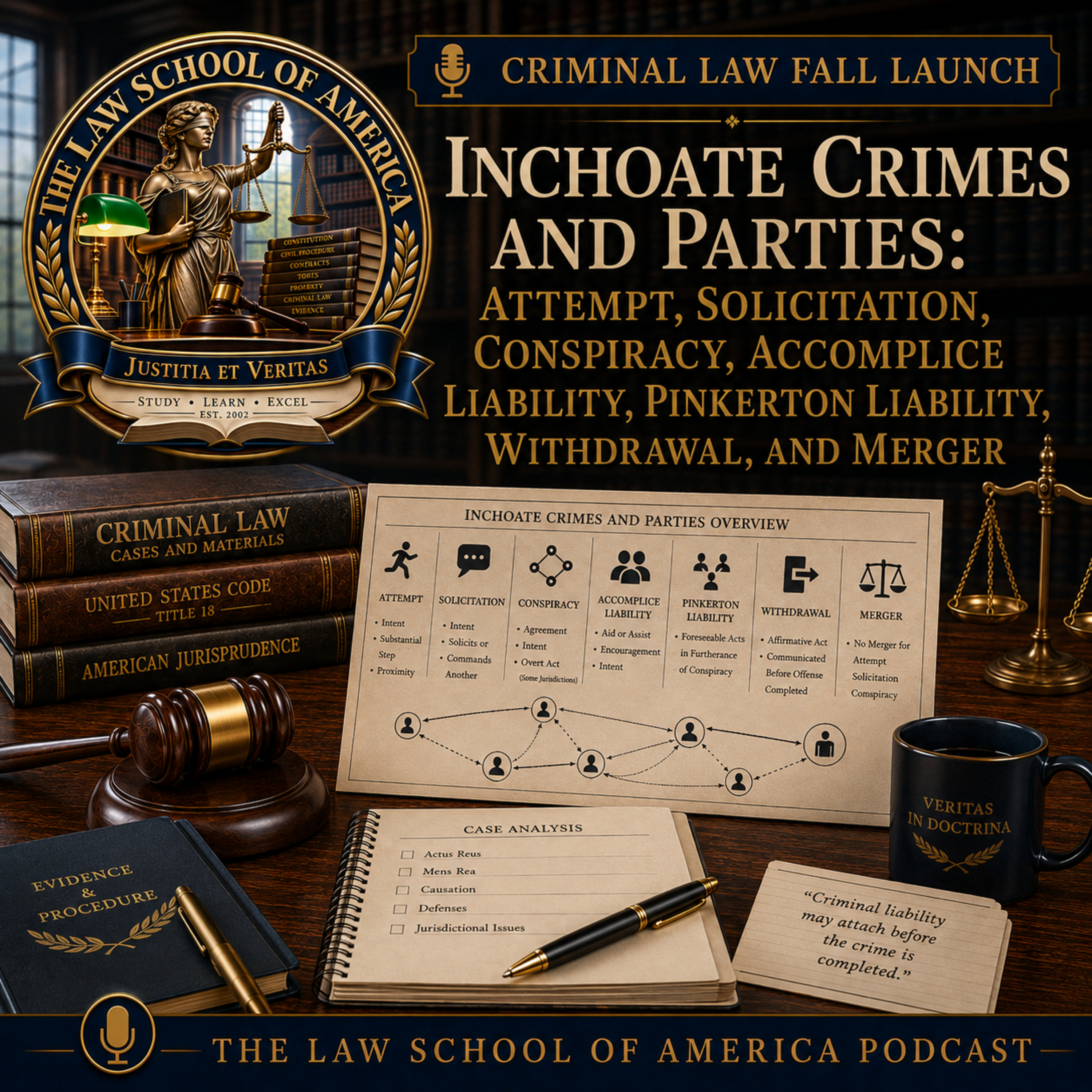
Criminal Law Fall Launch: Inchoate Crimes and Parties: Attempt, Solicitation, Conspiracy, Accomplice Liability, Pinkerton Liability, Withdrawal, and Merger
📘 FREE COMPANION STUDY GUIDE 📘
👉 CLICK HERE TO OPEN YOUR FREE STUDY GUIDE 👈
Turn this episode into an exam-ready study plan.
🎧 EPISODE SUMMARY 🎧Criminal liability can arise before, during, or around completion of an offense.
Key doctrines include:
Attempt.
Solicitation.
Conspiracy.
Attempt requires specific intent to commit the target offense plus acts beyond preparation.
For example, attempted murder requires intent to kill; recklessness is insufficient.
Attempt tests include:
Last-act.
Dangerous proximity.
Model Penal Code substantial step.
The last-act...
Criminal Law Fall Launch: Property Crimes: Larceny, Embezzlement, False Pretenses, Robbery, Extortion, Burglary, Arson, Receiving Stolen Property, and Forgery

📘 FREE COMPANION STUDY GUIDE 📘
👉 CLICK HERE TO OPEN YOUR FREE STUDY GUIDE 👈
Turn this episode into an exam-ready study plan.
🎧 EPISODE SUMMARY 🎧Embezzlement: Defined by initial lawful possession and the subsequent fraudulent conversion (e.g., spending, selling, or unauthorized use) of entrusted property, without requiring asportation.
False Pretenses vs. Larceny by Trick: False pretenses involves a false representation of material fact, intent to defraud, victim reliance, and the transfer of title. In contrast, fraud that transfers only possession constitutes larceny by trick. Common-law distinctions remain essential baseline concepts despite modern statutory consolidation of theft crimes.
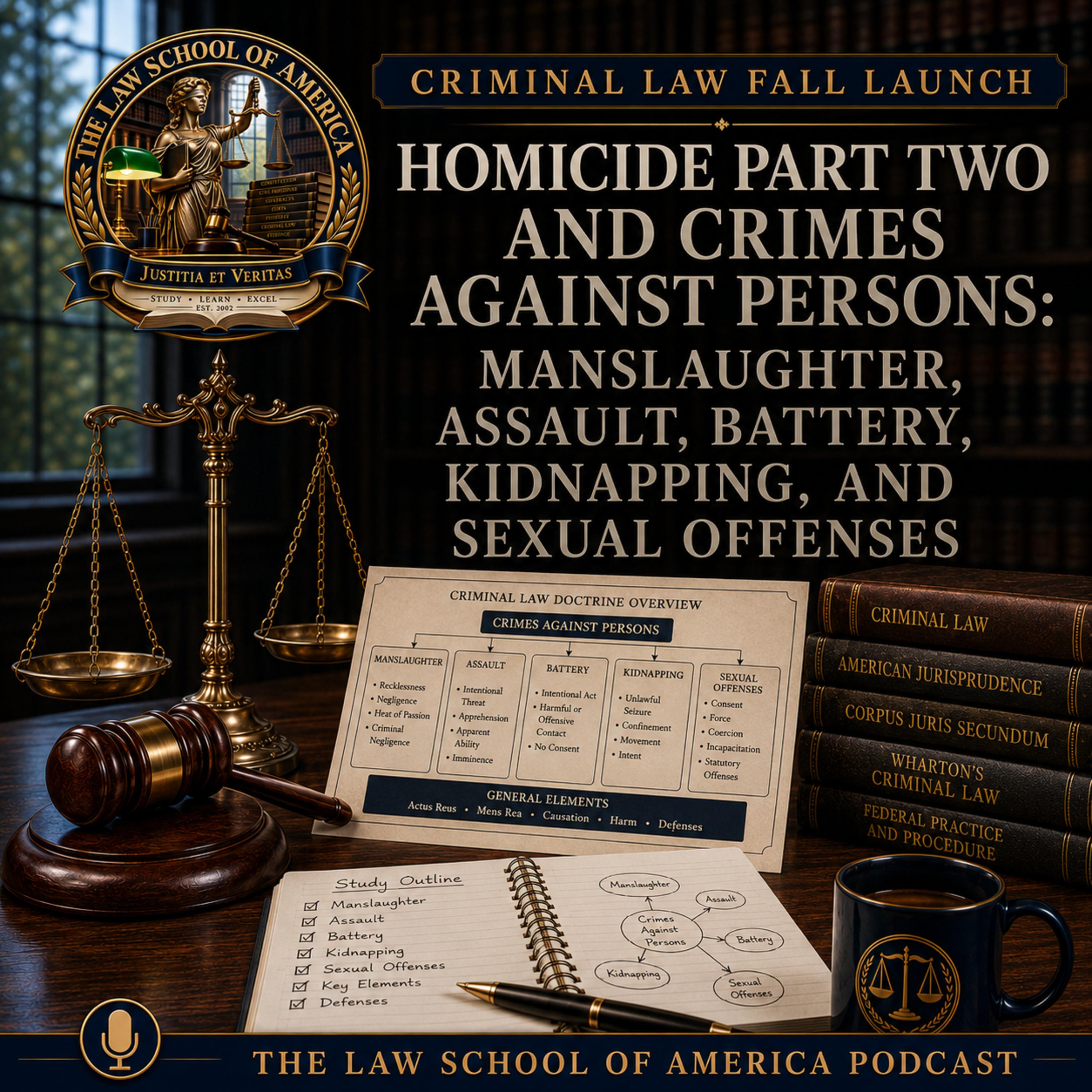
<...Criminal Law Fall Launch: Homicide Part Two and Crimes Against Persons: Manslaughter, Assault, Battery, Kidnapping, and Sexual Offenses
📘 FREE COMPANION STUDY GUIDE 📘
👉 CLICK HERE TO OPEN YOUR FREE STUDY GUIDE 👈
Turn this episode into an exam-ready study plan.
🎧 EPISODE SUMMARY 🎧Voluntary Manslaughter
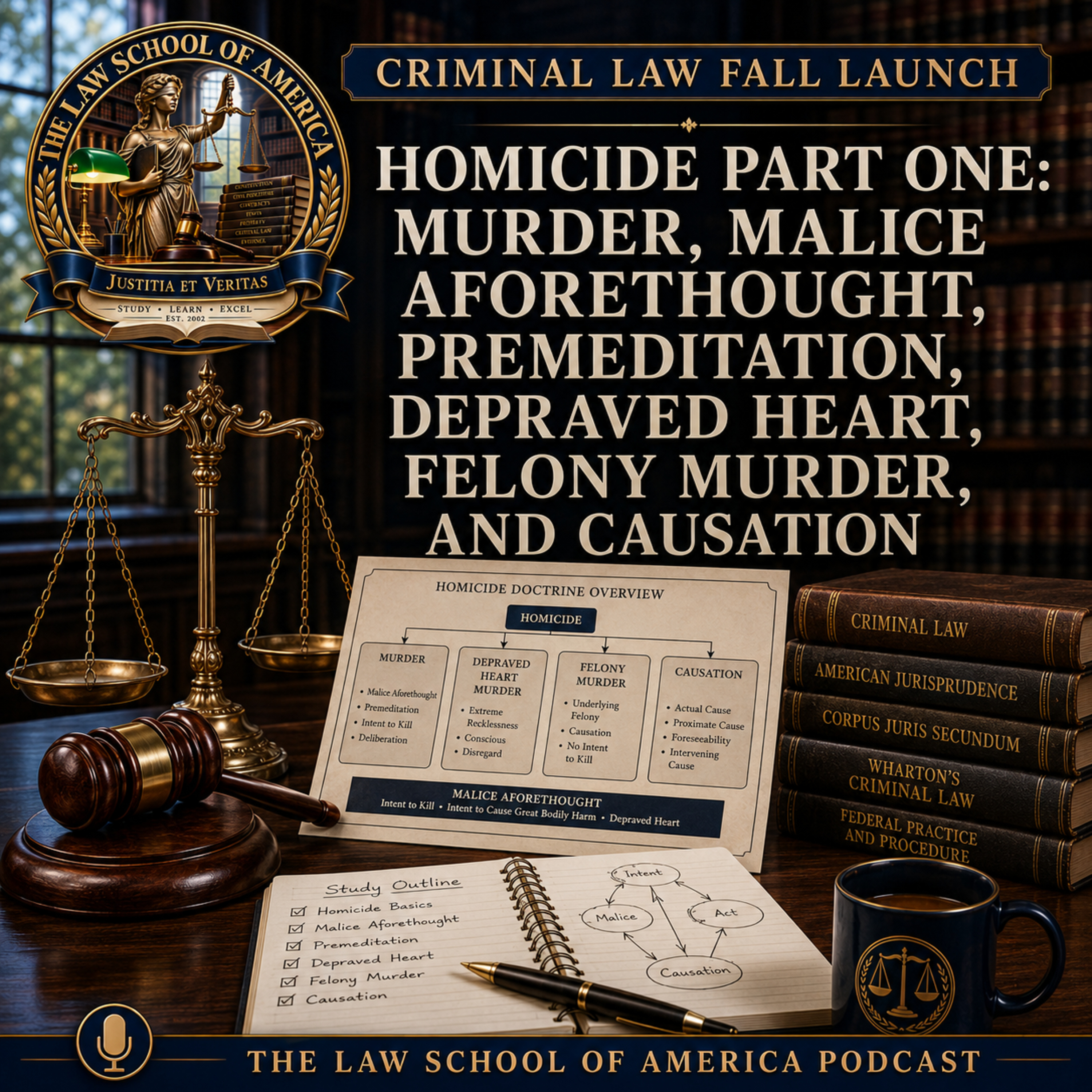
Intentional killing mitigated by adequate provocation (heat of passion).Elements: Adequate/actual provocation, no cooling time, causal connection.Categories: Serious assault/battery, mutual combat, illegal arrest.Modern standard: Ordinary reasonable person's loss of self-control.Reduces murder to manslaughter when the defendant unreasonably believes deadly force is necessary. Not universally recognized.Broader "extreme emotional disturbance" standard; requires reasonable explanation or excuse.Unintended killing via criminal negligence (gross deviation from care), recklessness, or misdemeanor-man...Criminal Law Fall Launch: Homicide Part One: Murder, Malice Aforethought, Premeditation, Depraved Heart, Felony Murder, and Causation
📘 FREE COMPANION STUDY GUIDE 📘
👉 CLICK HERE TO OPEN YOUR FREE STUDY GUIDE 👈
Turn this episode into an exam-ready study plan.
🎧 EPISODE SUMMARY 🎧Homicide is the killing of a human, which may be lawful or criminal.
Assess causation, mental state, category, and potential defenses.
Common-law murder is an unlawful killing with malice aforethought.
Malice requires one of four mental states:
Intent to kill (proven by circumstantial evidence).
Intent to inflict serious bodily injury.
Extreme reckless indifference (depraved heart).
Felony murder.
Premeditation requ...
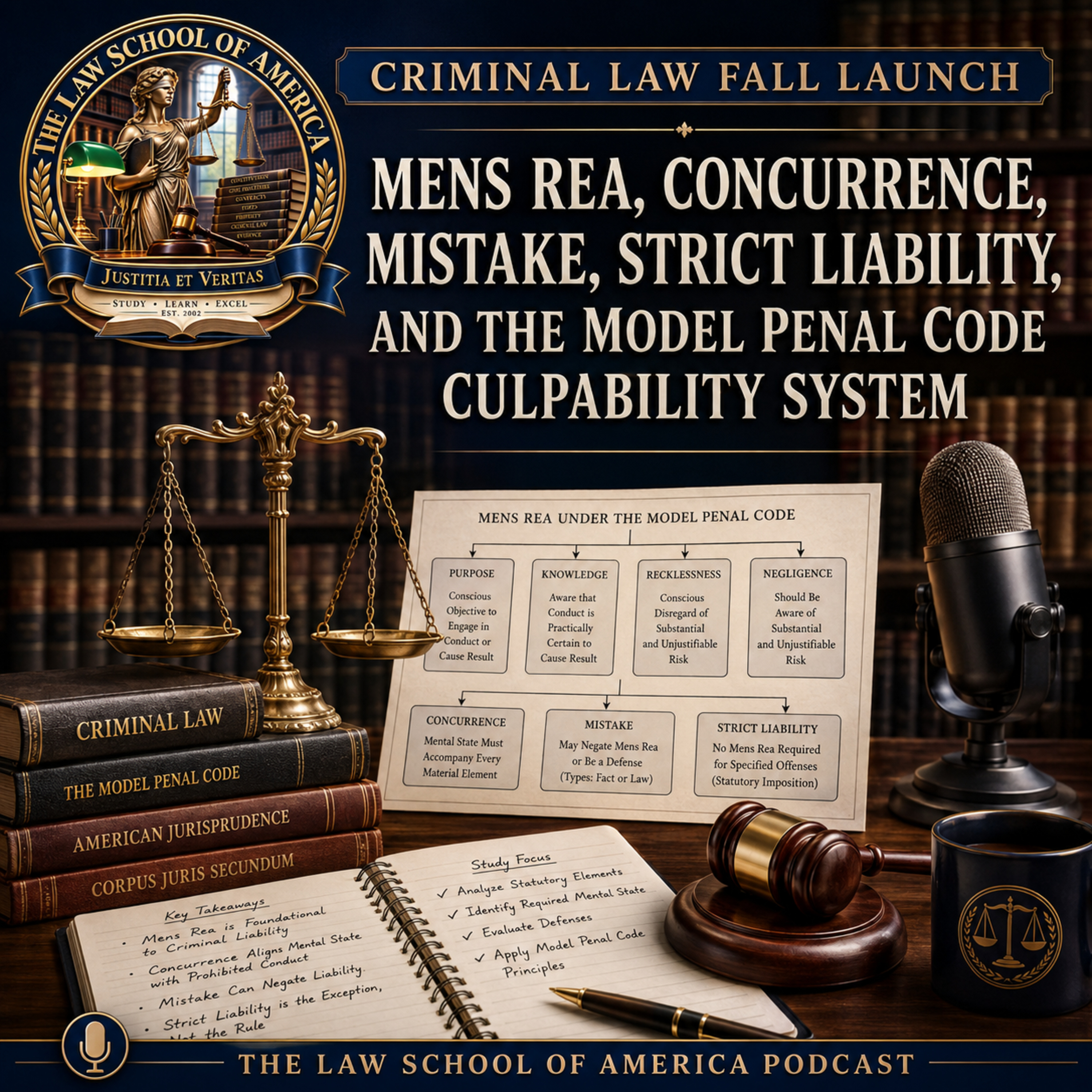
Criminal Law Fall Launch: Mens Rea, Concurrence, Mistake, Strict Liability, and the Model Penal Code Culpability System
📘 FREE COMPANION STUDY GUIDE 📘
👉 CLICK HERE TO OPEN YOUR FREE STUDY GUIDE 👈
Turn this episode into an exam-ready study plan.
🎧 EPISODE SUMMARY 🎧Mens rea is the culpable mental state required for a criminal offense, attached to specific statutory elements.
Model Penal Code Culpability Levels:
Purpose: Conduct/result is defendant’s conscious object.
Knowledge: Aware result is practically certain.
Recklessness: Consciously disregards a substantial, unjustifiable risk.
Negligence: Fails to perceive a substantial, unjustifiable risk.
Common Law Categories:
Specific Intent: Requires an objective beyond the act (e.g...
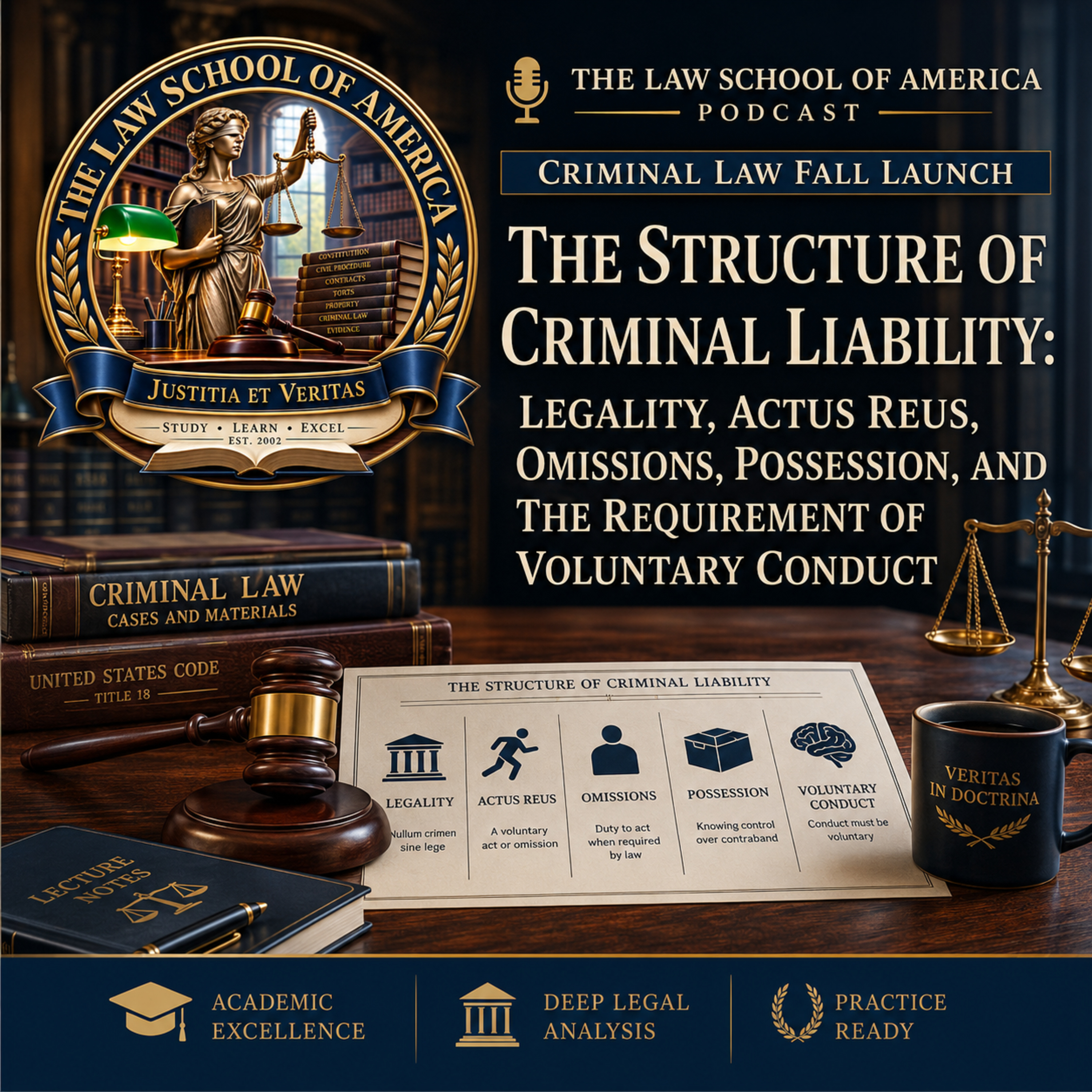
Criminal Law Fall Launch: The Structure of Criminal Liability: Legality, Actus Reus, Omissions, Possession, and the Requirement of Voluntary Conduct
📘 FREE COMPANION STUDY GUIDE 📘
👉 CLICK HERE TO OPEN YOUR FREE STUDY GUIDE 👈
Turn this episode into an exam-ready study plan.
🎧 EPISODE SUMMARY 🎧Criminal liability requires more than harm; it involves conduct, mental state, concurrence, and causation.
Under the principle of legality, criminal prohibitions must predate conduct to ensure fair notice and limit vague or retroactive laws.
Modern Criminal Law is heavily statutory, requiring students to parse offenses into elements like conduct, result, circumstances, and mens rea.
An aggravated-burglary example shows why each statutory element must be proved separately rather than relying on ge...