How I Work
You know those annoyingly successful people who seem to have it all figured out? Time to steal their playbook. Organisational psychologist Dr Amantha Imber gets world‑class achievers to spill their secrets - the daily strategies behind their success through to life hacks and productivity hacks they’d rather keep to themselves. We’re talking practical tips for boosting your output (including clever AI tools and shortcuts that’ll make you look like a genius), managing overwhelm without losing your mind, and optimising both work and wellbeing. No motivational fluff. Just battle‑tested tactics from people who’ve cracked the code.
What is an AI skill (and why you should care)

**Join our AI Mastery program: https://www.inventium.ai/ai-mastery **
You’ve typed the same instructions into AI for the third week running, tweaked the wording slightly, and got a slightly different result again. It’s tiring, and it makes the output hard to trust.
Meanwhile, the tools you may have built along the way like GPTs and Gems are starting to disappear, and a new term keeps turning up in every major AI platform: Skills
In this How I AI episode, Neo and I get into what a skill is, why the platfor...
How to make your frequent flyer points go further in 2027

You've spent years collecting frequent flyer points. Then you finally go to book a flight, and somehow the seats you want are never available. Or the points required seem ridiculous. Or you give up and pay cash anyway.
As it turns out, collecting points is only half the game. Knowing which airlines to book with, where to look for reward seats, and when to use your points can make a difference of tens of thousands of dollars.
In this episode, I sit down with Steve Hui and Steve Pirie-Nally from the Flights Club (also known as...
The prompt that shows what your AI actually knows about you (and it’s less than you might think)

Your AI greets you like an old friend, then hands back something painfully average. Sometimes it even refers to a job you left two years ago.
What your AI knows about you and what it simply assumes are two very different things, and the gap between them shapes every answer you get.
In this How I AI episode, Neo and I look at what is actually sitting in your AI’s memory. We cover how to see it for yourself, how to correct it, and the blind spot that keeps good-sounding assistants from doing great work...
How to master difficult conversations at work, with Tim Duggan
Around 80% of us will avoid conflict if given the chance, and Tim Duggan was firmly in that camp.
In this episode, I sit down with Tim, author of Clear In Tension: How to Get Better at Conflict, to explore how we can all handle conflict with more skill and less dread. Tim spent 15 years running the media company Junkie Media, mediating other people’s disputes, all while dreading conflict himself.
We walk through his five-step CLEAR framework, two listening techniques you can use in your very next tough conversation, and what the four symbols tattooed on Am...
Still arguing with AI over a bad first draft? Try these 4 tips

Do you still have a prompt formula saved somewhere, maybe an acronym from an Instagram reel that promised better answers from AI? You paste it in, swap a few words, hit send, and what comes back still misses the mark.
Years of typing a few keywords into a search box have shaped how we talk to AI, and that habit might be costing you time and patience.
In this How I AI episode, Neo and I look at why prompt formulas took off, what has changed since, and how to brief AI so you get be...
REPLAY: Feel like you’re always behind? Chris Guillebeau has a fix for your time anxiety (Part 1)
**REPLAY**
Do you ever get the sense that no matter how much you do, you’re still running out of time? Like there’s something you should be doing, but you can’t quite figure out what it is?
In this episode of How I Work, we sit down with New York Times bestselling author Chris Guillebeau to talk about a feeling so many of us carry but rarely name: time anxiety. From guilt over unread emails to the pressure to leave a legacy, Chris shares the practical strategies that helped him stop chasing time - and s...
Your prompts are stuck in 2025. Here are 5 fixes

Some prompts have been with you for a year or more. They open with a grand persona for the AI, add a few rules in capital letters, and finish with a request to think it all through. They worked well once, and lately the results feel slightly off.
The AI models have changed, and a few of the habits we picked up in 2024 and 2025 now work against us.
In this How I AI episode, Neo and I walk through five ways good prompting has changed as of October 2026. You will come away with a simple wa...
REPLAY: Why you feel busy all the time (even when you’re not), with Laura Vanderkam
**REPLAY**
What would you do with four extra hours a day? Probably say you don't have them. But according to Laura Vanderkam, one of the world's leading thinkers on time, they're already there. You're just not seeing them.
Laura has tracked her own time for 11 years. She's run large-scale time-tracking studies with hundreds of participants. And what she keeps finding is the same thing: the stories we tell ourselves about our time are almost always wrong. The tasks we dread feel longer than they are. The free time we insist we don't have keeps showing up in t...
Your custom GPTs and Gems are going away. Here's how to save them.

Who keeps moving my buttons? You know the one. You finally learn where everything lives, and overnight the menu has been rearranged, the feature has a new name, and the thing you spent months perfecting is on a list of things being retired.
In this How I AI episode, Neo and I make sense of the latest shake-up: what is replacing GPTs and Gems, when the lights go out on each platform, and how to back up your hard work so none of it vanishes without warning. You'll leave knowing what to save, what to convert, and w...
The Work Edit: The AI skill that saves me 200 minutes a week. Here's how to build yours.
Twenty minutes doesn't sound like much. Multiply it by ten sales calls a week and it adds up to more than three hours spent on a task that someone, or something, else could be doing.
Now think about how many tasks like that are hiding in your own week, repeated so often that you no longer notice them.
In this Work Edit, I sit down with Stephen, an organisational transformation advisor with more than 20 years of experience. Stephen uses Claude every day for client research, interview synthesis, first-draft deliverables and thought leadership, but he knows hi...
AI is a terrible brainstormer (until you do this)

You ask AI for ideas and get a tidy list of ten, each one praised as being brilliant. The tempting move is to grab the first one that looks decent and get on with your day. The catch is that you've handed over the thinking, and what comes back tends to look a lot like what everyone else is getting.
AI can be a far better brainstorming partner when it sharpens your thinking instead of replacing it. The difference comes down to how you set it up and what you ask it to do.
In th...
The 7 types of rest you need, and how to find the one you're missing, with Dr. Saundra Dalton-Smith
One surgeon takes his boat out onto a lake, screams until he can't scream anymore, and then cries. It is how he recovers from a job where patients die and he can't fall apart in front of his team.
That is what emotional rest can look like for one person, and it is only one of seven types of rest that most of us have never thought to separate. Which raises this possibility: you might be resting effectively in one area while a completely different part of you runs on empty.
In this episode, I si...
Your AI gets dumber at 60%. Here's the free fix.

Some of us have a favourite chat thread we keep coming back to, adding a bit more context every time we open it. It feels efficient, like you're building up a work buddy who really knows your stuff. But every extra message quietly chips away at how reliable that thread becomes, and by the time you notice, it's surprisingly hard to pull it back.
Knowing when to walk away from a chat, and how to take your best thinking with you, is one of the most useful AI habits you can build.
In this How I...
The Work Edit: 3 evening strategies to actually help you switch off
You've read the books. You've locked the phone in a drawer. You've set a hard cut-off at 8 PM. And none of it has lasted more than two weeks.
That's exactly where Shaun found himself. By day he's a senior corporate strategy leader at Bupa, and by night he's the volunteer operations manager for a junior footy club responsible for 450 kids across eight teams. The systems he runs at work are tight. The systems he runs at home? Nowhere to be seen.
In this Work Edit, I sit down with Shaun to figure out why the pr...
The 4 recurring tasks you should hand off to AI permanently

Most people treat AI like a vending machine: you show up, you ask, you wait. But what if there's another way to use it, one where the work gets done before you've even thought to ask for it.
In this How I AI episode, Neo and I explore scheduled prompts: what they are, why they're worth setting up, and how to actually write one that works.
What you'll learn:
What a scheduled prompt is and how it differs from a regular AI conversation When it makes sense to run a prompt in the background rath...Steal Jane Lu's system for delegating without losing control

Hiring someone is one of the highest-stakes decisions a founder makes. Get it wrong and you can lose time, money, and momentum. And after 16 years of building Showpo from her parents' garage into a nine-figure business, Jane Lu is the first to admit they still do not always get it right.
But across all those hires, she has landed on one single biggest red flag she screens for, and it is probably not what you would expect.
In this episode, I sit down with Jane Lu, founder of Showpo, to talk about what that red fl...
3 signs it's time to start a new chat thread

You've put in the work on your prompts. You know how to give AI the right context, set the right tone, ask the right questions. But then, mid-conversation, something shifts. The AI starts making things up, forgetting what you told it five minutes ago, contradicting itself.
In this How I AI episode, Neo and I unpack what is actually happening when AI gets unreliable mid-conversation, including how to read the warning signs that tell you it is time to close a thread and start fresh.
What you'll learn:
Why AI gets unreliable mid-conversation, and wha...Why planning 60% of your day is the most productive thing you can do, with Cyril Peupion

There's a specific kind of exhaustion that comes not from working hard, but from never quite feeling like you've worked on the right things. You finish a full day, maybe a long one, and yet the projects that actually matter haven't moved. The inbox is cleaner, the meetings are done, but the needle hasn't shifted.
Cyril Peupion has spent two decades coaching executives on exactly this problem, and his diagnosis is consistent: the issue is the gap between where leaders want to go and what they actually spend their time on.
In this episode, I si...
Quick Win: The million-dollar moment that tested Catriona Wallace’s integrity
When Dr Catriona Wallace was offered a million dollars to take out her nose ring, she didn’t hesitate. Her response wasn’t defiance - it was clarity.
In this Quick Win, Catriona shares how she dealt with the sexism and double standards she faced as a tech CEO, from being told to “brush her hair” to being offered a million dollars to look more like the kind of leader investors expected.
Her story is a reminder that staying true to yourself is sometimes the most strategic move you can make.
Catriona and I discuss: ...
The Work Edit: When gratitude becomes entitlement, and how to reset it
You give your team something rare. A four-day week. Flexible hours. Real breathing room. And for a while, it works beautifully. Then, gradually, the gratitude fades. The expectation creeps in. And suddenly, the gift feels like a given.
This is one of the more uncomfortable paradoxes of building a genuinely good workplace: the better the culture you create, the faster it becomes the new normal. And once people stop noticing it, they start resenting any friction that interrupts it.
This episode is part of The Work Edit, a format where I sit down with someone facing...
Quick Win: How to rebuild trust at work when its broken
Trust doesn’t rebuild with one big apology. It grows back quietly - through small, consistent moments that prove you mean what you say.
In this Quick Win episode, my teammate Aly Solly and I share how we rebuilt trust after one of Inventium’s toughest years. Together, we discovered that trust isn’t restored overnight - it’s rebuilt in small, deliberate ways that show care, honesty, and vulnerability.
Aly and I discuss:
The moment a leadership wellbeing survey sparked real vulnerability Why openness - when it feels uncomfortable - can transform a relationship...The two numbers that predict whether you'll actually hit your goal, with Jia Jiang
Every productivity guru will tell you the same thing: set realistic goals, or you're setting yourself up to fail. Jia Jiang did the opposite. He told the internet he'd sell 10,000 copies of his new book in 100 days, sold about 3,000, and is now going around calling it one of the best things he's ever done.
He's not being delusional about it either. He'll tell you straight up that part of him wishes he'd hit the number. He just thinks failing loudly beats succeeding quietly, which might explain why only 9% of people who make a New Year's resolution actually s...
Quick Win: The hidden reason AI isn’t delivering value at work, according to Dom Price
AI might be saving you time, but if you don’t know what to do with that time, it’s not worth much. In this Quick Win, I’m joined by Dom Price, who spent 12 years as the Work Futurist at Atlassian. Dom shares a powerful reminder: saving time with AI is meaningless unless you know how to reinvest that time intentionally. After watching organisations roll out sophisticated AI tools without upgrading the human system around them, Dom explains why people often use their newfound hours poorly - and how a single, deliberate question can transform the return you get from AI.
...The Work Edit: How to scale a consulting business without growing the team
Hiring feels like the obvious next move when a business starts doing well. More people, more capacity, more revenue. The logic is so clean it barely needs questioning.
But the businesses with the smallest teams are sometimes the ones making the most money.
This episode is part of The Work Edit, a format where I sit down with someone facing a real professional challenge and we work through it together. My guest is Lisa, who has spent four years building The Culture Ministry, a diversity and inclusion consulting business. She came to me with a questi...
The prompting mistake almost everyone makes

How much of your week goes into fixing what AI just handed you? Not writing from scratch, just cleaning up, correcting, and nudging a draft that looked fine for about ten seconds before you actually needed it to work.
That endless back and forth has a name. We call it slop fixing, and there is research suggesting it is quietly eating close to a full day of our working week.
In this How I AI episode, Neo and I get into why this happens and the two very different ways of working with AI that decide...
The 3 questions that reveal whether someone is actually motivated, with Dr Justin Coulson
Every manager and every parent has met the same wall. Someone who won't engage, won't budge, won't do the thing, no matter how hard you push or how much you offer.
Dr Justin Coulson has spent two decades inside the research explaining why pushing and bribing rarely work, and what actually does.
Justin is a psychologist, bestselling author, host of the TV show Parental Guidance, and father of six daughters, and his work sits inside self-determination theory, one of the most evidence-based bodies of research in psychology.
In this episode, I sit down with Justin t...
Do these 2 things if you're worried about AI and the environment

There is a quiet guilt a lot of people carry every time they open ChatGPT. Somewhere between the headlines about data centres and the vague sense that AI is somehow worse for the planet than everything else we do without a second thought, it becomes easier to just feel bad than to actually work out whether that guilt is warranted.
Nobody hands you the comparison points. Is a heavy day of prompting worse than a night of Netflix? Worse than a round of golf? Nobody says.
In this How I AI episode, Neo and I go looking...
Are you an insecure overachiever? Oliver Burkeman on why success never feels like enough
There's a particular kind of tightness that creeps in when the world feels unpredictable. We tidy the to-do list, tighten the routine, optimise one more thing, all in an attempt to feel a bit more in control.
Oliver Burkeman has a word for this: clenching. And he reckons it's squeezing the life out of us, even when it looks a lot like productivity.
In this episode, I sit down with Oliver Burkeman, New York Times bestselling author of Four Thousand Weeks and Meditations for Mortals, and former writer of The Guardian's This Column Will Change Your Life...
What you should never paste into AI

Before you paste that customer list, that blood test result or that contract into your favourite AI tool, it's worth pausing for a second. Whatever you hand over doesn't just disappear after you get your answer. It sits somewhere, and depending on the tool and the settings, it might be doing more than just answering your question.
Most people have never actually checked what happens to their data once it goes in or thought about the difference between what's fine to share and what's better redacted first.
In this How I AI episode, Neo and I work through...
Part 2: The loneliness of leadership no one warned you about, with Christian O'Connell
There is a version of leadership that looks effortless from the outside. The one where the leader always has the answers, always holds the vision, always appears composed. And then there is the version that happens in private, at 5:00 AM, when your mind is rehearsing every possible failure and no one can see it.
What surprises most people is how often those two versions belong to the same person.
In part two of my conversation with Christian O'Connell, breakfast radio host heard by hundreds of thousands of Australians every morning, we get into the parts of l...
Agents, Projects, and Skills (oh my!): A no-fluff guide on when to use each one

The AI world has has done a spectacularly bad job of naming things. Agents, GPTs, gems, notebooks, projects, skills - you'll find a completely different word for what is essentially the same kind of tool. Agents in one place, GPTs in another, gems somewhere else. Different names, similar ideas - and no handbook to tell you that.
But the tools themselves are not that complicated. Once you know what each one is built to do, knowing which to reach for becomes straightforward.
In this How I AI episode, Neo and I cut through the jargon and map...
Part 1: Christian O'Connell on the habit that means he never runs out of stories
** Grab tickets for The Energy Game Melbourne launch (29 July, 6:30pm) here and order The Energy Game book here.**
What if the stories you're most afraid to tell are the ones people most need to hear?
Christian O'Connell has spent 28 years pulling stories out of strangers on live radio. He's had two number one breakfast shows on opposite sides of the planet. And yet off-air, he still catches himself at dinner with his family thinking he hasn't said anything funny in a couple of minutes, and that inner critic starting to spiral.
In part one of our two-p...
The three questions to ask before picking an AI platform

You see another article. "This platform just changed everything." And suddenly, the AI platform you've been using for months feels completely inadequate. You wonder if you're behind. You wonder if you should switch again.
Neo and I have had this conversation more times than we can count, and it's one of the questions we get asked constantly at Inventium AI. Which of the four major AI platforms, Copilot, ChatGPT, Claude and Gemini, should you actually be using?
In this How I AI episode, Neo and I walk through the three questions you should ask yourself before co...
How to get your energy back without overhauling your life
** Grab tickets for The Energy Game Melbourne launch (29 July, 6:30pm) here and order The Energy Game book here.**
If you're someone who keeps saying yes when you should say no, or who has never once thought of rest as a skill worth building, this conversation will give you a starting point that doesn't require overhauling your life.
This is part two of a two-part crossover with the This Is Work podcast, hosted by Shelley Johnson. In this episode, Shelley and I go deep into the science-backed strategies from my new book, The Energy Game, covering all three...
Cowork explained in 10 Minutes

You've probably seen Cowork mentioned inside Claude, or perhaps you clocked the headlines when Microsoft folded it into Copilot a couple of weeks ago. Either way, the question people keep asking is simple: how is this actually different from just chatting with Claude?
The answer comes down to files, time and money - three things that change quite dramatically once you move from chat to Cowork.
In this How I AI episode, Neo and I unpack exactly what Cowork can do that regular chat can't, how to know which one to reach for, and what the new Microsoft...
The warning signs of burnout I missed for nearly an entire year
** Grab tickets for The Energy Game Melbourne launch (29 July, 6:30pm) here and order The Energy Game book here.**
What does it take to realise you've hit burnout? For me, it wasn't a dramatic collapse. It was a fantasy about being hospitalised just so no one could contact me, and the hardest decision I'd face would be lime or raspberry jelly.
When I shared that thought with a friend who is also a clinical psychologist, she told me she'd heard it so many times she had a name for it. That moment of recognition, equal parts relief...
What is tokenomics, and why should you care

If your organisation has moved its AI licenses onto a per-use plan, every single chat thread your team sends is now adding to a bill. Some companies are already burning through their entire IT budget for AI within the first couple of months of the year, and most staff have no idea their usage is costing anything at all.
It doesn't have to be a mystery. There are simple habits, from which model you default to, to what time of day you send your first message, that change how far your usage actually stretches.
In this How...
Behind the book deal: How a book goes from pitch to print, with Penguin Random House's Izzy Yates
** Grab tickets for The Energy Game Melbourne launch (29 July, 6:30pm) here and pre-order The Energy Game book here.**
Writing a book is hard. But getting a publisher to say yes to your book? That is an entirely different challenge, and one that most aspiring authors know almost nothing about.
What actually happens when a proposal lands on a publisher's desk? Who else needs to sign off before an offer is made? And in a world where anyone can ask AI to explain any topic, why has "great content" stopped being enough on its own?
This on...
Which AI model should I use for which task?

If you've ever stared at a model picker and wondered whether to click Flash, Sonnet, Opus, Instant, or Think Deeper, you are not alone. These naming conventions are genuinely confusing, and most people just pick something and hope it works. The stakes are higher than they might seem, though. Token misuse has left some companies with eye-watering AI bills, including one case where a single employee ran up a $500,000 tab in a month.
The good news is that there is a simple mental model that cuts through all the noise, and once you have it, choosing the rig...
The two AI mistakes hurting your team's productivity, with Dom Price
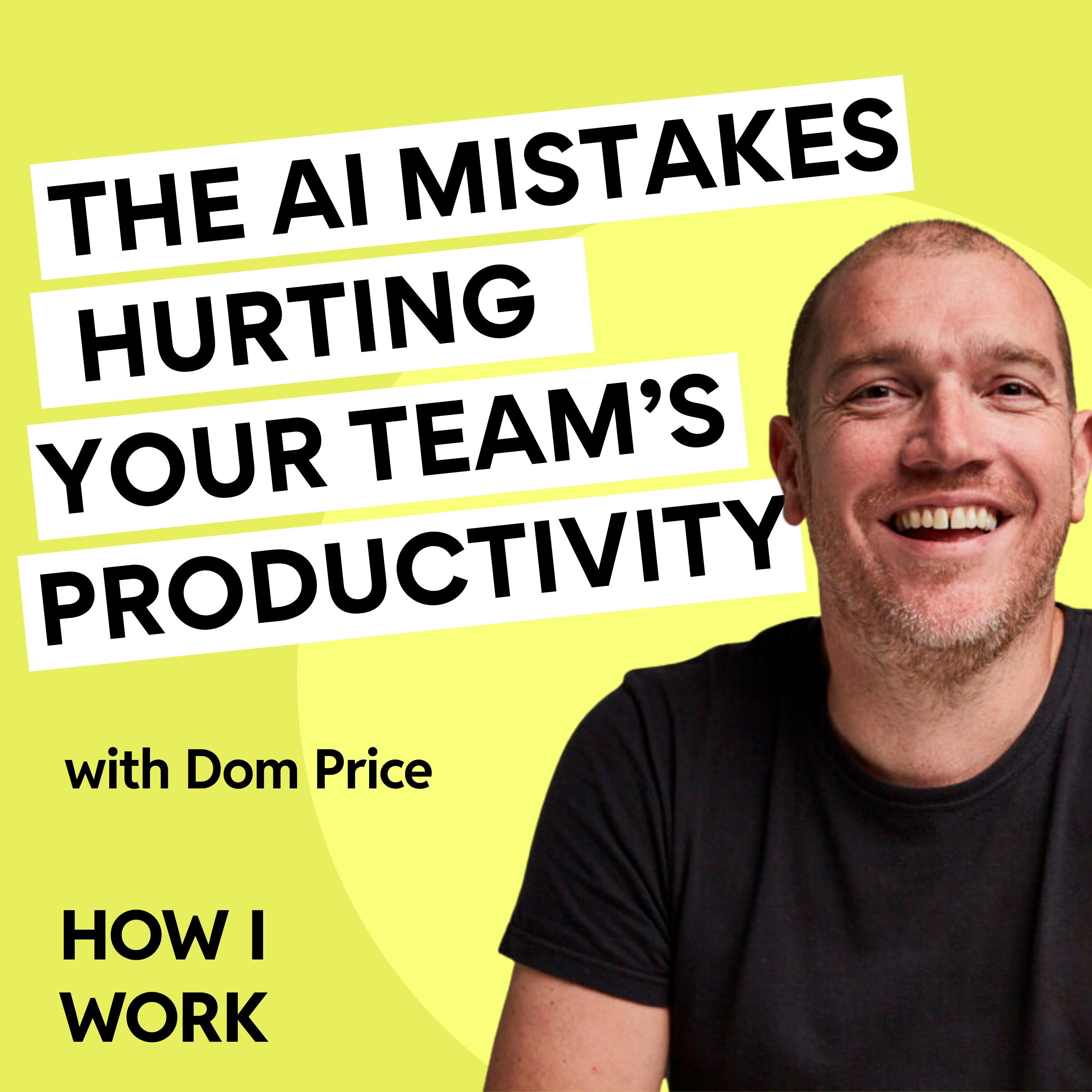
We're using AI more than ever. And yet, according to research from Glean's Work AI Institute, only 10% of Australians say AI is significantly improving organisational performance.
The truth is that most organisations have done what Dom Price calls the "Woodstock theory" of AI adoption: build it and they will come. Throw the tools out there, hope people figure it out, and wait for the productivity miracle that never quite arrives.
In this episode, I sit down with Dom Price, former Atlassian work futurist and one of the sharpest thinkers I know on how organisations actually work. Dom j...
