The Science Show
The Science Show gives Australians unique insights into the latest scientific research and debate, from the physics of cricket to prime ministerial biorhythms.
The Australian Museum celebrates 200 years
And we compare interest in science amongst Australian school students with students in Taiwan.
Lab Notes: Earth's missing billion years
Sections of rock are completely missing from our geological record across continents.
The great unconformity spans just over a billion years of history, leaving out critical periods in the evolution of life.
Jonathan Webb speaks with Associate Professor Nicolas Flament about this geological puzzle and what could have caused it.
You can binge more episodes of the Lab Notes podcast with science editor and presenter Jonathan Webb on the ABC Listen app (Australia). You'll find episodes on animal behaviour, human health, space exploration and so much more.
Get in touch with...
The world in flux
* New spins in the nanoworld* Making sense of the chaos* Penguin behaviour hidden, now reassessed* Hop to it! It’s Frog ID week!* The history and challenges for Australian media and arts bodies
Lab Notes: The end of the world — on Friday
66 years ago, three researchers published a paper in the Journal Science titled Doomsday: Friday, 13 November, A.D. 2026.
In it, they predicted the end of the world, but a few assumptions they made make the event unlikely.
Jonathan Webb unravels this prediction with our myth-busting science reporter, Ellen Phiddian, explaining why we shouldn't worry… hopefully.
You can binge more episodes of the Lab Notes podcast with science editor and presenter Jonathan Webb on the ABC Listen app (Australia). You'll find episodes on animal behaviour, human health, space exploration and so much more.
Ge...
School students share their concerns and introducing young children to science
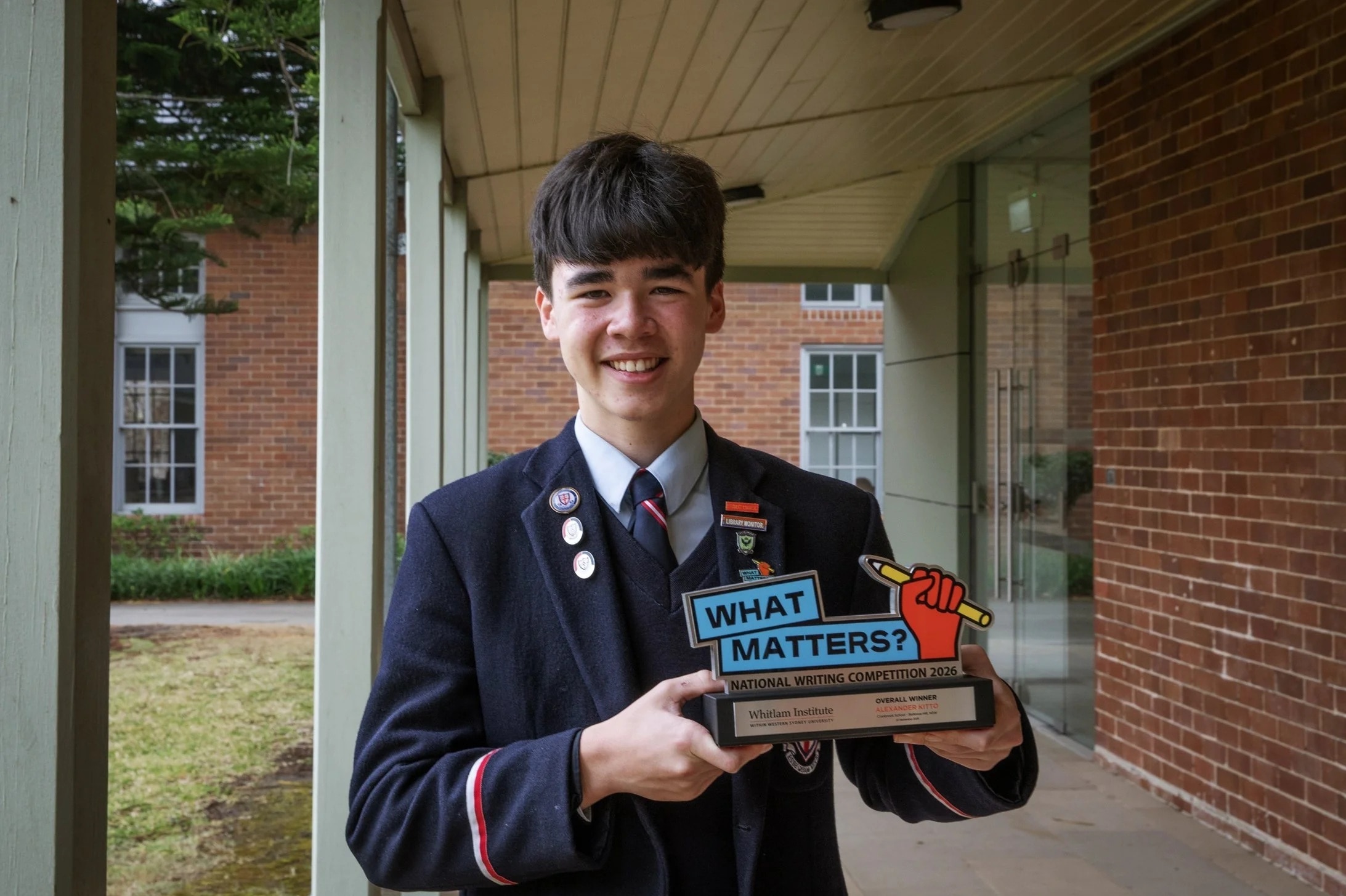
The Whitlam Institute at Western Sydney University is home of the What Matters? Writing Competition, one of Australia's longest-running and largest national writing competitions for young people. We hear from 4 of this year’s finalists.
Lab Notes: Eel sex ball
We don't know a lot about deep-sea eels, so when 2.8 million of them are found in the same place every year, scientists (and science reporters) get excited.
Why are they there? Where are they coming from, and why should we care about these creatures from the depths?
Jonathan Webb dives into this world of eels off the coast of Tasmania with environment reporter Peter de Kruijff.
You can binge more episodes of the Lab Notes podcast with science editor and presenter Jonathan Webb on the ABC Listen app (Australia). You'll find episodes on...
The British Science Festival
Robyn Williams reports from The British Science Festival in Southampton UK.
Lab Notes: Bogong moths bounce back?
Across south-eastern Australia, bogong moths seem to be everywhere.
A few years ago, it was a different picture: scientists witnessed a population crash, and habitat threats put the species on the IUCN Red List. Are we seeing a bogong bounce-back? Jonathan Webb speaks to Dr Kate Umbers about these incredible critters, the many unsolved mysteries of their lives — and what their future could look like.
You can binge more episodes of the Lab Notes podcast with science editor and presenter Jonathan Webb on the ABC Listen app (Australia). You'll find episodes on animal behaviour, human heal...
Collaboration between life forms and how bees protect their hives from disease
Plus a call for accuracy in dinosaur displays.
Lab Notes: What's in store for wildlife this summer?
Over the past few years, our environment seems to have experienced multiple extreme events in quick succession.
With a summer fuelled by what may be the strongest and wettest El Niño ever, can our wildlife withstand more extremes?
Jonathan Webb speaks with Professor Euan Ritchie about what we're currently seeing with flying foxes, what could happen to other species over the summer, and what we can do to help our native creatures.
You can binge more episodes of the Lab Notes podcast with science editor and presenter Jonathan Webb on the ABC L...
72 per cent of UK trees threatened by changing climate, plus the simple spud’s complex genetics
And palm oil producers in South-East Asia have changed their ways, considering the environment more than they did. Brendan May is turning his attention now to nickel mines in tropical countries.
Lab Notes: When astronomers make mistakes
In March 2018, a South African astronomer looking into the distant universe "discovered" a bright red spot in the sky that hadn't been there previously; it felt like an exciting potential discovery. A message was sent to other astronomers, asking them to look at this new dot and study it further.
After forty minutes and a few more calculations, he realised this "star" was much closer to home and nothing new at all: it was the planet Mars.
According to Dr Kat Ross, making this kind of mistake is something of a rite of passage for...
Nobel Prizes, kitchen fumes and a biography of Francis Crick
* 2026 Nobel prizes in science* Air fryer vs deep fryer: Which produces more indoor air pollution?* First major biography of Francis Crick
Lab Notes: When is it time to throw in the towel?
If you reach for the old tea towel in the cupboard, this episode is for you.
It's time to talk textiles: why older towels seem to be better at drying, and when it may be time to throw out your more well-worn towels.
Jonathan follows the thread with Ellen Phiddian to find out what we can do with our linen.
You can binge more episodes of the Lab Notes podcast with science editor and presenter Jonathan Webb on the ABC Listen app (Australia). You'll find episodes on animal behaviour, human health, space exploration an...
Paul Nurse and assessing the health of Australian trees
And genetics reveals further details of a great friendship story – humans and dogs.
Lab Notes: Why you shouldn't leave your phone charging
Your phone battery doesn't like being fully charged or discharged. This is why it's sometimes advised that to extend its life, you shouldn't charge your phone beyond 80 per cent, or let it drop below 20 per cent.
But what's actually happening inside a lithium-ion battery to cause this effect, and what does it mean for battery engineering — and the life of the battery in your phone, or your electric car?
Jonathan Webb powers through the chemistry of batteries with Professor Neeraj Sharma.
You can binge more episodes of the Lab Notes podcast with science ed...
Deep sea nodules, ideas in ecology, and three brilliant scientists not always on the money
Millions, perhaps billions of sharks teeth lie on the ocean floor. Valuable mineral deposits collect on their fossilised remains. Now they are viewed as a resource and if exploited devastation will come to an little known ecosystem.
Lab Notes: Have we found dark matter?
Deep in an old gold mine in South Dakota, scientists witnessed a flash of energy in a giant pool of xenon. Some in the astronomical community are pretty excited, saying this is our best hint yet at what dark matter is. How do we know, why does it matter — and what happens next?
Jonathan Webb shines a light on dark matter with Dr Theresa Fruth, who was involved in the potential discovery.
You can binge more episodes of the Lab Notes podcast with science editor and presenter Jonathan Webb on the ABC Listen app (Australia). Yo...
The big cats that stalked early humans and why ancient concrete outlasts the modern stuff
Plus the tree bark which hosts a whole world of methane-absorbing microbes.
Lab Notes: The AI maths wars
AI is getting so good at maths that it is now tackling, and apparently solving, some of the hardest mathematical problems that exist. But as huge companies like OpenAI and Anthropic race to outdo each other, human mathematicians are getting caught in the crossfire... and their field is changing forever.
Jonathan Webb speaks to ABC AI Technology Reporter Cam Wilson about the furore over the Navier-Stokes equations and the million-dollar Millennium Prize.
Featuring:
Cam Wilson, AI Reporter at ABC.Professor Tristan Buckmaster, Mathematician at New York University.You can binge more episodes of t...
AI boost for people with dyslexia and how algorithms shape what we read
And botanists intervene to save a plant that may have become sterile
Lab Notes: Where could bird flu go next?
It's been three months since the first case of bird flu was found on the Australian continent.
Many cases have been found in birds since then, along with other mammals. So where has it spread? And what can we expect to see as spring and summer arrive?
Jonathan Webb speaks with Peter de Kruijff, who's been following bird flu since the very beginning.
You can binge more episodes of the Lab Notes podcast with science editor and presenter Jonathan Webb on the ABC Listen app (Australia). You'll find episodes on animal behaviour, human...
As fire ravages the Northern Hemisphere, is Australia ready for a record-breaking El Niño? And why optimists live longer than pessimists
The Science Show gives Australians unique insights into the latest scientific research and debate.
Lab Notes: Why are we ticklish?
Most people know the feeling of ticklishness, whether it's the tickle attacks that bring about uncontrollable laughter or the feather-like touch from something brushing against your skin.
But why do we feel ticklish? Can we stop it? And why did we — and all our ape cousins — evolve this sensation?
Jonathan Webb speaks to Dr Anina Rich to explore the science of this everyday experience.
You can binge more episodes of the Lab Notes podcast with science editor and presenter Jonathan Webb on the ABC Listen app (Australia). You'll find episodes on animal behaviour, huma...
A moon beyond our Solar System, dust storms on Mars and questioning of reality
Dust storms on Mars make the biggest on Earth seem like a gentle breeze. Chelsea Huang describes the Martian conditions which produce humungous dust storms that cover the entire planet.
Lab Notes: The redback sex-death somersault
These little spiders that live in the dark corner of your garage have a pretty crazy sex life. Researchers have known for a while that male redback spiders get eaten during sex — but not only that, they somersault themselves right onto the fangs of the female.
Considering the ultimate aim of this process is to create more spiders , this seems pretty counterintuitive. So it begs the question: why do they do it?
Jonathan Webb and Ellen Phiddian get caught up in the science of this act, discussing what researchers have uncovered in the genes of th...
The debate over who should be in the genus Homo, and the trailblazing botanical illustrators, Harriet and Helena Scott
Plus hope for corals, and the story of a museum thief who liked butterflies.
Lab Notes: The 'Hail Mary' effort to rescue a telescope
Right now, a high-stakes mission is underway to save NASA's Swift telescope before it falls back to Earth.
There's just one problem… the rescue satellite has run into some issues. So who rescues the rescuer?
Jonathan Webb and Dr Sara Webb launch into this issue to see what scientists are doing to get this satellite back on track, and whether it can save Swift in time.
You can binge more episodes of the Lab Notes podcast with science editor and presenter Jonathan Webb on the ABC Listen app (Australia). You'll find episodes on an...
How nematodes love smelly feet, plants that trap insects, Australians at CERN and vale Peter Raven
* The attraction of smelly feet * Plants that trap insects* Pollen grains reveal Australia's first flowering plants* Vale botanist Peter Raven* Australians smashing it at CERN
Lab Notes: How do flowers know when to bloom?
The last days of winter are here and already you may be seeing flowers blooming around you. Why is that? How do flowers know when to bloom, and is it always around springtime?
Jonathan Webb digs into these questions with Dr Greg Moore to try and uncover the mechanisms behind flowering plants.
You can binge more episodes of the Lab Notes podcast with science editor and presenter Jonathan Webb on the ABC Listen app (Australia). You'll find episodes on animal behaviour, human health, space exploration and so much more.
Get in touch with...
Dark Matter search from inner Melbourne, Gelion update, Bach and maths and vale Bill Oddie
* Mathematics as the basis of western musical harmony and how J. S. Bach loved numbers* Victoria's first dark matter detector fires up* Hurdles for new battery technology* Vale Bill Oddie
Lab Notes: In an era of AI hacking, how safe is the census?
It's census time, which means lots of us are about to submit personal information via the Internet.
Whether it's the ABS or your favourite online shop — how safe is our data in an era when AI models have shown they can hack companies without even being asked to?
Jonathan Webb opens a back door to this new normal of cybersecurity with Professor Toby Murray.
You can binge more episodes of the Lab Notes podcast with science editor and presenter Jonathan Webb on the ABC Listen app (Australia). You'll find episodes on animal behaviour, hu...
Looking inside cells, and how seals hear so well underwater
* Fluorescent sensors bring cell contents to life* Plotting the Oceans: Stories of Powerful Maps and Their Makers* Animal senses that work as well in water as on land* Mushroom Day: A Story of 24 Hours and 24 Fungal Lives* Descend two kilometres underground to the cleanest lab on Earth
Lab Notes: What will we see in a 10-year movie of the universe?
The longest survey of our southern skies — The Legacy Survey of Space and Time (LSST) — has just begun from the Vera Rubin Observatory in the Chilean Atacama Desert.
Over the next 10 years, the largest digital camera on Earth will look at the same patches of sky time and again, aiming to record exploding stars, new asteroids, and maybe find what's behind dark energy.
Jonathan Webb gets sucked into grand cosmic questions with Dr Anais Möller, as they discuss how astronomers are getting a head start on their research from the survey.
You can b...
Pioneers past and present, and fiddling with life brings a heavy caution
* Celebrating Charles Todd, father of the overland telegraph* Diverse background ideal for leader in pioneering science* Mirror life risks catastrophe* Future Right Now reveals concerns of young people* Botany courses becoming an endangered species
Lab Notes: How do we predict the snow season?
This year has been one of the worst starts to the snow season since records began. And it's a trend that researchers say will only continue in the years to come.
But what's causing this change? What's the outlook for the rest of this ski season, and should we all just be booking a holiday to Japan?
Jonathan Webb goes off-piste with climate reporter Romy Stephens about what this all means.
You can binge more episodes of the Lab Notes podcast with science editor and presenter Jonathan Webb on the ABC Listen app (Austr...
Fossil graveyards an archive of past climate and ecology
* Gillard tribute to Ogilvie* The future of sleep* Fossil graveyards an archive of climate and ecology* How bacteria behave in the body* White possums in peril
Lab Notes: What's it like to be in a clinical trial?
Before any new therapy or medicine is placed on the shelves of a pharmacy, it needs to be tested in humans first.
What does that process look like? And who are the people testing these new drugs?
Jonathan Webb goes behind the curtain of clinical trials with health reporter Lauren Roberts to take a look at what happens in Australia.
You can binge more episodes of the Lab Notes podcast with science editor and presenter Jonathan Webb on the ABC Listen app (Australia). You'll find episodes on animal behaviour, human health, space exploration...
Monitoring Antarctic glaciers and the science of gluten-free baking
A team from Caltech is using ultrasound to reveal processes at work one kilometre under Antarctic ice.
Lab Notes: Is AI taking over mathematics?
AI chatbots are helping to crack long-standing mathematical problems, including some of the famous Paul Erdős conjectures that have remained unsolved for nearly 80 years. It's not just researchers finding these solutions, either: it's also amateur mathematicians armed with off-the-shelf ChatGPT.Jonathan Webb wheels out the chalkboard with Dr Melissa Lee to discuss how AI is shaping the field of mathematics, and if anyone can be a mathematician these days.
You can binge more episodes of the Lab Notes podcast with science editor and presenter Jonathan Webb on the ABC Listen app (Australia). You'll find episodes on a...
