Psychology in the Classroom

Psychology in the Classroom: bridging the gap between educational science and daily teaching practice. Hosted by Lucinda Powell, the show provides expert insights in education by translating complex educational psychology into actionable, science for educators. Through high-level education expert interviews, listeners gain access to the latest findings in the science of learning, including evidence-based revision strategies and methods for creating an effective classroom environment. If you are looking for psychological education tools to improve student outcomes, this podcast delivers a mix of theory deep-dives and educational myth busting.
The Power of Professional Dialogue: Turning Lesson Observations into Meaningful Conversations for Growth

...with Angela Myers
In this episode, Angela, an educator with 60 years of experience spanning primary, secondary, further and community education shares her thoughts on classroom observations. Having held roles from classroom teacher through to Deputy Principal at Solihull College, Angela brings a remarkable depth of knowledge to one of the most talked-about — and often dreaded — aspects of teaching: the lesson observation. Whether you're a classroom teacher who feels a knot in your stomach every time someone walks through your door with a clipboard, a middle leader tasked with observing your colleagues for the first time, or a seni...
Gender Identity Decoded: How Biology and Society Shape Who We Are

...with Dr Diana Sorrentino
In this episode, Dr. D, an expert on gender diversity and transgender identities with over 40 years of experience, explores gender identity's neurobiological foundations, social influences, and evolving terminology. Dr. D shares her personal journey, explains foetal development and intersex variations, and discusses support strategies for transgender youth. She highlights the critical role of family acceptance, outlines age-appropriate medical guidelines, and emphasises that gender diversity is a natural, biological phenomenon. The episode encourages educators to examine their biases and seek reliable resources to better support gender-diverse individuals.
Paradoxes of Gender Podcast can...
Changing the Narrative Around Neurodivergence in Schools

With Prof Edmund Sonuga Barke and Dr. Susie Chandler.
This episode marks the end of the series of podcasts on the RE-STAR project. In this final episode we discuss the four-and-a-half-year research initiative supporting neurodivergent adolescents with ADHD and autism. The discussion covers how the project shifted focus from internal emotion dysregulation to the school environment's role in mental health, introducing the concept of "emotional burden." Key findings include the importance of teacher understanding, consistent accommodations, and moving away from deficit-based language. The episode concludes with an introduction to their intervention, Place Positive, designed to foster inclusive...
How Do Habits Shape Students' Use of Effective Learning Strategies?

...with Ann-Kathrin Krause
In this episode, Ann-Katrin Krause, a PhD student in educational psychology at the Leibniz Institute for Research and Information in Education in Frankfurt, discusses her research on the role of habits in students' learning strategy use, exploring why students often default to ineffective strategies like rereading despite knowing better alternatives exist. The conversation covers how environmental cues trigger habitual behaviours, the distinction between automaticity and effectiveness, and practical strategies like habit stacking and if-then planning. Ann-Katrin also highlights how teachers can foster effective study habits by embedding strategies into classroom routines.
Ann-Kathrin...
How Can Positive Psychology Transform Wellbeing in Secondary Schools?

...with Hannah Brownhill
To kick off the summer term, Hannah Brownhill, a positive psychology practitioner and former secondary teacher shares her insights into embedding wellbeing in to schools through positive psychology.
Following her Churchill Fellowship research in Australia, Hannah shares how schools can move beyond "wellbeing as an add-on" to create a culture of genuine flourishing. This episode explores the PERMA framework, the power of character strengths, and the systemic shifts needed in UK education. Hannah also offers practical, classroom-ready strategies for teachers, alongside honest reflections on the systemic challenges facing UK schools and encouragement...
Spring Takeover: Exploring the Multi-Store Model of Memory and the Rise of AI in Psychotherapy

Kicking off the summer term, this episode features two brilliant sixth-form students sharing their passion for psychology. Estelle, a year 13 student unpacks the multi-store model of memory, offering teachers genuinely practical strategies around attention, rehearsal, and retrieval practice to support student learning. Then Charlie, a Year 12 student, explores the exciting and thought-provoking role of AI in psychotherapy, examining how technology is making mental health support more accessible and affordable. Together, they demonstrate just how dynamic and relevant psychology is today — a timely reminder of the incredible thinking happening in our classrooms.
A bullet point summary:
Discussion of...Dilemmas in the Classroom: How to Balance Inclusion and Individual Needs

...with Dr Tracy Edwards
In this episode, Tracy Edwards, senior lecturer at Leeds Beckett University and author of Severe and Profound and Multiple Learning Difficulties in Schools, explores the ethical and practical dilemmas teachers face when supporting learners with complex needs. Drawing on her experience in both mainstream and special education, Tracy discusses inclusion, differentiation, and the importance of reflective, learner-centred practice. She highlights the value of embracing difference, fostering choice, and maintaining high aspirations for all pupils. This insightful conversation offers practical guidance and reassurance for secondary teachers navigating the challenges of inclusive education in UK s...
Mental Health Research: Practical Tips for Teachers and Practitioners to Navigate the Evidence

...with Andre Tomlin
In this episode, Andre from The Mental Elf discusses how we can make mental health research accessible and useful for teachers and practitioners. The conversation tackles the challenges of jargon, paywalls, and misleading headlines, sharing practical tips for spotting reliable studies and avoiding common pitfalls. Andre highlights the power of co-producing interventions with young people, the importance of prevention, and the value of focusing on emotions and relationships in schools.
*Trigger Warning* - the discussion is focussed on mental health and there is brief discussion of suicide.
Links to the...
The Power of Voice in the Classroom

...With Professor Silke Paulmann
In this episode I am joined by Professor Silke Paulmann to discuss why how we sound matters just as much as what we say - the irony, as you will hear, being that my voice this week is far from fine! We often focus on the words we use to support student autonomy—offering choice and avoiding pressure—but Professor Paulmann's research reveals that our vocal tone is a primary carrier of psychological information.
Whether you are teaching Early Years or Secondary, the way you modulate your voice can directly impact a stud...
How Can We Combat Cyber Aggression in Schools Today

...With Protyasha Bhattacharyya
Kicking off 2026 this episode dives into the latest research on cyber aggression and its effects on young people. We explore new findings about how different parenting styles can influence online behaviour, and why fostering psychological safety in schools is more crucial than ever. Listeners will discover practical, up-to-date strategies for teachers to help students navigate digital spaces safely and kindly. The episode concludes with a curated list of fresh resources for continued learning, setting a positive tone for the year ahead and empowering everyone to create kinder, safer online communities.
Background and qualifications...How Teacher Emotions and Motivation Shape Student Success
With Prof. Rebecca Lazarides
In this motivational end-of-term episode, Professor Rebecca Lazarides (Professor for Empirical Research on Instruction and Schools at the University of Potsdam, Germany) discusses what keeps teachers motivated - even when energy is running low. Rebecca shares insights from her work on teacher motivation, explaining how self-reflection, supportive colleagues, and celebrating small wins can help teachers stay positive. The conversation explores practical strategies for managing emotions, the importance of authentic enthusiasm, and how school environments shape motivation. Listeners are encouraged to reflect on their successes and try new ideas, leaving them with a boost...
Speaking Up: How to Cultivate Confident Communicators in the Classroom
...With Prof. Neil Mercer
Neil Mercer is Emeritus Professor of Education at the University of Cambridge and a psychologist and in this episode we discuss the pivotal role of spoken language and oracy in education. We explored how classroom dialogue, reasoned discussion, and public speaking can be systematically taught to enhance students' thinking and communication skills. Neil shared insights on the impact of the pandemic on language development, practical strategies for fostering effective dialogue, and the importance of classroom culture and listening. We also discussed the value of public speaking for all students and highlighted resources for t...
Listening to Learners: How Meaningful Talk Fuels Motivation and Achievement
…with Dr. Marc Skelton.
In this episode we bridge the gap between classroom practice and psychological theory to share actionable strategies for fostering student success. Drawing on years of teaching experience to research at the University of Warwick, Marc breaks down what truly drives student engagement.
Marc introduces us to Paulo Freire's "banking model" of education, and advocates for a shift to active, meaningful learning where students are co-creators of knowledge. The core of the conversation centres on Self-Regulated Learning (SRL), exploring Barry Zimmerman's three phases: Forethought (planning), Performance (the "missing middle" of self-monitoring), and Se...
SLOP: The Power of Repeated and Varied Practice in Education
...with Dr Mike Hobbiss
Mike is an experienced psychology teacher and co-author of "How to Teach Psychology: An Evidence-Informed Approach." In this episode Mike explains how learning and disciplinary fundamentals shape classroom practice, and introduces the SLOP (Shed Loads of Practice) approach, emphasizing varied, repeated practice for deeper understanding. Despite examples and context being set within Psychology as a subject, the concepts and practice is applicable to a wide range of subjects. The discussion explores practical strategies, the importance of building flexible schemas, and how these principles apply beyond psychology.
For Mike's blog please visit: ho...
Zines and Emotional Literacy: A Fun and Engaging Path to Better Mental Health
…with Julie Kane
In today's educational landscape, supporting young people's mental health and emotional literacy is more important than ever. We know that many young people are struggling with managing their emotions and this impacts their education in a range of ways.
Julie is a third-year PhD student at Aston University, and discusses her innovative research using zines to support emotional literacy and mental health in young people. Julie shares how her background in psychology and art inspired her to develop creative workshops for primary and secondary students. We discuss the benefits of arts-based approaches, th...
Creating Safer Spaces: How Schools Can Foster Mental Wellbeing for All Students
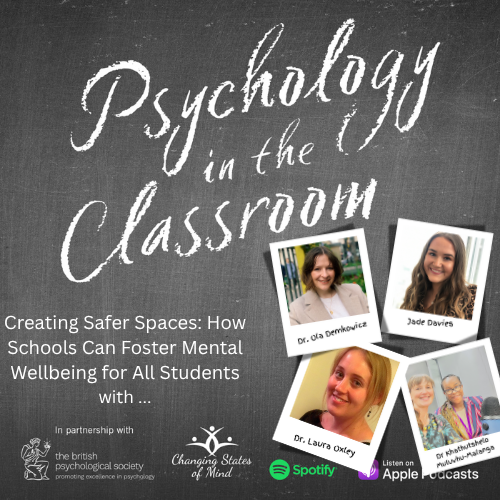
With Jade Davies, Dr Ola Demkowicz, Dr Khathustshelo Muluvhu-Malanga and Dr Laura Oxley
In this final episode from the BPS Psychology of Education Setion's conference we hear from four experts on different elements of mental health in schools. We explore how social media impacts teenagers' wellbeing, the unique mental health challenges faced by adolescent girls, effective counseling models for supporting students towards academic excellence, and the importance of teacher wellbeing. The guests share research insights and practical advice, emphasising the need for open conversations, systemic change, and collaborative support. Together, they highlight the complexities of mental health...
Why Students Want AI Feedback but Crave Human Connection in Learning
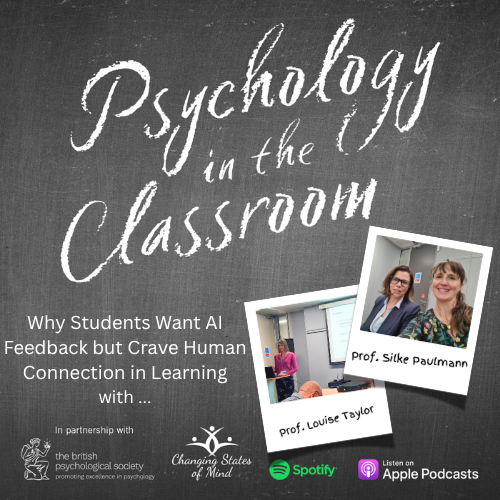
...with Professor Louise Taylor and Professor Silke Paulmann
In this episode of Psychology in the Classroom, Professor Louise Taylor discusses students' perceptions of using generative AI for assessment feedback, highlighting its benefits and the continued need for human connection in the marking and feedback process. In part two Professor Silke Pohlmann shares research on how a teacher's tone of voice shapes students' classroom experiences. Both conversations, recorded at the British Psychological Society's conference, offer practical insights for educators on integrating AI thoughtfully and using voice effectively to support student wellbeing and engagement.
Subscribe to my n...
Evaluating Mental Health in Schools: Tools, Challenges, and Collaborative Solutions for Success
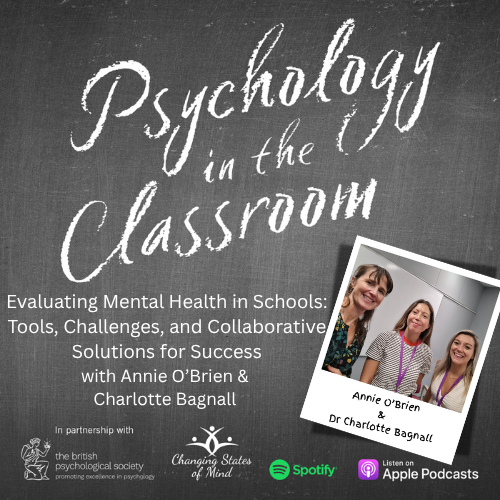
…with Dr Charlotte Bagnall and Annie O'Brien
In this episode, Charlotte and Annie discuss the complexities of mental health and wellbeing interventions in schools with me. We explored the challenges of evaluating these programs in real-world settings, the development of child-centered measurement tools, and the decision-making processes schools use when selecting interventions. Our conversation highlighted the importance of stakeholder collaboration, context-sensitive evaluation, and balancing evidence with practical realities. We agreed that while there are no easy answers, ongoing research and co-production with educators and students are essential for creating effective, sustainable mental health support in schools.
...
From words to action: how teacher language shapes student success
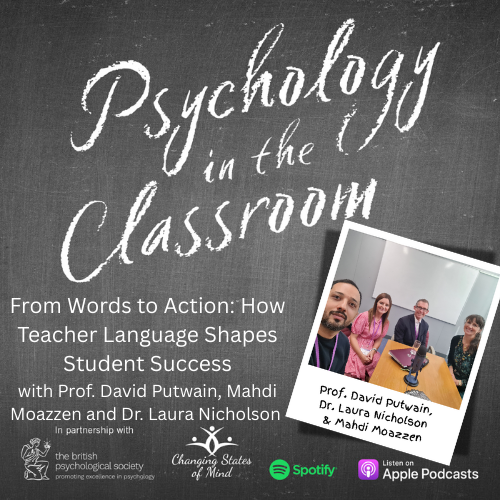
...with Prof David Putwain, Dr Laura Nicholson and Mahdi Moazzen
This episode is a lively discussion with educational researchers Prof. David Putwain, Dr. Laura Nicholson, and Mahdi Moazzen. We explored how teachers' language and message framing influence student motivation, engagement, and resilience. The conversation covered research on positive messaging in science classes, the impact of gain- versus loss-framed messages, and the role of coping strategies in academic buoyancy. We also discussed practical implications for teachers in the classroom and the potential of technology to support personal reflection and positive communication. The episode offered valuable insights into fostering...
The Benefits of Reading for Pleasure: Unlocking a World of Opportunities
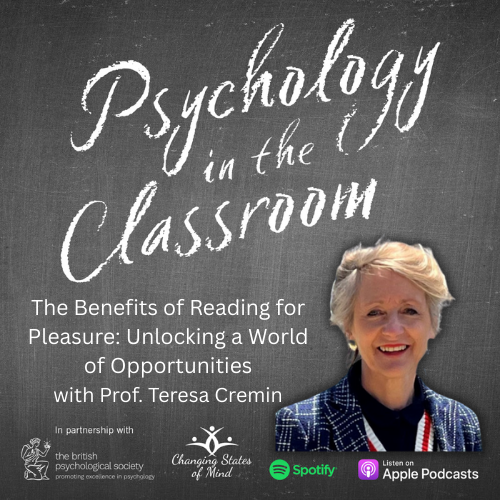
...with Prof. Teresa Cremin.
In this episode, Professor Teresa Cremin from the Open University, an expert on reading for pleasure, talks about why encouraging children to read voluntarily is so important. We explored the academic, social, and emotional benefits of reading, discussed the challenges posed by technology and changing family habits, and highlighted the crucial roles teachers, schools, and libraries play in fostering a love of reading. Teresa shared research insights and practical strategies for building positive reader identities and creating supportive, social reading environments that inspire lifelong engagement with books.
In summary:
...
Unpacking the Complexities of Bullying: From Counter Connecting to Whole-School Solutions
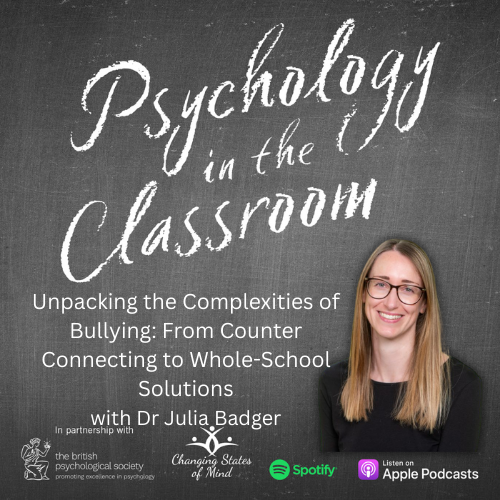
...with Dr Julia Badger
In this episode of #Psychologyintheclassroom bullying expert Dr Julia Badger, from Oxford University discusses her conference talk, "Peer Power: Understanding and Changing Bullying Dynamics in Mainstream and Specialist Special Schools." Bullying is a public health priority. As teachers we need to know about bullying involvement and its impact. In this conversation Julia explores the challenges of defining bullying, introduces the concept of "counter connecting," and highlights the unique experiences of children with SEND. She shares evidence-based strategies, including the KIVA program and its SEND adaptation, emphasizing whole-school approaches and community involvement.
De...
Beyond Social Media and Smartphones: Factors Affecting Youth Mental Health
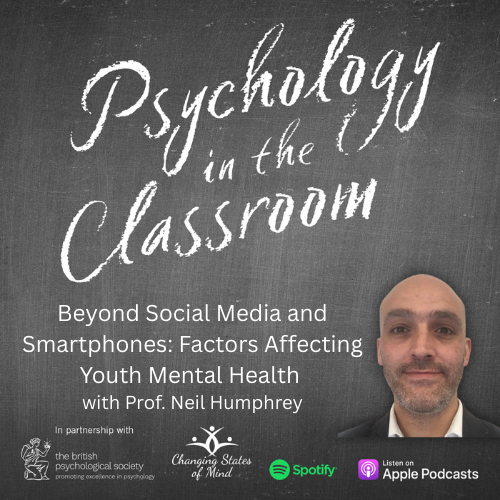
...with Prof. Neil Humphrey
In this episode Professor Neil Humphrey from the University of Manchester, discusses trends in youth mental health, the rise in internalising issues like anxiety, and the impact of societal changes such as sleep hygiene and service cuts. He critiques current research methods, advocates for evidence-based, cost-effective school interventions, and emphasizes the importance of promoting well-being through arts, physical activity, and sleep. The episode offers practical insights for teachers and highlights the need for nuanced, whole-community approaches.
Key points: Current state of child and adolescent mental health
Decline in young...
Navigating Friendships: The Hidden Struggles of School Transitions
In this episode Lucy Keller, a PhD researcher in psychology, discusses her work on improving friendship and social connectedness among young people during the critical transition from primary to secondary school. Lucy shares insights on the impact of social connectedness on mental health, In addition she touches on the unique challenges faced by neurodivergent and gender-questioning students. She advocates for inclusive school environments, student-led clubs, and systemic education reform. Lucy highlights the importance of extracurricular activities amongst other practical tips and resources for supporting students are discussed.
Useful Links:
World Health Organisation on social connection: ht...
Navigating Mental Health Issues in Schools: Strategies for Teachers and Students with Prof. Jess Deighton
In this episode, Professor Jess Deighton, a leading children's mental health expert, discusses the growing mental health challenges facing young people today and what this means for educators and schools. We dive into how student mental health impacts learning outcomes, the unique challenges teachers encounter in the classroom, and the critical importance of adopting a whole-school approach to wellbeing.
Jess offers evidence-based insights on effective mental health strategies for schools, highlighting what truly works (and what doesn't) when supporting students. We discuss the power of fostering a sense of belonging, practical ways to build student resilience, and...
Exploring the Intersection of Psychology and Education: Insights for Teachers
In this episode, Dr Andrew Holliman, Associate Professor at UCL's Institute of Education and chair of the BPS's Psychology of Education Section discusses the upcoming annual conference focused on psychological well-being in education, highlighting its inclusive, supportive atmosphere for teachers, researchers, and students. Andy shares insights on how psychology informs teaching, learning, and motivation, and emphasizes the importance of teacher and student well-being. Practical advice for engaging with psychological research and self-care is offered, along with conference details. The episode concludes with encouragement for educators to prioritize self-compassion and mental health.
To find out more about the...
Emotionally Based School Avoidance: A Personal Story
In this deeply personal episode, I'm joined by Harriet Ennis, a psychology teacher from York and this year's winner of the British Psychological Society's Pre-Tertiary Education Psychology Teacher of the Year (PEPTOTY). Harriet reached out to share her personal experience of Emotionally Based School Avoidance (EBSA), previously referred to as school refusal. Harriet brings both professional insight and a powerful parental perspective to the conversation, as she opens up about her daughter J's journey through this challenging experience.
EBSA describes children who are unable—not unwilling—to attend school due to overwhelming emotional or mental health difficulties. It's e...
Learning from Failure: The Biological Case for Embracing Mistakes
In this episode of Psychology in the Classroom, Dr. Lauren Margulieux helps explore why failure isn't just a learning opportunity—but a biologically powerful one. Drawing on neuroscience, Lauren explains how our brains react to failure, the role of neurotransmitters like epinephrine and acetylcholine, and why moderate emotional discomfort can actually prime the brain for better memory and attention.
We discuss:
How to help students frame failure positively
Why emotional regulation is key to learning
Practical strategies for secondary teachers to support learning in the face of setbacks
The im...
The Perils of Perfectionism: Understanding Its Impact on Mental Health in Education
In this episode we explores the impact of perfectionism on exam anxiety, particularly among neurodivergent individuals. Dr. Tracey Donachie, a lecturer in sports and exercise psychology, discusses the components and prevalence of perfectionism, highlighting its psychological and behavioral effects. Maciej Matejko, from the Re-Star Project, shares his perspective on perfectionism in relation to autism, while consultant Julia Gudinchet offers strategies for managing perfectionistic tendencies in individuals with ADHD and autism. The episode provides valuable insights and practical advice for educators and students to foster healthier attitudes towards achievement.
Find out more:
Dr Tracy Donachie: https...
First do no harm: Universal Mental Health Interventions in Schools

Summary
In this episode Dr. Carolina Guzman Holst is a NIHR Research Fellow at the University of Oxford, discusses her recent paper titled Scoping review: potential harm from school-based group mental health interventions.
Where the authors 'examine three areas: the types of potential harms and adverse events reported in school-based mental health interventions; the subgroups of children and adolescents at heightened risk; and the proposed explanations for these potential harms.'The conversation explores the rising mental health issues among young people in schools, focusing on universal interventions like mindfulness and CBT. Carolina Guzman discusses her...
The Process of Learning is Uncomfortable

This month Dr Katy Burgess, Senior Lecturer in Psychology at Cardiff University, talks about her research into students' learning - what they do and how effective they think this is - this is useful for us, as teachers, to understand how, what we are teaching them in school about learning and revision, is being interpreted and used by students. We discuss the best ways to revise but perhaps more importantly what we should be telling our students to get them to use more effective strategies. Plus additional thoughts on where we could slip retrieval practice when students don't even...
Peer Support for Neurodivergent pupils
The NEurodivergent peer Support Toolkit (NEST) is a set of free resources for staff in mainstream secondary schools who wish to facilitate peer support for neurodivergent young people. The toolkit was co-created by researchers at the University of Edinburgh, neurodivergent young people and a neurodiverse group of adults who work with neurodivergent young people. The project was funded by the Salvesen Mindroom Research Centre Scientific Advisory Board.
In this episode Katie Cebula and Catherine Crompton talk about how the NEST came about, what it involves and how it could support pupils in your school.
You...
RE-STAR - From Emotional Dysfunction to Emotional Burden

This is the 7th podcast from the RE-STAR team and Professor Edmund Sonuga-Barke and Dr Georgia Pavlopoulou share the findings from work package one. This episode explores how the RE-STAR team has collected qualitative data through innovative methods that really allow the voices of young people with ADHD and Autism to be heard. They also share the findings about the upsetting experiences of young people with ADHD and Autism, what these experiences are (and if you are a teacher you might be surprised) and the intensity of those emotional experiences and as well as how these differ for neurotypical...
Improving Mental Fitness in Schools with Vi Gandhi

In this week's episode Purvi (Vi) Gandhi shares her knowledge about implementing effective and evidence based strategies to improve mental health or mental fitness in schools.
Vi has recently published a book 'A little guide for teachers: Student Mental Health' with lots of ideas of how teachers can support the mental health and fitness of the young people in schools. In this interview we discuss the language we use around mental health, why mental health is so important in school and how we can support our pupils to thrive and much more.
If you would l...
Reframing Mindfulness for Teachers

On World Mental Health day 2024 Psychology in the Classroom discusses Mindfulness. We eschew the 'Crystals and Muesli' version and reframe it to ask how to be more attentive, calmer, more grounded, more aware, more responsive, less anxious. Willem Kuyken and Maggie Farrar join me to discuss, how we can make moments in our day to be mindful and how this can help us align ourselves better with our personal values.
You can find the podcasts on the Myriad Trial into Mindfulness in schools via this link: https://changingstatesofmind.com/mindfulness-miniseries
This is the link to W...
What have we learned about failure?

In this final summary interview with Prof. Dr. Suzanne Narciss, we review all our learning about failure over the last few months. There is much we can do to encourage our students to learn from errors, including interactive formative assessment and feedback strategies, prompting reflection and adaptive strategies for dealing with errors and using other people's errors. As teachers we need to help students overcome their fear of failure by creating a positive error climate and supporting students to develop a more positive error mindset. But this is an area that is challenging to research and we still have...
What do parents communicate about failure?

More than one in 10 children 'almost always' or 'often' fear failure. But where do they learn this from?
This fear can often pass from parents to children. Parental communication about failures and setbacks plays a critical role in shaping a child's perception of mistakes. In her research Dr Elizabeth Peterson found that:
Clear action plans without discussion of collaborative resources increased children's fear of making mistakes.
When mothers acknowledged their child's emotions and discussed collaborative problem-solving, there was a notable decrease in the child's fear of mistakes.
Many mothers minimally acknowledged o...
The Impact of Teacher Failure Mindsets

Today's discussion focuses on our perceptions, as teachers, of failure. When as a teacher we watch our lessons back on film where do we see failure and how do we respond? Reflecting on our own relationship with failure could be important in informing our practice in the classroom. For example our personal relationship with failure will inform how we respond to student failure and this in turn could hinder or facilitate student growth and learning. In this episode Dr Amber Simpson and Dr Alice Anderson discuss their paper 'Identifying and shifting educators' failure pedagogical mindsets through reflective practices'.
<...Teachers v Pupils: differing views of failure

How students and teachers navigate and prioritise different learning processes after encountering impasses during learning can be complex. Recognising that failure moments can be multifaceted, today's episode explores how classroom discourse reveals varied valued learning processes, such as problem-solving, preventing future issues, and developing troubleshooting skills. The research being discussed identifies five valued learning processes in debugging: resolving the immediate issue, preventing future bugs, developing skills for novel problems, engaging with authority, and calibrating self and collective efficacy. It explores the tensions between pursuing different learning outcomes and how these decisions are negotiated between teachers and students. It also...
Errors and Alienation

How errors are handled in the classroom is an important aspect of teaching and has a variety of consequences for students' own dealing with errors, their learning and their performance. In classrooms with a negative error climate, students are more likely to experience fear of making mistakes and feel alienated from their teachers. Teachers' unsupportive behaviours, such as negative reactions to errors, may increase students' alienation. Unsupportive teacher behaviours may also indirectly contribute to the development of fear of failure by influencing students' self-beliefs and motivation to do well in school. Positive and supportive student–teacher relationships have been sh...
Creating a Positive Error Learning Orientation

In order to learn from errors it is important that pupils regulate their emotions. The emotions that they feel when they make an error is underpinned by their Error Learning Orientation - whether they see errors as positive and an opportunity to learn or as a negative thing that brings shame. In this interview Rahel Schmid discusses her paper about emotions pupils feel when they make errors and how this may be linked to error learning orientation. This episode includes lots of great tips to help teachers develop a positive error learning orientation in their pupils.
Schmid...