Aswath Damodaran

I teach corporate finance, valuation and investment philosophies at the Stern School of Business at New York University. I have online versions of all three courses here, as well as other finance-related videos. 1. The Corporate Finance Online playlist has an introductory video and 36 sessions that cover all of corporate finance (at least as I see it). 2. The Valuation playlist has 25 sessions that cover valuation approaches, issues and questions.3. The Investment Philosophies playlist has sessions that cover different investment philosophies.4. The Accounting and Statistics playlists reflect my quirky and unorthodox introductions to two disciplines that are critical to my valuation and...
Session 15: More excursions on the dark side of valuation

In this session, we continued on the dark side of valuation with a look at mature companies on the verge of transitions, and how you have to value the status quo company and the restructured one to make a judgment on investing in it. We then moved on and looked at declining companies, where your forecasts may have to show declining revenues and margins, and added a twist with distressed companies, where you have to follow up your DCF. In the second half of the class we examined the issues (country risk, cross holdings and currency gyrations) that are...
Data 2017 Update 1: The Promise and Perils of Data

Learn more about your ad choices. Visit megaphone.fm/adchoices
Session 17: More excursions on the Dark Side of Valuation

In today’s session, we continued on the dark side of valuation with a look at mature companies on the verge of transitions, and how you have to value the status quo company and the restructured one to make a judgment on investing in it. We then moved on and looked at declining companies, where your forecasts may have to show declining revenues and margins, and added a twist with distressed companies, where you have to follow up your DCF. In the second half of the class we examined the issues (country risk, cross holdings and currency gyrations) that ar...
Session 15: The Tesla Bot Case and Side Benefits/Costs in Projects

The bulk of this session was spent discussing the Tesla Bot case (see below for the case) and the broader implications for investment and valuation. In the last 30 minutes of class, we turned our attention to the side costs and side benefits in projects, including opportunity costs and synergies and how to incorporate them into decisions. (I am sorry, but I screwed up on sharing the slides for this section for the first 15 minutes or so, but the link to the slides is below as well).
Tesla Bot Case: https://pages.stern.nyu.edu/~adamodar/pdfiles/cfexams/TeslaBots...
Active Investing: Rest in Peace or Resurgent Force?

When Jack Bogle started the Vanguard 500 Index fund in 1975, I am sure that he never visualized how successful he would be. In the last few decades, passive investing has widened its offerings (to include ETFs and other markets) and has taken away market share from active investing, but the pace of disruption seems to have quickened in the last decade. The best advertising for passive investing is the performance of active investors, who seem to lag their passive counterparts, across time, style classes and geographies. I argue that active investing is destined to shrink as a business and that...
Session 16: Closure on Investment Analysis

In this quiz shortened session, after the quiz, we looked at the final pieces on investment analysis, starting with side benefits from projects (from small pluses to synergy in acquisitions). We also looked at optionality in projects, i.e., times when you can legitimately override conventional investment metrics to take a project, because you may have the option to delay, expand or abandon the project. We then looked back at the process of analyzing projects in place, either for accountability (review forecasts versus actuals) and for decision making (continue, abandon or expand the project).
Slides: https://pages.stern...
Session 16: Tying up Intrinsic Value

In this session, after the second quiz, we wrapped up our discussion of intrinsic valuation. For decades, we have valued banks using the dividend discount model, simply because getting cash flows is so difficult, but that approach is built on trusting management at banks to behave sensibly (paying out what they can afford to in dividends) and regulators to do the same. For me, that trust was breached in 2008, and I present a way of estimating FCFE for a bank, using investment in regulatory capital as my stand in for reinvestment. Next session, we will wrap up the valuation...
Session 18: Tying up Intrinsic Value

In this session, after the second quiz, we wrapped up our discussion of intrinsic valuation. For decades, we have valued banks using the dividend discount model, simply because getting cash flows is so difficult, but that approach is built on trusting management at banks to behave sensibly (paying out what they can afford to in dividends) and regulators to do the same. For me, that trust was breached in 2008, and I present a way of estimating FCFE for a bank, using investment in regulatory capital as my stand in for reinvestment. Next session, we will wrap up the valuation...
Session 23: The Options to Expand and Abandon, Financial Flexibility and Distressed Equity

We started this class by looking at the option to expand, where your capacity to enter or expand into new (big) markets can justify up-front bad investments and then at the option to abandon poorly performing investments. We then valued financial flexibility as an option, and argued that it was worth more to capital-constrained companies with unpredictable and high-value-added investments. We continued with our examination of equity in trouble, debt-laden companies. Given that the equity in these companies takes on the characteristics of an option, we teased out three implications:
The equity in these companies will be valued...
Session 17: The Financing Mix Trade off

In this class, we started our discussion of the financing question by drawing the line between debt and equity: fixed versus residual claims, no control versus control, and then used a life cycle view of a company to talk about how much it should borrow. We then started on the discussion of debt versus equity by looking at the pluses of debt (tax benefits, added discipline) and its minuses (expected bankruptcy costs, agency cost and loss of financial flexibility). Even with the general discussion, we were able to look at why firms in some countries borrow more than others...
Session 22: The Option to Delay

In this shortened session after the webcast, we looked at the option to delay and applied it to valuing patents and undeveloped natural resource reserves.
Slides: http://www.stern.nyu.edu/~adamodar/podcasts/valfall16/valsession22.pdf
Post class test: http://www.stern.nyu.edu/~adamodar/pdfiles/eqnotes/postclass/session22Atest.pdf
Post class test solution: http://www.stern.nyu.edu/~adamodar/pdfiles/eqnotes/postclass/session22Asoln.pdf
Learn more about your ad choices. Visit megaphone.fm/adchoices
Session 19: First Steps on Pricing

We started the class by setting the stage of pricing companies, contrasting the pricing process with the value process. The rest of the class was our first foray into pricing, with why pricing is so much more common than intrinsic value and how multiples are just standardized prices. We also started on the first steps in deconstructing pricing, with the definitional and descriptional tests.
Start of the class test: https://pages.stern.nyu.edu/~adamodar/pdfiles/eqnotes/relval1test.pdf
Slides: https://pages.stern.nyu.edu/~adamodar/podcasts/valUGspr23/session19slides.pdf
Post class test: https...
Terminal Value Myth 5: The Terminal value ate my DCF!
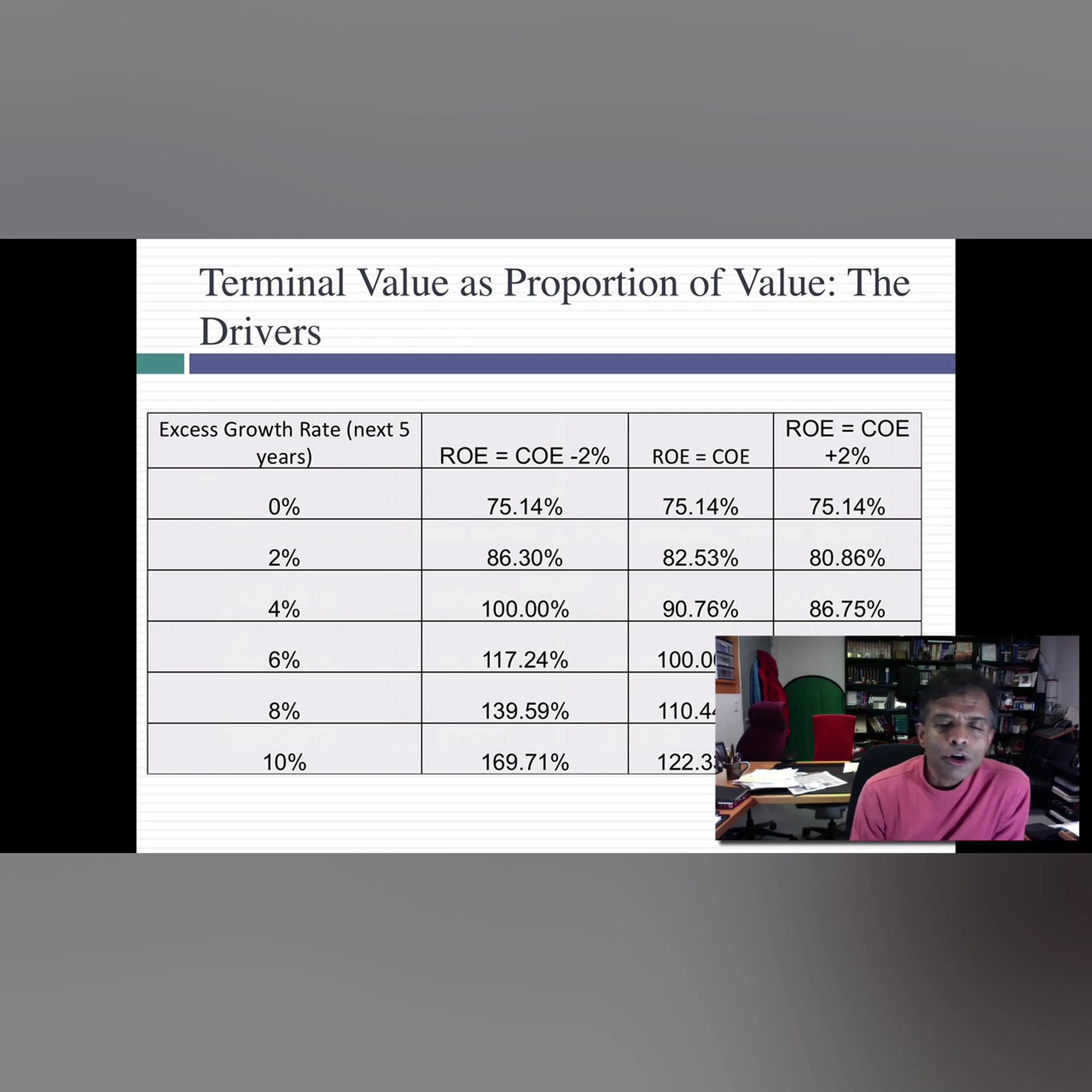
In a DCF of a business, the terminal value will account for a large proportion of value and this is viewed by some as a flaw in DCF and by others as a license to not worry about assumptions made during growth periods. Both presumptions are wrong. A DCF is a mirror of how you make money investing in stock, with the terminal value playing the role of capital gains (price appreciation). Also, the terminal value, though a high proportion of value, is heavily affected by your growth assumptions (about level & efficiency).
Slides: http://www.stern.nyu.edu/~...
Terminal Value Myth 4: Negative Growth Rates are impossible

In this session, I confront the myth that you cannot do a DCF with negative growth rates and that the perpetual growth model will not work if you have negative growth. In fact, negative growth is more common among companies than we think and we need to use negative growth in our projections more frequently.
Slides: http://www.stern.nyu.edu/~adamodar/pdfiles/blog/TermValyeMyth14.pdf
Blog Post: http://aswathdamodaran.blogspot.com/2016/11/myth-54-negative-growth-rates-forever.html
Learn more about your ad choices. Visit megaphone.fm/adchoices
Session 18: Optimizing Financing Mix

We started this class by completing the debt trade off, by bringing in agency costs and financial flexibility, and looking at a financing hierarchy, starting with retained earnings as the most preferred and convertible preferred as the least preferred financing for firms. We looked at the Miller Modigliani theorem through the prism of the debt tradeoff and followed up by using the financing hierarchy that companies seem to move down, when they think about raising fresh financing. I then moved on to looking at how the cost of capital can be used to optimize the right mix of debt...
Terminal Value Myth 3: Growth is good, more growth is better!
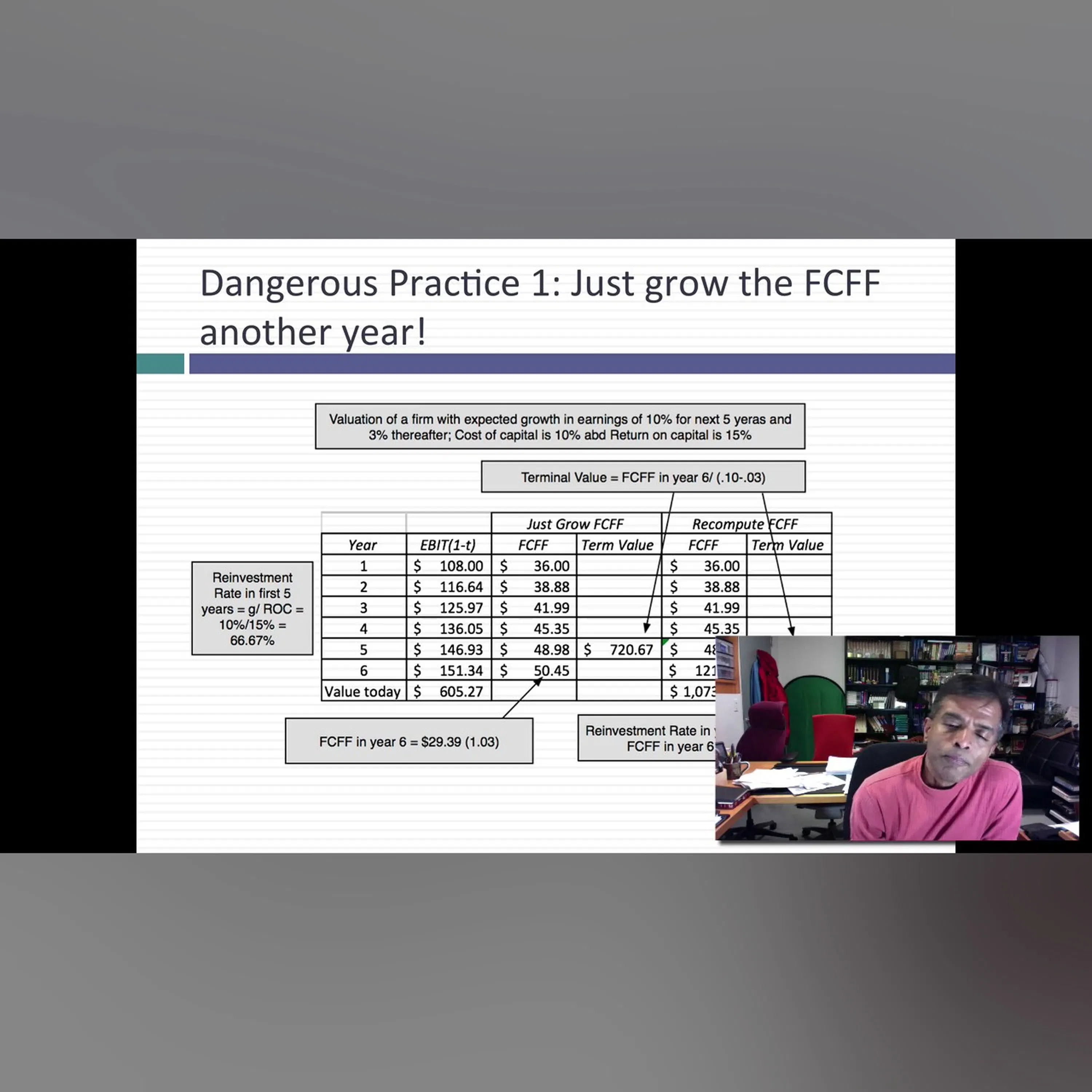
In the perpetual growth model, increasing growth while holding all else constant will always increase value. That is the problem. If you follow consistency requirements, increasing growth will affect your cash flows and the effect of growth becomes ambiguous. It can increase, decrease or do nothing to value.
Slides: http://www.stern.nyu.edu/~adamodar/pdfiles/blog/TermValyeMyth3.pdf
Blog Post: http://aswathdamodaran.blogspot.com/2016/11/myth-53-growth-is-good-more-growth-is.html
Learn more about your ad choices. Visit megaphone.fm/adchoices
Session 18: Deconstructing Multiples

In this session, we continued with our discussion of pricing, starting with the analytics that drive PEG, PBV, EV/EBITDA and revenue multiples. During the session, I played the role of a naive equity research analyst, using sloppy pricing to push buy recommendations on stocks in a number of sectors, based purely on the level of multiples (low PE, low PBV etc.) and asking for pushback. I The bottom line, though, is that most companies that look cheap deserve to be cheap. The key to pricing is finding a mismatch between the pricing and the fundamentals (low PE & high...
Terminal Value Myth 2: As g approaches r, it is to Infinity and beyond!

Many analysts when they first see the perpetual growth model feel the call of Buzz Lightyear, since moving the growth rate towards the discount rate will make your terminal value explode before it implodes. In this session, I look at the constraints on growth in the terminal value equation and explain why I use the risk free rate as my cap on the growth rate.
Slides: http://www.stern.nyu.edu/~adamodar/pdfiles/blog/TermValyeMyth2.pdf
Blog Post: http://aswathdamodaran.blogspot.com/2016/11/myth-52-as-g-rto-infinity-and-beyond.html
Learn more about your ad choices. Visit megaphone...
Session 20: Analyzing Multiples

In this session, we continued with our discussion of pricing, starting with the analytics that drive PEG, PBV, EV/EBITDA and revenue multiples. During the session, I played the role of a naive equity research analyst, using sloppy pricing to push buy recommendations on stocks in a number of sectors, based purely on the level of multiples (low PE, low PBV etc.) and asking for pushback. I The bottom line, though, is that most companies that look cheap deserve to be cheap. The key to pricing is finding a mismatch between the pricing and the fundamentals (low PE & high...
Terminal Value Myth 1: Don't believe in forever? You can't do DCF!

In classrooms and textbooks, you are taught that there is only one way to estimate a terminal value and that is to assume cash flows grow at a constant rate forever. That is one way but it is not the only one. In this session, I look at two acceptable alternatives and one that should not (but unfortunately is).
Slides: http://www.stern.nyu.edu/~adamodar/pdfiles/blog/TermValyeMyth1.pdf
Blog Post: http://aswathdamodaran.blogspot.com/2016/11/myth-51-if-you-don-believe-in-forever.html
Learn more about your ad choices. Visit megaphone.fm/adchoices
Session 19: Optimal Financing Mix - Determinants and Drivers

In this class, we started by tying up loose ends on the cost of capital approach, starting with why moving to the optimal changes the value of a business (hint: it is all in the tax code) and then looking at how sensitive the optimal debt ratio is to changes in operating income or rating constraints. We also looked at enhancements to the approach, where we incorporated indirect bankruptcy costs in the analysis. Finally, we examined the determinants of the optimal. In particular, it was differences in tax rates, cash flows (as a percent of value) and risk that...
Session 21: IPO and VC Valuation and First Steps on Real Options

In today's class, we put the finishing touches on private company valuation by looking at key questions that arise in private company valuation (illiquidity, key person etc.) and then looked at valuing IPOs. In particular, the question of what happens to the proceeds from an offering can affect value per share, and the offering price itself is subject to the dynamics of the issuance process, with investment bankers more likely to under price than over price offerings. In the second part of the class, I did a quick introduction to real options, setting up the intuitive rationale for real...
Session 19: Pricing Closure

In this class, we closed the book on relative valuation by looking at how to price young companies, using forward multiples, and how to pick the "right" multiple for a valuation, with the answers ranging from cynically picking one that best fits your agenda to picking one that reflects what managers in that business care about. It is amazing how widespread relative valuation is. I found this link recently on rules of thumb in valuation. Take a look at it.... especially the multiples mentionedmultiples, and how to pick the "right" multiple for a valuation, with the answers ranging from...
Faith, Fear and Feedback: Ready for the Valeant Test?

In May 2016, I bought Valeant at $27, contending that it was worth $44. The stock dropped to $15 on November 9, 2016, leading me to a decision of whether to abandon the stock, hold on or add to my position. In this webcast, I reason my way to an answer and I will let you decide how much I am letting hope override common sense.
Slides: http://www.stern.nyu.edu/~adamodar/pdfiles/blog/ValeantNov16.pdf
Blog Post: http://aswathdamodaran.blogspot.com/2016/11/faith-feedback-and-fear-returning-to.html
Learn more about your ad choices. Visit megaphone.fm/adchoices
Session 21: Closure on Pricing

In today's class, we closed the book on relative valuation by looking at how to price young companies, using forward multiples, and how to pick the "right" multiple for a valuation, with the answers ranging from cynically picking one that best fits your agenda to picking one that reflects what managers in that business care about. It is amazing how widespread relative valuation is. I found this link recently on rules of thumb in valuation. Take a look at it.... especially the multiples mentionedmultiples, and how to pick the "right" multiple for a valuation, with the answers ranging from...
Session 20: Following up on optimizing debt mix

We started this class with the adjusted present value approach, where we begin with the unlevered firm value, and then add the tax benefits of debt and net out expected bankruptcy costs. We then looked at peer group analysis, where companies decide how much to borrow by looking at what other companies in the sector do. You can check out the debt ratios for other companies in your sector by going to my website:
US industry averages: http://www.stern.nyu.edu/~adamodar/pc/datasets/dbtfund.xls
Global industry averages: http://www.stern.nyu.edu/~adamodar/pc...
All in the family: The Ups and Downs of Family Group Companies

In October 2016, the board of directors of Tata Sons, the controlling entity for India's best known and perhaps most highly regarded family group, fired Cyrus Mistry, its chairman, in a shocking break from Tata group decorum. In this webcast, I look at that incident through the lens of family group companies, evaluating the trade off that has allowed them to prosper in Asia and Latin America, and why globalization and more open capital markets may threaten their prosperity.
Slides: http://www.stern.nyu.edu/~adamodar/pdfiles/blog/TataGroup.pdf
Blog Post: http://aswathdamodaran.blogspot.com/2016/11/the-4c-tradeoff-promise-and-peril-of...
Session 20: Asset-based valuation and Intro to Private Company Valuation

In this session, we looked at asset based valuation: liquidation valuation, accounting valuation and sum of the parts valuation. Specifically, we focused on when it makes sense to value a company by valuing its assets and what pitfalls to avoid. If you are interested in a more extensive assessment of companies like United Technologies, you may find this reading useful:
https://papers.ssrn.com/sol3/papers.cfm?abstract_id=1609795
We then started our discussion of the valuation of private companies by noting how the lack of a market price for a business can affect your valuation in...
Session 19: Closing the books on Pricing and Asset-based valuation

In this class, we closed the book on relative valuation by looking at how to pick the "right" multiple for a valuation, with the answers ranging from cynically picking one that best fits your agenda to picking one that reflects what managers in that business care about. It is amazing how widespread relative valuation is. I found this link recently on rules of thumb in valuation. Take a look at it.... especially the multiples mentioned
http://www.bizstats.com/reports/valuation-rule-thumb.php
And the site below has valuation spreadsheets as well as a valuation blog.
http...
Session 22: Sum of the parts Valuation and first steps on Valuing Privately owned businesses

In this session, we looked at asset based valuation: liquidation valuation, accounting valuation and sum of the parts valuation. Specifically, we focused on when it makes sense to value a company by valuing its assets and what pitfalls to avoid. If you are interested in a more extensive assessment of companies like United Technologies, you may find this reading useful:
https://papers.ssrn.com/sol3/papers.cfm?abstract_id=1609795
We then started our discussion of the valuation of private companies by noting how the lack of a market price for a business can affect your valuation in...
Session 18: Relative Valuation - Analysis and Application

In this session, we extended the discussion of the analysis of multiples by looking at PEG ratios, EV multiples and book value multiples. Each multiple, we argued, has a driver and companion variable.We then moved on to application and how best to find comparable firms and control for differences.
Start of the class test: http://www.stern.nyu.edu/~adamodar/pdfiles/eqnotes/tests/relva;2atest.pdf
Slides: http://www.stern.nyu.edu/~adamodar/podcasts/valfall16/valsession18.pdf
Post class test: http://www.stern.nyu.edu/~adamodar/pdfiles/eqnotes/postclass/session18Atest.pdf
Post class...
Session 21: Debt Design (Continued)

In this class, we looked at the design principles for debt. We started by completing a five step process for designing the perfect debt before looking at both intuitive and quantitative ways of debt design. In particular, we looked at a macro economic regression of firm value/operating income against interest rates, GDP, inflation and exchange rates. Keeping in mind the objective of matching debt to assets, think about the typical investments that your firm makes and try to design the right debt for the project. If your firm has multiple businesses, design the right kind of debt for...
The Election Surprise: The Trump Election's Market Effect

On November 8, 2016, US voters delivered a surprise to pollsters, experts and markets by electing Donald Trump to be the 45th president of the United States. In this session, I focus on the investment and financial implications of a Donald Trump presidency and the lessons that we can learn from the US election.
Slides: http://www.stern.nyu.edu/~adamodar/pdfiles/blog/TrumpElection.pdf
Blog Post: http://aswathdamodaran.blogspot.com/2016/11/the-trump-effect-on-markets-financial.html
Learn more about your ad choices. Visit megaphone.fm/adchoices
Session 21: Valuing Private Companies

In this session, we started by looking at the challenges of valuing private-to-private transactions, where the buyer of a private business is undiversified and cares deeply about illiquidity, and how the values are depressed as a consequence. We then drew a contrast to the same company being valued by a public company, and argued that this should lead to private businesses increasingly become parts of public companies or going public themselves. In the final section of the class, we looked at valuing/pricing IPOs, and how to deal with offer proceeds from the IPO and the IPO process itself. <...
Session 17: Analyzing Multiples -- Part 1

In this shortened session after the quiz in the first 30 minutes (edited out),, we continued with our discussion of multiples by looking at an analytical device that can be used to find the drivers of multiples. With equity multiples, you go back to a simple equity DCF model (a DDM or FCFE stable growth model) and with some algebra make the equation an intrinsic one for a multiple. With enterprise value multiples, you go back to a firm valuation models and do the algebra. We even expanded the model to consider high growth companies and saw how changing the...
Session 16: Value and Price - Discerning the Difference

In this class, we started by looking at why the value and pricing processes can diverge and the difference between investing and trading. Value is driven by cash flows, growth and risk and price is driven by momentum, liquidity and herd behavior. A trader makes money playing the pricing game (buy low and sell high) and an investor from playing the value game (buy something when its price is less than your assessed value and then wait for the gap to close). Each side has its own weaknesses, but it is important that you decide which game you are...
Session 22: Dividends, Taxes and Trade offs

We spent this session first talking about the shift towards buybacks in recent decades, and how that shift can be explained by the increased desire for flexibility among companies that face more uncertainty about future earnings. We then moved on to two measures of dividend policy - dividend payout and yield, before looking at three schools of thought on dividends that cover the spectrum (dividends don’t matter, dividends are bad, dividends are good)., We ended the class by looking at two bad reasons for paying dividends (that they are more certain, that you had a good year). As yo...
Discount Rate Myth 5: As rates approach zero, value goes to infinity!

In this session, the last of five on discount rate myths, I look at how low interest rates have skewed both actual valuations and how we think about DCF. Specifically, holding all else constant and lowering the risk free rate will cause valuations to implode but you cannot hold all else constant. As risk free rates change, so do nominal growth rates, risk premiums and even debt ratios, making the effect on value much more unpredictable.
Slides: http://www.stern.nyu.edu/~adamodar/pdfiles/blog/DiscountRateMyth5.pdf
Blog Post: http://aswathdamodaran.blogspot.com/2016/11/myth-45-dcfs-break-down-with-near-zero.html
Session 22: Real Options - Fact and Fiction

We started this class by looking at the basic option pricing models. After that, we moved on with an examination of option pricing models, and used real options to examine why the rights to non-viable technology can be valuable and why the values of natural resource companies are affected by both the level and variability of commodity prices . As a cautionary note, you are pushing option pricing models to breaking point when using them to value these options, but the key takeaway is that even if you do not value the options explicitly, understanding that they exist can alter...
Discount Rate Myth 4: The Discount Rate is the receptacle for all your hopes and fears

In this session, the fourth of five on the discount rate myths, I look at how analysts and appraisers use the discount rate as a receptacle for all their hopes and fears. Specifically, they try to lower (raise) discount rates for well managed (badly managed) companies and to raise discount rates to capture any risks that they see on the horizon. The discount rate in a DCF is a blunt instrument and is designed more for carrying continuous, going-concern risk than discrete and estimation risks.
Slides: http://www.stern.nyu.edu/~adamodar/pdfiles/blog/DiscountRateMyth4.pdf
Blog...