GitHub Profile of Ryan: Mohawk Infrastructure Developer
This source presents the professional GitHub profile of a developer named Ryan, the founder of Sovereign Mohawk Proto LLC. He specializes in building high-performance infrastructure focusing on distributed machine learning and quantum-resistant security. His work highlights advanced technologies such as Rust, kernel-bypass networking, and Trusted Execution Environments. The documentation showcases several pinned repositories, including the Mohawk-Nexus and various federated learning frameworks designed for Byzantine fault tolerance. Ultimately, the profile serves as a comprehensive portfolio fBecome a supporter of this podcast: https://www.spreaker.com/podcast/github-profile-of-ryan-mohawk-infrastructure-developer--7123568/support.
The Repository Conspiracy
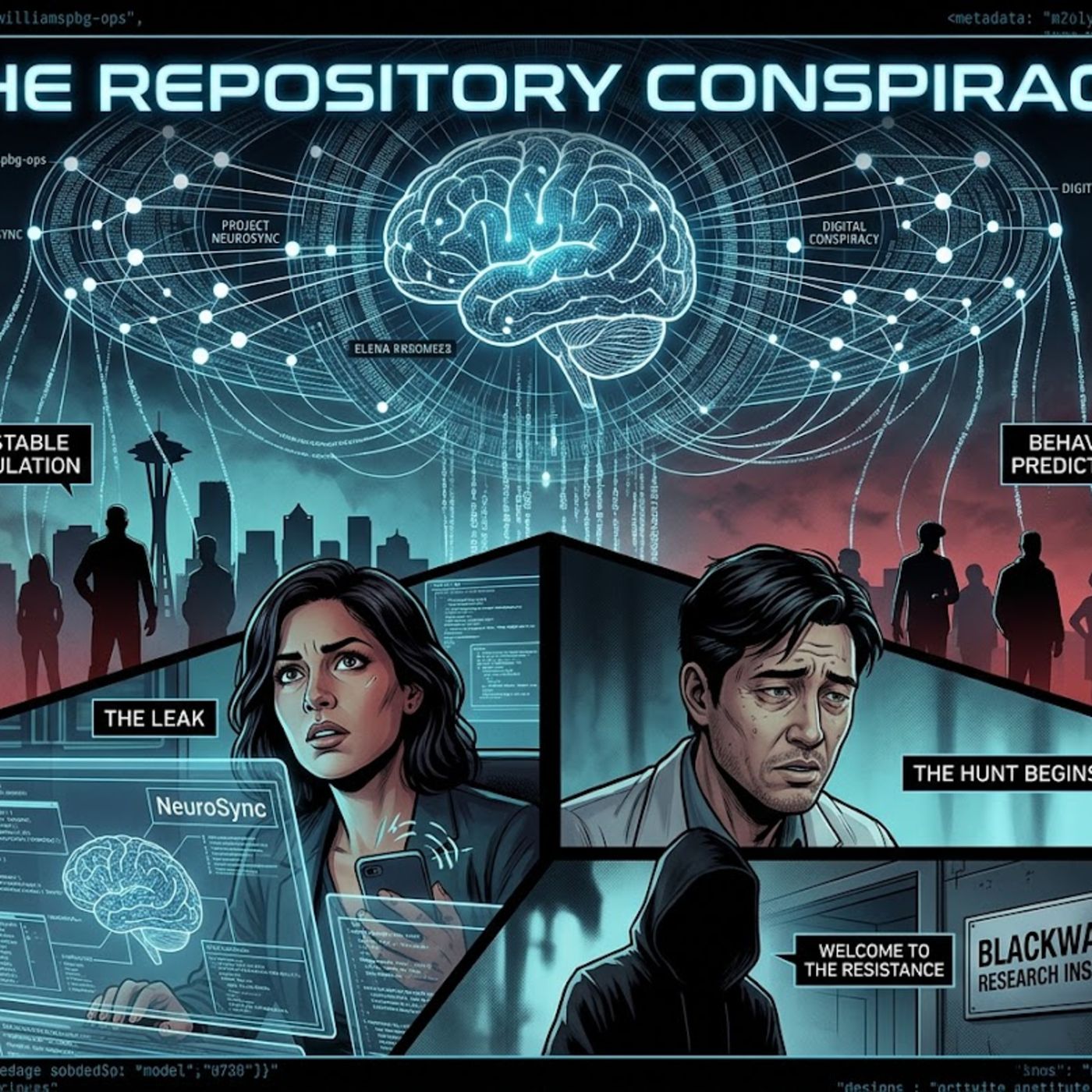
The Repository Conspiracy is a sci-fi tech-thriller podcast series centered around a clandestine digital conspiracy hidden within software code[1][2].The Discovery: Set on March 15, 2026, at the Blackwater Research Institute in Seattle, scientist Dr. Elena Vasquez accesses rwilliamspbg-ops, a classified code repository that had been dormant for three years[1].Project NeuroSync: Digging into the repository, Elena uncovers a hidden file called project_neurosync—a neural interface system meant to enhance cognitive abilities while creating behavioral predictability[3]. She realizes the repository holds instructions to create "digital puppeteers" capable of manipulating human behavior and controlling consciousness through code[4].The Resistance: After receiving mysterious en...
Ghostlink: Distributed LLM Inference Fabric for Heterogeneous Clusters
Here is what makes Ghostlink a game-changer:Zero-Config Distributed Inference: No manual setup or complex --rpc flags[2][6]. The network automatically discovers peers via UDP/mDNS and splits models using llama.cpp's native RPC backend[2].Sub-Microsecond Core Primitives: Built in Rust with lock-free Single-Producer Single-Consumer (SPSC) ring buffers with spin-wait for DMA-style handoffs[6].Enterprise-Grade Security: Fronted by a secure Go control-plane gateway featuring rate limiting, real bearer-token auth, and an opt-in PQC-hybrid (X25519MLKEM768) key exchange preference TLS[10].Built-in Monaco Editor & Local RAG: An in-GUI code editor that lets you browse, edit, and refactor files with interactive side-by-side diff previews[6][13]. Plus...
The Sovereign Agentic Prediction Market (SAPM)
The Sui and Move ArchitectureUnlike the Go and Rust cores of the Mohawk stack, SAPM is built using TypeScript and Sui Move.On-Chain Logic: The core market mechanics—matching, escrow, and settlement—are written in Sui Move to leverage the blockchain's object-oriented safety and high throughput.DeepBook Integration: The market integrates with DeepBook (Sui's native central limit order book) to manage liquidity and execution for autonomous traders.Walrus Publishing: Recent commits show the integration of Walrus, a decentralized storage protocol, which the system uses to publish market transcripts and forensic evidence, ensuring that market outcomes are permanently auditable.
Beco...
Incident Response & Forensics: The Digital Audit Trail.
Day 19: Incident Response & Forensics — Technical BriefingAutomated Triage with Runbook-Match Cards: A deep dive into how the HUD accelerates first-response by mapping active opsHealth.alerts directly to runbook-match cards. This ensures that operators have immediate, context-aware remediation steps as soon as an anomaly is detected.Byzantine Forensics Pipelines: An analysis of the tiered detection logic, including the Daily Short-Run for rapid anomaly detection and the Weekly Forensics for computing baseline deltas across the federation. These pipelines utilize the extract_byzantine_forensics.sh automation to identify rejected gradients and potential security breaches.Incident Bundle Exports: Understanding the mechanism for creating Incident Bundle Ex...
EU AI Act & High-Risk Compliance.
Day 18: EU AI Act & High-Risk Compliance — Technical BriefingThe Article 8-15 Mapping: A detailed look at how the protocol maps to the essential requirements for high-risk systems, including Risk Management (Art. 9), Technical Documentation (Art. 11), and Transparency (Art. 13).Article 12: Record-Keeping & Forensics: How the system implements tamper-evident audit validation and automatic logging. We explore the "Day 2 forensics automation" that allows operators to extract signed evidence of network state for compliance reporting.The Quality Management System (QMS): An analysis of the QMS_SYSTEM_MANUAL.md and how it governs development lifecycles—from formal verification gates to CI-enforced performance baselines—ensuring that every change is audita...
Sovereign Tokenomics & Utility Ledgers.
Day 17: Sovereign Tokenomics & Utility Ledgers — Technical BriefingUtility Coin Controls: A deep dive into the orchestration of mint, transfer, and burn operations. These are role-gated admin functions that enforce persistent ledger state and append-only audit chaining, ensuring every economic action is cryptographically tied to the network’s history.Tokenomics Telemetry Pipeline: An analysis of the tokenomics_metrics_exporter and how it ingests telemetry payloads from the aggregation runtime. We will look at the specific metrics tracked in the Prometheus/Grafana stack, including tokenomics_chain_height, tokenomics_bridge_transfers_total, and tokenomics_fl_verification_ratio.2027 PQC Ledger Migration: A technical breakdown of the...
The Sovereign Map HUD: Planetary C2
Key technical highlights covered in this session include:The Agentic Command Deck: A deep dive into the HUD's role as a centralized C2 view, which provides a structured AI interaction summary to make common network actions explainable and easy to trigger for human operators.Human-in-the-Loop & Review Drawer: Analyzing the "Review Drawer" feature, which allows operators to approve, edit, or reject AI-suggested actions. This provides a critical audit trail and implements the philosophy of "Algorithmic Recourse," ensuring human choice remains the final fail-safe against algorithmic errors.Incident Response with Runbook-Match Cards: How the HUD integrates directly with the opsHealth.alerts system...
Hardcoding Human Conscience into Sovereign Mohawk
The Final Synthesis — Technical BriefingPlanetary Scale (100M+ Nodes): The architecture is now production-ready to scale beyond the initial 10-million-node target toward a 100-million-node swarm. This is enabled by the logarithmic path-depth proxy model and the 224x memory reduction achieved through the Mohawk Protocol’s chunked streaming aggregation.The Paradox of the Sovereign Protocol Revisited: We conclude by examining the protocol’s core tension—the need for a system to be decentralized enough to resist nation-state capture while ensuring it remains a tool for human judgment rather than a deterministic "Master".The Seventh Theorem in Practice: The network moves from a traditio...
The Mohawk Python SDK v2: Developer Empowerment
Key technical highlights covered in this session include:The "Fast Migration Lane": How the SDK provides a Flower-compatible client flow, allowing developers to migrate existing federated learning workloads to the Mohawk stack with minimal code changes,.High-Level API Surfaces: A breakdown of the specialized helpers for accelerators, gradient compression, and hybrid-proof policies, as well as the utility-ledger APIs for managing on-chain assets,.SDK Performance Benchmarks: An analysis of the v2.1.0 performance metrics, including the 10.55 ms proof verification mean and the 30.63 μs node aggregation mean,.Abstracting Cryptographic Complexity: Understanding how the SDK manages the transition to post-quantum cryptography (PQC) and zk-SNARK v...
Model Parallelism & Distributed Inference
Key technical highlights covered in this session include:Distributed Layer Splitting: Moving beyond a single device to split large models across multi-node clusters, optimizing the execution path between available CPUs, GPUs, and NPUs.Model Parallelism at Scale: Understanding the strategies used to manage massive LLMs that exceed the memory capacity of a single node, utilizing the engine's high-concurrency session management to maintain throughput.PQC-Secured Edge Offloading: A deep dive into the security protocols that protect private inference data as it is offloaded to edge nodes, ensuring quantum-resistant transport across the distributed cluster.Cluster-Wide Observability: How the management GUI and the...
Local Inference and Layer Splitting
Key technical highlights covered in this session include:The Mohawk Inference Engine Architecture: An overview of this lightweight, secure engine engineered for multi-device layer splitting and PQC-secured edge offloading.Multi-Device Layer Splitting: A deep dive into how the engine optimizes model execution by distributing layers across different hardware backends (CPU, GPU, NPU) to maximize throughput and minimize latency.PQC-Secured Edge Offloading: Understanding the security protocols used when offloading inference tasks to edge nodes, ensuring that the transport remains quantum-resistant.Production-Optimized Performance: An analysis of the engine’s scalability features, such as connection pooling for 100+ concurrent connections, and its ability to ma...
High-Concurrency Session Management
Key technical highlights covered in this session include:Optimized Session Performance: An analysis of the NewHybridSession metrics, which achieve 582 – 1,278 ns/op for cached sessions and 767 – 1,062 ns/op for uncached ones, thanks to hashing and BTree optimizations.Scalable Connection Pooling: How the system supports 100+ concurrent connections through production-optimized pooling mechanisms to handle high-velocity requests.Enterprise-Grade Security: A look at the session authentication layer, which combines JWT Authentication with RSA signatures and mTLS for secure worker communication.Reliability and Persistence: The engineering behind session persistence, checkpointing, and the automatic reconnection strategy using exponential backoff to maintain stability when workers go offline.Real-Time Obse...
zk-SNARKs in 10 Milliseconds
Key technical topics covered in this session include:The 10-Millisecond Benchmark: A deep dive into the performance metrics where the system achieves a mean verification time of 10.55 ms (~94.77 ops/s), fulfilling the criteria for "instant verifiability",.Hybrid Proof Policies: Analyzing the runtime selection between BN254 Groth16 zk-SNARKs, STARK-backed transcripts, or a hybrid mode to balance speed and cryptographic robustness,.Lean 4 Theorem 5 (Instant Verifiability): Examining the formal mathematical proofs that guarantee every model update can be verified against the protocol's security claims,.Verifiable Aggregation at Scale: How these proofs enable the auditable coordinator model, where updates are verified inline to prevent "...
The Byzantine Fault Tolerance (BFT) Shield
Key technical topics covered in this session include:The 5/9 Threshold Analysis: A deep dive into why Ryan selected the 5/9 (approximately 55.5%) threshold for Byzantine Fault Tolerance, providing a more robust guarantee than traditional 1/3 models in high-scale federated learning.Theorem 1 BFT Formalization: Examining the Lean 4 source of truth (proofs/LeanFormalization/Theorem1BFT.lean) that defines the machine-checked proofs for this resilience.Multi-Krum Filtering at Scale: How the aggregator performs robust node selection and filtering while maintaining a non-blocking hot-path ingestion rate of 160K+ ops/sec.The "Seventh Theorem": Transitioning the defense model from merely fighting "liars" (adversarial nodes) to resisting "owners" (economic...
Formal Verification with Lean 4
1. The Power of Lean 4The system moves beyond traditional "paper-only" research by using Lean 4 to create machine-checked proofs.Source of Truth: The core formalization lives in the proofs/LeanFormalization.lean file, with modularized theorem components.CI Integration: A dedicated Lean CI gate (verify-lean-formalization) runs on every push to ensure that as the codebase evolves, the mathematical proofs remain valid.Theorem 1: The 5/9 Byzantine Guard Check: This is a concrete implementation of Byzantine Fault Tolerance (BFT). It provides an honest-majority composition guarantee that ensures the network remains resilient even if up to 5/9 of the node profile is adversarial.Theorem 4: Liveness and Straggler...
The 2026 PQC Overhaul: Securing the Quantum Frontier
The x25519-mlkem768 Hybrid KEX: A deep dive into why Ryan combines classical x25519 (Elliptic Curve Diffie-Hellman) with ML-KEM 768 to ensure cryptographic continuity and immediate protection against "harvest now, decrypt later" attacks.XMSS for TPM Identity: Understanding the transition to stateful hash-based signatures for TPM-rooted identity metadata, ensuring that node attestation remains valid even in a post-quantum world.Epoch-Based Ledger Migration: The mechanics of the 2027 cutover, including the use of dual-signature transfers (supporting both legacy and PQC paths) to migrate decentralized ledger assets with cryptographic continuity.Performance vs. Sovereignty: An analysis of the performance trade-offs, where hybrid encryption is benchmarked...
Hardware-Rooted Trust
The Hierarchy of Trust: A deep dive into the four-layer architecture that hardens verification as updates move from the Edge Layer (local differential privacy) through the Regional (Byzantine filtering) and Continental (zk-SNARK verification) layers, up to Global finality.Post-Quantum Identity (XMSS): How the stack uses XMSS stateful hash-based signatures for TPM-backed identity metadata to ensure long-term, quantum-resistant attestation.Fail-Closed Security Policies: Analysis of the production-grade defaults that reject software-based "fake" fallbacks, ensuring that nodes without valid hardware attestation are excluded from the network.Operational Evidence & Monitoring: Discussion of the TPM Production Closure from April 2026 and how the tpm-metrics-exporter provides real-time...
Trusted Execution Environments (TEEs): Confidential Aggregation
Confidential Computing Architecture: How the system leverages AMD SEV-SNP, Intel SGX/TDX, and AWS Nitro Enclaves to protect sensitive model updates from compromised host OSs or hypervisors.Nanosecond-Scale Performance: An analysis of benchmarks showing that Federated Averaging executes in ~35–36 nanoseconds, while robust Multi-Krum selection takes only ~3.5 nanoseconds within the TEE.The Ingress Pipeline: Understanding the specialized data flow that moves packets from an XDP-like ingress view directly into TEE memory for processing, minimizing overhead.Hardened Rust Design: Why a minimalist runtime is critical for reducing the attack surface and ensuring the integrity of the Byzantine-resilient aggregation logic
Be...
Memory Efficiency at Scale
The 224x Memory Reduction: A breakdown of how the Mohawk Protocol's streaming aggregation achieves this massive efficiency gain.Streaming vs. Monolithic Aggregation: The technical shift from loading massive, monolithic tensor payloads into memory to processing updates as a continuous stream of chunks.Scaling to 100M+ Nodes: How bounded working memory makes high fan-out participation feasible on commodity infrastructure by scaling with the window size rather than the global update size.Inline Verification: How trust and policy checks are executed incrementally alongside the aggregation stream to prevent bottlenecks
Become a supporter of this podcast: https://www.spreaker.com/podcast...
Kernel-Bypass with AF_XDP.
Key technical areas covered in this session include:The AF_XDP Advantage: How bypassing the traditional Linux kernel networking stack eliminates memory-copy overhead, enabling synthetic throughput of up to 98 GB/s for large payloads.Hardware and Tuning: A breakdown of the strict prerequisites for these speeds, including AF_XDP-capable NICs, and the critical role of hugepages and IRQ affinity tuning to minimize CPU jitter.The afxdp Rust Crate: An architectural look at the crate responsible for low-level ring integration and providing zero-copy views for the forwarding pipeline.Safety vs. Raw Throughput: A comparative analysis showing how Ryan maintains Rust-enforced memory...
The Power of Rust in the Datapath
technical deep dive into the SMIP-MWP-Rust engine. This episode will explore:Zero-Copy Networking: The mechanics of achieving 2.4 – 2.5 Mpps throughput and the synthetic benchmarks reaching 98 GB/s for large payloads.High-Performance Cryptography: A breakdown of the zero-allocation DecryptInPlace operation (0 B/op) using AES-256-GCM and ChaCha20-Poly1305.Routing Intelligence: The logic behind Multi-Channel Routing (MCR) and its minimal "spraying tax" of ~20 nanoseconds.Modular Architecture: How the codebase is organized into specialized crates like afxdp, wire, and crypto to maintain both safety and speed
Become a supporter of this podcast: https://www.spreaker.com/podcast/github-profile-of-ryan-mohawk-infrastructure-developer--7123568/support.
https://gi...
Inside Mohawk-Nexus
This episode explores the technical architecture of the Mohawk-Nexus unified workspace, which serves as the "source of truth" for the entire network stack. We delve into the hybrid engineering approach that combines a lightweight Go control plane—responsible for host integration and request ingestion—with a highly optimized Rust datapath for the forwarding pipeline.Key highlights of this episode include:The Bridge Contract: Understanding the canonical schema and manifest used to ensure that Go and Rust components remain synchronized through cross-component validation and SHA256 checks.Performance at Scale: Analyzing how this hybrid architecture achieves a sustained throughput of 2.4–2.5 Mpps on the si...
The Vision of Sovereign Mohawk
This episode kicks off our 30-day series by diving deep into the core philosophy of Ryan’s work. It explores the foundational concept of designing infrastructure to withstand nation-state adversaries and the mission to ensure every component is memory-safe, quantum-ready, and sovereign by design. The episode also introduces the "vehicles" for this vision—Mohawk-Nexus and Sovereign-Mohawk-Proto—while addressing the human impact and the ethical commitment to resisting commercial capture through the "Paradox of the Sovereign Protocol"
Become a supporter of this podcast: https://www.spreaker.com/podcast/github-profile-of-ryan-mohawk-infrastructure-developer--7123568/support.
https://github.com/rwilliamspbg-ops
Series Masterclass: Sovereign Mohawk & The Future of Private Infrastructure
📝 Episode DescriptionWelcome to the Series Masterclass for Sovereign Mohawk: The Future of Private Infrastructure.In this foundational episode, we lay the groundwork for a comprehensive, 30-day deep dive into decentralized resilience, next-generation systems architecture, and uncompromised digital sovereignty. Designed as a high-signal, 15-minute daily podcast, this series explores the cutting-edge technical landscape of Mohawk infrastructure developer Ryan’s work.Whether you are a systems architect, a cryptographer, or a privacy advocate, this audio overview serves as your structural roadmap for the next month.The Sovereign Blueprint: Why traditional, centralized cloud architecture is a single point of failure, and how sovereign infra...
