Cold Case Unsealed
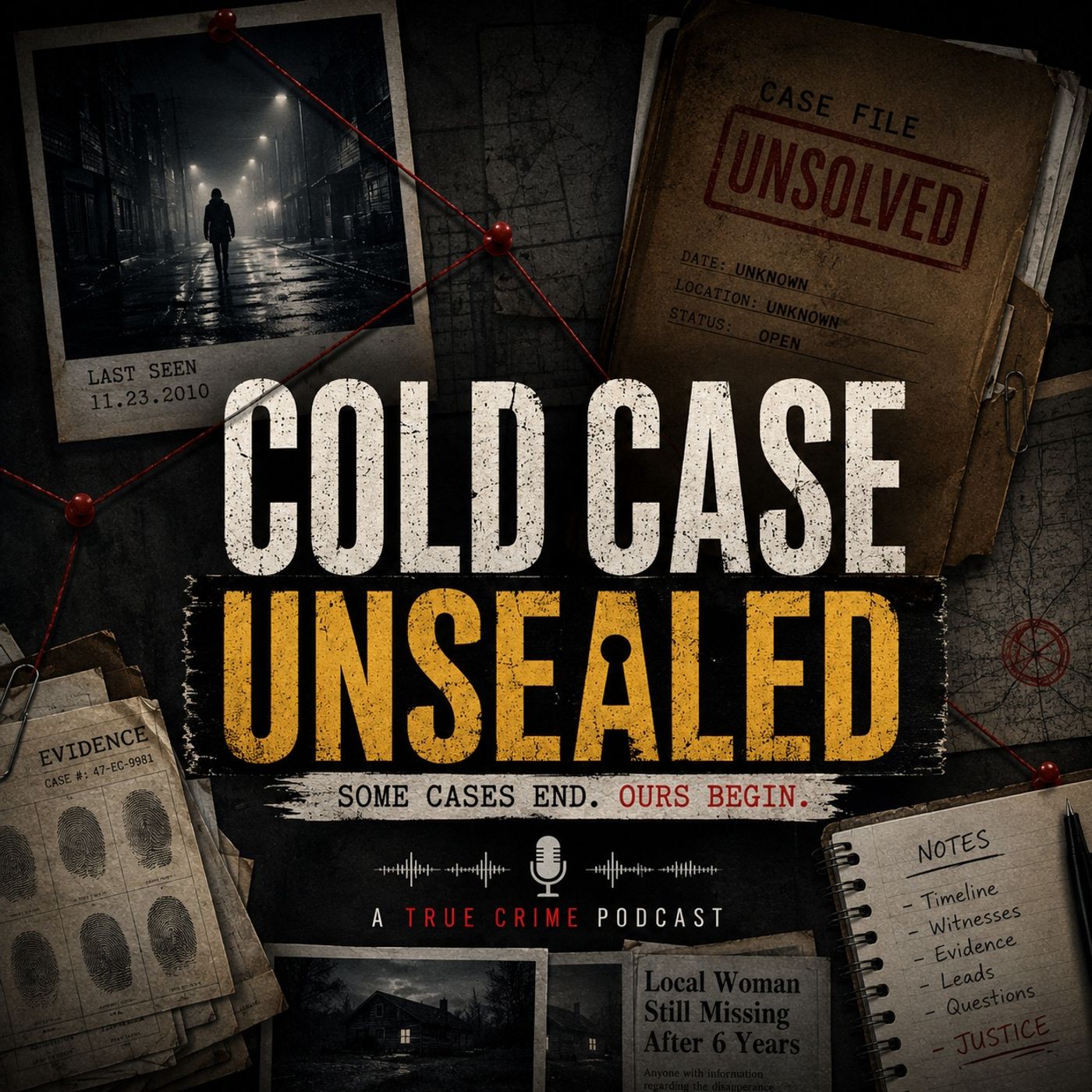
Cold Case Unsealed is a gripping true crime podcast that reopens forgotten investigations, unsolved murders, and mysterious disappearances that never received the answers they deserved. Each episode dives deep into cold case files, police reports, witness statements, timelines, and overlooked evidence to uncover the stories buried beneath years of silence. From abandoned leads and vanished suspects to shocking twists and hidden connections, Cold Case Unsealed explores the haunting mysteries that continue to leave families searching for justice. With immersive storytelling, atmospheric narration, and detailed research, the podcast examines the cases that time refused to solve. Some files were closed.These...
PENNSYLVANIA 1976 Cold Case Solved
This source details the tragic 1976 cold case of Evelyn Colon, a pregnant teenager whose dismembered remains were found in suitcases in Carbon County, Pennsylvania. For over four decades, she was known only as "Beth Doe" until forensic genealogy and a nephew’s DNA submission finally restored her identity in 2021. The investigation revealed that her boyfriend, Luis Sierra, allegedly used a fraudulent letter to trick her family into believing she had moved away safely. Although Sierra was eventually arrested and charged with homicide, the case faced significant legal hurdles regarding jurisdiction and the suppression of evidence. Ultimately, the narrative highlights the pe...
Cold Case in the Freezer
This source details the disappearance and murder of Denise Huber, a young woman who vanished after her car broke down on a California highway in 1991. For three years, the case remained cold until police in Arizona discovered her frozen remains inside a stolen truck belonging to John Famalaro. Investigators utilized advanced forensic techniques, such as skull reconstruction and DNA analysis, to link the suspect to the crime through bloodstains and a murder weapon found in his former warehouse. The account emphasizes how meticulous scientific evidence and community persistence eventually led to Famalaro’s conviction and death sentence. Ultimately, the narrative serves as...
The Body Farm Discovery: Justice for Katherine Foster
This true crime episode documents the decades-long investigation into the 1980 murder of Katherine Foster, an 18-year-old student at the University of South Alabama. Initially baffled by an execution-style killing with no clear motive, detectives and medical examiners spent years pursuing false leads, including a suspicious maintenance man and a security guard who eventually committed suicide. The case remained cold for twenty years until a tip led investigators to Katherine’s close friend, Jamie Letson, who had confessed the crime to a confidant. Scientific advancements at a forensic body farm allowed experts to correct an initial error regarding the time of de...
The Wolf in Priest’s Clothing: Justice for Irene Garza
This source details the harrowing legal battle and ultimate conviction of former priest John Fight for the 1960 murder of Irene Garza. Though the young teacher was killed after attending confession, the Catholic Church and local authorities allegedly conspired to suppress evidence and shield the perpetrator for over five decades. The narrative traces how the case transformed from a cold case legend into a trial fueled by new witness testimony from a former monk and a retired reporter. Despite the decades of silence, a new district attorney successfully prosecuted the elderly Fight, bringing closure to the community and Garza's family. The...
Targeted Clearance - The Ambush of Kanika Powell
This episode examines the 2008 unsolved murder of Kanika Powell, a Maryland laboratory employee with top-secret security clearance. Before her death, Powell was stalked by several men impersonating federal agents and delivery drivers, eventually leading to a fatal ambush outside her apartment. The source explores various investigative theories, including a potential government connection or a link to a local serial killer known for targeting women in their homes. Private investigator Derrick Levasseur analyzes the suspicious circumstances surrounding the case, questioning whether the crime was a professional hit or the work of a novice offender. He highlights the critical details of the...
Murdered Mom’s Mystery Killer Caught 23 Years Later
This episode recounts the resolution of the 2001 murder of Leslie Prier, a woman brutally killed in her upscale Maryland home. For over two decades, the case remained unsolved, leaving Prier’s husband under a cloud of suspicion until his death. The investigation reached a breakthrough in 2022 through forensic genealogy, which linked unidentified crime scene DNA to Eugene Glegor, a former boyfriend of the victim's daughter. Glegor eventually pleaded guilty to second-degree murder and received a prison sentence, finally providing the family with closure. The source highlights the persistence of cold case detectives and the transformative impact of modern DNA technology in...
The 34-Year Secret - The Murder of Janet Walsh
The episode explores the decades-long investigation into the 1979 homicide of Janet Walsh, a 23-year-old woman found murdered in her Pennsylvania apartment. For over thirty years, the case remained a unsolved mystery involving several suspects, including her estranged husband, a local drifter, and her boss. The narrative highlights how modern DNA technology eventually revitalized the cold case, leading investigators to focus on Scott Hopkins, a former lover whose genetic material was found at the crime scene. Despite his claims of innocence and alibi witnesses, Hopkins was convicted of third-degree murder in 2013 based on the concentrated placement of his DNA. The episode...
Justice on the Banks of the Red River
The episode details the ongoing investigation into the 2002 unsolved murder of Jennifer Harris, a young woman from Fannin County, Texas, whose body was discovered in the Red River. Despite efforts by local law enforcement, private investigators, and her family, the case remains hindered by a lack of physical evidence and the accidental destruction of original files. Various theories and suspects are explored, including her ex-husband and a former business partner, alongside rumors of a hidden pregnancy that may have served as a motive. A professional consultant critiques the initial investigation as weak and mishandled, highlighting the difficulty of achieving justice...
The Thomas the Train Toy Box Murders
The episode details the disturbing confession and legal aftermath of Shawn Lannon, a convicted serial killer who admitted to murdering at least 16 people. The narrative focuses on a 2021 killing spree where Lannon dismembered three victims in New Mexico and left their remains in a truck at an international airport before fleeing to New Jersey to commit another murder. During intense police interrogations, he claimed his actions were retaliation for the alleged drugging of his children and past personal traumas, though investigators found no evidence to support some of his justifications. Legal experts in the source analyze the logistical challenges of...
Justice Delayed and the Coldest Case
This episode provides a detailed account of the 1957 kidnapping and murder of Maria Rudolph, a seven-year-old girl from Sycamore, Illinois. The narrative tracks the case from her disappearance during a snowstorm to the 2011 arrest of Jack Daniel McCulla, formerly known as John Tessier. Although McCulla was initially convicted 55 years after the crime based on eyewitness identification and family testimony, the passage explains how his conviction was eventually overturned. New evidence confirmed a documented alibi involving a long-distance phone call made from another city at the time of the abduction. Ultimately, the episode highlights the complexities of cold case investigations and...
The Highway Trail of William Reese
This episode recounts the harrowing investigation into William Reese, a serial predator responsible for the disappearances and murders of several young women in the late 1990s. The narrative focuses on the tragic cases of Laura Smither, Kelly Cox, Tiffany Johnston, and Jessica Cain, detailing how their families endured decades of uncertainty while the killer remained imprisoned for a separate kidnapping. Through DNA breakthroughs and Reese’s eventually negotiated confessions, authorities were finally able to locate the remains of the missing victims in remote Texas fields. The source highlights the psychological profile of the killer as a pathological liar who manipulated in...
The 100-Stab Cold Case: Justice or Wrongful Arrest?
Law enforcement officials recently arrested Myra Velasquez for the 2012 cold case murder of her friend, Iraima Chavez, who was stabbed over 100 times. Investigators linked Velasquez to the crime using genetic genealogy to match a decade-old blood droplet to a DNA sample recovered from a discarded fork. Although charged with capital murder, Velasquez was released on a $450,000 bond, a move legal experts suggest reflects potential weaknesses in the prosecution's 14-year-old evidence. Her defense attorney maintains her innocence, highlighting the lack of a murder weapon and questioning whether the grainy surveillance footage actually depicts his client. The case now centers on the...
An Arrest is Made in 25 Year Old Cold Case
This episode highlights several high-profile legal cases, beginning with a twenty-five-year-old cold case in Alabama that was solved after the suspect provided a deathbed confession. The broadcast also previews the third season of Court Cam, a program that examines intense and often violent interactions within American courtrooms. Further segments discuss the legal complexities surrounding officer-involved shootings in New York and Florida, specifically focusing on self-defense claims and 911 audio evidence. Finally, the program covers the trial of Erica Stefanko, who is accused of helping her ex-husband lure an army veteran to her death over a custody battle. Through interviews with legal...
Suburban Mom Killed Young Realtor at Open House
A recent breakthrough in a fourteen-year-old cold case has led to the arrest of Kristen Ramsay for the 2011 murder of real estate agent Ashley Oakland. Prosecutors allege that Ramsay, a former colleague of the victim, was seen acting erratically near the crime scene shortly after witnesses reported hearing gunshots. While the defendant maintained a seemingly normal life as a suburban mother for over a decade, law enforcement cited conflicting statements and evidence found during home searches as grounds for her indictment. The legal proceedings have become a battleground over bond reductions and the privacy of digital data, with the defense...
A Body With No Name—Solved 52 Years Later
This episode chronicles the fifty-two-year investigation into the murder of Anita Piteau, a young woman found dead in a California field in 1968. For decades, the victim remained an unidentified Jane Doe while her family in Maine searched for her without success. The case finally reached a breakthrough through the use of modern genetic genealogy, which allowed detectives to link DNA from the crime scene to the family of the killer, Johnny Chrisco. Simultaneously, investigators re-examined the victim’s clothing to extract a profile that confirmed her identity and reconnected her with her relatives. Although the suspect died before he could fa...
Secrets and Lies in Death Investigations Cold Case Files
This episode examines several high-profile criminal cases involving abductions, murders, and long-term quests for justice. The narrative highlights the disappearance of Sarah Wood and the eventual confession of serial predator Lewis Lent, while also exploring the suspicious vanishing of Maya Millette and the role of domestic abuse. Another segment details the wrongful conviction of Vincent Simmons, who spent decades in prison before modern legal efforts secured his release. Additionally, the text covers the tragic killing of therapist Amy Harwick and the high-profile assassination of fashion icon Gianni Versace. Together, these accounts illustrate the enduring trauma experienced by families and the...
Man Arrested in 2012 Cold Case Murder of 16-Month-Old Boy in La Porte, Texas
Texas authorities recently arrested Eric Johnson for the 2012 cold case murder of 16-month-old Shawn McCloskey in La Porte. Although Johnson was the initial primary suspect, prosecutors originally lacked the necessary evidence to file charges after the toddler died from severe blunt force injuries. The breakthrough resulted from the "Texas Solves" initiative, a collaborative workshop that unites local police with state forensic experts to reexamine stagnant investigations. Now facing capital murder charges, Johnson was apprehended after updated investigative techniques and multi-agency cooperation successfully revived the 14-year-old case. This development highlights the state's commitment to using modern resources to seek justice for...
Shattered Devotion: The Death of Bethany Deon
This episode review on a 48 Hours special examines the suspicious death of Bethany Deon, a young woman found dead in her vehicle shortly after joining a high-control religious community. The group was led by her husband, Tyler Deon, a charismatic figure who allegedly manipulated members' lives and concealed his own secret sexual relationships with men. While a friend named Micah Moore initially confessed to killing Bethany at Tyler's request, he later recanted, claiming the admission was coerced through a religious ritual. Prosecutors eventually dropped the murder charges due to a lack of forensic evidence, leaving investigators and family members divided...
The Case of Michael Politte
This episode chronicles the wrongful conviction of Michael Politte, who was arrested at age fourteen for the vicious murder of his mother, Rita. Although he was sentenced to life in prison based on flawed forensic science and a questionable confession, his sisters and a legal team from the Innocence Project eventually uncovered evidence that challenged the original verdict. New analysis proved that the accelerant detected on Michael's shoes was likely a chemical from the manufacturing process rather than gasoline. After serving over two decades, Michael was released on parole due to new juvenile sentencing laws, though he continues to fight...
3 Cold Cases Solved After the Most Unexpected Suspect Was Exposed
This episode details three cold cases that were eventually solved through the use of genetic genealogy and DNA analysis. The first case involves a Syrian immigrant whose murderer was revealed to be a veteran police detective who had been surveilling the victim. The second account describes the tragic deaths of two teenage girls and the subsequent identification of a pastor as their killer twenty years later. Finally, the text explores the strangulation of a sixteen-year-old girl in her own home, a crime eventually linked to her cousin long after his own death. These stories highlight how modern forensic technology can...
Man charged in 37-year-old cold case out of Ozark
After nearly four decades, Joel Bremer has been formally charged with the 1988 murders of his pregnant wife, Ronna Bremer, and their unborn child. The investigation into the young mother’s disappearance from Ozark, Missouri, remained cold for years until forensic advancements and a true-crime series prompted a renewed look at the evidence. While a human skull belonging to the victim was recovered in 1991, her husband was only recently indicted following re-interviews of witnesses and updated DNA analysis. The sources detail the timeline of the crime, the suspect’s extensive criminal history, and the persistent efforts of law enforcement to seek just...
The Bloody Footprint - The Cold Case of Jeanie Childs
In 1993, Jeanie Childs was found brutally murdered in her Minneapolis high-rise, leaving behind a crime scene marked by extreme violence and mysterious bloody footprints. The case remained a cold case for decades until 2015, when investigators utilized genetic genealogy to identify a potential match in Jerry Westrom, a local businessman with no history of violence. Despite having no apparent motive and a normal family life, Westrom was arrested after his DNA was surreptitiously collected from a discarded napkin. Forensic experts eventually linked his bare footprint to the blood found in the bedroom, providing the crucial "timestamp" needed for a conviction. Although...
Torrey Pines - The Cold Case of Two Murders
This narrative details the investigation into two brutal cold cases involving the murders of teenage girls at Torrey Pines beach in California. In 1978, Barbara Nantes was killed while camping, an attack that left her boyfriend, Jim Alt, with permanent brain injuries. Years later in 1984, Claire Huff was found murdered in a nearly identical fashion, leading investigators to initially believe a serial killer was responsible. While DNA evidence eventually linked the 1984 crime to a convicted criminal and a former police criminalist named Kevin Brown, Brown’s family and colleagues argue that lab contamination explains the findings. Despite these leads, Brown’s suic...
The 30-Year Hunt for Sarah Yarborough’s Killer
This source details the decades-long investigation into the 1991 murder of Sarah Yarborough, a high school student killed on her school campus. For over thirty years, the case remained cold despite DNA evidence and eyewitness descriptions of a "boogeyman" suspect. The narrative highlights how forensic genetic genealogy eventually linked the crime to Patrick Nicholas, a serial predator whose prior release from prison allowed the tragedy to occur. After a trial featuring powerful emotional testimony from Sarah’s loved ones and a surviving past victim, Nicholas was finally convicted and sentenced. Ultimately, the episode explores the profound trauma experienced by the community an...
Business Cards Left at a Murder Scene—Solved 38 Years Later
This episode chronicles the decades-long investigation into the 1982 murder of Regina Reynolds, a nineteen-year-old student who vanished while hitchhiking in New York. Although detectives discovered business cards belonging to a local carpenter named Donald Sigby near the victim’s body, a lack of physical evidence prevented an initial arrest. The case remained unsolved for over twenty years until cold case investigators utilized modern DNA technology to re-examine biological samples preserved from the original crime scene. By covertly trailing Sigby to a restaurant, authorities secured his genetic profile from a discarded drinking straw, which directly linked him to the killing. This br...
The Murder of 9-Year-Old Debbie Randall
In 1972, the small community of Marietta, Georgia, was devastated by the abduction and brutal murder of nine-year-old Debbie Lynn Randall. Despite an extensive search and decades of investigation, the case remained cold for nearly fifty years as numerous false confessions and leads proved fruitless. The mystery was finally unraveled through the persistence of a dedicated cold case unit and revolutionary advancements in forensic genetic genealogy. By testing degraded DNA samples against ancestry databases, investigators identified William Bradford Rose as the perpetrator. Although the killer committed suicide in 1974, the discovery provided long-awaited closure for the victim’s family and the local community...
The Genetic Search for Christina Castiglione’s Killer
The episode details the 1983 cold case of Christina Castiglione, a Michigan teenager who was abducted, sexually assaulted, and murdered. Although investigators collected biological evidence and developed a psychological profile at the time, the case remained unsolved for nearly four decades. The narrative highlights the recent breakthrough achieved through investigative genetic genealogy, which utilized advanced DNA testing to identify Charles David Shaw as the killer. Though Shaw died shortly after the crime, forensic science confirmed his guilt by matching DNA from his living relatives. This discovery not only provided answers for the victim's sister but also linked the deceased suspect to...
An Entire Town Fell Under Suspicion After Her Murder
The episode reviews the 25-year pursuit of justice following the brutal 1989 murder of 18-year-old Shannon Siders in Newaygo, Michigan. After the teenager’s body was discovered in a local forest, the investigation languished for decades until a cold case task force and a determined civilian reopened the files. Detectives utilized victimology, a difficult exhumation, and hundreds of interviews to dismantle the false alibis of the last people seen with her. The breakthrough came when eyewitness testimony linked brothers Paul and Matt Jones to the crime, revealing a sexually motivated attack that ended in Shannon’s death. This account highlights the pers...
Justice for the Nameless - Solving Cold Case Jane Does
These episode review from a documentary series examine three distinct cold cases where unidentified victims were eventually linked to their killers through DNA technology and persistent detective work. The first case details the hunt for Wilson Chiest, a serial offender identified decades later via genetic evidence and witness testimony regarding two murdered women. The second narrative focuses on the tragic death of Francine Megan, an infant whose remains were discovered in the Arizona desert after a failed adoption scheme led to her murder by her father. Lastly, the text chronicles the 1973 disappearance of Kathy Divine, whose killer, William Cosden Jr...
The Shocking Murder of Janet Stallcup
This episode details the 1976 cold case of Janet Stallcup, a 19-year-old nursing student who was kidnapped, raped, and murdered in Garden Grove, California. For over four decades, her death remained a mystery alongside a similar assault on a neighbor and the 1975 killing of Guadalupe McClelland. The narrative illustrates how modern Investigative Genetic Genealogy (IGG) allowed detectives to overcome the limitations of older DNA databases by building extensive family trees from distant relatives. Through this forensic breakthrough, authorities identified Terry Dean Hawkins as the predator responsible for these heinous crimes. Although Hawkins died in jail in 1977, the discovery provided long-awaited closure...
The Serial Killer Who Linked Florida & Virginia Cold Cases
The episode highlights the critical role of forensic anthropology in solving cold cases where only skeletal remains are left to tell the story. It contrasts a Virginia homicide investigation struggling to identify a nameless victim with a Florida case involving a confessed serial killer whose victim's body was hidden in a swamp. Scientists like Dr. Douglas Owsley and Dr. William Maples utilize skeletal analysis to determine age, sex, and trauma, providing essential evidence that confessions alone cannot offer. The episode also describes the University of Tennessee’s Body Farm, where researchers study human decomposition to help law enforcement pinpoint time of...
15-year-old found buried in shallow grave at vineyard identified in 1978 cold case
After nearly five decades, authorities have successfully identified the remains of Michelle Louise Collier, a fifteen-year-old girl discovered in a California vineyard in 1978. For decades, she was known only as Arvin Jane Doe until a partnership between law enforcement and a private laboratory used forensic genetic genealogy to bridge the gap between skeletal evidence and living relatives. The breakthrough provided long-awaited answers for her surviving family, who were finally able to reclaim her remains for a proper burial. While the identification marks a major milestone in the cold case, the investigation into her homicide remains active as detectives now possess...
The Trailside Killer: Terror on Mount Tamalpais
This source chronicles the investigation and eventual capture of David Carpenter, a notorious serial killer recognized as the Trailside Killer who terrorized Northern California hiking trails. The narrative details how Carpenter utilized his knowledge of remote terrain to stalk and execute numerous victims through gunshot wounds and stabbings between 1979 and 1981. Although initial law enforcement efforts were hindered by conflicting witness accounts, specialized FBI profiling eventually accurately identified the suspect as a socially awkward man with a severe speech impediment. The episode highlights how a crucial tip from a former acquaintance and subsequent forensic links, such as matching ballistics and prison-issued...
The 25-Year Secret: A Cold Case Confession
In 1993, nineteen-year-old Frank McAlister vanished from Redding, California, after leaving with a large sum of insurance money to conduct a drug transaction. His abandoned vehicle was discovered shortly after containing significant blood evidence, leading investigators to shift their focus from a missing persons case to a homicide investigation. Although his skeletal remains were located a year later, the trail went cold for nearly twenty-five years due to a lack of physical evidence and the silence of three key witnesses. The case reached a breakthrough in 2018 when Brian Hawkins approached a news reporter to confess his involvement, citing a religious awakening as his mo...
The Hitman and the Husband: A Forty-Year Cold Case
The episode details the four-decade investigation into the 1982 murder of Lee Rotatori, a dietician discovered dead in an Iowa motel. Although the victim's husband, Jerry Nemke, was a convicted murderer with a suspicious background, his ironclad alibi initially shielded him from being charged. The case remained unsolved until recent advancements in genetic genealogy allowed investigators and a volunteer researcher to identify Thomas Oscar Freeman as the killer through DNA evidence. Further inquiries revealed that Freeman was likely a hired hitman connected to Nemke through their shared prison history and suspicious phone calls. Ultimately, the investigation concluded that while Freeman committed...
The Orange Sock Murders: Justice for Two Cold Cases
This source details the decades-long investigation into the 1982 cold case murders of Annette Schnee and Bobby Joe Oberholtzer in Breckenridge, Colorado. Both women disappeared while hitchhiking on the same frigid night, and their bodies were eventually discovered miles apart with matching forensic evidence linking the crimes. Although investigators initially suspected Oberholtzer’s husband, modern genetic genealogy eventually identified Alan Lee Phillips as the true killer through DNA found on a discarded napkin. A dramatic revelation during the trial revealed that Phillips had been rescued from a snowbank by a local fire chief on the very night of the killings. In 2022, a...
Justice for Claire: The Hunt for a Midnight Stalker
This episode details the tragic 1993 cold case murder of sixteen-year-old Claire Tiltman, who was brutally stabbed in an alleyway in Greenhithe, England. For over two decades, the investigation faced significant hurdles, including a lack of forensic evidence and a false alibi provided for the primary suspect, Colin Ash Smith. The narrative follows the tireless efforts of the Kent Police and Claire’s friends to find justice, even after her parents passed away without seeing the killer caught. A pivotal shift in UK law eventually allowed prosecutors to present Ash Smith’s violent history and disturbing diaries as evidence of his pred...
DNA Evidence Cracked the 20-Year Cold Case of Leslie Prier
This source details the resolution of the 2001 murder of Leslie Prier in Maryland, a cold case that remained unsolved for over two decades. Investigators originally focused on the victim's husband, Sandy Prier, but DNA found at the scene eventually cleared him and later identified Eugene Glegor as the killer. Glegor, a former boyfriend of the victim's daughter, was linked to the crime after police surreptitiously collected his DNA from a discarded water bottle. During a dramatic interrogation, Glegor initially claimed he had no memory of the event and requested legal counsel before eventually pleading guilty to second-degree murder. He was sentenc...
Justice for Amy: The Serpentine Cold Case Investigation
This investigative transcript examines the suspicious 2014 death of Amy Lee Winedly, a young Australian mother whose passing was initially dismissed by detectives as a suicide. Family members and first-responding officers challenge this official narrative, citing evidence of domestic violence and the fact that Amy was prepared to leave her partner when she died. Through crime scene reconstructions and expert analysis, the report highlights significant procedural failures and contradictions in the original police inquiry. A million-dollar reward and a new forensic review now aim to resolve whether the incident was actually a homicide. Ultimately, the source serves as a call for...
A Cold Case Led Police to a Serial Killer
These sources detail two harrowing cold cases from Kentucky involving female victims whose lives were cut short by extreme violence. The first narrative describes how advanced DNA testing and ballistics finally identified Robert Eugene Brashers as the serial killer responsible for the 1998 murder of Linda Marie Rutledge, linking him to several other notorious crimes across the country. In contrast, the second account focuses on the 1990 stabbing of Lucinda Strange, a case that remains unsolved despite investigations into local serial killers and other persons of interest. Both reports highlight the long-term efforts of law enforcement and the devastating impact these tragedies...