Mine Print Hash
The weekly podcast from Matt Dines and Cameron Otsuka, where our team dissects the week's most important news and their impact on capital markets. From macroeconomic trends and policy decisions to geopolitical events and sector-specific developments, join the team for timely analysis and thoughtful conversations to help you form a narrative for the rapidly evolving capital markets landscape. www.mineprinthash.com
The AI Capital Vacuum
TL;DR: AI spending is colliding with capital-market limits. Meta and a potential Tesla-SpaceX combination point toward equity issuance, M&A and a repricing of growth risk in Treasuries.
📄 Summary
Ukraine: From Fighting to Negotiating
Matt Dines reads Zelensky’s latest comments as a change from “playing to win” to “playing not to lose” (00:04:45). He expects security talks first, then economic settlements around energy trade, sanctions, frozen Russian reserves and Western ownership stakes (00:05:52).
Abu Dhabi Talks and Geopolitical Leverage
Polymarket pricing puts the UAE at roughly 64% to host potentia...
Negative Convexity: Do Treasury Bond Futures & Datacenter Capex Spell Potential Trouble in Q4?
TL;DR: Energy-driven inflation is pushing borrowing costs higher, squeezing vulnerable airlines and AI infrastructure financing while exposing a possible Treasury futures feedback loop.
📄 Summary
Energy Inflation: The Root Constraint (00:02:30)
Matt Dines says September CPI rose 65 bps, with roughly 35 bps attributable to fuel costs. Refining and diesel constraints following 2026 geopolitical disruptions remain what he calls the “underlying story of 2026” (00:03:44).
U.S.-Russia Diesel Deal: A Policy Reversal (00:04:46)
Matt describes a new diesel import agreement, including temporary relief for Rosneft, Lukoil and other Russian energy firms through April 2027, as a sh...
Competing Visions of the West: Sovereign Debt, State Power and Monetary Innovation
TL;DR: The 2026 midterms are becoming a referendum on AI-driven growth, who pays for electricity grid expansion, and which balance sheets support the next monetary system.
📄 Summary
The Midterms as a Grid Policy Referendum (00:01:25)
Matt Dines describes November’s election as a “grid policy referendum.” The AI/superintelligence buildout is a major U.S. growth engine, but rising electricity demand raises a critical question: will ratepayers, utilities, taxpayers or hyperscalers absorb the infrastructure costs and financial risks?
Ratepayer Protection Act: Who Bears the Risk? (00:07:45)
H.R. 9340 passed the House...
America.gov: The End of the Napoleonic Era of Government
TL;DR: Credit is tightening, AI capex is shifting toward a harvesting phase, and America.gov may be an early model for agentic digital government.
📄 Summary
Sovereign Debt Moves Into the Mainstream
Matt Dines uses the “shoeshine boy” analogy to argue that sovereign-debt stress is moving from macro specialists toward broader public awareness. U.S. interest-rate searches are elevated but still below the March 2020 peak, while Japan and France remain comparatively quiet despite yield breakouts.
* His takeaway: “we’re in the first inning of this process,” with the sovereign-debt story likely...
ECB Pontes: Tokenizing European Sovereign Debt
TL;DR: Energy and credit scarcity are repricing sovereign debt while Europe builds tokenized rails to expand financing capacity.
📄 Summary
Sovereign Debt Breakout & the Diesel Constraint
Developed-market long yields are breaking higher, with the U.S. 10-year testing/breaking 5% and France showing a more acute acceleration (00:01:17). Matt links the move to tightening real-economy inputs: refinery outages, constrained diesel supply, and rising financing costs. His shorthand is “diesel equals growth” — if fuel and credit become scarce, projects become harder to complete and the late-cycle contraction deepens (00:05:37).
* The throughline: energy, commodities, and credi...
The Hike Phase: Fed Hikes, AI CapEx, and the Long-Yield Signal
TL;DR: The Fed hike confirms the contraction phase.
📄 Summary
Fed Hike as a Business-Cycle Signal
Matt Dines uses Gordon Pepper’s framework: “Bond prices tend to reach a trough shortly after the boom turning point.” He argues the two-year Treasury moving above the policy corridor and a four-week T-bill auction above it forced the Fed to hike, with Epic Fury/resource constraints pushing the real and financial economies out of balance (00:02:49).
* The key question is whether short-term tightening can flatten long yields, attract savings, and preserve long-term credit capacity...
I’m the House Now: Treasury Policy, a Volatile Central Bank Week, and Xinbi Guarantee
TL;DR: A potentially volatile central-bank week is colliding with higher long-end yields, while Treasury policy, reindustrialization and stablecoin enforcement increasingly look like parts of the same monetary transition.
📄 Summary
CPI, Housing & a Possible Fed Hike
Matt Dines says the next week could be “action-packed” for money markets as CPI lands ahead of Fed, Bank of England and Bank of Japan decisions (00:01:42).
* Housing is central to the inflation debate: shelter remains a major CPI component, but higher-end housing is slowing, listings are lingering and sellers are cutting prices (00:03:49).
* Fed...
Quantitative Credit Guidance: G20 Says Growth is the Only Way Out
TL;DR: Asheville’s message was growth — with private credit, industrial policy, and new monetary rails doing more of the work than a return to 2010s-style QE.
📄 Summary
Growth Is the G20’s Core Priority
Cameron Otsuka and Matt Dines highlight the conference’s repeated focus on growth: “Most fundamental priority is economic growth” (00:01:14).
* Matt’s throughline is that growth is the preferred way to manage the global debt overhang, while avoiding another cycle of crisis-driven stimulus and balance-sheet expansion.
China Is the Main Point of Friction
China object...
Operation Economic Outcast: Bessent's D-Day and the Race to Build New Dollar Infrastructure
TL;DR: Economic pressure on Iran and competition over stablecoin infrastructure are presented as two fronts in a broader reshaping of the dollar system.
📄 Summary
Operation Economic Outcast: An “Economic D-Day”
The hosts frame the new Iran campaign as the next stage of a longer U.S.-led strategy, using Executive Order 13902 authority to target IRGC-linked activity across digital assets, technology, gold, aviation and shipping, including transactions routed through third countries (00:00:40).
* Secretary Bessent’s “economic D-Day” language is interpreted as a beachhead rather than a quick strike: after pressure on oil and fi...
Canada, Brookfield, and the Geopolitics Surfacing in Markets
TL;DR: Global growth is slowing as the U.S.-Canada trade fight expands from tariffs into resources, mortgages, insurance and Treasury-market defense.
📄 Summary
The Slowdown Is Appearing Before GDP
Matt Dines links weaker Southeast Asian oil demand, a 349 billion yuan PBOC liquidity injection, Walmart’s Q2 consumer warning signs and slack in copper into one picture: growth is slowing across fragmented regional spheres (00:00:53).
* He argues the PBOC action was a liquidity injection—not the liquidity-removing “reverse repo” associated with the Fed—and a sign of stress reaching China’s banking syste...
Asheville: Bretton Woods for the Stablecoin Dollar Era
TL;DR: Yen intervention is the opening move in a wider reset linking monetary negotiations, trade-route rewiring, and tokenized settlement rails.
📄 Summary
Yen Intervention Becomes a Negotiation
Matt Dines reads the July 31 U.S. yen intervention as a public first move designed to force a response, not a completed operation. Prime Minister Takaichi faces both political and financial pressure as the yen carry trade remains unresolved (00:00:57).
* The Aug. 29-Sept. 1 G20 finance and central-bank gathering in Asheville is framed as the next checkpoint. Matt rejects “new Bretton Woods” hype: “This is laying...
Yentervention: Japan as a Critical Nexus in US Monetary and Resource Policy
TL;DR: The yen intervention is the opening move in a much larger fight over dollar liquidity, the yen carry trade, Fed authority, and Japan’s role in the next U.S.-aligned AI/industrial system.
📄 Summary
Yen Intervention as a Monetary Transition
The episode opens with the July 31 U.S. Treasury intervention to support the yen after USD/JPY moved beyond 160. Matt Dines argues this should not be read simply as a prelude to yen or Japanese sovereign collapse, but as a bridge from the post-1990 Japanese monetary order and the o...
Reading the Fed Vote Tea Leaves, China Creates a SOFR Bridge, and America’s Defense Cycle
TL;DR: A Fed “hold” that eases the front end, China’s SOFR-style monetary bridge, and a multi-year U.S. defense buildout.
📄 Summary
Fed Hold Acts Like Front-End Easing
The FOMC kept rates at 3.50%-3.75%, but roughly 9-10 basis points came out of the four-month area of the curve. Matt calls the market reaction a “mini version of a rate cut” (00:03:22).
* Continued Reserve Management Purchases mean more Treasury-bill buying, lower short-term rates and a steeper curve that supports credit creation while U.S. borrowing demand remains strong (00:05:20).
Regional Diss...
Houthis, the Red Sea, and Sovereign Debt Repricing
TL;DR: Sovereign debt is repricing as AI-driven resource demand and Middle East energy conflict collide; the long-term exit is physical investment, new trade routes, and emerging financial blocs.
📄 Summary
Sovereign Debt Repricing and the “Dog Not Barking”
Matt Dines says the ECB had already warned of an “abrupt repricing in sovereign bond markets” (00:02:38). Most Western-aligned sovereign yields are near 52-week highs, while China and some South American U.S.-dollar debt are bucking the selloff. He reads this divergence as an early sign of competing financial spheres and a still “first inning”...
GENIUS Act Deadlines, Kimi K3, and the China Competition
TL;DR: Energy disinflation is easing CPI pressure, making housing affordability the Fed’s next battle; Circle’s OCC charter advances the regulated digital-dollar stack; and China’s open-source AI gains are turning model access into a sovereignty contest.
📄 Summary
June CPI: Energy Rollover, Not a New Inflation Shock
Matt Dines argues June’s CPI drop was predictable after oil rolled over, echoing 2022. Food, core goods, and services also contributed little, signaling weak purchasing power, though geopolitical rewiring keeps energy volatility as the main wildcard (00:01:48).
Housing Becomes the Fed’s Core Problem
SCOTUS on the Fed, Open USD, and Brady Bonds
TL;DR: Fed governance, stablecoins, and Mexico’s debt stress all point to a dollar-system transition from offshore Eurodollars toward a stablecoin/Treasury architecture.
📄 Summary
Cook v. Trump & The Fed’s Legal Opening
Cameron Otsuka and Matt Dines start with the Supreme Court’s Lisa Cook/FOMC ruling. Matt says the headline outcome preserved the status quo by upholding due process, but the deeper impact is Justice Clarence Thomas’s dissent.
* Matt frames it as “nothing happened, but then everything happened,” because the case creates a legal record around Fed independenc...
SpaceX, FHLB Lending, and the Dollar Liquidity Scramble
TL;DR: Dollar liquidity scramble.
📄 Summary
SpaceX Taps Dollar Credit Markets
Mine Print Hash Week 26 opens with SpaceX’s $25B bond offering, framed as the latest sign that AI infrastructure is consuming U.S. dollar investment-grade credit capacity. Matt says the AI buildout is “in full swing,” while June 2026 issuance is within $2B of the COVID-era record (00:02:00).
* SpaceX raised $87.5B in its IPO, then added a five-part $25B debt deal — a “massive cash liquidity buildup” (00:01:00).
* The proceeds largely rolled over older, higher-yielding debt tied to X and xAI via a bridg...
AI Export Controls and the Warsh Era: Fed Regime Change Amidst AI Sovereignty Challenges
TL;DR: Kevin Warsh’s first FOMC is framed as the start of a multi-year Fed regime change: less forward guidance, more institutional reform, and more credit directed toward real growth and AI.
📄 Summary
Kevin Warsh’s First FOMC: A New Fed Era
Cameron Otsuka and Matt Dines open Mine Print Hash with Warsh’s first FOMC as Fed Chair, calling it a “new transitionary era” likely to play out over years (00:01:19).
* Matt compares Warsh to a new coach entering an old locker room: the Fed “used to be winning,” but f...
Tokenized Assets: The Market Plumbing Contest
TL;DR: U.S. inflation is still rising, but the impulse is decelerating. Matt connects CPI, Hormuz energy flows, dollar onshoring, and tokenized securities into one Mine Print Hash thesis: capital-market gravity is moving away from the old offshore/continental system toward U.S./Western Hemisphere rails.
📄 Summary
CPI: High, But Decelerating
Matt says the key is the impulse: CPI was 0.47% month-over-month, annualizing to 5.6%, a “big impulse” (00:03:22). But after three post-Epic Fury prints, “the second derivative is negative,” meaning the impulse is slowing (00:03:59).
* March was mainly energy as Brent/WTI spiked...
Hawkish Weakness: ECB Hikes, Dollar Flows, and Kalshi/Polymarket as Stablecoin Demand Markets
TL;DR: Eurozone hawkish weakness, dollar liquidity squeeze, and stablecoin rails.
📄 Summary
ECB Hikes Into Weakness
Cameron Otsuka and Matt Dines open Mine Print Hash Week 23 with markets signaling “potentially tough times ahead for the Eurozone” as swaps price a June 11 ECB hike and roughly three 25 bps hikes by year-end (00:00:12).
* Matt frames this as “hawkish weakness”: the ECB is hawkish on rates, but the underlying economy is weak (00:02:12).
The Four-Week T-Bill “Smoking Gun”
Matt calls the four-week Treasury bill move the key signal, labeling it “Drowning Man Gasp...
The Yen Battlefront: Europe's Weak Hand and the Dollar Stablecoin Hierarchy
TL;DR: Europe’s energy shock is becoming sovereign-debt stress, offshore dollar liquidity is signaling disinflation, and Japan is the next battleground in the stablecoin vs. eurodollar transition.
📄 Summary
Europe Admits The Energy Shock
Cameron Otsuka frames the episode around Europe’s energy/debt stress, the offshore dollar system, and Japan’s role in stablecoins (00:00:04). Matt Dines says Europe is “admitting it’s lost this phase of the Iran fight” through energy and commodity supply chains (00:01:31).
* EU officials expect oil/gas prices to stay elevated through 2027, while Christine Lagarde “double stamped” t...
Treasury Supremacy: Stablecoins, Bitcoin, and the Building New Dollar Rails
TL;DR: The “new dollar” framework: Bessent’s 3-3-3 plan, stablecoins, Bitcoin reserves, and money-market stress point to a U.S. monetary transition away from CBDCs and legacy fiat credit expansion.
📄 Summary
Bessent’s 3-3-3 Plan & The New Dollar
Cameron frames the episode around Scott Bessent’s 3-3-3 goal: 3% real growth, a 3% deficit, and 3 million additional barrels of domestic energy production. Matt says the key message is: “We’re going to monetize the asset side of the U.S. balance sheet for the American people” (00:02:53).
* Stablecoins, Bitcoin reserves, d...
The Funding Squeeze: Sovereigns, Money Markets, and AI Compute
TL;DR: Stablecoin dollars, money-market stress, and AI compute constraints are all converging into one macro regime shift.
📄 Summary
Clarity Act and the Monetary Fork
Cameron Otsuka and Matt Dines open Mine Print Hash with Kevin Warsh “confirmed as Fed Chair” (00:00:39), then shift to the Clarity Act and GENIUS Act as the week’s key monetary development.
* Matt frames the Tillis-Alsobrooks compromise as historically significant: a fork in the road for stablecoins, Treasury bills, and dollar issuance.
* He argues the offshore dollar system “is being completely rewired” (00:03:38).
Stableco...
The Trans Adriatic Pipeline: Eurasian Energy Corridor Chess Game
TL;DR: Energy corridors are the chessboard upon which major powers are competing.
📄 Summary
Trans-Adriatic Pipeline & the Great-Power Chessboard
Cameron Otsuka and Matt Dines open Mine Print Hash Week 18 by framing recent Trans-Adriatic Pipeline news as more than an energy story: it is a window into “political maneuvers” and influence campaigns around strategic corridors (00:00:12). Matt says the region sits between the “big four” spheres of influence — the U.S., China, Russia, and continental Europe/EU — and should be understood as a “chess game” where every move forces a response (00:02:14, 00:02:47). The throughline: pipelines, trade ro...
Sphere of Influence Skirmishes: Fed Politics, Central Bank Stress, and Resource Competition
TL;DR: Central bank stress, dollar liquidity, and resource competition are converging.
📄 Summary
From Kinetic Conflict To Financial Stress
Cameron Otsuka and Matt Dines frame Mine Print Hash Week 17 around stress moving from the Iran/Persian Gulf military layer into finance, FX, and resource procurement. The throughline: disrupted commodity flows are pushing central banks into a “bad quadrant” of soft growth, energy-linked inflation, and FX risk (00:00:23).
Japan: BOJ Holds, Then Intervenes
Matt starts with Japan, where the Bank of Japan held short-term rates steady at 75 bps instead of hiki...
Gold & Iron ⇢ Bitcoin & Silica
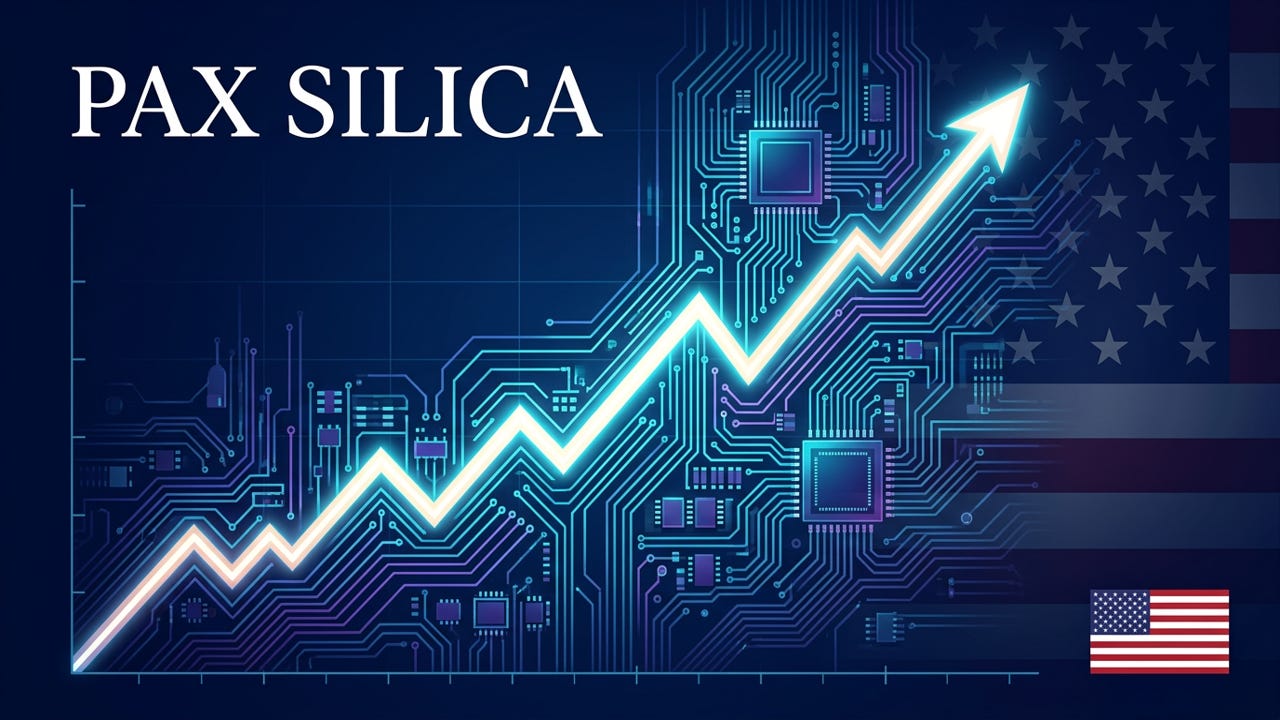
TL;DR: Pax Silica, gold, iron, and Bitcoin.
📄 Summary
Gold and Iron: A Historical Framework
Cameron Otsuka and Matt Dines open with Fritz Stern’s Gold and Iron as the lens for the episode: how Bismarck built a new German order by combining military power, finance, industrialization, and political coalition-building.
* The key analogy: Bismarck’s era transformed feudal Europe into an industrial state system; today’s post-2008 order is transforming into something new (00:06:33).
* Finance is central: Bismarck was not a financier, but his banker played the financial role behind the geopo...
Ceasefire and Contagion
TL;DR: The Iran ceasefire is one small but critical step in a much larger Middle East “reordering” that is now showing up across FX, sovereign debt, commodities, and even AI infrastructure.
📄 Summary
100 years of context: from World War I to today
Matt frames the current Iran ceasefire as part of “the largest reorder of the Middle East since World War I” (00:00:31). He traces the setup from the collapse of the Ottoman, Russian, Austro-Hungarian, and German empires after WWI, then argues that 9/11, the Iraq/Afghanistan wars, the 2008 crisis, the Arab Spring, and Syria a...
The Return of Productive American Growth
TL;DR: The Brent/WTI “flippening,” the Artemis II launch, and stress in private-credit plumbing all point to the same story: a messy but accelerating return to American-led growth.
📄 Summary
Brent/WTI “flippening” as the opening signal
Matt Dines says the key market tell is that “the WTI price was quoting above the Brent crude reference price” (00:01:50). He frames that as more than an oil-market anomaly: a possible “changing of the guards” in commodity pricing away from Europe and toward the U.S./Gulf Coast complex (00:05:46). The episode ties that shift to broader geopolitical realig...
Iran Hyperinflation Signals the Next Step
TL;DR: The Iran conflict is a fight over who controls Iran’s state, economy, and strategic geography, specifically targeting the IRGC’s hybrid role as a paramilitary and economic empire, with hyperinflation acting as the clearest sign that the system is breaking.
📄 Summary
* Iran’s core issue is structural, not just military. Matt says Iran effectively has “two separate power factions” (00:01:57): a civilian government and an IRGC-centered power bloc that grew into a “private equity” plus “private military” regime. That framing is the throughline for the whole episode.
* The IRGC is described as having evolved fro...
Money Madness: The Central Bank Competition Heats Up
TL;DR: This week’s U.S. and U.K. crypto-policy moves are really a fight over monetary control: whether states accommodate new digital rails or try to absorb and suppress them. That regulatory split then flows through to stablecoins, capital movement, gold, Bitcoin, sovereign debt, and the broader “capital wars” shaping the next monetary order.
📄 Summary
What “central bank independence” really means
Matt says the phrase is misleading. In practice, it is about how much control an institution has over monetary authority, capital, and policy inside a jurisdiction. At the far extreme...
Major Energy Market Reset Underway
TL;DR: A major global trade realignment is underway, driven by shifting consumption markets, Middle East energy routes, and the financial dominance of the U.S. dollar. Geopolitics, shipping routes, and currency systems intersect to reshape global macro markets.
📄 Summary
Global Trade Realignment
The episode opens with a discussion of a major shift in global trade patterns, framed as a split between Western markets and Asia. Cameron Otsuka notes that the current geopolitical environment reflects “a realignment in terms of these consumption markets that are so important to every… large economic player in the wor...
Final Nail in the Coffin for 20th Century Global Trade?
TL;DR: The “old world” system (maritime trade insurance + post-2008 central-bank plumbing) is cracking, and the U.S. is trying to backstop and rebuild the rails.
📄 Summary
Trade System Teardown
Cameron Otsuka and Matt Dines frame the episode around “global trade going back to the old world” and why the real story is the insurance/route infrastructure behind headlines (00:00:24).
* Iran strikes: focus on the chokepoint, not the missiles: They walk through “Operation Epic Fury” and the regional spillover, but argue the market-moving angle is maritime war-risk coverage and the trade routes it...
Iran Realignment is the Key Domino to the New Geopolitical Order
TL;DR: A “monetary transition” is accelerating a rethink of global trade links, and it’s showing up in wartime-style capital markets (strategic equity + supply-chain stockpiles) and in EU leadership uncertainty (Lagarde trial-balloon resignation).
📄 Summary
Restructuring Global Trade
Cameron frames the week’s main theme as “restructuring global trade” (0:48). Matt zooms out to the Silk Road and the idea that civilizations’ relationships ultimately “comes down to trade as that key linkage” (3:25). From there, he connects today’s headlines to geopolitics: “Iran, center of attention” (2:04), U.S.-Iran talks in Oman “centered around the nuclear deal” (2:0...
Bretton Woods: China Edition
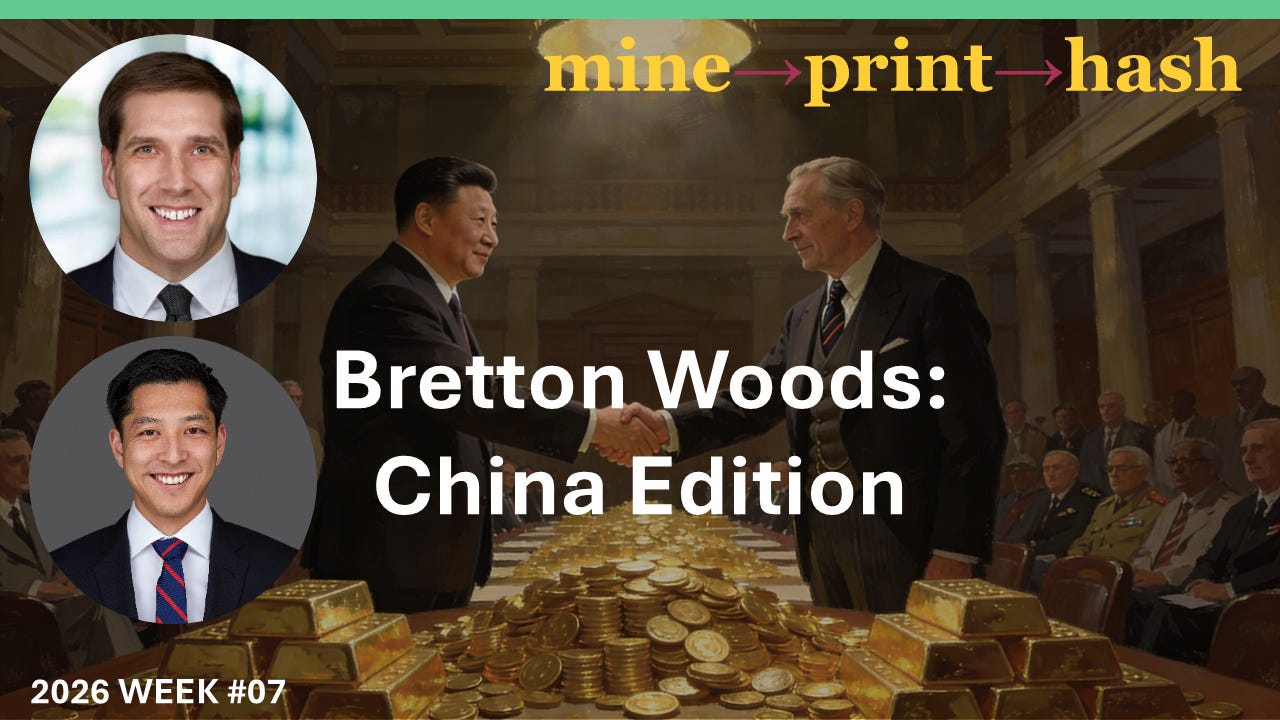
TL;DR: China bids for reserve currency status, the U.S. builds a new dollar architecture, and everyone is still finding their dance partners.
📄 Summary
Bretton Woods Redux: China’s Gold-Backed Reserve Currency Bid
Xi Jinping called internationally for the Chinese RMB/Yuan to attain global reserve currency status. Matt Dines frames this as a copy-paste of the post-WWII Bretton Woods system, where the U.S. dollar sat at the center, redeemable into gold -- except now China is being asked to fill that role. Critically, it is gold, not the euro...
Liquidity Setup Week
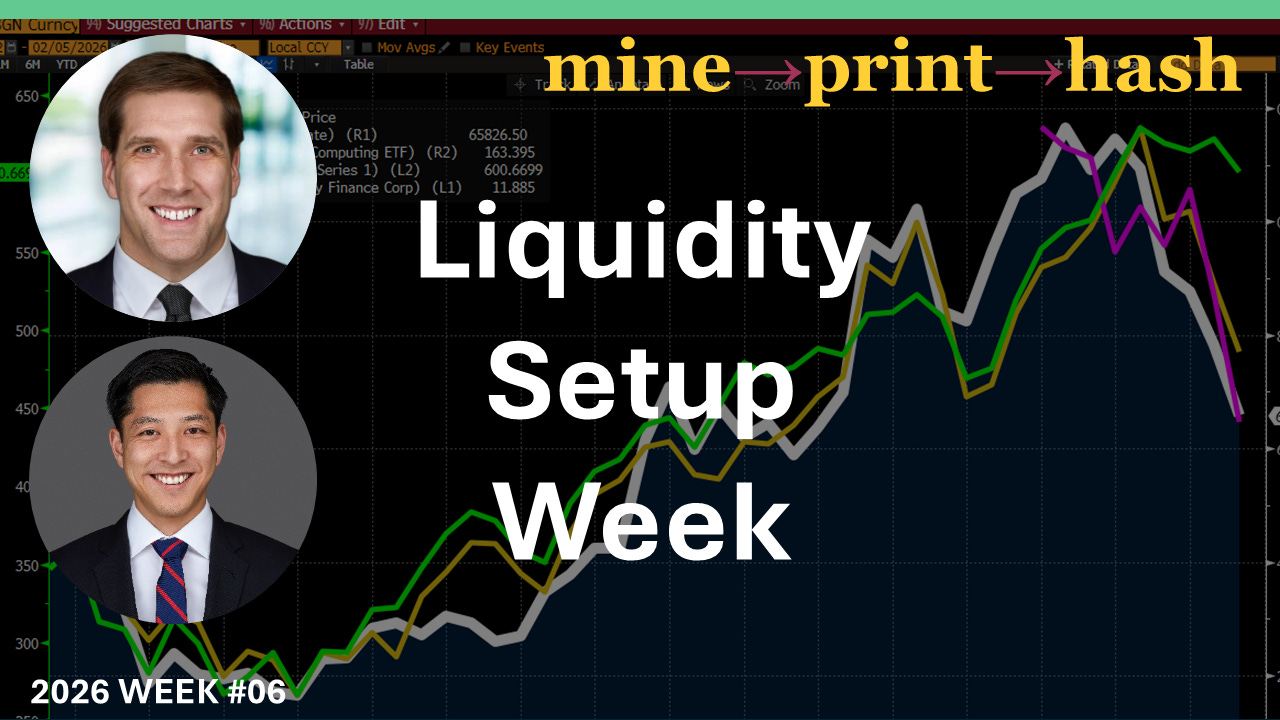
TL;DR: Liquidity setup week. US industrials bull market confirmed, Japan elections loom, and Bitcoin takes the pain.
📄 Summary
US ISM Manufacturing: Bull Market Confirmed
The US ISM Manufacturing PMI printed at 52.6, a major beat versus the 48.5 consensus expectation. Matt Dines calls out that the consensus “tends to herd with each other and get these signals wrong” at inflection points (3:28). This expansionary reading confirms the Dow Theory breakout MindPrint Hash flagged weeks ago between industrial equities (XLI) and the Dow Jones Transportation Index. The signal: the US goods-producing economy is in a bull...
The Bermuda Triangle: Japanese Life Insurers, US Private Credit & Indonesia's Money Center
TL;DR: Kevin Warsh nominated for Fed Chair, Japanese life insurers signal stress, Bessent calls for "Bountiful 2026."
📄 SUMMARY
Kevin Warsh Nominated for Fed Chair
Matt Dines analyzes the nomination through the lens of Walter Bagehot's "Lombard Street" framework for central bank governance. Warsh fits the ideal profile: younger (forward-looking 20-year time horizon), prior Fed experience (2006-2011 Board of Governors), not actively involved in banking but has the network, and maintains a low-risk personal capital approach.
- "Managing the cash reserve of the country is as precious a deposit as...
Davos 2026: Sovereigntists vs. Globalists and Geopolitical Power Shifts
TL;DR: Fed under fire, Greenland geopolitics intensify, and Iran's currency collapse signals a new era.
📄 SUMMARY
Davos 2026: A "Wake-Up Call" for Western Institutions
Matt Dines and Cameron Otsuka analyze the World Economic Forum meeting in Davos, noting a starkly different tone from previous years. Christine Lagarde appeared visibly flustered in her CNN interview, calling the moment "a wake-up call, a bigger one than we ever had" and announcing Europe would do a "SWAT analysis" and develop a "Plan B" to become more independent (3:00). The hosts argue this represents the fin...
Iran Goes Weimar, DOJ vs. Powell & Arctic Standoff: The Monetary War Escalates
TL;DR: Fed under fire, Greenland geopolitics intensify, and Iran's currency collapse signals a new era.
📄 SUMMARY
Fed in Check: DOJ Subpoena and Criminal Threat
The Trump administration escalated its pressure on the Federal Reserve with a DOJ subpoena and criminal indictment threat against Fed Chair Jerome Powell. Matt Dines frames this as the Fed being pulled from the sidelines onto the battlefield in a broader conflict between legacy institutions and disruptive forces.
- Powell responded publicly, claiming the threat stems from his refusal to force rates down (2:02).
<...Venezuela, Dow Theory, and Western Hemisphere Integration
TL;DR: Western Hemisphere economic integration is underway - Venezuela, Dow Theory, and what to watch in 2026.
📄 SUMMARY
Venezuela: The Climax of Phase One
The U.S. extraction of Maduro represents a major geopolitical shift. Matt characterizes it as flawless execution reflecting months of preparation. Key observations:
- Cyber capabilities: The U.S. cut power to Caracas and exploited BGP inconsistencies, with reports that Chinese defense systems failed to respond (6:00-8:30).
- Not regime change per se, but integration of Venezuela into the Western Hemisphere economic orb...
BITCOIN AND THE INNOVATOR'S DILEMMA - BUILD WEEKLY ROUNDUP - 2025 WEEK #52
TL;DR: Bitcoin collateral pilot, innovator's dilemma, and digital sovereignty tensions.
📄 SUMMARY
Bitcoin vs. Metals: Reality Check for the Community
Matt Dines and Cameron Otsuka open by addressing the disconnect between Bitcoin community expectations and market reality. While metals have been breaking out, Bitcoin has had a flat to down year, leading to low sentiment.
- The breakage of metals pricing mechanisms was one of the most important financial developments of 2025 (3:28)
- Weak assumptions like four-year cycles and rainbow charts need to be abandoned in favor of...
