High Concept Labs

How Science Encrypted The Sacred In Math
How Science Encrypted The Sacred In Math explores the autopoietic transformation of static nouns into living verbs, analyzing systems boundaries and recursive dynamics.
How Fixed Beliefs Weaponize Identity (1)
How Fixed Beliefs Weaponize Identity (1) explores the autopoietic transformation of static nouns into living verbs, analyzing systems boundaries and recursive dynamics.
Genesis Was an Ancient Engineering Manual
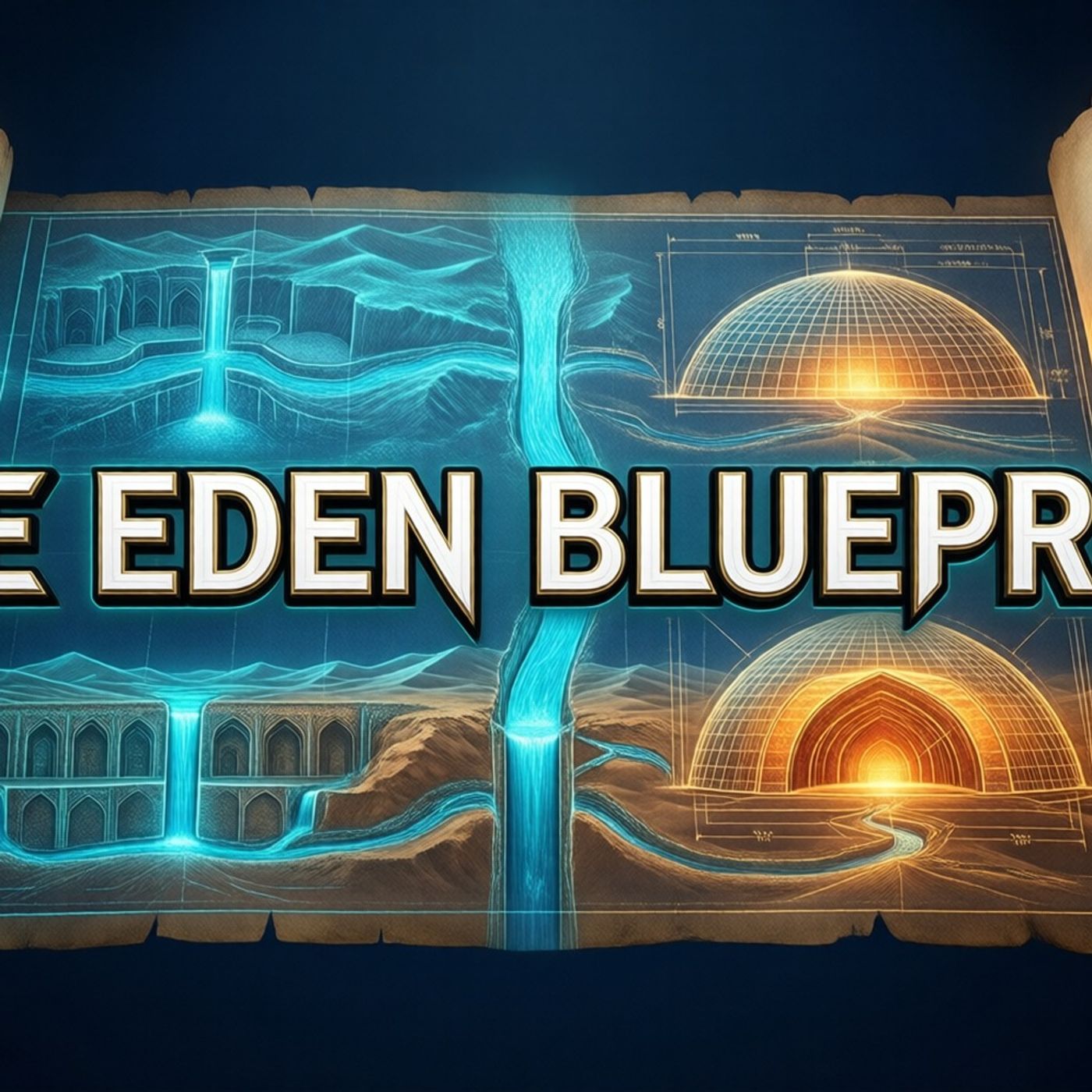
What if the Greco-Roman world didn't invent rational engineering—and instead, an extractive Roman Empire accidentally erased a far more sophisticated systems-literate civilization in the ancient Near East? Applying the lens of systems archaeology to fresh linguistic translations of the Hebrew Tanakh, paleoclimatological soil data, and ancient hydroengineering, this deep dive reveals that early Levantine texts were not superstitious fables, but literal agrohydrological engineering manuals and community survival blueprints.
Long before Roman aqueducts relied on conspicuous monumentality and brute-force extraction, ancient Near Eastern engineers mastered subterranean qanat networks, gravity-fed hydrology, and passive thermodynamics. Through structures like the yakchal—comb...
How Christian Orthodoxy Colonized Knowledge

How Christian Orthodoxy Colonized Knowledge explores the autopoietic transformation of static nouns into living verbs, analyzing systems boundaries and recursive dynamics.
Cybernetics And The Hidden Math Of Scripture

Cybernetics And The Hidden Math Of Scripture explores the autopoietic transformation of static nouns into living verbs, analyzing systems boundaries and recursive dynamics.
Why Reality Is A Verb
The Western mind is ensnared in a linguistic trap of its own making, mistaking the map for the territory. We are culturally conditioned to parse the universe into static nouns—discrete, independent things—because our grammar demands a subject and an object to form a sentence. This cognitive habit, however, is not a biological imperative but a colonial imposition
God Is a Verb, Not a Noun
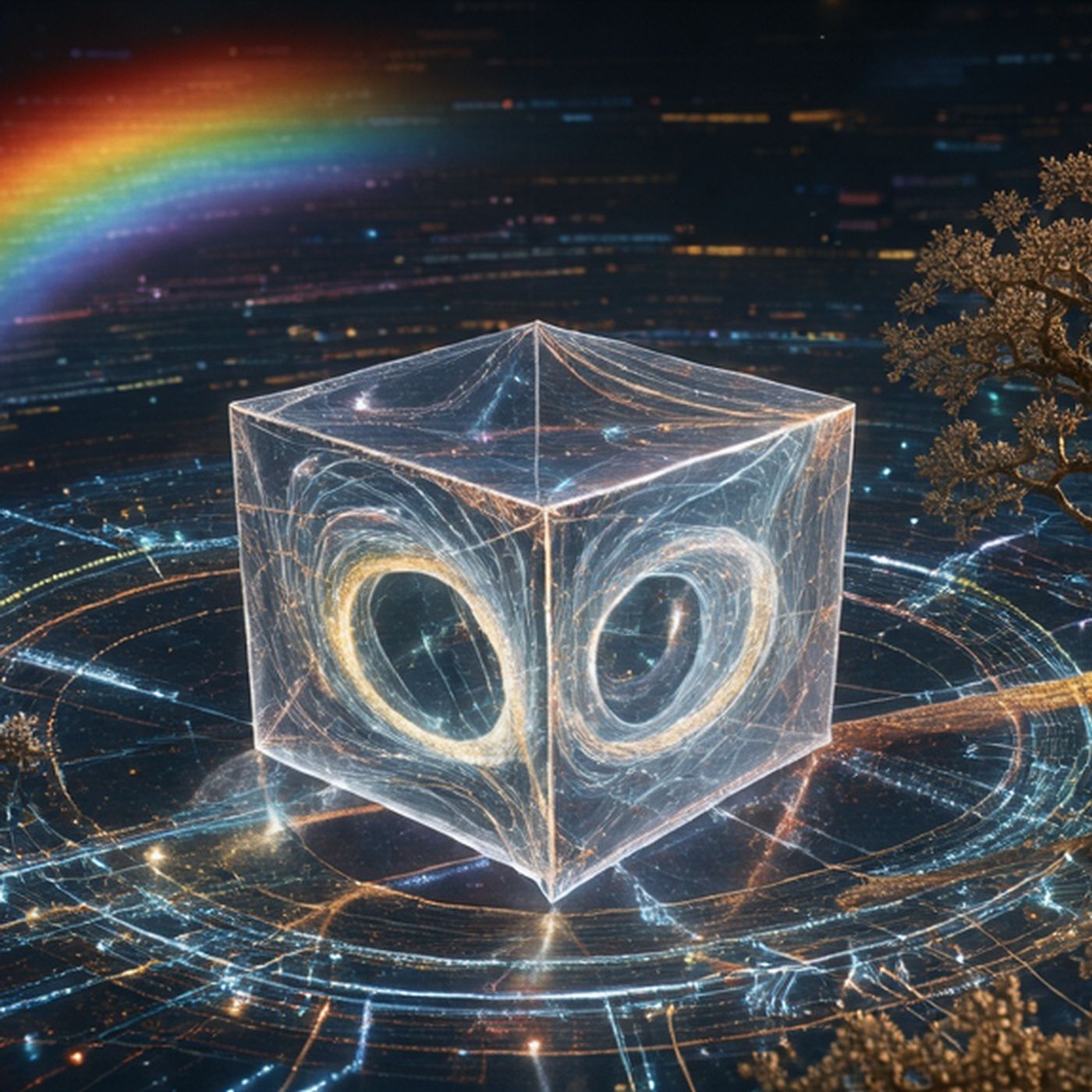
The episode dismantles the Western habit of reifying reality into static nouns, arguing that ancient Semitic languages conceptualized existence through dynamic verbs and processes rather than fixed objects. By contrasting the rigid Subject-Verb-Object syntax of Indo-European languages with the action-oriented structure of biblical Hebrew, the hosts reveal how a fundamental grammatical error—forced by translation—has shaped centuries of theological and scientific debate. This linguistic shift forced the living, recursive verb of the divine (YHWH, "the action of causing to become") into a static noun, creating a conceptual idol that paved the way for the "God is dead" narrative when Newt...
How Mistranslating Hebrew Froze Ancient Wisdom

This podcast episode profoundly recontextualizes ancient wisdom by pinpointing a foundational linguistic error: the Western world's ingrained fixation on static nouns, a consequence of Indo-European grammar, which has significantly distorted the dynamic, action-centric essence of ancient Semitic thought. This mistranslation transformed the divine, originally understood as an unceasing "verb of becoming"—represented by the acronym Generative Ordering Differentiation (G.O.D.)—into a rigid, external "noun God," inadvertently fueling centuries of intellectual conflict between mechanical atheism and religious fundamentalism. Concepts like "Torah" are thus recast, not as arbitrary legal codes, but as a "ballistic flight manual" for "trajectory vector calibration," guid...
Ancient Semitic Texts As Systems Theory
This episode radically reinterprets ancient Semitic texts, proposing they are not rigid moral codes but empirical operating manuals for reality, encoded with sophisticated concepts from complex systems theory, cybernetics, and quantum physics. By re-translating key Hebrew terms like "Torah" as telemetry for hitting a target, "chet" as structural drift, and "shalom" as dynamic homeostatic coherence, the discussion reveals how these narratives describe universal physical and biological laws. It unpacks Genesis as an algorithmic cosmogenesis of information emergence through boundary creation, critiques imperial monocultures through the lens of Ashby's Law, and re-frames rituals like the Red Heifer as empirical sanitization protocols...
Why Reality Needs The Devil
This episode fundamentally rethinks our understanding of good, evil, and the ultimate adversary by arguing that reality is not defined by clean, static categories but by dynamic, unfolding processes. It critiques how Western language, particularly its noun-heavy grammar, distorts our perception, creating an illusion of separation and leading to a form of idolatry where linguistic tools are mistaken for ultimate reality. The episode posits that the adversary, traditionally personified as the devil, is not inherently evil but represents a necessary structural function: the boundary-drawing force essential for creating form, distinction, and knowledge within an otherwise undifferentiated unity. Evil arises when...
How Nouns Distort Reality
This episode delves into the profound philosophical and linguistic argument that Indo-European grammar, particularly English, acts as an invisible epistemic training system, compelling us to perceive a dynamic, relational universe through the lens of static nouns and discrete objects. By dissecting the implications of this "grammatical habit," the discussion reveals how the pervasive subject-verb-object structure fosters an ontology of masters and victims, obscuring the inherent participatory "middle voice" of reality, where entities like a "river" or a "tree" are understood not as fixed things but as continuous, unfolding events—intersections of processes. The podcast further illuminates how this linguistic partitioning cr...
Ancient Myths As Data Compression
This episode radically redefines ancient myths not as primitive superstitions, but as sophisticated, high-density data compression formats designed to preserve advanced relational system science across millennia and civilizational collapse. Challenging chronological snobbery, it proposes history as a recursive cycle where what we perceive as spirituality can be the post-scientific synthesis of profound ecological awareness, encoding complex system dynamics like characters as variables and plot as algorithms, secured by ritual and sacredness. Through deconstructions of the Tower of Babel, understood as a warning against epistemic monoculture, and the Genesis Rainbow, revealing observer-dependent relational physics and creation as division, the discussion illuminates...
Why Science Always Rediscovers Ancient Myth
This episode fundamentally redefines humanity's understanding of progress, shattering the illusion of linear advancement—dubbed "chronological snobbery"—to reveal a cyclical "wheel of knowing." Instead of a staircase leading to ever-superior modern cognition, we explore "epistemic cycles" where advanced science matures into profound relational synthesis, or "spirituality." This evolved understanding then transforms into myth during civilizational collapse, solidifies into dogma, and ultimately sparks scientific rebellion that, paradoxically, rediscovers the very relational synthesis it sought to dismantle. The discussion delves into how ancient civilizations like the builders of Stonehenge possessed sophisticated empirical knowledge, not through lost technology, but through millennia of rigo...
How Your Body Reorganizes After Death
This episode fundamentally redefines the human body, moving beyond the traditional notion of a sealed-off individual to embrace it as a dynamic, multi-species ecology, outnumbered by trillions of microbial cells crucial for functions like mood regulation. Challenging the pervasive illusion of an isolated self, the discussion reveals our constant, vital exchange of matter and energy with the environment, emphasizing the inherent permeability of our perceived physical boundaries. This profound philosophical shift extends to reconceptualizing death itself, presenting it not as a hard stop or a void, but as an intricately connected reorganization within an unbroken, living continuum, offering a liberating...
God Is A Verb Not A Noun
This episode unpacks the profound philosophical misstep at the heart of the modern debate between religious fundamentalism and popular atheism, asserting both sides are trapped in a shared illusion rooted in a grammatical error. Beginning with a vivid analogy of arguing over a superhero's reality, the discussion reveals how the concept of 'God' was reified from a dynamic, relational 'verb'—as understood in ancient Hebrew thought and validated by contemporary quantum fields and second-order cybernetics—into a static 'noun' through a historical translation error from ancient Hebrew into Greek, heavily influenced by Aristotelian philosophy. This reification, embodied in the simple phra...
Why The Universe Never Began
This episode challenges humanity's ingrained perception of absolute beginnings and endings, arguing that such concepts are fundamentally flawed linguistic traps arising from our evolved cognitive mechanics. Our brains, optimized for detecting discrete "forms" (nouns) for survival, project these localized boundaries onto the entirety of existence, leading us to erroneously demand a "start" and "stop" for the cosmos. Through the ripple analogy, the discussion illustrates how perceived beginnings and endings are merely "observer's cuts"—points where a specific configuration is distinguished from an underlying, continuous process of "universing," a concept explicitly rejecting the notion of static "Legos." The "problem of nothing" re...
The Universe Is A Verb
This episode challenges the ingrained Western "static error" — our noun-centered linguistic habit that falsely assumes reality is comprised of isolated, fixed objects rather than a continuous, relational process. By examining the "binocular-like" limitations of first-order science, which gained analytical resolution by suppressing context and created "ontological technical debt," the discussion reveals how modern systems theory serves as a "technological bandage" to re-integrate what our grammar artificially disconnected. Drawing on insights from ancient engineering feats like the Egyptian pyramids and Gobekli Tepe, which demonstrate "imminent formalization" and procedural knowledge without abstract, written blueprints, the episode argues against "formalization supremacy" and "archival ep...
English Nouns Are A Scientific Trap
This episode delves into the profound philosophical and scientific limitations imposed by the very grammar of Western languages, particularly English, arguing that its inherent bias towards nominalization — transforming dynamic processes into static nouns — creates a fundamental cognitive trap that distorts our understanding of complex, interconnected realities. Exploring the concept of epistemic multilinearity, the discussion proposes building an "ideal language stack" to overcome this obstacle, advocating for the integration of diverse linguistic structures as rigorous scientific instruments. Biblical Hebrew offers an ontology of ceaseless process by focusing on verbal aspect rather than linear tense, challenging the Western philosophical legacy of mistaking abst...
How Language Carves Reality
This episode delves into the profound philosophical concept that language is not merely a transparent vehicle for thought, but an active architectural force fundamentally shaping our perception of reality. It introduces High Concept Labs' groundbreaking "epistemic interferometer" experiment, designed to probe whether a single multilingual AI model processes identical semantic events differently based solely on the grammatical coordinate system used. By meticulously comparing internal neural network states across languages like English, Greek, Hebrew, Arabic, and Chinese—selected for their distinct cognitive lineages—researchers aim to pinpoint the "epistemic divergence layer" where linguistic structures actively reorganize thought, moving beyond mere lexical or s...
Why The Universe Is A Verb
This episode challenges the fundamental perception of reality, proposing that the world isn't composed of static, isolated objects, or "nouns," but is instead a singular, continuous process, and our language, particularly grammar, actively tricks our brains into perceiving discrete entities for cognitive manageability. Drawing insights from academic papers like "Before the Noun" and "The Epistemic Signature of Language," the discussion posits that our ingrained understanding of existence, where things 'exist' before they 'do things,' is fundamentally backward. Rather than a dog existing and then barking, the core reality might be the "barking" itself, from which the concept of "dog"...
The Mathematics Of The Reified Ego
This episode rigorously interrogates "Reverse Reification Cybernetics," a theory positing that dogmatism and egotism aren't moral failings but a structural collapse of second-order cybernetic feedback, mathematically modeled as the "reification error" (M=E), where internal models are mistakenly equated with external reality. This error underpins "isomorphic dogma," demonstrating how dogmatic atheists and fundamentalist theists exhibit identical cognitive architectures, merely reversing conclusions, and fuels "epistemological absolutism" in phenomena like scientism and religious fundamentalism. The analysis reveals the grammatical noun itself as the "supreme idol," an artificial linguistic construct that freezes the continuous cosmic flux into static, reified concepts, thereby replacing dynamic...
Why Your Brain Hallucinates Nouns
This episode delves into the profound philosophical framework of reverse reification cybernetics, which posits that humanity's deepest intellectual conflicts, particularly the long-standing debate between dogmatic atheists and theists, are entirely manufactured illusions stemming from a fundamental misunderstanding of reality and language. Drawing an analogy to demanding a physical blue envelope inside a smartphone microchip, the framework argues that both biological perception and human language act as 'user interfaces,' hallucinating simplified realities for survival. Our visual system fabricates colors from invisible radiation, while language transforms a universe of dynamic 'verbs' (processes) into static 'nouns' (objects) to make the world navigable...
Unfreezing Reality With Reverse Reification
This episode delves into humanity's inherent cognitive flaw: our remarkable ability to create concepts and models to navigate the world, yet our tendency to forget these are mere tools, often mistaking them for reality itself—a phenomenon termed reification. We explore 'reverse reification,' a philosophical method to dismantle these frozen concepts, uncovering the dynamic processes beneath. Drawing on Alfred North Whitehead's 'fallacy of misplaced concreteness,' the discussion reveals how our language, particularly its noun-verb structure, encourages us to perceive continuous processes, like a river's flow or a flame's burn, as static entities, fundamentally shaping our ontology. This deep di...
Genesis As An Information Theory Blueprint
This episode delves into a revolutionary reinterpretation of ancient texts, specifically Genesis, arguing that its core philosophical blueprint has been fundamentally obscured by noun-heavy English translations. It introduces a sophisticated methodology, "reverse reification," akin to linguistic archaeology, designed to uncover the dynamic, action-driven processes and relational operations that constitute the text's true foundation, rather than viewing it as a static inventory of manufactured objects. This intellectual endeavor is rigorously guided by four controls: deep Hebrew philology highlighting the language's inherent kinetic energy, textual archaeology preserving layered historical meanings, comparative myth analysis to isolate invariant structural truths across cultures, and applied...
How Scientists Rebranded Ancient Mysticism
This episode delves into the profound question of what remains when all physical matter is removed, revealing the existence of "non-empirical realities" that fundamentally govern human logic, society, and perception of reality. Exploring concepts like the "50 non-empirical realities" and the intriguing "academic chop shop," the discussion unveils how modern thought, confronting the limits of physical matter, has historically co-opted and rebranded ancient spiritual technologies into secular jargon to navigate intellectual gatekeeping—dubbed the "greatest intellectual heist." The episode meticulously defines non-empirical truths as those validated by internal logic, structural rules, or communal agreement, rather than physical observation, highlighting their necessity fo...
The Fake War Between Atheists And Theists
This episode explores a profound philosophical critique arguing that the entrenched conflict between modern atheism and theism is a manufactured category error, stemming from a fundamental misunderstanding of human perception and language. Drawing from a paper titled "Atheism versus Theism, the Sin of Dogmatism," the discussion introduces the "physics of the user interface," illustrating how our biological senses, like vision, computationally fabricate subjective experiences such as color for survival, not objective truth. This biological user interface is mirrored by language, which creates static "nouns" to navigate a universe of continuous "verbs," leading to the concept of "God" as a supreme...
Your Dollar Is A Leap Of Faith

This episode profoundly dissects how the U.S. dollar, often perceived as a purely rational tool of commerce, actually represents a monumental triumph of non-empirical technology, arguing that modern finance fundamentally relies on a massive structural leap of faith. The ubiquitous motto, "In God We Trust," is revealed not as a mere historical artifact, but as a critical structural component embodying the "dual divinity of the dollar," which encompasses the "ghost of the state"—the collective belief in an abstract government that underpins fiat currency's value—and the "linguistic placeholder" of a "supreme noun" (God) essential for psychologically stabilizing money as a...
Atheists And Fundamentalists Are Identical Twins
This episode delves into a profound psychological inversion, arguing that the vehement crusading atheist and the fervent religious zealot are not opposing forces but rather mirror images of the same human flaw: dogma. Drawing from a fascinating essay titled "A True Atheist Does Not Try to Debunk Theism, Only a Dogmatic One Does," the discussion unpacks how both seemingly opposite positions employ identical cognitive playbooks, driven by an evangelical impulse to conquer and destroy opposing thoughts, rather than a genuine, secure non-belief or open-minded inquiry. The episode critically distinguishes between a 'true skeptic'—characterized by an agile mind, awareness of pe...
The Ambidextrous Path To Cognitive Artistry
This episode from High Concept Labs plunges into the profound capabilities of the human nervous system, beginning with a compelling thought experiment: flawlessly catching a wildly spinning cap while blindfolded, illustrating the brain's astonishing capacity for predictive modeling that fundamentally outpaces real-time sensory input. Challenging the pervasive assumption that such extraordinary physical precision is merely an innate, genetically predetermined gift, this deep dive explores a radical counter-thesis pioneered by Joseph Garrity. He transformed his own nervous system into a rigorous, longitudinal "n of one" experimental trial, systematically documenting his lived experience. Partnering innovatively with artificial intelligence, Garrity leverages this computational...
The Vocation Of The Cognitive Artist
This episode introduces a profound cognitive shift from the restrictive 'dictionary mind,' which treats concepts as isolated, exclusive definitions, to a more expansive 'chordal mind,' where meaning resonates from the simultaneous interplay of interconnected ideas, akin to a musical chord. This relational paradigm defines the 'vocation of the cognitive artist,' emphasizing the art of organizing meaning, discerning hidden structural architectures, and forging connections across seemingly disparate domains, rather than creating traditional art. Challenging the isolating effects of modern hyper-specialization, the discussion champions 'cultural idea-sthesia,' an ancient capacity to perceive symbols as cognitively dense environments that activate...
Space Is Your Internal Projection
This episode profoundly challenges the ingrained cultural and scientific belief that humanity is an insignificant speck within a vast, pre-existing external cosmos, introducing the revolutionary concept of the topological inversion of space. It posits that the finite observer is, in fact, the primary container, and the infinite universe perceived outwardly is merely an external projection of one's own internal mathematical depth. This paradigm-shifting perspective delves into an observer-centric topology, questioning the fundamental geometry of boundaries and how personal consciousness renders physical space, supported by mathematical proofs that suggest this infinite universe never repeats. The discussion grounds itself in George Spencer...
The Universe Is An Internal Projection
This episode fundamentally deconstructs the Cartesian-Newtonian "external container model of reality," which posits an objective, pre-existing universe independent of observation. Challenging naive realism, the discussion reveals how quantum mechanics, via theorems like Koch and Specker and Bell's, mathematically disproves preformed physical properties, demonstrating that observation creates rather than discovers reality. The inherent mathematical absurdities of an infinite external universe, highlighted by the Ergodic Paradox and Poincaré recurrence, necessitate a paradigm shift: the "observer-centric inverted locus model." This framework proposes that the finite biological observer is the primary container, with infinity structured inwardly. Drawing on bounded continuum mathematics, it illustrates how a...
Gender Dynamics From Parenting To Physics
This podcast challenges conventional understandings of gender, biology, and the universe by introducing "The Fractal Grammar of Gendered Relationality," a framework that moves beyond limiting biological essentialism and arbitrary social constructivism. It posits gender as an "infinite, scale-free relational operator," describing a fundamental, complementary polarity of "push and pull" dynamics inherent in all stable systems, from individual minds to cosmic mechanics. The "masculine" dynamic is functionally defined as the differentiating, boundary-setting force providing structural integrity, while the "feminine" represents the integrative, containing, generative, and nurturing force fostering internal coherence. Illustrated by a house needing both its steel frame and insulating...
The Systems Logic Of The Yin Yang
This episode critically reexamines the ubiquitous Taijitu, or yin yang symbol, urging a departure from its conventional interpretation as a static representation of opposing forces or compromise. Instead, it unveils the symbol as a dynamic blueprint for comprehending fundamental systemic mechanics, challenging the deeply ingrained Western dualistic mindset that compartmentalizes reality into mutually exclusive categories. The discussion centers on the profound concept of "recursive isomorphism," revealed through the Taijitu's often-overlooked inner dots, which signify that every relational pole intrinsically contains and necessitates its apparent opposite, denoting fundamental interdependency rather than opposition. Applying this principle, the podcast asserts that both extreme...
Modern Science Validates Ancient Metaphysics
This episode explores a profound paradigm shift, moving beyond the limitations of reductionist scientism, which mistakenly dissects reality into isolated, static components, akin to analyzing musical instrument parts instead of experiencing a symphony. It champions a holistic understanding of the "cybernetic logos," revealing reality as a dynamic, interconnected web of ongoing processes rather than a collection of billiard-ball objects. Drawing from both modern computational biology and ancient metaphysics, the discussion illuminates general systems theory's mathematical formalization of ancient intuitions like the Stoic concept of logos, focusing on dynamic relation and information flow as the fundamental primitive. Key concepts covered include...
All Life Is One Quantum Observer

This episode fundamentally redefines humanity's place in the cosmos, dismantling the classical physics narrative of human insignificance within an indifferent, infinite universe. It posits that all life on Earth is not a fragmented collection of individual organisms, but rather a single, continuous, 3.8-billion-year-old macro organism, structurally and energetically unified through "monocentric autopoiesis." This singular entity operates as the universe's primary localized observer, actively collapsing infinite quantum potential into a unique, non-repeating reality, counteracting the "ergodic fallacy" by continuously generating unprecedented novelty. Functioning as a "dissipative structure" and a "planetary-scale Markov blanket," this biosphere-as-observer processes information and minimizes "variational free energy"...
Gnostic Cosmology Fixes Ai Memory Bloat
This episode delves into the profound engineering crisis of 'graph context bloat' in modern AI memory architectures, particularly in graph retrieval augmented generation (RAG), where systems are overwhelmed by exponentially expanding data from knowledge graphs. It proposes a radical solution by bridging ancient Gnostic cosmology, five-dimensional holographic quantum physics, and multi-layered tensor networks. The discussion maps concepts like the Gnostic Pleroma (infinite potential) and Kenoma (illusory physical space) to the holographic principle's 5D bulk and 4D boundary, demonstrating how the universe itself performs 'dimensional reduction' to prevent computational collapse for localized observers. The Demiurge is reinterpreted as a universal rendering...
The Universe Is Internal Data Compression
This episode unveils a radical paradigm shift in understanding reality, proposing that the universe is not an external, empty container but an internal projection of the observer's cognitive processes. Drawing on George Spencer Brown's 1969 "Laws of Form" and modern theoretical physics, specifically MERA (Multiscale Entanglement Renormalization Ansatz) networks and holographic quantum gravity, the discussion redefines space, time, and observation. Listeners will discover how the fundamental logical operations of "calling" (condensation) and "crossing" (cancellation) found in Spencer Brown's calculus are precisely mirrored in the physical architecture of quantum tensor networks, where disentanglers clean noise and isometries compress data, literally generating spatial...
The Universe Is An Inverted Container
This profound episode challenges our fundamental understanding of the cosmos, radically inverting the conventional "dead box" universe model. By dismantling Cartesian dualism, it proposes that outer space is not a vast, empty void we are precariously placed within, but rather the boundless, externalized architecture of life's own interior depth, where telescopes become "nerves" allowing consciousness to "feel" its cosmic body. Exploring the "flat sun" metaphor, the discussion reveals that the universe's unimaginable size isn't meant to diminish us, but provides a "local horizon of infinity" – a massive buffer of phase space essential for generating absolute novelty and allowing complex systems li...
Spirituality Is Advanced Pattern Recognition
This episode challenges conventional notions of spirituality, reframing it as a rigorous, advanced form of "structural knowledge" distinct from, yet complementary to, empirical understanding. Drawing heavily on Gregory Bateson's systems theory, it posits that meaning and deeper understanding emerge from recognizing patterns and relationships within complex systems, rather than solely from isolated, quantifiable data. While modern society often conflates data accumulation with true comprehension, leading to a pervasive "starvation for meaning," the discussion highlights how structural knowledge—exemplified by a chess grandmaster's insight or the implicit wisdom of riding a bicycle—involves discerning the "pattern which connects" elements into a cohe...
