A Change in Conversation

Leading a complex tech transformation across multiple countries? Struggling to keep stakeholder engagement on-brand, on-message, and on-time—while making your program stand out in a noisy workplace? Whether you're migrating your ERP, rolling out a new HR system, or boosting AI adoption, you're in the right place. A Change in Conversation shows you how to communicate tech change that actually lands. You'll learn how to create communication that doesn't just sit in inboxes—but drives action across your organization. We share proven methods and real-world insights from 20 years of experience to help you reduce resistance, boost stakeholder buy-in, and ultimately driv...
19_Protecting the business case: What 30 years as CIO teach about IT transformation | Christian Graf (ex-CIO Schüco)
Why IT transformations still miss their business case, why the board has to own them, and which early warning signs every tech leader must act on.
Problem
Most large programs have governance, stage gates and training plans. Under delivery pressure, the evidence gets bent: good news gains weight, bad news gets explained away, and a program can pass its gates while people are far from ready. After go-live, the business case erodes in decisions nobody wants to take.
Why it matters now
AI has put data, processes and IT's contribution to value in...
19_Warum scheitern immer noch so viele IT transformationen? | Christian Graf (ex-CIO Schüco)
Why IT transformations still miss their business case, why the board has to own them, and which early warning signs every tech leader must act on.
Problem
Most large programs have governance, stage gates and training plans. Under delivery pressure, the evidence gets bent: good news gains weight, bad news gets explained away, and a program can pass its gates while people are far from ready. After go-live, the business case erodes in decisions nobody wants to take.
Why it matters now
AI has put data, processes and IT's contribution to value in...
18_How to build AI adoption without hype | Philipp Günther (Bosch Climate Solutions)
Philipp Günther, Director AI Enablement & Adoption at Bosch Climate Solutions, on how to turn AI curiosity into real usage, leadership role modelling, and measurable business value.
* Problem*
Many organisations approach AI adoption as a tool and training challenge: provide access, explain the basics, and expect usage to follow. Philipp Günther argues that this misses the real issue. People are already flooded with tools, information, and training. What they often lack is trust, confidence, time, and permission to try.
* Why it matters now *
AI will affect work across the whole organisation, including le...
17_Beyond Consultants and DIY AI: A Third Way to Drive Tech Adoption
Empower your internal project teams to build culturally aligned tech-adoption strategies that protects your ROI – without risking consulting dependency or AI-slop.
Problem
CIOs leading multi-million-euro transformations are currently trapped between two flawed extremes for driving user adoption: slow, expensive consultants who create long-term dependency, or generic AI tools that lack the cultural context to actually land the change. Both options fail to bridge the 'adoption gap,' leaving organizations with technically perfect systems that employees simply ignore. This failure quietly erodes ROI and creates unpredictable noise long after go-live.
Why it matters now
Wi...
16_4 things CIOs must get right to build influence
AI puts IT at the centre of business change – now CIOs must turn that moment into influence.
Problem CIOs have long wanted IT to be seen as more than an operational provider. But influence is not earned through technical delivery alone. It depends on whether business stakeholders understand the direction, trust the guidance, adopt the technology, and see the value.
Why it matters now AI and data have moved IT into the centre of business change. This creates a rare opportunity for CIOs to strengthen IT’s strategic role — or miss the moment.
**What you’ll learn...
15_Building trust with credibility:How to move IT from firefighting to trusted business partner/Linda Söderberg (Sysmex)
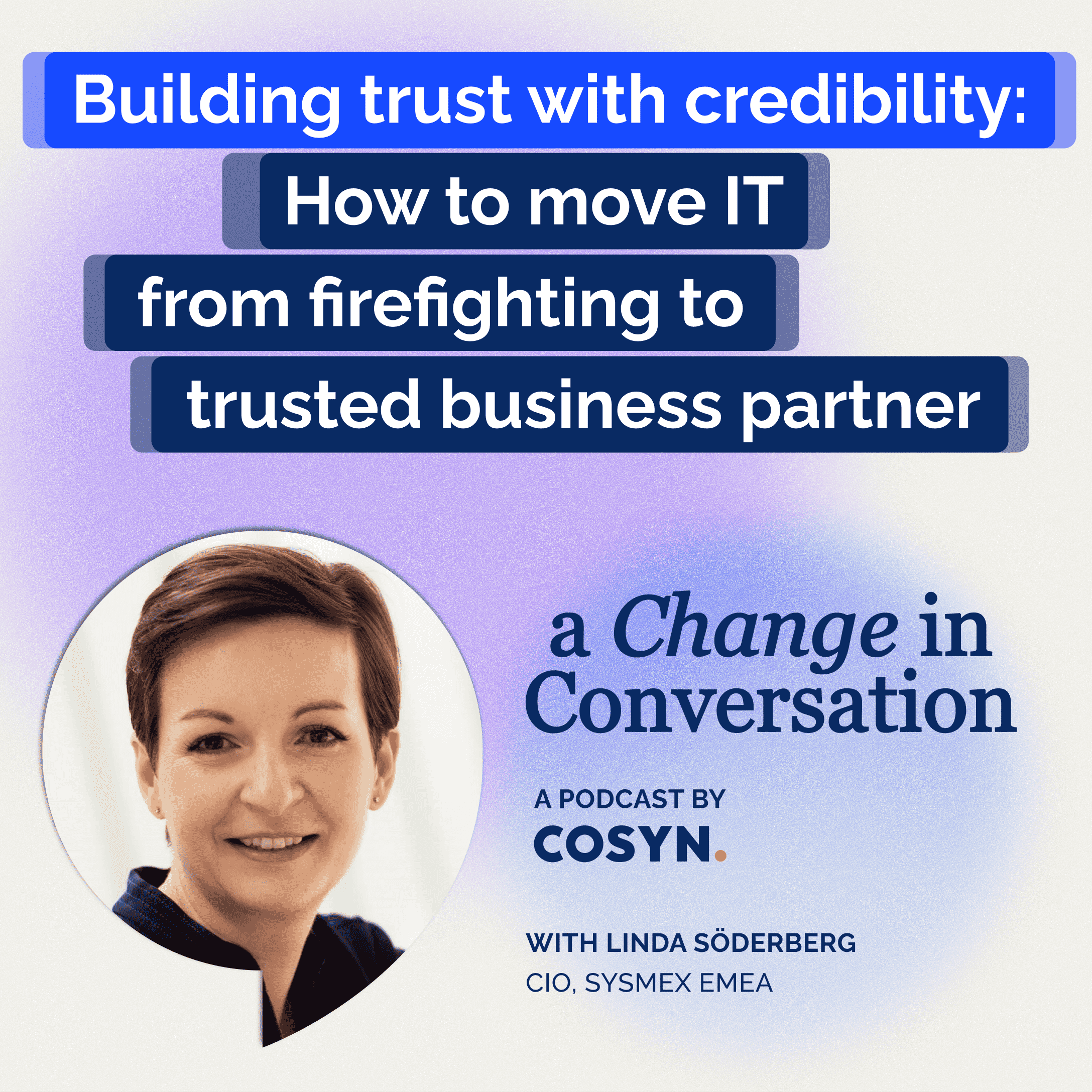
A practical CIO perspective on reducing operational noise, rebuilding IT confidence, and creating the conditions for tech adoption.
Problem
Many IT organisations are still trapped between operational firefighting and rising business expectations. When noise, unclear priorities, and constant demand dominate the agenda, IT struggles to create room for innovation, strategic partnership, and long-term credibility.
Why it matters now
CIOs are under pressure to keep the business running while preparing for AI, automation, and new digital demands. Without focus and trust, even strong IT teams risk being seen as reactive rather than value-adding.
<...#14_Stakeholder buy-in at scale:How to mobilize 80 countries behind one SAP transformation |Jorge Lopez (Syngenta Group)

A reverse, customer-led approach that turns early stakeholder engagement into stronger ownership, faster adoption and less resistance.
Problem
Most SAP programs still treat rollout as a deployment problem. The result is familiar: late stakeholder pushback, weak local ownership, uneven adoption and endless Hypercare phases. In this episode, Jorge Lopez explains why large-scale transformation only works when program leaders build business commitment, strong team alignment and clear governance long before go-live.
Why it matters now
Global programs are under pressure to standardise faster while proving value earlier. If adoption lags, the business case weakens...
#13- When to start your stakeholder engagement
Early engagement protects adoption, program credibility, and ROI.
Most ERP programs start stakeholder engagement too late. By the time questions, frustration, and local pushback become visible, the program has already lost time, goodwill, and part of its adoption potential. What looks like a communication issue is often a business risk: weaker adoption, slower stabilization, and an ROI story that starts to crack.
Why it matters now
This matters now because large tech programs are under more scrutiny than ever. CIOs and program leads are expected not just to go live, but to prove usage, value...
#12- The 4 forces behind tech adoption
Why users resist, where adoption breaks down, and what leaders can do early to protect ROI.
Most tech programs do not lose value at go-live. They lose value in the weeks and months after, when usage drops, workarounds appear, and local teams quietly disengage. The issue is rarely the system alone. Adoption is shaped by four forces that either reinforce behaviour change or weaken it before the rollout has a real chance.
Why it matters now
This matters now because CIOs and program leads are under pressure to show ROI faster, reduce disruption, and move...
#11 - Why recognition is the fuel that will power your team through the ERP marathon
Discover why recognition is your program’s "immune system" and how to operationalize it to sustain performance.
ERP programs are marathons where recognition often disappears between stage gates, creating a dangerous "Rush & Drop" cycle. This oversight isn't just about morale; it's a delivery risk that erodes the resilience your team needs for critical phases like UAT and cutover.
Why it matters now
Recognition acts as your program's "immune system," protecting delivery capacity and preventing expensive talent churn in high-pressure, multi-year projects.
What you’ll learn
Avoiding the "Rush & Drop" engagement trap.
<...#10 - Mind the gap: How to spot comms risks before they drive resistance
Learn to use the "Hit vs. Shit" radar to predict resistance and protect your program's ROI and reputation.
Every program log tracks data migration and cutover, but few track the communication risks that actually kill adoption. This "hidden risk" often manifests as "silent noise"—quiet withdrawal or non-compliance—that sabotages your rollout long before go-live.
Why it matters now
Your program is an internal brand; if expectations don't match reality, trust erodes, and once trust is gone, your ROI evaporates, regardless of technical readiness.
What you’ll learn
Why "Silent Noise" is mor...
#9 - How decentralising comms can help to hedge local resistance
Learn how to activate local multipliers to turn 'HQ noise' into local ownership and secure global adoption.
Global tech programs often fail when local teams treat them as distant "HQ initiatives," leading to passive resistance and low adoption. This disconnect is rarely about language; it's an ownership deficit that leaves local leaders disengaged when you need them most – and creates shaky go-lives.
Why it matters now
Without a strategy to bridge the central-local gap, you risk costly rollout delays, overloaded hypercare, and a solution that technically works but fails to deliver value on the ground...
#8 - How to find the sweet spot of visibility for your IT program
Standing out in an increasingly noisy organisation to protect buy-in and user adoption.
Many IT programs struggle to secure buy-in because they misjudge visibility—sharing too much, too early, or too late. In a saturated attention economy, broadcasting every technical milestone trains stakeholders to ignore you, creating noise rather than alignment.
Why it matters now
Your program competes with every other initiative for airtime and leadership focus; without precise calibration, you risk eroding credibility before your rollout even begins.
What you’ll learn
The 3 visibility traps that kill adoption: Noise, Timing, and...
#7 - How the ghosts of project past shape adoption before you even start
Uncover how past failures create early resistance—and learn how to fix it before rollout.
Many tech programs struggle long before rollout because past failures quietly shape how people respond to the new initiative. Years of overpromising and underachieving, along with burned terminology, sit in the collective memory and trigger visible or hidden resistance that standard communication can’t fix. Without diagnosing this heritage, adoption stalls, engagement drops, and credibility weakens – even when the technical solution is strong.
Why it matters now
CIOs and program leads are under pressure to protect ROI and avoid another “quiet fa...
#6 - Why your Why is everything
How a clear business purpose strengthens alignment, reduces resistance, and keeps your tech program credible when pressure rises.
Many tech programs are launched with a solid plan for the “what” and “how” of their change, but the core business “why” is vague or missing. Without a clear why, stakeholder commitment stays shallow, resistance increases, and programs lose momentum when pressure rises. The result is higher adoption risk and greater vulnerability to credibility issues when challenges appear.
Why it matters now
Long programs like SAP and ERP require sustained alignment across functions, markets, and leadership layers. A clear why...
#5 - Why understanding your stakeholder is the key to fixing tech resistance
Spot hidden concerns before they escalate into visible resistance.
Many ERP and platform programs struggle not because the technology is weak, but because teams overlook critical stakeholders whose concerns surface too late.
Superficial stakeholder analysis creates avoidable noise, unexpected pushback, and jeopardises adoption and program credibility. Most of this risk is predictable – if you know what to look for.
Why it matters now
Tech changes now touch more functions, regions, and workflows than ever. Missing even one influential group can slow decision-making, stall testing, or trigger visible resistance at the worst possible moment.
...
#4 - Discover the early-warning system every IT leader needs before go-live
How structured dialogue surfaces risks before they hit your rollout and ROI.
Most tech programs don’t fail because the system is wrong — they fail because stakeholder misalignment goes undetected until it damages adoption, timelines, or ROI. When IT teams rely on training and top-down information alone, they miss the early signals that something in the field isn’t lining up with the project plan.
Why it matters now
With parallel transformations and rising CFO scrutiny, IT leaders can’t afford late-stage surprises. You need a reliable way to detect reputational risks before go-live.
What y...
#3 - The art of positioning your change to deliver buy-in, not resistance
Avoid the trust and adoption risks caused by overpromising or underselling your transformation.
Most tech programs lose credibility long before go-live — not because the system fails, but because leaders set the wrong expectations.
Overpromising creates disappointment. Underwhelming stories disappear in the noise. Both increase stakeholder risk and quietly erode adoption.
This episode breaks down how to position your program in a way that earns trust and protects ROI.
Why it matters now
Right now, CIOs and program leads are under pressure to show value, avoid resistance, and justify major investments. Getting yo...
#2 - The three common blind spots that could derail your ERP comms strategy
How to surface the early warning signs that shape adoption, credibility, and ROI long before go-live exposes the gaps.
Many tech programs fail not because of the system, but because leaders overlook the organisational signals that shape behaviour long before go-live. History, context, and strategic alignment are often ignored, leaving adoption to chance. These blind spots quietly erode credibility and turn expensive transformations into low-usage investments.
Why it matters now
CIOs and program leads are under pressure to show ROI, reduce stakeholder risk, and avoid becoming the next “quiet failure” after a technically successful go-live.
<...#1 - Five comms strategies to guarantee your most successful ERP launch ever
The human factors that determine ERP adoption, alignment, and long-term value.
ERP programmes rarely fail because of technology. They struggle because ERP reshapes how an organisation works — how decisions flow, who owns what, how people collaborate, and which routines and power structures survive the change. Most teams prepare rigorously for technical risk, but treat the human side as an afterthought. That’s where adoption, data quality and alignment quietly fall apart.
Why it matters now
This episode explains why ERP is uniquely human, and why ignoring the underlying behavioural dynamics can turn even strong programmes into...
#0 - The school of stakeholder engagement for IT leaders
Why we are on the mission to empower IT Leaders to deliver stakeholder engagement with confidence and impact
Your dashboard shows green, yet 70% of enterprise tech transformations fail to deliver their business case. The failure point is rarely the software; it is the critical gap between technical readiness and actual user adoption.
Why it matters now:
With $66 billion lost annually to cost overruns, sustainable adoption is the only metric that truly protects your ROI and your leadership reputation.
What you’ll learn:
Why "Go-Live focus” is often a shortsighted mistake. The hidden fina...Trailer A Change in Conversation
Welcome to A Change in Conversation. The podcast that helps IT Leaders to land their Tech Change with minimal noise and maximum adoption.