Okay, But... Birds

Hosted by evolutionary biologist Dr. Scott Taylor, Okay, But... Birds explores the drama, brilliance, and science behind bird life. Each snackable 30-minute episode blends smart storytelling, expert interviews, and a touch of humor to reveal how birds shape our world. No jargon. No binoculars required. Just real science, quirky insights, and bird-brained drama you’ll want to share at brunch. Because birds aren’t background. Birds are cool.
Okay, but... cranes!

E40. There are only 15 crane species on the planet, and 11 of them are in trouble. Dr. Andy Caven, Director of Central Flyway Programs for the International Crane Foundation, has spent his career on two of them: the sandhill cranes that pour into one stretch of Nebraska's Platte River every spring, and the whooping crane, which came back from the edge and is still nowhere near safe. Scott asks him what it actually takes to keep a bird like that on the landscape, and the answer runs through soggy grassland, private ranches, and one river worth fighting over.
...
Okay, but why does that bird look so rough?

E39. Every August the questions start: there is a cardinal at the feeder with no head feathers, and it looks terrible. Nothing is wrong with it. It is molting, which every bird does at least every year. Dr. Ryan Terrill of the San Diego Natural History Museum studies what a feather endures over a year and what it takes to replace one, and he makes the case that the few weeks a bird spends looking its worst may be the most consequential weeks it has.
In this episode, you'll hear about:
Why the cardinal at your...Okay, but what's up with feathers?

E38. You have pulled one out of a jacket sleeve at a bad angle, picked one up on a walk, and you are almost certainly within arm's reach of a few thousand of them right now. Dr. Cody Limber, who recently finished his PhD at Yale, spent it taking growing feathers apart one cell at a time to find out what they are actually made of. A feather is not a fancy scale, it does not grow the way you would guess, and after all this time nobody can say what the first ones were for.
In...
Okay, but does age bring Wisdom?

E37. A bird called Wisdom was banded on Midway Atoll in 1956 and is still laying eggs today, which makes her at least 75 and the oldest known wild bird on the planet. She has also outlived the man who banded her, and most of the scientists who tracked her since. Dr. Etienne Rouby studies long-lived seabirds at the Institute of Arctic and Alpine Research at CU Boulder, working with data from the French sub-Antarctic islands where wandering albatross have been followed for more than half a century. Scott asks him what you can learn from a bird that will outlast...
Okay, but do hummingbirds ever chill?

E36. Hummingbirds run one of the fastest metabolisms of any animal with a backbone, which is why we picture them as permanently buzzing. Scott sits down with Dr. Anusha Shankar, assistant professor at the Tata Institute of Fundamental Research, who studies how hummingbirds budget energy in a world that keeps moving the goalposts. It turns out the blur at your feeder is the exception, not the rule.
In this episode you'll hear about:
Why the same bird might spend three hours a day flying, or thirteen, depending entirely on what the flowers are doingWhat happens overnight...Okay, but what's the deal with Darwin's finches?

E35. Eighteen species of small brown bird on a pile of volcanic rock have taught us more about how evolution actually works than almost anything else on Earth. Not because Darwin figured them out. He didn't. Because a handful of scientists went back, banded every bird on one island, and watched it happen in real time. Scott heads to the Galapagos with Dr. Erik Enbody, Assistant Professor of Computational Biology at Cornell University, to find out how one ancestor became eighteen, why the beak is the only thing worth looking at, and what happens when species that aren't supposed...
Okay, but what's the deal with nests?

E34. Not all birds build one, but for the ones that do, a nest has a single job and a shockingly wide range of ways to get it done. Dr. Vanya Rohwer, Curator of Birds and Mammals at the Cornell University Museum of Vertebrates, joins Scott to walk the far end of that spectrum, from nests made entirely of spit to a colony structure heavy enough to snap the tree it sits in.
In this episode you'll hear about:
The complete and comical inventory of one hamerkop nest, read aloud, contents includedWhat a bird does when...Okay, but how do birds handle a heatwave?

E33. When the air temperature climbs past a bird's own body temperature, staying cool stops being free and starts to cost them water they may not have. Dr. Blair Wolf, University of New Mexico, has spent his career studying how desert birds survive heat that should kill them, and what happens when it finally gets too hot.
In this episode you'll hear about:
Why some backyard birds can shrug off oven-like temperatures while others just a few feet away don't make itThe strange, water-saving trick birds use to dump heat without a single drop of sweatWhat...Okay, but how does wildfire smoke impact birds?

E32. Wildfire smoke is blanketing more of the map every year, and it turns out a smoky sky changes everything for birds, from how they breathe to whether we can find them at all. Dr. Olivia Sanderfoot, Research Scientist at the Cornell Lab of Ornithology, is back to walk Scott through what all that haze is doing to the birds living in it.
In this episode:
Birds don't breathe the way we do, and that single fact shapes everything about how smoke hits themStay, shift, or go: the framework for what a bird actually does when...Okay, but did birds invent music?

E31. If a bird sings a phrase worthy of Beethoven, is that music, or just biology in a nice outfit? Dr. Hollis Taylor, a violinist, composer, and ornithologist, has spent more than two decades recording and transcribing the songs of the Pied Butcherbird, an Australian songbird whose vocal life keeps blurring that line.
In this episode:
How a single pied butcherbird can sing for seven hours through the night, almost never repeating itself, then return the next spring with a brand new repertoireWhat a violin can and can't reproduce when it tries to follow a butcherbird...Okay, but is the dawn chorus getting quieter?

E30. That wall of birdsong outside your window at sunrise has a name, a structure, and a surprising amount of drama. This week Scott talks with Dr. Dan Mennill, a professor at the University of Windsor who wires whole forests with microphones to eavesdrop on the entire neighborhood at once, about what the dawn chorus is actually for, and what it means when it starts to thin out.
In this episode:
Why dawn, why so loud, and who gets to sing first (hint: it's not about who's the best singer)What 16 microphones and kilometers of cable...Okay, but what's it like as a bird at the top of the world?

E29. Standing at 11,000 feet, lungs burning, Scott watched birds go about their afternoon in the exact thin air that had nearly taken him out. This week he sits down with Dr. Chris Witt, evolutionary biologist at the University of New Mexico and curator of birds at the Museum of Southwestern Biology, who has spent his career figuring out how birds make a living in the thinnest air on Earth. From the hummingbird blood that rewrites itself to match a mountainside to a five-pound coot that has no business existing, this one is about the birds thriving where our bodies...
Okay, but does easy living make birds dumber?

E28. A bird's brain is the most expensive thing it owns, and evolution doesn't hand one out for free. Dr. Carlos Botero, Associate Professor at the University of Texas at Austin, has spent a decade tracing what variable, unforgiving environments actually do to bird cognition, and the answer flips a lot of conventional wisdom on its head.
In this episode:
Why the harshest places on Earth produce two kinds of birds: the puzzle-solving geniuses and the brute-force survivors, with almost nothing in betweenHow big brains might not have evolved for the reasons we always assumedWhy being...Okay, but... pigeons!

E27. They’ve been called "rats with wings," but pigeons are actually elite athletes, historical icons, and evolutionary marvels. Scott chats with Dr. Elizabeth Carlen, a postdoc at the Living Earth Collaborative at Washington University in St. Louis, to look past the common stereotypes and uncover the remarkable biology of the Rock Pigeon.
In this episode, you’ll hear about:
The deep historical bond between humans and pigeons and how domestic birds successfully transitioned back into the wild.How pigeons navigate the constant threat of specialized hunters like Peregrine Falcons and Red-tailed Hawks.How mapping the DNA...Okay, but did birds originate the open relationship?

E26. We borrowed a phrase from human dating and tried to pin it on birds. Turns out they never needed the rulebook. Dr. Wenfei Tong, biologist and author of Bird Love, joins Scott to unpack what bird partnerships actually look like once you stop projecting our scripts onto them, from females who run the territory to males who guard their paternity in deeply weird ways.
In this episode you'll hear about:
Why the drabbest little brown bird in the garden has one of the wildest sex lives in the animal kingdomHow a female calls the shots...Okay, but... boobies!

E25. The blue-footed booby has become an internet personality: cartoon feet, a goofy strut, a name that practically begs to be a punchline. But Scott sat down with Dr. Carlos Zavalaga, Universidad Científica del Sur, and one of the people who first taught him how to study seabirds in Peru, and the "fool" reputation falls apart fast. Get a booby in the air or underwater and you're watching one of the most specialized hunters in the bird family tree.
In this episode you'll hear about:
How six-plus booby species carve up the same ocean without s...Okay, but what about birds that can't fly?

E24. Flight is the thing we associate most with birds, so what does it mean when a lineage gives it up? Dr. Scott Edwards, Harvard, joins Scott to unpack how flightlessness evolves, why it keeps happening across the bird family tree, and what the genome reveals about how a bird loses the ability to fly.
In this episode you'll hear about:
How losing flight reshapes a bird's body, from feathers to forelimbs to that one famously enormous eggWhy the answer wasn't where geneticists expected to find itWhat an extinct giant and a tiny tropical relative can...Okay, but can a bird really cooperate with humans?

E23. Across sub-Saharan Africa, wild birds and people work together to find honey. No taming, no breeding, no domestication… just a partnership thousands of years in the making. Behavioral ecologist Dr. Jessica van der Wal, FitzPatrick Institute of African Ornithology, joins Scott to unpack what's actually happening when a honey hunter calls and a greater honeyguide answers.
In this episode you'll hear about:
What each side gets out of one of the only known mutualisms between humans and a wild animal, and why this bird in particular evolved to seek us outThe remarkable signal the honeyguide us...Okay, but can a bird really cooperate with humans?

E23. Across sub-Saharan Africa, wild birds and people work together to find honey. No taming, no breeding, no domestication… just a partnership thousands of years in the making. Behavioral ecologist Dr. Jessica van der Wal, FitzPatrick Institute of African Ornithology, joins Scott to unpack what's actually happening when a honey hunter calls and a greater honeyguide answers.
In this episode you'll hear about:
What each side gets out of one of the only known mutualisms between humans and a wild animal, and why this bird in particular evolved to seek us out The remarkable signal the hon...Okay, but can birds predict the weather?

E22. Folklore says birds know a storm is coming before we do. Scott talks with Dr. Gunnar Kramer, Iowa State University, about what's actually happening when a tiny warbler decides it's time to fly, or time to bail.
In this episode:
Why the question itself might be slightly wrong, and what's really going on inside that birdA storm, some missing warblers, and a discovery nobody set out to makeWhat 300 birds falling out of the sky over Texas can tell you about how much fuel is in the tankListen, follow, and tell a friend...
Okay, but can birds predict the weather?
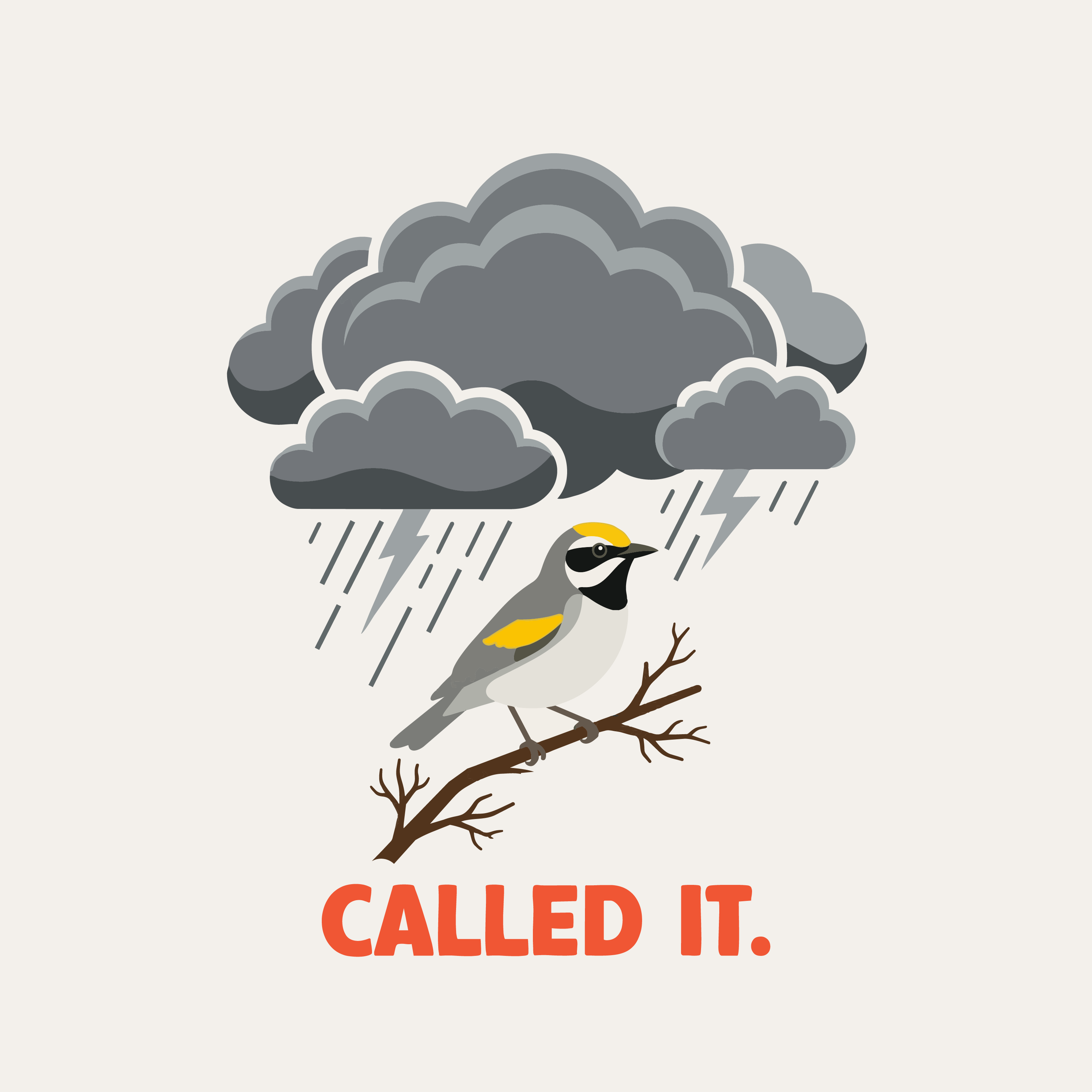
E22. Folklore says birds know a storm is coming before we do. Scott talks with Dr. Gunnar Kramer, Iowa State University, about what's actually happening when a tiny warbler decides it's time to fly, or time to bail.
In this episode:
Why the question itself might be slightly wrong, and what's really going on inside that birdA storm, some missing warblers, and a discovery nobody set out to makeWhat 300 birds falling out of the sky over Texas can tell you about how much fuel is in the tankListen, follow, and tell a friend...
Okay, but can birds smell?

E21. We're talking sense and scents with Dr. Danielle Whittaker, Oregon State, and author of The Secret Perfume of Birds, who spent a decade unraveling a 200-year-old myth that started with John James Audubon and a dead pig under a bush.
In this episode:
The bird that smells like a fresh-baked sugar cookieWhy preen oil is a dating profile written in chemistry, and how seabirds use the same chemical cue that's now leading albatross parents to feed their chicks plasticThe bonus myth Danielle wants goneNew here? Listen, follow, and tell a friend who...
Okay, but what can we learn from a drawer of birds?

E20. Less than 1% of what's in a museum is actually on display. So what's happening with the other 99%? Scott talks with Dr. Sushma Reddy, Breckenridge Chair of Ornithology at the Bell Museum and Associate Professor at the University of Minnesota, about the extraordinary scientific afterlife of a specimen in a drawer.
In this episode:
How birds collected 150 years ago are answering questions their collectors never imagined, from air pollution to insect declineWhy falcons turned out to be closer to parrots than hawks, and what other surprises fell out of the bird family treeThe case for making...Okay, but are bird feeders helping or hurting?

E19. More than 55 million Americans feed birds, and it's not exactly clear the birds asked us to. Dr. Olivia Sanderfoot, Research Scientist and Project Leader of FeederWatch at the Cornell Lab of Ornithology, joins Scott to unpack what four decades of data tell us about whether feeding birds helps them, hurts them, or is really just for us.
In this episode you'll hear about:
Why bird feeding is mostly for us, and the handful of moments when it actually tips the scales for birdsWhat forty years of FeederWatch data reveal about shifting ranges, feeder dominance, and...Okay, but what's in a bird's toolbox?

E18. Turns out "bird brain" is less of an insult and more of a compliment. Scott sits down with Dr. Alex Kacelnik, Emeritus Professor at the University of Oxford, to dig into one of the most mind-bending questions in animal behavior: are birds actually building and using tools, or are we just projecting?
In this episode you'll hear about:
The experiment that left researchers completely flabbergasted and rewrote what we thought we knew about animal intelligenceWhy flexibility, not raw smarts, is the real test of a thinking mindWhether the drive to use tools is something birds...Okay, but do birds have culture?

E17. From sparrow songs that go viral across a continent to cockatoos that watch each other to learn how to open bins, Dr. Lucy Aplin, Australian National University / University of Zurich, studies how birds learn from each other and why it matters. Doing it for the culture? Yep. Birds are that impressive!
In this episode you'll hear about:
How a new white-throated sparrow song spread over 3,000 kilometers in just two decades, replacing a tune that had been stable since the 1950sThe experiment that proved wild great tits can establish lasting cultural traditions through their social networksWhy...Okay, but why put eggs in another bird’s basket?

E16. What if the secret to raising more babies was to never raise a single one yourself? Dr. Chris Balakrishnan, Associate Adjunct Professor of Biology at East Carolina University and co-founder of Nerd Nite, has spent his career studying the strangest birds on the planet: the ones that outsource parenthood entirely.
In this episode you'll hear about:
The evolutionary arms race between brood parasites and their hosts, from mimetic eggs to alien-looking chick mouth patternsHow the "password hypothesis" explains how brown-headed cowbirds avoid imprinting on the wrong speciesWhy host-switching in African parasitic finches can drive the...Okay, but what makes a yard a bird paradise?

E15. Most people picture a bird-friendly yard and imagine feeder, birdbath, maybe a decorative birdhouse with mortgage vibes. And feeders are great. But a feeder can give you the illusion of helping birds without creating the thing birds need most: habitat.
In this episode, Dr. Doug Tallamy, Professor in the Department of Entomology and Wildlife Ecology at the University of Delaware, joins Scott to explain why your yard is conservation infrastructure in disguise, and what it actually takes to turn it into a place birds can live, breed, and thrive.
In this episode you'll hear...
Okay, but what makes a bird… a bird? Hint: Dinosaurs!

E14. What do feathers, toothless beaks, and a 66-million-year-old asteroid have in common. Paleontologist Dr. Daniel Field, University of Cambridge, joins Scott to unpack how birds evolved from dinosaurs, and why defining "bird" is trickier than you think.
In this episode you'll hear about:
Why Archaeopteryx had half the features of a modern bird and lacked the other half, and what that tells us about 150 million years of evolutionThe "Wonderchicken," a tiny fossil from the border of Belgium and the Netherlands that rewrote what we know about birds surviving the asteroid impactHow micro CT scanning lets...Okay, but why do some birds babysit?

E13. Some birds skip having their own families and spend years helping raise their siblings instead. It sounds like altruism, but it's probably more complicated than that. In this episode, host Dr. Scott Taylor is joined by Dr. Nancy Chen, UCLA, to unpack the notion that it takes a village to raise a child chick.
In this episode, you'll hear about:
Why some birds spend years as unpaid helpers before starting families of their ownWhat the Florida Scrub-Jay's 50-year study at Archbold Biological Station revealed about cooperative breedingWhether helping your siblings is really altruism or just...Okay, but how do birds stay warm?

E12. Winter isn’t just “cold” for a bird, it’s a nightly survival math problem: generate enough heat, lose as little as possible, and don’t get eaten while you’re fueling up. In this episode, host Dr. Scott Taylor is joined by Dr. Maria Stager, UMass Amherst, to break down the clever physiology and weird little behaviors that let birds ride out freezing temps, from icy duck feet to “feather puffball” mode to energy-saving torpor.
In this episode, you’ll hear about:
How birds keep their feet from freezingHow feathers and shivering muscles act like a built-in wi...Okay, but why is a bird’s world more colorful?

E11. Bird vision isn’t just “better than ours,” It’s operating in a different color space, including ultraviolet. In Host Dr. Scott Taylor is joined by Dr. Allison Shultz, Associate Curator at the Natural History Museum of Los Angeles County, to break down what birds can actually see, how scientists measure color in the real world, and why feather color is one of evolution’s most powerful (and misunderstood) tools.
In this episode, you’ll hear about:
How birds see a whole extra dimension of color (including UV) and why we can’t truly experience “bird vision” wit...Okay, but can birds keep up with climate change?

E10. Seasons used to feel predictable. Winter showed up, spring arrived on cue, and birds could run their annual schedules like clockwork. But now the timing is weird: early heat, late snow, shifting green-up, and food peaks that don’t always line up. In this episode, host Dr. Scott Taylor is joined by Dr. Morgan Tingley, Professor of Ecology and Evolutionary Biology at UCLA, to unpack what “keeping up” with climate change actually means for birds, how scientists measure it, and what gives birds a fighting chance on a rapidly warming planet.
In this episode, you’ll hear abo...
Okay, but is birdwatching the original Pokémon?

E9. Birdwatching, birding, twitching… whatever you call it, it’s got everything: quests, rare finds, elaborate gear, a sprawling universe of characters, and a deeply committed fandom. Sound familiar? In this episode, host Dr. Scott Taylor is joined by NYT best-selling author and Pulitzer Prize-winning journalist Ed Yong to explore how modern birding became more accessible than ever (hello, Merlin and eBird), why it can feel like an open-world RPG, and what the Pokémon comparison misses.
In this episode, you’ll hear about:
How Ed Yong fell into birding after moving to Oakland, and why the “vi...Okay, but why do some birds thrive in cities?

E8. Cities can look like a concrete nightmare for wildlife… yet some birds are absolutely crushing it, while others vanish. In this episode of Okay, But... Birds, host Dr. Scott Taylor is joined by Dr. Fran Bonier, Professor at Queen’s University, to unpack what “urban birds” really are, why cities create winners and losers, and what it actually costs a bird to live the high-rise life.
In this episode, you’ll hear about:
Which birds tend to become “city birds,” and why some species thrive in urban spaces while others disappearThe concrete benefits and hidden costs of city...E7: Okay, but who helped build the world’s bird soundtrack? The inside scoop on Merlin!

E7. Every bird song you’ve ever heard on a hike, through an open window, or sampled in a nature documentary has a story behind it. In this episode, host Dr. Scott Taylor is joined by Linda Macaulay, Chairman of the Board of the Cornell Lab of Ornithology, to explore how bird sounds get recorded, preserved, and shared with the world, and why audio might be one of the most powerful tools we have for understanding and protecting birds. And yes, it’s THAT Macaulay; the one with the library named after her. Casual.
In this episode, you’...
Okay, but how do chickadees never forget?

E6. While chickadees look cute, they are also running one of the most impressive memory systems in the animal world. They hide food across the landscape, then somehow return to an insane number of individual spots later, even after snow, wind, and chaos try to erase the evidence. In this episode, host Dr. Scott Taylor is joined by Dr. Vladimir Pravosudov, Professor at the University of Nevada, Reno, to dig into how chickadee brains pull off this feat, what we know from decades of experiments.
In this episode, you’ll hear about:
How many caches chickadees ac...Okay, but why fly from the Arctic to Antarctica and back every year?

E5. Every spring and fall, billions of birds pull off the most ambitious commutes on Earth. In this episode, host Dr. Scott Taylor is joined by Dr. Nate Senner, Mass Audubon Bertrand Chair for Ornithology in the Department of Environmental Conservation at the UMass Amherst, to break down why birds migrate, how they navigate, and what happens when the world (or the bird) gets thrown off course.
In this episode, you’ll hear about:
Why birds migrateHow birds navigate long-distance routes, and what’s instinct vs. learnedHow scientists track migration across continents and the wildest journey Nate...Okay, but bird flu is really bad, right?

E4. Bird flu used to sound like a “poultry industry problem.” Now it’s showing up everywhere and rewriting the rules for wild birds, ecosystems, and what “outbreak” even means. In this episode, host Dr. Scott Taylor is joined by Dr. Nichola Hill, disease ecologist and Assistant Professor at UMass Boston, to unpack what’s different about the current H5N1 wave.
In this episode, you’ll hear about:
How today’s H5N1 differs from past avian flu strains and why this version has scientists so alarmedWhat changed in the virus (and the world) to make outbreaks m...Okay, but why did my life list just shrink?

E3. One day you’re proudly sitting at 312 species… and the next day your list is missing a bird (or two). What happened? In this episode, host Dr. Scott Taylor is joined by Dr. Dave Toews, Assistant Professor at Penn State, to pull back the curtain on bird taxonomy: what a “species” even is, who decides when birds get split or lumped, and why those decisions ripple out into birding, field guides, and conservation.
In this episode, you’ll hear about:
What “species” means (and why it’s messier than it sounds)The split vs. lump process—and why...