Art Happens: The Divine Mess of Art History

Art Happens: The Divine Mess of Art History is where masterpieces meet mayhem. Join artist and educator James William Moore for fast, funny journeys through the artists, movements, mysteries, scandals, and strokes of genius that shaped the art world.From missing masterpieces and artistic rivalries to radical ideas that changed how we see, each bite-sized episode brings art history to life with sharp insight, irreverent humor, and just the right amount of chaos.Perfection is overrated. History is messy. And that is where art happens.
Winged Victory of Samothrace: The Mystery of the Missing Head

Walk into the Louvre, turn toward the grand Daru staircase, and there she is: wings spread, marble drapery whipped by an invisible sea wind, standing triumphantly on the prow of a ship.
The Winged Victory of Samothrace—La Victoire de Samothrace—is one of the most recognizable sculptures in the world. There is just one fairly significant problem: she doesn’t have a head, and nobody knows where it is.
In this episode of Art Happens: The Divine Mess of Art History, presented by J-Squared Atelier, James investigates the disappearance of Victory’s face. Follow the scul...
Edvard Munch's The Scream: What if the Figure Isn't Screaming?

You know the face: hands pressed against the head, eyes wide, mouth open, and a blood-red sky twisting behind it. Edvard Munch’s The Scream has been parodied, memed, printed on mugs, and transformed into the international symbol for “I am not handling this well.”
But what if the figure isn’t screaming?
In this episode of Art Happens: The Divine Mess of Art History, presented by J-Squared Atelier, James looks beyond the famous face to uncover what makes The Scream so unsettling. The figure may be c...
Francisco Goya: When The Lights Went Out

Francisco Goya painted kings, queens, duchesses, and children dressed in silk. He became one of Spain’s most celebrated royal court painters.
Then he painted witches, executions, war crimes, mutilated bodies—and Saturn devouring his own child.
So what happened?
In this episode of Art Happens: The Divine Mess of Art History, presented by J-Squared Atelier, James follows Goya’s extraordinary journey from cheerful tapestry designs and glittering royal portraits to Los Caprichos, The Disasters of War, The Third...
The Amber Room: The Eighth Wonder that Vanished

How do you lose an entire room?
Not just any room, either. The Amber Room was an eighteenth-century masterpiece made from tons of carved amber, gold, mirrors, and mosaics—a glittering royal treasure so spectacular it became known as the Eighth Wonder of the World.
Then the Nazis invaded the Soviet Union.
German troops stripped the room from the Catherine Palace in roughly thirty-six hours, packed it into twenty-seven crates, and carried it away. After being reassembled and displayed in Königsberg Castle, the Amber Room vanished during the final chaos of World War...
The 1913 Armory Show: Modern Art Scandalizes the United States

In February 1913, Americans paid twenty-five cents to enter a New York military armory and discover that art had apparently lost its mind. The women were blue, the bodies were geometric, perspective was broken, and Marcel Duchamp had sent a nude down a staircase—although no one could find the nude or, for that matter, the staircase.
In this episode of Art Happens: The Divine Mess of Art History, James explores the 1913 Armory Show, the exhibition that introduced a massive American audience to European modernism. Encounter the radical colors of Henri Matisse, the fractured figures of Cubism, and Du...
Cindy Sherman's Untitled Film Stills: The Movies That Don't Exist

A nervous woman glances over her shoulder. A lonely figure stares through a window. A young ingénue arrives in the city with a suitcase—and somehow, you already think you know what happens next.
Between 1977 and 1980, Cindy Sherman created 69 black-and-white photographs inspired by the visual language of classic cinema. But these aren’t stills from real movies, and Sherman isn’t playing actual characters. She gives us costumes, poses, and familiar stereotypes—then lets our own cultural programming write the plots.
In this episode of Art Happens: The Divine Mess of Art History, James explores...
Constructivism: Art Builds a New World

A revolution has overturned the government, the economy, and nearly every reliable plan for next Tuesday. The old world is gone. Now someone has to design the new one.
In this episode of Art Happens: The Divine Mess of Art History, James explores Russian Constructivism—the radical movement that wanted art to leave the museum, enter everyday life, and get a job. Its artists traded precious masterpieces for industrial materials, photography, posters, clothing, theater sets, furniture, and the ambitious belief that design could help build a new society.
Meet Vladimir Tatlin and his spectacularly impractical ro...
Marcel Duchamp: The Man Who Broke Art

Marcel Duchamp could paint. He understood perspective, composition, Cubism, and the rules of art history—and then he decided those rules were optional.
Inspired by MoMA’s sweeping Duchamp retrospective, James explores nearly six decades of work by one of modern art’s most disruptive figures. The exhibition moves from Duchamp’s early paintings and drawings through readymades, mechanical contraptions, optical experiments, wordplay, alter egos, and the mysterious installation he constructed in secret for roughly twenty years. Together, these works reveal that the infamous urinal was never the whole story. Duchamp’s real masterpiece may have been the questi...
The Gardner Museum Heist: Cops, Canvases, and a Very Bad Night

In the early hours of March 18, 1990, two men dressed as police officers walked into Boston’s Isabella Stewart Gardner Museum—and walked out with thirteen works of art worth an estimated $500 million.
The haul included a Vermeer, three Rembrandts, five works by Degas, a Manet, and, because apparently priceless masterpieces weren’t enough, the decorative top of a Napoleonic flagpole.
More than three decades later, the art is still missing. No one has been charged. And the empty frames still hang on the museum walls, waiting for paintings that may—or may not—ever come home.
<...Ana Mendieta: Earth, Body, Exile, and Absence

Ana Mendieta didn’t simply place the body in nature—she let it disappear into it.
In this episode of Art Happens: The Divine Mess of Art History, James William Moore explores how Ana Mendieta transformed earth, fire, water, blood, flowers, photography, and film into a deeply personal language of exile, memory, ritual, and belonging. From her childhood departure from Cuba and years in Iowa to the haunting Silueta works that fused body and landscape, we trace the experiences that shaped one of the most distinctive practices of the 1970s.
We’ll look at the influe...
The Night Watch - The Rembrandt That Got "Trimmed"

In 1715, Amsterdam officials faced a decorating dilemma: Rembrandt’s monumental masterpiece The Night Watch didn’t fit between two doors. Their solution? Cut it down to size.
In this episode of Art Happens: The Divine Mess of Art History, James explores how Rembrandt transformed a conventional militia portrait into a scene bursting with light, movement, muskets, and one mysteriously glowing girl—only for later generations to trim away figures, architecture, and nearly two feet of canvas.
Discover how a small seventeenth-century copy preserved evidence of the original composition, and how the Rijksmuseum used advanced imaging and ar...
Futurism - Speed, Machines, Violence, and Very Bad Decisions

Futurism wanted art to move at the speed of modern life—and it wasn’t interested in asking permission.
In this episode, James follows Filippo Tommaso Marinetti and the Italian Futurists as they transform speeding cars, factories, electric lights, experimental typography, and industrial noise into a new artistic language. Along the way, paintings learn to move, words escape their sentences, orchestras become factories, and performances erupt into confrontations.
But Futurism’s obsession with youth, aggression, destruction, and war carried it toward increasingly dangerous politics. Its artists helped reinve...
Alexander Calder - The Art That Learned to Dance

Alexander Calder didn’t just make sculpture move—he taught it how to dance.
In this episode of Art Happens: The Divine Mess of Art History, James William Moore explores how a mechanically minded artist transformed gravity, air, balance, and motion into artistic materials. From Calder’s miniature, five-suitcase circus and his wire “drawings in space” to the encounter with Piet Mondrian that helped set abstraction in motion, we follow the experiments that led to his revolutionary mobiles and stabiles.
We’ll meet the avant-garde artists who helped name Calder’s inventions, discover why he abandoned pred...
The Case of the Missing Caravaggio
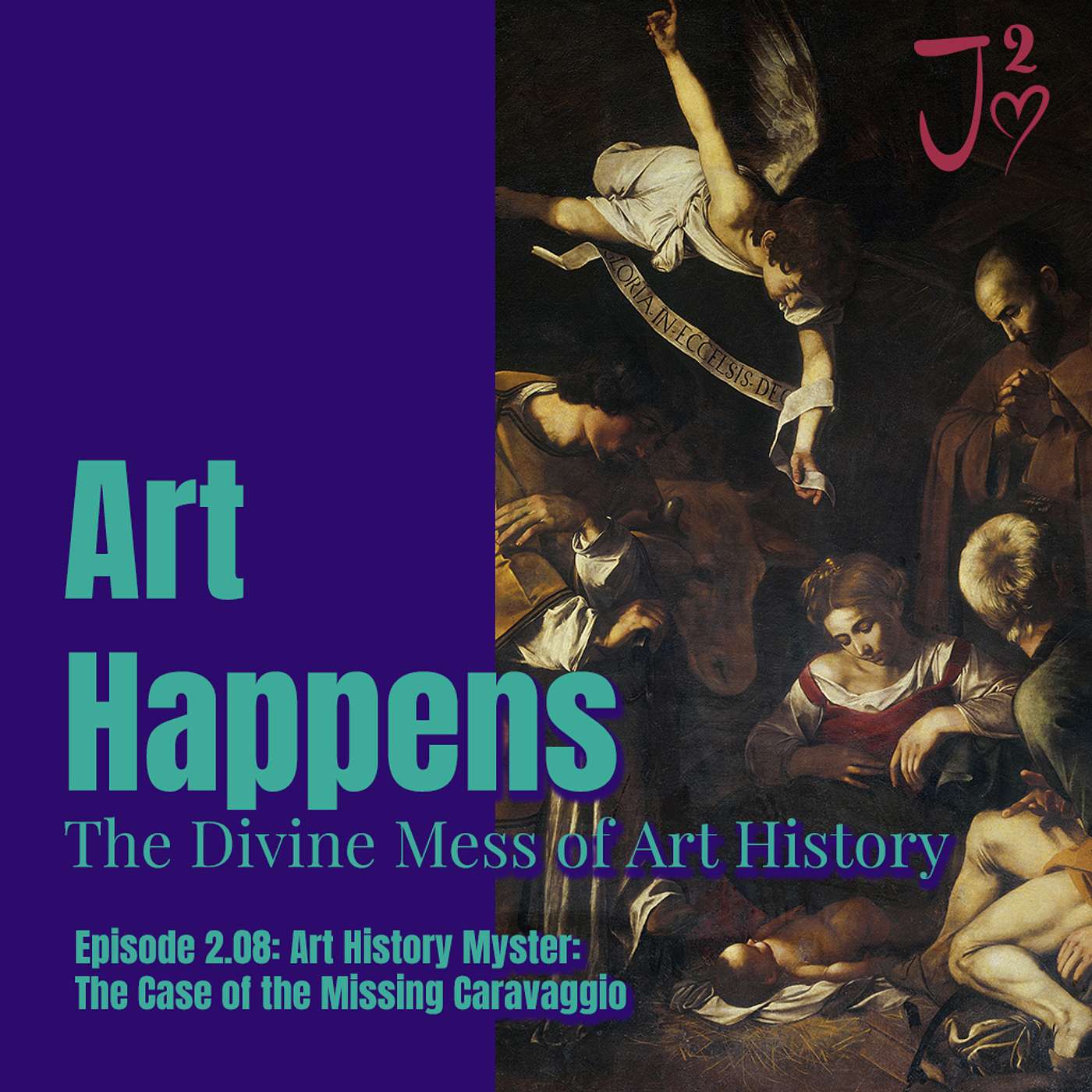
On a stormy night in Palermo in 1969, thieves entered the Oratory of San Lorenzo and sliced a priceless Caravaggio masterpiece from its frame. Nativity with St. Francis and St. Lawrence hasn’t been seen since.
In this episode of Art Happens: The Divine Mess of Art History, James follows the painting from Caravaggio’s turbulent life and revolutionary use of light and shadow into a decades-long mystery filled with Mafia informants, black-market collectors, contradictory confessions, and rumors of a masterpiece destroyed by rats and pigs.
Was the missing Caravaggio hidden, sold, buried—or lost forever? Explor...
The Birth of the Museum Blockbuster
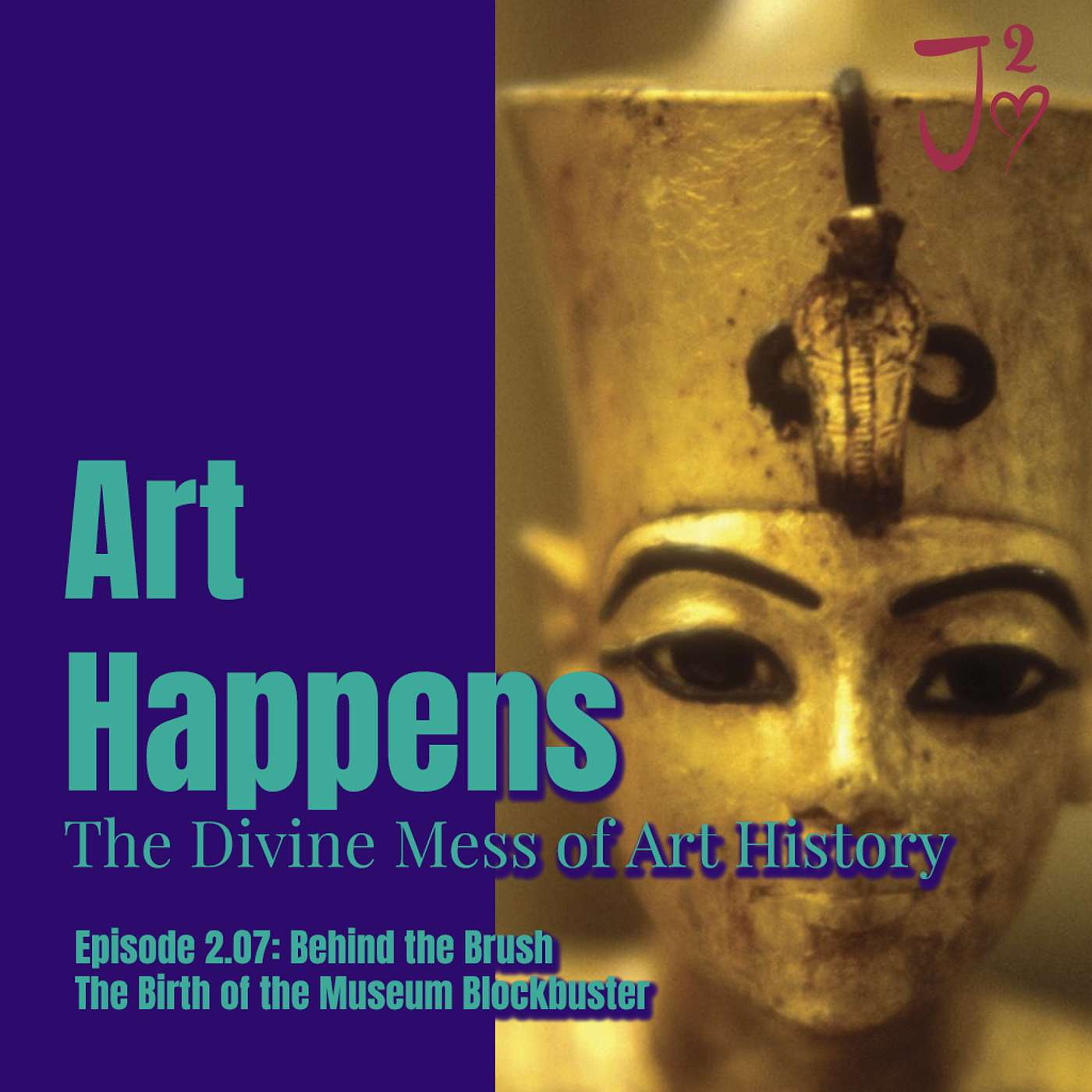
Museums, spectacle, velvet ropes, and the moment art became an event.
In this episode of Art Happens: The Divine Mess of Art History, James looks at how museums went from quiet temples of culture to full-blown engines of anticipation, crowds, merch, timed tickets, and “limited engagement” panic. From the King Tut exhibition craze to Van Gogh posters, immersive rooms, gift-shop snow globes, and blockbuster shows marketed like superhero movies, this episode asks what happens when art history becomes an event experience.
Blockbusters brought millions of people into museums, sometimes for the first time. They created unfo...
The Americans - Robert Frank's Road Trip
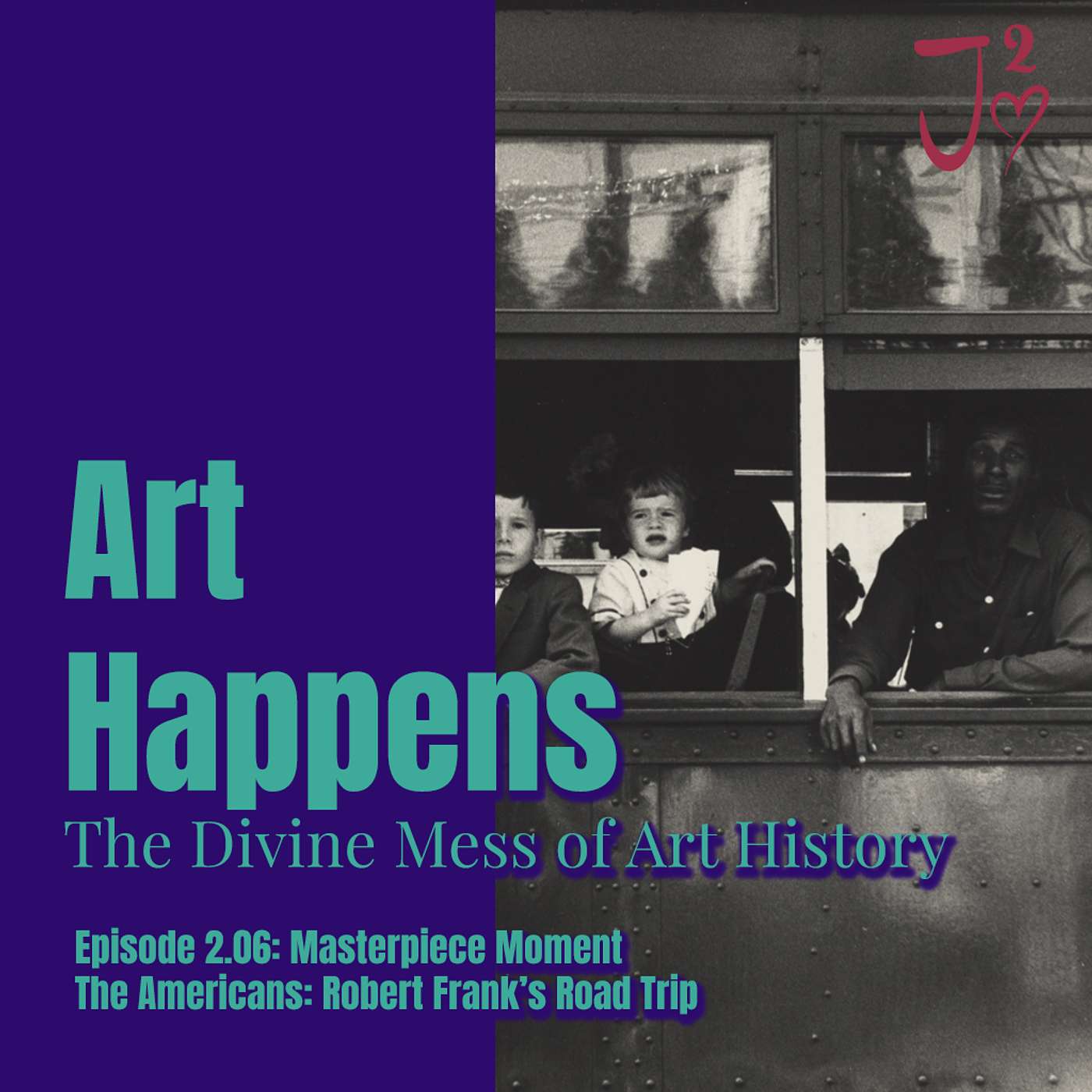
Robert Frank’s The Americans looks like a road trip, but it feels more like a cracked mirror held up to postwar America.
In this episode of Art Happens: The Divine Mess of Art History, James William Moore follows Frank across the highways, diners, jukeboxes, parades, cemeteries, sidewalks, and lonely rooms of 1950s America. Published in 1958 in France and 1959 in the United States, The Americans challenged the glossy national story of prosperity, confidence, and cheerful conformity. Instead of photographing the country as it wanted to see itself, Frank photographed th...
Leonora Carrington - Surrealism's Wildest Escape Artist

In this episode of Art Happens, we step into the strange, rebellious, magical world of Leonora Carrington: painter, writer, Surrealist, mythmaker, and professional refuser of being decorative. Born into wealth in England, Carrington was expected to become obedient, polished, marriageable, and socially useful. Naturally, she chose horses, hyenas, witches, alchemy, Celtic myth, feminist rebellion, and a lifelong commitment to making reality behave badly.
We’ll follow Carrington from her debutante beginnings to the chaos of Surrealist Paris, her relationship with Max Ernst, the trauma of war and institutionalization, and her eventual reinvention in Mexico, where he...
Who Should Own the Parthenon Marbles?

Did one of the world’s greatest cultural treasures get rescued… or stolen?
In this episode of Art Happens, we climb the Acropolis and unravel one of the art world’s longest-running controversies: the Parthenon Marbles. Carved nearly 2,500 years ago for the Parthenon in ancient Athens, these remarkable sculptures have spent more than two centuries in London after being removed by Lord Elgin during the days of the Ottoman Empire.
But who should own them today?
Join James William Moore as he explores the history of the Parthenon, the rise and fall of empire...
Blaue Reiter (Blue Rider): Modernism Needed a Tuning Fork

What if color could make sound—and a blue horse could tell the truth?
In this Movement in About 10 Minutes episode, James gallops into Der Blaue Reiter, the short-lived but revolutionary movement led by Wassily Kandinsky and Franz Marc. Discover how these artists broke color free from reality, treated painting like music, and searched for spiritual meaning through abstraction, animals, symbols, and emotion.
From Kandinsky’s belief that a canvas could behave like an orchestra to Marc’s spiritually charged blue horses, The Blue Rider transformed what modern painting could express. James also explores the group’...
Migrant Mother - The Face of the Great Depression

Masterpiece Moment: Migrant Mother
Dorothea Lange’s Migrant Mother became one of the defining images of the Great Depression — a photograph of poverty, endurance, and uneasy compassion. But behind the symbol was Florence Owens Thompson, a real woman whose life was far more complex than the image America came to know.
In this episode, we look at how one photograph shaped public memory, what it reveals about documentary photography, and what happens when a person becomes an icon.
Send us a Note! Let us know what...
Lee Miller: From Vogue to Hitler’s Bathtub

What happens when a woman once framed by the fashion world turns her camera toward history’s darkest moments?
James explores the extraordinary life of Lee Miller—a celebrated model who stepped behind the camera, became a daring Surrealist photographer, and ultimately emerged as one of World War II’s most important visual witnesses. From her complicated collaboration with Man Ray and experiments with solarization to her photographs of the London Blitz, the liberation of Dachau, and the collapse of Nazi Germany, Miller refused to observe history from a safe distance.
At the center of the ep...
Artist Spotlight: Hilma af Klint

Hilma af Klint may be one of the most important artists modern art history almost erased. Long before Kandinsky, Mondrian, or the official arrival of abstraction, af Klint was painting massive works filled with spirals, symbols, radiant color, cosmic diagrams, and mysterious systems that blended science, spirituality, philosophy, and the unseen world. And then she did something almost unbelievable: she packed much of the work away, convinced the future would understand it better than her own time ever could.
In this episode of Art Happens: The Divine Mess of Art History, James William Moore...
Masterpiece Moment: Guernica

There are paintings you admire.
And then there are paintings that refuse to let you look away.
In this Masterpiece Moment, James William Moore dives into Guernica by Pablo Picasso—a work that doesn’t document war so much as detonate it across the surface of the canvas.
Created in response to the 1937 bombing of the town of Guernica during the Spanish Civil War, this monumental painting rejects tidy storytelling in favor of fracture, distortion, and emotional truth. There are no heroes here. No victories. No clean endi...
Movement in about 10 Minutes: Minimalism (audio)

In this episode of Art Happens: The Divine Mess of Art History, James William Moore steps into the pristine white room of Minimalism and asks the question so many viewers have thought: Wait… this is art? From boxes, slabs, and fluorescent lights to the radical quiet of Agnes Martin, this episode unpacks how Minimalism stripped art down to form, repetition, material, and space—and in doing so, shifted the focus from the object alone to the viewer’s encounter with it. Along the way, James explores Dona...
Behind the Brush: Michelangelo vs The Ceiling Part 2 (audio)

In Part Two of Behind the Brush: Michelangelo vs. the Ceiling, James William Moore looks past the glory of the Sistine Chapel ceiling and into the grind that made it possible. This episode explores the power of Pope Julius II, the politics of patronage, the physical misery of fresco painting, and the psychological pressure of making something monumental under scrutiny. The result is a masterpiece that does not feel effortless, but wrestled into being. Beneath the beauty is strain, ambition, damage, and endurance—an...
Behind the Brush: Michelangelo vs The Ceiling Part 1 (audio)

Before the Sistine Chapel ceiling became a legend, it was a gamble. In Part One of Behind the Brush: Michelangelo vs. the Ceiling, James William Moore looks up into the artistry, ambition, and sheer audacity of one of the most famous ceilings in the world. This episode explores Michelangelo the sculptor, the brutal demands of fresco, the visual genius of the ceiling as a total system, and why The Creation of Adam still holds so much power. Less polished myth, more divine mess—this is the Sistine ceiling as...
Artist Spotlight: Lee Krasner - More than Pollock's Wife

They called Lee Krasner a wife, a footnote, a supporting character in someone else’s masterpiece. But this episode of Art Happens: The Divine Mess of Art History tells a different story. James William Moore takes a closer look at Krasner as a force in her own right—an artist of discipline, reinvention, ambition, and power who helped shape modern American art while fighting against the lazy captions history tried to pin on her. From her early training and place in the New York art world to her complicated partnership with Jackson Poll...
Art History Mystery: Gustav Klimt's The Golden Lady

When is a masterpiece more than a masterpiece? In this episode of Art Happens: The Divine Mess of Art History, James William Moore follows the glittering, complicated trail behind Gustav Klimt’s famous Portrait of Adele Bloch-Bauer I—often called Woman in Gold. What begins as a story of beauty, luxury, and Viennese modernism becomes something much deeper: a story of Nazi theft, museum power, historical memory, and the long fight for restitution.
James unpacks how this dazzling portrait became both a cultural icon and...
Movement in about 10 Minutes: The Harlem Renaissance

In this episode of Art Happens: The Divine Mess of Art History, James William Moore dives into the Harlem Renaissance—one of the most powerful cultural movements in American history. More than a moment, it was a declaration: that modern Black culture belonged at the center of modern American life. From the Great Migration to the creative fire of Harlem’s streets, this episode explores how artists, writers, and musicians transformed visibility into power and redefined what modernity could look and sound like.
James looks at the work of figures like Aaron Douglas, Archibald Motl...
Masterpiece Moment: Hokusai's The Great Wave - The Print that Ate the World

Hokusai’s Great Wave may be one of the most recognizable images in art history—but it didn’t begin as a rare treasure meant for palace walls. It began as a print: reproducible, portable, and built to circulate. In this episode of Art Happens: The Divine Mess of Art History, James William Moore dives into the image that became a global symbol, tracing how one dramatic woodblock print turned into an artistic phenomenon, a design icon, and one of the most successful visual “viruses” the world has ever seen.
Along...
Movement in about 10 Minutes: DADA (audio)

In this Movement in about 10 Minutes episode of Art Happens: The Divine Mess of Art History (presented by J-Squared Atelier), James William Moore dives headfirst into Dada—the “anti-art” movement that didn’t politely critique the world… it heckled it.
Born out of the chaos of World War I, Dada looked at “rational” modern society—its progress, its logic, its grand speeches—and basically said: If this is what your system produces, why should we keep following its rules? Cue the noise poems, nonsense chanting, cut-up performances, and the kind of art that b...
Artist Spotlight: Caravaggio (audio)

Rome, around 1600—alleyway Rome. Knife-in-the-boot Rome. A city where debts are loud, tempers are louder, and the shadows feel like they’ve got teeth.
In this Artist Snapshot of Art Happens: The Divine Mess of Art History (presented by J-Squared Atelier), host James William Moore dives into the life and lighting of Caravaggio—the volatile genius who didn’t paint saints like polished icons… but like real people dragged straight out of the messy human world.
We’ll break down the signature pu...
Marcel Duchamp: The Fountain (audio)

Imagine walking into a gallery in 1917 and seeing… a urinal. Not in a restroom. Not in a hardware store. In the sacred, echoing temple of “taste.” The label reads: The Fountain. The artist: R. Mutt. And suddenly the art world makes that same sound you make when you bite into something that should not be crunchy.
In this episode of Art Happens: The Divine Mess of Art History (presented by J-Squared Atelier), host James William Moore dives into Marcel Duchamp’s Fountain—the artwork that didn’t just start...
Frida Kahlo: The Two Fridas (audio)

In this Masterpiece Moment, we step into the storm-lit space of Frida Kahlo’s The Two Fridas (1939)—a double self-portrait painted in the emotional aftermath of her divorce from Diego Rivera. Two nearly identical Fridas sit hand-in-hand beneath a heavy sky, dressed in opposing identities: European white lace on one side, Tehuana tradition on the other. Their hearts are exposed. A single vein connects them. And one of them is bleeding.
This episode is an intimate, lyrical close-look at how Kahlo turns the body into biography—where heartbreak isn’t metaphor, it’s anatomy. We trace the...
Movement in about 10 Minutes: Pop Art (audio)

Pop Art is everywhere—on soup cans, comic panels, billboards, and celebrity faces. But this episode isn’t asking, “Is it beautiful?” It’s asking, “Who sold this to you… and why did you buy it?”
In this episode of Art Happens: The Divine Mess of Art History, host James William Moore dives into the movement that dragged advertising, packaging, and fame onto the gallery wall—and made it impossible to unsee the machinery underneath. From Andy Warhol’s silkscreen assembly line of Campbell’s Soup and Marilyn, to Roy Lichtenstein’s Ben-Day dot melodramas that turn emotion into a...
David Hockney: Pools, Polaroids, & iPads (audio)

A splash is the fastest thing in the world—blink-and-it’s-gone. So how did David Hockney turn a half-second event into an entire philosophy of looking?
In this episode of Art Happens: The Divine Mess of Art History, James dives into Hockney’s lifelong obsession with vision: not “How accurate is it?” but “How does seeing feel?” We start with “A Bigger Splash” (1967)—that calm modern pool interrupted by a frozen white explosion—now in Tate Britain. From there, we jump to Hockney’s 1980s Polaroid “joiners,” whe...
When Art Gets Political (audio)

In this episode of Art Happens: The Divine Mess of Art History (presented by J-Squared Atelier), host James William Moore pulls back the curtain on the myth that art is “above politics.” Because history doesn’t back that up—when the world catches fire, artists don’t always whisper. Sometimes they make images so loud you can’t unsee them.
In Behind the Brush: When Art Gets Political, we follow political art as witness, protest, and pressure—starting with Francisco Goya’s The Third of May 1808, a painting that...
The Arnolfini Portrait: Secrets in the Mirror

A portrait that refuses to sit still.
In this episode of Art Happens: The Divine Mess of Art History, host James William Moore opens the case file on Jan van Eyck’s Arnolfini Portrait (1434)—a painting where the real plot twist isn’t the couple… it’s the mirror. A convex glass “eye” on the back wall reflects two unexpected figures in the doorway, pulling us into the room and turning a simple portrait into a staged moment, a legal-looking document, and a psychological trap.
We examine the...
Surrealism: Dreams, Freud, and Lobsters on Telephones

In this episode, we drop straight into Surrealism—where logic takes a back seat and the subconscious grabs the wheel. If you’ve ever seen a lobster perched on a telephone and thought, “Yep… that tracks,” you already understand the vibe.
Born in the 1920s after World War I, Surrealism wasn’t “random for random’s sake”—it was a rebellion against the idea that reason alone could explain (or prevent) catastrophe. Guided by André Breton’s manifesto and supercharged by Sigmund Freud’s dream theories, Surrealists chased the hidden forces underneath everyda...
Jean-Michel Basquiat: The Poet in Paint

In this Artist Snapshot episode of Art Happens: The Divine Mess of Art History (presented by J-Squared Atelier), host James William Moore traces Jean-Michel Basquiat’s rise from the SAMO© tag on late-1970s Manhattan streets to the early-1980s gallery scene. The episode breaks down how Basquiat “samples” language and imagery—using words, cross-outs, repetition, crowns, skulls, and anatomy—to build paintings that feel like the city itself.
You’ll hear key milestones, including his first New York solo show at Annina Nosei Gallery...
