Signal and Symptoms Podcast
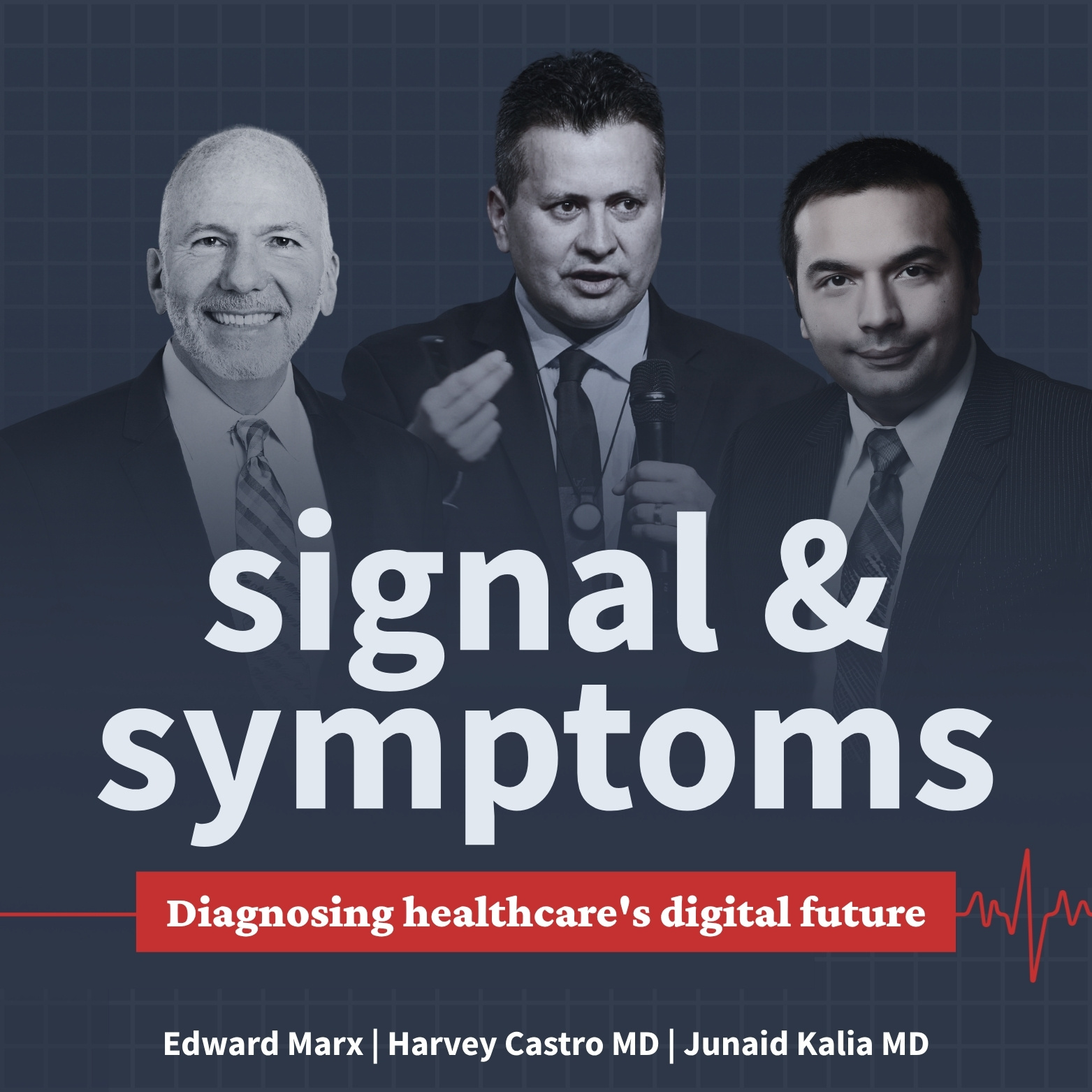
Three healthcare AI experts who've watched millions wasted on failed projects. Dr. Harvey Castro, Dr. Junaid Kalia, Edward Marx, and guest experts cover all things healthcare AI - from digital transformation to clinical reality. Every Tuesday, we diagnose real failures, reveal what actually works, and help you avoid the expensive mistakes we've seen repeated everywhere. Because when AI decisions affect patient care, getting it right isn't optional.
Making Care Make Sense: AI, Fragmentation, and the Patient in the Middle, with Dr. Kaitlan Baston (Vinyl Health)
Less than half of what a doctor says in a visit is remembered. You cannot fix that with a better algorithm alone, but you can fix the record. That is Dr. Kaitlan Baston’s whole thesis: “We aren’t necessarily fixing universal healthcare, but we are fixing the universal record, and making sure the patient is at the center.”
Dr. Kaitlan Baston, Founder and CEO of Vinyl Health and a former New Jersey Health Commissioner, joins host Dr. Junaid Kalia with co-hosts Dr. Isha Mannering, DR GPT™ Harvey Castro, and Edward Marx. A primary care and addiction physician...
Will AI Replace the Doctor? The Empathy Debate, with Dr. Alan Weiss
“Medicine is fundamentally a relationship, and I don’t think AI replaces that.” That is where Dr. Alan Weiss plants his flag, seconds before Dr. Junaid Kalia throws down the provocation the whole episode circles: what if 65% of patients soon get 85% of their primary care through AI agents? This is the empathy debate, and it is not the one you expect.
Dr. Alan Weiss, Senior Vice President of Clinical Advancement at Banner Health and a physician-informaticist who describes himself as “a nerd turned doctor, gone back to being a nerd,” joins host Dr. Junaid Kalia with co-hosts Dr. Isha M...
Built Without Us: Physician Led AI Governance — Dr. Ryan Walsh (CMIO, Memorial Hermann)
Technology keeps getting built for clinicians and too often without them. This episode of Signal & Symptoms is about closing that gap. Dr. Junaid Kalia is joined by co-hosts Ed Marx, DR GPT™ Harvey Castro, and now officially on the roster Dr. Isha Mannering, with guest Dr. Ryan Walsh, Chief Medical Information Officer at Memorial Hermann. Ryan calls his path “the Forrest Gump of health IT”: a family physician and residency educator who raised his hand when someone asked “does anyone know about computers?” and ended up double-board-certified as a “human + machine” leader.
The conversation is a working clinician’s fi...
The Decision, Not the Model: Lessons from Oncology AI — Dr. Agata Krasoń
“AI alone is very rarely the real breakthrough.” That’s how Dr. Agata Krasoń a Senior Clinical & Imaging Data Scientist at Roche, joining from Switzerland opens the conversation, and it reframes the entire episode. The breakthrough, she argues, happens when the right data, the right model, the workflow, the validation, and the clinical decision are all connected. The model is the easy part.
In this episode of Signal & Symptoms, Dr. Junaid Kalia and co-host Ed Marx dig into the unglamorous middle layer where medical imaging actually becomes clinical AI: data standardization, harmonization, and the FAIR foundations that decide...
Run the Model Yourself: A Clinician’s Guide to Local AI
This one is a roundtable no guest, just the three of us. Dr. Junaid Kalia sits down with co-hosts Ed Marx and DR GPT™ Harvey Castro for a hands on, slightly geeky conversation about something most clinicians have never been told they can do: run capable AI models yourself, on your own hardware, without ever sending a patient’s data to someone else’s cloud.
It starts with a provocation Junaid running a local model on a $2,000 Mac at ~100 tokens/second and asking why he’d keep paying Azure for the privilege. From there the three of them wal...
Buyer to Builder — The Invisible Layer of Patient Monitoring
A small sensor sits on a tripod across the room — no wearable, no camera, nothing taped to a chest — and it’s reading a heartbeat through the air. What does it take for a tool like that to survive contact with a real hospital?
In this episode of Signal & Symptoms, Dr. Junaid Kalia hosts — with co-hosts Dr. Harvey Castro and Ed Marx — a conversation with Nayan Patel, SVP of Transformation & Digital Health at Neteera and a career hospital CIO who spent decades buying health technology before he crossed over to building it. Neteera’s premise is radical subtraction...
Explainable Clinical Digital Twins: One Engine for Power Plants and Patients
The same software engine can run a 400 megawatt power plant and simulate whether a cancer drug will survive a real world patient population. That’s not two companies it’s one engine, built by a founder who came up not in medicine but in gas turbines and heavy industry.
In this episode, Dr. Junaid Kalia hosts with co-hosts Ed Marx and Dr. Harvey Castro a two guest conversation with Dr.-Ing. Amir A. Hashmi, founder of Xcelenz and creator of the GENEXIX digital twin platform, and Dr. Dania Amir, the internal medicine physician leading its clinical validation. GENE...
Who Owns Your Medical Record Now? — Stephen Rouse, Co-Founder, Savva
For a generation, your medical record has lived behind the hospital’s firewall. What happens the day the patient walks in holding it already read, already interpreted by AI, on their own phone?
In this episode, DR GPT™ Harvey Castro, hosts with co-hosts Ed Marx and Dr. Isha Mannering — a conversation with Stephen Rouse, co-founder and head of growth at Savva, a consumer health app (in beta, launching this summer) built on a single premise: patients should own and understand their own health data. Coming from the enterprise-EHR world, Stephen argues the next shift isn’t inside the hosp...
Can Medicine Keep Up with AI? — Dr. Yeshe Kway (Oxford)
Somewhere in Oxford, there’s an AI that can produce a contrast-enhanced cardiac MRI without ever injecting the contrast. No needle, no gadolinium, no risk. It works and it has for years. Walk into a community hospital in Dallas tomorrow, and you still can’t get it.
In this episode, DR GPT™ Harvey Castro hosts with co-hosts Ed Marx and Dr. Isha Mannering a conversation with Dr. Yeshe Kway, a medical data scientist in Oxford’s Zhang Group building the AI that reads cardiovascular MRI. Together they take on the question every health-system leader is quietly asking: can medi...
AI Won’t Replace Your Pediatrician — But It Will Change the Visit
The hardest part of a pediatric visit now happens before the appointment even begins.
In this episode, Dr. Isha Mannering a board-certified pediatrician with 16 years in the Dallas–Fort Worth area and founder of InTuneMD joins Dr. Junaid Kalia, DR GPT™ Harvey Castro, and Ed Marx to confront a new reality in the exam room: parents arrive having already consulted TikTok and ChatGPT, and the physician’s first job is winning back trust. Drawing on more than a decade in practice and her decision to go independent, Isha makes the case for treating AI as a tool, not a...
How Brain Organoids Work (And Why They Could Replace Silicon)
The foundation of tomorrow's diagnostics is being rebuilt — and it starts in biology, not silicon.
In this episode, Edmund White, biomedical innovator and bestselling author, joins the conversation to challenge an assumption quietly embedded in every AI tool entering healthcare: that silicon is the only material worth building on. Drawing from three decades at the intersection of cardiac care and medical innovation, Edmund traces a through-line from digital twins of children's hearts to brain organoids — arguing that biology's energy efficiency and adaptability aren't limitations to engineer around, they're the very properties that could unlock earlier inte...
Why AI Isn't the Tech Hype Hospital Leaders Think It Is
We built a healthcare system engineered for sick care, but the future of medicine belongs to those who seek health.
In this episode, global Digital Health Futurist Philippe Gerwill joins the panel to unpack the real bottlenecks stalling clinical innovation. He highlights a critical inversion happening in modern medicine. Historically, technology lagged behind clinical needs. Today, advanced technology vastly outpaces our institutional capacity to adopt it. The conversation delivers an evidence-based perspective on how to manage this rapid acceleration from a global innovator who understands both big pharma infrastructure and the reality of clinical adoption. <...
Healthcare AI: What To Know, What's Still Broken, and Where To Go Next
What does it actually cost when a diagnosis comes six months too late, a test gets ordered twice, or a treatment decision gets made without the best information available?
In this special recap episode of Signal & Symptoms, we synthesize the strongest healthcare AI insights from previous episodes — moving from the promise of what AI can do, to the real patient stories that reveal what's at stake when we delay, to an honest look at the barriers still standing in the way, and finally to the path ahead for clinicians and leaders ready to act.
...
What Hospitals Actually Need Before They'll Deploy Your AI
Will AI eliminate primary care — or finally give primary care physicians their time back?
That's the central question driving this episode, as Dr. Junaid Kalia, Dr. Harvey Castro, and Ed Marx sit down with Dr. John Dayton — an ER physician who has evaluated healthcare startups as an angel investor, built pilots at Intermountain Ventures, and is now raising a $5M fund. He brings a rare view of what AI looks like from the bedside, the boardroom, and the cap table. Dr. Dayton maps how AI decisions actually get made inside health systems: why a technology has...
The Hidden Risk of AI-Powered Clinical Decisions
You already know not every AI tool belongs in your workflow. The real question is whether your filter is sharp enough to tell the difference.
In this episode, Dr. Junaid Kalia and Dr. Harvey Castro sit down with Dr. Hansa Bhargava, Chief Innovation Officer at Healio and a physician who has spent her career building trust at scale, to examine what trustworthy clinical AI actually looks like from the inside. They trace how the content integrity crisis predates AI, why clinician-in-the-loop development is the clearest signal of a tool worth adopting, and how evidence-sourced curation...
Why Will Digital Twins Change the Way We Treat Patients?
What if the most powerful diagnostic tool wasn't a scan or a lab result — but a continuously learning model of your patient, built from their own data?
In this episode, Dr. Junaid Kalia sits down with co-host Dr. Harvey Castro, this time in the guest seat, to unpack one of the most transformative concepts in modern medicine: the healthcare digital twin. They trace how the concept evolved from NASA simulations and factory floors into clinical reality, breaking it down clearly for those new to the idea while grounding it in real applications — predictive analytics, personalized pharmacogenomics, and Harv...
What Happens to Hospital Revenue When AI Replaces Primary Care?
Most healthcare conversations stop at disruption, but this one starts there.
In this episode, three healthcare experts sit down to map what happens when AI doesn't just change clinical workflows — it rewires the economics behind them. From the slow-adoption trap crippling hospital governance, to the cultural lag quietly signaling a broken system, to a collapse of the referral pipeline impacting financial stability — the kind of conversation most boardrooms aren't having yet.
The twin disruption isn't coming. It's already restructuring the room. Where do you stand?
What You Will Discover:
- In...
The Business Playbook for Physicians Who Want to Win Beyond the Clinic
You went into medicine to save lives. But somewhere between residency and the real world, you started wondering — is there more I could be doing?
That question is not a distraction. It might be your next diagnosis, and the biggest obstacle is knowing where to start.
In this episode, host Dr. Junaid Kalia sits down with Dr. Sara Rana, a physician-turned-venture capitalist and MD-MBA, who saw the gap between healthcare and finance firsthand and built her career bridging it. The conversation moves from her origin story into the practical frameworks, honest realities, and ha...
How Ultrasound Frequencies Enable Early Intervention and Save Lives
What if the difference between a late diagnosis and a successful intervention was simply how we decode the signals of a sound wave?
In this episode, we are discussing the transition of ultrasound from a static hospital tool to a mobile network of care that brings diagnostics directly to the patient. Dr. Junaid Kalia, Dr. Harvey Castro, and Edward Marx explore a radical shift in medical imaging with Soner, Co-founder and CEO of PONS Tech. By analyzing raw ultrasound frequencies rather than just the visual image, PONS makes visible the early-stage features that are typically...
The Treatment Exists But Why Aren't Patients Getting It?
What if the real barrier to better patient outcomes isn't the medicine — it's the infrastructure to prescribe it well?
This episode surfaces a broader signal: personalized medicine is no longer a future ambition — it's a present clinical need. And the system, as it stands, is not equipped to deliver it at scale.
Joining the conversation are Itay Segal and Dr. Jean-Claude, co-founders of Unlock Healthcare, to explore one of medicine's most underexamined tensions: the gap between what a treatment can do and what the current system is built to support. The discussion centers on c...
AI Is In Healthcare—So Why Isn't It Working?
The overarching signal is: we're early, it's messy, and the people closest to the work know it best.
In this episode, Dr. Andrew Kim joins hosts Dr. Junaid Kalia, Dr. Harvey Castro, and Edward Marx for an unfiltered look at what healthcare AI implementation looks like from the inside. They are diagnosing the vendor translation failures, the physician workflow wars, the governance structures being built in real time, and the looming AI-vs-AI battle between health systems and insurance companies.
The episode reveals an insider implementer’s perspective on where most AI deployments succeed or fail. Tu...
71% of FDA-Approved AI May Be a Clinical Liability (Here’s Why)
When 71% of training data for FDA-approved AI comes from just three states, geographic bias shifts from a technical oversight to a direct clinical liability. To deliver on the promise of value-based care, we must move beyond "clean" academic datasets and integrate the diverse, real-world data that reflects the actual patients we serve.
In this episode, Dr. Junaid Kalia and Dr. Harvey Castro sit down with Dr. Martin Willemink, a radiologist and former Stanford faculty member who transitioned into the entrepreneurial world to solve AI’s most significant bottleneck: data diversity. As a clinician-turned-founder of Segmed, Dr. Willemink pr...
The Data Problem That Healthcare Can't Ignore
What happens when the data behind AI doesn't actually reflect the patients it's meant to help? And if precision medicine is the goal, what’s truly standing between us and getting there?
These are not rhetorical questions. They sit at the center of this week's conversation with Dr. Saira Haque, Senior Director of Clinical Informatics at Pfizer Medical Affairs. Together with the hosts, they examine why AI's promise in healthcare keeps encountering the same recurring limitation: fragmented, unrepresentative data that was never built to reflect the full diversity of patients it is meant to serve.
Sh...
Why Healthcare Leaders Are Still Denying the AI Shift
Global anxiety about AI and jobs is at its peak. And the data suggests people are right to feel it. But this episode isn't a warning. It's a diagnosis.
Dr. Junaid Kalia, Edward Marx, and Dr. Harvey Castro step back from the weekly AI noise to examine the macro trajectory of the era we're actually living through — where five major innovation platforms are converging simultaneously, the cost of intelligence is collapsing, and the gap between technology and human adaptability has never been wider.
The anxiety isn't irrational. It's a signal. And understanding what it's pointing to...
How a 200-Year-Old Hospital Is Adapting to an AI-Driven World
What happens when a 200-year-old safety-net hospital decides it's had enough of losing revenue to insurance denials and uses AI to fight back? The answer may change how you think about the intersection of clinical care and financial sustainability.
In this episode, we sit down with Jani Rad, Dr. Kito Lord, and Robin Clanton from Regional One Health in Memphis, Tennessee. Together, they walk us through how a historically under-resourced hospital became an unlikely AI innovator — starting not with flashy technology, but with a simple question: can we just see our own data? From breaking down departmental si...
Why Healthcare AI Startups Fail—Microsoft Global Health Leader Reveals the Fix
Why do brilliant healthcare products fail before they ever reach patients? Sally Ann Frank, who leads Microsoft's worldwide strategy for health startups, exposes the fatal mistake and her proven protocol to avoid it.
In this episode, Sally Ann Frank, Global Lead for Health & Life Sciences at Microsoft for startups, breaks down her proven Startup Protocol framework to achieve healthcare AI startup success in an agentic AI era. Drawing from her work with hundreds of early-stage companies, Sally emphasizes the critical mistake first-time founders make: investing all their energy in building a great product without doing customer discovery...
Why Only Doctors Can Fix What's Broken
Healthcare is at a critical crossroads where clinicians are increasingly sidelined by administrative weight and third-party interests. The path forward isn't just surviving a broken system—it’s reclaiming our roles as primary stakeholders and system architects through a unified, "Doctor-to-Doctor" movement.
Joining us to lead this conversation is Dr. Kianor Shah, a Southern California-based oral surgeon with 20 years of clinical experience and founder of the Global Summit Institute. Dr. Shah argues that the integration of medicine and dentistry is the next frontier of patient care, with AI serving as the "divine tool" to bridge these historical silo...
What FDA's Step Back Means in Building Credibility
The FDA stepped back. Now, organizational governance is the only thing standing between innovation and liability.
At CES 2026, the FDA officially announced it won't regulate wellness devices or Clinical Decision Support tools—removing approval bottlenecks and accelerating innovation. But this regulatory shift transfers responsibility to healthcare organizations themselves. Who builds the frameworks for data management when there's no FDA requirement? How do health systems justify physician time reviewing continuous patient streams without reimbursement pathways? And where does liability fall in this new landscape?
In this episode, Dr. Junaid and Ed tackle the AI governance vacuum, ex...
From Individual Patients to System-Level Impact: A Neurologist's Journey
AI transformation in healthcare isn't something happening to physicians—it's an evolution physicians can actively shape and lead.
In this episode, we introduce our host, Dr. Junaid Kalia, a practicing neurologist who experienced healthcare's systemic failures firsthand and decided to build the solution himself. As founder of SaveLife.AI, his journey embodies physician-led innovation: combining clinical expertise with entrepreneurial action to create real transformation. Joining the conversation are his sister, Dr. Saira Kalia (academic program director), and close friend, Dr. Danish Bhatti (angel investor/advisor), as they discuss the evolution from clinician to innovator—and why "action bias...
Why Are Junior Researchers Outperforming Gene Editing Experts?
Drug development today forces patients to fit standard medications—but what if we could reverse that paradigm and design treatments tailored to each patient's unique biology?
This episode explores how specialized AI cloud infrastructure is transforming drug discovery and healthcare research–not as a distant future possibility, but as tools available to researchers today. Joining the conversation is Dr. Ilya Burkov, who shares how the right computational foundation and HPC tools accelerate scientific breakthroughs at AI speed.
The conversation reveals a significant shift in accessibility: junior researchers without specialized training now achieve 80-90% success rates in c...
Is Healthcare Sustainable Without AI?
The most dangerous assumption in healthcare AI today is that we have time to "wait and see" how tools develop. With the state-of-the-art for AI models now shifting every 7 days, the traditional 3-year implementation cycle isn't just slow—it’s stagnating clinical transformation.
In this episode, Dr. Khan Siddiqui (Radiologist and Founder of Hoppr AI) joins the panel to reveal why the future of medicine isn’t about choosing the "perfect" tool. Instead, it’s about building a sustainable system that can keep pace with technology improving at 1,600 times the speed of human practice.
This conversa...
15 Healthcare Leaders Predict 2026: AI Will Transform Care (Or Collapse Under Bureaucracy)
This Holiday Special brings together 15 healthcare leaders, technologists, and innovators to tackle the biggest questions facing medicine in 2026. AI tools are proliferating across hospitals, but can healthcare systems integrate them effectively?
Healthcare stands at a crossroads in 2026. AI is everywhere—from radiology to clinical decision support—but critical questions remain. Will it lower costs for patients? Can hospitals keep pace with innovation? And most importantly: who's steering this transformation? Our diverse panel of physicians, educators, consultants, and entrepreneurs shares their frontline perspectives on what's working, what's failing, and what must change.
Tune in to discover prac...
What If Better Patient Care Actually Cost Less? The AI Reality
The future of AI-enabled care is massive and available, but the question remains: will we be the ones leading it?
In this episode, Dr. Robert Pearl – Former CEO of Permanente Medical Group (Kaiser Permanente), Author of "ChatGPT, MD", Forbes Contributor – joins the panel to challenge the core of how we practice medicine today. Medical students are entering training with AI capabilities that their professors don't possess. But beneath this technological evolution lies a clinical crisis: 400,000 deaths annually from misdiagnosis, intermittent care for chronic diseases, and a system that could eliminate up to $2 trillion in wasteful spending.
Th...
AI in Healthcare 2025: 3 Insiders Reveal 9 Non-Negotiable Strategies
If healthcare AI is truly evolving, why are there still gaps between what technology can do and what healthcare organizations are actually doing? These gaps aren't just inefficiencies. They're creating real clinical risks that directly impact patient outcomes.
This year-end roundtable brings together three healthcare AI experts—Dr. Harvey Castro, Dr. Junaid Kalia, and Edward Marx—following their appearance at AIMed 2025 to share their key takeaways from deploying AI in the messy reality of hospital systems. They synthesize insights across policy, culture, and implementation: how cost disruption reshapes hospital innovation budgets, what Singapore's mandatory retraining model signals abou...
Why Surgeons Can't Measure Brain Temperature Directly (And What's Finally Changing)
Innovation signals are everywhere, but what matters are those that move from laboratory potential to measurable clinical impact.
Joining the conversation are Jim Pollock and Tom Meese from LumenAstra, demonstrating how clinical insight, technical capability, and strategic execution bridge the gap between healthcare innovation and patient outcomes. The discussion explores how their innovative work in developing non-invasive internal body temperature measurement technology will transform the future of AI development, enhance predictive models, and drive the creation of new clinical applications, all while leveraging the interdisciplinary nature of healthcare technology.
This isn't promotional & theoretical. Just the...
From Fragmented Silos to Integrated Services: Transforming Cancer Care Delivery
What if the biggest barrier to better cancer care isn't technology—it's how physicians approach treatment with ego?
In this episode, we sit down with Dr. Talia Baker, a transplant surgeon who walked away from clinical practice to solve a problem she witnessed firsthand: the liver cancer patient journey is fundamentally broken.
Dr. Baker introduces the Lori MDT project, a vision for reshaping how patients navigate fragmented cancer care. But the real conversation goes deeper—into the uncomfortable truths about institutional incentives, the care gaps between diagnosis and treatment, and why even the best a...
From Sick Care to True Healthcare: Why AI Demands a New Kind of Leader
What if we're running a sick care system pretending to be healthcare? AI promises to change that by improving access for patients and reducing burden for providers, but only if we have leaders who know how to guide the transformation. The challenge: healthcare offers no structured pathway for developing these leaders.
Joining today's expert panel: Arlen Meyers, MD, MBA, President & CEO of the Society of Physician Entrepreneurs, and Muhammad Siddiqui, Chief Digital & Information Officer at Reid Health. Together, they reveal why this leadership gap exists across four levels (personal, organizational, systemic, and societal) and what's actually working...
Mindset, Audits, & Equity: What’s REALLY Slowing Down Healthcare AI?
If AI is the future of healthcare, why is its adoption moving at a glacial speed?
In this episode, Sherri Douville, CEO of Medigram and Chair of the Trustworthy Technology and Innovation Consortium (TTIC), argues the true bottleneck is not technology, but a crisis of accountability. She explains that systems—even those that are FDA-approved and cyber-secure —stall because hospital leadership lacks robust governance frameworks to properly evaluate solutions and grant final approval for patient care.
The panel reveals how to establish trust infrastructure and why elevating AI governance to the same rigorous level as finan...
What Keeps a Pediatric AI Pioneer Up at Night (It's Not What You Think)
What if the biggest threat to the future of medicine isn't AI—but our refusal to use it?
That's exactly what keeps Dr. Anthony Chang up at night. As founder of Intelligence-Based Medicine (AIMed) and a pioneering pediatric cardiologist, he's dedicated his career to a singular mission: ensuring clinicians aren't left out of healthcare's AI revolution.
In this episode, Dr. Chang joins us to outline the new paradigm where AI serves as the great equalizer—amplifying the reach of elite institutions while empowering rural hospitals with the same capabilities. He shares his vision for a futu...
Healthcare AI's Triple Conflict: The Politics, Prices, and Paralysis of Progress
Artificial Intelligence is being hailed as the Fourth Industrial Revolution, but if you're a clinician or a healthcare executive, it might feel more like a permanent roadblock. You’re past the hype, but still wrestling with the paradox: Why does technology that can predict diseases days in advance get stuck in endless, expensive pilot programs?
Join physician-founder Dr. Junaid Kalia and international advisor Dr. Harvey Castro as they diagnose the true state of AI in healthcare. They argue that the friction you feel trying to implement a new tool is merely a symptom of a much larger, gl...