Happy English Podcast

Learn English with the Happy English Podcast. Fun, practical, and useful English lessons for students of all levels and ages. Learn American English idioms, phrasal verbs, pronunciation, confusing vocabulary, grammar and more! Get Happy, Get English. Happy English! Visit myhappyenglish.com to hear all of the episodes.
1034 - What's GRAB? - English Tips in a Minute | Happy English
Hey there! It’s Michael here - and welcome back to English Tips in a Minute from Happy English. I’m here every week with a short, simple tip to help you speak English more naturally and confidently.
Today, let’s look at a really common conversational use of the word “grab.”
In everyday English, we use grab to mean quickly get something or go get something, often in a casual way. It doesn’t always mean physically grabbing - it just means getting something fast or without a lot of planning.
I’m gonna grab a coffee.L...
1033 - Special Uses of AT and IN
At. In. These are small words, but as you saw in episode 1032, they can be a little tricky. We use both of them to talk about location, and sometimes the meaning feels the same. But there are also some very specific situations where we use at and in in different ways. Like, is it, "Jack is at the hospital" or "Jack is in the hospital?" Or Both? Well, if you’ve ever wondered about that, don’t worry. I've got good news. We’re going to look at all of this today.
In the last episode, we talked about t...
1032 - AT vs. IN - What’s the Difference?
At. In. Two very small words, right? But these prepositions can be confusing, because we use both of them to talk about location. So how do you know when to use at and when to use in? Like, Jack is in the office. Jack is at the office? If you’ve ever wondered about that, don’t worry - you’re not alone. And the good news is that’s what we’re going to look at today.
The Happy English Podcast
Helping people speak English better since 2014
Over 1,000 episodes • 8 million downloads
📘 Build your vocabulary with...
1031 - Good At vs. Good In - What’s the Difference?
Good at. Good in. These two phrases seem simple, right? But a lot of people get confused about when to use each one. Should you say, “I’m good in English,” or “I’m good at English”? And what’s the real difference between these two? If you’ve ever wondered about that, don’t worry. Because that’s what we’re going to look at today.
Let’s start with a simple idea that will help you remember everything. We usually use good at to talk about ability or skill. And we use good in to talk about performance in scho...
1030 - Have to → Hafta Speak Naturally in a Minute | Happy English
Hey there! It’s Michael here - and welcome back to Speak Naturally in a Minute from Happy English. I’m here every week with a quick one-point lesson to help you improve your pronunciation, rhythm, and intonation.
Today, let’s talk about a very common reduction in American English: “have to.” In everyday conversational English, have to usually becomes hafta. That’s because the V sound in HAVE is pronounced like a weak F sound. And TO is pronounced like TUH. So have to become hafta
Here are some examples:
I have to go now sounds lik...
1029 - Hit Means Go TO - English Tips in a Minute | Happy English

Hey there! It’s Michael here - and welcome back to English Tips in a Minute from Happy English. I’m here every week with a short, simple tip to help you speak English more naturally and confidently.
Today, let’s look at a really casual conversational use of the word “hit.” In everyday English, we use hit to mean go to or visit a place. It doesn’t mean you’re actually hitting something - it just means you’re going there, usually quickly or casually.
For example, you might say: “I need to hit the restroom.” Or t...
1028 - Work vs. Job – What’s the Difference?
Work. Job. Two very common words, right? But a lot of people get confused about how to use them. Do you say, “I have a work,” or “I have a job”? Can you say, “I’m going to my work” or "I'm going to my job" I mean like, what’s the real difference between work and job?
If you’ve ever wondered about that, don’t worry - you’ve come to the right place. Because that’s what we’re going to look at today.
The Happy English Podcast
Helping people speak English better since 2014
1027 - Bored vs. Boring - What’s the Difference
Bored. Boring. Two simple words, right? But this is something that a lot of people mix up all the time. Like, if the party wasn't so good, is it, “I’m boring,” or “I’m bored”? And what about if someone says, that teacher is so boring. If you’ve ever been confused about this, don’t worry - you’re not alone. So let's dive into this today!
The Happy English Podcast
Helping people speak English better since 2014
Over 1,000 episodes • 8 million downloads
📘 Build your vocabulary with my free Vocabulary Workshop
https://learn.myhappyenglish.com/voca...
1026 - Borrow, Lend, Rent, Lease - What's The Difference?

Borrow. Lend. Rent. Lease. Four simple words, right? But it seems like it's easy to mix these up. Is it , can you lend me a pen? Or can you borrow me... wait... can I borrow. So what IS the difference? When can we use borrow, lend, rent, and lease? And how do we actually use these in everyday English?
If you need help with this vocabulary, you've come to the right place. Because that’s what we’re going to look at today.
The Happy English Podcast
Helping people speak English better since 2014
Over 1,000 epis...
1025 - Don’t you IS Don-cha Speak Naturally in a Minute | Happy English

Hey there! It’s Michael here - and welcome back to Speak Naturally in a Minute from Happy English. I’m here every week with a quick one-point lesson to help you improve your pronunciation, rhythm, and intonation.
Today, let’s look at another very common sound change in American English: “don’t you.” In everyday American English, we usually pronounce don'y you as don-cha.
That’s because when the T sound and the Y sound come together, they blend into a CH sound. And the OO of you becomes UH. So... don’t you becomes don-cha
Don’t...
1024 - The Thing Is - English Tips in a Minute | Happy English
Hey there! It’s Michael here - and welcome back to English Tips in a Minute from Happy English. I’m here every week with a short, simple tip to help you speak English more naturally and confidently.
Today, let’s look at a really common conversational phrase - “the thing is…”
We use the thing is when we want to explain a situation or give a reason, especially when there’s a problem, a limitation, or something we need to clarify. It’s very similar to here’s the thing, but a little softer and more casual.
...
1023 - Practical Uses of Like in Everyday English
Do you ever feel like people use the word like all the time… and you’re not really sure why? You hear things like, “I was like…” “It was like…” “He’s like, 50…” and sometimes it feels like that word is everywhere. So if you’re wondering - what does like actually mean in these situations, or, how can I use like like that, you’ve come to the right place. By the end of the podcast English lesson, you’ll learn several practical ways you can use like.
The Happy English Podcast
Helping people speak English better since 2014
Over 1...
1022 - Play vs Do vs Go - How to Talk About Sports Naturally

Have you ever tried talking about sports in English and suddenly, you get mixed up with using play, do, or go? Is it “I play skiing”? “I do skiing”? “I go skiing”? Or maybe you’ve heard things like, “I play tennis”… but also “I go swimming”… and then someone says, “I do yoga”… and now you’re thinking… wait, what’s the rule here?
Don’t worry - you’re not alone. This is one of the most common questions English learners have. So in today’s podcast English lesson, we’re going to look at how to use play, do, and go when talking about spo...
1021 - Win, Lose, Beat - How to Talk About Sports in English

Game. Match. Two simple words, right?
But then when you watch sports in English, you understand the game… but not always the language.
Which one should you use? Sometimes I hear people say things like, “I watched a baseball match,” and yeah… it’s understandable, but not so natural.
So what’s the difference? When do you say game, and when do you say match? And how do native speakers actually talk about sports in everyday English? How about win, lose and beat? That’s what we’re going to look at today.
The Happy E...
1020 - To Be Honest – English Tips in a Minute | Happy English
Hey there! It’s Michael here - and welcome back to English Tips in a Minute from Happy English. I’m here every week with a short, simple tip to help you speak English more naturally and confidently.
Today, let’s look at a really common conversational phrase - “to be honest…”
We use to be honest when we want to soften our thoughts or feelings, Like when we need to say something negative Or if we need to disagree or decline an invitation.
Like if a friend asks, “Did you like the movie?” You could say: “To be...
1019 - Just vs Already vs Yet - How to Really Use Them
Just. Already. Yet. Three little words. They should be simple, right?
But then when you try to use them in conversation, you’re not really sure which one sounds right.
Should you say, “I just finished”? Or “I already finished”? Or “I haven’t finished yet”?
These are small words, but they can be kind of confusing. So for today’s podcast English lesson, we’re going to look at how you can actually use just, already, and yet in everyday conversation.
The Happy English Podcast
Helping people speak English better since 2014
Over...
1018 - Practical Uses of Will and Gonna in Everyday English
Have you ever studied will and be going to and thought… “Okay, I understand the rule… but I still don’t know which one to use when I speak”? Maybe your textbook says something like: “Use will for the future,” and “Use be going to for plans.” And technically… that’s correct. But in real conversations, native speakers are not thinking about grammar rules. We’re reacting in the moment. And depending on the situation, we naturally choose will or gonna.
So for today’s podcast English lesson, we’re going to look at several very practical situations where you can use will and g...
1017 - Spring Idioms for Everyday English

Have you ever noticed how spring feels like a fresh start? The weather gets warmer, the days get longer, and suddenly you feel like doing something new. Maybe you want to start exercising, clean your house, or even change your habits. That feeling of new energy and new beginnings is something we often connect with spring.
In English, we actually have a lot of idioms and expressions that reflect this idea of growth, change, and starting over. For today’s podcast English lesson, we’re going to look at several very useful idioms related to spring that you can u...
1016 - Did you → Didjya Speak Naturally in a Minute | Happy English
Hey there! It’s Michael here - and welcome back to Speak Naturally in a Minute from Happy English. I’m here every Sunday with a quick one-point lesson to help you improve your pronunciation, rhythm, and intonation.
Today, let’s talk about a very common sound change in American English: “did you.” sounds like did-ju
That’s because when the D sound and the Y sound come together, they blend into a J sound.
Dd you sounds like didjuDid you eat yet? sounds like Didju eat yet?Did you see that movie? sounds like Didju see that movi...
1015 - Here’s the Thing – English Tips in a Minute | Happy English
Hey there! It’s Michael here - and welcome back to English Tips in a Minute from Happy English. I’m here every Saturday with a short, simple tip to help you speak English more naturally and confidently.
Today, let’s look at another really common conversational phrase - “here’s the thing.”
We use here’s the thing before giving a reason, an opinion, or sometimes even an excuse. Here’s the thing is a perfect thing to day when you want to introduce a point or explain a situation clearly.
For example, imagine a friend asks you...
1014 - Phrasal Verbs for Social Situations
Have you ever made plans with a friend and they said something like, “Let’s hang out this weekend”… or maybe someone told you, “Just drop by anytime”… or you hear people say, “Let’s catch up soon”… These are all very common phrasal verbs that we use all the time when talking about social situations. Phrasal verbs are everywhere in daily life.
So for today’s podcast English lesson, we’re going to look at several very practical phrasal verbs that you can use when talking about friends, plans, and everyday social life.
The Happy English Podcast
Helpi...
1013 - Practical Uses of “Actually” in Everyday English
Have you ever noticed how people use the word actually in conversation? It’s one of those small words that shows up all the time, but it doesn’t always mean the same thing. Sometimes it’s used to correct someone. Sometimes it adds new information. And sometimes it helps soften disagreement so you don’t sound too direct. For example, someone might say, “Actually, I already did that.” Or, “Actually, there’s another option.” Or even, “Actually, I think we should wait.”
So in today’s podcast English lesson, we’re going to look at several very practical ways that you ca...
1012 - Practical Uses of “Just” in Everyday English
Have you ever noticed how often native speakers use the word just? It’s a small word, but it shows up everywhere in everyday conversation. Like, “I just finished lunch.” Or, “I was just asking...” Or maybe, “I just think this might work.” OR, even the phrase, “just saying”. That little word just helps make English sound more natural, softer, and more conversational. But the interesting thing is that just doesn’t always have the same meaning. Depending on the situation, it can show time, minimize something, or soften what we’re saying.
So in today’s podcast English lesson, we’re go...
1011 - TO Sounds Like TUH

Hey there! It’s Michael here — and welcome back to Speak Naturally in a Minute from Happy English. I’m here every Sunday with a quick one-point lesson to help you improve your pronunciation, rhythm, and intonation.
Today, let’s talk about another tiny word that changes in natural American English: TO.
In everyday English conversation, to usually reduces to a quick “tuh” sound.
I went to bed, sounds like I went tuh bedI need to study, sounds like I need tuh study.I walk to the station sounds like, I walk tuh the station
Th...
1010 - Fair Enough – English Tips in a Minute | Happy English
Hey there! It’s Michael here - and welcome back to English Tips in a Minute from Happy English. I’m here every week with a short, simple tip to help you speak English more naturally and confidently.
Today, let’s look at a really useful conversational response - “fair enough.”
We use fair enough when we want to acknowledge what someone said, even if we don’t completely agree. It’s a polite and natural way to say, “Okay, I understand your point.”
Like, imagine you’re choosing a restaurant with a friend and they say:
“I do...
1009 - Phrasal Verbs Related to Time

Have you ever been in a meeting that felt like it would never end? You keep looking at the clock and thinking… “Is this meeting ever going to finish?” But then there are other times when the opposite happens. Maybe you’re hanging out with friends, watching a great movie, or traveling somewhere fun, and suddenly you look at the clock and think, “Wow… where did the time go?”
In English, we actually have several very useful phrasal verbs to talk about situations like these. So in today’s podcast English lesson, we’re going to look at some common phrasa...
1008 - Why Americans Say “I Already Ate” - Simple Past vs Present Perfect

Have you ever studied the present perfect in English and thought… “Okay… I understand the rule… but nobody actually talks like this.” Maybe your textbook says something like: “You must use the present perfect for actions that happened at an unspecified time in the past.” So the example sentence is something like: “I have eaten lunch.” And technically… that sentence is perfectly correct. But if you walk into an office in New York and someone asks you, “Hey, do you want to grab lunch?” most people are not going to say, “No thank you, I have eaten lunch.” They’re going to say something like: “No...
1007 - Practical Uses of Would in Everyday English
When I was a kid, my friends and I would ride our bikes around the neighborhood until it got dark. And then, we would sit around the kitchen table talking about our day. I would like to talk about that more.I mean, I would if I had more time. Notice something interesting there? I used the word would several times. And do you know why? A lot of people learn that would is just the past form of will, but in real life, native speakers use would in several very practical ways in everyday conversation. And that’s what we’...
1006 - OF Sounds Like UH - Speak Naturally in a Minute | Happy English

Today, let’s talk about another tiny word that changes in natural American English: OF
In everyday conversation, OF usually reduces to a quick “uh” sound. The “v” sound is dropped and you’re left with the vowel sound, UH
a cup of coffee becomes a cup uh coffeea lot of people becomes a lotta peoplekind of strange becomes kinda strange
You can also say things like: a piece uh cake. a bunch uh flowers. a bottle uh water
Now, you’re speaking like a native!
Hey, thanks for listening! And remember to follo...
1005 - The Bottom Line Is - English Tips in a Minute
Hey there! It’s Michael here - and welcome back to English Tips in a Minute from Happy English. I’m here every week with a short, simple tip to help you speak English more naturally and confidently.
Today, let’s look at a very common conversational phrase - “the bottom line is.” We use the bottom line is when we want to say the most important point after all the discussion. You’ll hear this a lot in business meetings, presentations, and even casual conversations.
For example, in a meeting, someone might say: “We’ve looked at all the numbers...
1004 - Phrasal Verbs to Describe Annoying People
Have you ever known someone who interrupts constantly… never finishes their work… or talks to people in a bossy way? We all run into people like that from time to time, right? And in English, we actually have some very colorful phrasal verbs to describe those kinds of behaviors. So, for today’s podcast English lesson, we’re going to look at five very common phrasal verbs that you can use to talk about annoying people.
Happy English Podcast – Speak English Naturally I’m Michael from Happy English, and I help people speak English more naturally, confidently, and clearly.
1003 - Practical Uses of the Past Perfect
By the time I got to the party, Jack had already gone home. Ah, the past perfect tense. Have you ever studied this grammar and thought… When do people actually use this? Maybe you learned something like, “The past perfect is the past of the past.” And technically, that’s true… but that rule is not very helpful in real conversation. Because the truth is, native speakers don’t walk around thinking about grammar rules.
We use certain grammar patterns because they help us explain time relationships in a story or conversation. And the past perfect is one of those patt...
1002 - How To Check Understanding
Have you ever been in a conversation in English and suddenly thought… “Wait. I didn’t catch that.” Maybe someone was speaking too fast. Maybe they used a word you don’t know. Maybe you understood the words - but not the meaning. And in that moment, you freeze. You don’t want to say the wrong thing. You don’t want to look confused. You don’t want to interrupt.
Well here’s the good news. Checking understanding and getting clarification is a natural part of a conversation in any language - even English. And today, I’m going to show you h...
1001 - And Sounds Like In
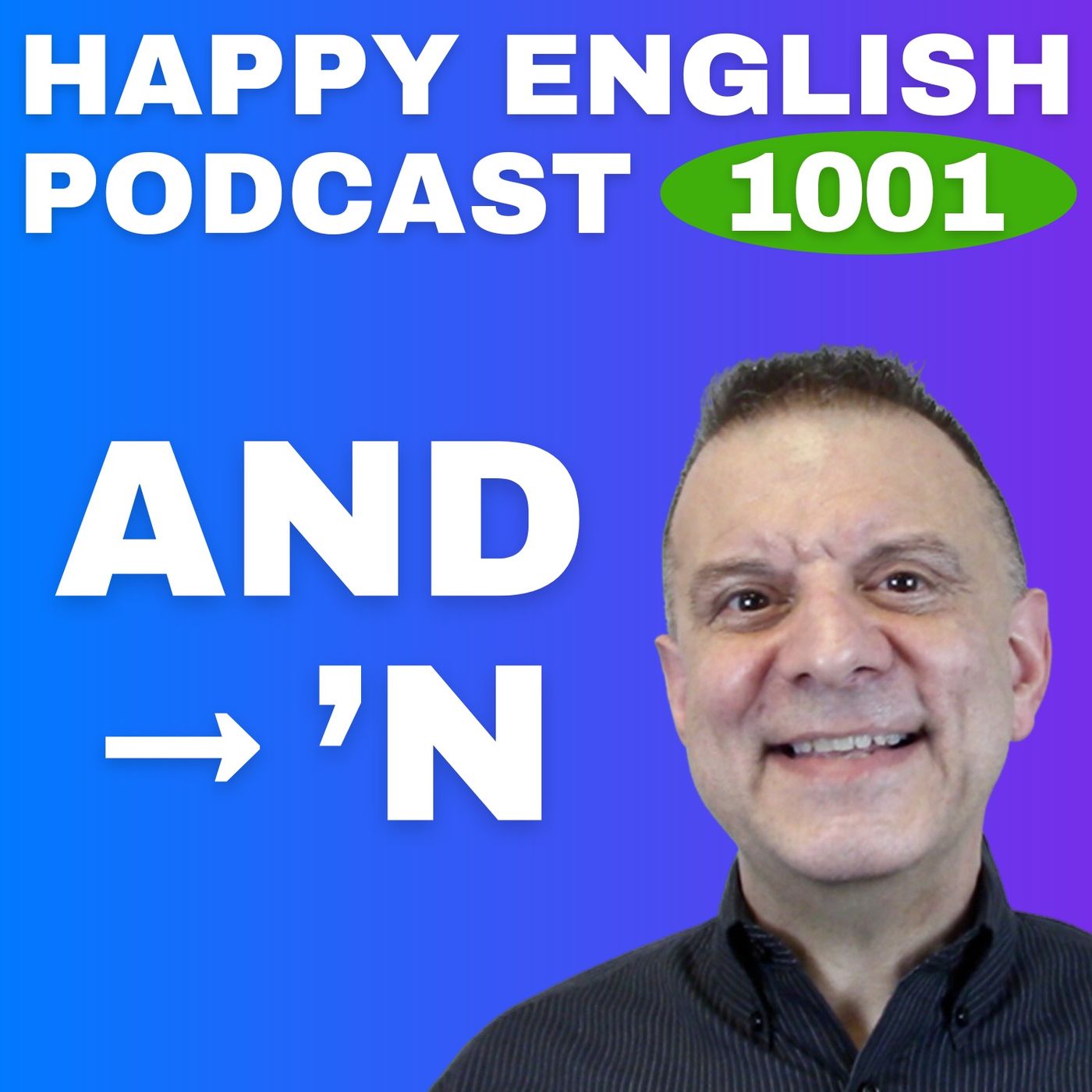
Hey there! It’s Michael here — and welcome back to Speak Naturally in a Minute from Happy English. I’m here every week with a quick one-point lesson to help you improve your pronunciation, rhythm, and intonation.
Today, let’s talk about a tiny word that changes a lot in American English: and.
In everyday conversation and usually reduces to something that sounds like a weak in
So rock and roll sounds like rock ’n rollsalt and pepper sounds like salt ’n pepperham and eggs sounds like ham ’n eggs
The reason is, like other short worlds, con...
1000 - Thank You for 1,000 Episodes
This is Happy English Podcast, Episode 1,000. Episode one thousand. I honestly didn’t know if I’d make it to ten.
When I started this podcast, I had no idea who would be listening… or if anyone would be listening. And now, here we are - one thousand episodes later.
And the best part? I’m not doing this alone. It’s the comments and messages I get from all over the world every week. That’s what makes this special. Language connects people. And this podcast became a small part of that connection.
This week, so...
999 - Throw on - Phrasal Verbs in a Minute | Happy English

Hey there! It’s Michael here, and welcome back to Phrasal Verbs in a Minute from Happy English. I’m here every Friday with a quick one-point lesson to help you learn a new phrasal verb and sound more natural when you speak.
Today’s phrasal verb is throw on. When you throw something on, it means you put on clothes quickly without thinking too much about how you look. You’re not planning an outfit - you’re just getting dressed fast.
Like this morning, I woke up late and just threw on a hoodie and jeans befor...
998 - How to Stall for Time When You’re Thinking in English
Have you ever been asked a question in English and suddenly your mind just goes blank? Has that ever happened to you? Maybe someone says, “What do you think about remote work?” Or, “Where do you see yourself in five years?” And inside your head you’re thinking, “Wait… give me a second…” Well, native speakers don’t always answer immediately either. In fact, we use small phrases to buy time while we think.
We use phrases like, “Let me think…” “That’s a good question…” “I’ve never really thought about that…” Or small words like, “Well…” and “Actually…” These little phrases help you sou...
997 - How Native Speakers Soften Statements in English
Episode 1000 of the Happy English Podcast drops on February 28, and I’d really love to include you in it. If you’ve been listening for a while and this podcast has helped you in any way, please send me a short message — about 20 to 40 seconds. Just tell me your first name, where you’re listening from, how long you’ve been listening, and how the podcast has helped you.
You can record it on your phone in a quiet room and email the audio file to me at michael@myhappyenglish.com. If you’d rather write a message instead, tha...
996 - Why Your and You’re Sound the Same
Hey there! It’s Michael here — and welcome back to Speak Naturally in a Minute from Happy English. I’m here every Sunday with a quick one-point lesson to help you improve your pronunciation, rhythm, and intonation.
Today, let’s talk about something that confuses a lot of learners. Why do “your” like, your pen and “you’re” like you are nice sound exactly the same in American English? The reason is, in natural speech, both words usually reduce to “yer.”
So instead of saying: “your phone” Americans say: “yer phone.” And instead of: “you’re late” We say: “yer late.”
...
995 - That Figures – English Tips in a Minute | Happy English
Hey there! It’s Michael here — and welcome back to English Tips in a Minute from Happy English. I’m here every Saturday with a short, simple tip to help you speak English more naturally and confidently.
Before we get to today’s English point, I need your help. Episode 1000 of the Happy English Podcast drops on February 28, and I’d really love to include you in it.
If you’ve been listening for a while and this podcast has helped you in any way, please send me a short message — about 20 to 40 seconds. Just tell me your first n...


