The Fossil Files
In "The Fossil Files", a pair of palaeontologists delve into the latest discoveries from the world of palaeontology and seek to bring fossils to back to life. Each episode, Susie and Rob will discuss an interesting new research paper ranging from topics of what dinosaurs ate, how plesiosaurs swam, where we came from, and the science of de-extinction. Whilst doing so, we peek under the hood of how the science of palaeontology is done and how research gets to see the light of day. It is for anybody interested in palaeontology and past life whether that is students, researchers themselves...
How to get a Species of Human Named after you [Preview]

Getting a fossil species named after you is an unsual way to acheive quasi immortality, especially so for a species of human. In this preview of our second bonus episode we take a look at the weird, and often tragic lives of 5 people who have given their names to species of fossil humans, ranging from mad Austro-Hungarian aristrocrats to rampant imperialists and German pastors. Along the way we ask if we can learn some lessons from this ecletic bunch, and explore the fascinating new science revealing the face of human ancestors.
The full episode is available via...
Fossil Fails: Weird ideas about how and when Mammoths were "Snuffed Out"

How and when did mammoths go extinct? This week we take a look at two bizarre mammoth related "fossil fails". The first is some unexpected results from from the "adopt-a-mammoth" scheme, a fascinating citizen science project trying to find the youngest mammoth fossil to date their extinction. In the second, we take some time to consider the most bizarre hypothesis of mammoth extinction yet: did they sneeze themselves to death as a result of horrible allergies and then get "snuffed out"? Get your skepticism at the ready.
The papers we discuss this week are "Adopted mammoths from...
How to become a palaeontologist [Preview]

How and when and why do you become a palaeontologist? Biology, Geology, something else? Childhood, undergraduate, PhD? Susie and Rob discuss the different routes and offer their advice and experiences. This is a preview of our first bonus episode. To hear the rest of the episode, support us on our Patreon https://patreon.com/FossilFiles
25. A dinosaur covered in porcupine spines & the earliest fossil cloaca

The idea that dinosaurs were all scaley beasts got a massive challenge in 2000s when a variety of feather-like structures were found in fossils in China and other places. An even greater diversity of weird coverings have been found since then, most recently an iguanodontian covered in spines. This week we take a look at the porcupine looking Haolong dongi and what this means for dinosaur evolution. We also take a look some amazing trace fossils from the Permian of Germany, so detailed they even show the scales of an early reptile, including its cloaca. That's right, an improbable...
How and when did animals first appear? Extraordinary new fossils from China

What (and when) is an animal? They are thought to have first arrived about 500 million years ago and immediately underwent an explosive diversifcation at the beginning of the Cambrian. When and how this important event took place has always been hard evolutionary problem to solve: fossils with the necessary preservation of soft-tissues are rare and limited. Two finds from China blow open new windows into this episode.
The first is a new site from just before the Cambrian. It yields all sorts of typical Ediacaran weirdos, but preserved in a way that we don't usually get to s...
Squishy fishies and horned Hungarian dinosaurs: Fossils hidden in plain sight
Sometimes the answer to palaeontological mysteries can actually be right in front of our faces, if only we know how, or where, to look. This week we take a look a two cases by the Fossils Files' own Susie, Rob and Jane. Firstly, we reveal how the eyes and skeletons of early vertebrates were right in front of us, hidden in Silurian Scottish fish fossils, but only observable when we applied high powered X-ray analysis to them. Secondly, we look at the mystery of the missing European ceratopsian dinosaurs. Turns out these horned dinosaurs were there all along after...
22. The dawn of dangerous seas in the Triassic
Life nearly died 252 million years ago in a mass extinction at the end of the Permian. It was long thought that it took 10s of millions of years into the Triassic for life to recover and get back to a 'new normal'. That was until a new and very muddy fossil site from the high Arctic revealed a staggering diversity of predators and tetrapods in the earliest Triassic seas. This week we take a look at the new findings and its implications for life's ability to recover from major extinctions.
This week's paper is "Earliest o...
Lead Poisoned Apes and Our Human Origins
Lead is a well known pollutant affecting human health over the course of our urbanisation and industrialisation. But what about before this? Analysis of a range of fossil hominid teeth from the Pleistocene reveals that lead poisoning might have been a ubiquitious part of our deep evolutionary history. Furthermore, lab experiments looking at the effect of lead exposure on human and neanderthal brain development reveals the interplay between this pollutant and 'the language gene' (FOXP2). Together, this suggests that the development of language, socialisation and ultimate evolutionary success of humans might be related to our ability to overcome lead...
20. Back-breaking and baby making, the disturbing bedroom habits of hadrosaurs
Having large body sizes conferred all sorts of advantages on dinosaurs, but it potentially made breeding a bit complicated. This week we take a look at some weird pathologies in fossil hadrosaurs (duck billed dinosaurs and friends) and what they might tell us about their amourous habits - do broken backs provide evidence of rough housing in the bedroom?
This week's paper is "Deciphering causes and behaviors: A recurrent pattern of tail injuries in hadrosaurid dinosaurs" by Filippo Bertozzo and colleagues, published in IScience November 2025 https://doi.org/10.1016/j.isci.2025.113739
The widescreen artwork is by T...
19. Dinosaurs were doing fine (before the asteroid), with Steve Brusatte. part 2
Part 2: Around 66 million years ago an enormous asteroid barrelled into the earth and wiped out ichthyosaurs, pterosaurs, and dinosaurs*. Debate has raged back and forth as to whether the dinosaurs were already in decline before this mass extinction or were still going strong. This week, Susie and Rob are joined by Prof. Steve Brusatte to take a look at what vertebrates were doing just before the asteroid hit. In part 2 we discuss what would have happened if the asteroid had missed, Steve's new upcoming book, Jurassic World, and Nannotyrannus.
*except birds of course.
Widescreen artwork by...
Dinosaurs were doing fine (before the asteroid), with Steve Brusatte. part 1
Around 66 million years ago an enormous asteroid barreled into the earth and wiped out icthyosaurs, pterosaurs, and dinosaurs*. Debate has raged back and forth as to whether the dinosaurs were already in decline before this mass extinction or were still going strong. This week, Susie and Rob are joined by Prof. Steve Brusatte to take a look at what vertebrates were doing just before the asteroid hit. We discuss his new paper on fossil vertebrates from New Mexico, its implications for scenarios of dinosaur evolution and extinction, and what is life is like for a working palaeontologist, digging up C...
Will palaeontologists go extinct? AI & the future of palaeo
Artificial Intelligence seems to be changing everything, everywhere, all at once. But how will the science of studying the very old be transformed by the technology of the new? In this episode Susie and Rob take a look at the risks and opportunities for palaeontology with the application of AI: palAIontology. Can we use AI to find, identify, and classify fossils?
The paper's discussed this week are: "Artificial intelligence in paleontology" by Congyu Yu and colleagues published in Earth Science Reviews May 2024 https://doi.org/10.1016/j.earscirev.2024.104765 and "Early humans and the balance of power: Homo habilis as...
Rotting crocs, the dino bus, and engineering skulls: Day 3 at the Society of Vertebrate Paleontology
In the last of our series from the massive Society of Vertebrate Paleontology meeting, Susie and Rob finally manage to catch up for a gossip. In this episode with get a disgusting taste of rotting crocodile experiments with Stephanie Drumheller of the University of Tennessee, an insight into the Dinosaur battle bus education project that has been travelling the Mongolian steppe with Bolor Minjin of the American Museum of Natural History and the Institute for the Study of Mongolian Dinosaurs, and finally how engineering approaches can help us figure out what fossil organisms were up to long after their...
Swimming robots and walking fish: Day 2 at the Society of Vertebrate Paleontology
New fossil discoveries keep coming thick and fast, but we managed to sit down with the researchers as they present them. In this episode Susie and Rob catch up (in person!) on their second day in Birmingham and talk to the researchers tackling important transitions in vertebrate evolution: the transitions of moving onto land, into the sea, into the air. This includes Emily Hillan of University of Chicago and her discovery of a new specimen of the walking fish (?) Tiktaalik, Dave Hone of Queen Mary University London on his new research on pterosaurs and spinosaurs, Dean Lomax about his...
Nanotyrannus and vertebrate origins: day 1 at the society of vertebrate paleontology
The Fossils Files are on Tour! Susie and Rob are in Birmingham for the massive Society of Vertebrate Paleontology conference which has made a rare trip to Europe. We will be meeting and chatting with palaeontologists from all over the world and bringing you the latest discoveries and hot gossip. On day 1 we join the Nanotyrannus craze and chat to co-author of that study, James Napoli of Stoney Brook NY. The amazing "Duelling Dinos" specimen has been released the world by the North Carolina Museum of Natural Sciences and has sent dinosaur fans aflutter with its implications for tyrannosaurs...
A new head banging dinosaur
A newly discovered fossil from the Cretaceous of Mongolia tells us an interesting story about the purported head butting behaviour of dinosaurs. Pachycephalosaurs are famous for their thick domed heads but it has been disputed how or when this evolved. The beautifully preserved Zavacephale rinpoche has a well preserved skull and dome but also loads of details of the body and tail as well. What is suprising is that this individual is much smaller, and occurs much earlier, than other pachycephalosaurs. We take a look at this new fossil and what this means for interpreting the evolution of dinosaur...
Cretaceous zombie ants
Cordyceps is a weird fungus that can take over the brain of ants and spiders causing them to go zombie and commit suicide in order to spread disease. Weirder still, some new fossils from the Cretaceous have directly captured this nightmarish behaviour for the first time. We take a look at these interesting fossils, their potentially shady origin story, and their implications for reconstructing evolution of this unsual parasitic behaviour. Side-note: did fungus cause the extinction of dinosaurs?
The main paper discussed this week is by Yuhui Zhuang and colleagues "Cretaceous entomopathogenic fungi illuminate the early evolution...
Fossil Fails: The tiny dino with a massive flaw
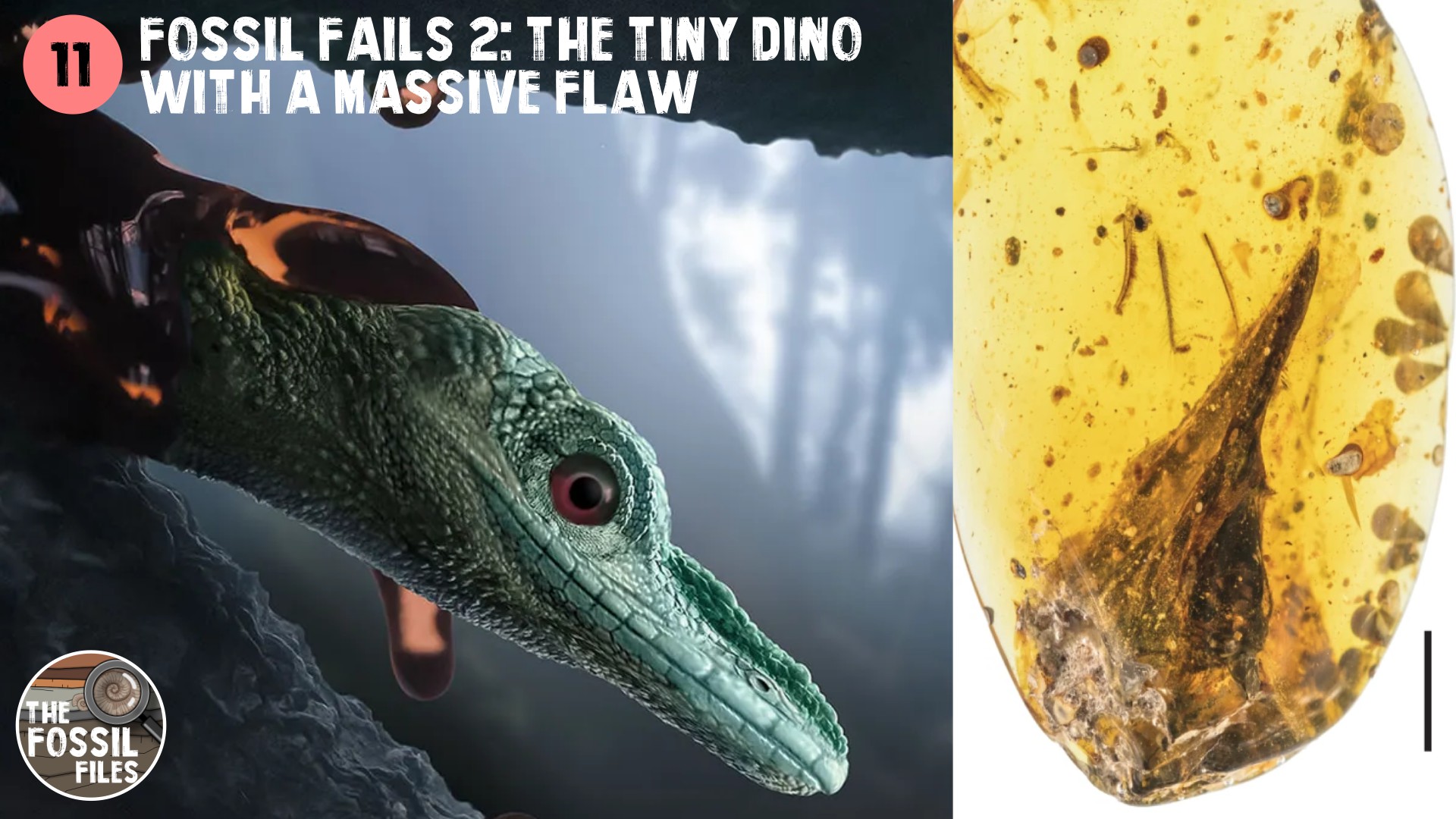
Discovery of the smallest ever dinosaur acheived quite a splash when it was publised on the front cover of Nature in 2020. The new critter, Oculodentavis, was the size of a hummingbird and reconstructed as close to Archaeopteryx on the lineage to birds. In this episode, Susie and Rob take a look at how this story quickly started to unravel as it turned out Oculodentavis might been something else altogether. This how episode also shed some light on a dark underbelly of an ethical problem for palaeontologists - what if your fossils are coming from a war zone and potentially...
Fossil Fails: A Precambrian beehive and dinosaurs on the moon
In the first of two episodes on notorious fossil fails, Rob and Susie take a look at how a serious case of mistaken identify unfolded for some Ediacaran 'fossils'. Herein lies a cautionary tail for all relating to pareidolia: our very human tendency to perceive patterns in random shapes and lines, or why we might see jesus is a piece of toast or a smiley face in a cut pepper. This takes us to unexpected destination for hunting for dinosaur fossils: the moon!
Image 1: A look at some 'Ediacaran fossils' from the Bhimbetka cave in...
The Spicomellus Special
Perhaps the weirdest dinosaur ever has just been described in Nature, by The Fossil Files' own Susie Maidment. In a worldwide EXCLUSIVE*, Susie gives as the unvarnshed truth about how this spikey Jurassic weirdo came to be found, what makes it different, and peek under the hood as to how palaeontological research like this is conducted. The story weaves in the local and scientific communities in Morroco, funding crises, a global pandemic, dodgy fossil collectors, international law, and a lot of hard work.
The paper is "Extreme armour in the world's oldest ankylosaur" by Susannah Maidment and c...
Mirasaura, Triassic Punk
This new discovery is WEIRD. Mirasaura (the 'marvellous lizard') has been described from the Triassic of France, and it has mad projections coming out of its back, far longer than its body. We take a look at what these projections were, and were not (i.e. not feathers), their implications for the evolution of integumentary structures, and our own historically bad haircuts.
The paper is "Triassic diapsid shows early diversification of skin appendages in reptiles" by Stephan Spiekman and colleagues, published in Nature in July 2025.
https://doi.org/10.1038/s41586-025-09167-9
Wide...
SQUID! (bonus episode)
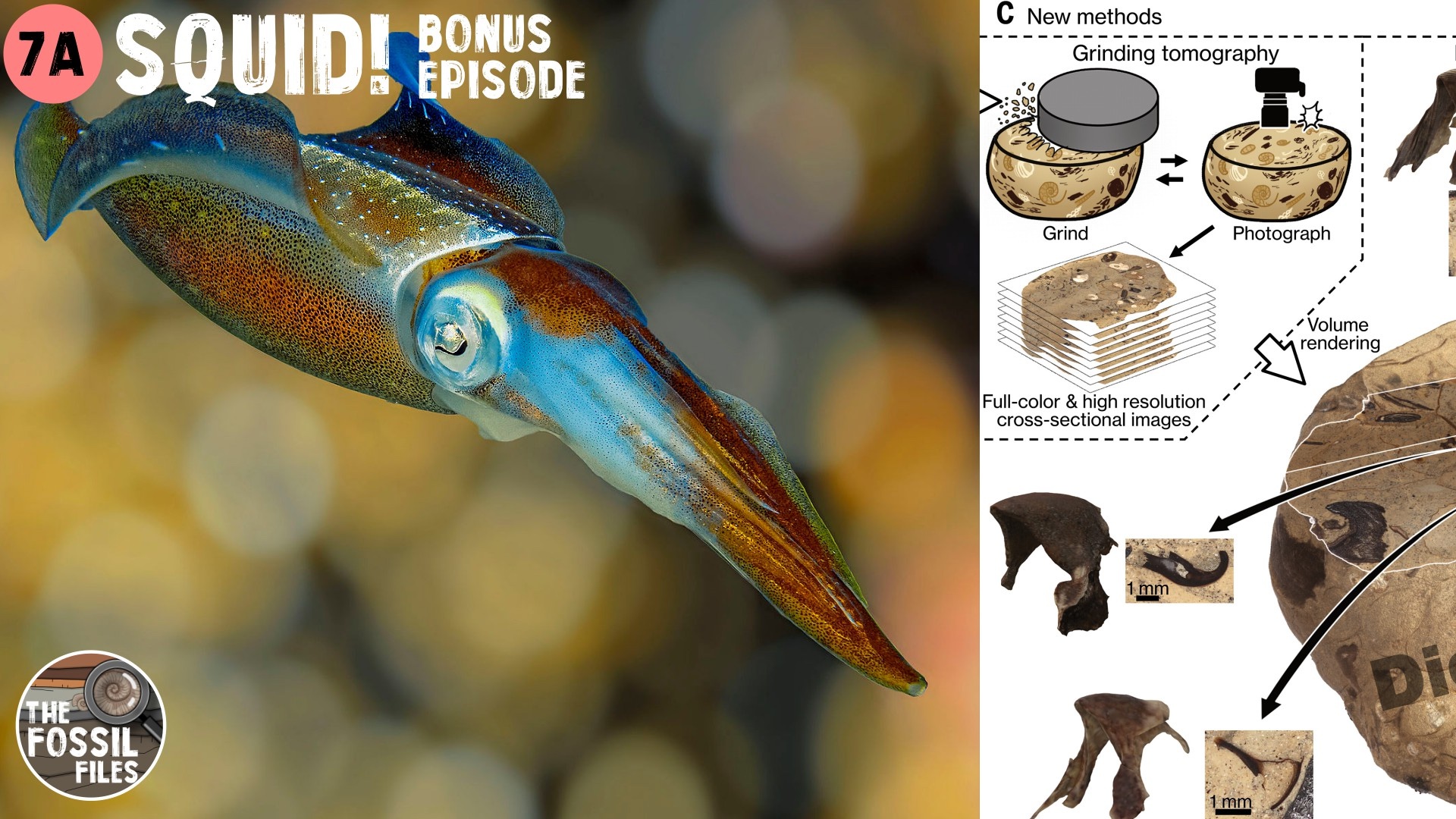
Squid are a really important part of marine ecosystems, but their fossil record is close to non-existent - their squishy bodies are just really unlikely to be fossilised. In this short bonus episode we take a new look at the squid fossil record. 'Digital fossil mining' reveals a massive diversity of squid in Creataceous oceans. How did the scientists do it and what does this mean?
The paper is "Origin and radiation of squids revealed by digital fossil-mining" by Shin Ikegami and colleagues of Hokkaido University, Japan. https://doi.org/10.1126/science.adu6248
Our deep origins and the vertebrate that wasn't
The origin of our own group, the vertebrates, has received quite the shake up. One of the important fossil players has been found to be an invertebrate imposter, and this completely changes our understanding of this evolutionary episode. We take a look at why and when, and how this boils to down to a interesting question all about teeth. Did our entire skeleton come from teeth on the outside of our bodies, even before jaws existed? Is this why we now get tooth ache?
The paper is "The origin of vertebrate teeth and evolution of sensory exoskeletons" b...
Where did Pterosaurs come from?
Pterosaurs dominated Mesozoic skies but it has always been a mystery where these flying reptiles came from. This week Susie and Rob discuss Pterosaur controveries and a cool new study that attempts to solve the problem of where and how they originated. How can you do this? By looking at the climate and locations of where pterosaurs lived and their closest relatives - the weird looking lagerpetids -, we can make predictions about how pterosaurs lived, thrived, and died. And maybe even where we should be looking for them...
Figure 4 from paper shows the authors...
Were Neanderthals the first fossil collectors?
Why do we collect fossils and who were the first fossil collectors? Cretaceious fossils have been found in a cave in Northern Spain alongside the Neanderthals that were living there 46,000 years ago. Were Neanderthals collecting fossils and if so why? This week Susie and Rob examine those claims and discuss fossil collecting and the recent surge in private trade in dinosaur fossils.
Because we are children, we also giggle at possibly one of the earliest fossils collected, the Erfoud Manuport as well as the Makapansgat pebble.
The paper is "Were Neanderthals the First Col...
Walking with… our Carboniferous ancestors in the rain
Our evolutionary timeline just leapt back an additional 40 million years into the past. Some new fossil trackways from the early Carboniferous of Australia have been interpreted as the first bone-fide "amniotes". This is the group of egg laying vertebrates which we belong to along, with all the other mammals, birds, and reptiles. These fossils are much earlier than previously thought possible and potentially turns our understanding of this event on its head. We take a look at these fossils and the implications, in particular that there could be loads of missing things out there yet to be found, including...
Is de-extinction a scam?
Can we bring extinct organisms back to life? Colossal Biosciences caused quite the stir earlier this year when claimed they could do just that, and indeed have done with Dire Wolves - an extinct species of candid from North America. What is going on here? We sense check those claims and ask what they did (and did not do) as well as the broader implications of the science (pseudoscience?) of de-extinction.
The front cover of "Time" magazine - no ambiguity here about what they are saying.
Here is the phylogeny (evolutionary t...
Dinosaur poos from Poland
How did dinosaurs rise to supremacy? This difficult question is given "fresh" insights from new data from a motherload of fossils from Poland. Over 500 bromalites - fossil vomit, gut contents or poo - were analysed with new technology allowing reconstruction of how diets and ecosystems changed over this crucial time. We take a look at some of these fossils and interpretations and speculate about how to experimentally test these smelly findings.
Figure 2: A selection of fossils found inside the bromalites (gut contents, vomit, and poos) from the paper. a - fish scales in a lungfish b...
How does your plesiosaur swim?
For our first paper, we look at some exceptional preservation of soft tissue in Jurassic plesiosaur (large marine reptiles). Detailed preservation of soft tissues to the sub-cellular level is very rare in the fossil record. We discuss this specific example from Germany (which we name Nigel) and the types of analyses that the authors did of its skin and tissues. This new data helps us reconstruct how plesiosaurs may have lived and moved. Or does it?
In this figure from the paper we can see the whole fossil of Nigel (A), a close up of...
Introducing the Fossil Files
In "The Fossil Files", a pair of palaeontologists delve into the latest discoveries from the world of palaeontology and seek to bring fossils to back to life. Each episode, Susie and Rob will discuss an interesting new research paper ranging from topics of what dinosaurs ate, how plesiosaurs swam, where we came from, and the science of de-extinction. Whilst doing so, we peek under the hood of how the science of palaeontology is done and how research gets to see the light of day. It is accessible to all those interested in palaeontology whether that is students, researchers themselves...


