Systems Thinking and Beyond
The AI team take a deep dive into successful innovative tools, practical and conceptual applications of systems thinking and beyond and systems engineering to various types of problems, summarizing the concepts behind the successes and usually drawing general conclusions for how the concepts may be used in other situations. The opinions expressed by the AI team in each deep dive are their own and have not been edited in any way. While systems thinking provides an understanding of the problematic situation, you need to go beyond systems thinking to create solutions, especially innovative solutions. Join my LinkedIn group (Tackling complex...
Book review: Claude for dummies

The AI team take a deep dive into Claude For Dummies, a comprehensive guidebook by Stephanie Diamond designed to help users master Anthropic's AI assistant. It covers fundamental operations such as account setup, effective prompting, and the use of specialized features like Projects and Memory. The manual also details advanced capabilities, including document analysis, automated workflows, and the creation of interactive Artifacts. By explaining how Claude differs from traditional search engines through its natural conversation style and complex reasoning, the source serves as a practical roadmap for both beginners and experienced users. Ultimately, the text highlights the tool's versatility in improving writ...
AI Through a Systems Lens: Solutions and Illusions
In this presentation, the AI team takes a deep dive into a YouTube video discusion the dual nature of artificial intelligence as both a powerful problem-solving tool and a source of deceptive illusions. He utilizes Large Language Models (LLMs) to demonstrate how they can assist with tasks ranging from systems engineering to resolving mundane household issues. The sources clarify that these models function using probabilistic text generation rather than genuine understanding, operating as stateless engines that rely on a context window to mimic memory. This structural design leads to significant risks, such as hallucinations where the AI confidently fabricates false information...
The Natureology Hallucination

The AI team takes a deep dive into "Natureology" hallucination which occurred when the AI was asked to define a non-existent term (a typo for "Naturology") and, rather than simply seeking clarification, invented a complete philosophical and academic framework for the word. Drawing on Joseph Kasser's nine Holistic Thinking Perspectives (HTPs), the AI defined this imaginary field as the "integrative study of the natural world" and detailed how it would function across every perspective, such as describing "Big Picture Natureology" as the recognition of interconnected Earth systems.
This behavior was a result of an approval-seeking bias inherent...
Book Review: How to Design Programs: Systematic Computing and Design Principles
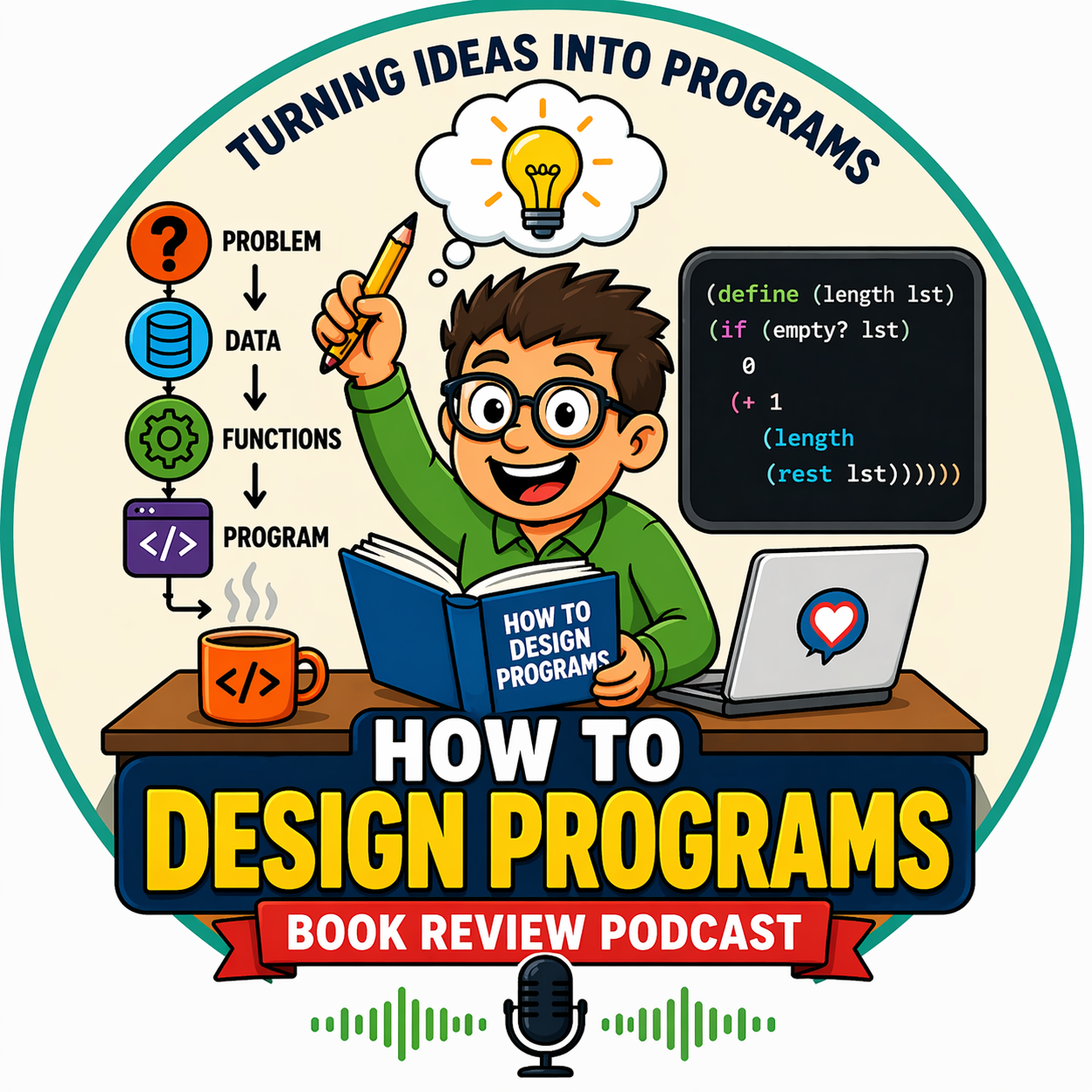
The AI team takes a deep dive into the second edition of How to Design Programs , which presents a systematic methodology for software creation, emphasizing program design over mere coding. The authors advocate for a design recipe consisting of six essential steps that transform a problem analysis into a functional, tested program. This approach utilizes the DrRacket environment and a series of teaching languages specifically crafted to provide clear feedback to beginners. Students learn to manipulate various forms of data, including numbers, strings, and images, through a process of iterative refinement. Beyond technical skills, the text aims to cultivate...
Book Review: Bilingual Messianic Passover Haggadah

Have you ever wondered about the Jewish Passover festival? The AI team takes a deep dive into a bilingual guide that presents the order of a Passover Seder through a blend of Jewish tradition and Christian theology. The text provides a step-by-step liturgical framework, including the lighting of candles, the four cups of wine, and the symbolic foods found on the Seder plate. It utilizes scriptural readings from both the Old and New Testaments to connect the exodus from Egypt to the life and sacrifice of Jesus. Written in both English and Chinese, the source serves as an educational tool for participant...
Mission Engineering, a Return to the Original Systems Engineering Analytical Paradigm?

The AI team takes a deep dive into the Department of Defense Mission Engineering Guide (Version 2.0), which provides a standardized, interdisciplinary framework for analyzing and designing military missions to achieve specific outcomes. This methodology decomposes missions into mission threads and engineering threads to evaluate how different technologies, systems, and tactics impact overall success. By utilizing digital engineering tools and quantitative modeling, the guide helps practitioners identify capability gaps and inform high-level investment and acquisition decisions. The process is highly iterative, moving from initial problem definition and characterization to rigorous analysis and final recommendations. It emphasizes the use of data-driven metrics, s...
Book Review: Learn Systems Thinking

The AI takes a deep dive into a book that serves as an instructional guide to systems thinking, a holistic methodology designed to address the complex, interconnected challenges of the modern world. The authour, Wallace Wright argues against linear, mechanistic problem-solving, encouraging readers instead to view organizations and global issues as dynamic feedback loops. By examining the underlying structures and patterns which exist beneath surface-level events—frequently illustrated through the iceberg analogy—individuals can identify the root causes of dysfunction. The book details various systemic archetypes, such as "drifting goals" and "shifting the burden," to explain why quick fixes often fail...
Bogdanov: The Unknown Pioneer of Systems Science

The AI team takes a deep dive into Alexander Bogdanov’s Tektology, a pioneering work that seeks to establish a universal science of organization. The author argues that all human, biological, and cosmic processes are governed by identical structural laws, positioning his theory as a precursor to modern systems theory and cybernetics. Through a detailed table of contents and introductory essays, the source explains how mankind and nature both function as organizers, utilizing mechanisms such as equilibrium, selection, and structural stability. The text also addresses the historical resistance Bogdanov faced from Marxist contemporaries, who viewed his scientific generalizations as a threat to...
Book Review: Systems Science for Engineers and Scholars

The AI team takes a deep dive into a text which introduces systems science as an interdisciplinary framework designed to bridge the gap between specialized academic "silos" such as biology, physics, and engineering. Written by Avner Engel, the book Systems Science for Engineers and Scholars outlines ten fundamental principles—including hierarchy, complexity, and emergence—that govern all systems regardless of their specific domain. It encourages professionals to adopt holistic thinking to solve modern global dilemmas, such as the climate and energy crises, by applying lessons learned from one field to another through isomorphic mapping. The material also provides a detailed road...
Understanding Large Language Model AIs

The AI team takes a deep dive into the technical architecture and operational logic of Large Language Models (LLMs). They explain that these systems are trained through a multi-stage process; pre-training, fine-tuning, and human feedback, to predict text sequence. A central focus is the Transformer architecture, which uses an attention mechanism to understand relationships between words and manage linguistic nuances such as spelling errors. The team clarify that AI "memory" is actually a process where the entire conversation history is re-read during every interaction to maintain coherence. Finally, the team define LLMs as probabilistic state machines that, despite their sophisti...
An Introduction to System Science

The AI team take a deep dive into a book, Introduction to System Science with MATLAB by Gary Marlin Sandquist Zakary and Robert Wilde. The book introduces system science as a multidisciplinary framework for analyzing and modeling rational systems through the use of MATLAB. It emphasizes that effective practitioners must combine mathematical proficiency with computer competence to evaluate complex phenomena ranging from physical sciences to human history and sociology. By applying the principle of causality, the material demonstrates how to quantify diverse topics such as economic growth, medical diagnoses, and even religious impacts or personal stress. The provided excerpts offer vario...
The Collapse of MBSE and the Collateral Damage to Systems Engineering

The AI team takes a deep dive into a provided text, The Collapse of MBSE and the Collateral Damage to Systems Engineering, by Art Villanueva, DEng, ESEP which argues that Model-Based Systems Engineering (MBSE) has mistakenly become a substitute for the broader discipline of systems engineering, leading to a decline in professional authority and decision-making quality. While MBSE is a valuable tool for organizing and documenting system information, it often lacks the analytical power required to drive critical engineering choices, which are instead handled by external simulations and expert judgment. This misalignment results in models that serve as post-hoc documen...
