eMotors: Electric Revolution
Innovation, Technology, and Tomorrow's Driving Welcome to the podcast that explores the electric mobility revolution. Each episode takes you on a journey to discover the latest innovations, cutting-edge technologies, and driving experiences that are shaping the future of automobiles. An electrifying journey into the future of sustainable mobility. If you enjoy these episodes or find them useful, you can buy me a coffee through this link: https://buymeacoffee.com/emotorselectricrevolution.
Geely E2: Ultimate EV Killer?
Can a compact Chinese EV truly disrupt the European B-segment? The Geely E2 enters the European market priced between €20,900 and €24,900, directly challenging key rivals like the Renault Twingo E-Tech and Citroën ë-C3. Positioned as a feature-packed alternative, the E2 combines superior mechanical specs, advanced safety ratings, and high battery efficiency against legacy European competitors.
Key Highlights & Features:
Class-Leading Architecture & Handling: The Geely E2 stands out as the only vehicle in its price segment featuring rear-wheel drive (RWD) and a multilink independent rear suspension, delivering superior ride balance and an exceptionally tight 4.95-meter turning radius.Space & Versat...Geely E2 vs European Rivals: Compact Electric Car Comparison
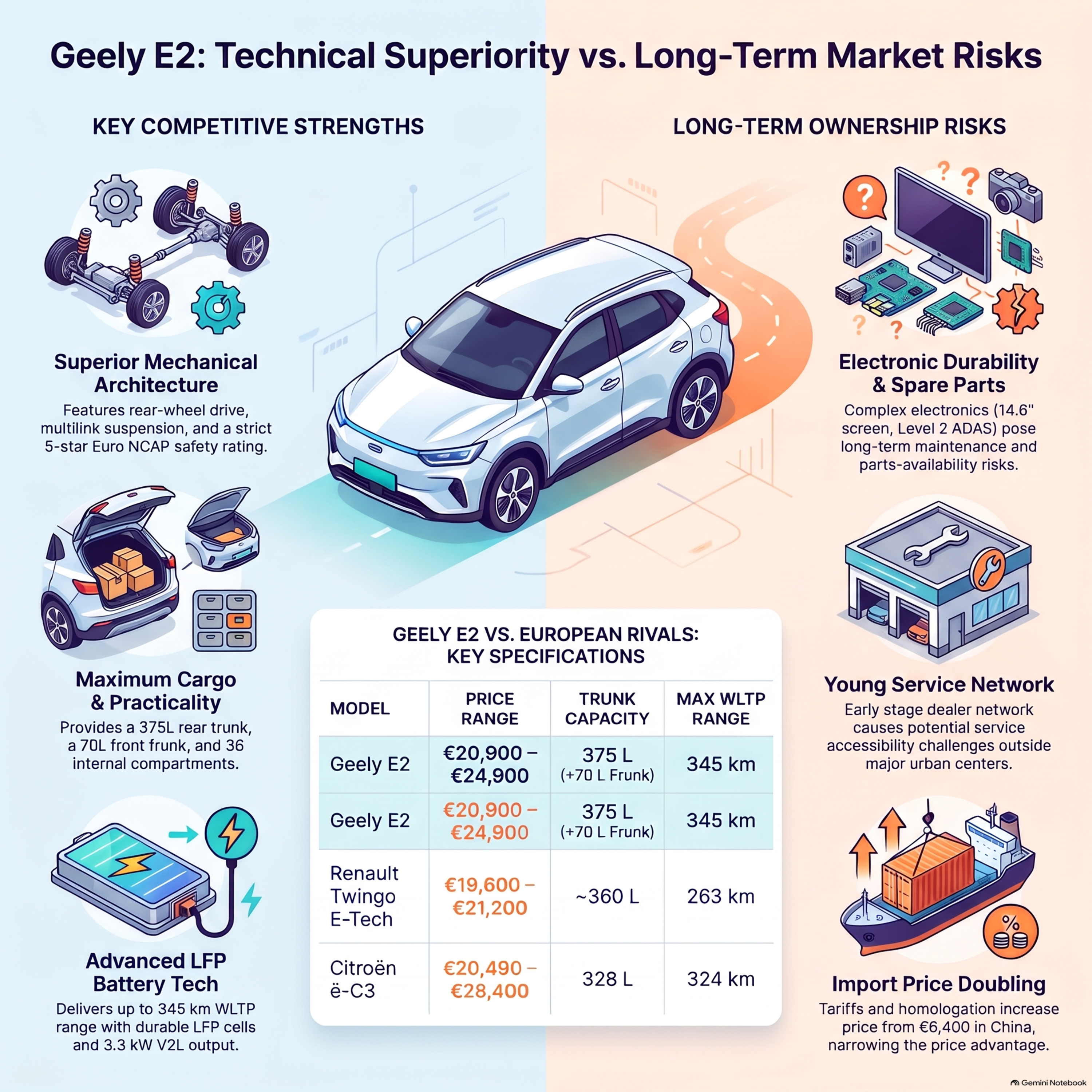
The provided episode evaluates the market potential of the Geely E2 electric vehicle in Europe by comparing its specifications against competitors like the Renault Twingo E-Tech and Citroën ë-C3. It highlights the vehicle's superior technical advantages, including a more generous driving range, premium cabin features, advanced rear-wheel-drive mechanics, and greater cargo capacity within its price bracket. Despite offering an exceptional price-to-equipment ratio, the vehicle faces significant hurdles in the European market due to soaring import costs, customs duties, and fierce competition from established brands.
Ultimately, while the model presents a compelling engineering package, its commercial triumph wi...
Tesla Model 3 Versus BYD Seal: Lifestyle Driving Guide
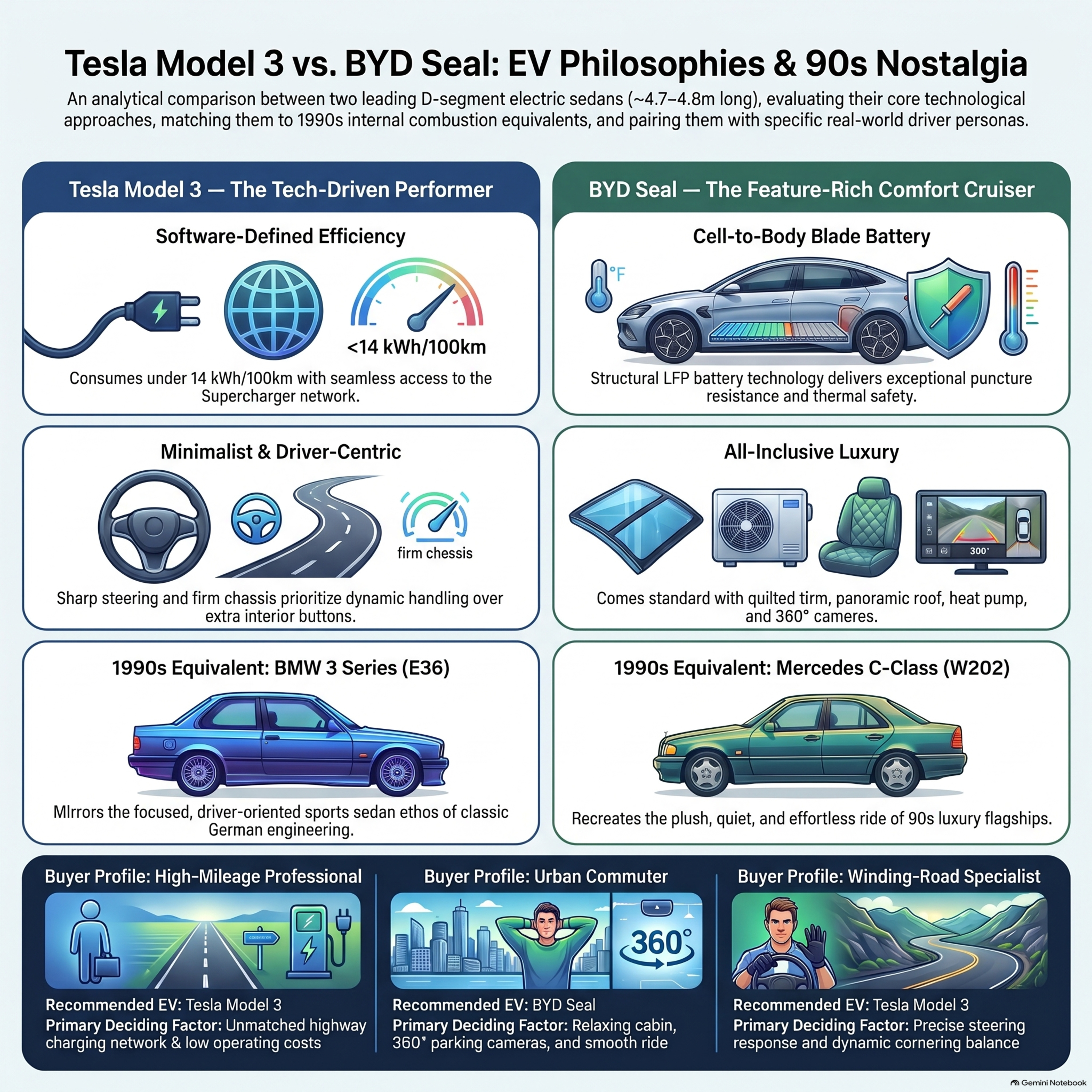
The provided episode evaluates whether the Tesla Model 3 or the BYD Seal better suits various drivers based on their specific lifestyles, daily routines, and geographic locations. For everyday local errands and urban commuting in heavy traffic, the BYD Seal emerges as the preferred option due to its plush interior comfort, comprehensive standard features, and helpful parking technology. Conversely, professionals requiring high-mileage efficiency, dependable long-distance travel, and robust charging access gravitate toward the Tesla Model 3. Ultimately, the comparison demonstrates that choosing between these two electric vehicles depends heavily on balancing local driving luxury against highway efficiency and charging infrastructure.
<...Tesla Model 3 vs BYD Sea
The analysis compares two D-segment electric sedans (~4.70–4.80 meters in length)—the Tesla Model 3 and the BYD Seal—evaluating their core engineering philosophies, historical 1990s automotive parallels, and practical lifestyle applications across five driver profiles.
Core Philosophies & Key Strengths
Tesla Model 3:BYD Seal:Tesla Model 3 as BMW 3 Series (E36) / Alfa Romeo 155 & 156: Captures the spirit of 1990s athletic compact executive saloons—driver-focused, firm, agile, and centered on mechanical and electronic performance.BYD Seal as Mercedes-Benz C-Class (W202) / Lancia Kappa / Alfa Romeo 166: Mirrors 1990s luxury cruisers—conceived as a traveling lounge prioritizing plush ride quality, high standard equipment, and quiet crui...Why EVs Last Long-Term
The article examines real-world roadworthiness data and long-term ownership dynamics of electric vehicles passing the 100,000-mile (160,000 km) mark. While conventional internal combustion engine (ICE) vehicles experience rising failure rates from mechanical wear and transmission breakdown, Battery Electric Vehicles (BEVs) demonstrate superior structural longevity thanks to simplified powertrain architecture. However, the article provides a critical reality check: high-mileage EV ownership fundamentally shifts financial exposure away from routine mechanical maintenance toward concentrated out-of-warranty electronic repair risks and heavy-chassis wear.Key Highlights & TakeawaysSuperior High-Mileage Reliability: Official inspection data analyzing millions of roadworthiness tests reveals that EVs past 90,000–120,000 miles (145,000–190,000 km) record a lower insp...
What Kills 100,000 Mile EVs
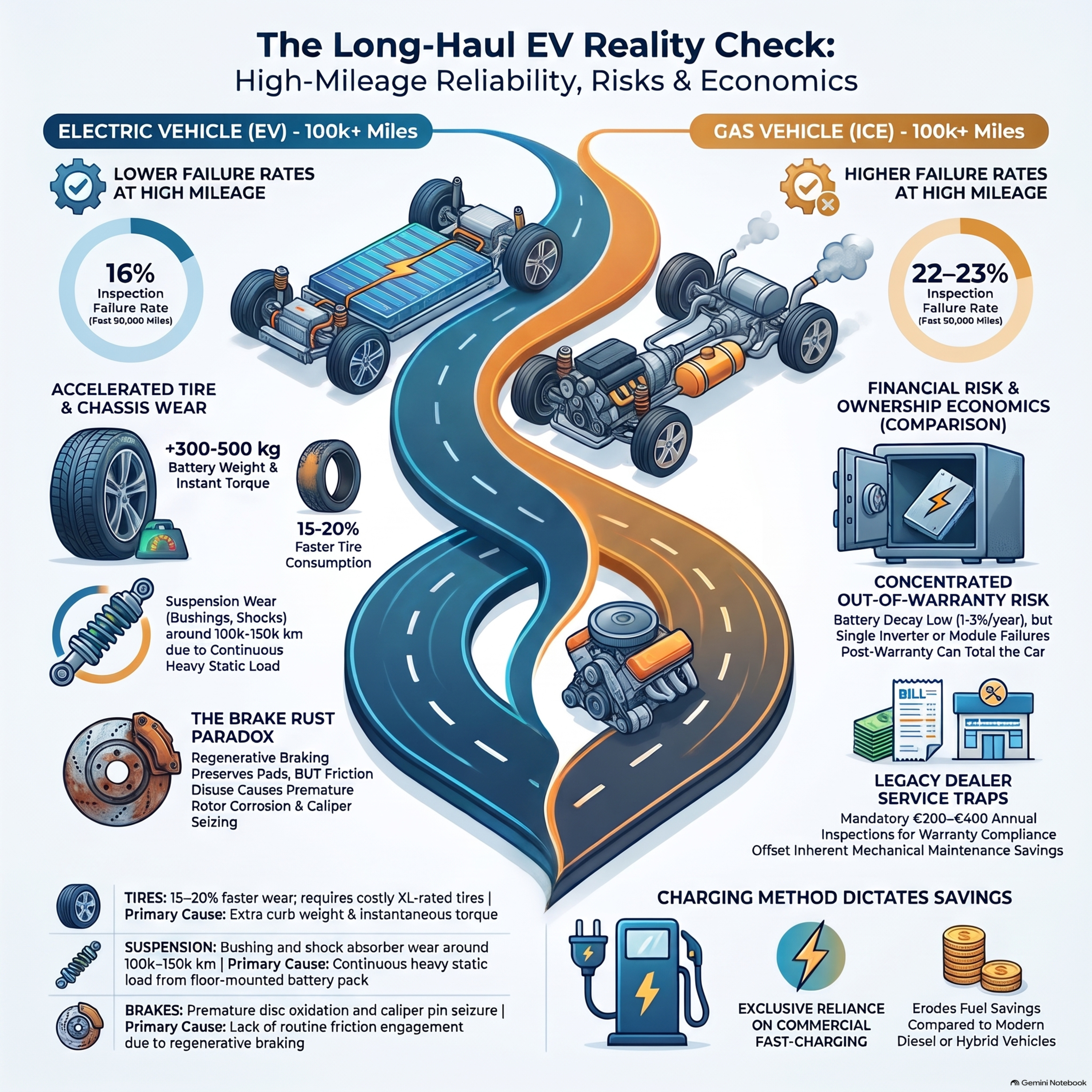
Based on discussions from automotive communities on Reddit, real-world electric vehicle ownership largely confirms scientific studies regarding battery durability, though significant financial nuances emerge in daily use.
While standard battery degradation is generally quite manageable, motorists face substantial financial risks from out-of-warranty hardware failures and accident damage, which can unexpectedly total the vehicle.
Additionally, drivers note a paradox with mandatory dealership maintenance, where traditional brands enforce costly annual checkups to preserve warranties, whereas newer manufacturers like Tesla maintain much lower upkeep expenses.
Vehicle wear and tear also heavily depend on driving habits, as...
The Hidden Truth About High Mileage EVs
Electric vehicles (EVs) are often marketed around frictionless operational simplicity, but what happens when they cross the 100,000-mile mark? Grounded in roadworthiness inspection data and driver community insights, this article explores the reality of long-haul EV ownership. While simplified drivelines help high-mileage EVs outlast conventional gas-powered vehicles, long-term ownership fundamentally shifts financial exposure from routine maintenance to concentrated out-of-warranty electronic risks and specialized chassis wear.
Key Highlights & Takeaways
Superior Powertrain Durability at High Mileage: Past the 90,000 to 120,000-mile (145,000–190,000 km) threshold, Battery Electric Vehicles (BEVs) show a lower inspection failure rate (~16%) compared to gas cars (~22–23%). Eliminating high-wear comb...Why EVs Are Ditching Rare Earth Magnets
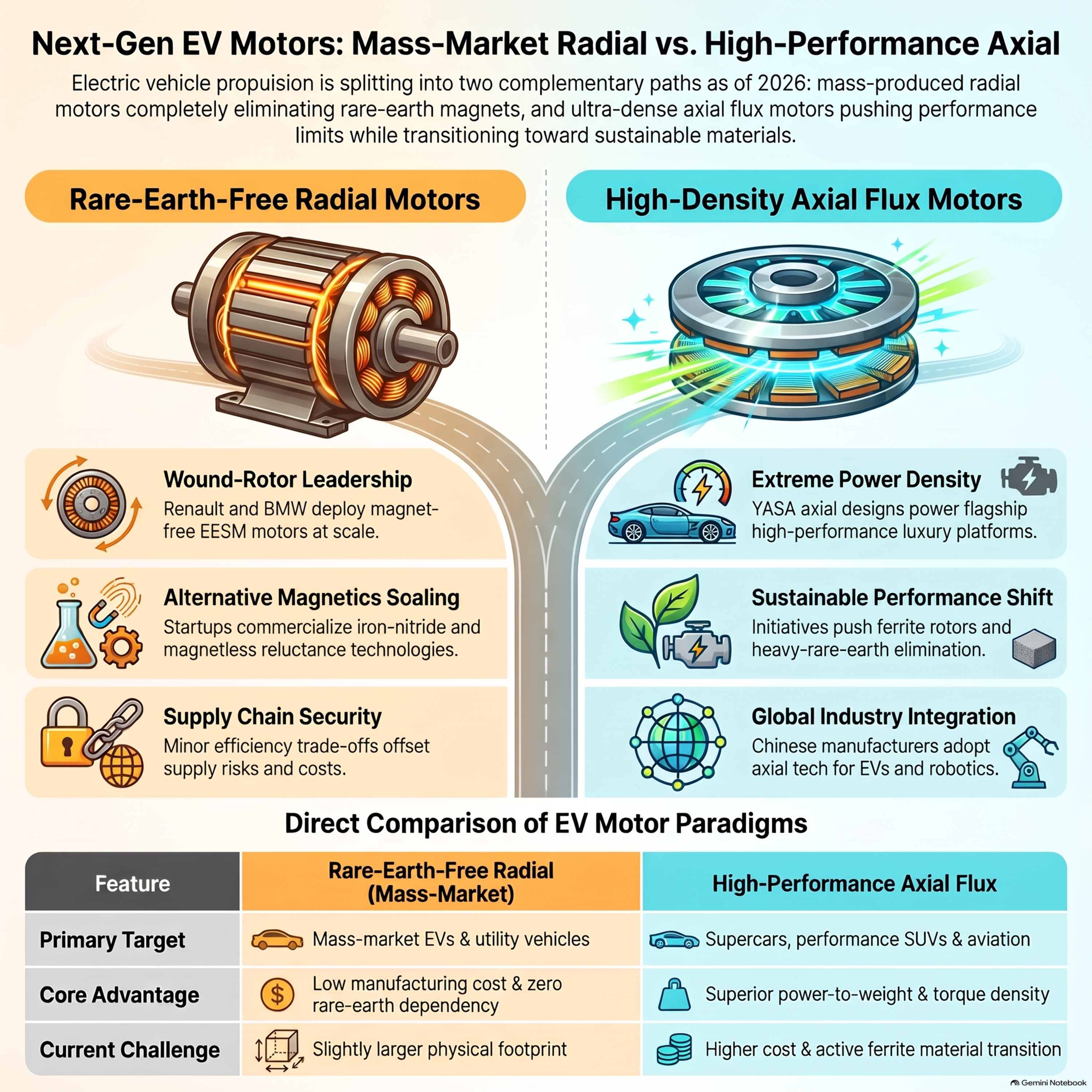
Modern electric vehicle engineering faces severe geopolitical and supply chain vulnerabilities regarding critical rare-earth minerals, forcing the automotive industry to rethink motor design through the insights of classical philosophy. To eliminate dangerous dependencies on foreign resources, major manufacturers and pioneering startups are adopting Senecan strategic autarky by scaling magnet-free architectures such as electrically excited synchronous motors, induction units, and alternative reluctance designs. Concurrently, Thalesian economic realism dictates that mass-market commercial viability and overall vehicle manufacturing costs outweigh an obsessive pursuit of peak motor efficiency, making minor performance trade-offs acceptable when paired with cheaper, larger battery packs. Furthermore, engineers apply...
Evaluating Modern Electric Motor Innovations Through Classical Philosophy
This article evaluates modern electric vehicle (EV) motor technology—specifically rare-earth-free designs and advanced flux topologies—not merely through mechanical metrics like horsepower, but through the combined lenses of resource geopolitics, market economics, and spatial geometry. To unpack these complex challenges, it applies the frameworks of three classical thinkers: Seneca, Thales of Miletus, and Aristotle.
1. The Core Philosophical Frameworks
Concept: Reliance on vulnerable foreign supply chains is strategic folly; absolute self-sufficiency (autarky) is essential for long-term stability.
Engineering Reality: Dependence on heavy and light rare-earth elements (such as d...
Leapmotor B05: Ultimate EV
Discover how the Leapmotor B05 (known in China as the Lafa 5) is set to disrupt the European electric vehicle market by bringing high-end 800V fast-charging technology to mainstream drivers. In this video, we explore how Leapmotor and Stellantis are combining luxury-level ultra-fast charging, futuristic interior features, and impressive range into an accessible fastback priced comfortably under €32,000.
Key Highlights:
Next-Gen 800V Charging: Moving beyond standard 400V systems, the 800V architecture reduces electrical resistance and heat generation during ultra-fast charging, helping to protect battery cell chemistry over time and maintaining a sustained charging speed.Long-Range Efficiency & High-Tech Cabin: Of...Leapmotor B05 Brings 800 Volt Charging
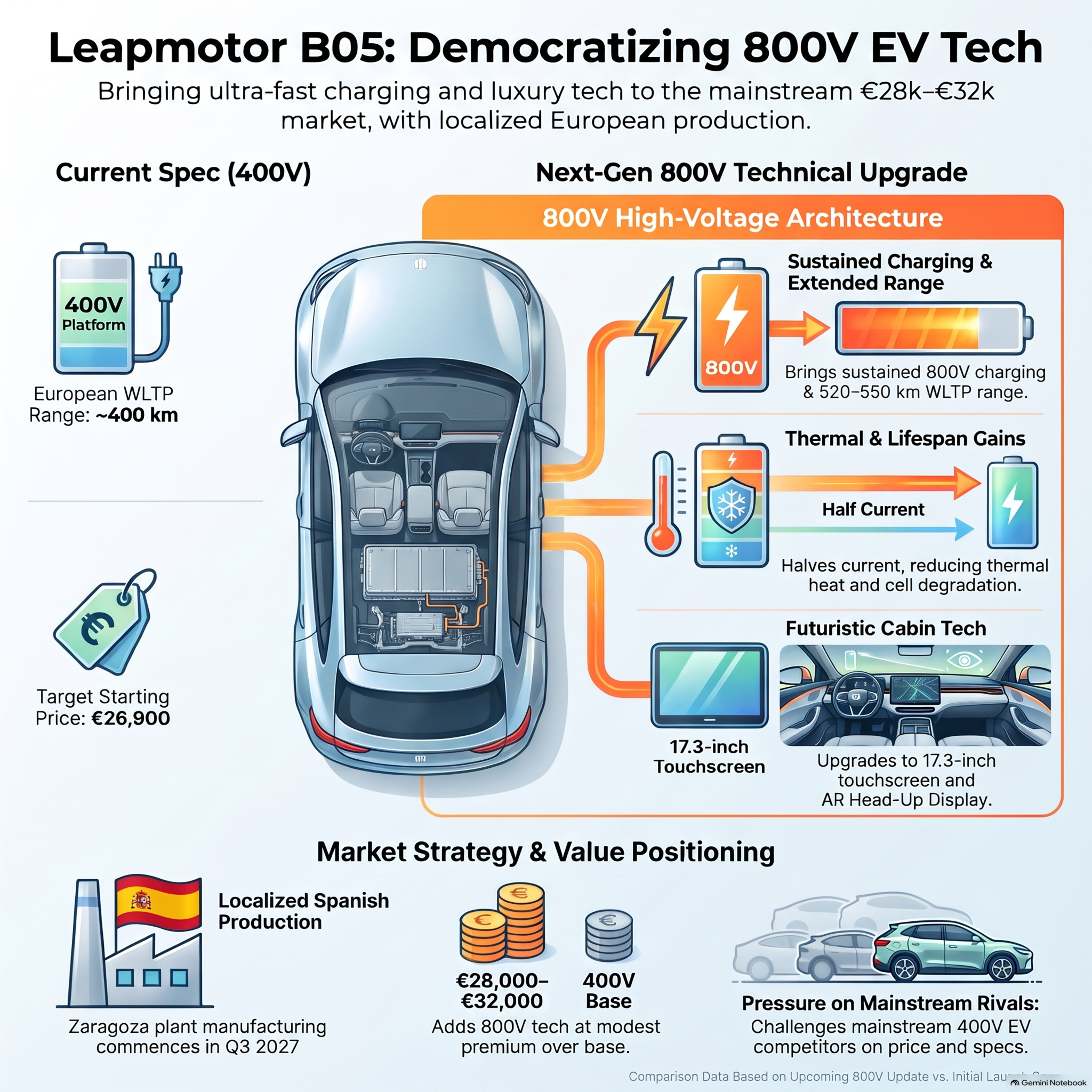
The sources discuss the upcoming updates for the Leapmotor electric vehicle, known as the Lafa 5 in China and the Leapmotor B05 in Italy. While the refreshed Chinese model is set to debut at the Guangzhou Auto Show with advanced features like an 800V architecture, an augmented reality head-up display, and extended driving range, the current Italian version relies on an older 400V system. European consumers are expected to receive these technical enhancements around 2027, coinciding with a scheduled model year refresh. Furthermore, Stellantis and Leapmotor plan to begin local manufacturing of the vehicle at a factory in Zaragoza, Spain, by...
The Trojan Horse
"The Trojan Horse" explores how major Chinese automotive groups like BYD, Geely, and SAIC are penetrating the European market from within to bypass EU import tariffs. The video highlights Geely's "Brand Shield" strategy of leveraging legacy European brands—such as Volvo Cars, Lotus, and Smart—to eliminate cultural prejudice and neutralize tariffs at the source.
It also covers BYD’s strategic hub in Szeged, Hungary, the localization of supply chains and acquisition of existing European manufacturing plants, and the strategic push into plug-in hybrid (PHEV) models to exploit regulatory loopholes surrounding tariffs on pure electric vehicles.
How Chinese Automakers Dodge EU Tariffs
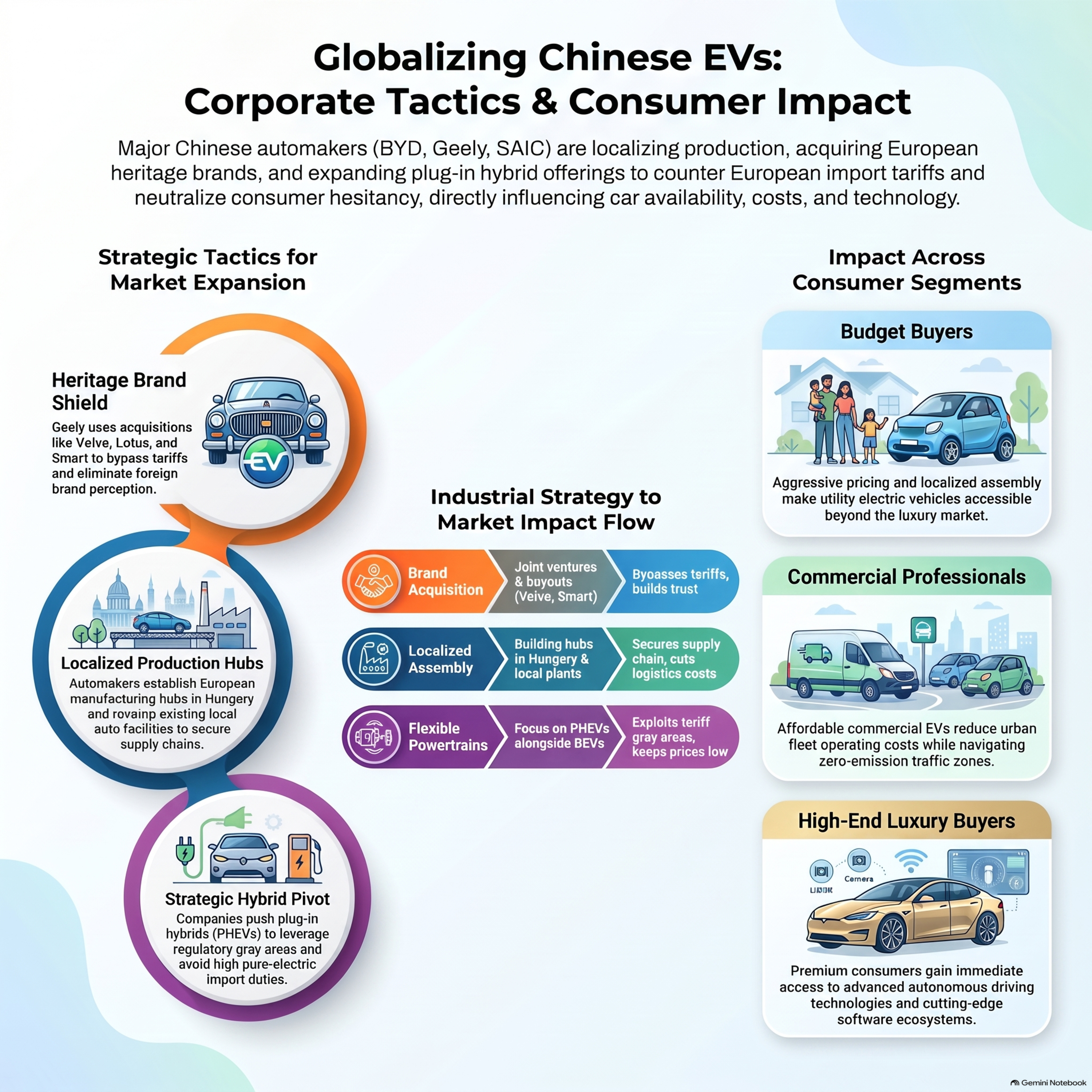
How Chinese Automakers Dodge EU Tariffs offers a fast-paced audio breakdown of the industrial tactics and real-world market impacts of Chinese automakers expanding into Europe. The episode examines key tariff-avoidance strategies, including local factory establishment in Hungary, brand acquisitions, and flexible multi-powertrain platforms. It further analyzes the practical effects across consumer segments: bringing lower-priced EVs and hybrids to budget-conscious drivers, providing cost-effective commercial vehicles with local support networks for small business owners, and delivering high-end autonomous driving and infotainment tech to luxury vehicle buyers.
Keeping an EV for 20 Years: Škoda Elroq vs. Kia EV3
Keeping an electric vehicle for 20 years to maximize financial savings is an ambitious yet achievable goal for modern family car buyers. This article examines the economic feasibility, technical longevity, and buyer psychology behind long-term EV ownership.
Key Topics Covered:
The 20-Year Financial Formula: How eliminating traditional maintenance items (engine oil, timing belts, spark plugs) and extending brake life up to 3 times via regenerative braking drastically cuts ownership costs. Home charging further repays a substantial portion of the initial purchase price over two decades.Battery Degradation Reality: Factoring in an expected 30–40% battery capacity loss over 20 years.Psychology of...Škoda Elroq vs Kia EV3
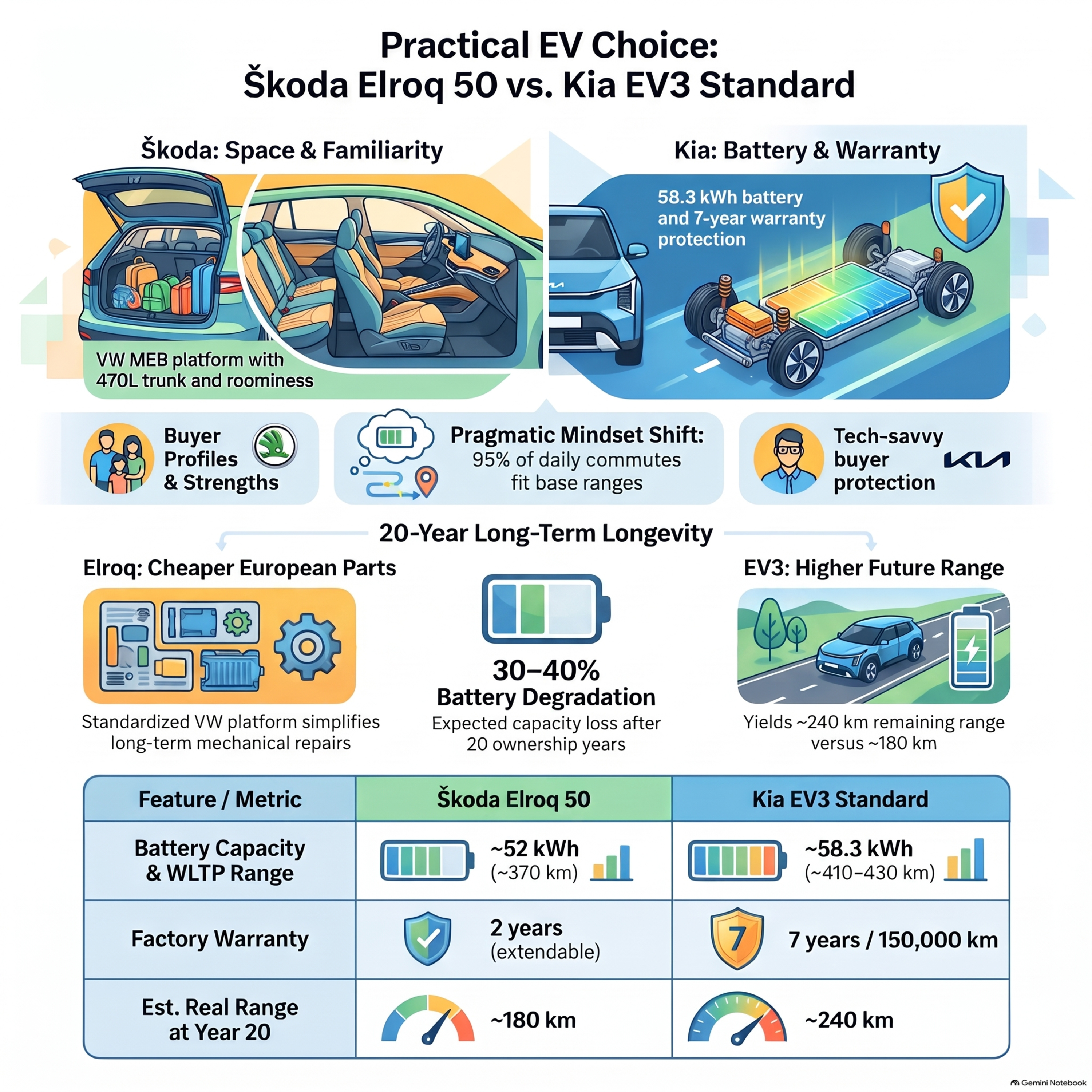
The modern mindset of electric vehicle buyers has transitioned from daring early adopters to pragmatic consumers who prioritize cost-efficiency, genuine daily driving needs, and family safety. This psychological shift is evident when evaluating affordable family options like the Škoda Elroq 50 and the Kia EV3 Standard Range. While the Škoda Elroq appeals to traditional buyers by offering a roomier cabin, a tight turning radius, and classic rear-wheel-drive dynamics, the Kia EV3 attracts tech-savvy motorists with a larger battery, advanced features, and an impressive seven-year warranty. Ultimately, choosing between these two vehicles depends on whether a household values maximum interior space an...
Hacking the Used EV Market
Discover how smart buyers leverage steep early EV depreciation to acquire like-new electric vehicles at 40–50% off list price. While traditional combustion cars suffer mechanical wear across hundreds of moving parts, a 3-year-old EV maintains over 90–92% of its original battery State of Health (SOH) with minimal maintenance costs.
Learn how skipping high-interest financing and choosing pre-owned models—such as the Peugeot e-208 or Opel Corsa-e—can save you €15,000 to €20,000 while securing 100 kW fast charging and over 300 km of real-world range.
Full Article & Episode Breakdown
The modern electric vehicle market hides one of the biggest financial sh...
Why a 3-Year-Old EV Beats Buying New
Discover how smart buyers capitalize on peak early EV depreciation to secure modern electric vehicles at 40–50% off list price. While combustion engine cars suffer mechanical wear across hundreds of moving parts like clutches, belts, and turbines, a 3-year-old EV retains over 90–92% of its original battery State of Health (SOH) with minimal mechanical degradation. Learn how skipping high-interest financing and choosing pre-owned models—such as the Peugeot e-208 or Opel Corsa-e—can save you €15,000 to €20,000 while delivering 100 kW fast charging and over 300 km of real-world range.Full Article & Episode BreakdownThe entry-level and pre-owned electric vehicle market conceals one of the most powerfu...
Voltage Wars: Why 800V Tech Makes 400V EVs Obsolete
This article analyzes the technical shift from standard 400V electrical systems to 800V high-voltage architectures in modern Electric Vehicles (EVs). It explores how high-voltage systems eliminate infrastructure bottlenecks, how automakers across Asia and Europe are adopting the technology, and how pricing is democratizing across different market tiers.
The Physics Behind 800V Charging Efficiency
The Power Formula ($P = V \times I$): Charging power depends on voltage multiplied by current.The 500-Ampere Station Bottleneck: Many fast-charging stations impose a physical current limit of 500A due to cable and connector constraints. Under a 500A limit, a traditional 400V EV...Why 800V Tech Makes 400V EVs Obsolete
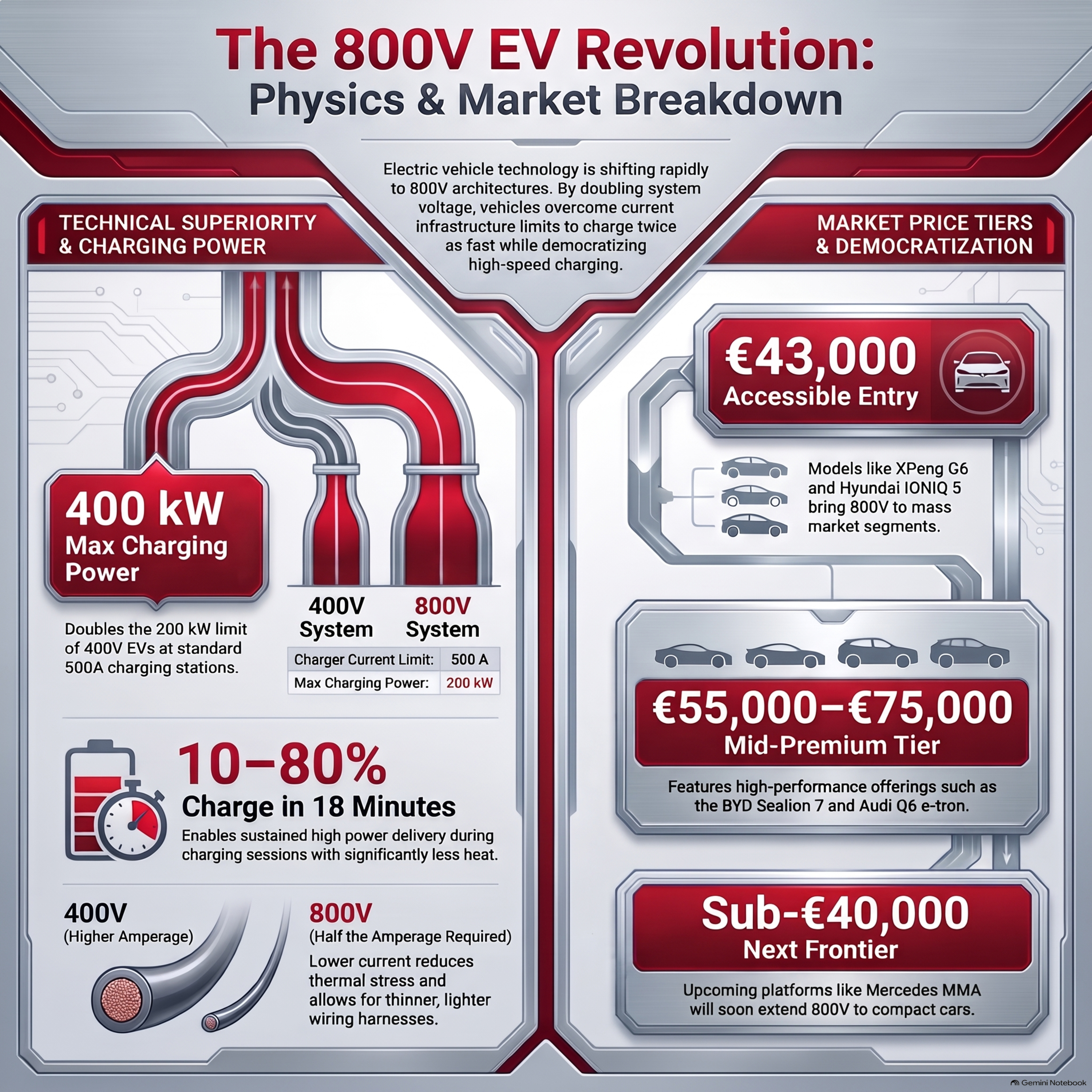
The automotive industry is rapidly making 800V architectures and software-defined vehicles accessible beyond luxury brands, transforming the standard for everyday electric cars. Industry pioneers like Hyundai-Kia have successfully introduced high-voltage platforms to the mass market, while aggressive Chinese manufacturers like BYD and XPeng offer rapid-charging technology at highly competitive price points.
Meanwhile, legacy European carmakers are replacing adapted thermal platforms with native high-voltage systems across their core vehicle lineups. These advanced setups provide significant technical benefits, including reduced wiring weight, faster charging speeds, and centralized software integration that enhances overall vehicle efficiency. Ultimately, this technological evolution democratizes...
Ferrari Luce: Flop to Record
Initially condemned by critics and social media as Maranello's biggest potential misstep, the electric Ferrari Luce has completely rewritten its narrative by achieving an unprecedented market triumph. Designed by former Apple design chief Jony Ive, the groundbreaking model sparked fierce debate upon its May debut, even prompting former Ferrari Chairman Luca di Montezemolo to claim it risked "destroying a myth". However, financial facts and market demand quickly silenced the skepticism.Key Highlights
Instant Sold-Out Success: Despite initial harsh criticism of its design on social media, CEO Benedetto Vigna confirmed that Ferrari Luce's production is already fully allocated through 2027...Ferrari Luce: The Triumph of Maranello's Unconventional Electric Car

Despite initial skepticism regarding its appearance following its debut, the new Ferrari Luce has completely defied expectations by selling out its production capacity through 2027. While critics heavily debated the vehicle's unconventional styling on digital platforms, actual buyers enthusiastically placed orders in showrooms, proving that the physical car is far more appealing than online photographs suggest. This commercial triumph was further underscored at a Monterey charity auction, where the very first production model shattered global records by fetching an astonishing $40 million. Far from stumbling, the manufacturer is experiencing a period of immense financial strength, reporting significant increases in both third-quarter...
How Vietnam Beats the US EV Market
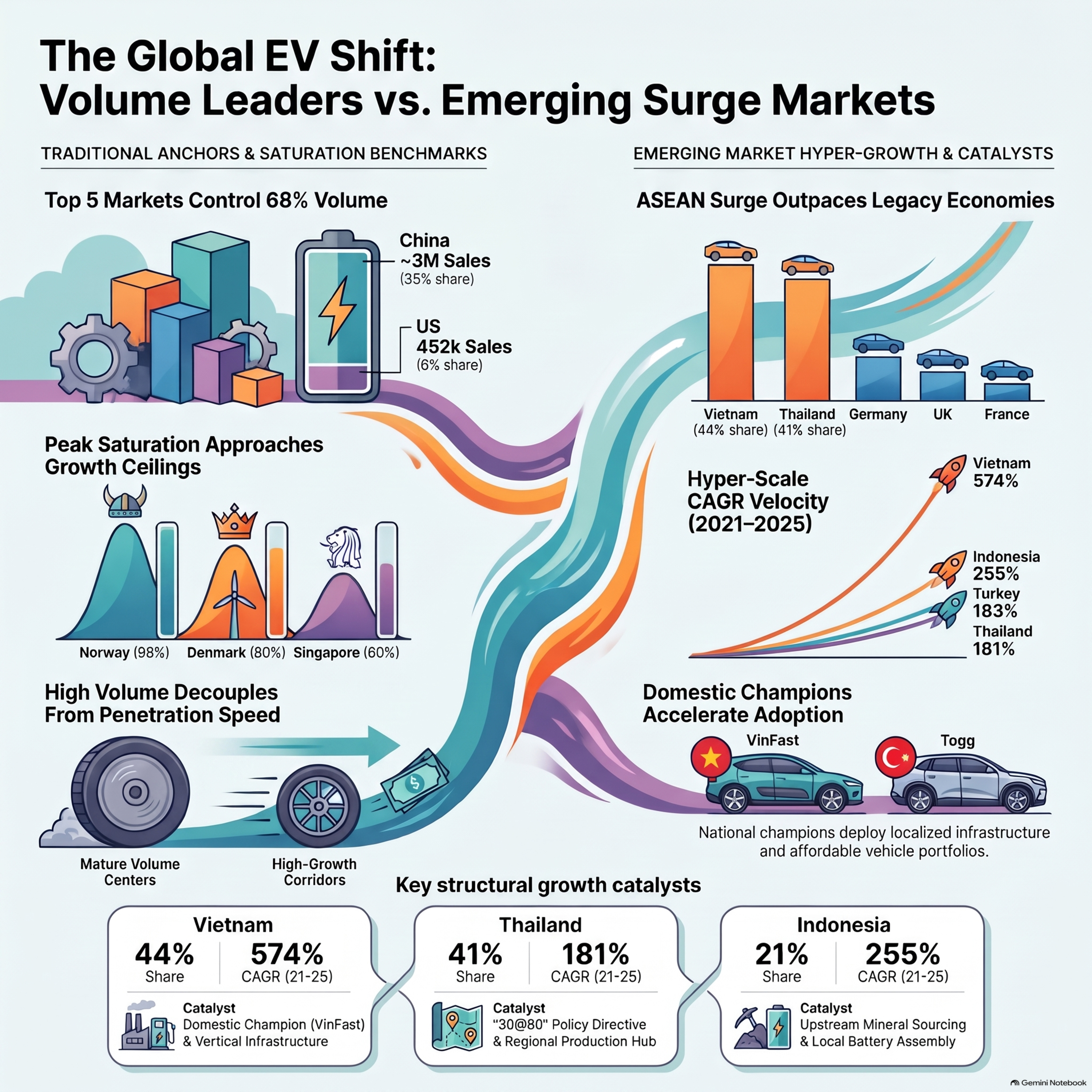
The global adoption of battery electric vehicles is rapidly shifting during the first half of 2026, extending far beyond wealthy, traditional nations. Emerging economies, particularly within Southeast Asia, are now experiencing unprecedented momentum, with countries like Vietnam and Thailand achieving remarkable new-car sales percentages. This widespread acceleration is largely driven by supportive government policies, expanding local supply chains, and the rising influence of domestic manufacturers. Meanwhile, traditional leaders like Norway and Denmark still maintain the highest overall market shares, while China continues to dominate absolute sales volumes globally. Ultimately, the transition toward electric mobility is occurring at an accelerated pace...
Leapfrogging the West: The Unexpected EV Boom in Emerging Markets
The article, examines a structural reallocation of global Battery Electric Vehicle (BEV) demand during the first half of 2026. It highlights that evaluating electric mobility solely by absolute unit sales volume masks where fleet conversion and market disruption are occurring most rapidly.
Key insights from the analysis include:
Volume Leaders vs. Penetration Velocity: In H1 2026, raw unit sales remain heavily concentrated in five traditional markets (China, the US, Germany, the UK, and France), which collectively represent 68% of total global BEV volume. While China leads globally in both unit sales (~3,000,000 units) and adoption share (35%), the United States generates...Why BYD Dolphin Beats Volkswagen ID.3
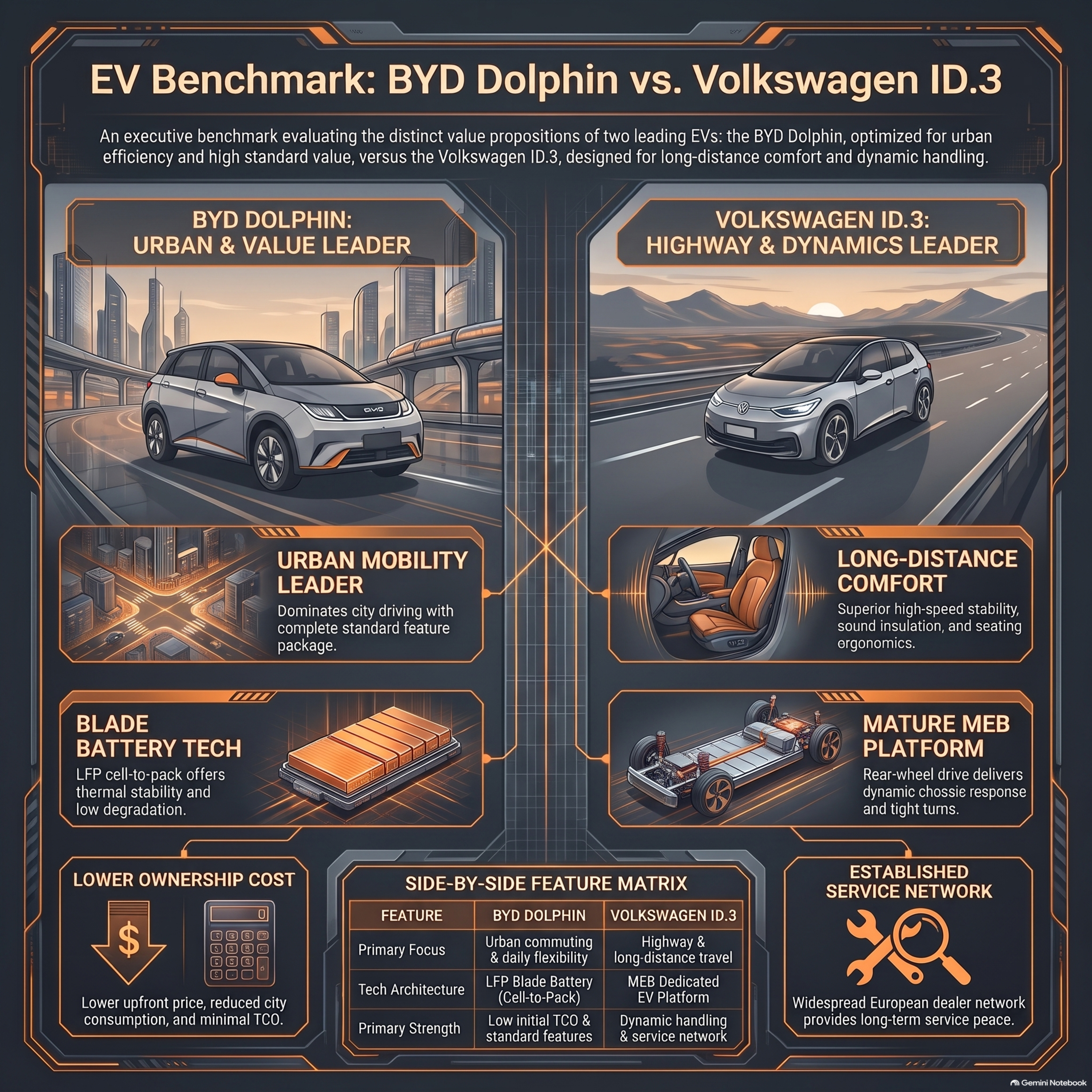
The provided episode evaluates and compares two prominent electric vehicles, the BYD Dolphin and the Volkswagen ID.3, through multiple professional perspectives focusing on daily usability, financial impact, and engineering innovation. The BYD Dolphin emerges as the superior choice for urban driving and overall economic value, praised for its comprehensive standard equipment, competitive purchase price, and exceptional battery safety.
Conversely, the Volkswagen ID.3 excels in long-distance travel, offering a more refined driving dynamic, superior high-speed stability, and the advantage of a well-established European support network. Ultimately, the comparison helps buyers choose between the immediate financial savings and rich...
City Tech or Long-Distance Comfort? BYD Dolphin vs. VW ID.3 Benchmark Analysis
A side-by-side benchmark comparison of the BYD Dolphin and Volkswagen ID.3. Learn how the Dolphin’s cell-to-pack LFP Blade battery and comprehensive standard features challenge the ID.3’s RWD chassis refinement, highway comfort, and European service network.
The BYD Dolphin offers transparent pricing, high standard equipment, and lower city operating costs. Meanwhile, the VW ID.3 provides exceptional high-speed stability, cabin sound insulation, and a tight turning radius for drivers covering high highway mileage
Find out which EV offers the best Total Cost of Ownership for your driving needs
B-SUV Battle Royale: Which Compact Electric Crossover Wins? ⚡🚗
Four popular electric B-SUVs, four completely different approaches to the future of urban mobility. We put the Jeep Avenger EV, Volvo EX30, Renault Megane E-Tech, and Smart #1 head-to-head to see how they stack up.Here is the quick breakdown:
🏞️ Jeep Avenger EV: The ultimate city explorer. Ultra-compact (4.08m), rugged design, Selec-Terrain modes, and up to 400 km WLTP range.🚀 Volvo EX30: Supercar acceleration meets Scandinavian minimalism. 0–100 km/h in an insane 3.6s (428 hp Dual Motor) with up to 476 km range.📱 Renault Megane E-Tech: Dynamic driving paired with native Google integration. Low center of gravity, smart heat pump, and seamless Android Autom...Confronto B-SUV Elettrici: Jeep, Volvo, Renault e Smart
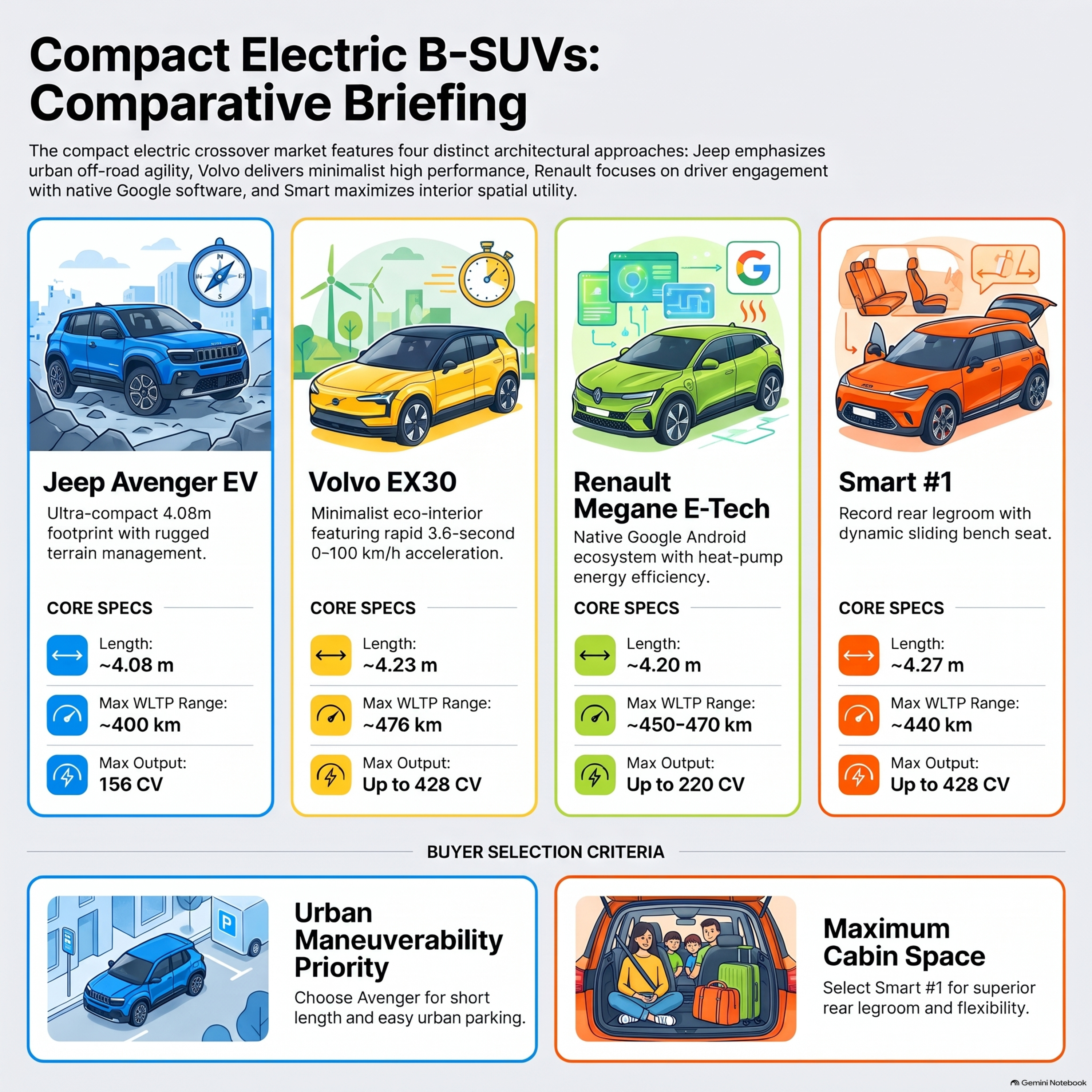
The provided episode offers a detailed comparative analysis of four popular electric B-SUV models: the Jeep Avenger EV, the Volvo EX30, the Renault Megane E-Tech, and the Smart #1. It evaluates each vehicle based on its physical dimensions, battery capacity, maximum power output, and distinctive features. Furthermore, the material highlights specific technological innovations, driving dynamics, and charging capabilities unique to each automobile. Finally, the overview concludes with practical purchasing advice, matching individual consumer priorities with the most suitable car from the selection.
Electric SUV Showdown: Volkswagen versus Kia
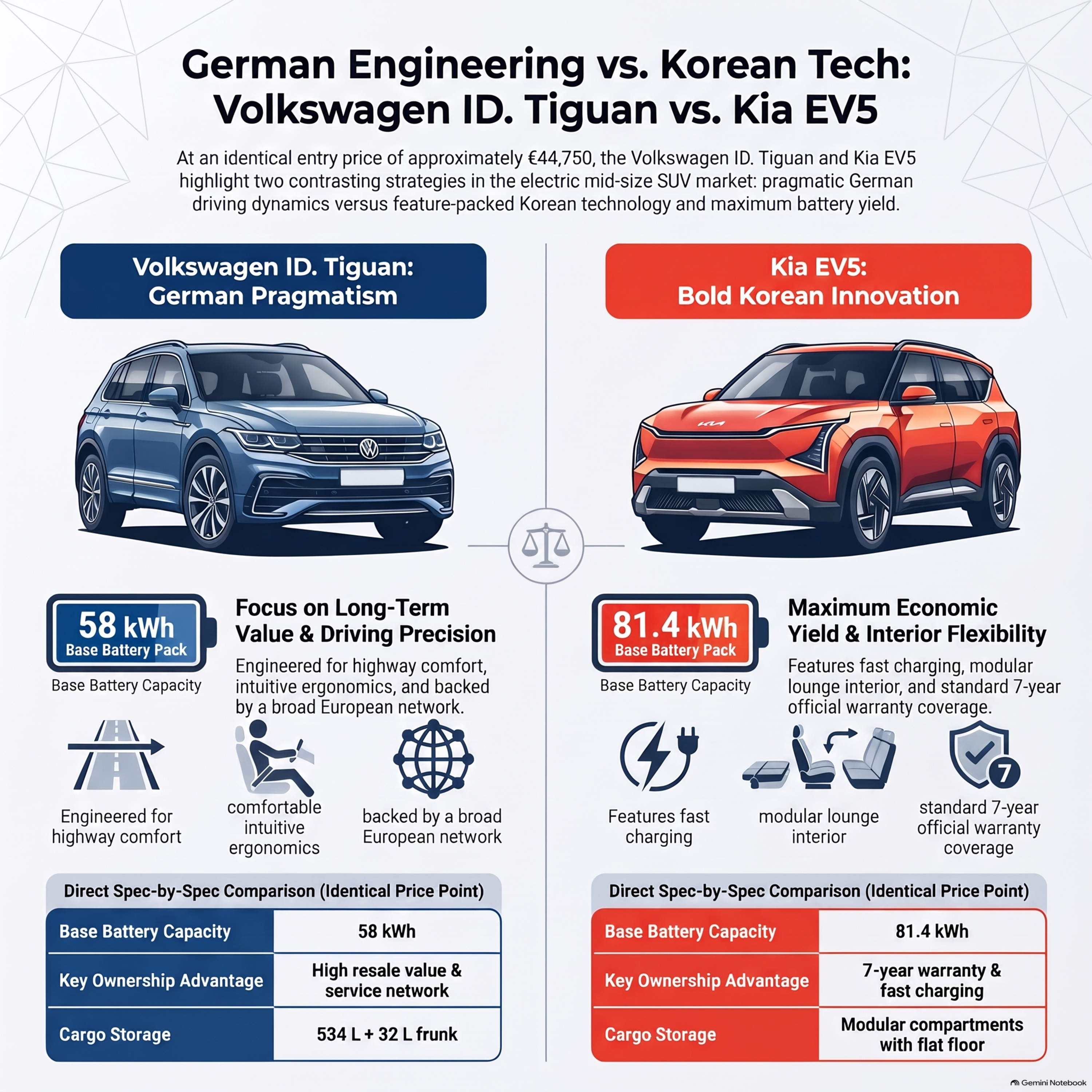
The provided source compares two mid-size electric SUVs that embody contrasting automotive approaches: the German engineering pragmatism of the Volkswagen ID. Tiguan and the Korean technological boldness of the Kia EV5. While the Volkswagen model relies on a well-known nameplate to deliver reliable long-distance comfort, precise handling, and strong long-term resale value, the Kia introduces a futuristic aesthetic with a family-oriented lounge interior crafted from recycled materials. Despite sharing a nearly identical starting price and overall length, the two vehicles cater to different buyer priorities. The Kia EV5 emerges as the more economical option due to its larger battery...
VW ID. Tiguan vs. Kia EV5: German Engineering or Korean Innovation?
Two contrasting automotive philosophies clash in the mid-size electric SUV market! In this video, we put the pragmatic Volkswagen ID. Tiguan head-to-head with the futuristic Kia EV5.
At an identical starting price of around €44,750:
• Kia EV5 brings maximum economic value with a massive 81.4 kWh battery, fast charging capabilities, a lounge-like interior with modular storage, and a 7-year official warranty.
• Volkswagen ID. Tiguan counters with a 58 kWh battery, precise highway driving dynamics, intuitive ergonomics, a 534-liter boot plus a 32-liter frunk, and strong long-term resale value retention.
Exact Same Car?
Stellantis Electric Twins: Citroën ë-C3 and Fiat Grande PandaShared Technical Architecture & Powertrain
Platform: Both the Citroën ë-C3 and Fiat Grande Panda Elettrica are built on Stellantis’s shared Smart Car architecture.Electric Motor: They share an 83 kW (113 hp) permanent magnet synchronous motor manufactured by the Nidec-Stellantis (Emotors) joint venture.Battery Pack: Both models utilize a 44 kWh (gross) Lithium Iron Phosphate (LFP) battery pack featuring cells supplied by SVOLT / BYD.Charging & Range: Both vehicles offer an estimated WLTP range of ~320 km. Charging capabilities are identical: DC fast charging up to 100 kW (20–80% in approx. 26 minutes) and AC charging at 7.4 k...Can Budget EVs Outlast Petrol Cars
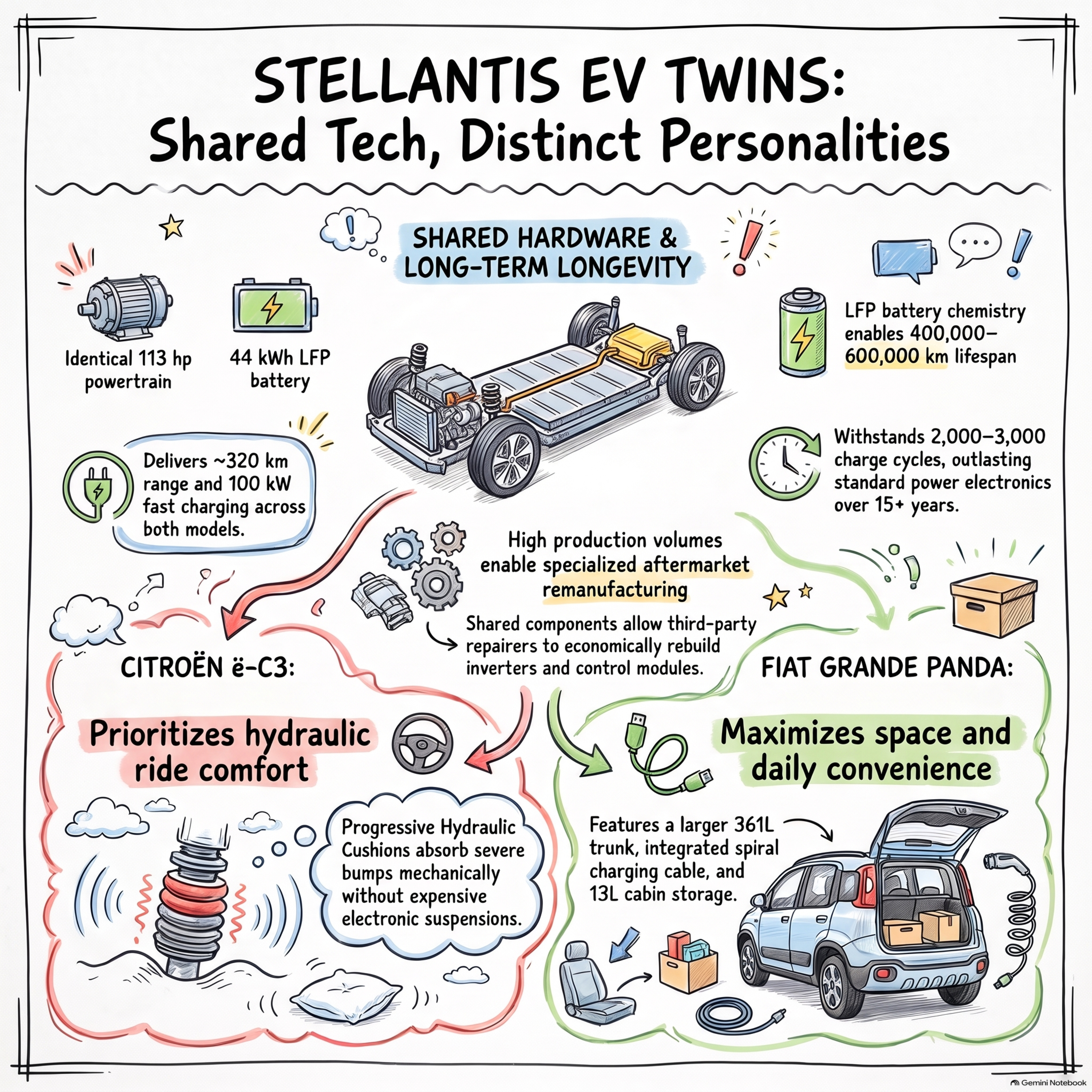
The vehicles (such as the Citroën ë-C3 and Fiat Grande Panda) utilize a 44 kWh Lithium Iron Phosphate (LFP) battery pack.Degradation Resistance: Compared to NMC (Nickel Manganese Cobalt) batteries, LFP chemistry is chemically more stable, highly heat-resistant, and less prone to degradation from frequent charging.Lifespan: The battery pack withstands 2,000 to 3,000 full charge/discharge cycles before dropping to 80% residual capacity, yielding a theoretical potential of 400,000 to 600,000 km (or 15–20+ years of operation).Fewer Moving Parts: Unlike traditional internal combustion engine (ICE) cars, electric powertrains lack high-wear components such as timing belts, valves, turbos, fuel injectors, and clutches.Reduced Failure Points: The...
Why Used Electric Vehicles Last Longer Than You Think
Contrary to the alarmist narrative framing electric cars as disposable gadgets destined to become unrepairable "e-waste" once factory warranties expire, this work demonstrates why used EVs are engineered for multi-decade survival.
By examining industrial production metrics and platform standardization, the analysis highlights how crossing high production thresholds—across major architectures like VW's MEB, Stellantis's e-CMP, Tesla's Model 3/Y, and shared city-car platforms—guarantees long-term spare parts availability, legal protection, and independent repair liquidity for decades.
Combined with accessible power electronics and affordable future battery retrofits using low-cost LFP and Sodium-Ion cell chemistries, the piece debunks deal...
Why Mass Production Saves Used EVs
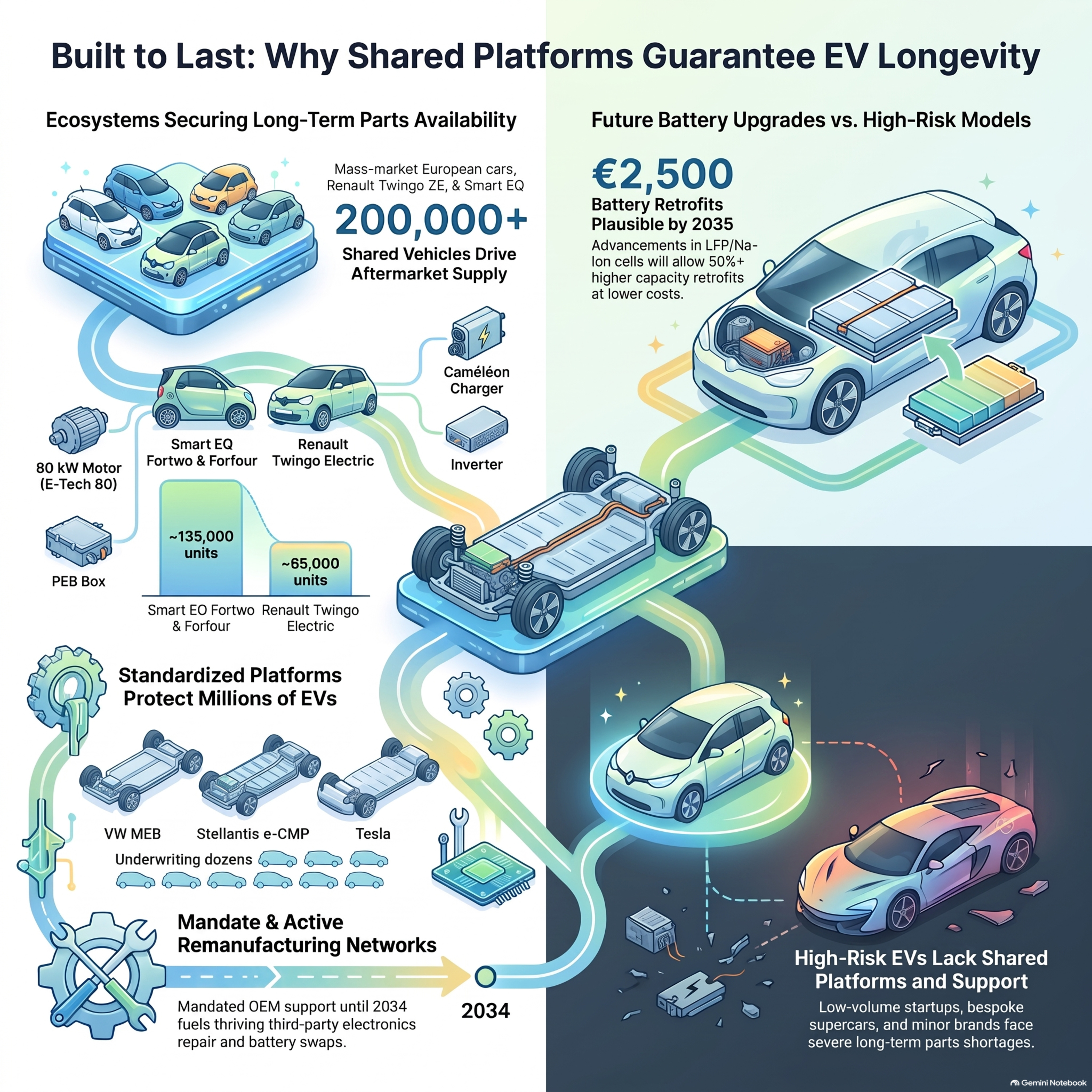
Between 2019 and 2024, European markets saw the sale of more than 200,000 electric vehicles built on a shared platform and powertrain system at the Slovenian Novo Mesto facility, consisting primarily of Renault Twingo Electric and Smart EQ models. This substantial fleet size creates strong economies of scale for independent suppliers like Bosch and Valeo, ensuring continued manufacturing of identical components such as the 60 kW motor and Caméléon charger. Furthermore, strict European regulatory requirements legally compel manufacturers to supply original replacement parts for a minimum of ten years following the discontinuation of a vehicle model, safeguarding official availability through at le...
48V Revolution in EVs: Engineering the Next Generation of Electric Vehicles
The transition from conventional 12-Volt (12V) to 48-Volt (48V) auxiliary electrical architectures represents a fundamental paradigm shift in modern electric vehicle (EV) engineering. As advanced EV platforms integrate higher power demands for computing, climate control, and active chassis systems, legacy 12V distribution networks create severe thermal and physical packaging bottlenecks.
Elevating auxiliary power delivery to 48V resolves these limits while staying strictly within low-voltage safety boundaries.
Key Highlights & Engineering Advantages:
Physics & Thermal Efficiency: Quadrupling the voltage to 48V reduces the electrical current required for auxiliary loads by four times ($I_{48\text{V}} = \frac{1}{4} I_{12\...Beyond 12V: How 48V Architectures Transform EV Efficiency and Assembly
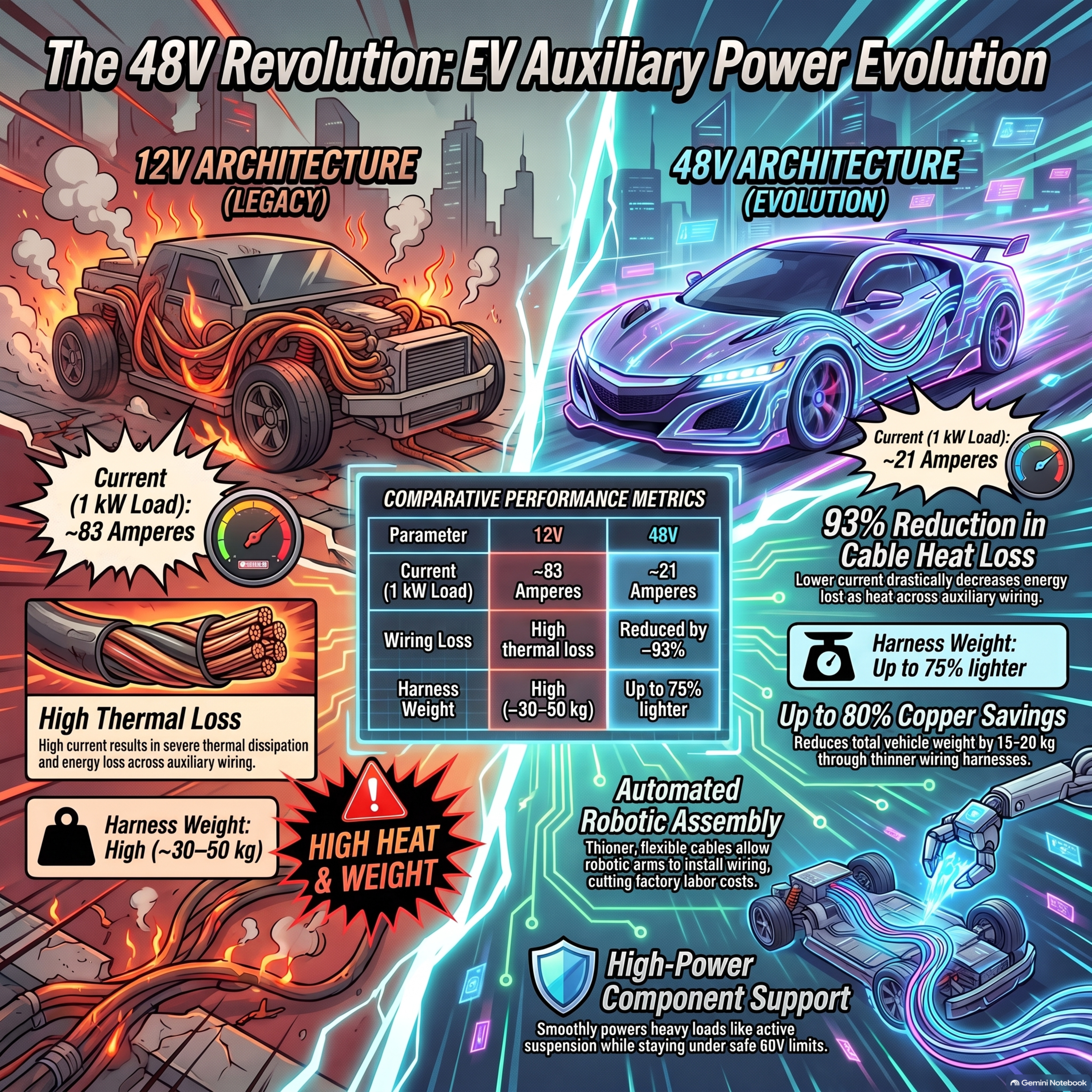
Upgrading electric vehicle auxiliary systems from 12-Volt to 48-Volt architectures fundamentally improves efficiency by quadrupling voltage and reducing required current fourfold. This significant drop in current slashes resistive heat dissipation by approximately ninety-three percent, allowing manufacturers to replace heavy, rigid copper wiring with much lighter and more flexible cables. Consequently, vehicles experience a substantial reduction in total mass and raw material costs while extending overall driving range. Furthermore, the thin cabling facilitates fully automated robotic assembly on factory floors, effectively streamlining production cycles. Operating safely below the sixty-volt extra-low voltage threshold also avoids the expensive protective housing required for...
BMW iX1 vs Audi Q4 e-tron - Core Concept & Philosophy
The confrontation between the BMW iX1 and the Audi Q4 e-tron illustrates two distinct and contrasting strategies within the premium compact electric SUV segment.
BMW focuses on driving dynamics, sharp steering, and software fluidity using a shared multi-energy platform, while Audi leverages a dedicated native electric architecture to maximize interior roominess, riding comfort, and battery capacity.
Platform Architecture and Space
Audi Q4 e-tron: Built on the Volkswagen Group's dedicated MEB electric platform. Measuring approximately 4.59 meters in length, its optimized layout allows for a 520-liter luggage compartment and rear passenger legroom comparable to larger segment...BMW iX1 vs Audi Q4 e-tron: Premium Electric Duel
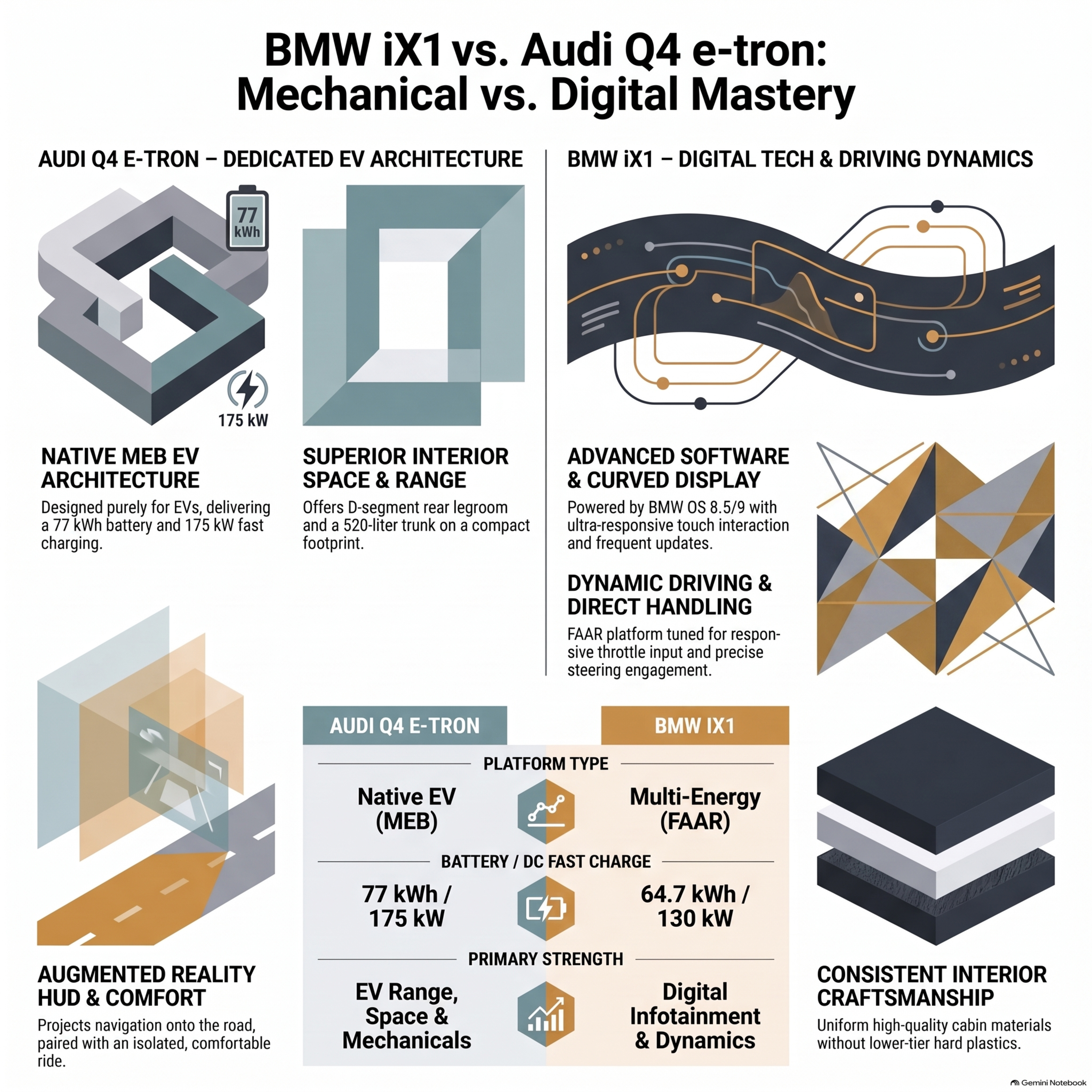
The provided episode offers a detailed comparison between two prominent premium electric vehicles, the BMW iX1 and the Audi Q4 e-tron. It highlights how BMW relies on a multi-energy platform to prioritize driving dynamics and uniform interior craftsmanship. Conversely, Audi utilizes a dedicated electric architecture that maximizes passenger space, comfort, and long-distance cruising capability. The evaluation breaks down various categories, including foundational engineering, cabin materials, infotainment software, and overall powertrain efficiency. Ultimately, the comparison illustrates contrasting philosophies in the luxury electric market, weighing BMW's agile performance against Audi's family-friendly spaciousness.
Renault 5 E-Tech EV: The Retro-Electric Revolution
Can an iconic 1970s hatchback redefine modern urban electric mobility? The Renault 5 E-Tech Electric brings back iconic heritage styling built on a modern, dedicated AmpR Small EV platform. Engineered with an ultra-tight 10.3-meter turning diameter and a compact 3.92-meter footprint, this compact EV is built for agile city maneuvering while delivering up to 410 km of WLTP range with its flagship 52 kWh battery option.In this fast-paced episode, we dive into what makes the new R5 truly unique—from its retro-futuristic bonnet LED battery display to its class-exclusive multi-link rear suspension that effortlessly absorbs urban cobblestones. We explore the Android Au...
Renault 5 E-Tech: A generational ride
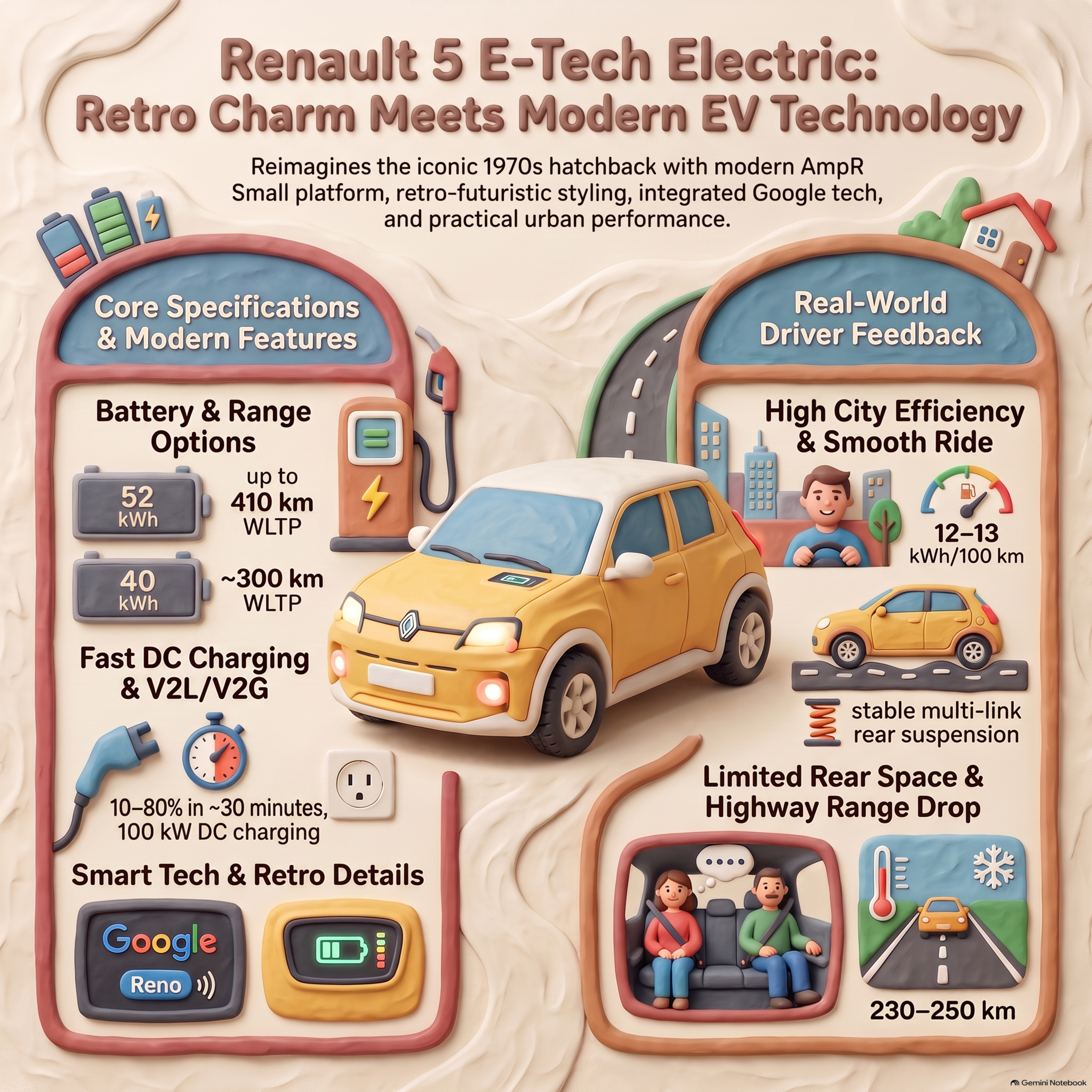
A generational ride unfolds as a grandson picks up his seventy-six-year-old grandmother in the modern, electric Renault 5 E-Tech, recalling her original yellow model purchased in 1974. The elderly woman immediately notices how the former carburetor air intake has evolved into an innovative LED battery indicator.
Inside the cabin, she experiences the silent, vibration-free propulsion of the EV alongside nostalgic touches like striped seats and the vehicle's familiar classic silhouette. Ultimately, the narrative contrasts past mechanical independence fueled by gasoline with contemporary zero-emission mobility seamlessly integrated with digital technology. Impressed by the experience, the grandmother embraces the transformation, proving...
The Right-Sized EV: The Power of Conscious Limits
We explore why chasing ever-larger batteries and extreme range specs leads to the "battery bloat" crisis—forcing drivers to pay for capacity they rarely use.
By applying the ancient Greek philosophy of Metriotes (the art of measure and proportionality) and Stoic restraint, we discover how right-sized engineering redefines sustainable mobility.
In this episode, we cover:
• The Myth of Excess:
Why designing vehicles around 1% edge cases (the annual road trip) drags unnecessary mass through 99% of daily life.
• The Power of Conscious Limits:
How a 40 kWh battery architecture delivering 300–320 km of re...
