Mysteries of the Vedas
Deep insights and explanations on the Srimad Bhagavatam, Bhagavad-Gita, Vedanta-sutra, Upanisads, and other books that are part of the Vedas. www.ccdas.net
Understanding the structure of Bhū-mandala (5th Canto #26)
Get full access to Mysteries of the Vedas (Caitanya Chandra Dasa) at www.ccdas.net/subscribe
The perfection of the varnāśrama system (5th Canto #25)
Get full access to Mysteries of the Vedas (Caitanya Chandra Dasa) at www.ccdas.net/subscribe
Nārada Muni worships Nara-Nārāyaṇa in Bhārata-varṣa (5th Canto #24)
Get full access to Mysteries of the Vedas (Caitanya Chandra Dasa) at www.ccdas.net/subscribe
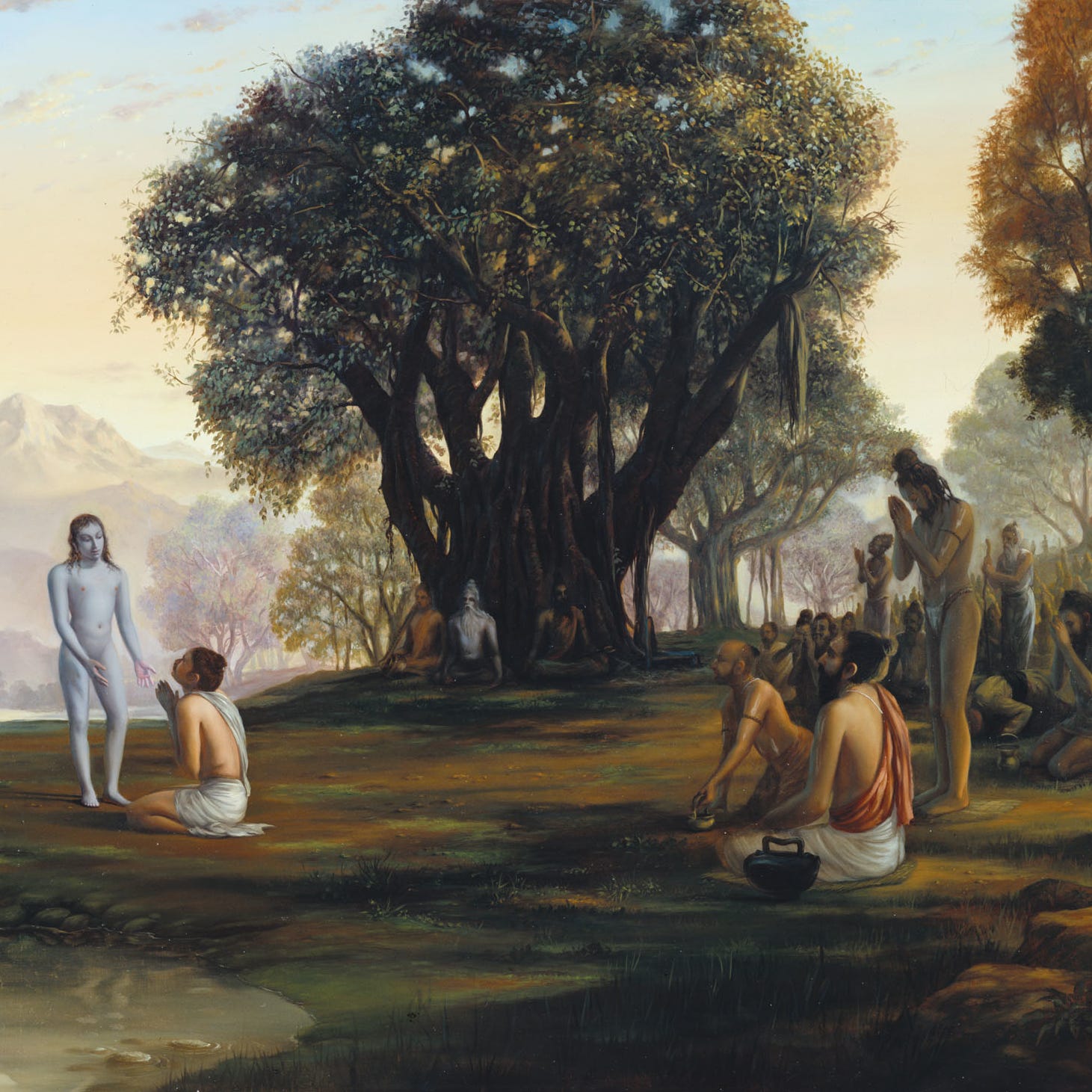
Hanumān worships Rāma in Kimpuruṣa-varṣa (5th Canto #23)
Get full access to Mysteries of the Vedas (Caitanya Chandra Dasa) at www.ccdas.net/subscribe
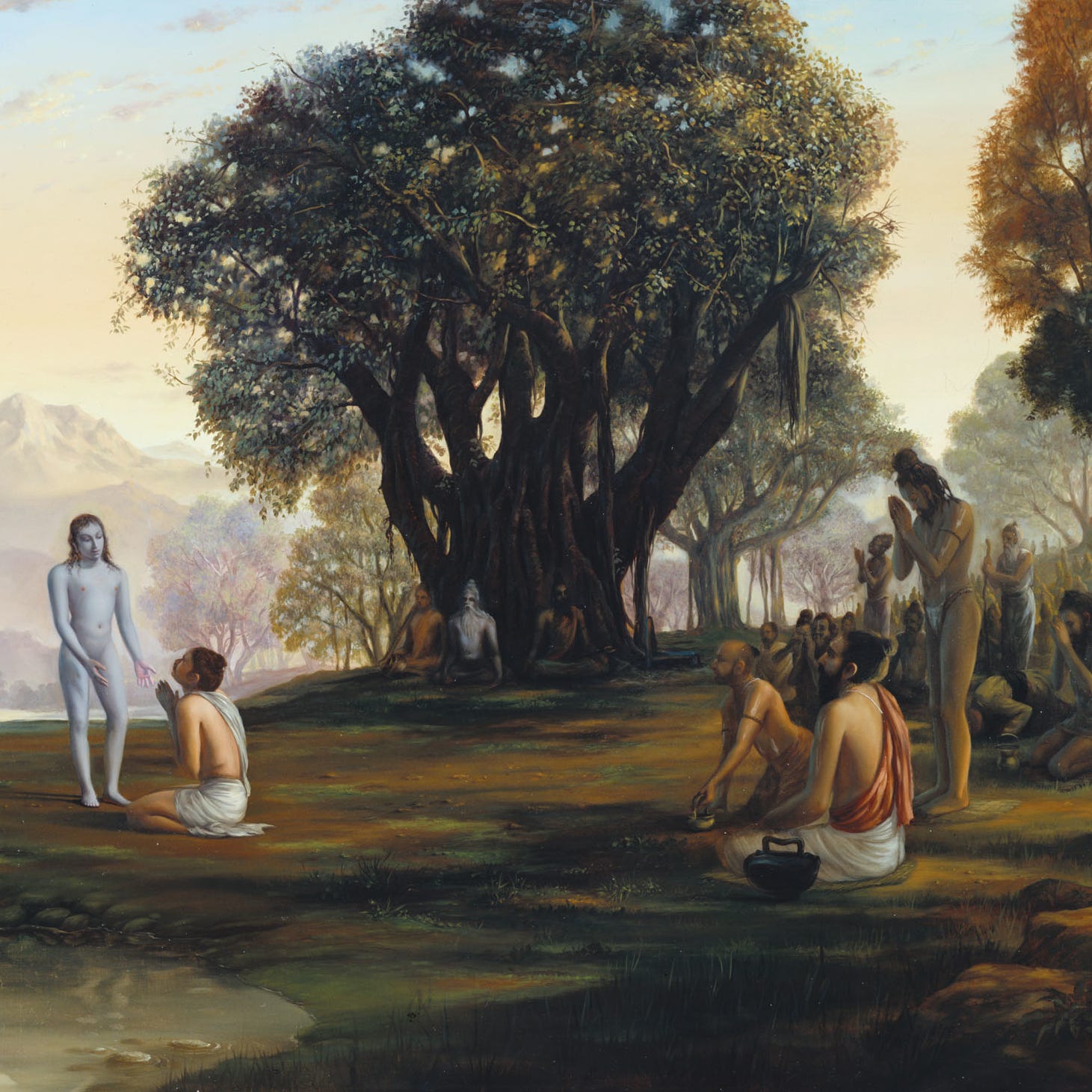
Vaivasvata Manu worships Matsya in Ramyaka-varṣa (5th Canto #22)
Get full access to Mysteries of the Vedas (Caitanya Chandra Dasa) at www.ccdas.net/subscribe
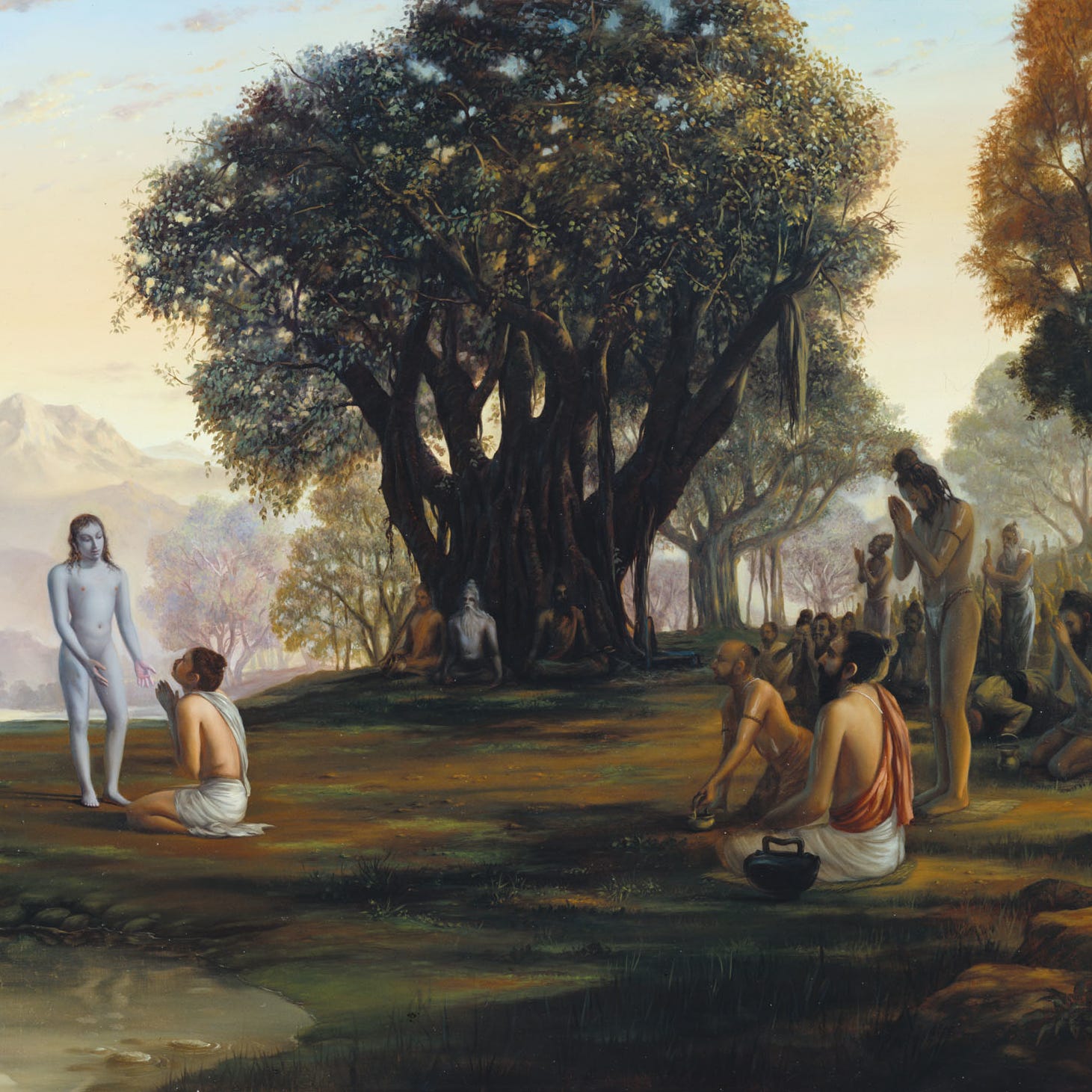
The real shelter for all women: Ramādevī worships Kāmadeva in Ketumāla-varṣa (5th Canto #21)
Get full access to Mysteries of the Vedas (Caitanya Chandra Dasa) at www.ccdas.net/subscribe
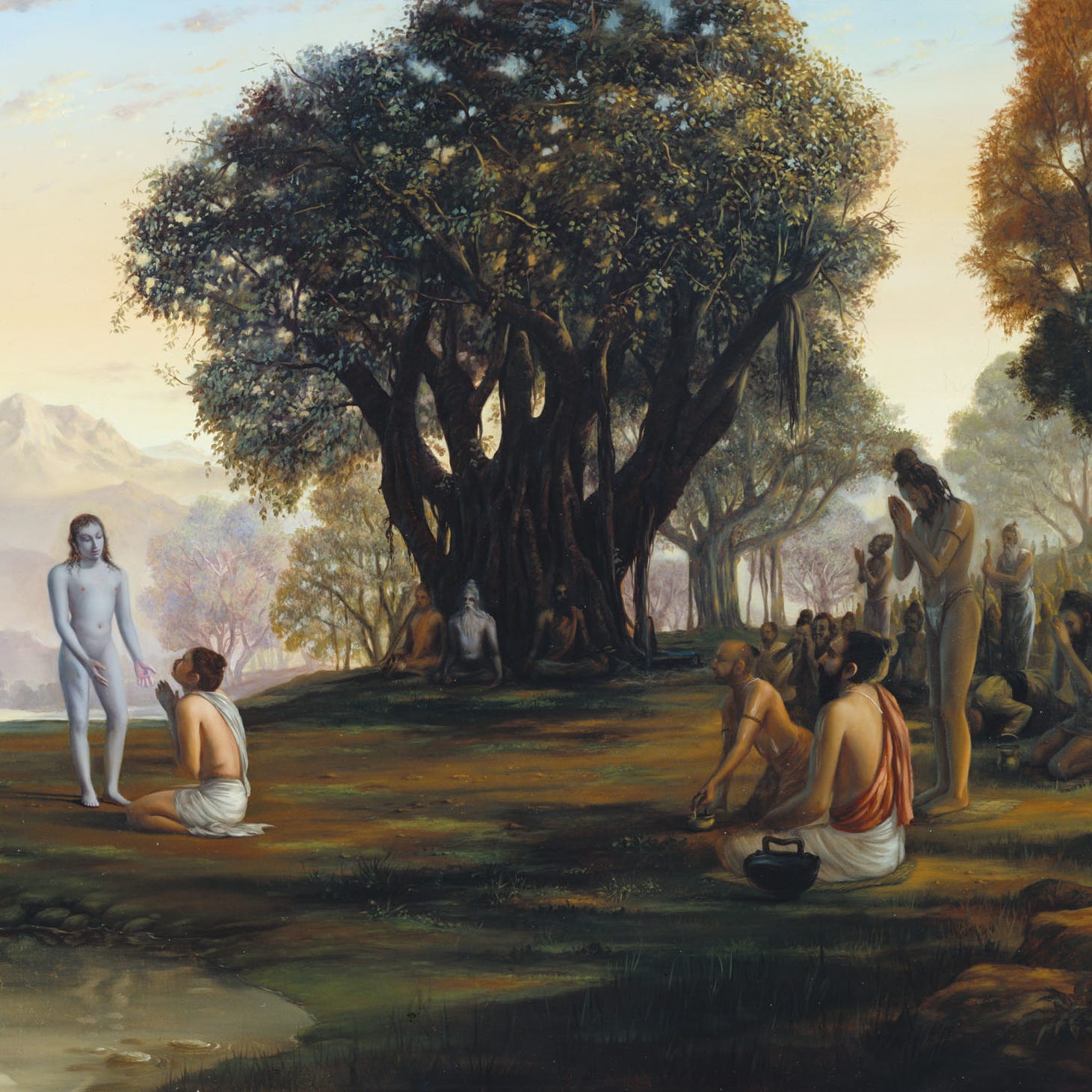
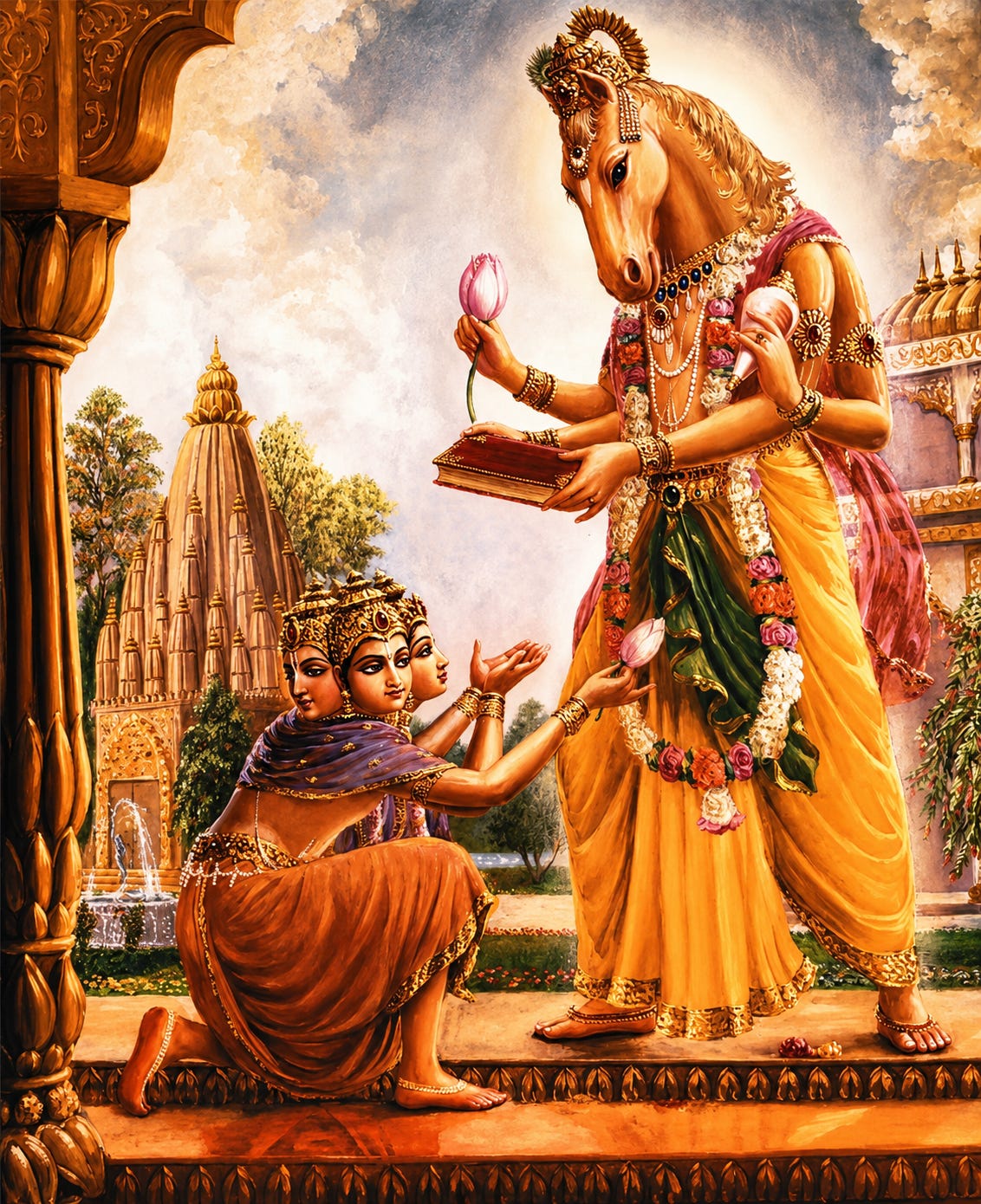
Recovering the Vedas: Bhadraśravā worships Hayagriva in Bhadrāśva-varṣa (5th Canto #20)
Get full access to Mysteries of the Vedas (Caitanya Chandra Dasa) at www.ccdas.net/subscribe
Recovering the Vedas: Bhadraśravā worships Hayagriva in Bhadrāśva-varṣa (5th Canto #20)
Subscribe to receive new articles by e-mail. It’s free, but if you like, you can pledge a donation:
Join the Telegram group if you would like to join the live lessons. This course is maintained with your donations. Click here to donate.
💬 Text of the lesson
Recovering the Vedas: Bhadraśravā worships Hayaśīrṣa in Bhadrāśva-varṣa
Bhadrāśva-varṣa is the tract of land east of Ilāvṛta-varṣa, ruled by Bhadraśravā, the son of Yamarāja. The Lord is present there in His form of Hayaśīrṣa (or Hayagrīva...
Escaping the influence of illusion: Lord Śiva worships Lord Saṅkarṣaṇa in Ilāvṛta-varṣa (5th Canto #19)
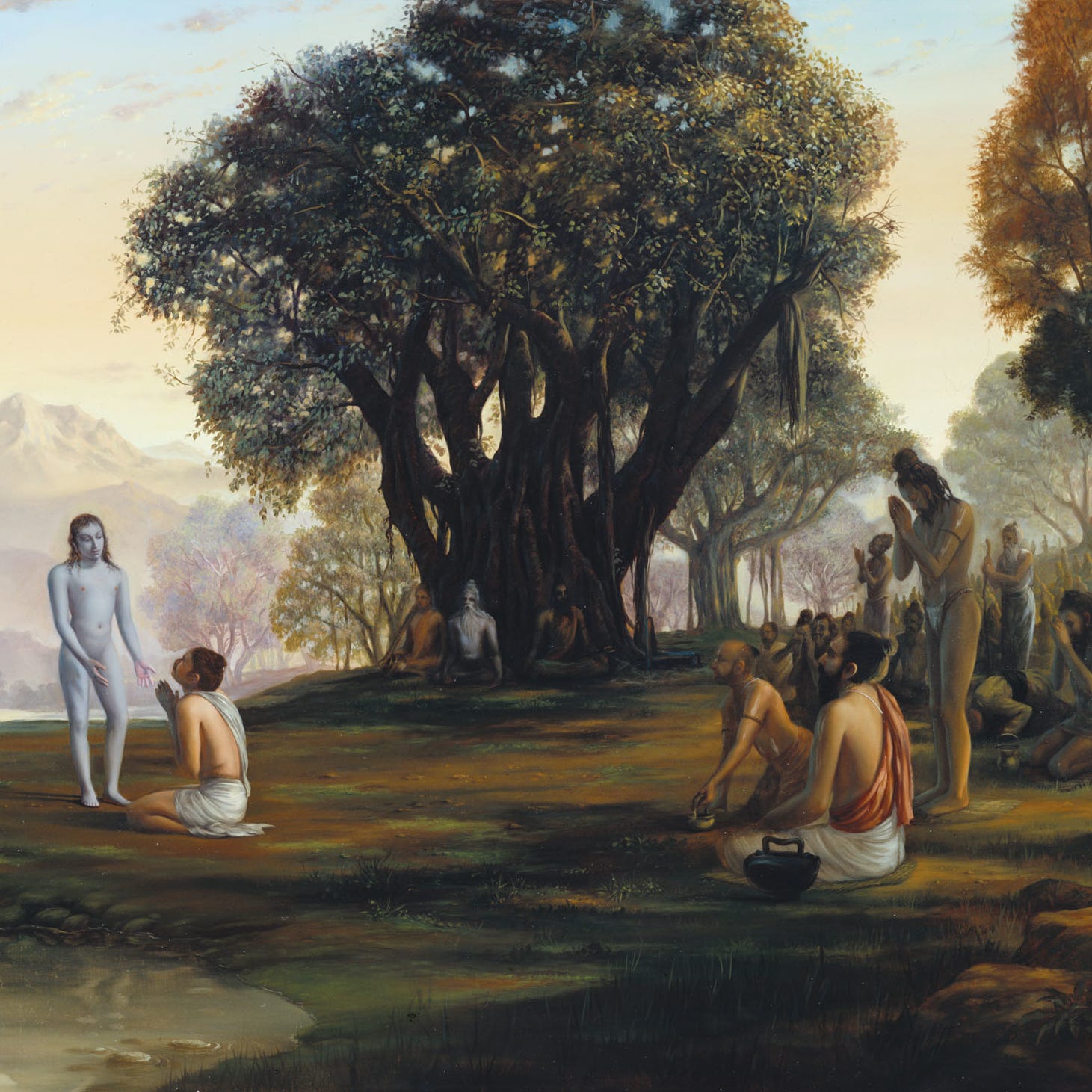
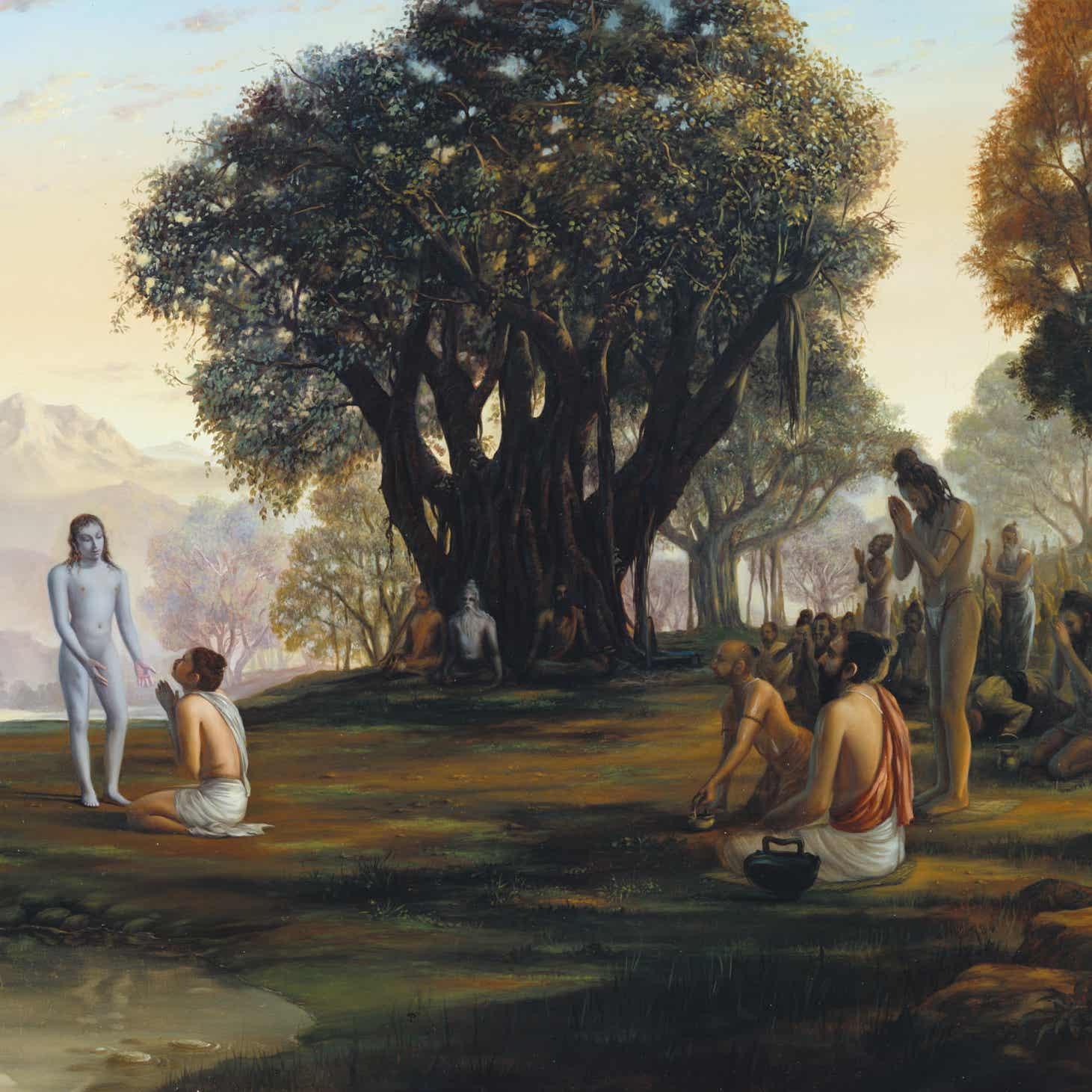
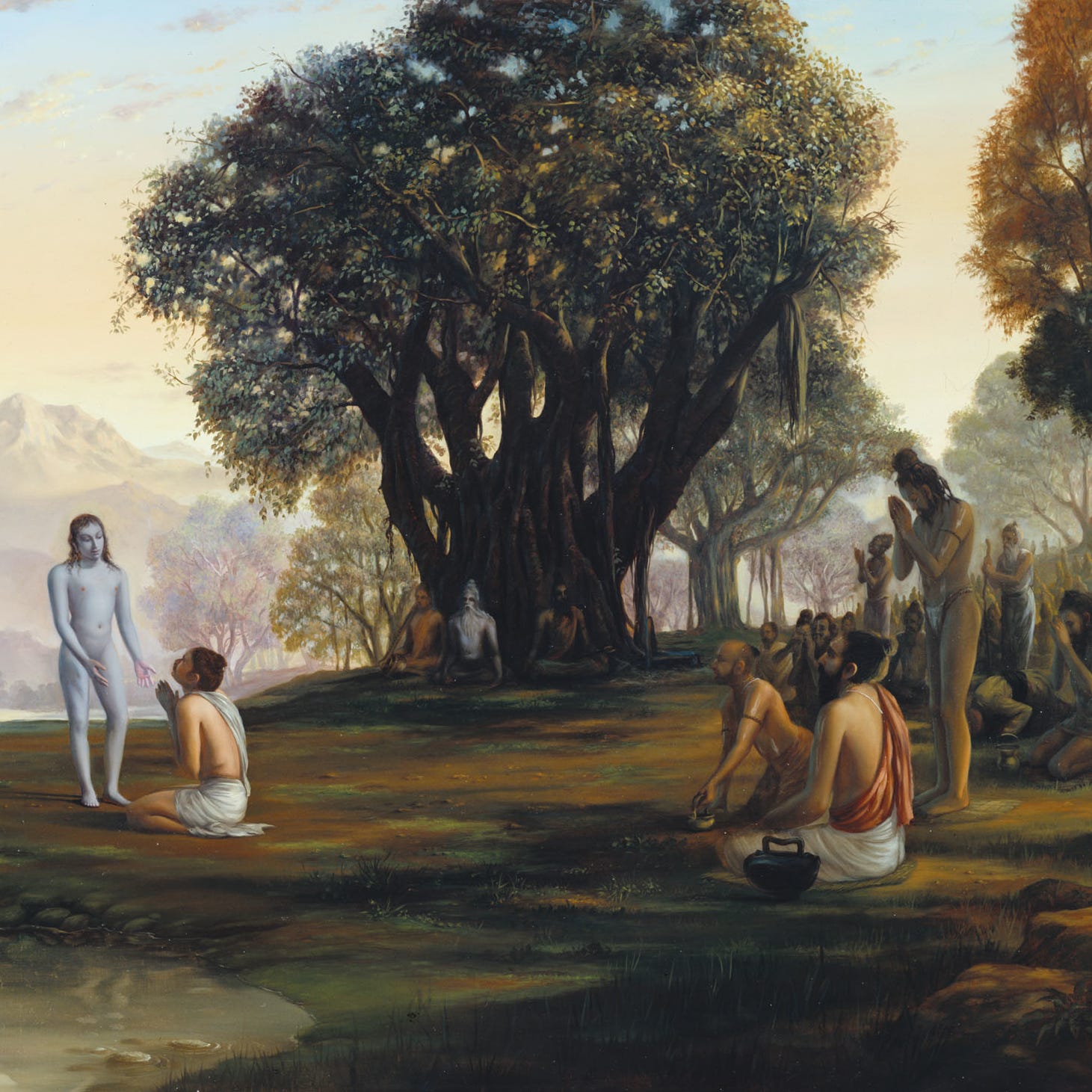
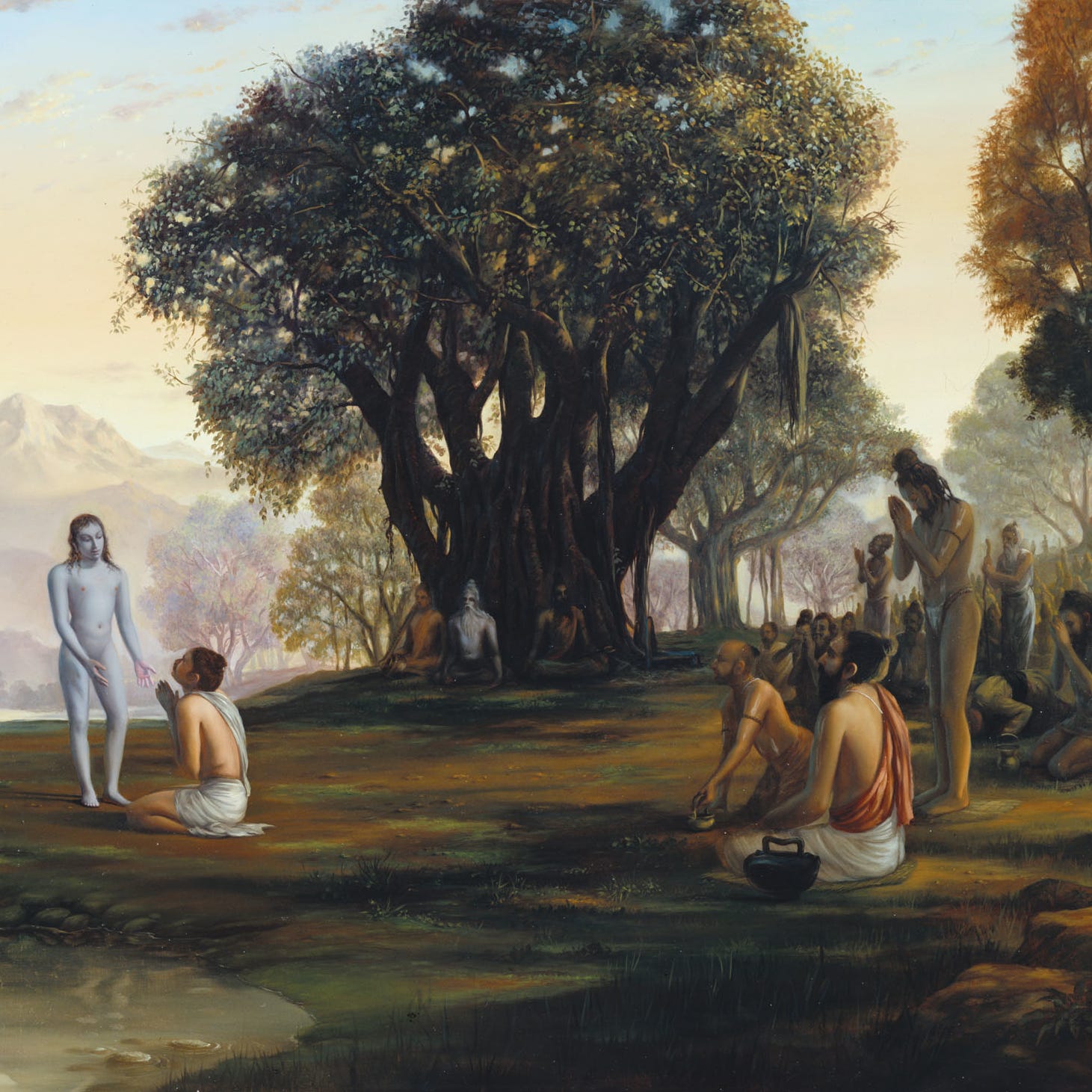
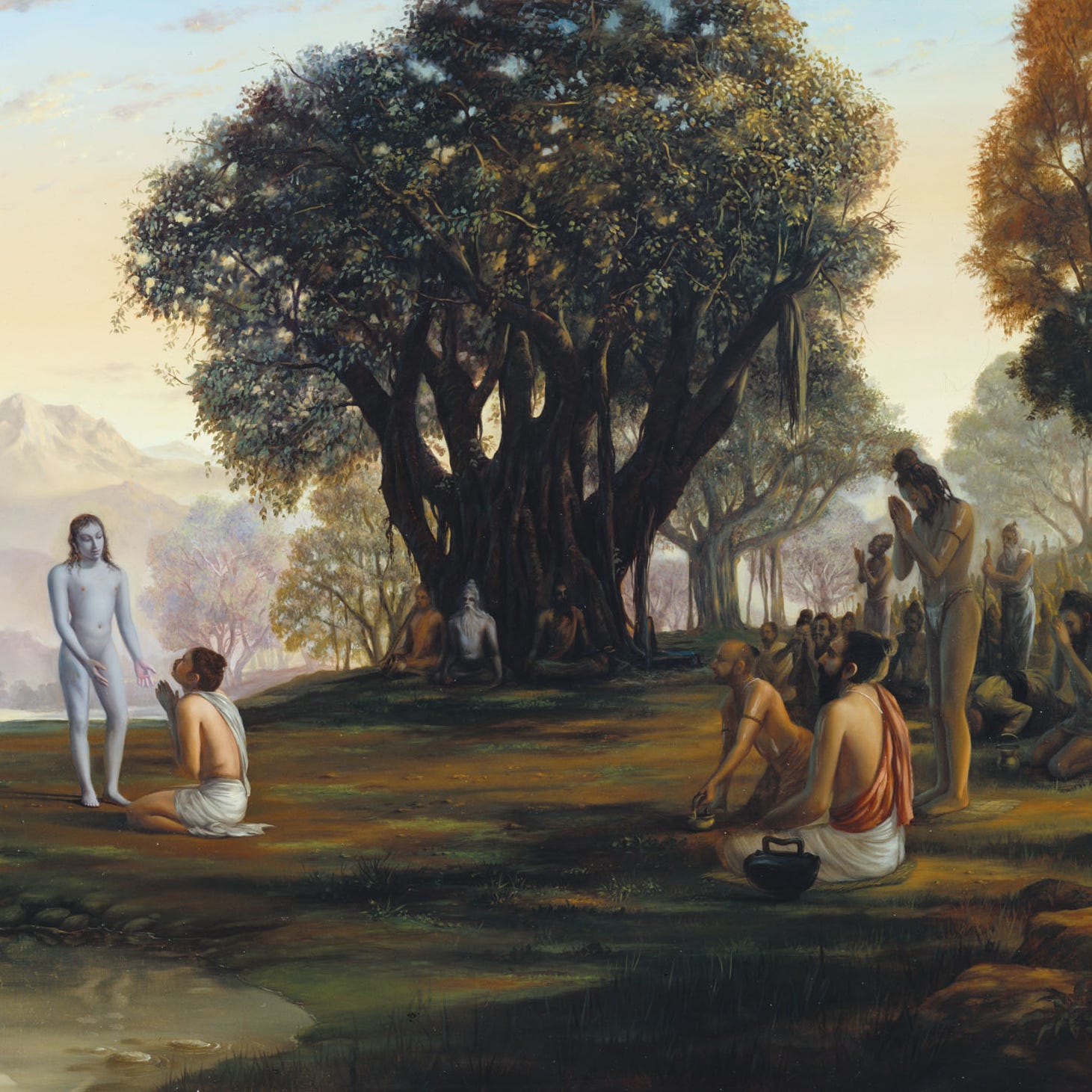
One of the eight sets of mountains surrounding Mount Sumeru, in Ilāvṛta-varṣa, is Kailāsa, located to the south. This is the abode of Lord Śiva. This abode is described in the Fourth Canto, chapter six (in the episode when the demigods go there to apologize to Lord Śiva after having offended him at the sacrifice organized by Daksa), as a paradisiac place, with pristine nature and all natural opulences. In the middle of it, there is a very auspicious place, where Lord Śiva sits under a great banyan tree, which is 100 yojanas high, with its branches...
The lifestyle and opulence of the inhabitants of Jambūdvīpa (5th Canto #18)
The lifestyle and opulence of the inhabitants of Jambūdvīpa
“On the side of Supārśva Mountain stands a big tree called Mahākadamba, which is very celebrated. From the hollows of this tree flow five rivers of honey, each about five vyāmas wide. This flowing honey falls incessantly from the top of Supārśva Mountain and flows all around Ilāvṛta-varṣa, beginning from the western side. Thus the whole land is saturated with the pleasing fragrance. The air carrying the scent from the mouths of those who drink that honey perfumes the la...
When service becomes too much
👆 I’m testing a new feature: an audio version of the article you can listen to. This is not an AI voice; it’s me reading the article and sometimes adding something. If you find it useful and would like to see it in other articles, leave a comment sharing your experience. Thanks! 🕉
You can receive new articles directly in your inbox. Subscription is free; donations are welcome.
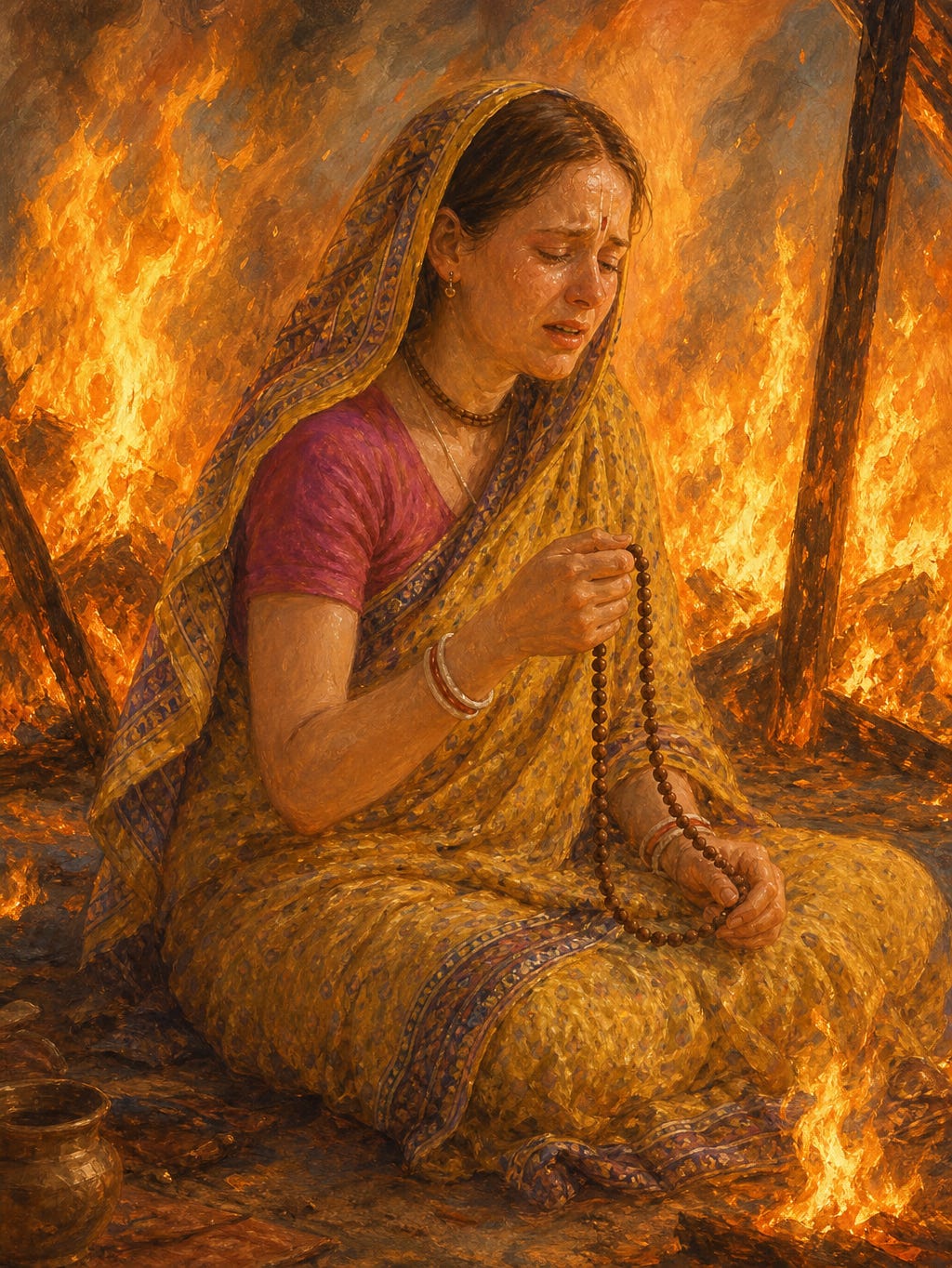
Burnout is a problem that affects many devotees. It can lead to many negative symptoms, like irritation and impatience, headaches and other physical discomfort, depression, low self-esteem, and a feel...
Understanding Jambūdvīpa, the central island of Bhū-mandala
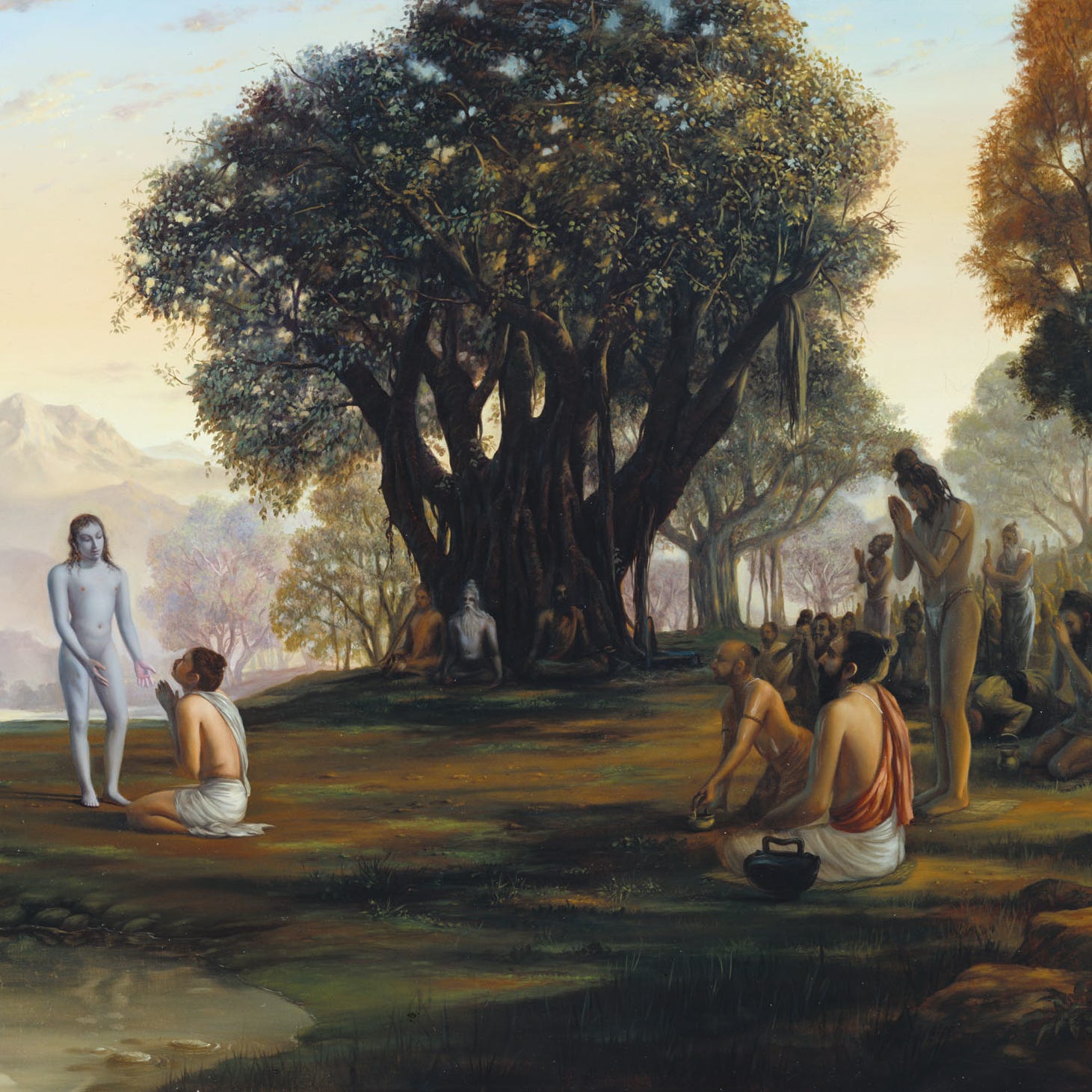
All the measurements in the description of Śukadeva Goswami are given in yojanas, an ancient Vedic unit of distance used in Sanskrit texts. The length of the yojana can vary according to the context, but Prabhupāda concludes that the descriptions of the Śrīmad Bhāgavatam are based on a yojana of eight miles.
Jambūdvīpa is described as being circular in form (round like the leaf of a lotus flower), with a length and breadth of 100,000 yojanas (800,000 miles), as confirmed in SB 5.20.2. It’s difficult to conceive something this size, but just for comparison, the equat...
The Vedic Cosmology of the 5th Canto (5th Canto #16)
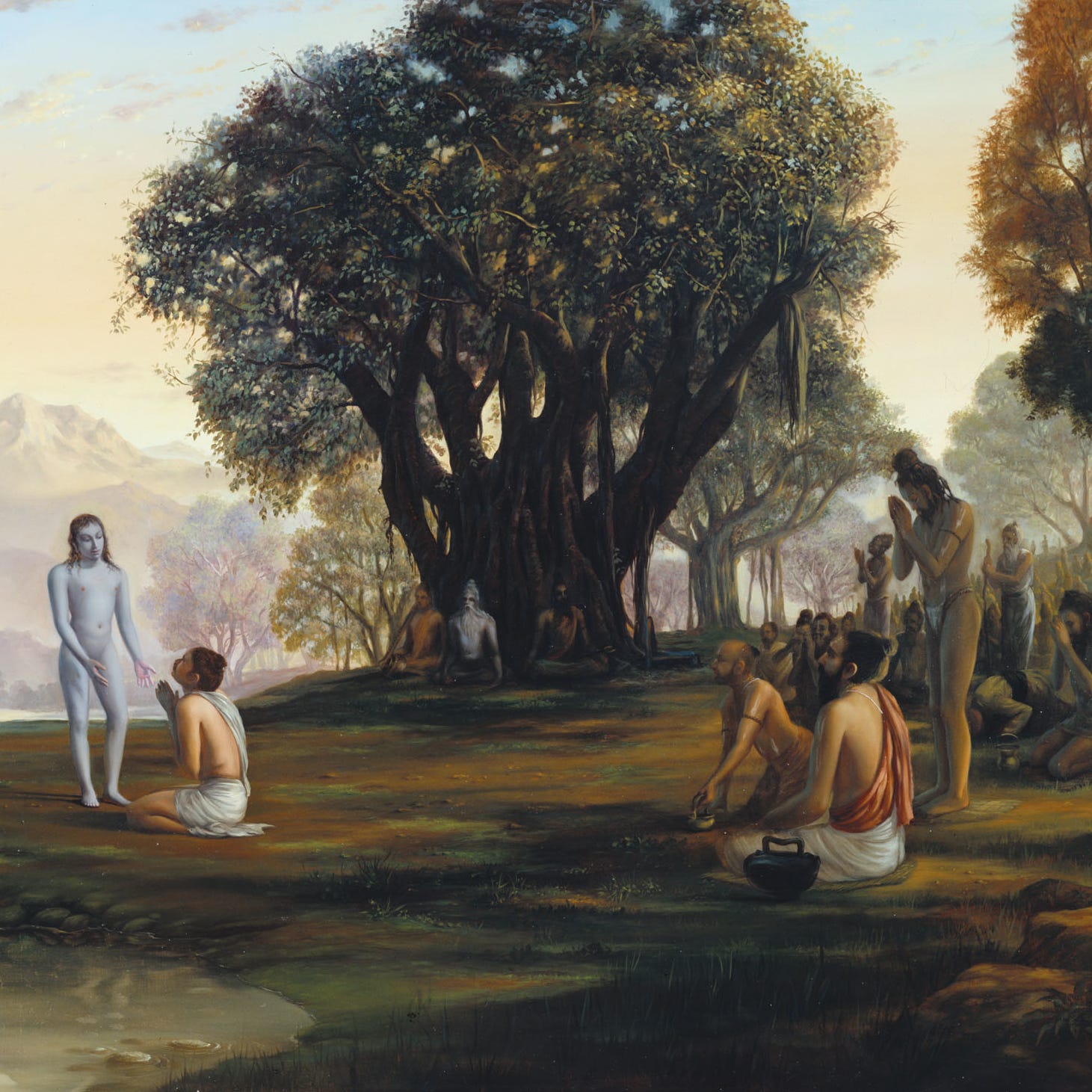
The Vedic Cosmology of the 5th Canto
The first part of the Fifth Canto describes the descendants of Mahārāja Priyavrata (who ruled during the first Manvantara), including the description of the activities of Mahārāja Āgnīdhra, the pastimes of Lord Ṛṣabhadeva, the fall of King Bharata, and so on.
The second part enters into details about Vedic cosmology, including the structure of Bhū-mandala, the orbit of the sun, the heavenly and hellish planets, and so on. One could question why such a description of the universe is necessary, since the main purpos...
A description for all of us: the final teachings of Jaḍa Bharata (The Fifth Canto #15)
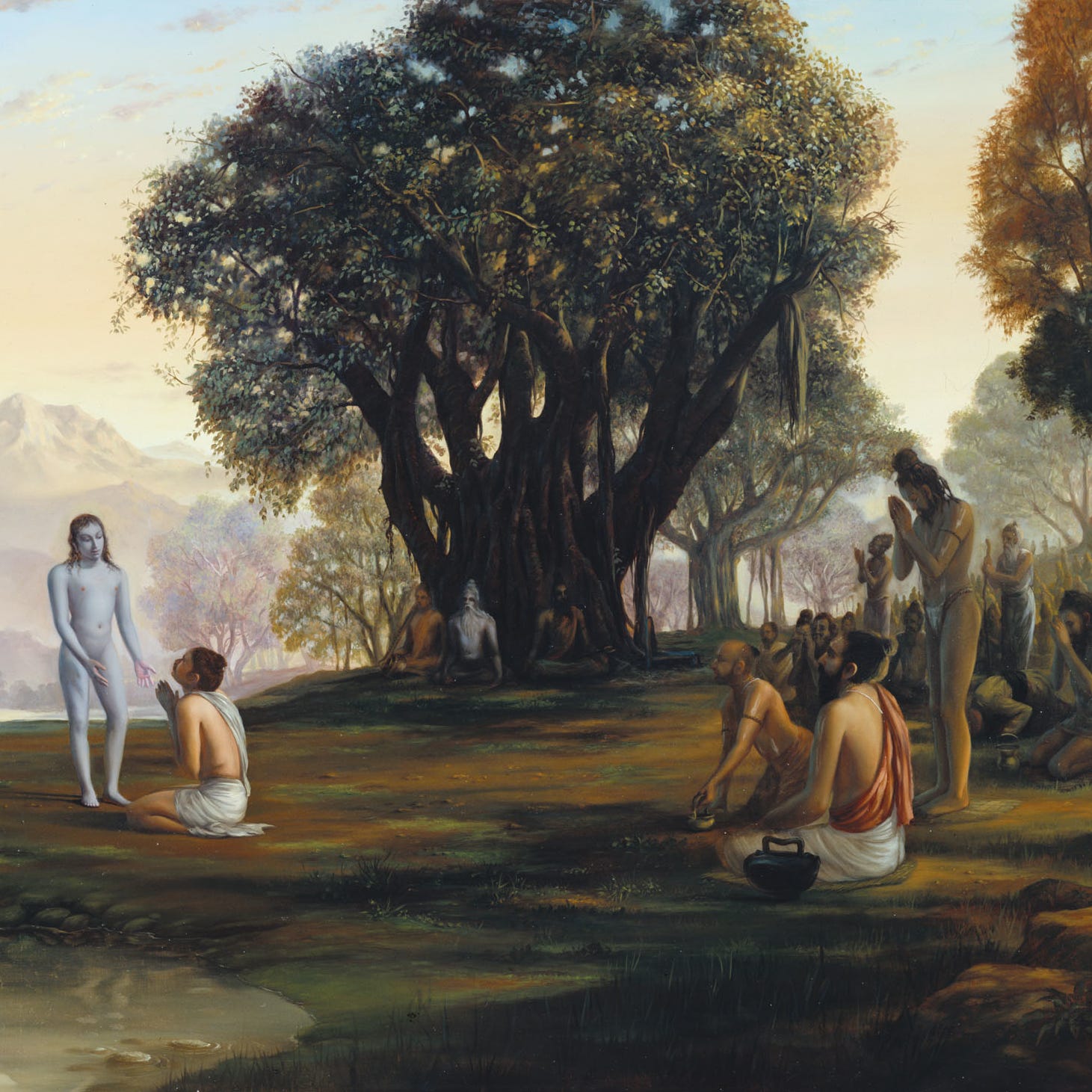
A serious mistake we often make when studying transcendental literature is to study it as a spectator, seeing it as something that is applicable to the personalities involved, but not to us. When we do that, we miss the whole point. Just as the Bhagavad-gītā was not just spoken to Arjuna, all the discussions in the Śrīmad Bhagavad and other books are not just for others, but especially to ourselves. When we see these passages as mere objects of intellectual study or historical narrations, we miss the purpose.
Just as Rahūgaṇa, we are current...
Material world: The place of ephemeral and temporary happiness (The Fifth Canto #14)
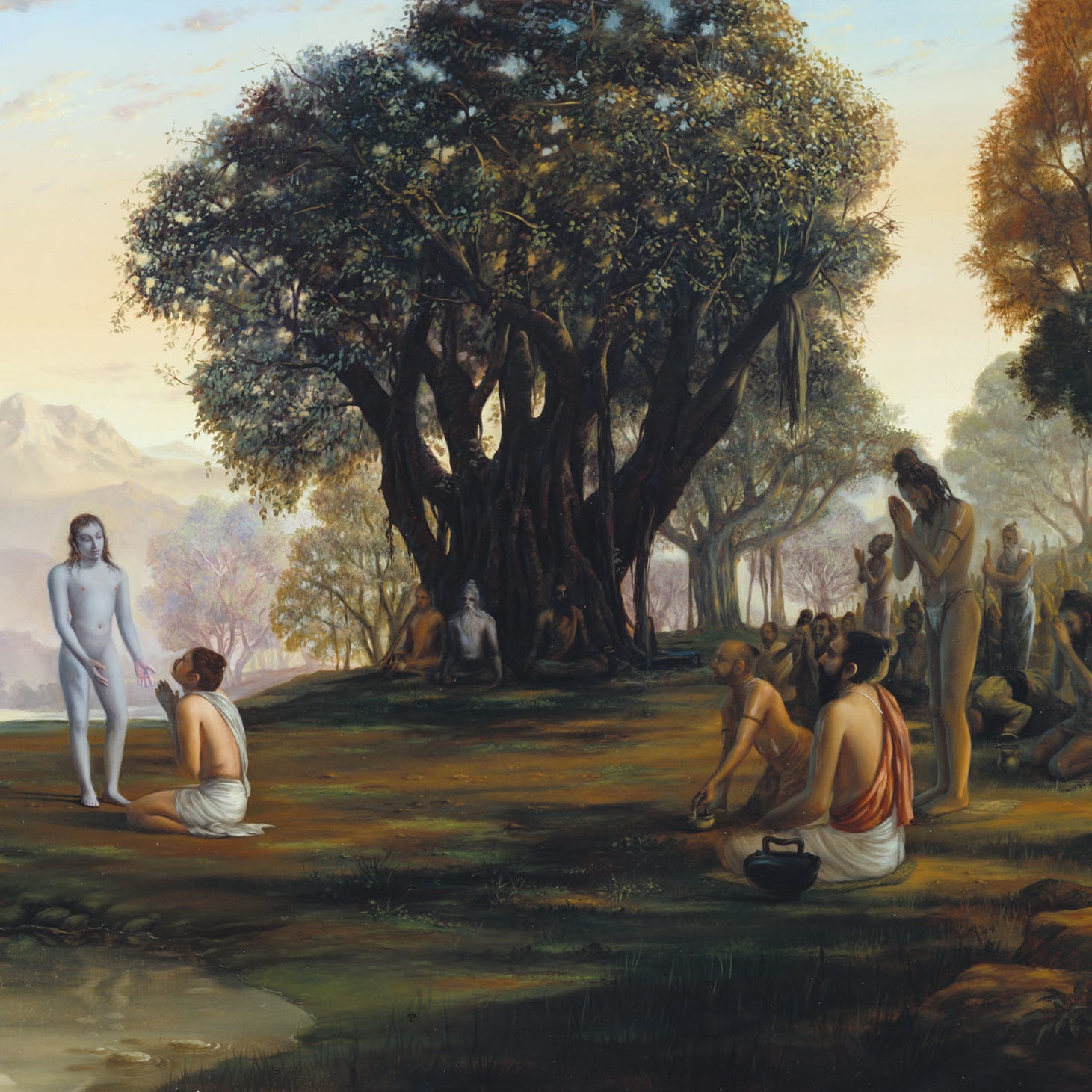
Material world: The place of ephemeral and temporary happiness
“Sometimes, being defeated or plundered by a superior, powerful agent, a living entity loses all his possessions. He then becomes very morose, and lamenting their loss, he sometimes becomes unconscious. Sometimes he imagines a great palatial city in which he desires to live happily with his family members and riches. He thinks himself fully satisfied if this is possible, but such so-called happiness continues only for a moment.” (SB 5.13.7)
In this world, everyone looks for happiness in relationships with friends, family, and society, but this happiness is i...
The material world, as the great forest of enjoyment (The Fifth Canto #13)
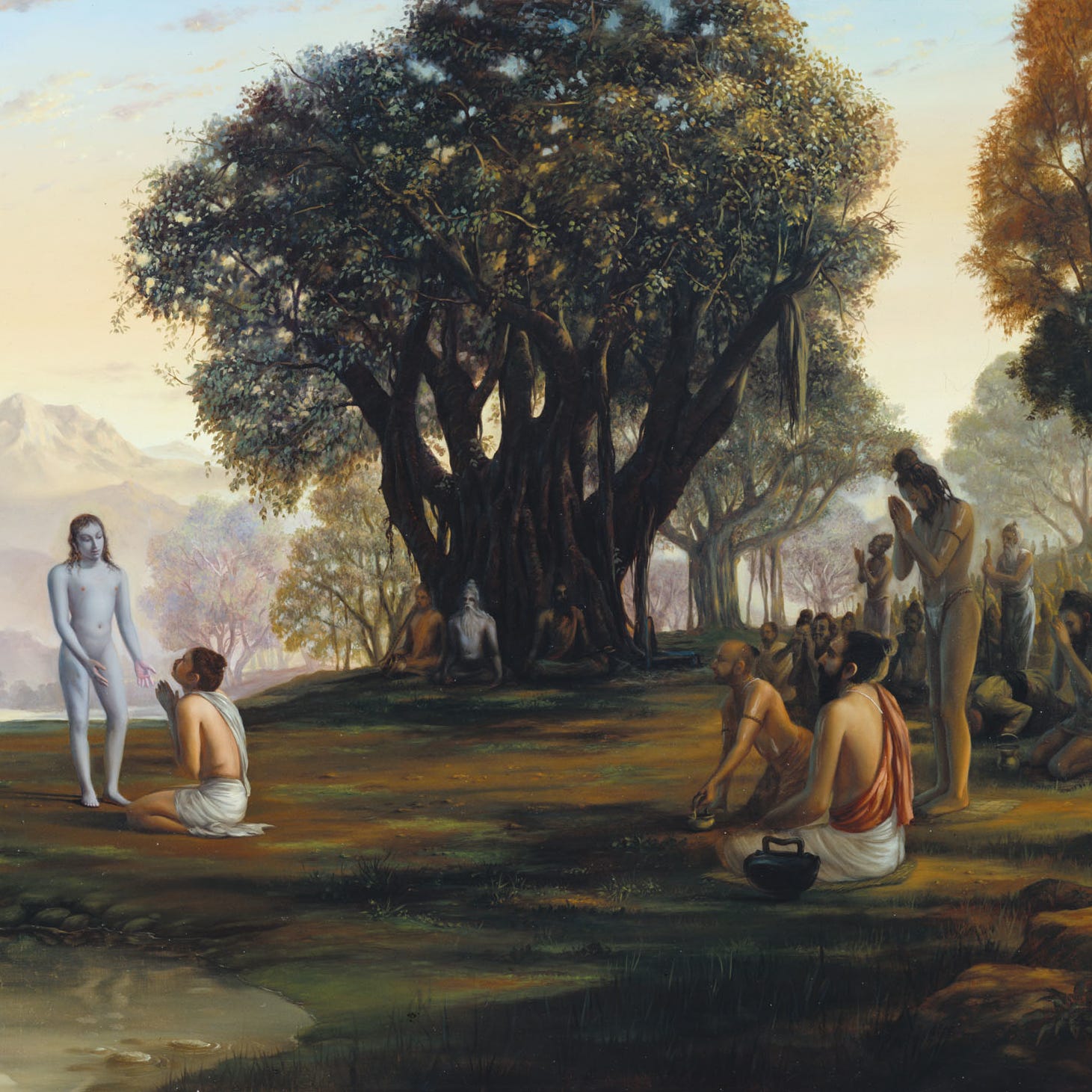
The material world, as the great forest of enjoyment
In chapter 13, Jaḍa Bharata further instructs King Rahūgaṇa, describing the features of this material world figuratively in his analogy of the material world as the great forest of enjoyment. Originally, this passage is quite cryptic, but the meaning is explained in detail in chapter 14, where the conversation goes back to Śukadeva Goswami and Parīkṣit Maharaja. The King enquires about the direct meaning of this analogy, leading Śukadeva Goswami to explain it more elaborately. The meaning is then further expanded by Śrīla Prabhupāda in his pur...
Mahārāja Rahūgaṇa inquires further, and Jaḍa Bharata deepens his teachings
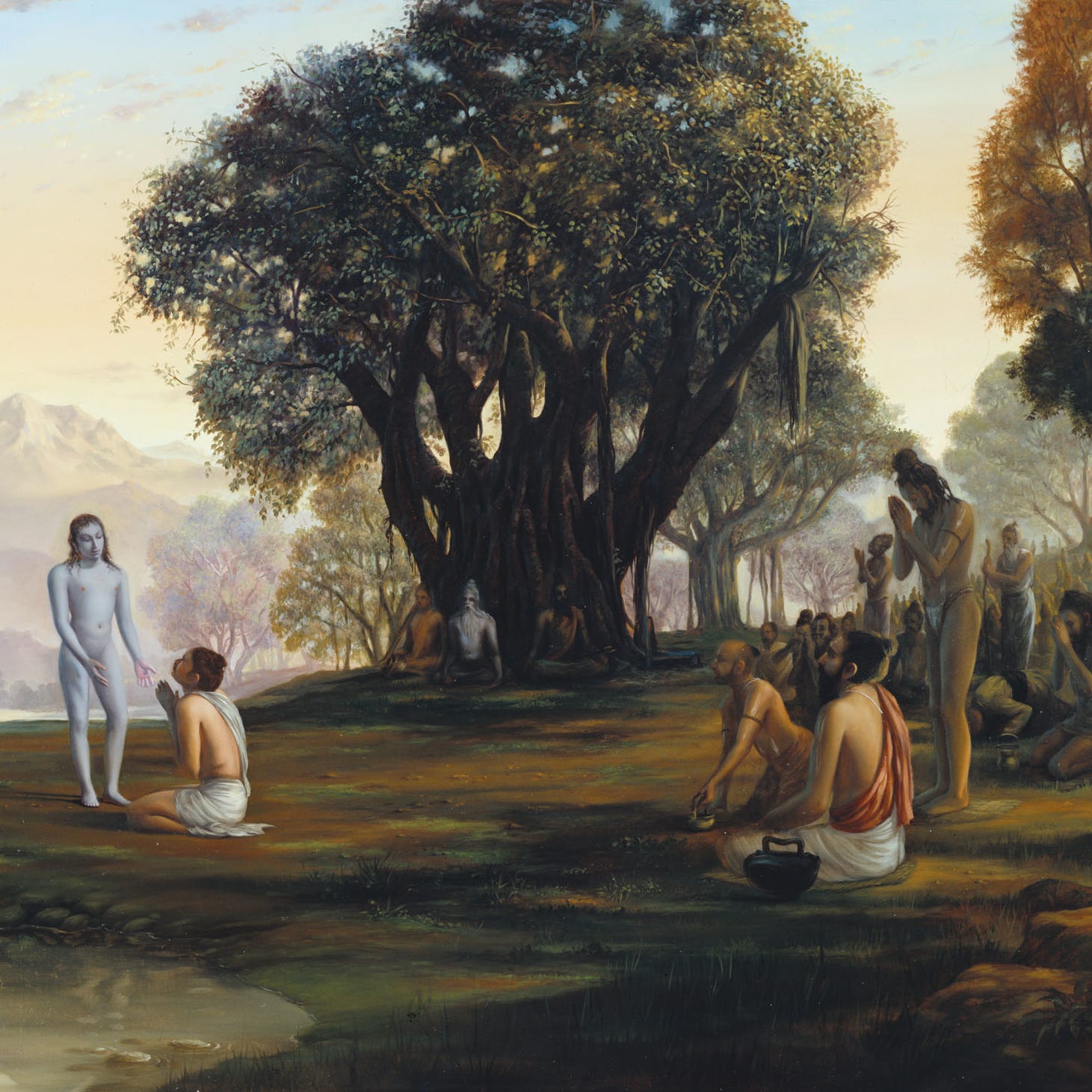
After hearing these teachings, Rahūgaṇa again became repentant for his offenses to Jaḍa Bharata. He had completely disregarded him, forced him to carry his palanquin, and even threatened him. Now he understands the extent of his mistake.
“King Rahūgaṇa said: O most exalted personality, you are not different from the Supreme Personality of Godhead. By the influence of your true self, all kinds of contradiction in the śāstras have been removed. In the dress of a friend of a brāhmaṇa, you are hiding your transcendental blissful position. I offer my respectful obei...
Jaḍa Bharata counters Rahūgaṇa’s arguments and offers a higher perspective
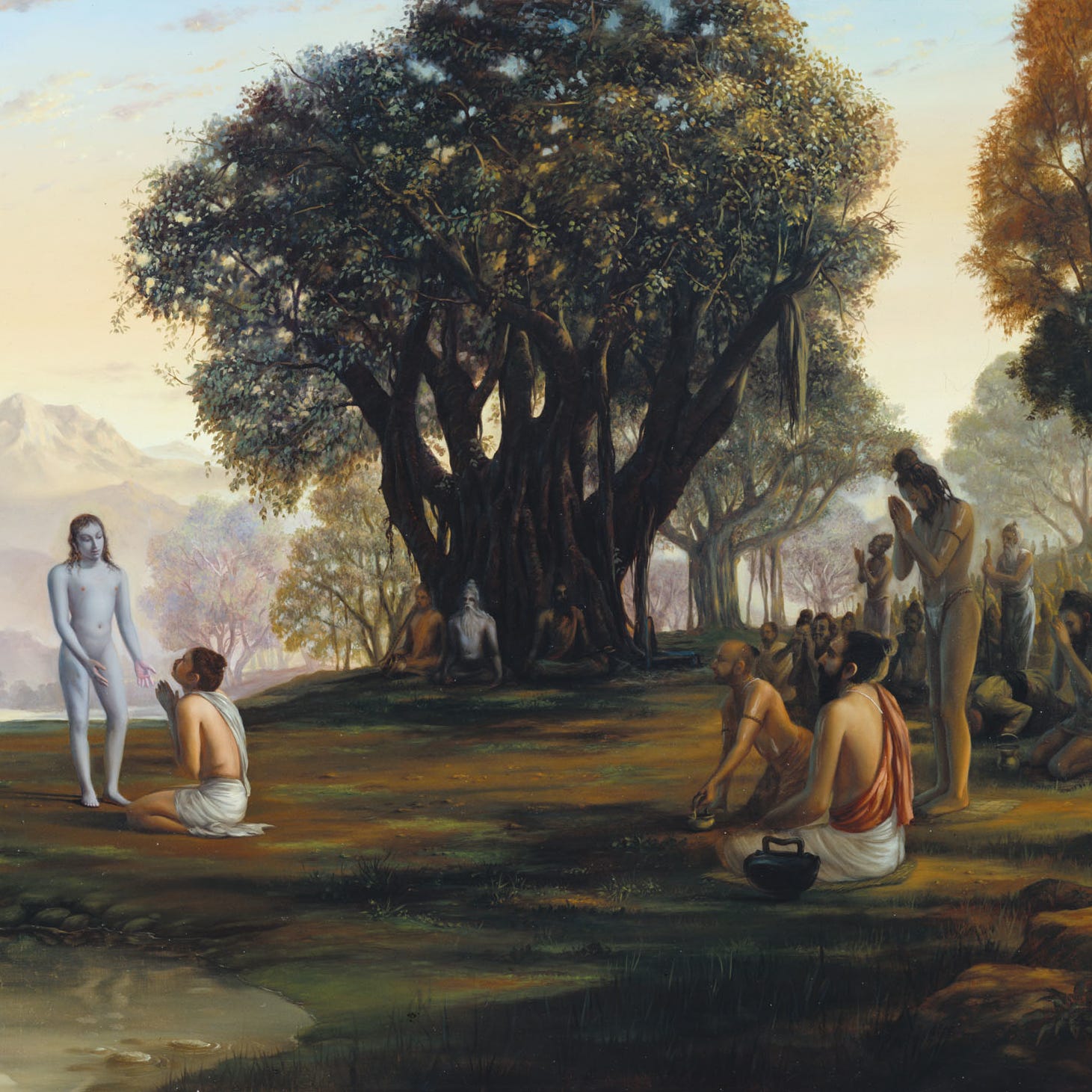
Rahūgaṇa’s logic is sound from a practical perspective, but it is based on the wrong perspective. He doesn’t see the soul as truly separated from the body, believing that body and soul are interconnected and that somehow the pains of the body factually affect the soul. Apart from that, he is still under the false ego, seeing himself as the king and others as his subjects. Jaḍa Bharata starts by chastising him for speaking on the bodily perspective, similar to how Kṛṣṇa chastised Arjuna at the beginning of the Bhagavad-gītā:
“The brāhmaṇa Jaḍa B...
Jaḍa Bharata breaks his silence and scolds the king (The Fifth Canto #10)
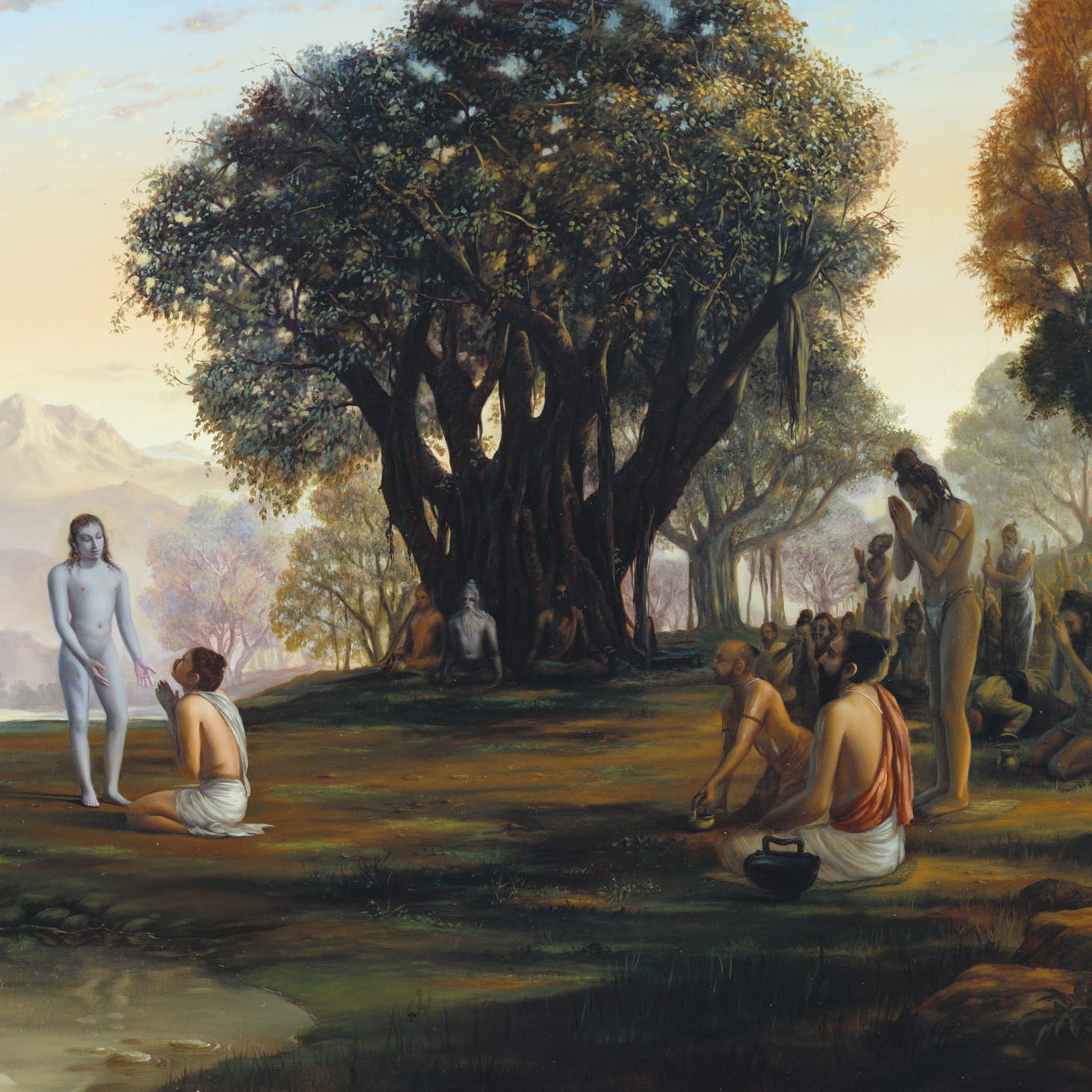
King Rahūgaṇa considered himself a learned man, but his knowledge was actually very limited. He was in the bodily conception of life, and could not even speak coherently from a philosophical point of view. Śukadeva Goswami describes his words as abaddham (incoherent, illogical, nonsensical). He was speaking, but his ideas were incoherent. This contradiction was noted by Jaḍa Bharata, who decided to deliver his teachings to him. Superficially, Jaḍa Bharata may appear to show a little anger in some of these verses, but this is just a show of mercy. Just as Kṛṣṇa’s killing of a dem...
Understanding the reason for the fall of Bharata Maharaja (The Fifth Canto #09)
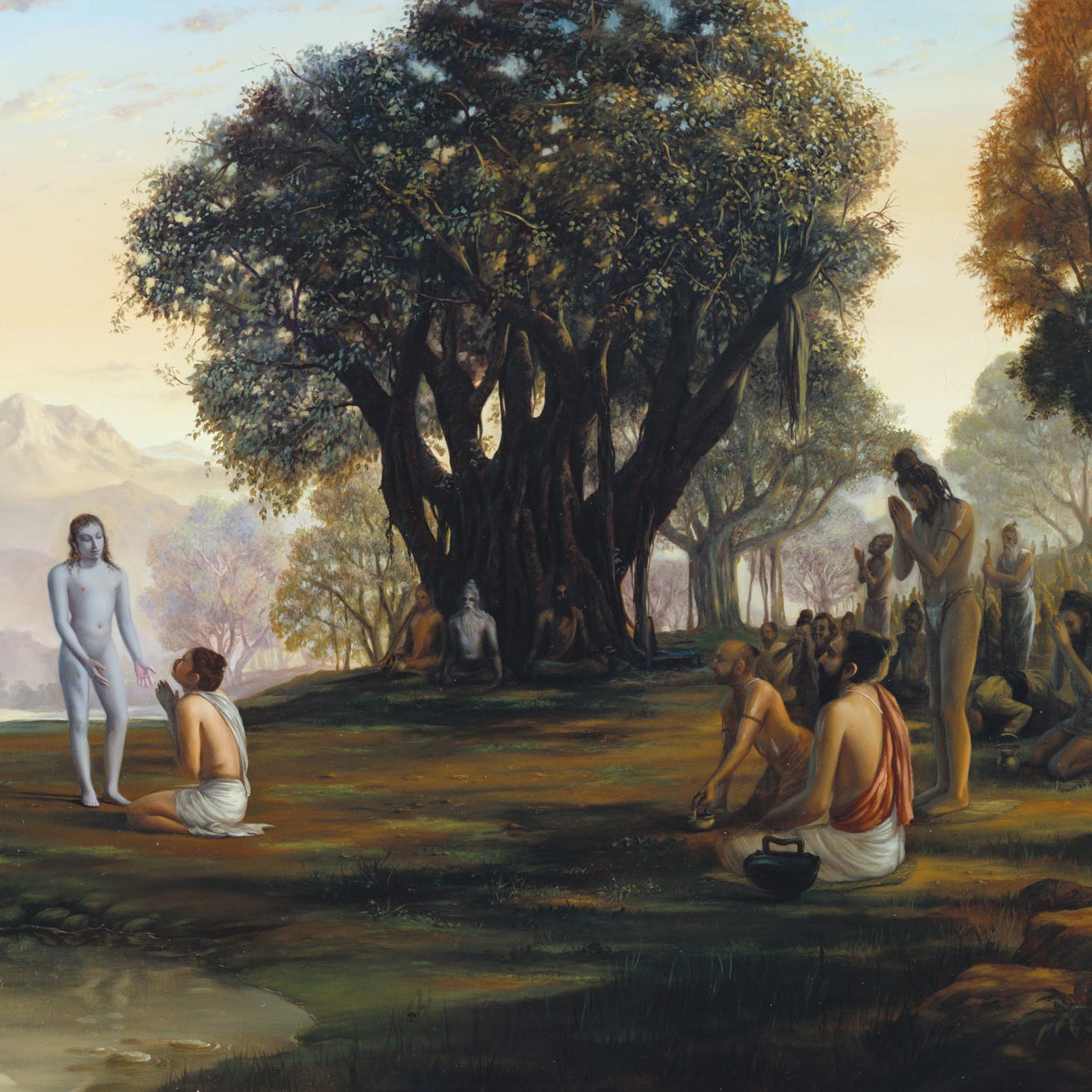
Get full access to Mysteries of the Vedas (Caitanya Chandra Dasa) at www.ccdas.net/subscribe
Bharata Maharaja becomes attached to a deer (The Fifth Canto #08)
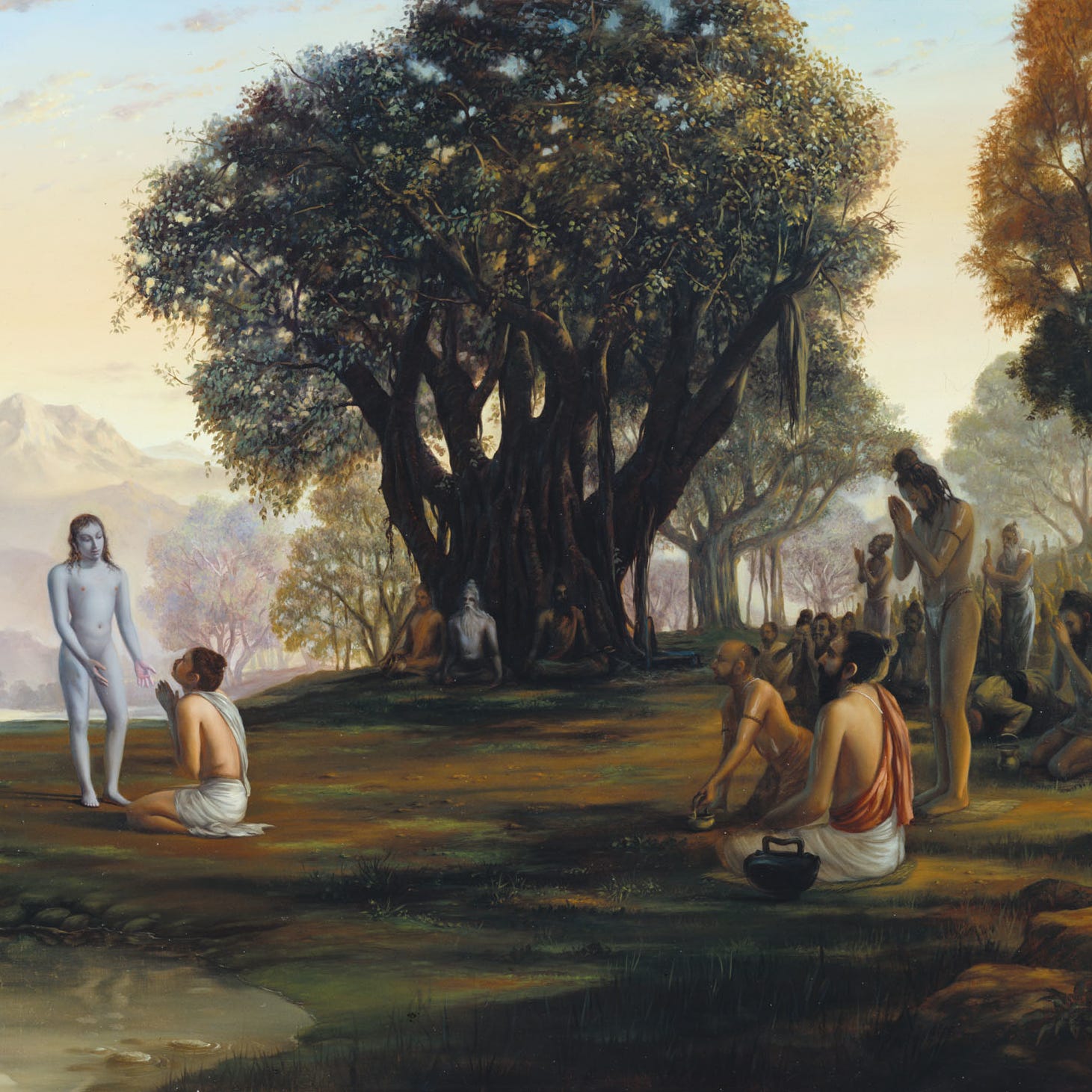
Bharata Maharaja worships the Lord in the forest
“That most exalted devotee, Mahārāja Bharata, in this way engaged constantly in the devotional service of the Lord. Naturally his love for Vāsudeva, Kṛṣṇa, increased more and more and melted his heart. Consequently he gradually lost all attachment for regulative duties. The hairs of his body stood on end, and all the ecstatic bodily symptoms were manifest. Tears flowed from his eyes, so much so that he could not see anything. Thus he constantly meditated on the reddish lotus feet of the Lord. At that time, his h...
The conclusion of the teachings of Rṣabadeva (The Fifth Canto #07)
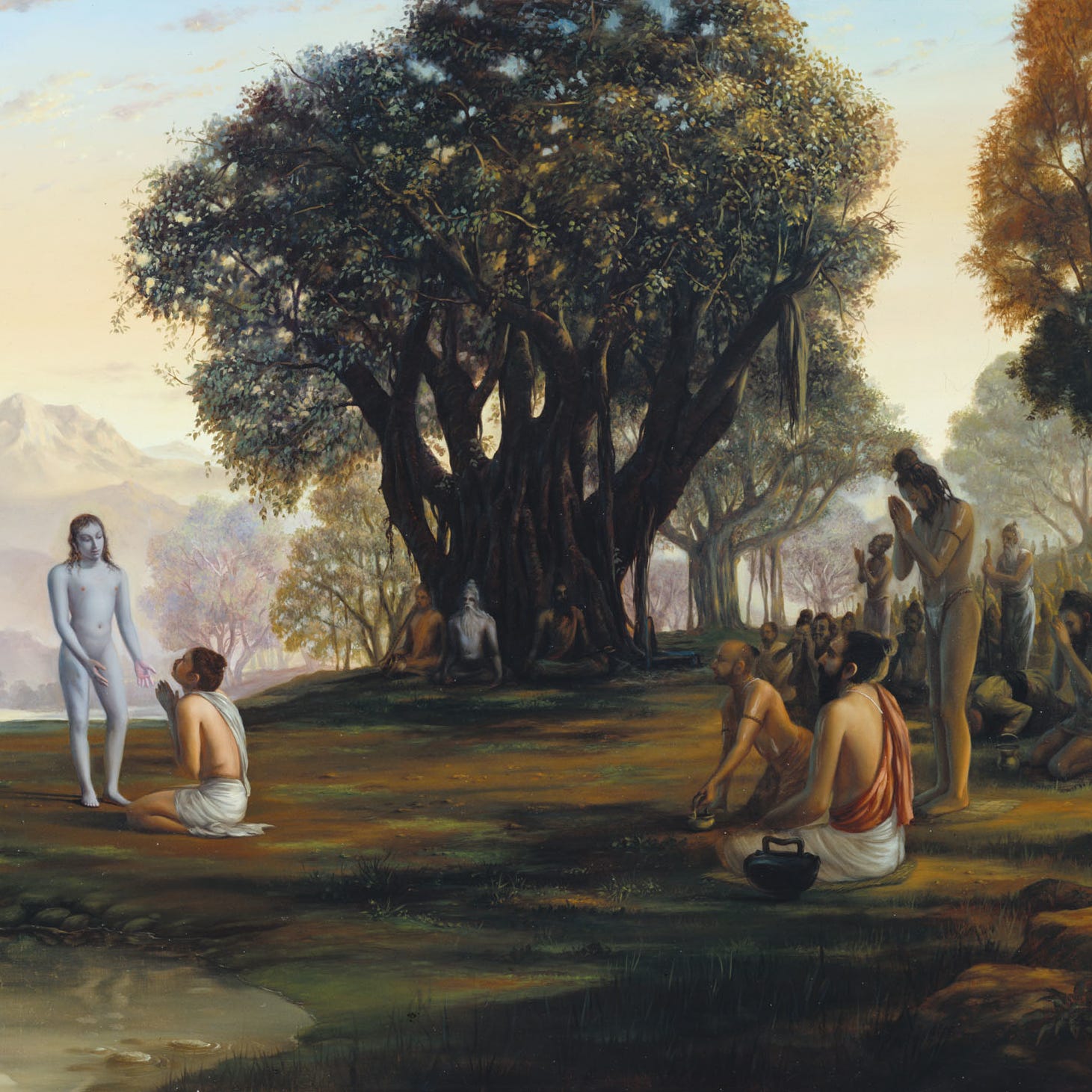
The conclusion of the teachings of Rṣabadeva
Seeing the mind as an untrustworthy person
As a devotee advances in devotional service, one automatically develops the mystical perfections, just as advanced yogīs. However, because a devotee is interested in attaining spiritual perfection, he doesn’t become distracted by the material possibilities offered by mystic powers. Similarly, Ṛṣabhadeva possessed all mystic perfections, but He neglected them, refusing to exercise their powers.
It was already established that Ṛṣabhadeva was completely renounced and free from the grasp of illusory energy. This brings us another question. It is underst...
The mood of a spiritual teacher (The Fifth Canto #06)
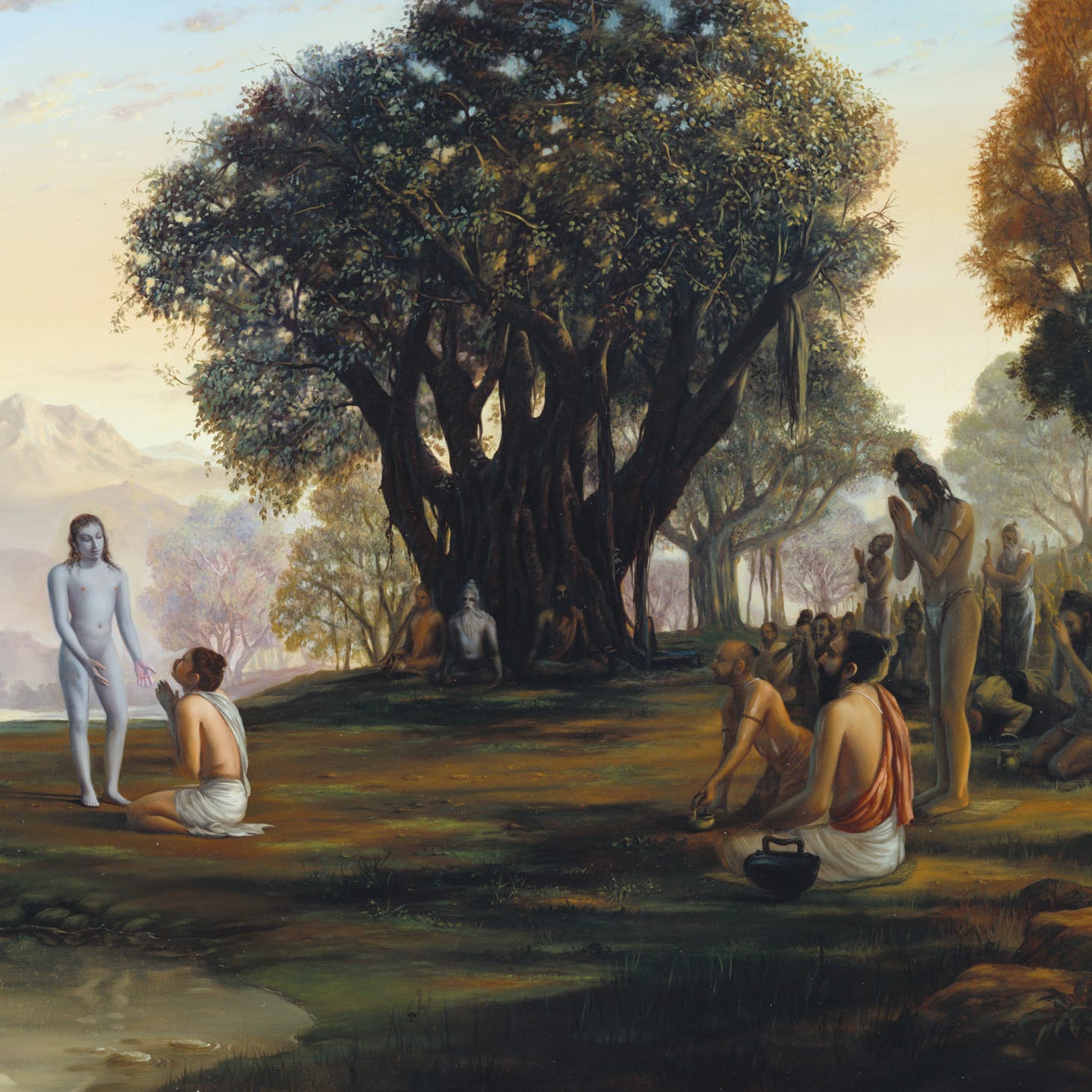
The mood of a spiritual teacher
“As I have advised you, My dear sons, you should act accordingly. Be very careful. By these means you will be freed from the ignorance of the desire for fruitive activity, and the knot of bondage in the heart will be completely severed. For further advancement, you should also give up the means. That is, you should not become attached to the process of liberation itself.” (SB 5.5.14)
In the Gītā (18.54), Krsna explains that “One who is thus transcendentally situated at once realizes the Supreme Brahman and becomes fully joyful...
Lord Ṛṣabhadeva instructs His sons (The Fifth Canto #05)
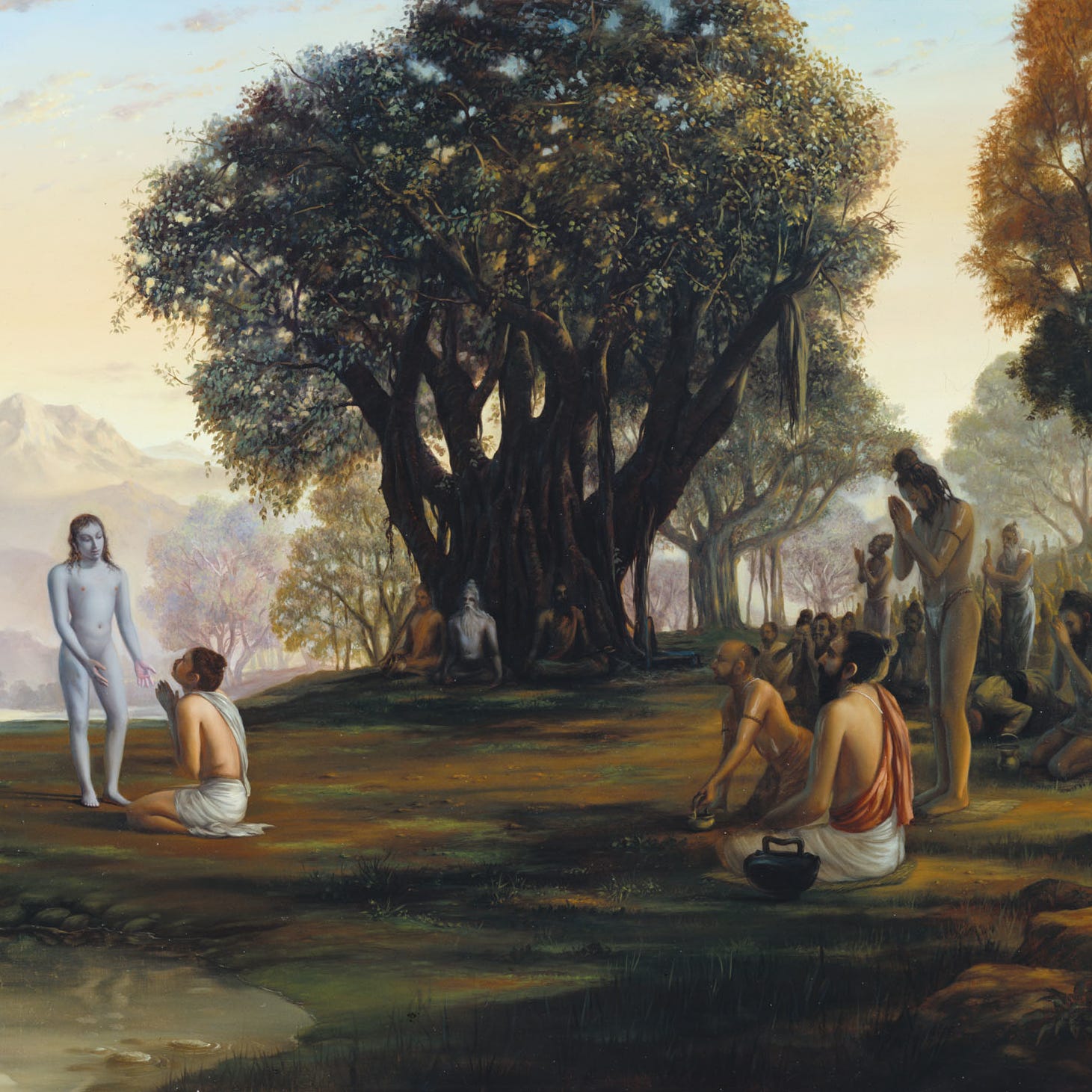
Lord Ṛṣabhadeva instructs His sons
We come then to the central part in this section of the Śrīmad Bhāgavatam, describing the teachings of Ṛṣabhadeva to His sons:
“Once while touring the world, Lord Ṛṣabhadeva, the Supreme Lord, reached a place known as Brahmāvarta. There was a great conference of learned brāhmaṇas at that place, and all the King’s sons attentively heard the instructions of the brāhmaṇas there. At that assembly, within the hearing of the citizens, Ṛṣabhadeva instructed His sons, although they were already very well-behaved, devoted and qualified. He instructed t...
The appearance of Lord Ṛṣabhadeva (The Fifth Canto #04)
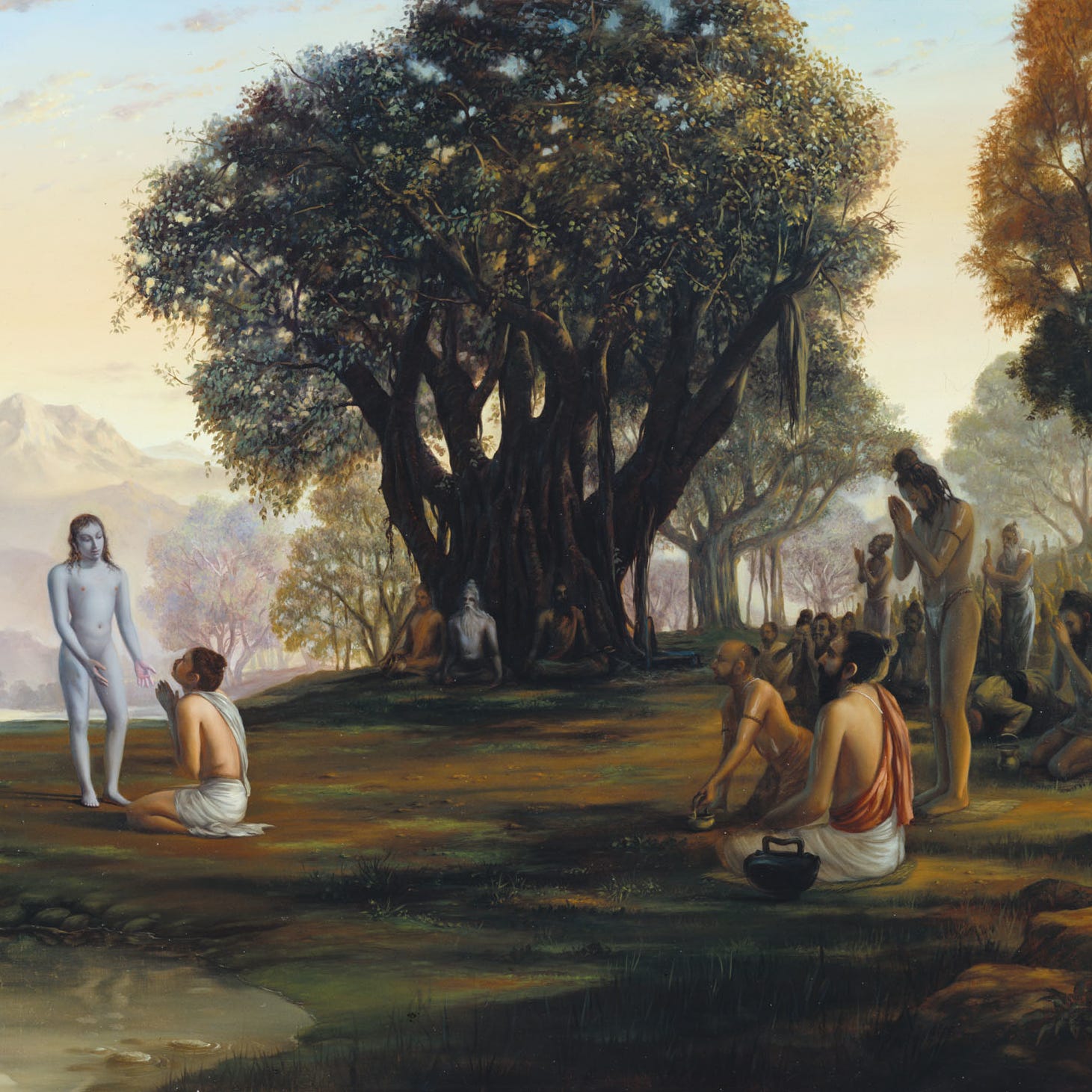
The Lord is not a hungry man who is dependent on our offerings, or a beggar who needs us to build a house for His residence. As Prabhupāda elaborates, “We may construct a gorgeous temple and spend thousands of dollars, but such a temple is not required by the Lord. The Lord has many millions of temples for His residence, and He does not need our attempt. He does not require opulent activity at all.”
If the Lord does not need our offerings, why do we endeavor to cook nice dishes and construct opulent temples for Him...
Mahārāja Āgnīdhra is hunted by Pūrvacitti (The Fifth Canto #03)
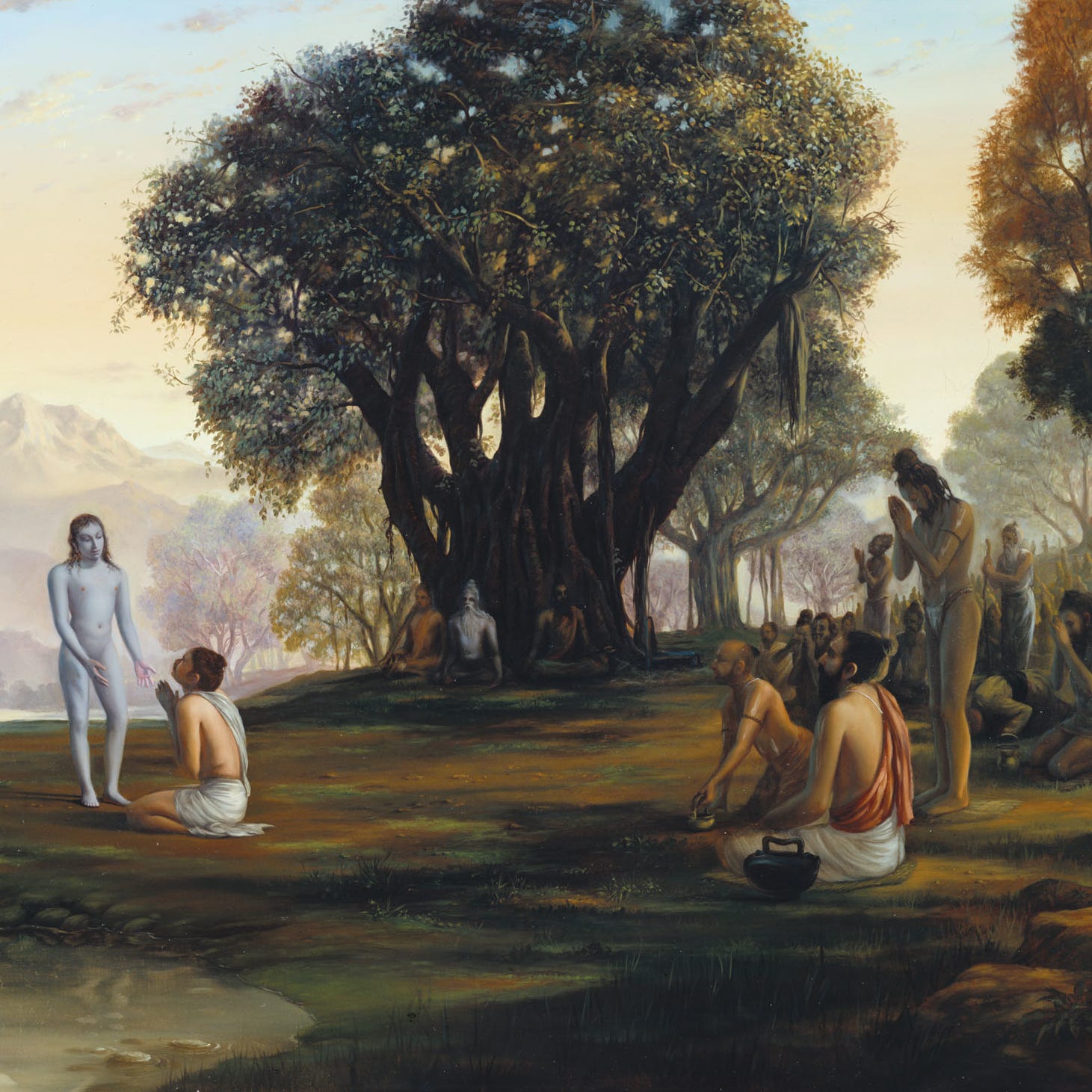
Priyavrata transmitted the rule of Bhu-Mandala to his seven sons, led by Āgnīdhra. Each son became the king of one of the islands, with Āgnīdhra ruling over Jambūdvīpa, the principal amongst the islands, and being accepted as the chief ruler by his brothers.
Āgnīdhra was a pious king who ruled based on religious principles and treated all citizens like his own sons. His protection was not just based on giving food, shelter, and security; he maintained the principles of varṇāśrama-dharma, training the citizens to live a progressive life, according to the principles o...
Priyavrata’s family life: The perfect example of a saintly king (The 5th canto #02)
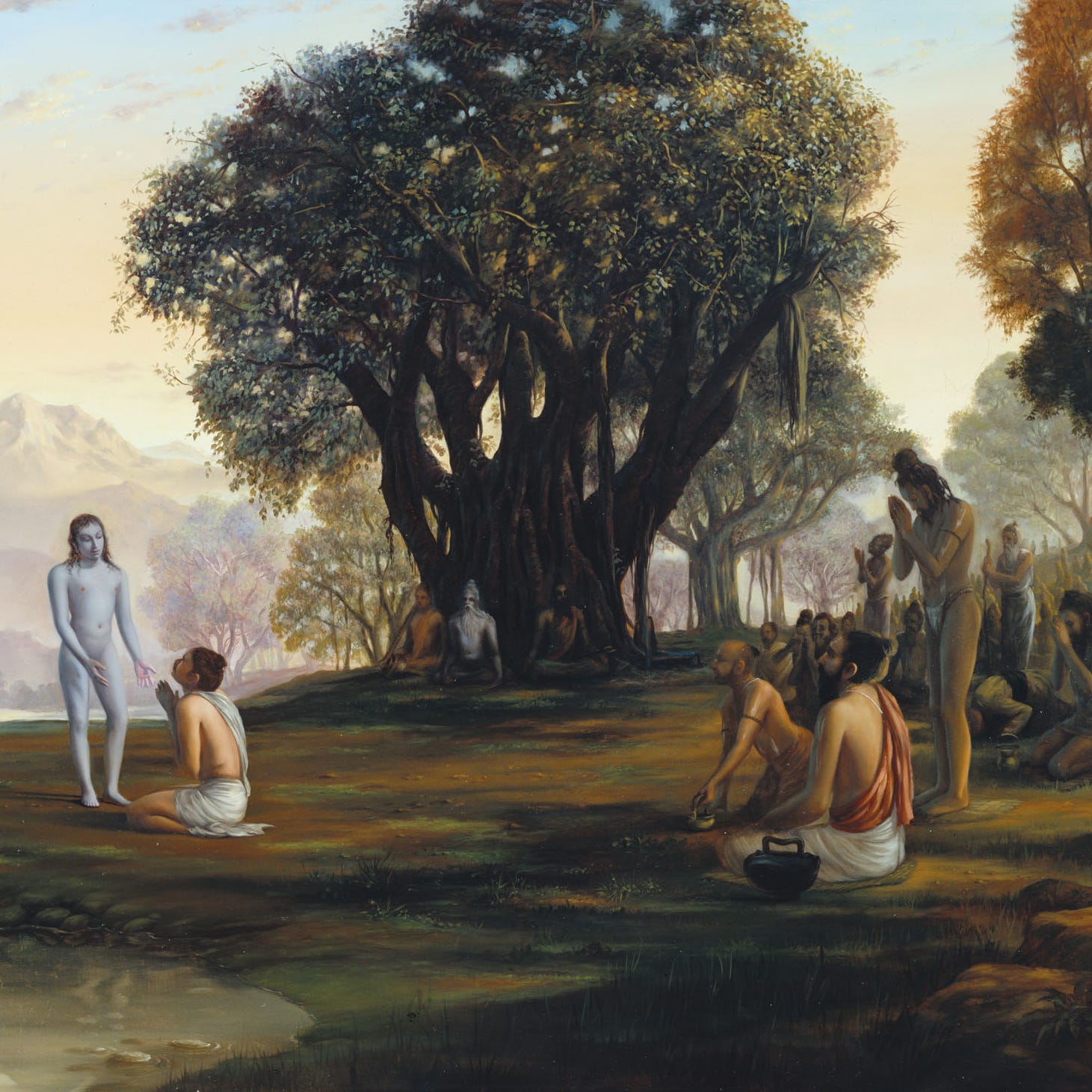
One could argue that since Priyavrata was free of material desire, why did he get married and get involved in sexual life? Why not just remain as a Brahmacārī king? Prabhupāda discusses this point in his purport:
“Since Mahārāja Priyavrata was fully trained in transcendental knowledge, he could have returned home and conducted the business of government as a brahmacārī. Instead, however, when he returned to household life, he accepted a wife also. The principle is that when one becomes a gṛhastha he must live perfectly in that order, which means he must liv...
Priyavrata returns to reign over the Universe (The 5th canto #01)
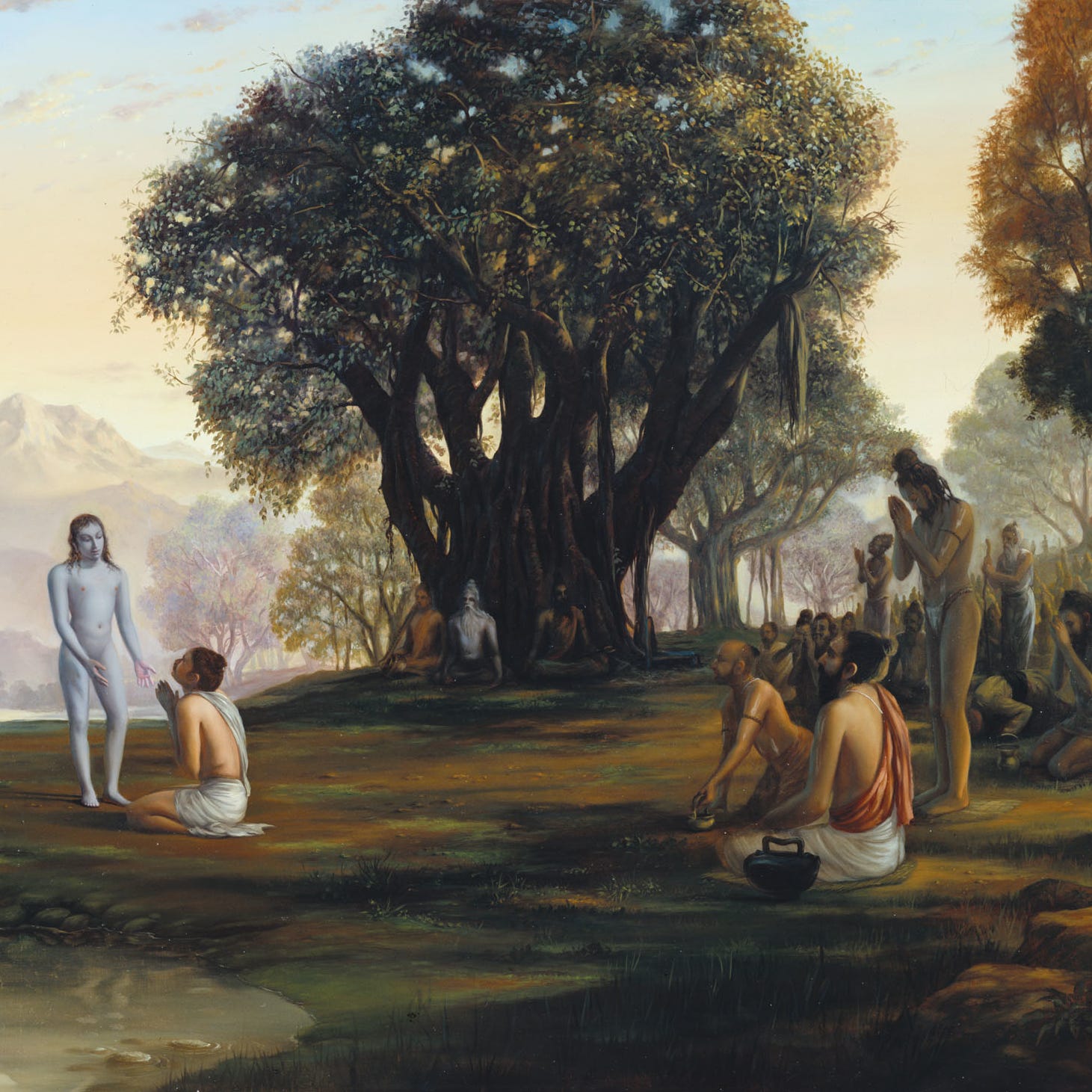
Previously in the Śrīmad Bhāgavatam, it was explained that Svāyambhuva Manu had two very qualified sons, of whom Uttānapāda, the younger, inherited the throne. The reason was that the elder son, Priyavrata, had a strong tendency to renunciation and retired at a younger age, becoming a disciple of Nārada Muni.
Uttānapāda was the father of Dhruva Maharaja, who succeeded him on the throne. Dhruva became the head of a great dynasty, which continued up to the Pracetas, who produced a single son through their wife, Marisa: Daksa (in his second bi...
The conclusion of the 4th canto (Srimad Bhagavatam #78)
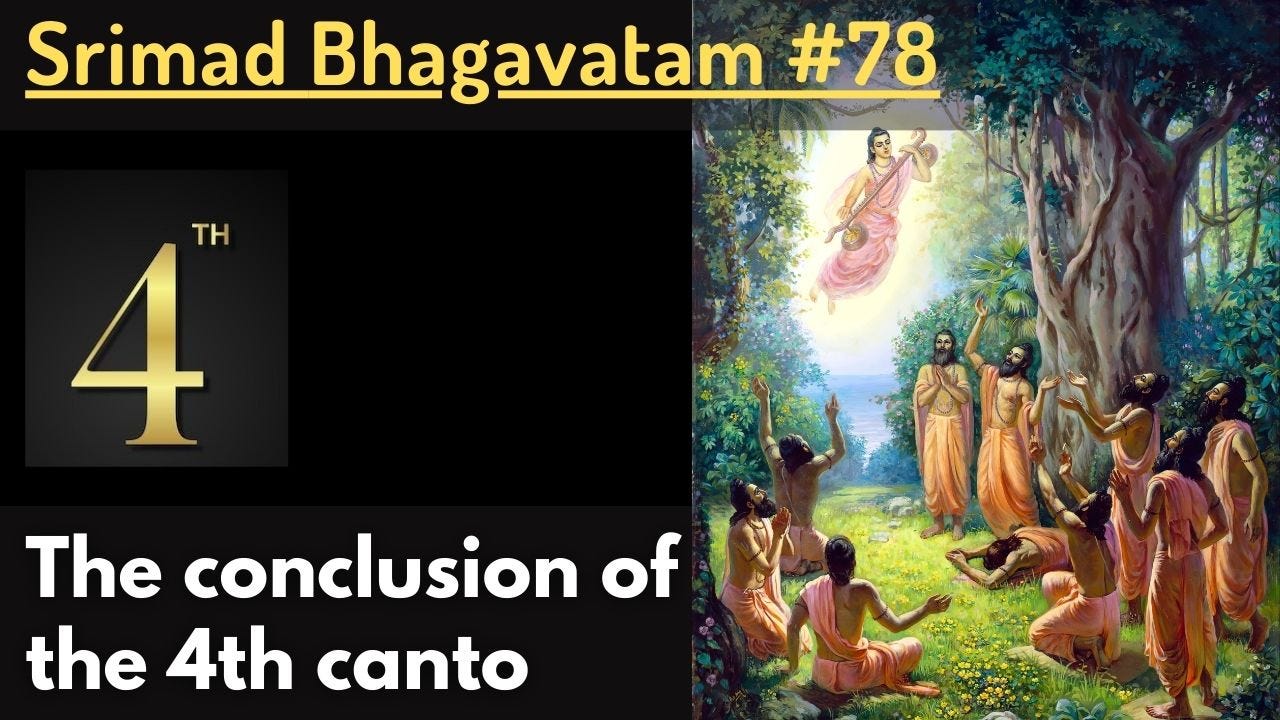
With this, we come to the end of the conversation between Vidura and Maitreya, which corresponds to most of the 3rd and 4th cantos of the Srimad Bhagavatam. By examining all of the important instructions we received in these two cantos, we can see how valuable they are and easily understand why Śukadeva Goswami chose to narrate them.
Vidura heard from Maitreya many descriptions of kings who attained perfection at the end of life. Dhṛtarāṣṭra is also a great personality in a sense, for no common person could be born from the semen of a great sa...
The Pracetas meet the Lord (Srimad Bhagavatam #77)
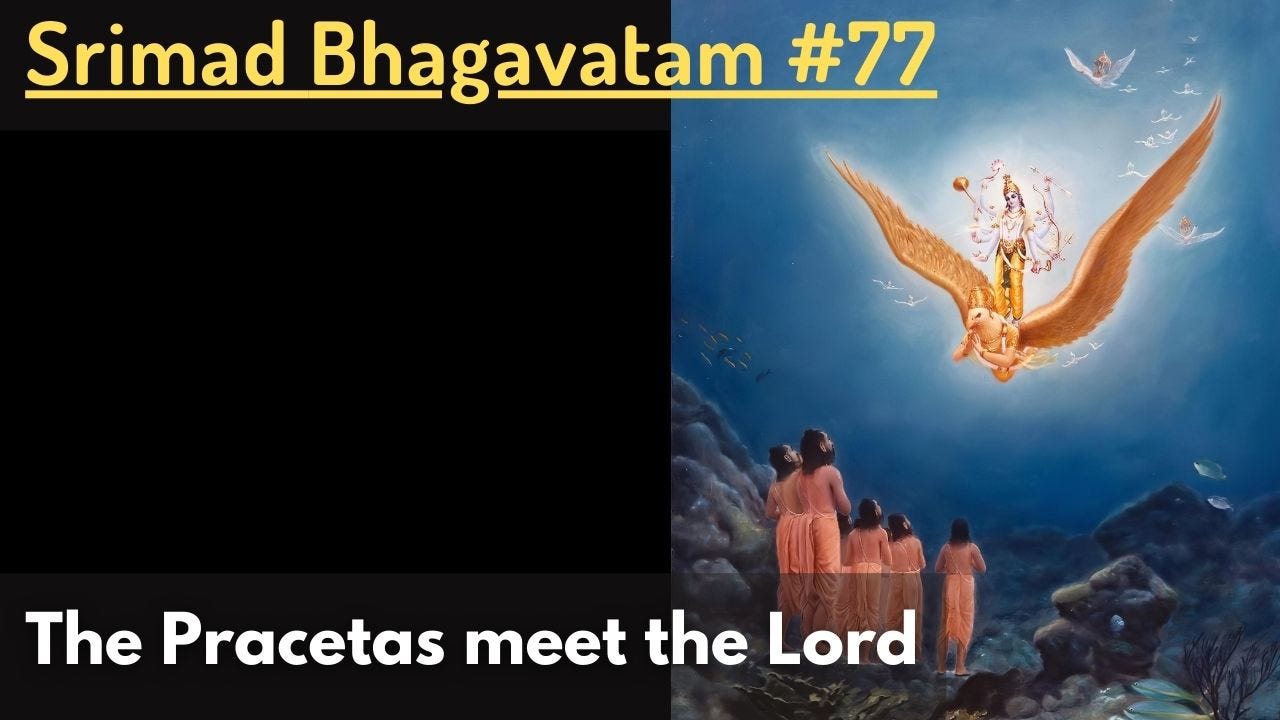
The Lord appeared on the shoulder of Garuḍa, in a form with eight arms, complete with all opulences. The Lord was satisfied with the Pracetas for their perfect recitation of the prayers of Lord Śiva, their dedication in the practice of devotional service, and many other factors, but the point he specifically mentioned when He met them was their sincere dealings with each other:
"My dear sons of the King, I am very much pleased by the friendly relationships among you. All of you are engaged in one occupation — devotional service. I am so pleased with your...
Going back to Godhead from family life (Srimad Bhagavatam #76)
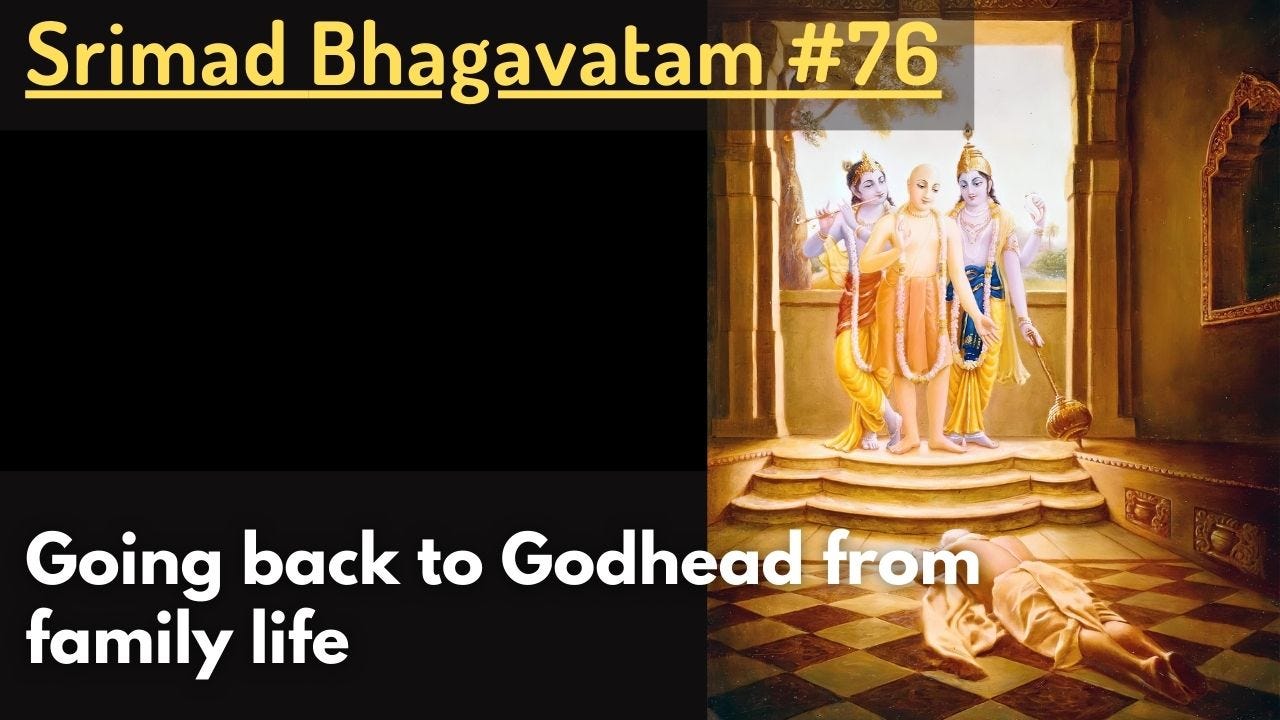
Just as Rāhu, which is normally invisible, sometimes becomes visible in the presence of the full moon, all the material desires stocked in the mind, which are normally invisible until manifested, become visible at once when the devotee attains the constant association of the Lord. One can thus see his entire stock of desires at once and, simultaneously, see the Lord present before him. In the presence of the Lord, all these material desires look insignificant, and a devotee completely loses interest in them. With all material desires destroyed, there is no more obstacle in one going back h...
Nārada explains the allegory of King Purañjana (Srimad Bhagavatam #75)
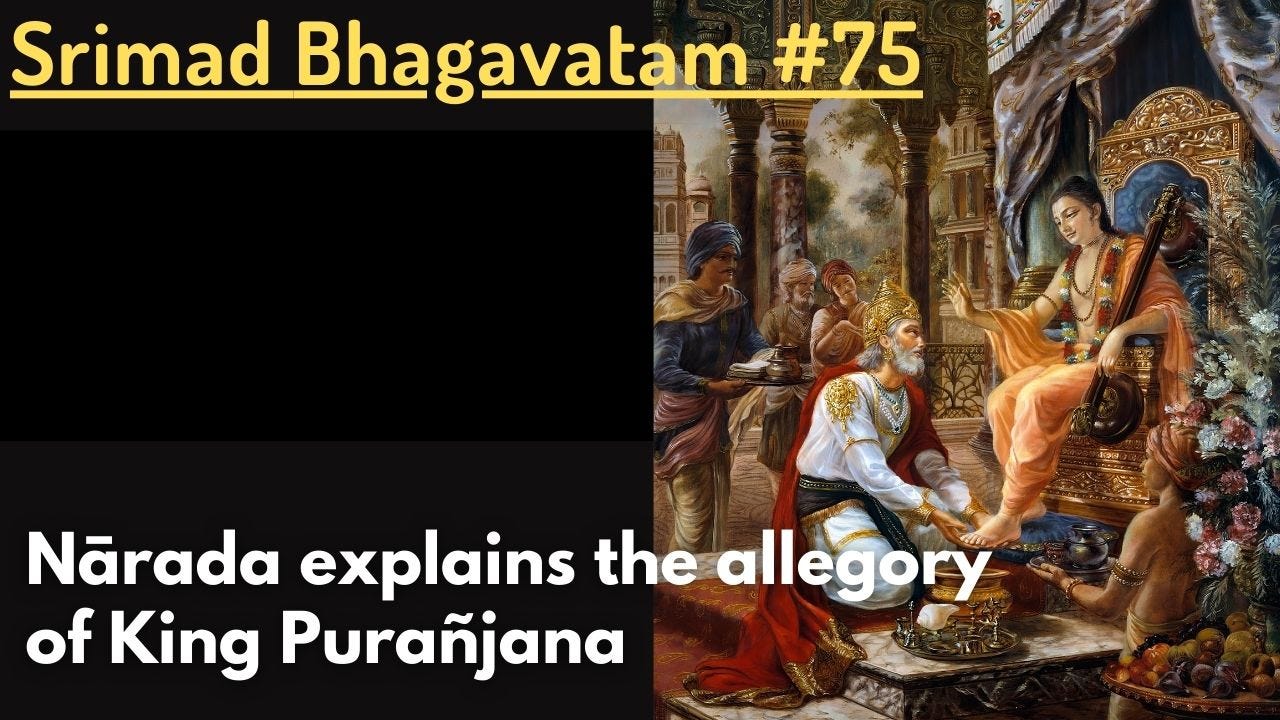
For us, the allegory of Purañjana is quite understandable because of all the details included in the purports of Srila Prabhupada. However, for one with access to just the Sanskrit verses, the meaning of the allegory is not clear at all. That's a situation similar to the second chapter of the Bhagavad-Gītā, where Arjuna becomes confused by the meaning of the verses, while for us, the meaning is quite clear due to the purports. Some of the symbolism was already revealed by the Lord, speaking in the form of the Brāhmana on verses 56 to 58 of the prev...
The final conclusion on the "fall" of the Jīva (Srimad Bhagavatam #74)
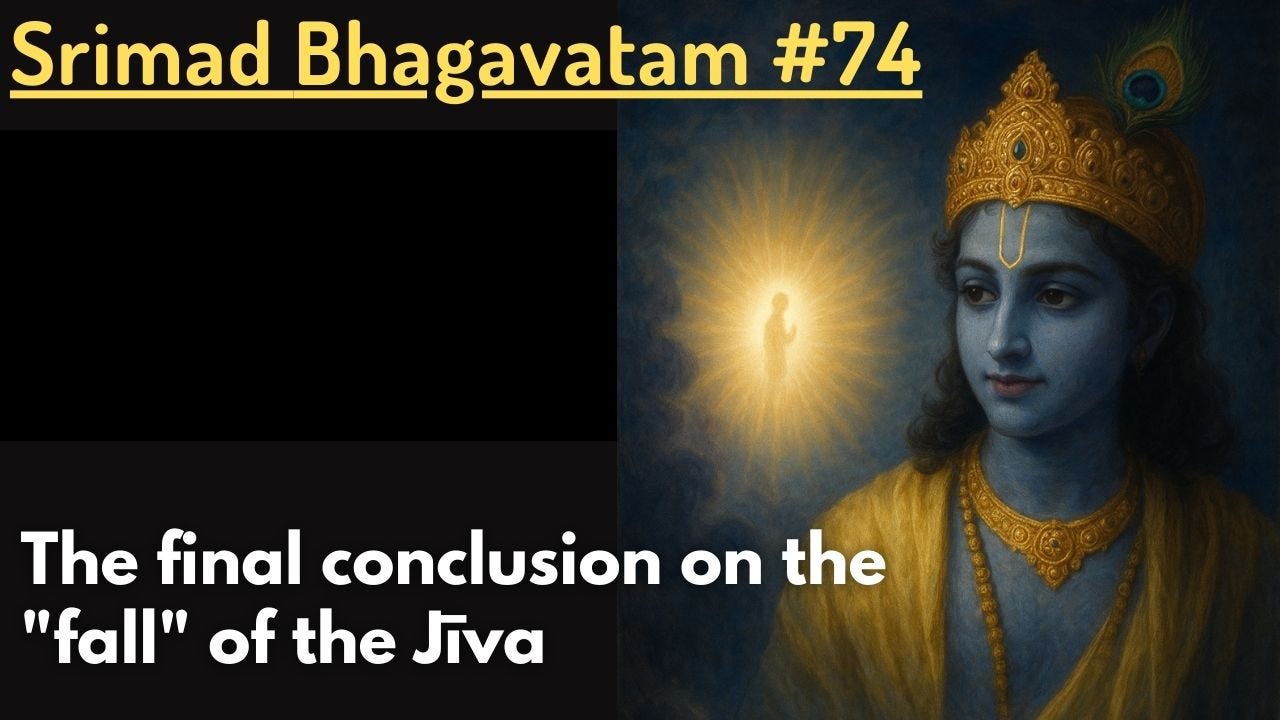
At the beginning of our movement, disciples of Prabhupada had no doubts about our eternal relationship with Krsna and how the soul ends up in the material world, because the only source of information for them was the books of Srila Prabhupada, where the question is explained clearly. However, in the late 1970s, devotees coming in contact with other ideas transformed this point into a battleground. At some point, Prabhupada wrote an essay directly clarifying the topic to his disciple, Madhudvisa Prabhu, which I try to explain in detail here.
Get full access to Mysteries of...
The final explanation on the "fall" of the Jīva: Krsna reveals our original nature (Srimad Bhagavatam #73)
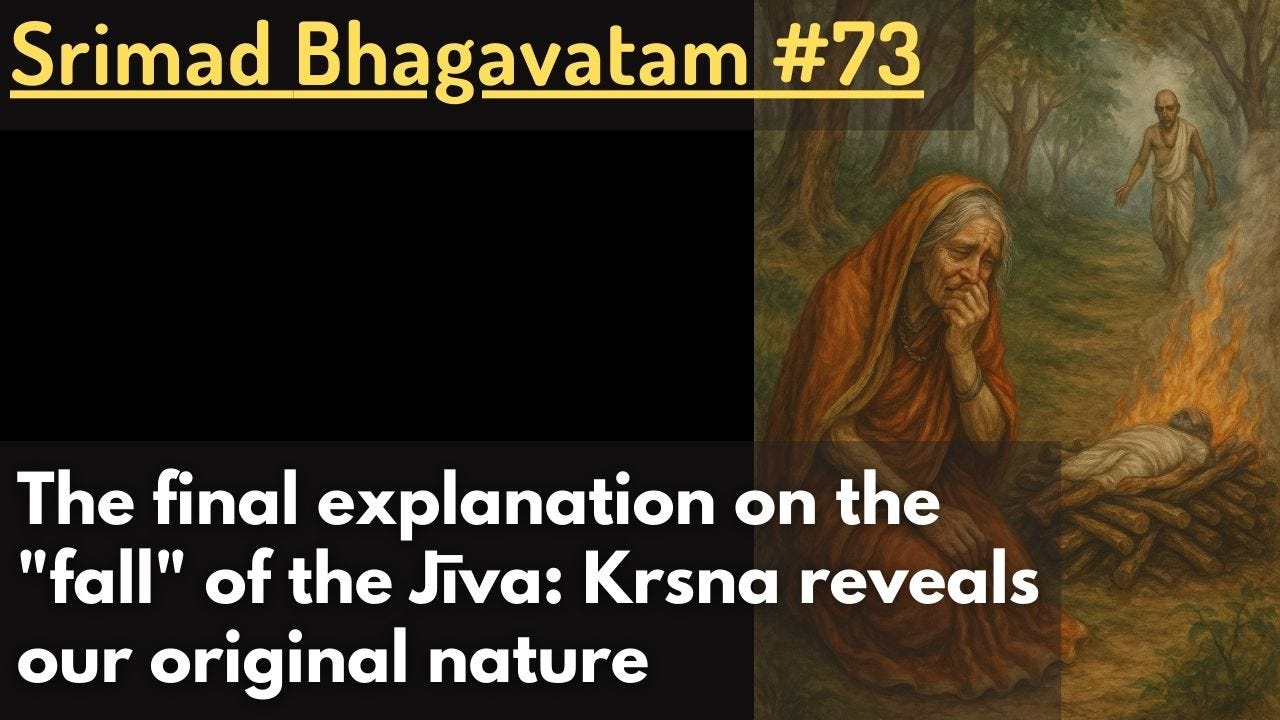
Some have the idea that Krsna doesn't care about the jīvas, sending some here and some to the spiritual world in a more or less random fashion. However, this idea is clearly dismissed in the Srimad Bhagavatam. Krsna is the friend of everyone, and the proof is that He follows each soul in its adventures in the material world, accompanying each soul as one goes from one material body to the other. No one can thus say that we are here due to the Lord's indifference. He wants us back; the question is just for us to accept H...
Purañjana comes to the path of devotional service (Srimad Bhagavatam #72)
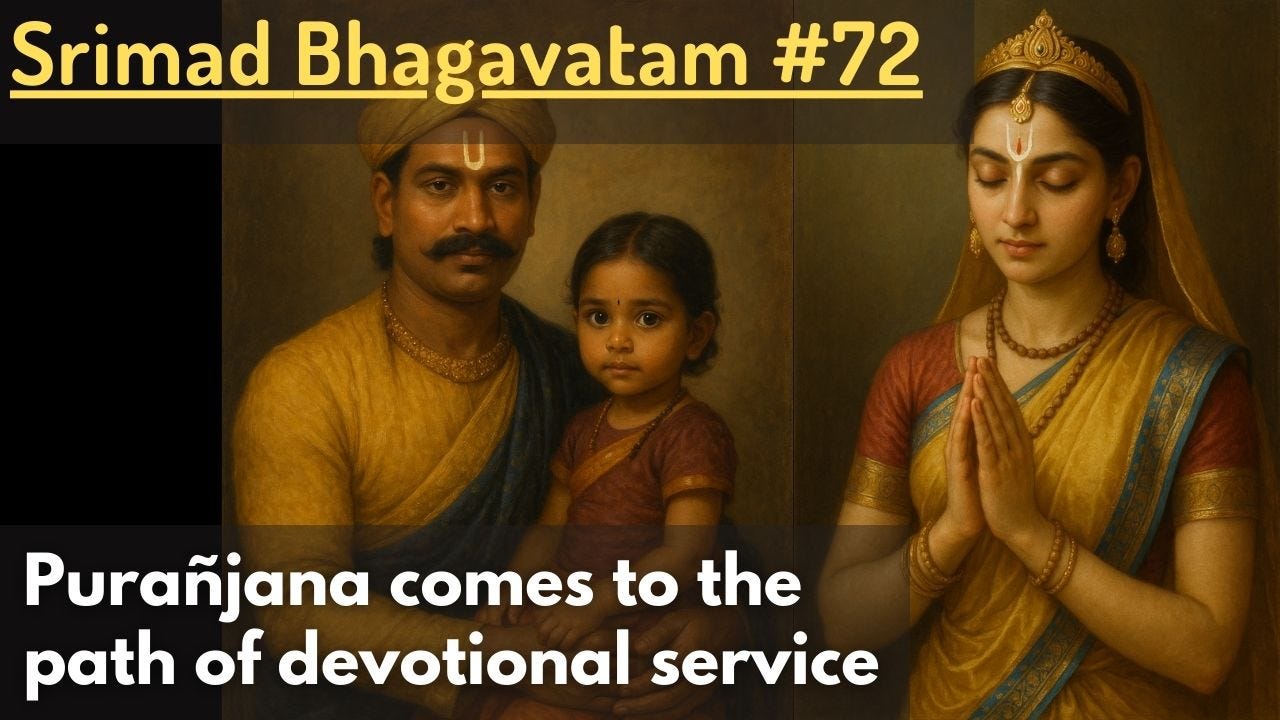
Just as in the first part of the allegory, Srila Prabhupada adds a completely new layer of understanding to the passage of Purañjana taking his next birth as a woman.
From verse 4.28.29 to 4.28.34, Prabhupada shows how the allegory describes the spread of the cult of bhakti, and how Vaidarbhī became involved in it as a result of her short devotional practice in her previous life as Purañjana. This meaning was first revealed by Srila Baladeva Vidyābhūṣaṇa in his commentary, and Prabhupada further expanded it to our contemporary context.
Get full acce...
Purañjana is embraced by old age (Srimad Bhagavatam #71)
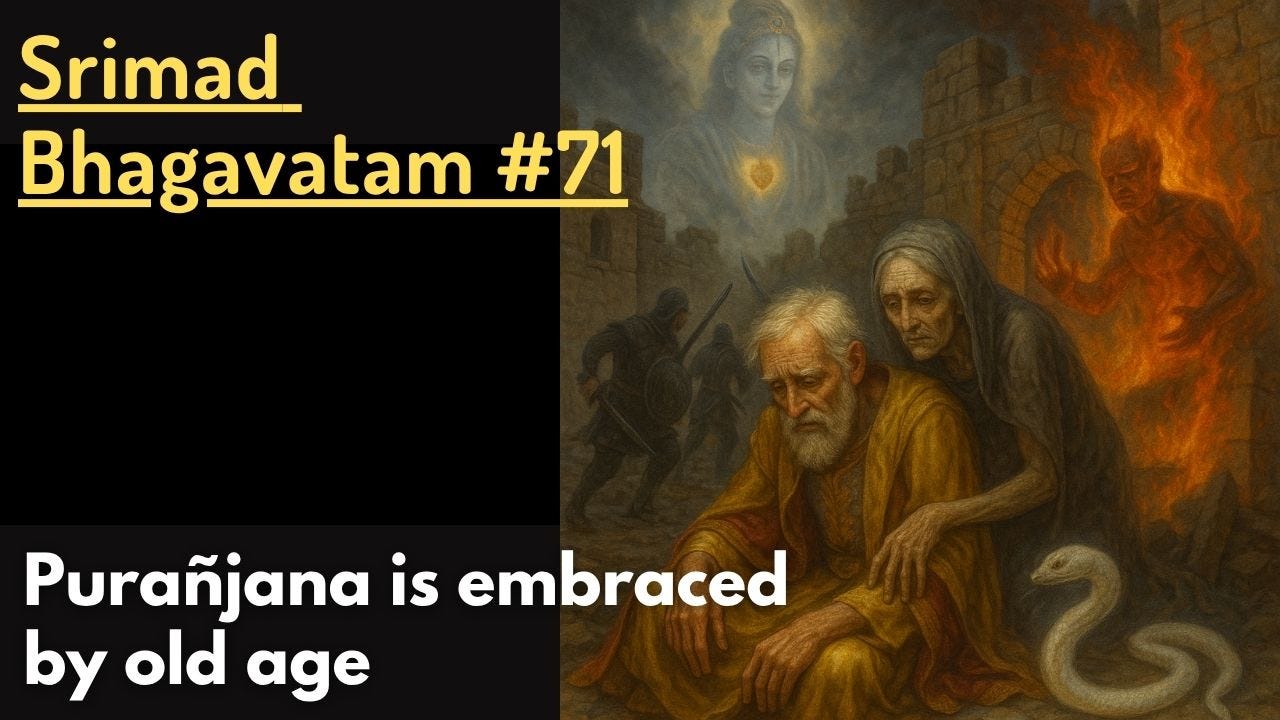
After being attacked by the forces of Caṇḍavega for many years, the defenses of the city of Purañjana are already worn out. This illustrates the period preceding old age, where one sees a great diminution of energy, and the body starts to give trouble. This is the age the scriptures recommend one retire from active family life and focus on one's self-realization. Purañjana, however, preferred to ignore the warnings, and now Kālakanyā, followed by Prajvāra and Yavana-rāja, will deliver the final blow.
Get full access to Mysteries of the Vedas (Caitanya C...
The vicious attack of time (Srimad Bhagavatam #70)
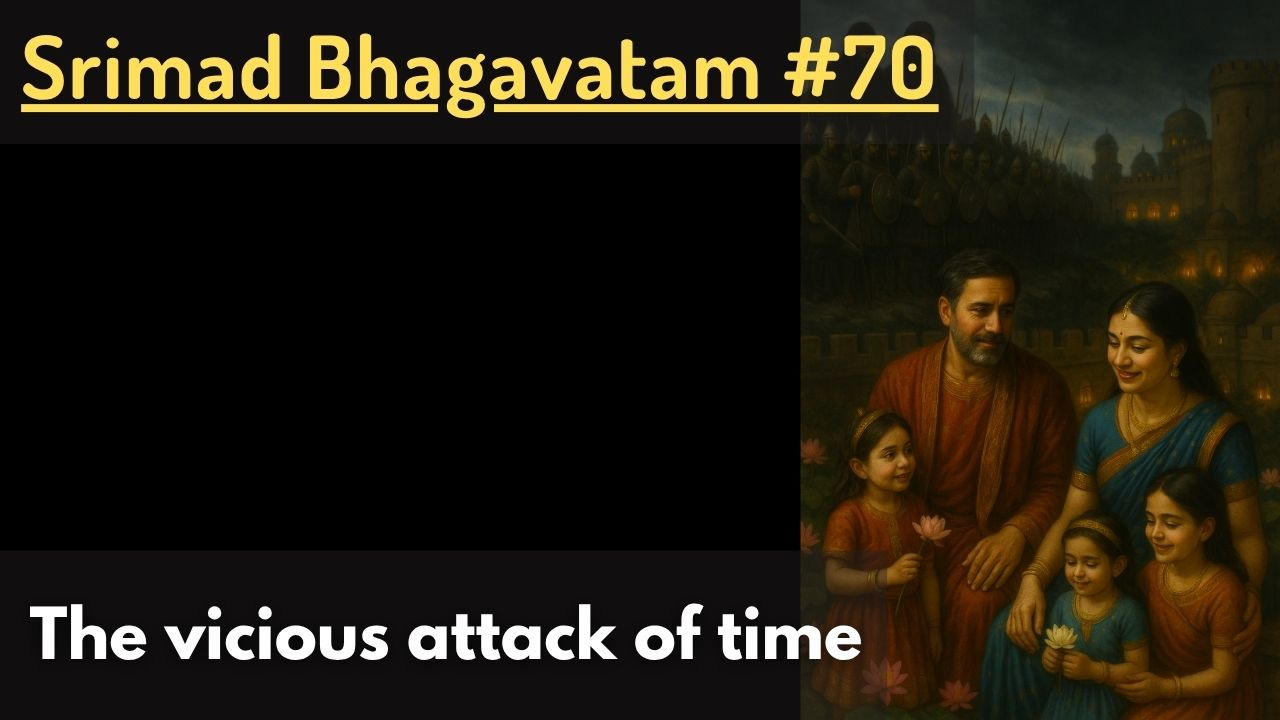
Every conditioned soul lives in a fort that is being constantly attacked by a powerful enemy, the irresistible force of time, which no one can stop. It is just a matter of time until the city falls, but still, Purañjana, the conditioned soul, continued to simply enjoy life together with the senses and desires, without caring for the future. Just like Purañjana, materialists prefer to ignore death until the last moment, believing that somehow or other, they will be able to avoid it. When the time comes, they are surprised.
Just as a king collects ta...
Purañjana abandons his intelligence and hunts in the forest (Srimad Bhagavatam #69)
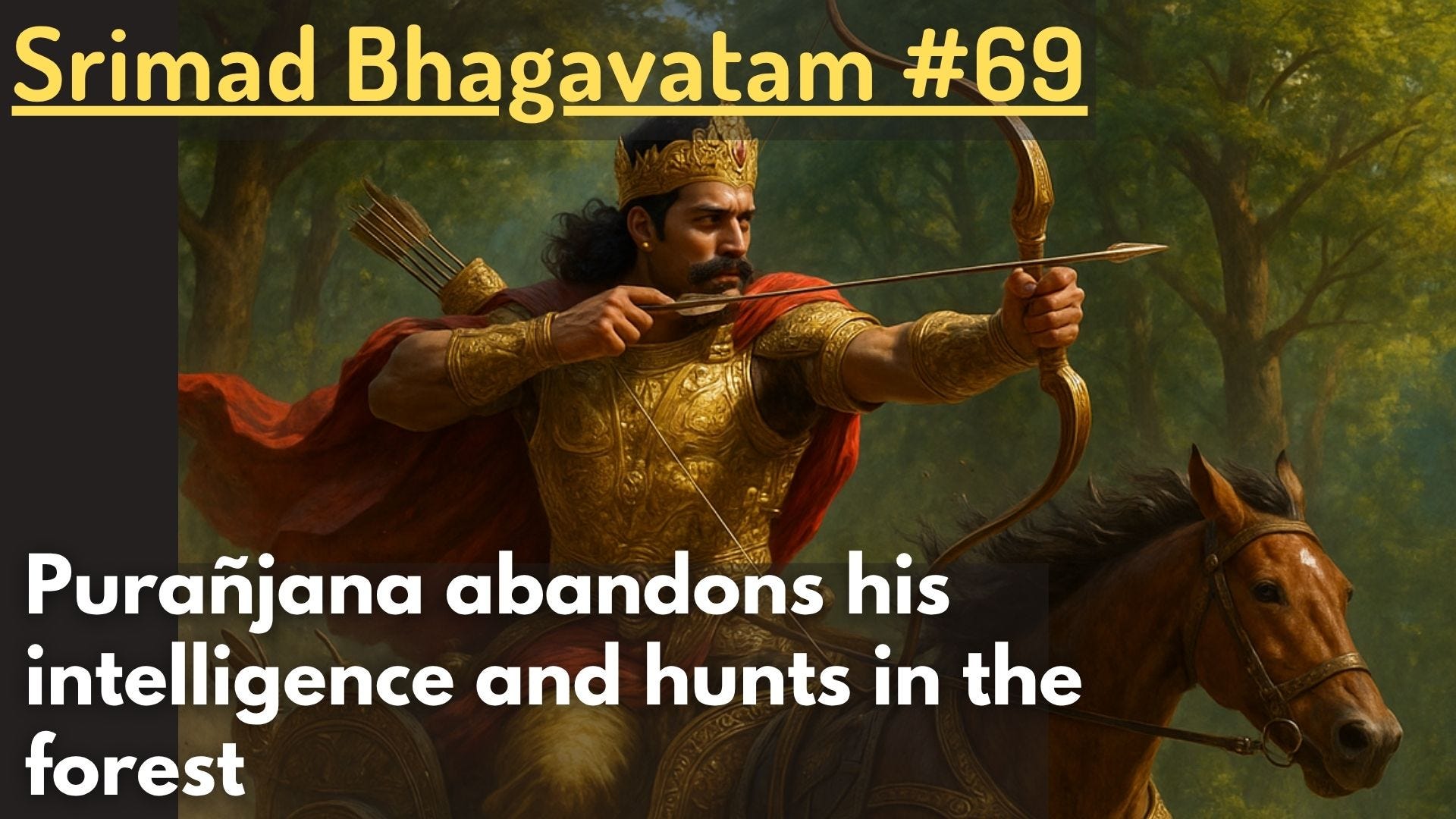
Purañjana left his queen and went to hunt in the forest. This part of the allegory illustrates the situation of a man who abandons his good sense and goes to perform sinful activities guided just by his senses and the desires of the mind. In the allegory, the queen represents one's intelligence, which may be imperfect and propense to materialistic activities, but that at least offers a degree of piety, religiousness, and morals to guide these activities. Purañjana was already entangled in material life by following his intelligence, but now, without it he becomes busy in simply pe...
Purañjana enters the city of the body and becomes illusioned (Srimad Bhagavatam #68)
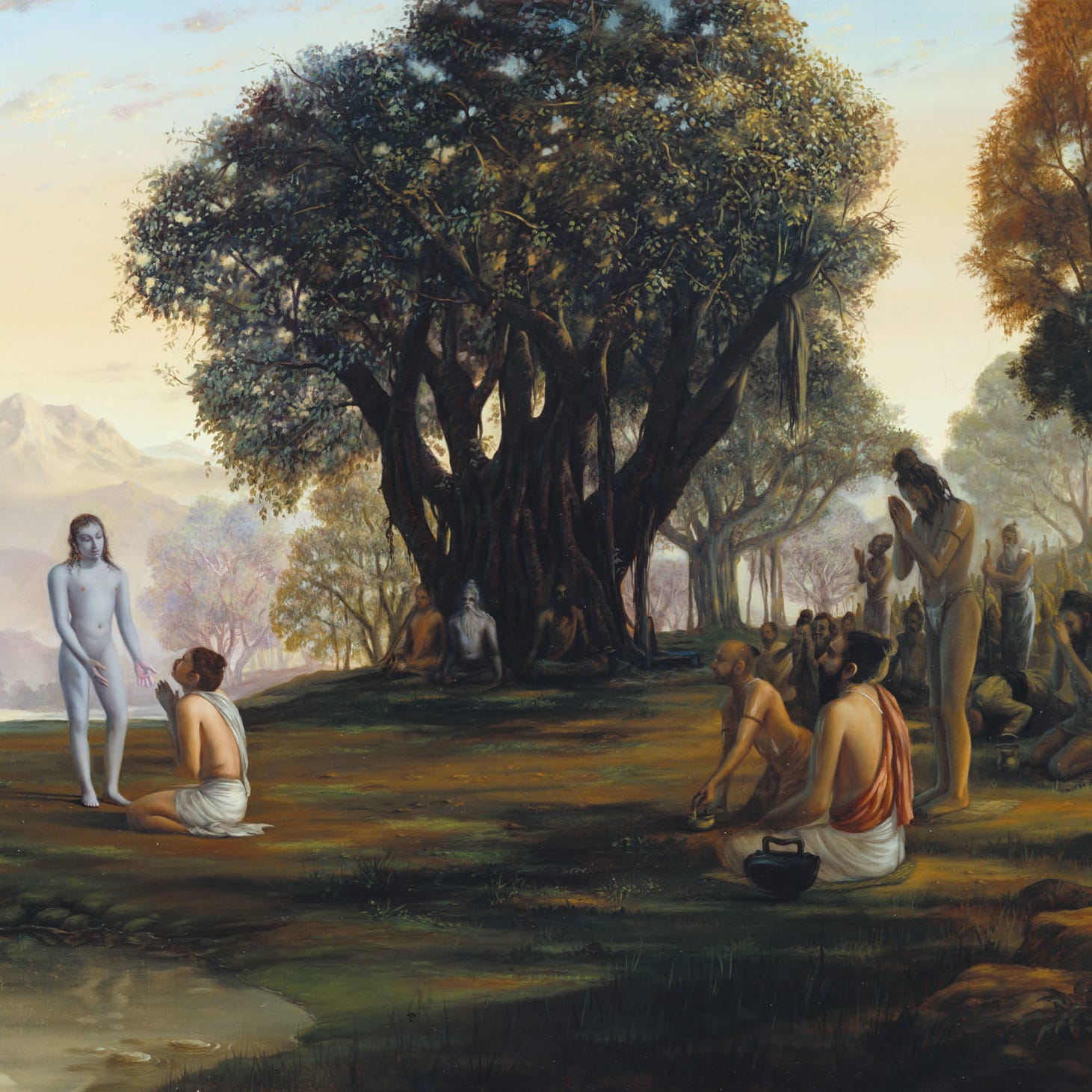
Affected by lust, a man sees a beautiful girl as the source of satisfaction for all his desires, and similarly, a woman sees a handsome man as the source of wealth, adventure, and satisfaction. Just as it is difficult for a man to resist the beauty of a young, attractive lady, it is very difficult for a woman to resist the advances of a handsome man who tries to seduce her. This is the very basis of material conditioning. The strategy of seduction may be different for the two genders, but the attraction is similar. Because of this mutual...
King Purañjana: The history of every conditioned soul (Srimad Bhagavatam #67)
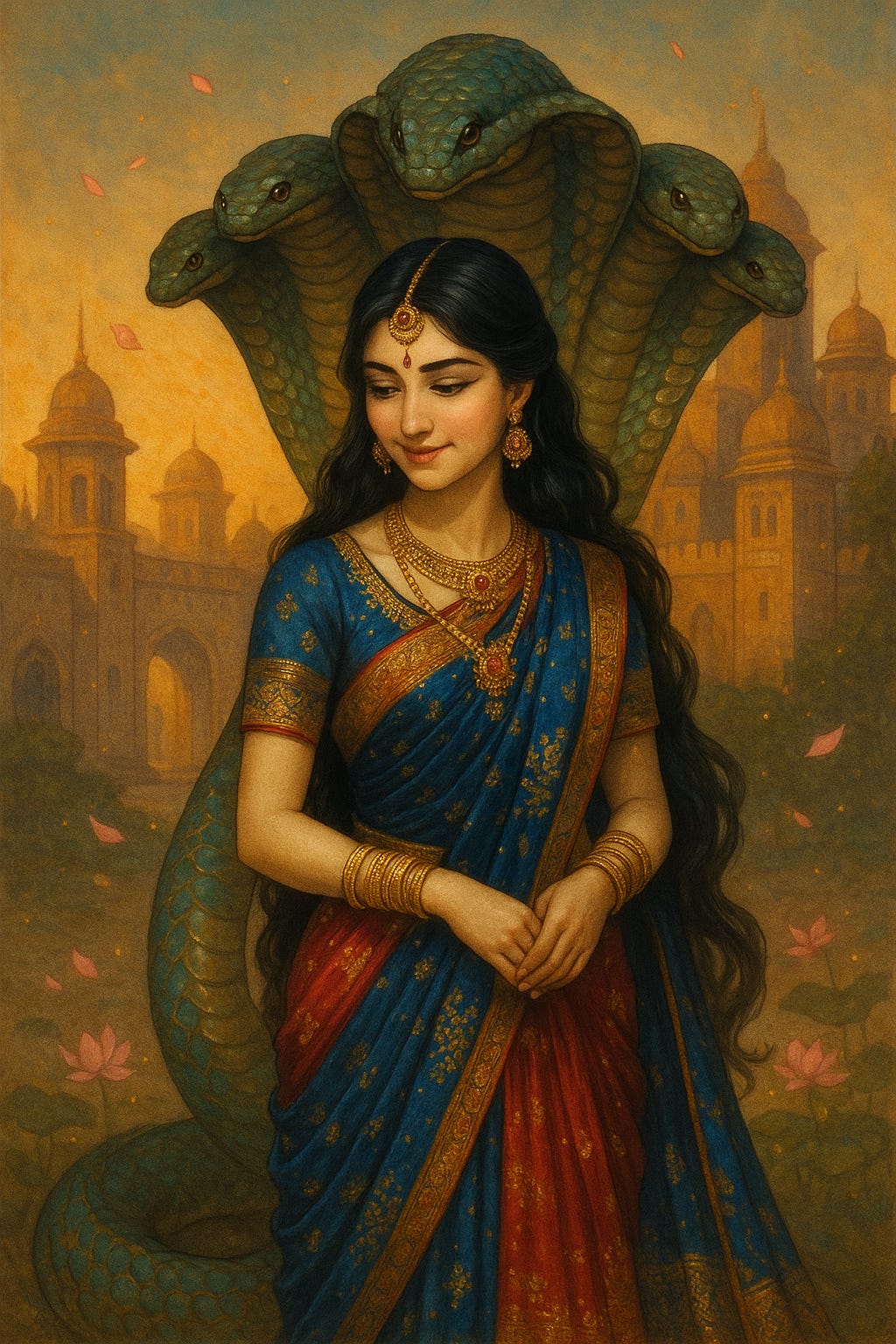
Materialistic life is compared to a dark well, since once failing there, there is little possibility of escaping. If one somehow comes in contact with devotees who can pull him out, one should grab this opportunity with all his will, just as Prācīnabarhi did.
As Prabhupada mentions in his purport to 4.25.6: "The King was very fortunate to be able to associate with Nārada, who enlightened him in spiritual knowledge. It is the duty of all saintly persons to follow in the footsteps of Nārada Muni and travel all over the world to every coun...