The AI Native Dev - from Copilot today to AI Native Software Development tomorrow

Welcome to The AI Native Developer, hosted by Guy Podjarny and Simon Maple. Join us as we explore and help shape the future of software development through the lens of AI. In this new paradigm of AI Native Software Development, we delve into how AI is transforming the way we build software, from tools and practices to the very structure of development teams.Our target audience includes developers and development leaders eager to stay ahead of the curve. If you're passionate about the future of software development and curious about how to leverage AI to build effective teams and groundbreaking...
Inside Anthropic: How Claude Tag Is Changing Agentic Work

Six people reacted to Boris's side-project Slack post. A year later, Claude Code is ubiquitous, and the company just launched its next evolution: Claude Tag, an AI teammate that lives in Slack.
Lamis Mukta, Member of Technical Staff at Anthropic, joins Simon Maple to unpack how Claude Tag works, why Anthropic built it, and what it took internally to go from a scrappy side project to a company-wide habit.
What we cover:
– What Claude Tag actually is, and how it differs from Claude Code and Cowork
– Why trust in AI agents is really a fu...
The Tessl Agent: Build Your Software Factory on Autopilot

What if the whole point of your AI agent was to eventually make itself redundant? Dru Knox, Head of Product at Tessl, introduces the Tessl agent — a new interface built not just for AI-assisted coding, but for building the software factory that keeps improving without constant human input.
This is a conversation about loop engineering: how to set up automated feedback cycles so your agents get smarter, your code review gets tighter, and your team ships more without adding more toil.
What we cover:
– What the Tessl agent is and how it fits into the...
Why Agents Are Forcing Enterprises to Finally Fix Their Dev Process

Enterprises are finally being forced to care about their software development lifecycle — not because anyone suddenly got disciplined, but because agents cost money and the waste is now visible. When it was humans, it was "Timmy's just lazy." Now it's a line item.
Simon Maple sat down with Patrick Debois (the godfather of DevOps, now DevRel at Tessl), Tammuz Dubnov (co-founder and CEO of Autonomy AI), and Daniel Jones (Head of Product at re:cinq) at AI Native DevCon London for a wide-ranging panel on AI enablement — who owns it, what's breaking, and what the organisations getting it ri...
BONUS: DevCon London: Real Talk on AI ROI, Harnesses & Evals

From the expo floor of AI Native DevCon London, Simon Maple went straight to the developers — speakers, attendees, and sponsors — to ask what's actually working with AI in 2026. The verdict? Outcomes beat outputs every time, 4,000-hour workloads are collapsing to 20 minutes, and the real bottleneck isn't code.
This is a conference floor walkthrough: honest, unscripted takes on harness engineering, evals, AI adoption mindsets, and the change management challenge that nobody talks about enough.
What we cover:
– Why measuring token usage, code commits, and outputs will lead your team astray
– How NearForm cut a 4,000-hour AM...
AI Security & the Agent-Ready Web: Experts Weigh In

What does it mean to build securely when agents can negotiate their own guardrails? And what happens to the web — CLIs, frameworks, even the browser itself — when the primary user is no longer human? At AI Native DevCon London, Simon Maple sat down with two panels of experts to find out.
First: a security roundtable with Joseph Katsioloudes from GitHub, Liran Tal from Snyk, and John Groetzinger from Cisco.
Then: a web AI conversation with Dana Lawson from Netlify, Maximiliano Firtman from codemia, and James Moss from Tessl.
What we cover:
– Why 83% of...
Ryan Lopopolo: OpenAI's Framework for Shipping Code at 70 PRs/Week

Most engineering teams are still arguing about whether to use AI coding agents.
Ryan Lopopolo's team at OpenAI shipped an entire product with no human-written code — and onboarding a new engineer made the team faster within two weeks.
That outcome didn't come from better prompts. It came from what Ryan calls Harness Engineering: the systems, constraints, and feedback loops that sit around the agent — the context it sees, the tools it can call, the tests and linters that close the loop, and the asynchronous CI jobs that catch slop before it compounds.
We sat...
Why Developers Hit a Wall at 4 AI Agents

Engineering teams are shipping twice as many pull requests with AI — but merge rates on AI-generated PRs have dropped from 80% to 60%.
Nick Arcolano, Head of AI & Research at Jellyfish, sits on one of the most comprehensive datasets in the industry: 250,000 developers, 40 million data points, monthly benchmarks on real agentic coding adoption across enterprise companies. What he's seeing in that data is both more promising and more complicated than the headlines suggest.
What we cover:
Why experienced engineers hit a hard ceiling at 4 concurrent agents, and what it would take to break through it The 80/20 vs 60...Don't Secure the Code. Secure the Coder.

AI agents don't just write insecure code — they can escape their sandboxes, delete files, and do whatever it takes to complete a task. The security mental model that served us through the cloud era isn't enough anymore. Guy Podjarny, founder of Snyk and CEO of Tessl, made the case at London's AI Security Summit: it's time to stop securing the code and start securing the coder.
Recorded live at the AI Security Summit in London, this episode features conversations with Brian Vermeer (Snyk), Sam Stepanyan (OWASP London), and a full recording of Guy's keynote on why agentic de...
The Hidden Security Risks of AI Coding Agents

Your AI coding agent has access to your secrets, pulls in content from the outside world, and can run shell commands. According to Joe Holdcroft, that combination makes you one prompt injection away from a very bad time. The tools haven't changed the fundamentals of security — they've just made every existing risk move faster, and introduced a few genuinely new ones. What we cover:
Why the "lethal trifecta" of agent capabilities creates a novel threat surfaceHow text and markdown files have become a new class of vulnerabilitySlop squatting: the attack vector created by agents hallucinating package na..."AI Doesn't Stand for Artificial Intelligence" — Venkat Subramaniam's Take Will Change How You Think About It

Is AI actually intelligent — or just very fast at guessing based on bad data?
Venkat Subramaniam, 40-year programming veteran, educator, and co-founder of Arc of AI, joins the AI Native Dev Podcast to share a perspective that cuts through the hype: AI stands for Accelerated Inference — not Artificial Intelligence. And that reframe changes everything about how developers should use it.
In this episode, Venkat unpacks why the speed of AI generation has outpaced our ability to review it, why you can delegate work to AI but never your reputation, and tells the story of a $2 millio...
The Creator of Spring Thinks You Can't Code Serious Software With AI

Rod Johnson — the creator of Spring Framework and founder of Embabel — joins Simon Maple on the AI Native Dev Podcast to share his unfiltered take on where enterprise AI is actually heading.
In this episode, Rod breaks down why enterprises are making a huge mistake rewriting Java apps in Python, why vibe coding will destroy your codebase if left unchecked, and why this might be the last generation of frameworks that developers ever choose for themselves.
Rod also pulls back the curtain on Embabel — the new JVM-native agentic framework he's building — including how it borrows...
What OpenAI, Stripe & ElevenLabs Devs Do Differently Now | AI Native Dev

How aligned are teams at Google DeepMind, OpenAI, Stripe, and ElevenLabs on what’s changing in software development?
At AI Engineer London, with 100+ speakers and 1000+ engineers in the room, Simon Maple pulls together perspectives from across the ecosystem to understand where AI-native development is heading.
• why traditional CI/CD “is dead”
• the growing need for automated code review and guardrails
• the move from more context is better to right context at the right time
• the difference between general-purpose models vs specialized domain models
To catch conversations like these in person, register for A...
Logan Kilpatrick on Who Ships AGI, DeepMind and the Problem With More Software

"If you could have a system that could build anything with code, humans can't compete on the same level. That's narrow superintelligence, and we're close."
In this episode of AI Native Dev, Simon Maple sits down with Logan Kilpatrick, who spent years at OpenAI working alongside Sam Altman before moving to Google DeepMind as Group Product Manager.
They get into:
Everything 100 Episodes Revealed About AI Native Dev

When did writing code stop being the job and start being the hobby?
One hundred episodes in, Guy Podjarny and Simon Maple pull the clips, check the predictions, and trace the through line across conversations with guests from Datadog, ElevenLabs, GitHub, and more.
They get into:
Thanks to every guest and every listener who made this possible. On to the next hundred.
...
How DeepSeek leveraged Qwen and Llama to build its model in $5M

Meta’s Llama might not actually be open source AI, and the developers building on it have no idea.
In this episode of AI Native Dev, Simon Maple sits down with Amanda Brock, CEO of OpenUK, to break down what open source actually means in the age of AI and why most of the industry is getting it wrong.
They get into:
Why Every Developer needs to know about WebMCP Now
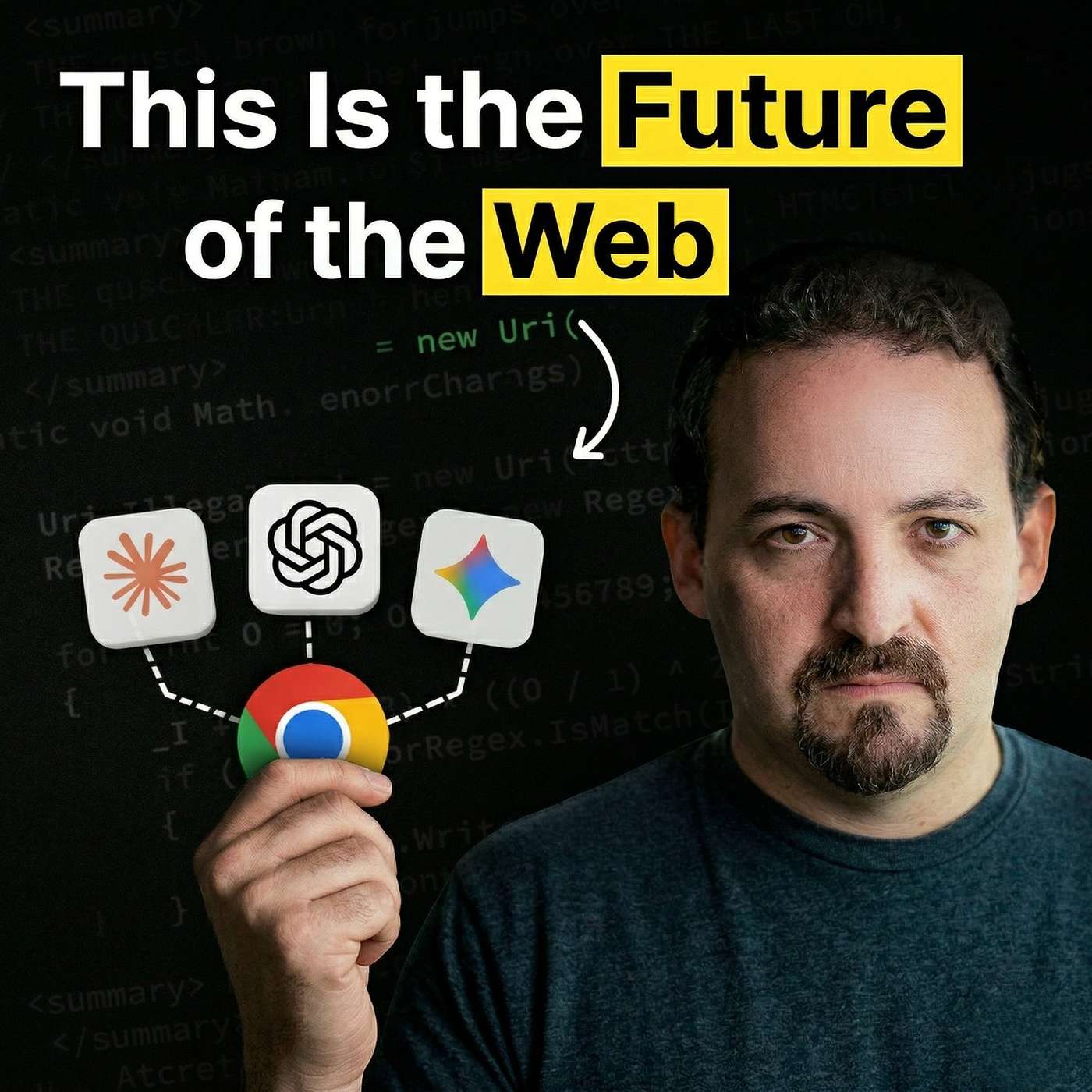
An agent cannot read your website. And that needs to change.
In this episode of AI Native Dev, Guy Podjarny sits down with Maximiliano Firtman, 30-year web developer and author of 14 books, to talk about what building for the web looks like when traffic comes from agents and humans both.
They get into:
Stop Maintaining Your Code. Start Replacing It

"The code that we have is a liability. The system is the asset we're building."
Chad Fowler, VC at Blue Yard Capital and former CTO at Wunderlist, sits down with Guy Podjarny to discuss the Phoenix Architecture: software designed to be replaced rather than maintained.
In this episode:
• why was the code written by Chad never longer than a page
• how he replaced 70% of a codebase in 3 months and cut costs by 75%
• shipping AI code no human ever reviewed, and how to make it safe
• the shadow specs your agents are making w...
We Scanned 3,984 Skills — 1 in 7 Can Hack Your Machine

Most developers install skills without reading what's inside them. But that's exactly what attackers are counting on.
Simon Maple sits down with Brian Vermeer from Snyk at DevNexus to get into the security risk hiding inside the skills and MCPs running on your local machine. They scanned over 4,000 skills and found that 1 in 7 had at least one critical security vulnerability.
Here’s what you need to know:
The Greatest Time to Build a Startup (The AI-Native Advantage)

The best agentic developers throw away their agent's work without guilt, run three agents at once and only use one, and treat their AI like a junior developer they genuinely dislike. It sounds wrong. It works.
Daniel Jones, Head of Product at re:cinq, has upskilled hundreds of developers across Northern Europe's largest enterprises. In this episode he joins Simon Maple to share the counterintuitive habits, hard data, and practical frameworks behind high-performing agentic development teams.
On the docket:
Why Your Agent Needs Memory, Not Just Context

Not onboarding your agent is on you.
Richmond Alake, Director of AI Developer Experience at Oracle, joins Simon Maple to make the case that most agent failures come down to one thing: memory. Not the model, not the infrastructure. Memory.
On the docket:
<...
Cisco Principal Engineer's Fix for AI Code Security

Your AI coding agent learned from millions of lines of code, including insecure ones. That means by default, it can write vulnerable code too.
So how do you fix that?
John Groetzinger, Principal Engineer at Cisco, built CodeGuard, a security skills layer that teaches coding agents how to write and review code securely. He tested it against real scenarios.
The result:
84% success rate vs 47% baseline. Nearly 2× improvement.
In this episode we get into:
Why Context Beats Every Prompt You'll Ever Write

Most teams think agentic dev is about writing better prompts. It's not.
Guy Podjarny and Simon Maple explain why managing context, not crafting prompts, is what separates teams that scale with agents from teams that don't. They walk through a practical framework for building, evaluating, and distributing the context your agents actually need.
In this episode:
• Why agents fail without structured context about your internal platform
• The 3 context layers: policies, platform docs, and application context
• How to build regression evals and torture tests for your agents
• The Context Development Lifecycle (CDLC) - a new...
From IBM Acquisition to AI-Native Observability | Dash0 CEO

"Charts are good for users, not good for agents. Agents look at the underlying data and do deep analysis."
Mirko Novakovic built Instana, sold it to IBM, and now he's building Dash0, rethinking observability for agents, not humans.
In conversation with Guy Podjarny, he explains:
• why OpenTelemetry turned out to be perfect for AI
• how UX changes when agents are your primary users
• why interactive collaboration beats static chat outputs
• the survival question for observability vendors in the AI era
Only 2-3 people in most companies can truly debug producti...
The End of Fragmented Agent Context

One skill took coding success from 28% to 71%. Another made things worse.
Guy Podjarny and Simon Maple tested 1000+ agent skills and reveal which ones actually work, which hurt performance, and why anecdotal evidence isn't enough anymore.
Tessl Skills Registry is the first package manager for agent skills with built-in evaluations, versioning, and lifecycle management. Explore tested skills and see real performance data: https://tessl.io/registry
On the docket:
• Claude roasted Anthropic's own skill with a 27% score ("monolithic wall of text")
• Why some popular skills actually decrease agent performance
• How Tessl is bri...
The Developer Skills That Will Actually Survive AI

“You have to prioritize between the thing you want to do and the thing that actually is driving the business, that’s what really big companies are fighting every single day.”
As former CEO of GitHub and now a startup founder again, Thomas Dohmke brings a rare, inside-out perspective on innovation across both worlds.
In conversation with Guy Podjarny, he explains:
• why startups and incumbents fight in different weight classes
• why humans shouldn’t sit in every feedback loop as agents scale
• the importance of learning as a core skill for future developers
How Too Much Information Destroys Agent Performance

Most AI agents fail because you're using them wrong. Here’s what actually works in production.
In this episode, Simon Maple sits down with Itamar Friedman (CEO of Qodo) and Robert Brennan (CEO of OpenHands) at QCon AI. They pull back the curtain on why agents hallucinate, provide inconsistent answers, and ship low-quality code.
On the docket:
• Why a third of developer-reported AI output is incorrect
• Why you must separate creative coding agents from structured review agents
• How excessive information destroys agent performance
• Parallelizing agents across 1,000+ repositories to resolve CVEs and legacy debt ...
Intelligence ≠ Knowledge: Why Context Beats Bigger Models

In this special milestone episode, Simon Maple and Guy Podjarny celebrate 1 million views by looking back at the chaos of 2025 and forecasting the high-stakes reality of 2026.
On the docket:
• Why appearing on this show has become a leading indicator for getting acquired or raising billions (and whether Simon should start charging a 2% carry).
• The end of prompt engineering and the rise of context as the ultimate competitive advantage.
• Our boldest 2026 predictions, including open models taking enterprise share and AI coding going truly multiplayer.
Whether you're building a solo unicorn or leading an enterp...
What AI Engineering Looks Like at Meta, Coinbase, ServiceTitan and ThoughtWorks

What does it take to make AI work inside engineering teams?
This high-stakes compilation episode with Ian Thomas (Meta), Wesley Reisz (ThoughtWorks), Sepehr Khosravi (Coinbase), and David Stein (ServiceTitan) goes inside the engineering rooms of the world's most sophisticated tech organisations to uncover how they're moving past AI hype into AI-native production.
On the docket:
• How Meta achieved 80% weekly AI adoption through grassroots community building instead of top-down mandates
• Why ThoughtWorks uses the RIPPER-5 framework to structure AI workflows and prevent agents from jumping straight to code
• When Coinbase engineers use Cursor versus...
What Developers Need To Know About Agents Before 2026

2025 changed what it means to be a developer.
And 2026 is about to change even more.
This Tessl episode brings a year-end reflection on how agents reshaped software development and what developers need to unlearn next, featuring Reuven Cohen, Founder of the Agentic Foundation, Maor Shlomo, Founder of Base44, and Maksim Shaposhnikov, Technical Member at Tessl.
On the docket:
• Reuven Cohen on why most agent systems fail and what agentic engineering demands
• Maor Shlomo on where vibe coding works, where it breaks, and how guardrails protect long-term software
• Maksim Shaposhnikov on develo...
Why Faster AI Development Often Increases Rework | Cian Clarke

Vibe coding is only good at creating a sense of progress for devs.
In this episode of AI Native Dev, Cian Clarke, head of AI at Nearform, joins Simon Maple to talk about BMAD, their spec-driven approach that prioritizes clarity before code over prompt first development.
They also get into:
• speed upfront vs. maintainability over time
• why senior engineers gain leverage as junior pathways narrow
• the cultural shift needed to scale AI-generated software beyond solo builders
AI Native Dev, powered by Tessl and our global dev community, is your go-to podcas...
Building an AI Agent in 100 Lines of Code | Yaniv Aknin

Before you add context, understand the context that’s already there.
In this episode, Yaniv Aknin, founding engineer at Tessl, explains the built in instructions that precede every user prompt, and why acknowledging that hidden layer is critical.
On the docket:
• why tool design matters more than raw reasoning ability
• how Codex does more with fewer tools
• how subagents let Claude stay flexible under context pressure
• why generalist models may adapt better to unfamiliar tools
AI Native Dev, powered by Tessl and our global dev community, is your go-to podcast fo...
How New Libraries Saw a 50% Improvement | Maria Gorinova

We’re holding probabilistic systems to deterministic standards.
In this episode of AI Native Dev, Simon Maple talks with Maria Gorinova, Member of Technical Staff at Tessl, about the mismatch between how developers expect software to behave, and how agents actually do.
• how structured context improves abstraction use
• why agent reliability can only be demonstrated through measurement
• how Tessl’s tiles improve reliability without bloating context
AI Native Dev, powered by Tessl and our global dev community, is your go-to podcast for solutions in software development in the age of AI. Tune in as we eng...
Agent Experience Is the New Developer Experience | Sean Roberts

Your codebase already has AI contributors. If they don’t understand it, that’s on you.
In this segment from AI Native DevCon, Sean Roberts, VP of Applied AI at Netlify, explains why agent experience is, in fact, an extension of developer experience.
He also shares:
AI Native Dev, powered by Tessl and our glob...
What Holds Devs Back From Multi-Agent Thinking | Guy Podjarny

LLMs don’t get smarter when you dump everything into context, they get distracted.
At AI-Native DevCon, Guy Podjarny unpacks the evolution of AI augmented development, and how devs can get the most from current tools.
On the docket:
• how to help agents close the capability-reliability gap
• why 'context engineering is basically the same as specs.'
• why statistical measurement is the only meaningful way to judge agent reliability.
• how ‘tiles’ level inconsistent documentation across old and new libraries.
AI Native Dev, powered by Tessl and our global dev community, is...
The Hidden Vulnerabilities Behind AI Code | René Brandel

If software can improve autonomously, why shouldn’t security?
On this episode of AI Native Dev, René Brandel, founder and CEO of Casco, explores how upfront specs enable reliable agent generated software, and how that same discipline drives Casco’s autonomous, continuously improving security.
On the docket:
• how small teams with self-improving agents can outperform large security orgs.
• why vibe coding is ideal for rapid prototyping and live customer iteration.
• what a practical, scalable specification format must solve for in real workflows.
Register now to AI Native DevCon - https://ainativedev...
What Developers Can Build Next With AI

In this compilation, Simon Maple brings together Baruch Sadogursky (TuxCare), Liran Tal (Snyk), Alex Gavrilescu (Greentube), and Josh Long (Broadcom) to break down where AI-assisted development fails, and what teams must do to keep it reliable.
On the docket:
• why spec-compiled tests must come before letting AI generate code
• the uncertainty around what “AI security engineering” actually means today
• how Backlog.md stays minimal so agents can split work autonomously
• how Spring shows AI plugging straight into the business logic companies already run on Spring microservices
Register now to AI Native DevCon
<...
Claude, TypingMind, AMP & MCP Servers: The Future Dev

How do you give an agent the same visibility a human developer has, without giving it full control?
Alan Pope, Senior Developer Advocate at Tessl, explains how Model Context Protocols (MCPs) give AI agents structured access to dev environments, enabling tools like Claude Code and TypingMind to read, build, and execute safely under human oversight.
On the docket:
• how MCPs enable hybrid collaboration, letting agents take controlled actions inside local environments while surfacing every change for review
• the era of “vibe coding” is fading, with developers moving towards intentional, spec-driven prompting for precise results<...
AI Agents Beyond Context Limits | Maksim Shaposhnikov

Bots follow scripts. Assistants wait for your commands. Agents act autonomously.
Maksim Shaposhnikov, AI Research Engineer at Tessl, joins Simon Maple to unpack the capabilities of AI coding agents, including how developers can test and trust the code they generate.
On the docket:
• how sub-agents operate independently, maintaining their own context windows to handle complex tasks without overloading the main agent.
• why human-in-the-loop oversight is still essential, even as agents can autonomously generate prototypes and fix bugs.
• predictions for the next generation of agents, including self-correcting feedback loops and improved code q...
Instant PR Feedback Without leaving GitHub | Merrill Lutsky on Graphite

As AI outpaces human review, latency compounds.
On AI Native Dev, Graphite co-founder and CEO, Merrill Lutsky joins Guy Podjarny to explore how stack aware reviews remove friction and accelerate AI-native development.
They also get into:
• how Graphite’s architecture ensures traceability across AI generated commits
• what engineering velocity means when code quality depends on alignment
• why the next generation of developers will act more like managers of autonomous dev teams than individual contributors
AI Native Dev, powered by Tessl and our global dev community, is your go-to podcast for solution...
AI-First Project Management for Developers | Alex Gavrilescu on Backlog.md

Even the smartest AI agent starts as a blank slate.
Alexandru Gavrilescu, creator of Backlog.md, and Simon Maple explore how to give AI the right context and specifications so it can deliver like a human teammate, and sometimes faster.
On the docket:
• why humans still matter for review, but AI can accelerate work beyond traditional sprints
• the rise of persistent agents that proactively manage tasks and subagents
• preparing for a world of disposable, single-use software and continuous development loops
• why current Agile metrics and bandwidth estimates need a major rethink
