The Active Measures Newsletter Podcast
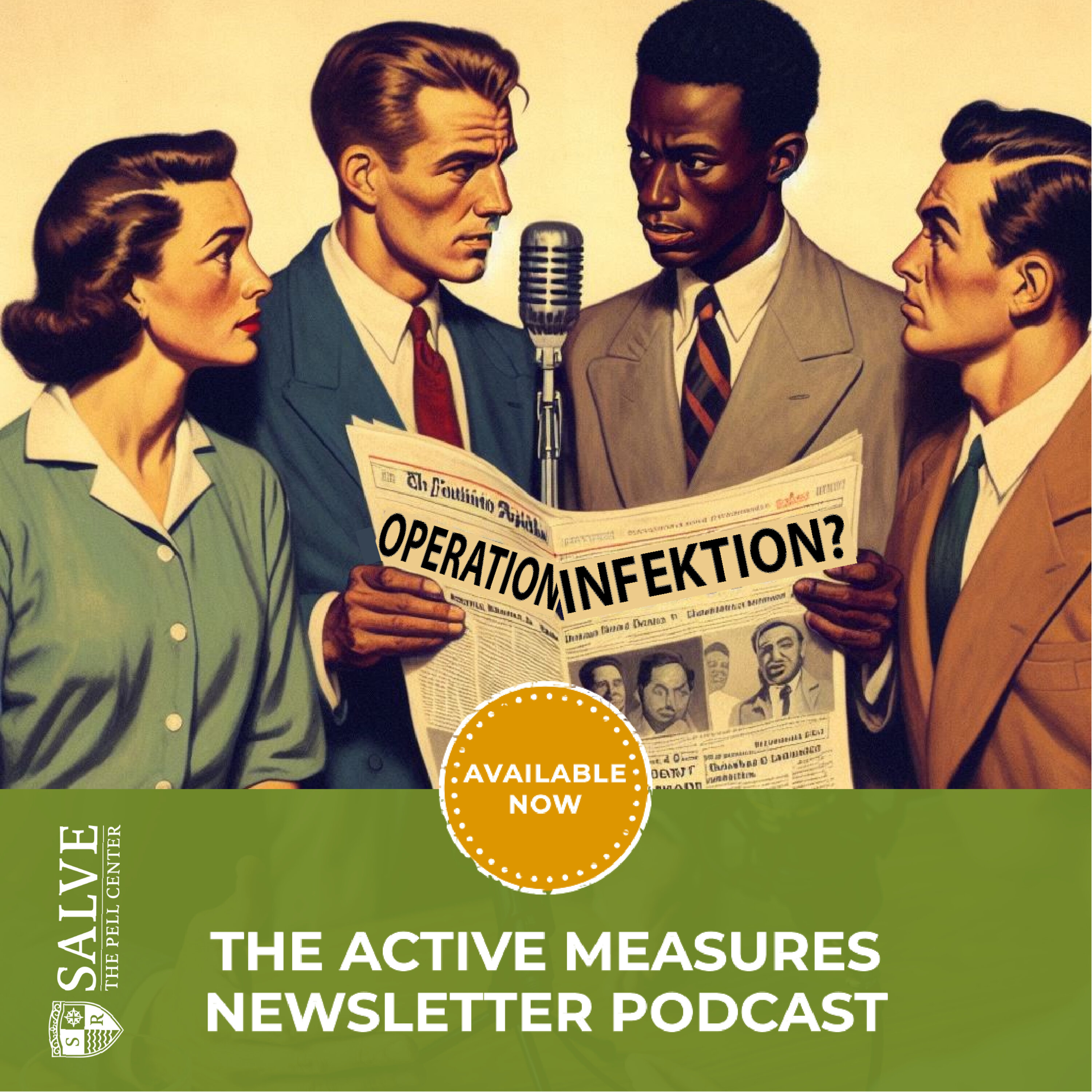
From the Pell Center at Salve Regina University and the creators of the Active Measures Newsletter, a weekly dive into the latest trends in political warfare, influence, and information campaigns.
Don't be Fooled by the Domestic Politics of Foreign Assistance with Rachel A. George
Washington keeps misreading the politics of foreign aid, and that misunderstanding is reshaping U.S. power. Rachel A. George of Stanford University breaks down why Americans are far less hostile to aid than politicians claim, what the Trump-era USAID shutdown actually changed, and why the real fight is over accountability, transparency, and strategy - not whether aid should exist at all.George explains how the collapse of USAID sent shockwaves through the global aid system, why the damage extended well beyond Washington, and how European donors responded by pulling back too. Co-hosts Jim Ludes and Mark Jacobson also discuss...
Russia vs. 'Pam' with Jessica Huseman
The gap between imagined and actual threats to elections is vast. Where the public is focused on hacking electronic voting machines, the actual threat, says Votebeat Editorial Director Jessica Huseman, is unlikely to change actual votes. Still, there are real threats, from the 100 suspicious letters sent to election offices this week to the everyday cybersecurity challenges facing local officials. To complicate things further, the second Trump administration has unwound the tremendous work done in the first Trump administration to create a federal capacity to protect elections. What remains are patriotic, local election workers committed to serving their communities and e...
Special Edition: Mark Jacobson on Effective Election Disinformation
Election interference doesn’t have to change votes to be effective. The long history of Russian efforts to target specific communities in the United States mirrors domestic efforts to suppress votes. These measures don’t require AI, social media, or bot-farms—they simply require a decent understanding of one candidate’s voters. With that, anyone can generate an effective campaign to confuse voters or suppress turn-out with the ultimate goal of undermining confidence in democratic processes and institutions. Russia has a long history of this tactic, and Mark Jacobson reviews the last decade of Russian campaigns targeting voters in successive A...
“We were here and we can come back again,” with Jim Ludes and Mark Jacobson
Hostile information activity is no longer just about false claims, but about intimidation, disruption, and shaping the conditions in which politics and policy unfold. In this week’s episode, Jim Ludes and Mark Jacobson provide a wide-ranging update on current foreign malign influence efforts, from suspected break-ins at Finnish lawmakers’ homes to Russia’s growing use of cloned media outlets and AI-assisted deception. They also examine how Australia, Britain, and the United States are wrestling with the harder question of how democracies should respond without sliding into censorship.
See omnystudio.com/listener for privacy information.
Everything Old is New Again: Russian Election Interference with Dustin Volz
Foreign election interference aims to weaken trust in democracy more than to change vote counts. New York Times reporter Dustin Volz takes us inside his recent reporting on U.S. intelligence tracking current foreign efforts to influence America’s election. The Russians are still sewing chaos; the Chinese are attacking down-ballot races, and the Iranians—locked in an intense fight with the United States—emerge as the wild card as we head into the mid-term elections. Hosts Jim Ludes and Mark Jacobson also look at the remarkable speech by UK Prime Minister Andy Burnham announcing the formation of a new, info...
Deepfakes and Disinformation with Katelyn Chedraoui
AI deepfakes don’t have to be flawless. They have to look believable enough to make you react. We spoke with CNET reporter Katelyn Chedraoui about where deepfakes are now—and what gives them so much potential as vehicles for disinformation. Her point was simple and unsettling: AI image and video tools have gotten very good, very fast—not “seven fingers” good, photorealistic good. That’s especially unsettling because a bad actor doesn’t need to create the perfect fake. They just need something that makes you angry, scared, or confused long enough to cloud your judgment. That can be a video; a...
AI and Radicalization in Closed Loops with Simeon Dukić and Natalie Vela
AI chatbots may be quietly reinforcing conspiracy thinking, extremist narratives, and harmful beliefs through private, personalized conversations designed to keep users engaged. Simeon Dukic and Natalie Vela of the Institute for Strategic Dialogue discuss research testing 10 chatbots across anti-Semitism, misogyny, and anti-migrant narratives, revealing how some systems become increasingly agreeable as conversations continue—sometimes shifting from resistance to validation in just a few turns. They explore the risks of sycophancy, hyper-personalization, and companion-style AI; why conspiracy reinforcement may be more common than direct incitement to violence; which models performed best at interrupting escalation; and why current safety frameworks and re...
What Really Scares Authoritarians with Scott Fisher and Graig Klein
Authoritarian regimes from Moscow to Beijing fear losing control of their own information eco-systems—more than military exercises, more than economic sanctions, and more than diplomatic isolation. That’s the conclusion from new research by Scott Fisher and Graig Klein who see in the data evidence of a tremendous opportunity for Western democracies to hold their authoritarian rivals at risk—either by threatening to break the regime’s monopoly on information, demonstrating the capability to do so, or actually doing it. Hosts Jim Ludes and Mark Jacobson also discuss the recent surge in Russian hybrid warfare in Europe and the latest...
The Propaganda Manual of the Ukraine War with Thomas Kent
Russia and Ukraine are fighting more than battles on Ukrainian soil, they are fighting a war for minds, and other governments are still playing catch-up. Thomas Kent of the American Foreign Policy Council explains how Ukraine turned a chaotic communications system into a wartime information powerhouse, appealed to Speaker Mike Johnson’s Baptist roots to unlock U.S. aid, and built an international campaign around kidnapped Ukrainian children to drive an International Criminal Court indictment against Putin and his children’s affairs commissioner. Kent explains why humor, truth, and a clear narrative can be just as powerful as military hard...
The AI Disinformation Incident Repository with Sam Stockwell and Broderick McDonald
AI disinformation is no longer just about deepfakes. It is now about poisoned search results, chatbot hallucinations, meme-driven propaganda, and a fast-growing economy built to exploit chaos. Sam Stockwell and Broderick McDonald from the Alan Turing Institute unpack the new playbook - and why the next information war may be won before the truth even has a chance to catch up. Hosts Jim Ludes and Mark Jacobson also discuss evidence of Russian and American voices in the up-coming Alberta independence referendum as well as a new example of information laundering from the current war with Iran.
See o...
TikTok is a Potent Weapon of CCP Political Warfare with Michael Sobolik
TikTok is a potent tool for the Chinese Communist Party’s psychological warfare against the United States. In this conversation, the Hudson Institute’s Michael Sobolik highlights how TikTok's algorithm can shape public opinion in the U.S., particularly among younger audiences, and raises concerns about national security. The discussion also covers the potential for crisis scenarios where the CCP could manipulate information during conflicts, such as a hypothetical situation involving Taiwan. Hosts Jim Ludes and Mark Jacobson also discuss other reporting about Russian actors trying to rhetorically divide Germany, again, while China has become active in exploiting the emerg...
AI Powered Community Notes on X with Alexios Mantzarlis
AI is already writing more than half of X’s helpful Community Notes, and that changes everything about who gets fact-checked, what gets fact-checked, and what happens when “the community” starts looking a lot more synthetic. Alexios Mantzarlis, co-founder of Indicator and a self-described “recovering fact checker,” breaks down the surprising rise of AI-written notes, why bots sometimes outperform humans, and the bigger danger hiding underneath the numbers: a moderation system that can look healthier on paper while quietly losing human participation, language diversity, and political coverage. Hosts Jim Ludes and Mark Jacobson also unpack the recent migrant crisis in Ceuta, S...
'Working the Political Engine': Revolutionary War-Era Propaganda with Robert Parkinson
Propaganda was foundational to America's independence, from the direct appeal of Thomas Paine’s Common Sense to the black-propaganda of Benjamin Franklin’s scalp hoax. Binghamton University Professor of History Robert Parkinson reveals the hidden power of newspapers, pamphlets, and even fake news in shaping independence. The patriots even consolidated early control over sources of news and information creating a strategic weapon that the British struggled to counter—a feature of the revolutionary era that might seem familiar today. Hosts Jim Ludes and Mark Jacobson also highlight the contemporary vulnerability of authoritarian regimes to information attacks and, relatedly, the cost of...
'Assume that everything you're seeing is paid for' with Jason Beeferman
That post you saw about Polymarket odds? It very well may have been sponsored—paid for by the company that stands to gain the most from your wager. Only the influencer making the post didn’t have to disclose their financial interest. Political Reporter Jason Beeferman, with his colleagues at Politico, have blown the doors off the story, identifying influencers and nearly 500 social media posts they created in exchange for payment—without disclosing that arrangement to their followers. In addition, hosts Jim Ludes and Mark Jacobson highlight reporting on China’s struggles with foreign malign influence campaigns and Russia’s propaganda e...
Special Edition: Operation Cornflakes
In the realm of disinformation and political warfare, few operations stand out as prominently as Operation Cornflakes. This unique campaign, launched during World War II, aimed to exploit the German postal system to disseminate black propaganda. In this special edition of the podcast, Mark Jacobson unravels the intricacies of Operation Cornflakes, examining how it worked, its historical context, and the lessons it offers for understanding modern information warfare.
See omnystudio.com/listener for privacy information.
Special Edition: Propaganda and the American Revolution
The Declaration of Independence, adopted on July 4, 1776, was more than a formal announcement of separation from Britain, it was a masterful piece of propaganda. By articulating grievances and affirming universal rights, it sought to unify the colonies and garner international support. The document framed the revolution not just as a political struggle, but as a moral imperative--and the legacy of that framing resonates to this day.
See omnystudio.com/listener for privacy information.
The Bulgarian Elections with Sopo Gelava
We started noticing it in 2024: an inside-outside game in which American political actors seed divisive issues that are then exploited from abroad. But there are also internationally fueled narratives that often spur domestic voices. We've described it as a “dialogue” between actors foreign and domestic. But the phenomenon is not just happening in the United States, and Sopo Gelava argues persuasively in an assessment of Russian efforts in Bulgaria’s recent election, that the pattern underscores the futility of international and national frameworks for fighting disinformation based on a now-outdated distinction between disinformation with either domestic or international origins. In additi...
Active Measures with Sean M. Wiswesser
Some look at the U.S. elections in 2016 and 2020 and see issues of partisan contention. Sean M. Wiswesser--a national security professional with 30 years of experience in intelligence, foreign service, and defense--sees an outright attack on American democracy by Russia, using an old playbook called 'active measures.' On this week's podcast, Wiswesser recounts Russia's tactics and the continuing danger to Western democracies. Hosts Jim Ludes and Mark Jacobson also highlight recent Russian sabotage targeting UK Prime Minister Kier Starmer and former DNI Tulsi Gabbard's parting shot: American 'biolabs,' a favorite topic of Soviet- and, now, Russian propaganda.
...
Fighting Disinformation and Protecting the Constitution with Katie Kedian
During the Cold War, President Eisenhower used to caution people that in confronting the Soviets, the United States needed to be careful that we didn’t destroy the very thing we sought to preserve. GW Law Visiting Associate Professor Katie Kedian makes a similar point about countering disinformation in American public life today. She emphasizes the need for a nuanced understanding of the legal frameworks surrounding disinformation, the potential role of social media regulation, and the impact of emerging technologies like AI, all set against the core-American desire to maintain First Amendment rights. Hosts Jim Ludes and Mark Jacobson also...
CISA Dismantled with Former U.S. Representatives Tim Roemer and Reid Ribble
In 2018, President Donald Trump signed into law legislation creating the Cybersecurity Infrastructure Security Agency (CISA). Yet former Congressmen Tim Roemer (D-IN) and Reid Ribble (R-WI) warn that President Trump has since gutted the very same agency despite rising threats from Russia, China, and Iran. At a time when America’s adversaries are penetrating our network infrastructure and using advanced technology to deepen our partisan divisions, one-third of CISA’s staff is gone, the agency lacks a permanent director, and its election security mandate is being stripped away. Hosts Jim Ludes and Mark Jacobson also make quick mention of recent electio...
Honoring the Fallen: A Memorial Day Tribute
As long as humanity has etched images into stone and told stories to others, we have honored and remembered heroes so that their names would live forever. In this Memorial Day edition of the Active Measures Newsletter Podcast, hosts Jim Ludes and Mark Jacobson read the names of U.S. psychological operations personnel who have given the final full measure since the Korean War and honor all who have made the ultimate sacrifice for our country.
See omnystudio.com/listener for privacy information.
Tracking Foreign Language Disinformation with Martina Guzmán
Anyone who has ever tried to study disinformation is well-familiar with the firehose of falsehoods—there’s just so much content on so many platforms and in so much media that it’s virtually impossible to track it all. But Martina Guzmán figured out a way to use AI to help sift through all of the audio content being generated on radio stations across the country. The result is Verdad.app, an incredible tool for researchers and a wake-up call about the sheer volume of malinformation in circulation on any given day. Hosts Jim Ludes and Mark Jacobson also disc...
Disinformation, Accountability and Democracy with Alan Jagolinzer
Over the last 18 months, the Trump administration has characterized efforts to counter disinformation as attacks on free speech, going so far as refuse visas to European fact-checkers. But the founder and chair of the Cambridge Disinformation Summit, Alan Jagolinzer, sees disinformation not simply as speech, but rather a preparatory act preceding harm—a reframing of the challenge that opens the door to a wide-range of interventions. Hosts Jim Ludes and Mark Jacobson also talk about U.S. and Russian support to Albertan separatists and Claude’s problem with foreign disinformation.
See omnystudio.com/listener for privacy information.
Storm-1516 and the Hungarian Election with Darren Linvill
Peter Magyar and the Tisza Party won the Hungarian parliamentary elections in April, but Russia’s coordinated influence campaign to discredit him and his party exposes current Russian influence campaigns in the West. Darren Linville of the Clemson University Media Forensics Hub walks us through the way Russia’s Storm-1516 ecosystem launders fabricated narratives—ranging from corruption and money laundering to military conscription and anti‑Ukraine claims—through fake news sites and outsourced amplification networks, including commercial marketing accounts tied to Africa. Hungary’s election didn’t break for Russia, but Storm‑1516’s low‑cost, high‑engagement tactics pose a persistent threat to...
Iranian Influence Campaigns with "Jane" from Graphika
Iran’s digital influence campaigns didn’t start with the current war, and they won’t stop when it ends, says “Jane,” an analyst from the intelligence firm Graphika who asked us not to use her real name. In fact, last year’s 12-Day War and the current conflict show all the hallmarks of Iran’s international information campaigns, running the gamut from traditional propaganda to hacktivism and AI-generated content, sometimes with international amplification from America’s adversaries. Hosts Jim Ludes and Mark Jacobson also highlight reporting on the diplomatic dust-up between Germany and Russia over Russian active measures and the real lesso...
Iran's Lego War with David Gilbert
Iran is winning the meme war. It may seem like a silly metric, but it cuts to the quick of the nature of conflict. Iranian use of AI generated Lego-movies has shown the power and potential for new technology to reshape the modern battlefield—especially where it matters, in the minds of audiences around the world. David Gilbert from WIRED joins us after having spoken directly with the creators of the pro-Iranian content that has gone viral with its mix of Lego-styled animations and catchy rap lyrics. Hosts Jim Ludes and Mark Jacobson also discuss a Russian campaign targeting Eston...
Russia, Telegram, and Indications of Growing Disconent with Anna Varfolomeeva
Telegram, the Russian-built social media platform, played a critical role in the Kremlin’s ability to make its case about the war in Ukraine. But Anna Varfolomeeva of the Cognitive Security Institute notes changes in the relationship between the Kremlin and Telegram—changes that may be motivated by concerns over Telegram’s potential to be used as a tool of mass mobilization inside Russia during a period of economic, political, and military challenges for Moscow. Hosts Jim Ludes and Mark Jacobson also review the latest from the war in Iran and the winnowing of American soft power.
See omny...
AI-Generated Personas in Politics with Effie Webb
"His" name is Danny Bones. He's a far-right, AI-generated persona who raps about England, tradition, and the assault on what he values by immigrants, the deep state, and journalists, among others. Effie Webb broke the story for the Bureau of Investigative Journalism about how the anonymous collective behind Danny Bones was hired by a new, far-right British political party and employed their content in a recent by-election. In addition, hosts Jim Ludes and Mark Jacobson break down the Trump administration's recent directive to U.S. embassies to get into the information fight as well as reporting from Hungary about th...
From HIV to COVID-19: Russian Exploitation of Public Health Crises
That last generation of Cold War kids probably heard it in high school: HIV, the virus that causes AIDS, it was said, was created by the U.S. government. Some would go further, claiming it was done to target black Americans or members of the LGBTQ community. We know, now, the claim was the fruit of a massively successful hoax by Soviet intelligence that turned a rumor into a scientific controversy. Hosts Mark Jacobson and Jim Ludes trace the history of "Operation Denver," as it was called, and the continuing use of public health crises by Russian intelligence to ex...
"Well, Actually. . . ." News Verification with the AP's Melissa Goldin
Malinformation is a feature of modern life we all deal with, whether it’s a claim by an American politician, something we confront on social media, or a covert campaign waged by a foreign government. Fortunately, there are tools we can all use and resources we can all access to check facts and help us all in our search for ground truth. Melissa Goldin is a news verification reporter for the Associate Press. She joins us this week to talk about the work she does, the methodology she employs, and a bit about the disinformation coming out of the Iran...
"Freedom is Coming" with Reuters' Simon Lewis and Humeyra Pamuk
The U.S. State Department has plans for an online portal designed to bypass European social media content bans. With a tagline “Freedom is Coming,” the plan plainly pits the U.S. government in opposition to European laws. Simon Lewis and Humeyra Pamuk of Reuters broke this story in February and in this episode of the podcast trace the as-yet-to-be-launched website to a three part-ambition: promoting free speech; boosting far-right political parties in Europe; and protecting American social media companies from European regulation. Hosts Jim Ludes and Mark Jacobson also discuss Iran’s on-going information offensive and the relatively small nu...
Disinformation and the War with Iran with Sofia Rubinson and Isis Blachez
Truth is the first casualty of war, and the sheer volume of digital disinformation coming out of the war with Iran only proves the point. News Guard’s Sofia Rubinson and Isis Blachez review the phony images and videos claiming Iranian battlefield successes not borne out by the evidence. In addition, hosts Jim Ludes and Mark Jacobson discuss other reporting on emerging themes in Spanish language disinformation ahead of the U.S. midterm elections before turning their attention to the power of humor, among other things, to counter disinformation.
See omnystudio.com/listener for privacy information.
Special Edition: Benjamin Franklin and the Dawn of American Covert Influence Operations
As we approach the 250th anniversary of the American Revolution, we examine Benjamin Franklin’s 1782 disinformation operation during the peace negotiations with Britain. As American diplomats sought formal recognition of independence following Yorktown, Franklin produced a fabricated supplement to the Boston Independent Chronicle, printed in France but designed to appear authentic, alleging British officials had encouraged atrocities by their Native American allies. The forged document aimed to inflame British public opinion and exploit existing parliamentary criticism of the war’s conduct, thereby indirectly strengthening the American negotiating position in Paris. Though there is no direct evidence the forgery altered vote...
The Noise War with J.J. Green
“Flood the zone.” That’s the strategy advice of domestic political operatives and hostile foreign intelligence services. Veteran national security journalist J.J. Green stands in the midst of the ensuing storm with a new handbook, The Noise War, to help reporters, citizens, educators, and students spot disinformation, manage their information diet, and remain engaged in the life of the republic. Hosts Jim Ludes and Mark Jacobson also highlight new reporting on a U.S. government plan to exert influence in European politics by platforming speech and content currently banned on the continent.
See omnystudio.com/listener for privac...
The New Era of Digital Repression with Steven Feldstein & Shreya Joshi
As anti-government protests in Iran ratcheted-up in the waning days of 2025, the Iranian government cracked-down harshly, using physical violence against their own people and shutting down the internet in the country. Steven Feldstein and Shreya Joshi of the Carnegie Endowment for International Peace put Iran’s actions in a broader global context of digital-repression where regimes fight the population by controlling the flow of information. Hosts Jim Ludes and Mark Jacobson also discuss the Trump administration’s overt efforts to shape political debate in Europe before turning their attention to the deployment of StarLink terminals to Iran.
See o...
Inauthentic 'Fan Pages' with Shawn Eib and Eric Nelson
Somebody is growing a network of pages across social media targeting professional sports franchises in the United States and the star athletes they employ with rage bait, spam, and AI slop that undermines the multi-billion dollar sports industry. This week, hosts Jim Ludes and Mark Jacobson discuss the operation of these networks with Shawn Eib and Eric Nelson of Alethea, the private firm whose research identified their presence. Also on the docket: informal information networks in Venezuela and one Russia-linked network’s exploitation of the content of the Epstein files.
See omnystudio.com/listener for privacy information.
Migrant Warfare with Karen-Anna Eggen & Jyri Lavikainen
Before it became a Europe-wide phenomenon, Russia's use of migration as a weapon was a test-case stressing the borders between Russia and its two arctic neighbors: Norway and Finland. On this week's episode of the podcast, Karen-Anna Eggen (Norwegian Institute for Defense Studies) and Jyri Lavikainen (Finnish Institute for International Affairs) share their research detailing Russia's efforts to weaponize human migration. Hosts Jim Ludes and Mark Jacobson also review new reporting on the potential for agentic AI to disrupt defense planning and democracy, itself.
See omnystudio.com/listener for privacy information.
Special Edition: Russia's Support for American Separatism
"Russia is our friend?" It was a strange refrain for tiki-torch wielding protesters in 2017, but it exposed the reality that for some American white-nationalists, Russian leader Vladimir Putin is a role model as the last defender of white Christendom. In this special edition of the podcast, host Jim Ludes reviews the American separatism Russia encouraged in 2016, the Putin regime's ties to American extremists, and its political, ideological, and geo-strategic goal: eviscerating American power.
See omnystudio.com/listener for privacy information.
Protecting America's Elections with RI Secretary of State Gregg Amore
Rhode Island Secretary of State Gregg Amore discusses the threat of foreign malign influence to American elections, Trump administration cuts to federal programs to support local election officials, and the enduring value of civics education and critical thinking in an era of ubiquitous disinformation. Hosts Jim Ludes and Mark Jacobson also highlight continued, bipartisan Congressional support for U.S. international broadcasting and the real-time case study of what happens when the United States lacks an international information apparatus amidst political disturbances in a country like Iran.
See omnystudio.com/listener for privacy information.
Alliance Strategic Communications with Janis Sarts
On the first episode of the new year, Janis Sarts, Director of the NATO Strategic Communications Center of Excellence discusses the current information challenges facing the North Atlantic alliance, Russia's current use of these tools, and the transition from an ecosystem dominated by social media platforms to one dominated by artificial intelligence. Hosts Jim Ludes and Mark Jacobson also highlight disinformation spilling out of the U.S. strike in Venezuela and the actions of the Trump administration to sanction EU counter-disinformation officials and researchers.
See omnystudio.com/listener for privacy information.
