The Misfit Behaviorists - Practical Strategies for Special Education and ABA Professionals

Are you a teacher looking for support with students with diverse needs or behavior management in the classroom? Tune into The Misfit Behaviorists podcast, hosted by Caitlin Beltran and Audra Jensen, BCBAs and special education teachers, as they bring you actionable tips to behavior reduction and skill acquisition. Listen to evidence-based strategies with a student-centered focus as they share practical advice for special education teachers, behavior support teachers, BCBAs, and ABA professionals. Whether you're seeking advice or just want to laugh, new to the field or a veteran looking for a fresh perspective, tune in for this unique blend of p...
Para Training in a Pinch #8: Collecting High-Quality Data

Get the Month 2 Para Training Workbook: https://abainschool.com/month2
Good data starts with one deceptively simple question: Does everyone know exactly what counts?
In Week 8 of Para Training in a Pinch, we’re building on the data basics from last week and focusing on how to make data more accurate, objective, and useful for the whole team.
We’ll cover how to:
✔️ Write and use clear operational definitions
✔️ Describe behavior objectively
✔️ Separate observations from opinions
Para Training in a Pinch #7: Data Collection Basics

Get the Month 2 Para Training Workbook: https://abainschool.com/month2
Data collection can sound intimidating, but most of the time we’re really trying to answer one simple question: What happened?
In Week 7 of Para Training in a Pinch, we’re breaking down the basics of special education data collection and the common ways paraprofessionals may be asked to measure student skills and behavior.
We don’t collect data just to fill out paperwork. We collect it because students deserve decisions based on evidence instead of gue...
Para Training in a Pinch #6: Reading the IEP

Get the Month 2 Para Training Workbook: https://abainschool.com/month2
IEPs can be 40, 50, even 60 pages long. The good news? As a paraprofessional, you don’t need to memorize the whole thing.
In Week 6 of Para Training in a Pinch, we’re breaking down the IEP and focusing on the information paras actually need to support students successfully throughout the school day. Think of the IEP as the team’s playbook. You don’t need every play. You need to know the ones for your position.
We’ll...
Para Training in a Pinch #5: Preventing Burnout

Get the Month 2 Para Training Workbook: https://abainschool.com/month2
Special education can be incredibly rewarding, but some days can also drain your battery before lunch. 🔋
In Week 5 of Para Training in a Pinch, we’re focusing on the adults in the classroom. Because when you’re overwhelmed, frustrated, or running on empty, it becomes much harder to be the calm and supportive person your students need.
We’ll cover how to:
✔️ Recognize your own stress early
✔️ Use quick reset s...
Para Training in a Pinch #4: Positive Classroom Interactions

Get the Month 1 Para Training Workbook: https://abainschool.com/month1
Before prompting, data collection, or behavior plans, there’s something even more foundational: the relationship you build with your students.
In Week 4 of Para Training in a Pinch, we’re talking about connection, pairing, reinforcement, and how strong relationships can make learning more effective. We’ll also look at how a little flexibility can help prevent unnecessary power struggles.
We’ll cover how to:
✔️ Build rapport through pairing
✔️ Find what actually
Para Training in a Pinch #3: Classroom Systems & Routines

Get the Month 1 Para Training Workbook: https://abainschool.com/month1
Strong classroom routines aren’t about making everything rigid and predictable forever. They’re about creating enough structure and consistency that students feel secure, know what’s coming next, and can become more independent.
In Week 3 of Para Training in a Pinch, we’re talking about classroom systems, routines, and visual supports, plus the important role paraprofessionals play in keeping those systems consistent.
We’ll cover how to:
✔️ Follow classroom ro...
Para Training in a Pinch #2: Understanding Our Students

Get the Month 1 Para Training Workbook: https://abainschool.com/month1
A disability label can give us useful information, but it doesn’t tell us who a student is.
In Week 2 of Para Training in a Pinch, we’re talking about understanding the individual students behind the labels. Every learner brings different strengths, interests, communication styles, experiences, and support needs to the classroom.
We’ll cover how to:
✔️ Presume competence
✔️ Look beyond disability labels
✔️ Recognize individual strengths and lear...
Para Training in a Pinch #1: Welcome to Special Education

Get the Month 1 Para Training Workbook: https://abainschool.com/month1
Welcome to Para Training in a Pinch, a quick weekly training series for special education paraprofessionals!
In Week 1, we’re starting with the foundation: professionalism and understanding your role as a para.
Being a great paraprofessional isn’t about knowing everything on day one. It’s about being someone your students and team can count on. We’re talking about knowing your role, communicating with your team, being open to feedback, protecting student confiden...
Why Students Behave Differently with Different Teachers (ABA without the Jargon)

Have you ever heard someone say, "They never do that for me!" or "She behaves completely differently in my class."?
In this episode, Caitlin breaks down one of the most important (and misunderstood) concepts in Applied Behavior Analysis: stimulus control. Learn why students often behave differently with different teachers, classrooms, and situations, and why those differences are a clue to understanding behavior, not a competition between educators.
Whether you're a special education teacher, BCBA, paraprofessional, or general education teacher, this episode will help you look beyond the behavior and start asking better questions.
🎙️ Key T...
FBA vs. BIP Explained: What's the Difference? (ABA terms explained)

What exactly is the difference between an FBA (Functional Behavior Assessment) and a BIP (Behavior Intervention Plan)?
These two terms are often used together, but they serve very different purposes. In this episode of ABA Without the Jargon, we explain how an FBA helps identify why a behavior is happening and how a BIP outlines what to do about it.
Using a simple car repair analogy and real classroom examples, you'll learn why understanding the function of behavior is the key to creating effective behavior support.
🎯 Key Takeaways
✔️ An FBA (Functional Behavior Assessm...
Motivating Operations Explained (EO vs. AO Made Simple)

Have you ever had a student suddenly stop working for a favorite reward? Or wondered why a reinforcer works one day but not the next?
The answer may not be the reinforcer at all. It could be a motivating operation (MO).
In this episode of ABA Without the Jargon, we explain motivating operations using everyday examples like cookies after Thanksgiving dinner, Skittles at your desk, and why water tastes so much better after a hot day outside.
By the end of the episode, you'll understand why motivation changes, how it affects behavior, and...
Positive vs. Negative Reinforcement and Punishment Explained (ABA Without the Jargon)

Positive reinforcement. Negative reinforcement. Positive punishment. Negative punishment.
These four ABA terms are some of the most misunderstood concepts in behavior analysis, but they're much simpler than they sound.
In this episode of ABA Without the Jargon, we're breaking down each term using everyday language, real classroom examples, and a few personal stories (including Skittles, chickens, and Bruno the dog 🐶).
By the end of the episode, you'll have an easy way to remember the differences and confidently explain them to someone else.
🎯 Key Takeaways
✔️ Positive means something is added, not "good."
ABCs of Behavior Explained: Antecedent, Behavior, and Consequence in Plain English

Welcome back to ABA Without the Jargon, the mini-series where we take common ABA and special education terms and translate them into everyday language.
In this episode, we're breaking down one of the most important concepts in behavior analysis: the ABCs of Behavior.
We'll explain:
✔️ What an antecedent really is
✔️ What counts as behavior (and what doesn't)
✔️ Why consequences are more than punishments
✔️ How the ABCs help us understand patterns in behavior
✔️ Why understanding behavior leads to better support
Whether you're a teacher, paraeducator, RBT, BCBA, parent, or caregiver, this epis...
What Is ABA? Applied Behavior Analysis Explained in Plain English
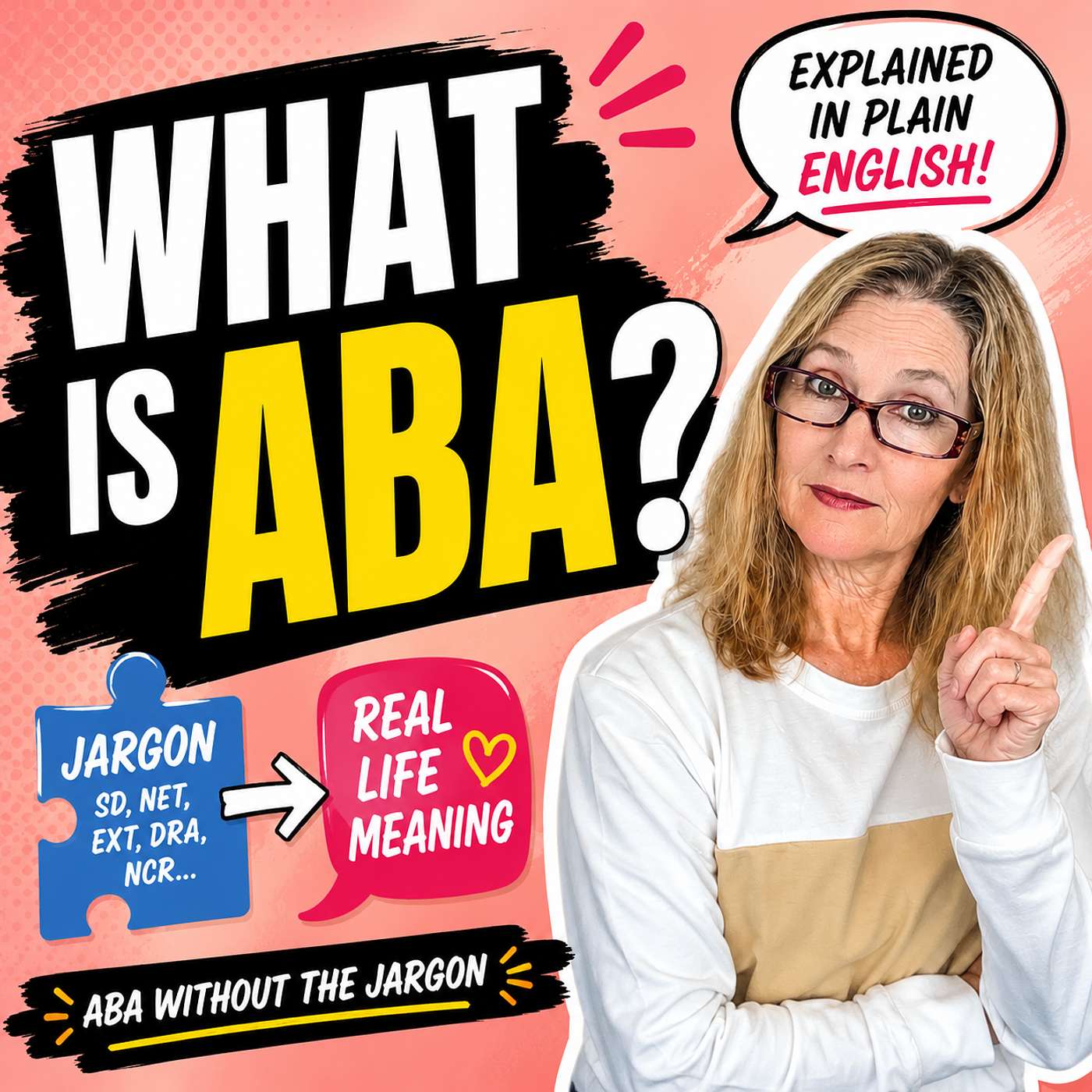
Welcome to the first episode of ABA Without the Jargon, a new mini-series from The Misfit Behaviorists where we take common ABA and special education terms and translate them into everyday language.
In this episode, we're tackling the biggest term of all: ABA (Applied Behavior Analysis).
We'll break down:
✔️ What "Applied" really means
✔️ What counts as behavior
✔️ Why analysis is simply figuring out what's working and why
✔️ Common misconceptions about ABA
✔️ How teachers, therapists, and parents already use ABA strategies every day
Whether you're a special education teacher, paraeducator, RBT, B...
Misfit Minute 29: That Time I Learned About Literal Language and the “Down” Internet

A quick story from an ABA clinic about a student checking the floor to see if the “down” internet had literally fallen down. This Misfit Minute is a reminder that language is not always interpreted the way we expect, especially for students who process communication very literally.
Key Takeaways
• Literal language can create confusion—Common phrases may not mean what we think they mean to every learner
• Everyday expressions are learned skills—Sarcasm, metaphors, and slang often need direct teaching
• Clarity matters—Sometimes clearer language reduces frustration and misunderstandings
• “Extra support” may just be clearer communicati...
Misfit Minute 28: You Can’t Punish a Skill Deficit Away (ABA & Special Education)

A quick reminder that behavior problems are not always “won’t do” problems. Sometimes they’re “can’t do yet” problems. In this Misfit Minute, Caitlin breaks down why consequences alone don’t teach skills like waiting, emotional regulation, frustration tolerance, or communication, and why practicing coping skills during calm moments matters so much.
Key Takeaways
• You can’t punish a skill deficit away—Consequences alone don’t teach missing skills
• Behavior often communicates missing abilities—Difficulty waiting, coping, or communicating may be skill deficits
• Replacement behaviors must be taught—Students need to learn what to do instead
• Practic...
Misfit Minute 27: That Time I Learned About... Sensory Overload in Autism (A Simple Moment That Changed Everything)

A quick story from early in my autism journey that completely shifted how I understand sensory overload. One small moment in a speech therapy room turned into a lifelong reminder: we may be in the same space, but experiencing it in very different ways.
Key Takeaways
• Sensory overload isn’t always visible—A child may be overwhelmed even when the environment feels “normal” to us
• Not all brains filter the same way—Some learners hear, see, and feel everything at once
• Small details can be big triggers—Sounds you don’t notice (like a ticking clock) can be i...
Misfit Minute 26: The Runaway Puppy Lesson for When Behavior Plans Don’t Work (ABA Strategies)

What happens when your well-planned behavior strategy falls apart in real life?
This quick episode uses a runaway puppy story to break down what to do in the moment—especially when safety, attention-seeking behavior, and real-world variables take over.
Key Takeaways
• Safety comes first
• Behavior plans aren’t one-size-fits-all
• Change the environment before blaming the learner
• Stay neutral, not emotional
• Calm, predictable responses matter
• Reflect after, not during
Resources
• See these Functions of Behavior social stories for some ideas! https://abainschool.com/fxbxstories
• If you need all the dox you need to crea...
Misfit Minute 25: Paraprofessional Not Keeping Up? Coaching & Support Strategies for ABA Classrooms

What do you do when a paraprofessional just can’t keep up with the pace, data, or demands of your classroom?
Before jumping to frustration, this Misfit Minute walks you through a practical, compassionate approach to coaching staff, improving systems, and making data-based decisions that keep your students first.
🔑 Key Takeaways
• Check the system, not just the person
• Define what “keeping up” actually means
• Simplify and prioritize tasks
• Model + narrate your thinking
• Practice together + give immediate feedback
• Reinforce effort and growth
• Reflect on fit using data, not emotion
• Document support an...
Misfit Minute 24: 5 Things I Wish I Knew as a New Special Education Teacher

In this Misfit Minute, Audra shares five career lessons she wishes she’d learned earlier as an educator: don’t overplan—use one strong activity with built-in extensions instead of many activities that won’t work; don’t skip data collection because “I’ll remember later” leads to missing or skewed data—quick tallies beat perfect data never recorded; don’t try to do everything alone—treat paras, therapists, and gen ed teachers as true collaborators; protect breaks and boundaries early to prevent burnout by leaning on staff and requesting admin support when needed; and prioritize connection over compliance, since connection creat...
Ep. 76: How to Talk to Parents When Behavior Isn’t Improving (Data-Driven IEP Conversations)
In this episode, Audra and Caitlin tackle one of the hardest parts of working in special education and behavior support: talking with families when things are not improving yet. When behaviors are escalating or strategies aren’t working, those meetings can feel tense for everyone in the room. The conversation explores how educators and BCBAs can stay transparent, rely on objective data, and keep relationships strong with families even when the news is difficult. Instead of panic, blame, or sugarcoating, the focus is on collaboration, trust, and problem-solving together.
🔑 Key Takeaways
• Tip 1: Start with transparency — Families usually k...
Misfit Minute 23: Quick Tips on How to Run Small Group & Dyad Instruction in ABA Classrooms
Running small groups in an ABA classroom can feel like juggling flaming data sheets. Two learners. Two programs. Two sets of behaviors. In this Misfit Minute, Caitlin shares four practical tips for running dyads and small group instruction without sacrificing instructional quality.
🔑 Key Takeaways
• Prep for success — have materials, reinforcers, pencils, and data sheets ready before you start. Less scrambling, more teaching.
• Plan the rotation — decide who gets your attention first and what the other learner will do while waiting. Keep them engaged.
• Position strategically — sit between students when possible so you can monitor engagement, beh...
Ep. 75: Special Education Burnout, Post-COVID Behavior Changes & Classroom Realities

The past few years have reshaped classrooms in ways many educators are still trying to make sense of. In this episode, Audra and Caitlin react to real conversations from teachers and parents about burnout, behavior changes, staffing shortages, placement decisions, and the growing gap between expectations and reality in special education. They share honest reflections, practical perspective, and reassurance for educators wondering if it’s just them… or if things really have changed.
🔑 Key Takeaways
• Post-COVID behavior shifts are still impacting classrooms — many educators report lasting changes in student readiness and regulation.
• Burnout often comes from systems...
Misfit Minute 22: Passive vs Active Noncompliance in the Classroom

Noncompliance isn’t always loud. Sometimes it’s quiet, avoidant, and easy to miss until it grows into something bigger. In this Misfit Minute, we break down the difference between passive vs active noncompliance and why recognizing the difference early helps you respond calmly, support regulation, and prevent escalation into unsafe behaviors.
🔑 Key Takeaways
• Not all noncompliance looks the same 👀 — passive noncompliance is quiet avoidance, while active noncompliance is disruptive and visible.
• Catch it early ⛰️ — it’s much easier to support students during passive noncompliance than after behaviors escalate.
• Think “can’t vs won’t” 🧠 — skill deficits need suppo...
Ep. 74: How Teachers Can Set Boundaries and Collaborate with School Support Staff

When another professional walks into your classroom, things can get complicated fast. In this episode, Audra and Caitlin answer a listener question about what to do when support staff, behavior consultants, or other specialists aren’t showing up in the way you expected. They share practical, professional ways to navigate power dynamics, clarify roles, and protect your classroom while keeping relationships intact.
🔑 Key Takeaways
• Document objectively and consistently 📋 — focus on facts, patterns, and student impact, not emotions.
• Start with direct communication 🤝 — go to the source before escalating to admin or supervisors.
• Frame concerns around student safety and le...
Misfit Minute 21: Handling Staff Pushback with Curiosity Instead of Control

Staff pushback happens. Eye rolls, sighs, and the dreaded “we already tried that” can make even the calmest team lead feel defensive. In this Misfit Minute, Caitlin talks about shifting from control to curiosity when staff resist new strategies and how asking the right questions builds trust, buy-in, and stronger teams.
🔑 Key Takeaways
• Staff pushback often comes from burnout or feeling unheard 😮💨—not resistance for the sake of resistance.
• Curiosity beats control 🔍—asking “What didn’t work last time?” opens the door to real insight.
• You don’t lose authority by asking questions 💬—you gain collaboration.
• Empathy creates...
Ep. 73: Five Easy Social Games for Preschool and Special Education Classrooms

Sometimes you just need five minutes, not a full lesson plan. In this episode, Audra and Caitlin share five simple social games you can pull out during transitions, brain breaks, or those in-between moments when it’s not time for intensive instruction but kids still need structure. These low-prep “pocket-size” games are designed for preschool, kindergarten, and special education classrooms and can be easily adapted for small groups or social skills instruction.
🔑 Key Takeaways
• Not every moment needs intensive teaching ⏱️—quick social games can reconnect and regulate learners.
• Keep games flexible 🧩—adjust group size, prompts, and structure based on y...
Misfit Minute 20: One Simple Visual Change That Can Improve Student Behavior

Small changes can make a big difference. In this Misfit Minute, we’re talking about one simple, actionable challenge you can try this week: update just one classroom visual. Whether it’s a schedule, emotion card, or token board, visuals only work when they’re relevant, motivating, and actually being used. This episode breaks down why visuals stop working over time and how a quick refresh can improve engagement and behavior.
🔑 Key Takeaways
• Visuals only work if they’re relevant and used 👀—what worked in September may not work now.
• Start small 🧩—update just one visual for one student.
Ep. 72: Center-Based Learning in the ABA Classroom - Practical Tips for Staffing, Data, and Differentiation

Center-based learning can feel overwhelming in ABA and self-contained classrooms—especially when staffing is tight, learner needs vary widely, and data collection feels nonstop. In this episode, Caitlin and Audra break down how to actually run centers in an ABA classroom without burning out your staff or your students. From staffing rotations to flexible grouping, this conversation focuses on practical, realistic ways to make center-based learning work in real classrooms.
🔑 Key Takeaways
• Centers ≠ small group instruction 📍—they serve different purposes and need different planning.
• Not every learner needs intensive teaching at the same time—shrinking DTT groups reduces...
Misfit Minute 19: How to Share Difficult Behavior Updates with Families

Talking with families about hard things is part of the job—but it doesn’t have to feel awkward, cold, or overly clinical. In this Misfit Minute, Caitlin shares four practical tips for sharing difficult behavior updates, regressions, or service concerns with families in a way that builds trust and keeps the relationship collaborative. The goal isn’t to deliver “bad news.” It’s to partner with families and open the door to problem-solving together.
🔑 Key Takeaways
• Start with a strength or shared goal 🌱—ground the conversation in what’s working and wha...
Ep. 71: Time Management & Supervision Strategies for Busy BCBAs

Ever feel like your BCBA schedule is just one long game of “calendar Tetris”? Between driving to in-home sessions, juggling billable hours, supervising staff, and trying to have a life outside of work, it can feel impossible to fit it all in.
In this episode, Audra and Caitlin break down 10 practical, doable strategies to help you build a sustainable schedule—whether you’re clinic-based, school-based, or driving from house to house—without sacrificing supervision quality or your own sanity.
🔑 Key Takeaways
• Plan backwards from priorities. Start with non-negotiables (IEPs, supervision, contract hours...
Misfit Minute 18: Stop Comparing Your Classroom — Focus on What Your Students Need

Some days it feels like every classroom around you is perfectly color-coded, freshly laminated, and Instagram-ready… and yours is, well, real life. In this Misfit Minute, Audra shares a mindset reset for teachers who feel stuck in the comparison spiral. Your classroom doesn’t need to look like anyone else’s—your heart work is what changes lives. These five quick tips help you shift from comparing to caring so you can focus on what truly matters: your students.
🔑 Key Takeaways
• Celebrate the invisible wins ✨—the tiny moments that show real gr...
Ep. 70: Modernizing ABA Assessment – Flexibility, Self-Awareness, and Real-Life Skills

Every BCBA and teacher has lived the moment: you pour months into an intervention… only to open an assessment and think, “Wait. Where did all that progress go?”
In this episode, Caitlin sits down with Casey Barron and Dr. Anika Hoybjerg—creators of the Meaningful Outcomes Treatment and Assessment Scale (MOTAS)—to talk about why so many traditional tools miss the skills that matter most, and how the MOTAS fills those gaps with flexible, functional, and family-aligned assessment practices.
🔑 Key Takeaways
• Why MOTAS? It addresses gaps in VB-MAPP/ABLLS/AFLS—especially flexibility, perspective taking, self-awareness, a...
Misfit Minute 17: How to Make Transitions Easier for Students with Autism

Transitions can be tough—especially when students move from a preferred activity to something less exciting. In this quick Misfit Minute, Audra shares practical ways to make transitions smoother and reduce challenging behaviors before they even start. Whether it’s adding countdowns, visuals, or empathy, these small tweaks can make a big difference in your day (and theirs).
🔑 Key Takeaways
• Predictability is prevention: Use visual cues, countdowns, or consistent verbal prompts to prepare students for change.
• Show empathy early: Acknowledge that stopping something fun is hard—this builds trust and reduces escalation.
• Use visuals and first/then...
Ep. 69: Catch Them First — 3 Proven Ways to Prevent Misbehavior Before It Starts

Every teacher has that moment when they realize—“ugh, I missed it.” The chance to redirect before things spiraled. In this week’s episode, Audra and Caitlin flip the classic “Catch Them Being Good” idea into something even more powerful: Catch Them First. They share three simple, proactive strategies you can use to prevent behavior issues before they happen—so you spend less time reacting and more time connecting.
🔑 Key Takeaways
• Catch Them First: Don’t wait for misbehavior—frontload support and reinforcement before problem moments arise.
• Prime Your Students: Use pre-corrections or positive greetings to set expectations early...
Misfit Minute 16: When Writing Tasks Cause Behaviors: Helping Students Stay Focused

Sometimes our students giggle, get wiggly, or completely check out when it’s time to write. Is it task avoidance? A skills gap? Sensory overload? In this Misfit Minute, Audra walks through 5 quick questions to help you figure out what’s really going on—and what to do about it—when pencil-and-paper tasks go sideways.
🔑 Key Takeaways
• Start with: Is it a can’t or a won’t? Skill deficits and motivation issues need different responses.
• If it’s a can’t, reduce the demand—use scribes, stamps, typing, or tracing to build participation.
• Use shaping to gradually in...
Misfit Minute 15: Can’t or Won’t? How to Tell If It’s a Skill or Motivation Issue

Sometimes behavior looks like defiance—but what if it's actually a missing skill? In this episode, Audra walks you through a simple visual tool to help determine whether a student’s challenging behavior is due to a skill deficit (“can’t”) or a motivation issue (“won’t”). Using her quadrant graphic, she explains the four learner profiles (Engaged, Frustrated, Avoidant, Resistant) and gives practical strategies for supporting each one.
Whether you're a teacher, para, or BCBA, this is a must-listen for decoding behavior and supporting students in meaningful ways.
🔑 Key Takeaways
• Use a skill × motivation quadrant to...
Ep. 68: From Chaos to Calm — 5 Quick Classroom De-Escalation Strategies

Every teacher knows those days when everything seems to erupt at once. In this episode, Audra and Caitlin share five quick, practical de-escalation strategies that help you shift from chaos to calm—without losing your sanity or your sense of humor. From using proactive visuals to setting the emotional “temperature” of the room, these are tools you can use right away in any classroom or therapy setting.
🔑 Key Takeaways
• Prevention is your protection: Plan ahead with visuals, pre-corrections, and clear expectations to reduce triggers before they start.
• Your calm...
Misfit Minute 14: Do You Really Need a New Behavior Plan?

Sometimes the issue isn’t that your behavior plan is “bad”—it’s that it’s not being followed with fidelity. Before you rewrite the whole thing, pause and check: are all staff on the same page, teaching replacement skills, and delivering reinforcement consistently? In this Misfit Minute, Caitlin shares some tough love and practical reminders about when you actually need a new plan versus when you just need to work the one you’ve got.
🔑 Key Takeaways
⦁ Consistency is critical—most plans fail because they aren’t followed, not because they’re wrong.
⦁ Fid...
Ep. 67: The Role of a BCBA on RTI & MTSS Teams in Schools

Being a BCBA in a public school means more than behavior plans—it’s about collaboration, data, and supporting teachers on RTI and MTSS teams. In this episode, we share tips for building relationships, starting with Tier 1 strategies, and making sure your role feels valuable (not overwhelming!) to your general education colleagues.
🔑 Key Takeaways
• Start simple: Review Tier 1 supports before jumping to FBAs or complex plans.
• Bring tools: Have ready-to-use data sheets and low-prep interventions for teachers.
• Collaborate first: Ask teachers what’s already working and build from there.
• Show, don’t tell: Bring visual exampl...
