Startuprad.io™ – Europe’s Voice on Startups, VC, Innovation & Growth

Startuprad.io™ is Europe’s English-language podcast for startups, venture capital, innovation, and growth. Hosted by Joe Menninger, Startuprad.io™ provides regular analysis and in-depth interviews with founders, investors, venture capitalists, operators, policymakers, and ecosystem builders shaping Europe’s startup economy. The show covers European startups, venture capital trends, startup funding, fintech, AI startups, deep tech, climate tech, B2B SaaS, scale-ups, innovation policy, and the startup ecosystems of Germany, Austria, Switzerland, and the broader European market. Each episode helps international founders, investors, corporates, and innovation leaders understand how Europe builds, funds, and scales venture-backed companies — from pre-seed and seed funding to...
Green Tech Investing Germany: Greener Isn't Enough
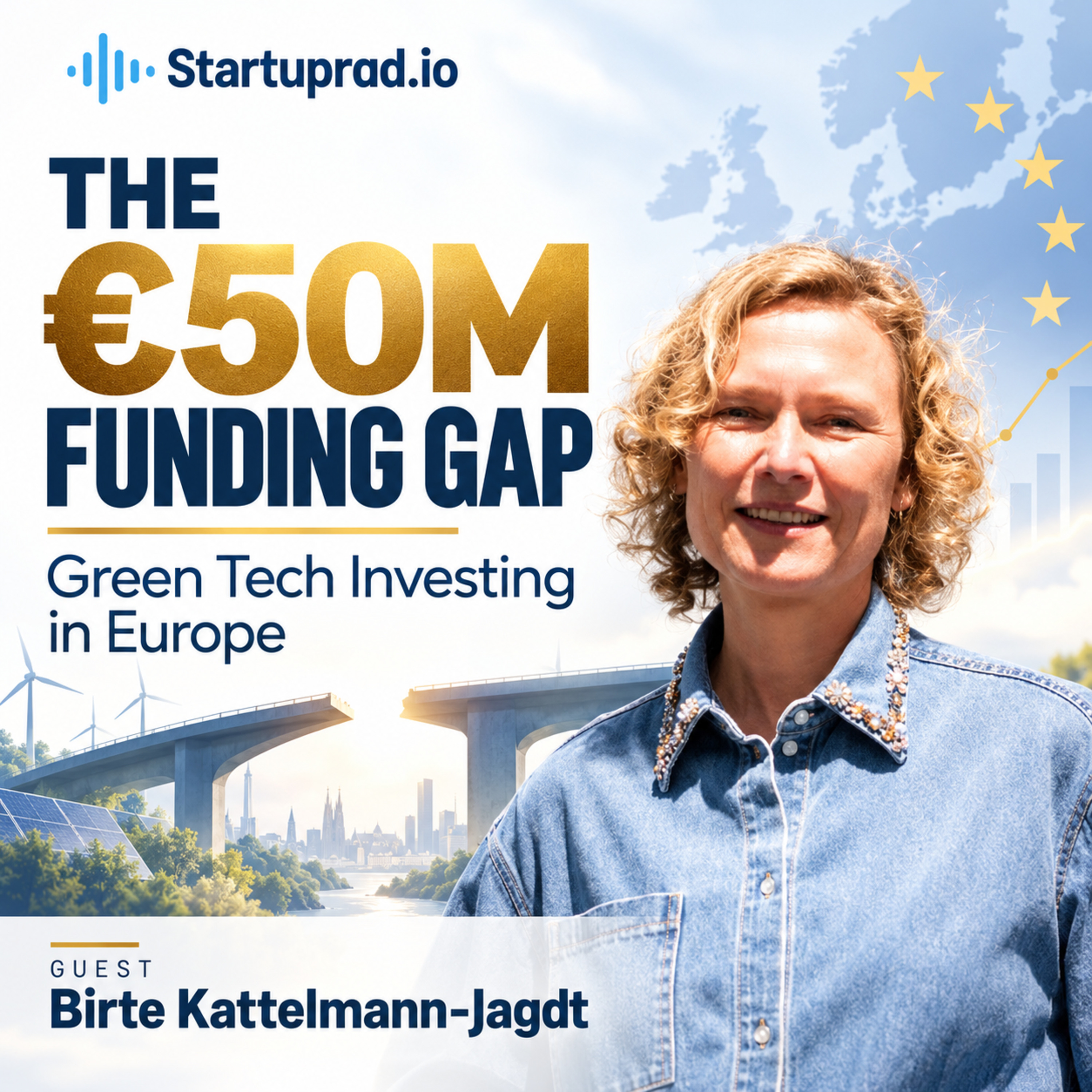
Business angel Birte Kattelmann-Jagdt screened about 200 German startups and made 10 green tech investments since May 2024. Her rule: being greener is not enough. Your product has to be cheaper, faster and better. Host Jörn "Joe" Menninger asks her what that means for founders and investors in Germany, Austria, and Switzerland.
Full blog post and sources:
Read the full episode notes on Startuprad.io
Why this episode matters: Birte spent more than 20 years at BASF and in corporate advisory before she started investing her own money. She won the first BAAR Green Angels Award NRW i...
E 781 — Europe's Scale-Up Gap: Why Strong Hubs Don't Add Up
.jpg)
Everyone asks where the Silicon Valley of Europe is. Jörn "Joe" Menninger asks a better question: when the capability your company needs sits in another European hub, can you actually use it? Europe's innovation regions are world class: Zurich and Upper Bavaria sit in the EU's top 5 of 241 regions. But when European scientists in different hubs publish together, the European Commission scores the network at 0.76 against America's 0.81. When inventors patent together, Europe falls to 0.40 against 0.68.
Full article and sources: startuprad.io
In this episode:
Germany 14th of 27 nationally, Munich and Zurich top-5 regionsEcosystem D...Q3 2026 DACH Review: Isar in Orbit, Helsing $18B, Uber Bid

The Q3 2026 review for Germany, Austria, and Switzerland. Germany passed the Strategic Necessity Test; Q3 posed the Ownership Test.
In this episode: the public prediction card (1 confirmed at 8/10 confidence — in 11 days) · Helsing $1.8B at $18B · Quantum Systems $1.2B · Proxima Fusion €411M · Isar Aerospace reaches orbit Sept 5 · 354 rounds (−11%), Berlin pre-seed −65% · Uber's $14.8B Delivery Hero offer, Cohere–Aleph Alpha, NVIDIA–Hugging Face · The Exploration Company: $450M + ESA in 48 hours · 3 new Q4 predictions with confidence levels.
Full article: startuprad.io · H1 review: Structural Rotation
Growth partnerships: startuprad.io/become-a-partner
Folge direkt herunterladen© Startuprad.io™ – All Rights Reserved | AI...
E 779 — Leapsome: 10 Years to an Agentic HR Platform

Leapsome bootstrapped 5 years to a $60M Series A, rebuilt its core as an HRIS in 2024, and now runs EU-hosted AI agents for 2,000+ organizations. Co-CEO Jenny von Podewils explains the 10-year bet.
Chapters:
03:52 Five bootstrapped years
12:44 The 2024 HRIS rebuild
17:04 AI agents in production
30:48 The Density Gap: 1:53 vs 1:299
56:00 The 2028 forecast
Why this episode matters: Every HR vendor claims AI agents in 2026. The real question is who built the data foundation that makes agents work. Leapsome's 2027 Workforce Trends Report (100 high-growth tech companies, 20+ public data points each, no surveys) puts numbers on it: the...
E 778 — Isar Aerospace, ESA & Europe's Sovereignty Stack

E 778 — Isar Aerospace, ESA & Europe's Sovereignty Stack
Europe found the money and the customers in September: Isar Aerospace reached orbit, The Exploration Company raised $450M and signed ESA for up to €760M, and Mistral raised €3B. Ownership is the trade-off — according to KfW, more than 3 quarters of Q1 venture money in German startups came from abroad.
Why this episode matters: Our startup podcast reads the startup scene in Germany, Austria, and Switzerland through one framework this month: capital, customers, ownership. For entrepreneurship and growth partnerships alike, the question is no longer only who funds a company...
E 777 — AI Agents, Missing APIs and Mittelstand Germany

Code costs fell. Software licences did not. Delia Hallberg of Amadeni AI on what actually makes a Mittelstand Germany company fire a vendor it has used for years — and it is not the price.
Part 2 of 2. Horizontal tools stay; everyone needs email and a browser. The exposure sits in rigid vertical products sold to companies whose business model falls between two industries.
The missing API — no open interface means no automation, and every improvement bought from the vendor
The Berlin engineering firm — one feature requested for over a year, no API, proactive move to cus...
E 776 — AI Agents Inside a German Mittelstand Company
AI agents are running an IT department at one of the newer German startups — and its co-founder says most companies adding AI to their processes are about to make things worse.
Delia Hallberg founded Amadeni AI in January 2026 and builds AI-supported custom software for Mittelstand Germany. Part 1 of 2 is the diagnosis: software, process or leadership, and why a bad process with AI on top breaks faster, louder and more expensively.
The naming test — if nobody can describe the process without naming a colleague, it is habits, not a process
Impuls KBB — 8 hours to 2 on dev...
E 775 — EDIP, SAFE & the EU Defence Fund: Who Can Sell
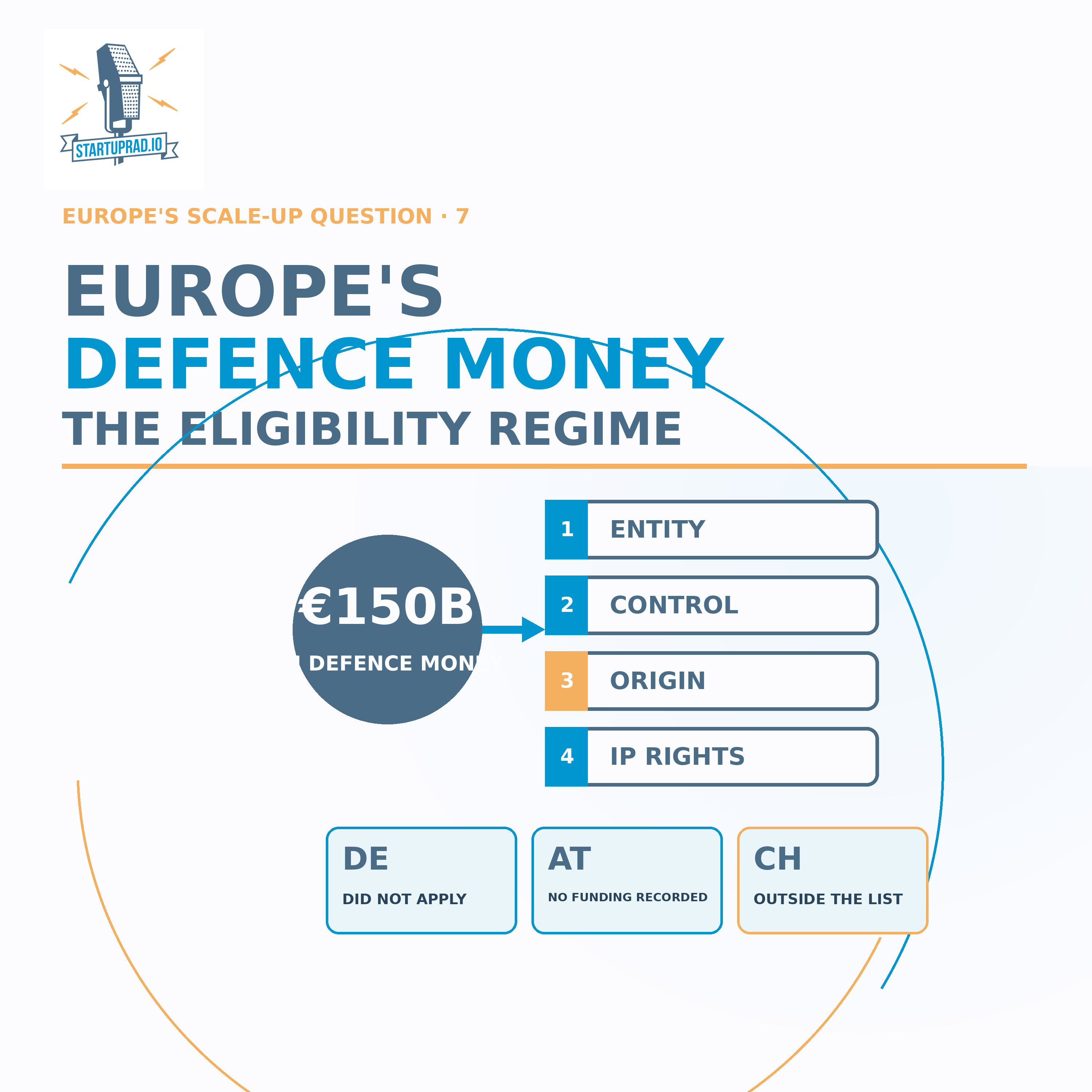
Germany has the largest defence budget in the European Union — 90.6 billion euros in 2024 — and was not among the 19 member states that applied for SAFE. Austria was not among them either, and the Court's 2021-2027 country breakdown records no EU defence funding for Austria. Switzerland is not on the eligibility list for any of the 5 instruments, while Liechtenstein qualifies for all of them. Three neighbours, three positions, and almost no coverage of any of it.
Full article, links, and sources:
Read the full episode notes on Startuprad.io
Why this matters for founders and investors: Jörn...
Delaware Flips: Why Europe Loses the Parent
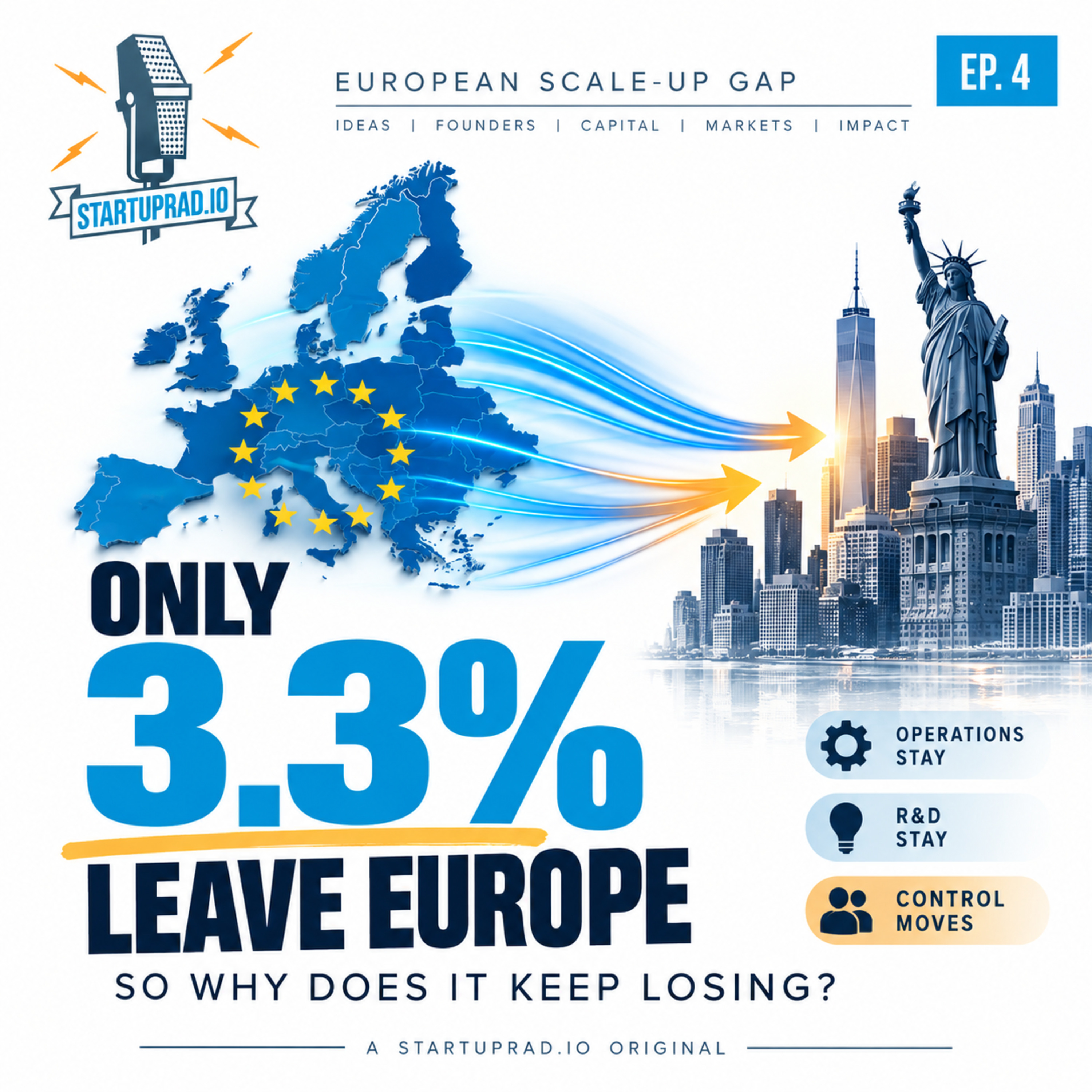
Only 3.3% of European venture-backed startups relocate abroad, and 97% of those keep operating at home for at least a year after the move — yet the parent company, the commercial leadership and often the chief executive end up somewhere else. Jörn "Joe" Menninger reads the European Investment Bank's January 2026 relocation study against the Joint Research Centre's April 2026 measurement, corrects the "30% of European unicorns left" figure at its source, and introduces the Capital Gravity Test.
Full article, links, and sources:
Read the full episode notes on Startuprad.io
Why this episode matters: Europe's scale-up debate treats rel...
E 773 — Startup News August 2026: Moss Unicorn, NEURA Robotics, Scalable Capital — Germany, Austria, Switzerland
Startup news Germany, Austria, Switzerland — August 2026. German startups produced their tenth unicorn when Moss hit a one-billion-dollar valuation. NEURA Robotics completed two acquisitions. Scalable Capital shipped the first pension-reform product. DACH startup news from Startuprad.io.
H1 2026 venture capital reached €5.3 billion, up 14%, but the deal count fell 11% to 354 rounds. Two-thirds of capital flowed to rounds above €50 million. 27% of German startups forwent new hires because of AI. The concentration economy is reshaping growth partnerships across the ecosystem — ten unicorns can sound like a rising tide, while much of the market below them faces a tougher funding environment.
This e...
E 772 — Helsing, Delivery Hero, Quantum Systems | Jul 2026
July 2026 was the month Germany's venture capital market completed its structural rotation from software to hardware. Helsing raised $1.8 billion at an $18 billion valuation, Quantum Systems closed $1.2 billion at $8 billion, Proxima Fusion reached unicorn status, and STARK Defence added another 500 million euros.
Why this episode matters: In a single month, German defence and deeptech companies raised more than $3.5 billion. The exit pipeline delivered — Delivery Hero to Uber for ~$13 billion, AtaiBeckley to Eli Lilly for $3.8 billion, SAP acquired Prior Labs. This is the structural rotation, not a cycle.
Entities covered: Helsing, Quantum Systems, Proxima Fusion, STARK Defence, De...
E771 — Europe's SME Credit Gap Is an Underwriting Problem
Europe’s small business credit gap is not a shortage of money. It is a shortage of any cheap way to underwrite borrowers who are all different from each other.
Patrick Stäuble founded Teylor in Zurich seven years ago. It lends to small and medium-sized businesses, factors invoices, runs a private debt vehicle, and licenses its lending software to banks including Landesbank Baden-Württemberg. Since 2024 it has acquired the listed German lender creditshelf, grenke’s factoring business across five European markets, and Düsseldorf software firm CapeTec — three deals in eighteen months, no capital increase for the third...
E 770 — Unicorn Atlas #5: HappyRobot's $1.2B Address Gap
.jpg)
On 4 August 2026 HappyRobot announced a 150 million dollar Series C at a 1.2 billion dollar post-money valuation, led by Prysm Capital and co-led by Eurazeo. Three days later the Technical University of Munich announced it as its 23rd unicorn. HappyRobot is a Delaware corporation headquartered in San Francisco, and its own funding announcement never mentions Germany. Jörn "Joe" Menninger audits both claims solo from Frankfurt am Main.
Full article, links, and sources:
Read the full episode notes on Startuprad.io
Why this episode matters: German public money was first into this company at roughly 118,000 euros t...
E 769 — Talent Without Recycling: The European Scale-Up Question, Part 5
E 769 · Part 5 of The European Scale-Up Question, recorded solo by Joe Menninger in Frankfurt am Main.
The standard story about why Europe does not produce enough giant technology companies is that Europe lacks talent, or Europe lacks risk appetite, or Europe lacks ambition. That story is wrong. Europe has 3.5 million tech workers. Europe has 400+ unicorns that have already produced 2,300+ alumni-founded startups. What Europe lacks is something more specific — and more fixable. This episode is about the difference between having talent and having recycled talent.
In this episode Joe covers:
The mistake in the usu...
E 768 — Unicorn Atlas #2: Moss — Berlin's Finance-AI Unicorn Betting on Control, Not Autonomy

Hello and welcome everybody. This is E 768 of Startuprad.io, recorded solo by Joe Menninger from Frankfurt am Main. Unicorn Atlas entry number two.
On 5 August 2026, Berlin fintech Moss closed a €35 million Series C at a €1 billion valuation, becoming Germany's newest unicorn. Portage — the fintech-specialist investment arm of Canadian asset manager Sagard — led the round. Existing investor Cherry Ventures re-upped. Total funding to date is approximately €200 million. Moss reports revenue grew twentyfold since its 2021 Series B (led by Tiger Global). More than 5,000 European companies now run on the platform.
The round size is no...
E 767 — Unicorn Atlas #1: Helsing — Europe's $18 Billion Defence AI Bet
Hello and welcome everybody. This is E 767 of Startuprad.io, recorded solo by Joe Menninger from Frankfurt am Main. This is the first entry in a new series — the Unicorn Atlas. Every entry takes one European unicorn and asks who owns it, what it actually makes, whether the headline numbers hold up under primary sourcing, and what an operator, investor, or policymaker should do with the information.
Unicorn Atlas number one is Helsing — Europe's most valuable pure-play defence-tech company. On July 13, 2026, Helsing closed a $1.8 billion Series E at an $18 billion post-money valuation. The lead investors are American (Drag...
E 766 — Germany's New Startup Strategy Is Really a Scaleup Strategy
Germany's new Startup and Scaleup Strategy: 152 measures, DefenceTech, procurement reform, DeepTech financing. Why this is really about the European scaleup gap — and whether Germany can close it.
Hello and welcome everybody. This is E 766 of Startuprad.io, recorded solo by Joe Menninger from Frankfurt am Main. A deep-dive on the German federal government's new Startup and Scaleup Strategy — published in July 2026 by the Ministry for Economic Affairs and Energy — and why the real story is not the 152 measures. It is that Germany is finally admitting its central problem is not startup formation but the European scaleu...
Europe's Startup Recovery Never Happened: The H1 2026 Structural Rotation
Europe's startup ecosystem isn't in a traditional recovery. In this special H1 2026 review, Jörn “Joe” Menninger analyzes why venture capital has undergone a structural rotation rather than returning to the previous cycle's patterns.
Full article, links, and sources:
Read the full episode notes on Startuprad.io
Why this episode matters: A rotation, not a recovery, resets the terms every founder and investor works within. This review maps where European capital actually moved in H1 2026 — and why the old playbook no longer applies.
In this episode, we cover:
Why H1 2026 is a struc...Germany's AI Bottleneck May Be Electricity: GreenTech as Industrial Infrastructure
.png)
Could electricity — not chips or talent — be Germany's real AI bottleneck? In this episode, Jörn “Joe” Menninger covers the GreenTech Monitor 2026, the AI-energy nexus, and why data centers are now central to industrial competitiveness.
Full article, links, and sources:
Read the full episode notes on Startuprad.io
Why this episode matters: If power constrains AI, then energy policy becomes industrial policy. This episode connects Germany's GreenTech data to the AI buildout and the cluster geography that will decide who wins.
In this episode, we cover:
The GreenTech Monitor 2026's full data setW...The Defence Capital Supercycle: Europe's New Venture Capital Infrastructure

More than €1.7 billion of defence-linked capital moved through Europe in a single month. In this news analysis, Jörn "Joe" Menninger examines why defence technology has become the dominant European venture asset class — tracing STARK's €3.5 billion valuation two years after founding, KNDS's preparation for Europe's largest defence IPO, and what Isar Aerospace's funding reveals about sovereign launch capability.
Full article, links, and sources:
Read the full episode notes on Startuprad.io
Why this episode matters: Defence has moved from the margins of European venture to its centre of gravity. Mapping the emerging European Defence Capital...
Germany's VC Market After the Correction: Stable Is Not Strong
German venture capital has stabilised after a multi-year correction — but stable is not the same as strong. In this analysis, Jörn "Joe" Menninger unpacks a market that has stopped falling yet remains highly concentrated, with AI, defence technology, biotech, energy infrastructure, and robotics absorbing a growing share of the capital that still flows.
Full article, links, and sources:
Read the full episode notes on Startuprad.io
Why this episode matters: Germany continues to invest far less venture capital as a share of GDP than the United Kingdom or the United States. That gap is...
Europe's Megafund Problem and the Capital Architecture Gap

Europe doesn’t just have a capital problem — it has a customer problem. In this scale-up series episode, Joe Menninger argues that even with funding fixed, European startups struggle to scale because institutions buy slowly: fragmented, risk-averse procurement that favors incumbents. Capital keeps startups alive; demand makes them dominant.
Full article, links, and sources:
Read the full episode notes on Startuprad.io
Why this episode matters: Revenue is non-dilutive capital, and in AI especially, deployment — not invention — compounds into advantage. If Europe won’t be the first customer of its own innovation, it stays structural...
European Venture Capital: Efficiency, IPOs, and AI Defensibility

Europe’s venture market has matured — but the IPO dream still misleads founders, and “generative AI wrappers” may soon struggle to raise. Partech partner Simone Riva on where European VC actually works, the costliest founder mistake, and what makes a startup defensible. A clear-eyed read on capital efficiency, exits, and AI defensibility across the continent.
Full article, links, and transcript:
Read the full episode notes on Startuprad.io
Why this episode matters: Most founders raise on assumptions about exits and AI moats that don’t hold in Europe. This is a working VC’s map of where...
When European Startups Should Raise Venture Capital
Capital accelerates everything — including your problems. Partech partner Simone Riva on when European startups should raise venture capital and when it quietly destroys discipline. Using Emma Sleep (≈€950M revenue, minimal funding) and Flix (capital-intensive, global) as bookends, he lays out the decision rules that separate durable companies from costly missteps.
Full article, links, and transcript:
Read the full episode notes on Startuprad.io
Why this episode matters: Most founders treat raising as a milestone; this reframes it as a trade-off. A practical guide to whether your business model actually needs VC — and how to avoid “c...
Europe's Scale-Up Gap: Why Startup Capital Isn't the Problem

Europe doesn’t lack startup capital — it lacks the architecture to move capital from innovation to scale. In this scale-up series episode, Joe Menninger explains why the gap bites at Series B and beyond: a thin institutional LP base, too few billion-euro funds (11 vs 137 in the US), and the “dry powder” that can’t actually lead a €100M round.
Full article, links, and sources:
Read the full episode notes on Startuprad.io
Why this episode matters: Founders keep losing ownership to US growth capital at the exact moment they scale. This is the mechanism — LP patterns →...
Startup News Germany, Austria, Switzerland for May 2026
.png)
May 2026 was the month DACH stopped catching up and started setting the pace. Joe and co-host Chris Fahrenbach — in his final news episode after 11 years — break down Helsing’s $1.2B raise to an $18B valuation, SAP’s €1B+ bet on a 15-month-old AI lab, Isar Aerospace’s orbital attempt, and why Bitpanda is heading to Frankfurt, not London.
Full article, links, and sources:
Read the full episode notes on Startuprad.io
Why this episode matters: The signal is unmistakable: sovereign defense, frontier AI, and space — backed by procurement and corporate money — are producing venture-scale outcomes in Euro...
Startup News April 2026 | DACH Venture Capital Is Leaving SaaS
DACH venture capital is undergoing a structural rotation. Capital is moving away from generic SaaS and toward startups tied to defense, space, industrial AI, procurement, tokenized finance, and physical infrastructure.
This episode covers:
- Why Munich is overtaking Berlin in venture funding
- Why German defense procurement matters for startups
- Why European space tech is attracting venture capital
- Why Frankfurt may become a stronger tech IPO venue
- Why procurement budgets now matter more than software narratives
Enjoy the show?
...
Can EU Inc Become Europe’s Delaware?
Building a company across Europe still means sitting on top of 27 different legal systems — so can “EU Inc,” the proposed 28th regime, finally be Europe’s Delaware? Nikolaus Bayer, deputy chairman of Business Angels Deutschland (BAND) and founder of IRIS Analytics (acquired by IBM), weighs the promise against the one thing investors price first: legal certainty.
Full article, links, and transcript:
Read the full episode notes on Startuprad.io
Why this episode matters: EU Inc could make Europe genuinely venture-compatible — €1 minimum capital, digital share transfers, SAFEs, 48-hour incorporation. But the hard part isn’t the rules; it’...
Aviloo and the Used EV Battery Trust Problem

The battery is the most expensive part of an electric car — and for years, the only data on its health came from the manufacturer selling you the warranty. Marcus Berger, CEO of Aviloo, on building the independent, manufacturer-agnostic battery test that now covers 96% of EV models across 15 countries, just as the EU Battery Passport makes transparency mandatory.
Full article, links, and transcript:
Read the full episode notes on Startuprad.io
Why this episode matters: A single number — state of health — decides whether a €40,000 used EV is worth buying. Aviloo’s bet is that trust in the EV...
The European Scale-Up Question Ep. 2 — Europe’s Hidden Growth Tax
Europe’s single market has 500 million customers — but for startups, scaling across it means re-entering a new legal, tax, and compliance regime in every country. This scale-up series episode names the cost: a “hidden growth tax” of regulatory fragmentation that makes cross-border seed deals close 3–5× slower than in the US and pushes founders to incorporate in Delaware.
Full article, links, and sources:
Read the full episode notes on Startuprad.io
Why this episode matters: Capital gaps are visible; friction is invisible — and it quietly drains time, money, and momentum from European founders. This is the case for...
Startup News April 2026 | DACH Venture Capital Is Leaving SaaS
DACH venture capital has completed a structural rotation: out of pure SaaS, into companies that build physical things governments and enterprises can’t do without — defense, space, and sovereign tech. Joe and co-host Chris Fahrenbach break down the April numbers, Munich’s permanent funding lead over Berlin, and Germany’s record €25B WIN initiative.
Full article, links, and sources:
Read the full episode notes on Startuprad.io
Why this episode matters: The funding bar has changed: if your startup doesn’t touch the physical world or hold a procurement contract, capital just got harder. This is the...
Why Quantum Middleware Matters for Enterprise Adoption

The hardest problem in quantum computing isn’t the algorithm — it’s getting your data into the machine. Nikola from quantum startup Haikyuu AI explains why scalable data encoding, not hardware, is the real bottleneck, and how flexible middleware (and their open-source Rivet toolkit) turns failed quantum pilots into useful enterprise workflows.
Full article, links, and transcript:
Read the full episode notes on Startuprad.io
Why this episode matters: Most enterprise quantum pilots stall before touching real hardware. This is a grounded, hype-free look at what actually works today in finance, chemistry, and engineering — and how...
Why Quantum Middleware Matters More Than Qubits — Mykola Myksymenko of Haiqu
Quantum computing isn’t waiting on physics anymore — it’s waiting on software. Mykola Maksymenko, co-founder and CTO of Haiqu, makes the case that middleware, not qubit count, decides whether quantum becomes real infrastructure: the software layer that tames noise, extends usable circuit depth, and makes today’s noisy machines economically useful.
Full article, links, and transcript:
Read the full episode notes on Startuprad.io
Why this episode matters: Most quantum pilots fail quietly — not on hardware, but on noise and a missing execution layer. This is a clear-eyed map of where quantum actually delivers t...
How Germany Is Building DE Hubs and Startup Factories

Germany is no longer relying on startup momentum — it’s engineering the structures that decide how startups emerge and scale. Thomas Jarzombek, Parliamentary State Secretary at the Federal Ministry for Digital and State Modernisation, explains the architecture: 25 thematic DE Hubs and 10 university-based startup factories, backed by 126 research partners and private capital.
Full article, links, and transcript:
Read the full episode notes on Startuprad.io
Why this episode matters: This is the policy answer to Europe’s scale-up gap, straight from one of its architects. If you want to know how Germany plans to turn resear...
Q1 2026 Quarterly Review: Why Germany’s Startup Market Is a Selection Event
Headlines say the funding winter is over. The data says something sharper: Germany’s startup market isn’t recovering — it’s selecting. In this Q1 2026 review built from ~400 signals, Joe Menninger lays out three structural shifts: capital concentrating into fewer mega-deals, Munich overtaking Berlin, and an exit window reopening only for proven category leaders.
Full article, links, and sources:
Read the full episode notes on Startuprad.io
Why this episode matters: The rule that “a big TAM and a good narrative equals funding” is dead. This is the clearest read on what investors now underwrite —...
The European Scale-Up Gap: System Defect or Deliberate Design?
Only 4 of the world’s top 50 technology companies are European — yet Europe creates startups at a world-class rate. In this series opener, host Joe Menninger argues the scale-up gap isn’t a failure of talent or ambition but the output of a capital architecture: European scale-ups raise 50% less by year 10, and nearly a third of unicorns leave for deeper US markets.
Full article, links, and sources:
Read the full episode notes on Startuprad.io
Why this episode matters: The companies that win the scale-up phase build the infrastructure everyone else depends on. This episode lays o...
DACH Startup News March 2026: Robotics, Defence and the Bavaria Signal
March 2026 was the month Bavaria overtook Berlin as Germany’s top startup-funding destination — and capital decisively pivoted to physical, industrial tech. Joe and co-host Chris Fahrenbach break down Neura Robotics’ €1B round, the Bundestag’s €540M combat-drone procurement, Amazon’s Swiss robotics buy, and Bitpanda’s Frankfurt IPO.
Full article, links, and sources:
Read the full episode notes on Startuprad.io
Why this episode matters: This is “procurement, not promise” — defense and industrial tech becoming a structural venture category backed by real government money. The clearest signal yet of how policy, geography, and capital are realigning across...
AI Agents, SaaS Economics, and Europe’s Industrial AI Window

AI agents can build software overnight — so is this the “SaaS-pocalypse,” or the start of a new industrial AI cycle? Stephan Wirries, General Partner at Ventech, argues seat-based pricing and net revenue retention are under structural threat as teams shrink from eight developers to one, and value migrates from code to data, infrastructure, and domain expertise.
Full article, links, and transcript:
Read the full episode notes on Startuprad.io
Why this episode matters: If software development is becoming nearly free, the old SaaS playbook breaks — and Europe’s industrial Mittelstand gets a rare window to leapfro...
ByeAgain and the Economics of Retail Refurbishment in Europe

Europe destroys millions of usable returned products every year — not because they’re broken, but because no one can process them economically. Wolfgang Weingraber co-founded ByeAgain to fix that, building refurbishment-as-a-service: AI-guided workflows and a proprietary ERP that turn returns and B-goods into controlled, monetizable inventory.
Full article, links, and transcript:
Read the full episode notes on Startuprad.io
Why this episode matters: Returns are now a structural P&L line, not an e-commerce side effect. This is the operating model for treating refurbishment as retail infrastructure — and a case study in disciplined, capital-efficient Europe...
Leadership Systems in Startups — Ray Zinn on Culture, Discipline, and AI
In Part 2 of the Ray Zinn conversation, the Micrel founder explains how he built leadership systems that produce results even when the leader isn’t in the room. After going legally blind during Micrel’s IPO roadshow, he led for years more — learning that empathy, discipline, and culture matter more, not less, as AI automates the routine.
Full article, links, and transcript:
Read the full episode notes on Startuprad.io
Why this episode matters: Most founders burn out chasing growth; Zinn’s people-first, discipline-driven model is a durable alternative. A contrarian leadership playbook for founders...
