New Books in British Studies
This podcast is a channel on the New Books Network. The New Books Network is an academic audio library dedicated to public education. In each episode you will hear scholars discuss their recently published research with another expert in their field. Discover our 150+ channels and browse our 28,000+ episodes on our website: newbooksnetwork.com Subscribe to our free weekly Substack newsletter to get informative, engaging content straight to your inbox: https://newbooksnetwork.substack.com/ Follow us on Instagram and Bluesky to learn about more our latest interviews: @newbooksnetwork Support our show by becoming a premium member! https://newbooksnetwork.supportingcast.fm/british-studies
Assassins and Secret Listeners: Britain's Invisible Armies, 1939-45 with Alistair Moffat (Birlinn, 2026)
Throughout Britain, all day, every day and in the dead of night, the secret listeners went about their solitary work. Hands on headphones, these men and women, drawn from all walks of civilian life, listened to the coded messages of German intelligence and passed hundreds of thousands of them on to Bletchley Park.
At the same time, men with firearms experience were recruited into secret patrols trained in sabotage and silent killing with knife or garotte. In June 1940, with a full-scale German invasion expected any minute, these auxiliary units were poised to undertake suicidal missions attacking enemy...
Fitness for Freedom: Disability, Degeneration, and Modern Irish Writing with Marion Quirici (Syracuse UP, 2025)
Fitness for Freedom: Disability, Degeneration, and Modern Irish Writing (Syracuse UP, 2025) explores the legacy of intersectional stereotypes of disability, race, gender, sexuality, class, and religion that justified imperial rule in Ireland and the forms of oppression that continued after independence. Marion Quirici identifies models of citizenship and creative autonomy in Irish modernist literature that valorize vulnerability over ability and interdependence over independence. She uncovers a history in which an entire nation, Ireland, was characterized as disabled and therefore “not fit for freedom.” Beyond symbolism, the Famine and decades of emigration led to a perception that Ireland’s racial stocks were deple...
Matthew Mason, "Seeking the High Ground: Slavery and Political Conflict in the British Atlantic World" (U Virginia Press, 2025)
How is it, Samuel Johnson famously asked on the eve of the Revolution, that Americans could so vociferously demand freedom for themselves while so conspicuously continuing to deny it to those they held in slavery? With Seeking the High Ground: Slavery and Political Conflict in the British Atlantic World (U Virginia Press, 2025), Matthew Mason helps answer that piercing question. As he shows, the language of slavery and freedom had long suffused Anglo-American political debates in the eighteenth century, with the Revolution emerging as one particularly hyperdramatic act during which combatants on both sides of the war of words connected the id...
Arthur der Weduwen, "The Last Invasion of England: 1688 and the Dutch Armada" (Princeton UP, 2026)
In popular accounts of the Glorious Revolution of 1688, the autocratic Catholic King James II was ousted by his subjects and replaced by his Protestant daughter Mary Stuart, wife of James’s nephew, the Dutch William III of Orange. Devoted to her husband, Mary would not accept the crown alone, and so William and Mary were crowned together, securing a smooth dynastic succession. The Last Invasion of England: 1688 and the Dutch Armada (Princeton UP, 2026) recounts the forgotten campaign that carried William and his army to English shores and led directly to James’s fall, bringing a revolutionary age vividly to life...
John Gilbert McCurdy, "Vicious and Immoral: Homosexuality, the American Revolution, and the Trials of Robert Newburgh" (JHU Press, 2024)
The fascinating story of a British army chaplain's buggery trial in 1774 reveals surprising truths about early America.
On the eve of the American Revolution, the British army considered the case of a chaplain, Robert Newburgh, who had been accused of having sex with a man. Newburgh's enemies cited his flamboyant appearance, defiance of military authority, and seduction of soldiers as proof of his low character. Consumed by fears that the British Empire would soon be torn asunder, his opponents claimed that these supposed crimes against nature translated to crimes against the king.
In Vicious and...
Ciara Breathnach, "Absence in the Archives" (Cambridge UP, 2026)
Ciara Breathnach is Professor of Irish Gender History at University College Cork. She has published widely on Irish socio-economic, gender, cultural and health history. Her last monograph Ordinary lives, death and social class: Dublin City Coroner’s Court, 1876-1902 (Oxford University Press, 2022) won the American Conference of Irish Studies, James S. Donnelly Sr. Prize for Books on History and Social Sciences in 2023.
In this interview she discusses her new book Absence in the Archives (Cambridge UP, 2026).
Absence in official records can have profound implications for social memory, civil rights, restorative and transitional justice, citizenship, social welfare, a...
Stuart McHardy, "Scotland's Geomythography: Myth, Landscape and the Roots of Culture" (Luath Press, 2025)
What can we learn from our landscape? How can Geomythography help us understand our cultural heritage? What is Geomythography?
Geomythography is the interpretation of prehistoric and later societies at specific locales through a combination of oral tradition, place-names, landscape analysis and archaeology. The process is a means of finding new perspectives and interpretations to further the understanding of early and extant cultures, the continuities between them and investigating oral traditions that initially arose in pre-Christian myth, much of it concerning a Mother Goddess.
In Scotland's Geomythography (Luath Press, 2025), Stuart McHardy unveils the intricate ties between...
Nikhil Kalyanpur, "Legal Weapons of the Wealthy: The Offshoring of Elite Conflict in Emerging Markets" (Cornell UP, 2026)
In Legal Weapons of the Wealthy: The Offshoring of Elite Conflict in Emerging Markets (Cornell University Press, 2026), Dr. Nikhil Kalyanpur examines a striking feature of today's global legal order: the use of foreign courts by elites to settle domestic disputes. On the surface, the "outsourcing" of disputes by elites from countries with fragile judiciaries looks like a search for fair treatment unavailable at home. Yet extraterritorial dispute resolution varies across such countries. Russian plutocrats, for instance, frequently litigate abroad, whereas Chinese and South African ones rarely do.
Dr. Kalyanpur argues that the pursuit of extraterritorial litigation depends on...
Aonghus MacKechnie, "Edinburgh: City of Romanticism" (Lund Humphries, 2026)
Romanticism made Scotland famous. It critically shaped the course of Scottish culture, while impacting on cultures elsewhere and inaugurating the country’s still-flourishing and lucrative tourist industry. This book is about Edinburgh’s most emblematic architecture over the long 19th century: the castellated and stone built cityscape of national revivalist architecture. It reveals why Scotland had by the 1820s become one of Europe’s great centres of Romanticism, due both to the majestic Highlands, and to Edinburgh itself as city of Romanticism. Additionally, Edinburgh developed as the main centre and hub for travellers drawn to Romantic Scotland through the work o...
Stefan Collini, "Literature and Learning: A History of English Studies in Britain" (Oxford UP, 2025)
Literature and Learning: A History of English Studies in Britain (Oxford University Press, 2025) by Stefan Collini
The study and teaching of English literature is generally regarded as one of the central disciplines in the modern university, yet for much of its history it struggled to gain academic legitimacy and was frequently derided as 'a soft option'. Its early professors responded by emphasizing its scholarly character, foregrounding philology and literary history in ways that marked the syllabus far into the twentieth century.
Stefan Collini provides here the first full account of the discipline's development from its la...
Catherine S. Chan, "Savage: The Making of Modern Dogs in British Hong Kong" (Cornell UP, 2026)
Savage: The Making of Modern Dogs in British Hong Kong (Cornell University Press, 2026) explores the dark side of colonial modernity through canine eyes, showing the many ways that dogs involuntarily contributed to the modernization of twentieth-century Hong Kong. Dr. Catherine S. Chan follows the piecemeal transplantation of British animal humanitarianism as pedigree dogs accompanied hardening class differences, dogmeat became a contested racial issue, and dogs were roped into the long list of undesirables fabricated in the so-called golden era of reforms following the social disturbances of the 1960s.
Dr. Chan reveals a fragmented civilizing project that constructed do...
Courtney Weikle‑Mills, "Sugarcoated Ethics: Children’s Literature and Atlantic Enslavement" (Johns Hopkins UP, 2026)
What if children’s literature was never as innocent as we imagine?
In Sugarcoated Ethics: Children’s Literature and Atlantic Enslavement (Johns Hopkins University Press, 2026), the relationship between childhood reading and Atlantic slavery is brought into sharp focus. The book argues that children’s literature did not merely emerge alongside the plantation economy; it was deeply shaped by it. Sugar, sweetness, moral instruction, and domestic comfort were all tied to systems of enslavement and colonial trade, even as the violence behind them was softened or erased in stories for young readers.
The book also examines how ideas...
Holly Crawford Pickett, "The Drama of Serial Conversion in Early Modern England" (U Pennsylvania Press, 2024)
After mounting London’s outdoor pulpit known as St. Paul’s Cross on 8th December, 1588, Anthony Tyrrell found himself perched before a skeptical audience. He stood in the shadow of St. Paul’s Cathedral to declare his recantation of Catholicism and return to England’s official Protestant Church. The trouble was he had been there before – in January of the same year, in fact – to do the same thing. On that occasion, however, he had shocked on-lookers by delivering an anti-Protestant tirade instead of his promised recantation. How could Tyrrell, a serial convert, who eventually changed church affiliation as many as ten...
An Honest Death: Life's End and Humanist Funerals with Matthew Engelke
A fascinating, behind-the-scenes look at non-religious funerals in contemporary London, An Honest Death: Life's End and Humanist Funerals (Princeton UP, 2026) is an intimate and moving ethnographic account of funerals for people who don’t believe in God or an afterlife. Focusing on secular funeral celebrants of the British Humanist Association (now called Humanists UK), the book examines how their ritual work is geared toward helping realize a secular world. There is a strong ethical commitment behind this effort, which is to face death with honesty based on the belief that this life is all we have. For the humanist ce...
Malcolm Murfett, "Eden's Alternative to Appeasement: The Anglo-American Strategy that Might Have Been, 1937–38" (Tithebarn Press, 2026)
As Foreign Secretary in Neville Chamberlain's Cabinet in 1937, Eden didn't believe in appeasing the German and Italian dictatorships or the militaristic Japanese regime. Instead, he wanted to confront their aggression head on. Faced with growing Japanese assertiveness, including the launching of an undeclared war on China in July 1937, Eden appealed to the US for help. He believed sending an Anglo-American naval force to the Western Pacific would demonstrate that the democracies were not spineless, but were prepared to stand up for what they believed in. Was this a viable alternative to Chamberlain's appeasement policy, now notorious for its failure...
Speech and the City
In this episode of the Language on the Move Podcast, Ingrid Piller speaks with Yaron Matras about his new book Speech and the City.
In this timely book, Yaron shows that cities can provide an important counter-weight to political polarization by forging civic identities that embrace diversity. The book traces the emergence of a city language narrative that embraces and celebrates multilingualism and helps forge a civic identity. He critiques linguaphobic discourses at a national level that regard multilingualism as deficient citizenship. Drawing on his research in Manchester, he examines the 'multilingual utopia', looking at multilingual spaces...
Paul Johnson, "Challenging Inequalities: How We Got Stuck and Where We Go Next" (Princeton UP, 2026)
There is a widespread sense throughout the developed world that progress towards a better society has stalled. Many countries, including the UK, have experienced persistent economic stagnation accompanied by declining trust in institutions. Governments are struggling to respond not only to traditional economic problems but also to newer challenges posed by climate change, migration and technological change. Challenging Inequalities: How We Got Stuck and Where We Go Next (Princeton University Press, 2026), written by Paul Johnson and coauthors, drawing on the findings of the six-year IFS Deaton Review, connects these conditions to inequality—inequality not just of income and wealth bu...
Ian Bradley, "Liquid Faith: Scotland's Sacred and Supernatural Waters" (Birlinn, 2026)
Since time immemorial, water has been a major theme in myth, religion and folklore throughout the world. With its 12,000-mile coastline, as well as a plethora of rivers and lochs, Scotland is a particularly rewarding place in which to explore the spiritual dimensions of what is both the most commonplace and yet the most mysterious of all chemical compounds.
Liquid Faith: Scotland's Sacred and Supernatural Waters (Birlinn, 2026) by Ian Bradley is a journey from healing wells, springs, river sources and bogs to the seashore, islands and whirlpools, to discover the legends, superstitions and rituals that have grown up...
Amy Blakeway, "War and Governance in Scotland, 1543-1559: Destruction, Reconstruction and Reform" (Edinburgh UP, 2026)
Drawing from local archives alongside national and international records, War and Governance in Scotland, 1543-1559: Destruction, Reconstruction and Reform (Edinburgh UP, 2026) by Dr. Amy Blakeway argues that warfare was the defining feature of government and politics in Scotland for the two decades following the death of James V. It demonstrates that beyond the direct effects of invasion, the need to raise unprecedented taxation, as well as warfare’s secondary consequences, such as plague and price inflation, disrupted communities throughout Scotland, engendering enhanced social control. These effects endured for many years after the peace of 1550: new laws were passed to ma...
Roderick Beaton, "Europe: A New History" (Allen Lane, 2026)
What do we talk about when we talk about Europe? Is it defined by geography? Or is it politics, or shared culture? In Europe: A New History (Allen Lane, 2026), award-winning historian Roderick Beaton tells the story of Europe as never before—as the history of an idea, and a collective identity.
Since its dramatic birth in ancient Greece, 'Europe' has been defined, and redefined, by its people. Through this powerful lens, and with the narrative drive and scope of a novelist, Beaton deftly surveys Europe’s major historical developments: the rise and fall of Rome; the explosion of Chris...
Utathya Chattopadhyaya, "Ganja Matters: Empire and the Pursuits of Cannabis in British India" (U California Press, 2026)
Ganja is the popular name in Hindustani, Bengali, and other South Asian languages for intoxicating substances produced from the plant species Cannabis sativa L. Starting in the eighteenth century, British India's colonial administrators sought ways to systematically tax and govern how ganja circulated from the farms of peasant families in rural Bengal to pipes, plates, and cups elsewhere in the subcontinent.
Ganja Matters: Empire and the Pursuits of Cannabis in British India (University of California Press, 2026) is an open-access book that follows the perpetual incongruity between regulatory efforts to pursue the plant through botanical observation, colonial reportage, an...
Karène Sanchez Summerer and Sary Zananiri eds., "Palestine in Transition: Frank Scholten's Visual Archive of the British Mandate Period" (CEU Press, 2026)
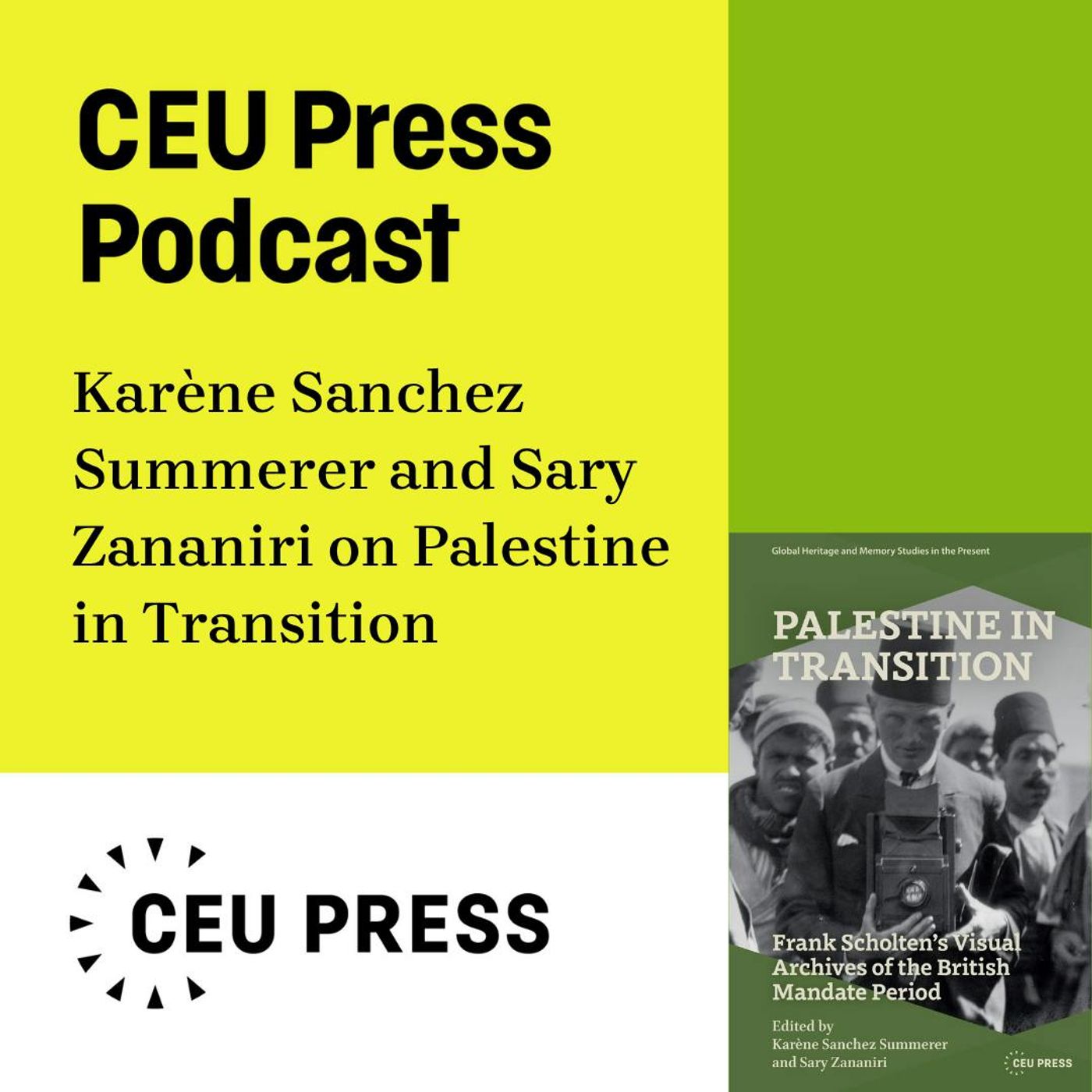
In this episode, host Andrea Talabér (CEU Press) talks with Karène Sanchez Summerer and Sary Zananiri, the editors of Palestine in Transition: Frank Scholten's Visual Archive of the British Mandate Period. They discuss who Frank Scholten was, the breadth and depth of the images he took in Palestine, and the archival holdings themselves.
You can browse Frank Scholten’s images here.
Follow the City Sarha Instagram account to be updated on when the app exploring Jerusalem’s modern cultural history will launch.
You can purchase a copy here. The book is also a...
Elizabeth Tynan, "Nuclear Archipelago: Secrets, Power and the Biggest Atomic Blast in Australia" (NewSouth, 2026)
Nuclear Archipelago: Secrets, Power and the Biggest Atomic Blast in Australia (NewSouth, 2026) tells the shocking story of the two British atomic weapons test series held at Western Australia's Monte Bello Islands in 1952 and 1956. Operation Hurricane and Operation Mosaic took place at a rugged archipelago 100 kilometres off the Pilbara coast, and each of the three bombs sent fallout over vast distances across the country. One of the tests, Mosaic G2 in June 1956, the largest nuclear weapon test ever held in Australia, sparked panic at the time that it had been a nuclear accident. In both the Mosaic tests, the crew of a...
Daniel Majchrowicz, "A Journey to Mecca and London: The Travels of an Indian Muslim Woman, 1909–1910" (Indiana UP, 2025)
Descended from Mughal nobility, Akhtar al-Nisa Begum Nawab Sarbuland Jung grew up in Hyderabad in southern India, where she lived a quiet, private, and privileged life at the heart of the state's royal court. In 1896, at the age of 20, she married Nawab Muhammad Hamidullah Khan Sarbuland Jung, a prominent lawyer and the scion of a leading Muslim reformist movement. In 1909, the wealthy couple embarked on a four-month journey through the Middle East and Europe, performing the hajj in Mecca and sitting for tea with the future king and queen of England.
A Journey to Mecca and London: The Travels of an...
Caro Pirri, "Colonial Failure and Theatrical Form in Early Modern England: Stages of Unsettlement" (Oxford UP, 2025)
Today’s guest, Caro Pirri, is the author of Colonial Failure and Theatrical Form in Early Modern England: Stages of Unsettlement (Oxford University Press, 2025). This book explores how early modern colonial travel writing informed the London theater’s spatial and placemaking conventions. It suggests that what the stage found most compelling about narratives of colonial settlement was their failure to claim interpretive control over unfamiliar places and people. The book goes on to link colonial misreadings of places and people to theatrical strategies for staging disorientation, which Pirri characterizes as a condition of “unsettlement.”
Each chapter focuses on a spe...
Edward T. G. Anderson, "Hindu Nationalism in the Indian Diaspora: Transnational Politics and British Multiculturalism" (Oxford UP, 2024)
Hindu nationalism is transforming India as an increasingly dominant ideology and political force. But it is also a global phenomenon, with sections of India’s vast and influential diaspora drawn to, or actively supporting, right-wing Hindu nationalism. Indians overseas can be seen as an important, even inextricable, aspect of the movement. This is not a new dynamic—diasporic Hindutva has grown over many decades.
Hindu Nationalism in the Indian Diaspora: Transnational Politics and British Multiculturalism (Oxford University Press, 2024) explores how and why the movement became popular among India’s diaspora from the second half of the twentieth century. It show...
Emma Parker, "Life Writing and the End of Empire: Homecoming in Autobiographical Narratives" (Bloomsbury, 2024)
Life Writing and the End of Empire: Homecoming in Autobiographical Narratives (Bloomsbury Academic, 2024) examines how autobiographical writing reflects the psychological and cultural afterlives of the British Empire. Rather than treating decolonization as a completed historical moment, Emma Parker shows how empire continues to haunt personal memory, identity, and ideas of home. Through close readings of memoirs and autobiographical texts by writers such as Penelope Lively, J. G. Ballard, Doris Lessing, and Janet Frame, the book explores how individuals who grew up in colonial settings experienced their later arrival in Britain as a complex and often disorienting “homecoming.” Many of thos...
Steven Veerapen, "Overlord: A New History of the Life and Reign of Henry VIII" (Simon & Schuster, 2026
Henry VIII is England’s most famous king. He is simultaneously the virtuous Renaissance prince gone wrong, the psychopathic, paranoid tyrant, the religious disruptor and the much-married glutton.
Overlord: The Life and Reign of Henry VIII (Birlinn, 2026) is a groundbreaking study of Henry’s life examines and destroys many of the long-repeated myths about this complex monarch: he was not particularly gluttonous, not particularly prudish, and not particularly messy in his religious changes. Nor did he see himself as simply King of England. Drawing on archival sources from across the British Isles, Dr. Steven Veerapen reveals how Henr...
Chasing Freedom: Coming of Age at the End of Empire with Simukai Chigudu
"In my home country, they call me a 'bornfree'." Simukai Chigudu was born in Zimbabwe, two years after the end of its bitter war of liberation - a war in which his father had fought. This is the story of his childhood journey through the chaos of that new country's birth to Britain, where he arrived alone, a teenager, burning with ambition but utterly lost in ways he had yet even to discover. Told with astonishing insight, his memoir describes the drama of his quest to belong and to succeed, and how his worldview was both shaped and shattered...
Elizabeth Darling, "Palace of the Ether: Broadcasting House and the Architecture of the BBC, 1922–32" (Lund Humphries, 2026)
Palace of the Ether: Broadcasting House and the Architecture of the BBC, 1922–1932 (Lund Humphries, 2026) by Dr. Elizabeth Darling is about the architecture and design of broadcasting in the 1920s and 1930s, examining the buildings which the BBC occupied in its founding decades, with a particular focus on Broadcasting House in London. It argues that these environments were as constitutive of the Corporation’s identity as the programmes and people that they housed. Borrowing from the architectural writer Christopher Hussey’s characterisation of Broadcasting House as a ‘palace of the ether’ Dr. Darling asks how the immaterial medium of the broadcast...
Brent Elliott and Roger Bowdler, "The British Cemetery: Architecture, Landscape, Sculpture" (Historic England, 2026)
Roger Bowdler and Brent Elliott’s The British Cemetery: Architecture, Landscape, Sculpture, published by Historic England (2026), traces the history of the cemetery from the 17th century to the present day. The cemetery emerged as a new landscape form in the 19th century in Britain but had deep roots in earlier churchyard practices and in fashionable garden landscape design. Cemeteries very quickly became a locus for the monumental expression of loss, family identity and social standing. The book offers a clear chronological narrative, with alternate chapters attending to landscape and monuments. The authors present unfamiliar primary data and introduce some we...
Nabi Sahak, "Anglo-Afghan Power and Politics, 1893–1947: The Durand Line Unmasked" (Palgrave Macmillan, 2025)
In this episode of New Books Network, I speak with Nabi Sahak about his book, Anglo-Afghan Power and Politics, 1893–1947: The Durand Line Unmasked (Palgrave Macmillan, 2025).
Anglo-Afghan Power and Politics revisits one of the most contested borders in the modern world. The roughly 2,640-kilometre line drawn in 1893 by Mortimer Durand and Amir Abdur Rahman Khan, which today divides Pashtun communities between Afghanistan and Pakistan. Sahak's central argument is that the historical purpose of the Durand Line has never been settled: was it a temporary sphere-of-influence arrangement, a frontier meant to manage dissent, or a genuine international border? The book c...
Meredith Gamer, "City of the Gallows: Art and Execution in Eighteenth-Century London" (Yale UP, 2026)
City of the Gallows: Art and Execution in Eighteenth-Century London (Yale UP, 2026) uncovers the complex and often unexpected connections between eighteenth-century London’s sites of punishment and its spaces of art-making, instruction, and display. Drawing together a wide range of images, objects, and texts – from popular woodcuts and anatomical sculptures to moral tracts and dictionaries of slang – it offers new readings of works by major artists, such as William Hogarth, Johan Zoffany, and Joseph Wright of Derby, and shines a light on others that traditional accounts of the period have overlooked or ignored. In doing so, this book shows how st...
Matthew Ritger, "Houses of Correction: Carceral Institutions and Humanist Culture in Early Modern England" (U Pennsylvania Press, 2026)
Today’s guest, Matthew Ritger, is the author of Houses of Correction: Carceral Institutions and Humanist Culture in Early Modern England (U Pennsylvania Press, 2026). This book delves into the archival records of Bridewell, Europe’s first house of correction, which was overseen by the humanist reformer Richard Grafton. It makes the case that the Bridewell prison and workhouse were central to the history of humanism in ways that both challenge idealized notions of European humanism and illustrate its commitments to civic and Christian reform. The book explores Bridewell’s mission to discipline the poor and the “idle” through hard labor, voc...
Claire Hubbard-Hall, "Her Secret Service: The Forgotten Women of British Intelligence" (Weidenfeld & Nicolson, 2024)
Since the inception of the Secret Service Bureau back in 1909, women have worked at the very heart of British secret intelligence - yet their contributions have been all but written out of history. Now, drawing on private and previously-classified documents, leading historian Claire Hubbard-Hall brings their gripping true stories to life in Her Secret Service: The Forgotten Women of British Intelligence (Weidenfeld & Nicolson, 2024).
From encoding orders and decrypting enemy messages to penning propaganda and infiltrating organisations, the women of British intelligence played a pivotal role in both the First and Second World Wars. Prepare to meet the tr...
Patrick Nunn, "Whispers from Celtic Seas: The True Meanings of Ancient Stories from Northwest Europe" (Reaktion, 2026)
What if the legends of submerged cities, land-making witches and sea-crossing bishops are not mere inventions but echoes of real events? Whispers from Celtic Seas: The True Meanings of Ancient Stories from Northwest Europe (Reaktion Books, 2026) by Professor Patrick Nunn at the University of the Sunshine Coast in Australia revisits coastal traditions from the Celtic fringes of northwest Europe, showing how they preserve memories of dramatic environmental change—floods, land loss and shifting shorelines—carried forward through oral storytelling for generations. Drawing on cutting-edge geological and archaeological research, this book recasts these tales not as fantasy, but as historical test...
Leah Pope Parker, "Light of the Everlasting Life: Disability and Crip Eschatology in Old English Literature" (U Michigan Press, 2025)
From disability metaphors to narratives structured around bodies presented as aberrant, early medieval English thoughtworlds conveyed the promise of resurrection and the hope of salvation through crip and disabled bodies. Light of the Everlasting Life: Disability and Crip Eschatology in Old English Literature (U Michigan Press, 2025) argues that early medieval Christian eschatology, as manifested in Old English literary texts, was a crip eschatology: a theology of the afterlife that relied upon disabled bodies and concepts related to disability in order to convey promises of resurrection and salvation. In addition to demonstrating how literature manifested theological approaches to the afterlife...
Mitra Sharafi, "Fear of the False: Forensic Science and the Law of Crime in Colonial South Asia" (Cornell UP, 2026)
Fear of the False: Forensic Science and the Law of Crime in Colonial South Asia (Cornell University Press, 2026) uncovers colonial South Asia's critical role in the development of forensic science. Around 1900, the government of British India created a web of institutions for the scientific detection of crime. Driven by anxieties about "native mendacity," newly minted forensic analysts focused on uncovering faked evidence planted by South Asians. These experts, joining toxicologists known as "chemical examiners," were supposed to extract objective, scientific truth in the service of British justice. But in trying to counteract the presumed tendency of colonized peoples to li...
Elisabeth van Houts, "Empress Matilda: Queen of the Romans, Ruler of the English" (Yale UP, 2026)
Born in 1102, Empress Matilda combined the blood of two dynasties: the house of Wessex and their conquerors, the dukes of Normandy. As a widowed German empress, she was named as heir successor by her father, Henry I. But, after his death in 1135, Matilda’s place on the English throne was usurped by her cousin, Stephen of Blois. Civil war followed, and she ruled the south-west of England in opposition.
In Empress Matilda: Queen of the Romans, Ruler of the English (Yale University Press, 2026), Professor Elisabeth van Houts explores the remarkable life of medieval England’s only queen regn...
Eamonn Gearon, "The Arab Bureau: The Story of Britain's Most Ingenious Intelligence Unit" (Hurst, 2026)
Many of us have watched the classic 1962 movie Lawrence of Arabia, the somewhat fictionalized work based on the life of T. E. Lawrence during the Arab Revolt and the First World War.
But Lawrence was part of the Arab Bureau, an effort to better understand and influence the region as Britain fought the Ottoman Empire for control of the Middle East. Chastened by their intelligence failures at Gallipoli and Kut al-Amara, the British tried to do something unthinkable: Actually learn how local communities operated, and ensure that propaganda was culturally authentic.
It’s the subject of...