Talks by Zen Roshi, Lola McDowell Lee
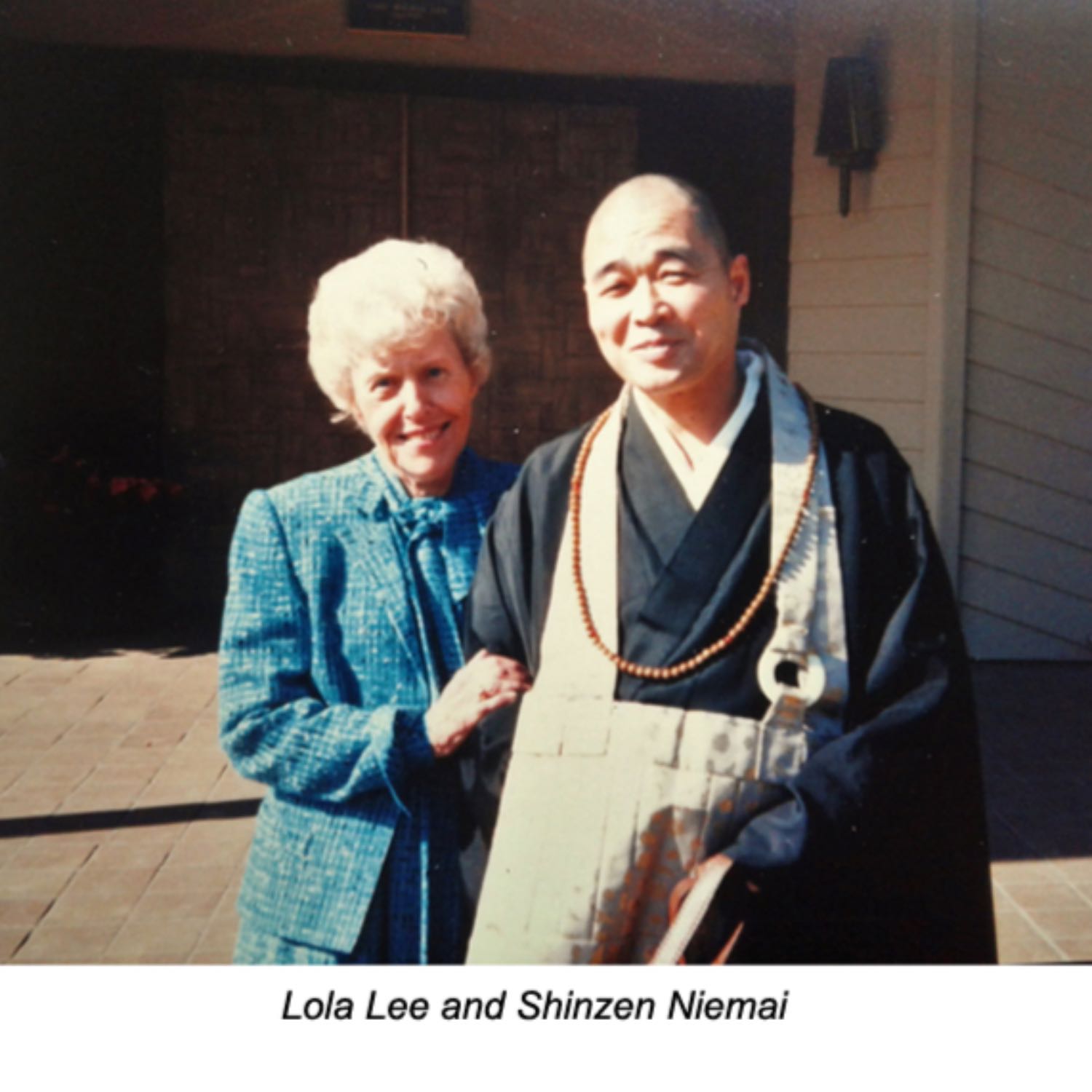
This is a series of newly digitized talks by spiritual teacher, Lola McDowell Lee, spanning two decades—from the early Seventies through the Nineties.Lola was a Zen Roshi whose Rinzai lineage included Doctor Henry Platov and renowned Zen master, Shigetsu Sasaki. Lola was a religious scholar as well as an ordained Christian minister.While the talks are focused mainly on Zen and Buddhism, Lola drew on many spiritual traditions—including those of Jesus, Plato, Lao-Tzu, the Hindu Vedas, Meister Eckhart and Gurdjieff.If you find Lola’s talks valuable, more will be posted in days to come. RSSVERIFY
The path from warrior to king. Delivered Nov 23, 1986
Zen Roshi, Lola McDowell Lee, contrasts two fundamental inner orientations: the path of the warrior and the path of the king.
Lola shares Tilopa's poem to Naropa about transcending dualities, dissolving distractions, and abiding effortlessly in the natural state. She notes that while spiritual traditions are numerous, every individual ultimately carves out a unique path based on their own inner focus.
Lola categorizes human approaches into two basic stances: the aggressive, conflict-driven warrior and the dispassionate, observing king.
The history and philosophy of Gnosticism.
The warrior mindset. How early Egyptian monotheism...
The importance of mastering attention. Delivered Nov 2, 1986
Zen Roshi, Lola McDowell Lee, discusses the importance of mastering attention—to uncover the silent inner ground of being.
Lola recounts a tale about Master Shoju, who calmly sat in a graveyard amidst howling wolves without fear. He had an unshakeable state of mind, invulnerable to the external turmoil of life and death.
Most people operate through the thinking mind, engaged in chores, conversations, with their attention scattered across "ten thousand things." People also talk to themselves endlessly about weather, politics, and trivialities—out of touch with their inner core.
When individuals first appr...
The Wisdom of Ikkyu. Delivered Sep 28, 1986
Zen Roshi, Lola McDowell Lee, reflects on the universal reality of death and the transition of consciousness, illustrated by the historical encounter between the legendary Zen master Ikkyu and his dying disciple Ninagawa.
When Ninagawa attempts to take comfort in traditional phrases about coming and going alone, Ikkyu challenges him, pointing to the path of no coming and no going.
Lola explains that at death, the physical senses and brain cortex are left behind, halting new sensory input into the psyche. Without fresh input, the mind loops over existing psychological contents.
True preparation...
The positive and the negative paths to enlightenment. Delivered Sep 21, 1986
Zen Roshi, Lola McDowell Lee, contrasts the "positive" and "negative" paths to enlightenment.
Drawing upon ancient Chinese Taoist, Li Tzu, she begins by questioning the value of emptiness. Because emptiness cannot be quantified, traded, or manufactured—unlike the walls of a house or the clay of a cup—it possesses an absolute value that transcends human commerce.
To abide in this emptiness one must embrace stillness and let go of the transactional nature of human existence.
She characterizes the positive path, often associated with asceticism and orthodox religious traditions, as one of accumulation. It i...
The Silent Night, the Holy Night Within. Delivered December, 1986
Zen Roshi and Christian minister, Lola McDowell Lee, illustrates the many harmonies between Eastern spiritual practices and Western mystical traditions.
Lola looks at the traditional nativity story and Christian parables and urges us to look beyond literal interpretations to uncover deeply transformative inner meanings within scripture.
She introduces the concept of the "subsistence of existence," the invisible ground or foundation of all being. While humans live outwardly, navigating the world through the cortex of the brain and accumulated societal roles, there remains a deeper, unspoken root consciousness. Maturing spiritually requires shifting our point of view...
The Tao of Ordinary Being. Delivered August 24, 1986
The Taoist approach to existence is much different from our usual rigid, goal-oriented conditioning. Lin-Li, a man nearly a hundred years old, lives in profound simplicity. To many, his life seems marked by poverty, loneliness, and the absence of family, a life of failure.
Yet to others’ surprise, Lin-Li maintains an inexplicable happiness. He sings while laboring for meager grains in the fields.
Lin-Li highlights a critical divide between the Confucian quest for status, behavioral perfection, and learning, and the Taoist path, which champions unlearning.
Human misery is largely rooted in our desperate, eg...
Freedom from preferences. Delivered Aug 31, 1986
Zen Roshi, Lola McDowell Lee, explores our tendency to confuse changes in external conditions with genuine inner liberation.
Lola recounts the classic Taoist parable by Chuang Tzu, "Three in the Morning," about a monkey trainer whose monkeys revolted.
The wise individual perceives both sides of dualism without partiality, viewing all phenomena in the unifying light of the Tao.
Why are we so easily tricked by these superficial arrangements? Lola examines the "monkeyish" mind. For most of us, the mind leaps wildly from thought to thought. She compares this to a person holding a...
Where Taoism, Christianity and Zen meet. Delivered August 17, 1986
Zen Roshi, Lola McDowell Lee explores the interplay between ego, consciousness, and the spiritual path, drawing on Taoist, Buddhist, and Christian traditions.
She explores the Taoist message of flowing with existence, free from effort or resistance. By aligning oneself with the totality of life, one can move beyond fear and obstruction.
Lola recounts the biblical narrative of Adam and Eve and the loss of innocence and the rise of the ego. If the Garden of Eden is a state of unconditioned innocence, then the Fall represents the emergence of self-consciousness, discrimination, and dualistic thinking.
<...Aug 17, 1986
Aug 17, 1986
Unlearning and existential trust. Delivered Aug 10, 1986
Zen Roshi, Lola McDowell Lee, explores the concepts of unlearning, existential trust, and the structural dynamics of the ego.
Lola describes the state of an enlightened individual as one whose nature has completely sunk back into its roots in the One. True spiritual power, she argues, is not achieved through cleverness, daring, or accumulated knowledge, but rather through an intense process of unlearning.
Within every person exists this pristine, unconditioned reality—the true man of no rank.
An obstacle to realizing this wisdom is the modern obsession with cleverness and interpersonal strategy. Individuals co...
The Trap of Words - Delivered August 3, 1986
Zen Roshi, Lola McDowell Lee, recounts Chuang Tzu’s advice: the purpose of a fish trap is to catch fish, and once the fish are caught, the trap is forgotten. So too with words — once an idea is truly grasped, the words that carried it should be released. Yet we find this nearly impossible. Words stick. They cling to the mind and take on a life of their own, trapping the very people who use them.
She illustrates with two ancient stories. In Egyptian lore, a god wished to thank humanity for its devotion and decided to give...
Zen is not an intellectual exercise. Delivered Jun 20, 1986
(Note on the recording: Thank you for your patience. Many of the remaining cassettes of Lola’s talks have substantial noise and echo issues. To overcome that, I’m trying out a different software to clean the audio. This software removes the noises, but it also sounds slightly clipped. Just so you know...if this sounds a little different from what you're used to. For those of you that follow her talks, I’m curious if you can accept these changes to improve the audio. Your comments are welcome. Thank you. – Bob)
***
Zen Roshi, Lola McDowell...
Jul 20, 1986
Jul 20, 1986
Emptiness is not nothingness. Jul 14, 1986
Zen Roshi, Lola McDowell Lee, discusses the concept of the "Unborn," the central teaching of Master Bankei.
Lola recounts the story of an arrogant Abbot trying to challenge Bankei. The Abbot told his congregation, “If I put a difficult question to him, I can stymie him with just one word. So saying this, he went off to see this supposed master. And here in this large crowd, in the middle of the talk, the Abbot shouted in his booming voice, “Everyone here accepts your sermon and believes it. But someone educated like myself doesn't accept. If a pers...
How to enter a gateless gate. Delivered July 6, 1986
Zen Roshi, Lola McDowell Lee, opens with the core question: How does one enter the gateless gate? Lola points to a mountain stream, suggesting that "listening" is entering. She distinguishes between the someone’s simple interest in Zen and the actual acquisition of a Zen mind.
Lola says the spiritual path begins only when the soul moves beyond a mild interest in Zen and raises the question: "Who am I?"
This inquiry is described as poking a stick into a beehive—it disturbs thousands of inmates within the psyche, necessitating a new way to deal with...
The Basic Teachings of Zen Meditation. Presented on June 29, 1986
(Note: Although there is some remaining quiet delayed echo from the original cassette tape, this talk by Lola about the basics of Zen meditation is still a good primer for a new student of the discipline)
---
Zen Roshi Lola McDowell Lee, explores the essence of Zen practice, noting that while the era of the 1960s opened Western minds to Eastern traditions, it often lacked the rigorous supervision required for deep spiritual growth.
By the mid-80s, she observes a stabilization where Zen schools (Soto and Rinzai) have established roots, offering methods developed...
Accumulating knowledge versus attaining true wisdom. June 22, 1986
Zen Roshi, Lola McDowell Lee, Lola discusses the distinction between accumulating knowledge and attaining true wisdom.
Lola shares the koan about a monk who asked his teacher, “Is there a teaching no master ever preached before?” And the teacher said, yes, there is. What is it, asked the monk. And the teacher replied, it is not mind, it is not Buddha, it is not things..
We require a different kind of perception—what Lola calls "listening with your eyes". She draws a sharp contrast between linear, "horizontal" learning—where teachers and students simply build upon accumula...
The Lesson of True Listening. June 15, 1986
Zen Roshi, Lola McDowell Lee, explores the difference between merely seeking reality and actually experiencing it through the practice of true listening.
Ancient Zen master, Tokai, is abruptly awakened from a nap by a frantic monk shouting about a fire under the kitchen floor. Rather than panicking or leaping into action regarding a future threat, Tokai requests that the monk wake him only when the fire reaches the passageway, instantly returning to sleep.
People often miss this present reality because their minds are busy searching for preconceived concepts of the Buddha or God. The ultimate...
An exploration of the subject of death. Delivered Jun 8, 1986
Zen Roshi Lola McDowell Lee, opens by recounting the classic Zen koan of Master Dogo and his disciple Zengen. When visiting a deceased parishioner, Zengen asks if the person is alive or dead, to which Dogo refuses to answer either way. Even after Dogo’s passing, another master, Sakeso, repeats this refusal, telling Zengen, "No saying whatever".
The story illustrates that life and death are not distinct realities, but two doors to the exact same cosmic secret. They are experiences to be lived through directly rather than intellectual problems to be solved.
The human mind co...
Does an enlightened Zen master live a saintly, extraordinary life? Delivered Jun 1, 1986
Zen Roshi, Lola McDowell Lee, explores the nature of truth, the limitations of the intellect, and the profound importance of trusting one's own immediate experience.
She begins by introducing a classic Zen Master Tozan’s question: "What is the Buddha?" While working in a storeroom, replied, "This flax weighs three pounds." This seemingly nonsensical answer helps dismantle our reliance on logical analysis.
Lola tells the story of a young student others thought stupid. He who suddenly comes alive in class to ask where numbers go when erased from a blackboard.
And th...
Give gifts with no notion of reward or praise. Like moving something from one hand to the other. Mar 9, 1986
Zen Roshi, Lola McDowell Lee, discusses the Diamond Sutra, known as the "Cutter of All Doubts."
She story of the Buddha and his disciple, Subhuti, a Bodhisattva. It’s a paradoxical teaching: A Bodhisattva should give gifts without being "supported" by anything—not by a notion of a sign, a gift, or a recipient. If a gift is given with the thought "I am giving this to you," it is limited. However, if a gift is given without support—without the self-identification of a giver—the merit is immeasurable.
Lola draws a parallel here to the Jesu...
Learning to live less from the mind and more from the hara. Oct 14, 1981
(Note: This recording contains a static hum that, in spite of efforts to remove, does remain somewhat. But the content of the talk might be worth overlooking).
Zen Roshi, Lola McDowell Lee, understands how odd it must sound to some that an individual human being can become one with the universe.
She explains that this search for unity is often misguided because people look out there for something that can only be found in the immediate present.
This issue begins with our own internal division. The split between spirit and body, or matter...
Allowing Purusha to extricate itself from the mindless play of Prakrit. Sept 27, 1987
Zen Roshi, Lola McDowell Lee, discusses the ancient Indian philosophy of Samkhya Yoga as a framework for spiritual observation. It includes the dual principles of Purusha (the essence of the self) and Prakrit (the "Great Mother" or manifested nature and energy).
While Samkhya might appear to be dualistic, it aims for a state of Sahaja, or awakened consciousness. This state contains and transcends the three states of objective self-consciousness, dreaming, and deep sleep..
The spiritual task involves two seemingly contradictory efforts, or "two ends of one stick.” They are rigorous self-observation and voluntary self-forgetting. To ob...
Plato, art and spiritual growth. Sep 5, 1987
Zen Roshi, Lola McDowell Lee, explores the concept of freedom through the conquest of self.
Per the Dhammapada, we should direct straying thoughts. The path to happiness is through quieting these elusive thoughts with single-mindedness, which brings freedom.
We struggle from confusing wants and needs and forgetting the primary goal: freedom.
This freedom is not worldly (economic, political, or social). It’s freedom from the ego. When the ego drops, it’s like a curtain falling, revealing the reality. This is the noumenal world described by philosopher Immanuel Kant.
We are caug...
The Middle Way—between the world of appearance and the inner world of consciousness. Aug 29, 1987
Zen Roshi, Lola McDowell Lee draws on the Dhammapada to emphasize a core principle of spiritual success: vigilance, or watching. The fool is careless and enslaved by desire. The master has firm resolve.
Man is the only creature on Earth with the ability to choose. Unlike animals and plants, whose lives are determined by nature, humans possess a mind that allows for conscious choice.
Man is not born a true being but a becoming. He is a state of perpetual movement between opposing attitudes and emotional states. This becoming is marked by a continual search...
How do you go in? Simply stop going out. Aug 2, 1987
Zen Roshi, Lola McDowell Lee, continues her discussion of the Dhammapada.
She warns us against mistaking the false for the true, urging us to look into our hearts and follow our true natures. Spiritual texts are meaningless without direct action.
Lola discusses the seeming conflict of seeking external rewards while professing detachment from the fruit of action.
Truth simply is. It is the truth of being, which human effort must uncover. Our chief obstacle is the web of conditioning. To find truth, one must deliberately extract oneself from this accidental conditioning of our...
The meanings of various Buddhist terms, practices & traditions. July 26, 1987
Zen Roshi, Lola McDowell Lee, explores the meaning of the Dhammapada -Twin Verses.
She discusses the importance of thought and self-mastery in shaping one's experience. We are what we think. All that we are arises with our thoughts. With our thoughts we make the world.
An impure, conditioned mind leads to suffering, while a pure, unconditioned mind leads to unshakable happiness. We have, over and over, a choice of conduct: the easy path of catering to personal ego desires, or the difficult path of conscious transformation.
The negative path is effortless and offers...
Dogen: “Not knowing is most intimate.” July 5, 1987
Zen Roshi, Lola McDowell Lee, explains the story of Dogen Zenji, the founder of the Soto Zen school in Japan. One master says, “Not knowing is most intimate.”
Dogen’s question: if we are already Buddha nature — if enlightenment is our essence — then why do we need to seek it?
When Dogen returned to Japan, he founded the Soto school and taught Shikantaza — just sitting. This practice, Lola explains, is single-minded meditation without striving or grasping — simply allowing truth to reveal itself.
Meditation, explains Lola, is about resting in awareness, with nothing held back. The natu...
How you form your ego—and can ultimately overcome it. Jun 28, 1987
Zen Roshi, Lola McDowell Lee, tells a parable about a powerful Chinese prime minister, who was a devoted Zen student. When the minister asked his master, "how does Zen explain egotism?" the master insulted him, calling him a "numbskull". As the minister's face filled with anger and hurt feelings, the master smiled and said, "Your Excellency, this is ego".
Lola explains that this ego is our very basic problem. Paradoxically, we need It presents we need the ego to function in the world, yet it is also our biggest stumbling block to discovering our true identity.
<...Zen and Socrates. Jun 21, 1987
Zen Roshi, Lola McDowell Lee, argues that most people waste their lives playing superficial games and are deceived by their own minds. They fail to engage in the urgent, life and death work of knowing themselves. The pursuit of money, power, prestige, and reputation are hollow endeavors, like waves on an ocean.
Lola draws parallels between Zen practice and the Socratic method.
Many of us meditate for a short period only to ignore one’s inner awareness for the other 23 hours of the day.
Lola describes Greek philosopher Socrates as a figure who ma...
Instructions for Koan study. And true understanding & non-discrimination. May 31, 1987
Zen Roshi, Lola McDowell Lee, recounts the story of master Joshu who offers cups of tea to the various monks, illustrating the idea of how distinction keeps us from seeing the world as it is. When he offers the same tea to newcomers and long-time members alike, the manager asks why. And Joshu has a shouting response. Why?
Our scientific world breaks the world into bits, opreating within a framework of complexity and duality because seeing the simplicity of the whole is so difficult for us to grasp.
Zen teaches us the value of non-discrimination—th...
Instructions for Koan study. And true understanding & non-discrimination. May 31, 1987
Zen Roshi, Lola McDowell Lee, recounts the story of master Joshu who offers cups of tea to the various monks, illustrating the idea of how distinction keeps us from seeing the world as it is. When he offers the same tea to newcomers and long-time members alike, the manager asks why. And Joshu has a shouting response. Why?
Our scientific world breaks the world into bits, opreating within a framework of complexity and duality because seeing the simplicity of the whole is so difficult for us to grasp.
Zen teaches us the value of non-discrimination—th...
The limitations of human knowledge. May 17, 1987
Zen Roshi, Lola McDowell Lee, discusses human knowledge an its limitations.
Typical knowledge is the result of fragmented perception. Our knowledge is narrow, limited to appearances and governed by desire, habit, and subconscious impulses.
The relationship of Surya (divine light) and Agni (divine force).
Agni symbolizes will in consciousness. Together, Surya (knowing) and Agni (will) form a unity. Knowledge and Will are not separate. They are two aspects of the same foundation of reality.
The Upanishads say that sin is not moral condemnation but that which causes a deviation from the...
In the struggle between opposites is the Truth. Mar 6, 1987
Zen Roshi, Lola McDowell Lee, draws on Buddhist and Hindu traditions (including the Mahabharata, Ramayana and Bhagavad Gita) to explain the human condition.
Struggles and opposition are partners in our growth. Manjushri (wisdom) is not found in shrines, but is alive within each person.
Lola recounts a tale of a monk and the village courtesan.
She talks about how struggle is necessary for growth; it develops character. Friend and foe, like rose and thorn, are inseparable opposites. The human tendency is to focus on one side and ignore the other. True vision includes...
Where is God? Feb 28, 1987
Note: Generally, this talk is more lighthearted than most that Lola gives. It’s nice to see that side of her personality.
Lola begins with a comical tale about a man and a priest he asks for advice.
Zen Roshi, Lola McDowell Lee, discusses Lao Tzu concept of how the hole in the wheel’s knave makes its utility. How the emptiness of a vessel creates its utility.
Lola asks, “Who would you rather be: a victim or a perpetrator?”
It is in the world of the Relative that we can discover...
Mystica Theologica, the Sutras of Patanjali and the Book of Genesis. Jan 31, 1987
Zen Roshi, Lola McDowell Lee, discusses various texts about the notion of God — from the biblical book of Genesis to Mystica Theologica to the sutras of Patanjali.
Dionysus was a disciple of St. Paul and one-time mayor of Athens.
We eat from the Tree of Knowledge of Good and Evil… but we must return to the Tree of Life.
Buddhism did not identify God. Or a self. So for a Buddhist, what is there? Perhaps a Buddhist might say there is a Power greater than himself.
Why did God create the worl...
How do you answer: “Does God exist?” Sep 20, 1987
Zen Roshi, Lola McDowell Lee, (who is also an ordained Christian minister) explores issues that are common to both Christian and Eastern thought to illustrate the difference between theology/philosophy and religious practice.
She explains that it is easier to join a religious group and hang around it than it is to truly struggle with oneself. There are many who participate in religions just so they can tell themselves they are doing their religious duty. They learn a religious system or structure and think they have learned some truth. Not so.
Simply wishing will not...
A detailed introductory talk about the Bauls — a religious sect of India—and the mystery of consciousness. Sep 13, 1987
Note: Unfortunately these talks about the Bauls were posted out of order. But the sound quality is much better on this one, which is also the most detailed in its explanation of who the Bauls were. And this talk develops into a wonderful, rich discussion of consciousness.
Lola says that not many people have heard of the Bauls because they had no organization or dogma or scripture. They were freewheeling practitioners who loved dance, music and poetry—and looked within.
Zen Roshi, Lola McDowell Lee, explains how the Indian Bauls were a group of Hindus al...
The Bauls religious sect of India. And Prakrit and Parusha. Oct 18, 1987
Note: this talk has some sound issues, but I found it valuable enough to include the bulk of it anyway. It’s about 8 minutes shorter because the cassette player apparently started warbling and slowing down badly at the end—during the discussion of Prakrit and Parusha. There is another talk on this subject available here if you are interested. It’s a fascinating doctrine.
Zen Roshi, Lola McDowell Lee, explores the accounts of the Indian Bauls - a religious group that included members of Vaishnava Hindus and Sufi Muslims.
They had a freewheeling spirit. And worshi...
Zen and the meaning of Easter. Apr 19, 1987
Zen Roshi, Lola McDowell Lee, gives a talk themed on Easter. (While Lola was primarily a Zen teacher, she was also an ordained Christian minister).
Lola reads from the Gospels exploring the meaning of Jesus asking, “Why have you forsaken me?”
Symbols of Easter include a baby chick, pecking its way out of an egg to become that which he was destined to be. That is also a good metaphor for the human situation.
Lola discusses various religious traditions, including that of the Mayans of Central America and Jewish Mysticism.
Nothing is t...