Underground History

Underground History connects culture, history, and place in Southern Oregon and beyond. The program is a collaboration with the Southern Oregon University Laboratory of Anthropology and is hosted by historical archaeologist and research faculty member Chelsea Rose.
Unbroken spirit: how Black homesteader Letitia Carson made Oregon history
Zachary Stocks (center) leads a discussion at the Oct. 3 Letitia Carson Legacy Project Fruit & Forage Field Day, recounting Letitia Carson's biography and how she and her husband, David, traveled the Oregon Trail before settling in the Soap Creek Valley. (Katterlea MacGregor / Oregon State University )
When Black pioneer Letitia Carson arrived in Oregon via the Oregon Trail in 1845, she embarked on a remarkable journey of resilience. Zachary Stocks, executive director of the Oregon Black Pioneers, described Leticia's story as unique in many ways. She was born into slavery in Kentucky, according to the Letitia Carson Legacy Project at...
Chinese American doctor Ing Hay provided essential healthcare to Eastern Oregonians
Kam Wah Chung and Company was a home, a general store, a community center and a medical clinic, where co-owner Ing "Doc" Hay served as a beloved doctor to residents across the region. (Courtesy of the Oregon Historical Society / OPB )
In Eastern Oregon’s John Day, a 160-year-old building holds one of the world's largest collections of traditional Chinese medicine. Kam Wah Chung and Company, once part of a thriving Chinatown, was owned and operated by Lung On and Ing Hay for over half a century. It was a home, a general store, a community center and a...
How Astoria shaped Oregon’s gothic icon, Vampira
Maila Nurmi ffrom Astoria, Oregon launched into national fame as the 1950s television horror host, Vampira.(Public domain image is a still from the 1959 movie, Plan 9 From Outer Space )
On this episode of Underground History, host Chelsea Rose speaks with Chelsea Vaughn, curator of the Clatsop County Historical Society. They discuss a popular walking tour dedicated to the life of Finnish American Maila Nurmi, better known as her alter ego, Vampira: Oregon's own trailblazing gothic icon.
Learn more about Nurmi’s life by taking the historical society’s nine-stop tour or picking up a copy of “Glamour Ghoul...
Beyond old headlines, Mail Tribune archives preserve a newsroom’s history
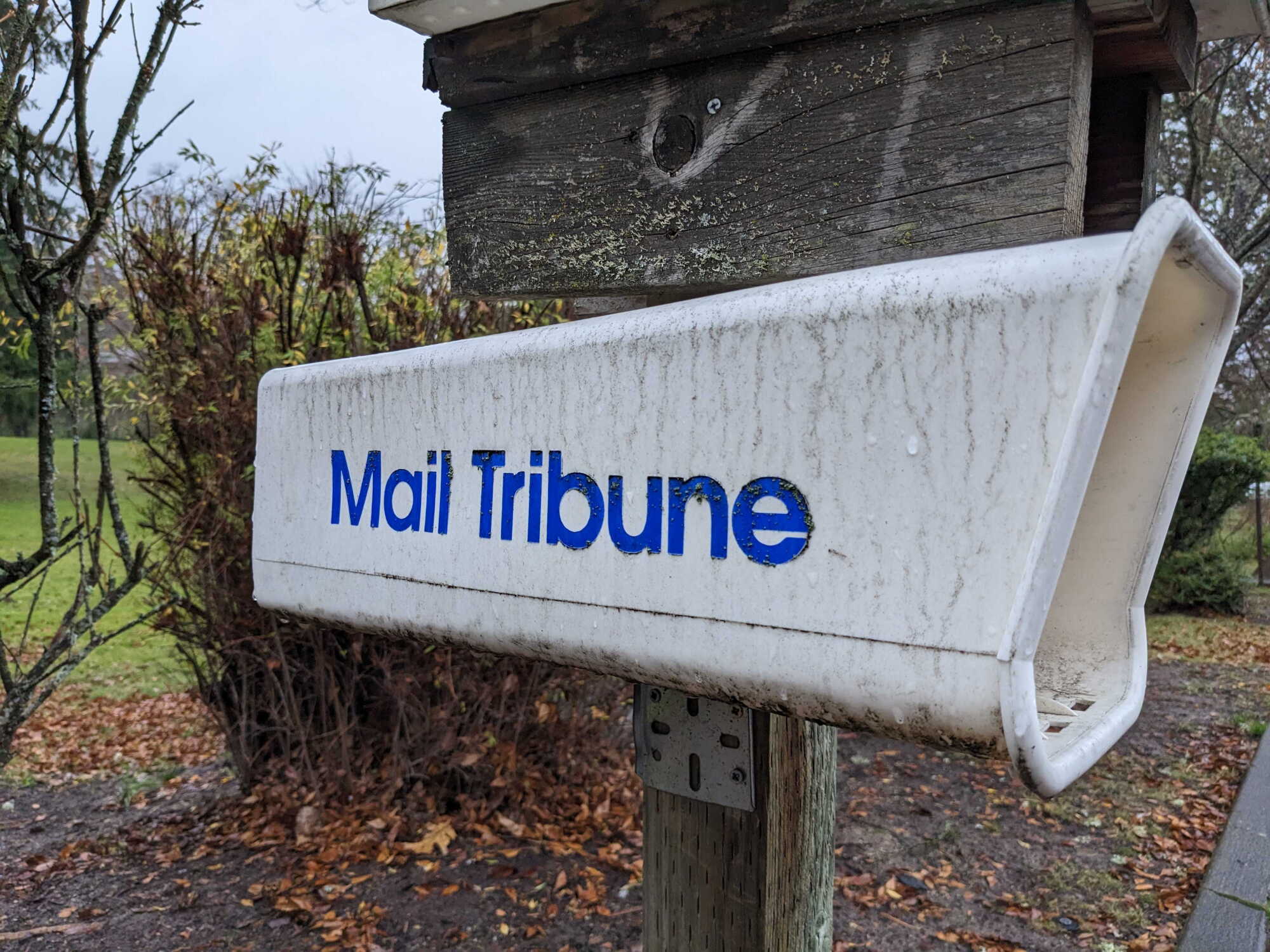
The Medford Mail Tribune, established in 1909, will cease publication this week.(Roman Battaglia / JPR News)
The Southern Oregon Historical Society is preserving the Medford Mail Tribune’s archives, keeping more than a century of local reporting after the newspaper closed in 2023.
The collection reaches beyond published stories. Research files, reporter correspondence, photographs and an in-house reference library document how journalists covered Southern Oregon and the work behind what readers saw in print.
“It’s really more than the papers,” said Anna Sloan, the society’s curator.
Moving the collection required staff and volunteers to act qui...
New archaeological research updates role of women in Oregon’s early timber industry
Men and women in front of the Baker White Pine Mill near Baker City, Oregon, circa 1910-1918. The main mill building, smoke stacks and water tower are visible in the background. (Courtesy of the Sumpter Valley Railroad Archives / OPB )
This story is a special collaboration with the Southern Oregon University Laboratory of Anthropology and the Oregon Historical Society, with support from Roundhouse Foundation.
Iron pipe, concrete foundations and an abandoned railroad grade off a dirt road deep in an Eastern Oregon forest mark a once-bustling mill community that operated in the early 20th century.
Established in...
Digging into discoveries from Oregon field schools
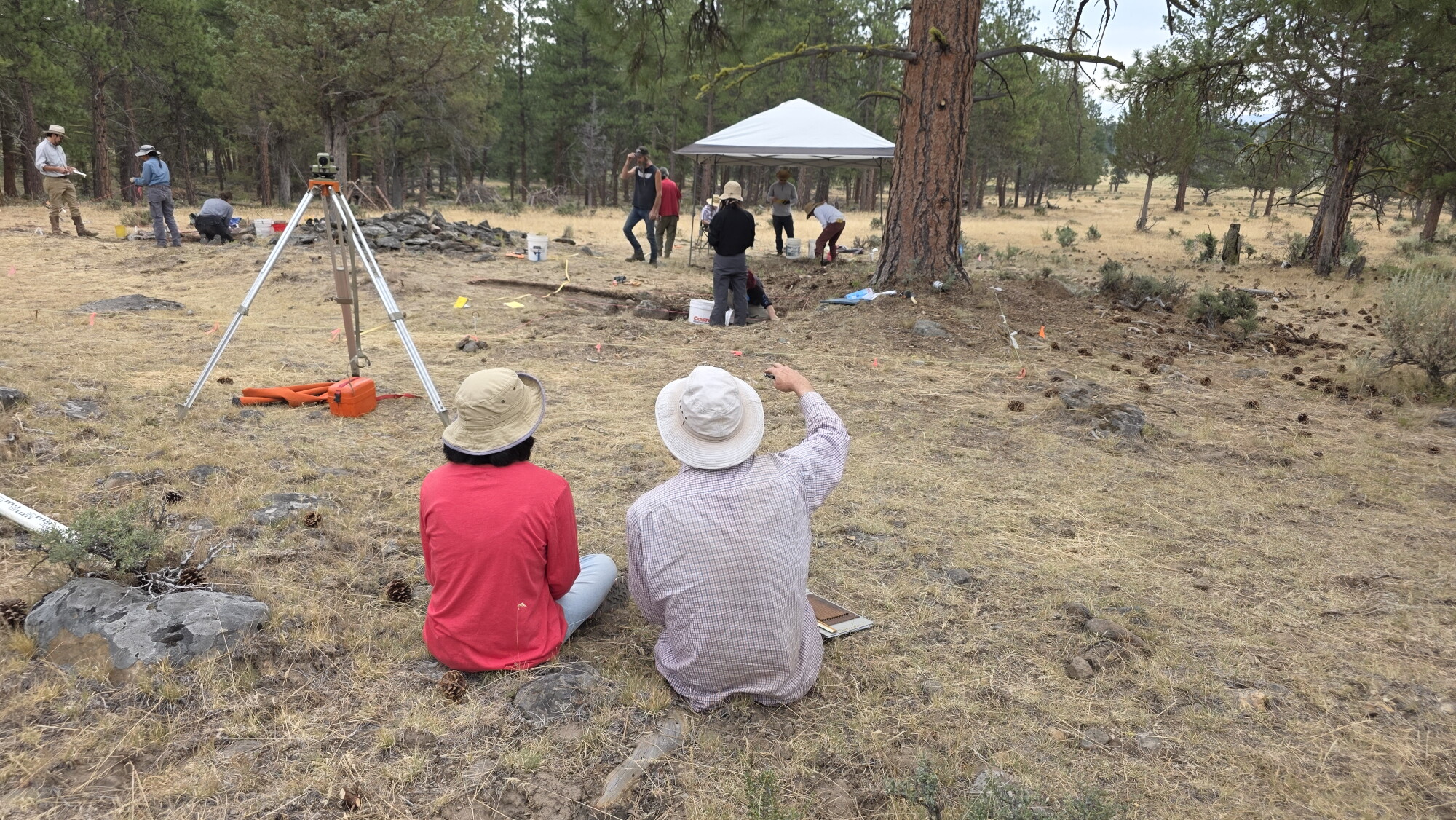
A day in the life of the Southern Oregon University Laboratory of Anthropology Field School.(SOULA)
For our second annual Archaeological Field School Roundup, Underground History host Chelsea Rose is joined by Chris Ruiz, interim director of the Archaeological Research Division at the University of Oregon's Museum of Natural and Cultural History, and Oregon State University professor Molly Carney to discuss highlights, challenges, cool finds and the best ways to unwind after a month in the field.
Guests
Chris Ruiz, interim director, archaeological research division, University of Oregon’s Museum of Natural and Cultural Hi...Archaeologists and community historians on the trail of Chinese cowboys in Eastern Oregon
The obituary of 'Buckaroo Sam' (left) was published in a 1935 edition of the East Oregonian. Sam was a well-known cowboy buckaroo in eastern Oregon. He is pictured in his later years in the John Day Chinatown. ( OPB / The Evergreen Podcast)
This story is a special collaboration with the Southern Oregon University Laboratory of Anthropology and the Oregon Historical Society, with support from Roundhouse Foundation.
Dale Hom looks out over the wild expanse surrounding Stewart Ranch in Grant County, one of dozens of historic ranches that have been linked with early Chinese immigrants in Eastern Oregon.
H...
Chinese American doctor Ing Hay provided essential healthcare to Eastern Oregonians
Kam Wah Chung and Company was a home, a general store, a community center and a medical clinic, where co-owner Ing "Doc" Hay served as a beloved doctor to residents across the region. (Courtesy of the Oregon Historical Society / OPB )
In Eastern Oregon’s John Day, a 160-year-old building holds one of the biggest collections of traditional Chinese medicine in the world. Kam Wah Chung and Company, once part of a thriving Chinatown, was owned and operated by Lung On and Ing Hay for over half a century. It was a home, a general store, a community ce...
How archaeologists restored Zane Gray's century-old Rogue River cabin
Curiosity seekers visit Zane Gray's cabin, which has been added to the Oregon registry of historic places. (BLM photo / Statesman Journal )
On this week's episode of Underground History, host Chelsea Rose speaks with Bureau of Land Management archaeologists Tony Saunders and Duane Erikson about their recent restoration at the Zane Gray Cabin along the Wild and Scenic Rogue River.
Gray built his rustic cabin in 1926 along Winkle Bar, where he wrote and drew inspiration for his novels about the American West over the decade that followed.
Today, this building is just one of the many...
New archaeological research updates role of women in Oregon’s early timber industry
Men and women in front of the Baker White Pine Mill near Baker City, Oregon, circa 1910-1918. The main mill building, smoke stacks and water tower are visible in the background. (Courtesy of the Sumpter Valley Railroad Archives / OPB )
This story is a special collaboration with the Southern Oregon University Laboratory of Anthropology and the Oregon Historical Society, with support from Roundhouse Foundation.
Iron pipe, concrete foundations and an abandoned railroad grade off a dirt road deep in an Eastern Oregon forest mark a once-bustling mill community that operated in the early 20th century.
Established in...
Oregon find may include world’s oldest sewn material, researchers say
A sewn hide, pictured from the front and the back, alongside another hide artifact from Cougar Mountain Cave were among a collection of artifacts dating back 12,000 years. A collaborative research study between the University of Oregon and University of Nevada, Reno reveals a culture of sewing textiles and fashion from many generations of indigenous peoples in Oregon.(Richard Rosencrance / Smithsonian
The cost of the 'cozy pioneer': unmasking genocide in the Pacific Northwest
Marc James Carpenter, Ph.D. is an associate professor in the Department of History and Political Science at Jamestown University. He's the author of "The War on Illahee."(Logan C. Adams) "The War on Illahee" by Marc James Carpenter, Ph.D. is published by Yale University Press.(Yale University Press )
Host Chelsea Rose speaks with Marc James Carpenter about the research behind his recent book "The War on Illahee: Genocide, Complicity, and Cover-Ups in the Pioneer Northwest." The book explores the many ways historians have erased, overwritten or morphed the atrocities of settler colonialism into what Carpenter calls "cozy...
Archaeologists and community historians on the trail of Chinese cowboys in Eastern Oregon
The obituary of 'Buckaroo Sam' (left) was published in a 1935 edition of the East Oregonian. Sam was a well-known cowboy buckaroo in eastern Oregon. He is pictured in his later years in the John Day Chinatown. ( OPB / The Evergreen Podcast)
This story is a special collaboration with the Southern Oregon University Laboratory of Anthropology and the Oregon Historical Society, with support from Roundhouse Foundation.
Dale Hom looks out over the wild expanse surrounding Stewart Ranch in Grant County, one of dozens of historic ranches that have been linked with early Chinese immigrants in Eastern Oregon.
H...
How a short-lived California commune left behind a musical time capsule
Buildings at Olompali State Historic Park in Novato, California.(Brian Baer / California State Parks)
In the 19th century, when California was still under Mexican control, Rancho Olompali in current-day Marin County, California, was the site of the only battle of the Bear Flag Revolt.
That conflict resulted from a group of Americans attempting to break away from Mexico to form an independent California Republic. Though it lasted less than a month, the California Republic flag, the "bear flag," was later adapted into the current state flag of California.
A mansion was later built...
The scars of colonialism in the archaeological record of the PNW
Douglas Wilson is an adjunct professor at Portland State University and author of "The Historical Archaeology of the Pacific Northwest." (Department of Archaeology + Historic Preservation at the University of Washington )
Between the 17th century and today, the Pacific Northwest underwent dramatic transformation with the arrival of European colonizers.
Chelsea Rose visits with Douglas Wilson, an archaeologist with the National Park Service and adjunct associate professor of anthropology at Portland State University.
He recently published "The Historical Archaeology of the Pacific Northwest," detailing the way that historical archaeology illuminates and links the past and present-day of...
Tribal members and archaeologists support elk conservation in Oregon’s Great Basin
Over the last 30 years, the elk population along Oregon’s northern coast has ballooned. An elk sighting like this file photo of a bull elk used to be an unexpected thrill, but now the animals, which can weigh 1,000 pounds, are trampling pets to death, ramming cars and even attacking people.(Courtesy of Oregon Department of Fish and Wildlife )
In November 2022, the Oregon Historical Society sponsored a symposium that centered Indigenous knowledge on the human experience in the Oregon Great Basin. The information presented was turned into the current issue of the Oregon Historical Quarterly.
Underground History host Ch...
A new book challenges the myths of the American West

Megan Kate Nelson(Sharona Jacobs / Simon and Schuster)
Underground History host Chelsea Rose speaks with Megan Kate Nelson about her new book, "The Westerners: Mythmaking and Belonging on the American Frontier."
Nelson's book reframes the oft-told story of the West through a new set of characters, inviting us to explore the ways the story has been romanticized and fictionalized over time.
Event
Nelson's new work will be featured in the upcoming Oregon Historical Society's Mark O'Hatfield Lecture Series on April 14, 2026.Guest
Megan Kate Nelson, historian and author(Oregon...Oregon find may include world’s oldest sewn material, researchers say
A sewn hide, pictured from the front and the back, alongside another hide artifact from Cougar Mountain Cave were among a collection of artifacts dating back 12,000 years. A collaborative research study between the University of Oregon and University of Nevada, Reno reveals a culture of sewing textiles and fashion from many generations of indigenous peoples in Oregon.(Richard Rosencrance / Smithsonian
New book explores Chinese American life during the Exclusion Era
The Commercial Commission of the Associated Chambers of Commerce of the Pacific Coast, 1910.(Oregon Historical Society / Oregon Encyclopedia)
Through the late 19th century and into the 20th, Chinese Americans faced systemic discrimination on interpersonal, societal and legal levels. Famously, the Chinese Exclusion Act of 1882 forbade all immigration from China and barred current Chinese residents from becoming U.S. citizens.
But these broad, federal laws are only one piece of the legal framework. A patchwork of local and statewide legislation targeted activities and stereotypes associated with Chinese-Americans and created other avenues of legal discrimination.
...
The Siskiyou Line linked Ashland to northern California for 137 years
The old Dunsmuir Railroad Depot was link between northern California and southern Oregon.( Dunsmuir Railroad Depot Historical Society)
In December 2025, the final train on the Siskiyou Line passed over the Siskiyou Mountains.
To commemorate the end of 137 years of use, Underground History host Chelsea Rose sat down with John Signor, who literally wrote the books on the famed line.
Signor worked as a conductor for the line for many years, and along with his colleague Jerry Harmon, rescued and now maintains an archive of historical records related to the Siskiyou Line at the Shasta Division...
Legacy of 'The Oregon Trail' video game
Screenshot from the iconic game of the 1980s, "The Oregon Trail."(R. Philip Brouchard )
Between 1843 and the mid-1870s, hundreds of thousands of Americans emigrated west across the Oregon and California Trail. A century later, millions of American children recreated this journey while playing the game "The Oregon Trail" from the safety of their school computer labs. They managed supplies and explored landmarks while trying to avoid dying of dysentery, cholera or accidents.
Underground History host Chelsea Rose speaks with the lead designer of the 1985 video game, R. Philip Bouchard, and Underground History producer Charlie Zimmermann about...
Unwinding complex legends about a presumed massacre of Chinese immigrants in the Pacific Northwest
(Torrey House Press )
Ana Maria Spagna lived in the remote town of Chelan, Washington, for more than 30 years before she learned of an alleged massacre of local Chinese miners by a group of Indigenous people.
Yet, years of research failed to turn up any definitive proof that a massacre ever happened. What it did produce was a window into the xenophobic attitudes and narratives throughout Pacific Northwest history. Spagna is the author of "Pushed: Miners, a Merchant, and (Maybe) a Massacre."
Underground History host, Chelsea Rose, talks with Spagna about her book. They're joined by...
From Bigfoot to 'Rumpology' ... uncovering the truth of myths rooted in pseudoscience
Underground History host Chelsea Rose visits with Nate Pedersen, a librarian, historian and journalist with more than 400 articles in major media. Nate Pederson is co-author of the book, "Pseudo Science: An Amusing History of Crackpot Ideas and Why We Love Them."
The discussion between Rose and Pederson revolves around old and modern-day myths that persist in society, which are rooted in the pseudoscience of past generations. They uncover such fun mythologies like Bigfoot and "rumpology," "bumology" or "butt reading," which is a pseudoscience that involves analyzing the shape, lines...
Renowned cocktail historian chronicles 500 years of mixed drinks in a new comic book
Craft cocktails are a staple of many holiday gatherings, and the history of your favorite boozy beverage goes back much further than you might think.
David Wondrich discusses his latest publication: The Comic Book History of the Cocktail(Penguin Random House)On this episode of Underground History host Chelsea Rose is joined by preeminent cocktail historian David Wondrich for a spirited discussion about his most recent publication, the Comic Book History of the Cocktail: Five Centuries of Mixing Drinks and Carrying On. Tune in to find out who wrote the first cocktail book...
Tribal members collaborate with archaeologists to support elk conservation in Oregon
Over the last 30 years, the elk population along Oregon’s northern coast has ballooned. An elk sighting like this file photo of a bull elk used to be an unexpected thrill, but now the animals, which can weigh 1,000 pounds, are trampling pets to death, ramming cars and even attacking people.(Courtesy of Oregon Department of Fish and Wildlife )
In November of 2022 the Oregon Historical Society sponsored a symposium that centered Indigenous knowledge on the human experience in the Oregon Great Basin. The information presented was turned into the current issue of the Oregon Historical Quarterly.
Underground History ho...
How Section 106 of the National Historic Preservation Act protects our cultural heritage
Dr. Chris Merritt testified before the Senate Committee on Energy and Natural Resources in late October 2025. Dr. Merritt lobbied Congress to preserve the National Historic Preservation Act.(Senate Committee on Energy and Natural Resources )
In 1966, Congress passed the National Historic Preservation Act (NHPA), a law intended to preserve irreplaceable archaeological and historical resources. Utah State Historic Preservation Officer Dr. Chris Merritt recently testified in front of the US Senate Committee on Energy and Natural Resources about a crucial element of that legislation, Section 106, which requires federal agencies to consider the impacts of their actions on historic properties. He joins Chel...
67 years later, one diver solves the mystery of a missing Portland family
Photo of the Martin family in December 1952, six years before their sudden disappearance.(Ken Martin family via AP)
Archer Mayo joins host Chelsea Rose on Underground History to discuss how he solved the mystery of the tragic death of nearly an entire family decades after the case was closed.
On December 7th, 1958, a Portland family disappeared in the Columbia River Gorge on their way to find Christmas greenery. The missing Martin family includes Kenneth Martin, 54, his wife Barbara, 48, and their three daughters, Barbie, 14, Virginia, 13, and Susan, 11. The couple also had a 28-year-old son, Donald, on...
Archivist publishes collection of recipes from beyond the grave
Rosie Grant stumbled upon a recipe on a graveyard headstone. Then she discovered another ... and many more. She produced a cookbook featuring recipes from those who left their legacy written in stone. (Instagram (ghostly.archive) )
Two years ago, Rosie Grant joined Chelsea Rose to discuss her TikTok page, which features gravestone recipes from all across the country.
Now, she's back with a cookbook, "To Die For." It profiles 40 individuals who chose to immortalize their food recipes on their headstones.
Chelsea Rose, host of Underground History, holds a platter of cookies made from...Decoding the summer archaeological field school

SOU Archaeological field school students excavate the remains of a Chinese blacksmith's workshop.
Field school is a rite of passage for any prospective archaeologist. Participants receive mentorship from archaeological professionals and learn a variety of skills in a real-world environment, typically in a four to six week excursion that may involve multiple sites and forms of archaeology.
Chris Ruiz, Deputy Director of the Archaeological Research Division at the Museum of Natural and Cultural History at the University of Oregon, joins Chelsea Rose, director of Southern Oregon University's Laboratory of Anthropology (SOULA) and host...
Archaeologists uncover a Native American mission school in Salem
Methodist missionary Jason Lee's 1836 arrival in the Willamette Valley marked the beginning of a new period of evangelization and colonialism towards Native Americans in modern-day Oregon. This work included establishing a series of schools designed to instill Euro-American religious and cultural values on Native children.
One of those schools was the Oregon Mission Indian Manual Labor Training School, opened in 1842 and closed in 1844 on what is today Willamette University's campus. Now, a new archaeological project is aiming to locate the site and recover artifacts to provide more information about its history.
...
How Anna May Wong defied stereotypes and blazed a trail for Asian-American women
Anna May Wong was one of the first Asian-Americans to grace the silver screen. Yet, early Hollywood shoved her into their narrow boxes of what an Asian woman could be. So she headed off to Europe, where she broke the mold and took on empowering roles rather than narrow ones. She continued to confront the racism of the film industry for the rest of her life after returning to the US.
Anna's incredible life is characterized in a new book, "Not Your China Doll." The author, Katie Gee Salisbury, joins Underground History host <...
Unwinding the fraught and complex narratives of the past
Ana Maria Spagna had spent more than 30 years living in the remote town of Chelan Falls, Washington before she learned of an alleged massacre of local Chinese miners by a group of Indigenous people. Yet, years of fruitful research failed to turn up any definitive proof that a massacre ever happened. What it did produce was a window into the xenophobic attitudes and narratives throughout Pacific Northwest history. Ana is the author of "Pushed: Miners, a Merchant, and (Maybe) a Massacre."
Underground History host, Chelsea Rose, talks with Ana about her book. She's joined by...
From Bigfoot to 'Rumpology' ... uncovering the truth of myths rooted in pseudoscience
Underground History host Chelsea Rose visits with Nate Pedersen, a librarian, historian and journalist with more than 400 articles in major media. Nate Pederson is co-author of the book, "Pseudo Science: An Amusing History of Crackpot Ideas and Why We Love Them."
The discussion between Rose and Pederson revolves around old and modern-day myths that persist in society, which are rooted in the pseudoscience of past generations. They uncover such fun mythologies like Bigfoot and "rumpology," "bumology" or "butt reading," which is a pseudoscience that involves analyzing the shape, lines...
'Oregon Black Pioneers' reveal the history where Black Oregonians lived, worked and played
The Oregon Black Pioneers (OBP) have been working to uncover, preserve, and tell the stories of Black Oregonians throughout the history of the state.
Underground History host Chelsea Rose sat down with Kim Moreland, president of the Oregon Black Pioneers Board of Directors, to discuss the process of creating the reports and black history in Oregon.
The work includes preserving sites and locations of historical significance, such as historical black-owned businesses, churches, and homes. Recently, OBP launched a line of merchandise with newly imagined logos for four historic black-owned businesses on...
A burned commune offers archaeologists a window into 1960s counterculture
In the 19th century, when California was still under Mexican control, Rancho Olompali in current-day Marin County, California was the site of the only battle of the Bear Flag Revolt. That conflict resulted from a group of Americans attempting to break away from Mexico to form an independent California Republic. Though the conflict lasted less than a month, the California Republic flag, the "bear flag," was later adapted into the current state flag of California.
A mansion was later built on the property, and in the 1960s, Rancho Olompali continued its legacy as a countercultural site. In 1967...
The scars of colonialism in the archaeological record of the PNW
Between the 17th century and today, the Pacific Northwest underwent dramatic transformation with the arrival of European colonizers.
Chelsea Rose visits with Douglas Wilson, an archaeologist with the National Park Service and adjunct associate professor of anthropology at Portland State University. He recently published "The Historical Archaeology of the Pacific Northwest," detailing the way that historical archaeology illuminates and links the past and present-day of the Pacific Northwest region.
Archaeologists reunite wildfire survivors with deceased loved ones
One devastating byproduct of the rapid spread of wildfires is that precious items are often left behind. That includes the cremated remains of loved ones.
In 2017, a group of archaeologists founded a nonprofit called the Alta Heritage Foundation to help reunite families with their loved ones' remains. The recovery process includes two steps. First, cremains are located with the help of specially trained dogs. Then, archaeologists carefully separate the remains from other debris. There is never a cost to families. (You can learn more about this work in this JPR story from 2022, featuring host Chelsea Rose as...
Underground History digs into the Oregon version of The Gold Rush
When we speak of The Gold Rush in American history, we usually mean the one in California, following the discovery of gold in 1849. That one still gets the headlines, but Oregon also had a significant gold mining history, and mining goes on--on a smaller scale--today.
Underground History, our joint project with the Southern Oregon University Laboratory of Anthropology, explores the efforts to unearth Oregon Gold Rush artifacts.
Chelsea Rose from SOULA recorded this UH segment in the field, visiting with several people involved in the process, to talk about...
