Data Skeptic
The Data Skeptic Podcast features interviews and discussion of topics related to data science, statistics, machine learning, artificial intelligence and the like, all from the perspective of applying critical thinking and the scientific method to evaluate the veracity of claims and efficacy of approaches.
Recommender Systems Origin Story

Where did recommender systems come from, and how do we know when they're actually working? In part one of Data Skeptic's three-part Recommender Systems finale, Kyle traces the field from collaborative filtering and the Netflix Prize to matrix factorization and modern approaches, while exploring why accuracy alone can't capture what makes a recommendation useful, surprising, or meaningful.
Social Choice for Fair Recommendations

Recommender systems influence nearly every aspect of our digital lives—but what does it mean for those systems to be fair? Robin Burke joins Data Skeptic to discuss the history of recommender systems, the limitations of optimizing purely for accuracy, and how ideas from social choice theory can help balance the needs of users, creators, and society. The conversation explores the future of recommendation algorithms and why fairness is a far more complex challenge than it first appears.
News Recommendations

News recommendation algorithms influence far more than what stories we click—they can shape our understanding of the world. In this episode, Kyle Polich speaks with Andreea Iana about responsible AI, filter bubbles, multilingual news recommendation, and her open-source NewsRecLib framework for evaluating recommender systems. They explore why bigger models aren't always better and how future recommendation systems can balance personalization with diversity and societal impact.
Give Users the Wheel

What if you could simply tell a recommendation system what you want instead of relying on likes, dislikes, and watch history? Kyle Polich talks with Fuyuan Lyu about the DPR framework, which combines large language models and traditional recommender systems to give users direct control over recommendations through natural language. Together they explore how conversational interfaces could transform platforms like YouTube, TikTok, and news feeds while preserving the strengths of modern recommendation algorithms.
AutoLike

How can researchers audit recommendation systems when the algorithms are hidden from view? Hieu Le joins Kyle Polich to discuss Auto-Like, a reinforcement learning framework that systematically explores how platforms like TikTok personalize content feeds. The conversation covers recommendation transparency, black-box auditing, and the future of platform accountability.
Student Spotlight: Aaron Payne, Data Analyst

Aaron Payne, an MBA student at Georgia Tech studying business analytics and a Senior Insights Analyst at Chick-fil-A, joins Kyle Polich to talk about turning analytics into decisions that matter. They unpack a real-world forecasting project with Comfama in Colombia, including messy data realities, interpretability tradeoffs, and why "data science for good" starts with the people impacted.
The Future is Agentic in Recommender Systems

Kyle Polich sits down with Yashar Deldjoo, research scientist and Associate Professor at the Polytechnic University of Bari, to explore how recommender systems have evolved and why trustworthiness matters. They unpack key dimensions of responsible AI, including robustness to adversarial attacks, privacy, explainability, and fairness, and discuss how LLMs introduce new risks like hallucinations.
The episode closes with a look at "agentic" recommender systems, where tools and memory shift recommendations from ranked lists to end-to-end task completion.
Book Ratings and Recommendations

Goodreads star ratings can be misleading as measures of "book quality," and research from Hannes Rosenbusch suggests that for many professionally published books, differences between readers often matter more than differences between books. The episode also explores how to model reader preferences, why reviews often reveal more about the reviewer than the text, and how LLMs can aid computational literary research while still falling short of human editors in creative writing.
Disentanglement and Interpretability in Recommender Systems

Ervin Dervishaj, a PhD student at the University of Copenhagen, discusses his research on disentangled representation learning in recommender systems, finding that while disentanglement strongly correlates with interpretability, it doesn't consistently improve recommendation performance. The conversation explores how disentanglement acts as a regularizer that can enhance user trust and interpretability at the potential cost of some accuracy, and touches on the future of large language models in denoising user interaction data.
Collective Altruism in Recommender Systems
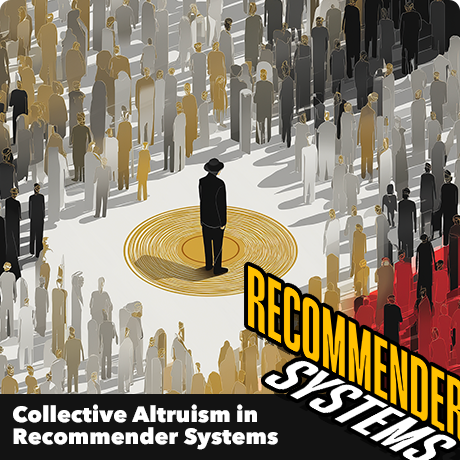
Ekaterina (Kat) Fedorova from MIT EECS joins us to discuss strategic learning in recommender systems—what happens when users collectively coordinate to game recommendation algorithms. Kat's research reveals surprising findings: algorithmic "protest movements" can paradoxically help platforms by providing clearer preference signals, and the challenge of distinguishing coordinated behavior from bot activity is more complex than it appears. This episode explores the intersection of machine learning and game theory, examining what happens when your training data actively responds to your algorithm.
Niche vs Mainstream

Anas Buhayh discusses multi-stakeholder fairness in recommender systems and the S'mores framework—a simulation allowing users to choose between mainstream and niche algorithms. His research shows specialized recommenders improve utility for niche users while raising questions about filter bubbles and data privacy.
Healthy Friction in Job Recommender Systems

In this episode, host Kyle Polich speaks with Roan Schellingerhout, a fourth-year PhD student at Maastricht University, about explainable multi-stakeholder recommender systems for job recruitment. Roan discusses his research on creating AI-powered job matching systems that balance the needs of multiple stakeholders—job seekers, recruiters, HR professionals, and companies. The conversation explores different types of explanations for job recommendations, including textual, bar chart, and graph-based formats, with findings showing that lay users strongly prefer simple textual explanations over more technical visualizations. Roan shares insights from his "healthy friction" study, which tested whether users could distinguish between real AI-generated explanations an...
Fairness in PCA-Based Recommenders

In this episode, we explore the fascinating world of recommender systems and algorithmic fairness with David Liu, Assistant Research Professor at Cornell University's Center for Data Science for Enterprise and Society. David shares insights from his research on how machine learning models can inadvertently create unfairness, particularly for minority and niche user groups, even without any malicious intent. We dive deep into his groundbreaking work on Principal Component Analysis (PCA) and collaborative filtering, examining why these fundamental techniques sometimes fail to serve all users equally.
David introduces the concept of "power niche users" - highly active users...
Video Recommendations in Industry
In this episode, Kyle Polich sits down with Cory Zechmann, a content curator working in streaming television with 16 years of experience running the music blog "Silence Nogood." They explore the intersection of human curation and machine learning in content discovery, discussing the concept of "algatorial" curation—where algorithms and editorial expertise work together. Key topics include the cold start problem, why every metric is just a "proxy metric" for what users actually want, the challenge of filter bubbles, and the importance of balancing familiarity with discovery. Cory shares insights on why TikTok's algorithm works so well (clean data and ma...
Eye Tracking in Recommender Systems
In this episode, Santiago de Leon takes us deep into the world of eye tracking and its revolutionary applications in recommender systems. As a researcher at the Kempelin Institute and Brno University, Santiago explains the mechanics of eye tracking technology—how it captures gaze data and processes it into fixations and saccades to reveal user browsing patterns. He introduces the groundbreaking RecGaze dataset, the first eye tracking dataset specifically designed for recommender systems research, which opens new possibilities for understanding how users interact with carousel interfaces like Netflix. Through collaboration between psychologists and AI researchers, Santiago's work demonstrates how ey...
Cracking the Cold Start Problem

In this episode of Data Skeptic, we dive deep into the technical foundations of building modern recommender systems. Unlike traditional machine learning classification problems where you can simply apply XGBoost to tabular data, recommender systems require sophisticated hybrid approaches that combine multiple techniques. Our guest, Boya Xu, an assistant professor of marketing at Virginia Tech, walks us through a cutting-edge method that integrates three key components: collaborative filtering for dimensionality reduction, embeddings to represent users and items in latent space, and bandit learning to balance exploration and exploitation when deploying new recommendations.
Boya shares insights from...
Designing Recommender Systems for Digital Humanities

In this episode of Data Skeptic, we explore the fascinating intersection of recommender systems and digital humanities with guest Florian Atzenhofer-Baumgartner, a PhD student at Graz University of Technology. Florian is working on Monasterium.net, Europe's largest online collection of historical charters, containing millions of medieval and early modern documents from across the continent. The conversation delves into why traditional recommender systems fall short in the digital humanities space, where users range from expert historians and genealogists to art historians and linguists, each with unique research needs and information-seeking behaviors.
Florian explains the technical challenges of building a...
DataRec Library for Reproducible in Recommend Systems

In this episode of Data Skeptic's Recommender Systems series, host Kyle Polich explores DataRec, a new Python library designed to bring reproducibility and standardization to recommender systems research. Guest Alberto Carlo Maria Mancino, a postdoc researcher from Politecnico di Bari, Italy, discusses the challenges of dataset management in recommendation research—from version control issues to preprocessing inconsistencies—and how DataRec provides automated downloads, checksum verification, and standardized filtering strategies for popular datasets like MovieLens, Last.fm, and Amazon reviews.
The conversation covers Alberto's research journey through knowledge graphs, graph-based recommenders, privacy considerations, and recommendation novelty. He explains why s...
Shilling Attacks on Recommender Systems

In this episode of Data Skeptic's Recommender Systems series, Kyle sits down with Aditya Chichani, a senior machine learning engineer at Walmart, to explore the darker side of recommendation algorithms. The conversation centers on shilling attacks—a form of manipulation where malicious actors create multiple fake profiles to game recommender systems, either to promote specific items or sabotage competitors. Aditya, who researched these attacks during his undergraduate studies at SPIT before completing his master's in computer science with a data science specialization at UC Berkeley, explains how these vulnerabilities emerge particularly in collaborative filtering systems. From promoting a friend's sk...
Music Playlist Recommendations

In this episode, Rebecca Salganik, a PhD student at the University of Rochester with a background in vocal performance and composition, discusses her research on fairness in music recommendation systems. She explores three key types of fairness—group, individual, and counterfactual—and examines how algorithms create challenges like popularity bias (favoring mainstream content) and multi-interest bias (underserving users with diverse tastes). Rebecca introduces LARP, her multi-stage multimodal framework for playlist continuation that uses contrastive learning to align text and audio representations, learn song relationships, and create playlist-level embeddings to address the cold start problem.
A significant contribution of R...
Bypassing the Popularity Bias
Sustainable Recommender Systems for Tourism

In this episode, we speak with Ashmi Banerjee, a doctoral candidate at the Technical University of Munich, about her pioneering research on AI-powered recommender systems in tourism. Ashmi illuminates how these systems can address exposure bias while promoting more sustainable tourism practices through innovative approaches to data acquisition and algorithm design. Key highlights include leveraging large language models for synthetic data generation, developing recommendation architectures that balance user satisfaction with environmental concerns, and creating frameworks that distribute tourism more equitably across destinations. Ashmi's insights offer valuable perspectives for both AI researchers and tourism industry professionals seeking to implement more r...
Interpretable Real Estate Recommendations

In this episode of Data Skeptic's Recommender Systems series, host Kyle Polich interviews Dr. Kunal Mukherjee, a postdoctoral research associate at Virginia Tech, about the paper "Z-REx: Human-Interpretable GNN Explanations for Real Estate Recommendations"
The discussion explores how the post-COVID real estate landscape has created a need for better recommendation systems that can introduce home buyers to emerging neighborhoods they might not know about. Dr. Mukherjee, explains how his team developed a graph neural network approach that not only recommends properties but provides human-interpretable explanations for why certain regions are suggested. The conversation covers the advantages of u...
Why Am I Seeing This?
In this episode of Data Skeptic, we explore the challenges of studying social media recommender systems when exposure data isn't accessible. Our guests Sabrina Guidotti, Gregor Donabauer, and Dimitri Ognibene introduce their innovative "recommender neutral user model" for inferring the influence of opaque algorithms.
Eco-aware GNN Recommenders

In this episode of Data Skeptic, we dive into eco-friendly AI with Antonio Purificato, a PhD student from Sapienza University of Rome. Antonio discusses his research on "EcoAware Graph Neural Networks for Sustainable Recommendations" and explores how we can measure and reduce the environmental impact of recommender systems without sacrificing performance.
Networks and Recommender Systems

Kyle reveals the next season's topic will be "Recommender Systems". Asaf shares insights on how network science contributes to the recommender system field.
Network of Past Guests Collaborations

Kyle and Asaf discuss a project in which we link former guests of the podcast based on their co-authorship of academic papers.
The Network Diversion Problem
In this episode, Professor Pål Grønås Drange from the University of Bergen, introduces the field of Parameterized Complexity - a powerful framework for tackling hard computational problems by focusing on specific structural aspects of the input. This framework allows researchers to solve NP-complete problems more efficiently when certain parameters, like the structure of the graph, are "well-behaved".
At the center of the discussion is the network diversion problem, where the goal isn't to block all routes between two points in a network, but to force flow - such as traffic, electricity, or data - thr...
Complex Dynamic in Networks
In this episode, we learn why simply analyzing the structure of a network is not enough, and how the dynamics - the actual mechanisms of interaction between components - can drastically change how information or influence spreads. Our guest, Professor Baruch Barzel of Bar-Ilan University, is a leading researcher in network dynamics and complex systems ranging from biology to infrastructure and beyond.
BarzelLab
BarzelLab on Youtube
Paper in focus: Universality in network dynamics, 2013
Github Network Analysis

In this episode we'll discuss how to use Github data as a network to extract insights about teamwork.
Our guest, Gabriel Ramirez, manager of the notifications team at GitHub, will show how to apply network analysis to better understand and improve collaboration within his engineering team by analyzing GitHub metadata - such as pull requests, issues, and discussions - as a bipartite graph of people and projects.
Some insights we'll discuss are how network centrality measures (like eigenvector and betweenness centrality) reveal organizational dynamics, how vacation patterns influence team connectivity, and how decentralizing communication hubs...
Networks and Complexity
In this episode, Kyle does an overview of the intersection of graph theory and computational complexity theory. In complexity theory, we are about the runtime of an algorithm based on its input size. For many graph problems, the interesting questions we want to ask take longer and longer to answer! This episode provides the fundamental vocabulary and signposts along the path of exploring the intersection of graph theory and computational complexity theory.
Actantial Networks
In this episode, listeners will learn about Actantial Networks—graph-based representations of narratives where nodes are actors (such as people, institutions, or abstract entities) and edges represent the actions or relationships between them.
The one who will present these networks is our guest Armin Pournaki, a joint PhD candidate at the Max Planck Institute for Mathematics in the Sciences and the Laboratoire Lattice (ENS-PSL), who specializes in computational social science, where he develops methods to extract and analyze political narratives using natural language processing and network science.
Armin explains how these methods can expose conflicting narr...
Graphs for Causal AI
How to build artificial intelligence systems that understand cause and effect, moving beyond simple correlations?
As we all know, correlation is not causation. "Spurious correlations" can show, for example, how rising ice cream sales might statistically link to more drownings, not because one causes the other, but due to an unobserved common cause like warm weather.
Our guest, Utkarshani Jaimini, a researcher from the University of South Carolina's Artificial Intelligence Institute, tries to tackle this problem by using knowledge graphs that incorporate domain expertise.
Knowledge graphs (structured representations of information) are combined with n...
Power Networks
Unveiling Graph Datasets
Network Manipulation
In this episode we talk with Manita Pote, a PhD student at Indiana University Bloomington, specializing in online trust and safety, with a focus on detecting coordinated manipulation campaigns on social media.
Key insights include how coordinated reply attacks target influential figures like journalists and politicians, how machine learning models can detect these inauthentic campaigns using structural and behavioral features, and how deletion patterns reveal efforts to evade moderation or manipulate engagement metrics.
Follow our guest
X/Twitter
Google Scholar
Papers in focus
Coordinated Reply Attacks in Influence Operations: C...
The Small World Hypothesis
Kyle discusses the history and proof for the small world hypothesis.
Thinking in Networks
Kyle asks Asaf questions about the new network science course he is now teaching. The conversation delves into topics such as contact tracing, tools for analyzing networks, example use cases, and the importance of thinking in networks.
Fraud Networks

In this episode we talk with Bavo DC Campo, a data scientist and statistician, who shares his expertise on the intersection of actuarial science, fraud detection, and social network analytics.
Together we will learn how to use graphs to fight against insurance fraud by uncovering hidden connections between fraudulent claims and bad actors.
Key insights include how social network analytics can detect fraud rings by mapping relationships between policyholders, claims, and service providers, and how the BiRank algorithm, inspired by Google's PageRank, helps rank suspicious claims based on network structure.
Bavo will also...
Criminal Networks

In this episode we talk with Justin Wang Ngai Yeung, a PhD candidate at the Network Science Institute at Northeastern University in London, who explores how network science helps uncover criminal networks.
Justin is also a member of the organizing committee of the satellite conference dealing with criminal networks at the network science conference in The Netherlands in June 2025.
Listeners will learn how graph-based models assist law enforcement in analyzing missing data, identifying key figures in criminal organizations, and improving intervention strategies.
Key insights include the challenges of incomplete and inaccurate data in...