New Books in European Politics
This podcast is a channel on the New Books Network. The New Books Network is an academic audio library dedicated to public education. In each episode you will hear scholars discuss their recently published research with another expert in their field. Discover our 150+ channels and browse our 28,000+ episodes on our website: newbooksnetwork.com Subscribe to our free weekly Substack newsletter to get informative, engaging content straight to your inbox: https://newbooksnetwork.substack.com/ Follow us on Instagram and Bluesky to learn about more our latest interviews: @newbooksnetwork
Fascists of the World, Unite?: A History of Fascist Internationalism in the 1930s with Martin Kristoffer Hamre (de Gruyter Oldenbourg, 2025)
Fascists of the World, Unite?: A History of Fascist Internationalism in the 1930s (de Gruyter Oldenbourg, 2025) analyzes the ideas and forms of international cooperation between Fascist Italy, Nazi Germany, and fascist movements from Denmark, Norway, Sweden, Switzerland, Ireland, and Britain. The study examines how fascists attempted to unite across borders by forming international organizations and networks, hosting conferences and exhibitions, disseminating multilingual publications, and exchanging propaganda. Their transnational cooperation was fuelled by shared ideas of ultranationalism, anti-liberalism, anti-communism, antisemitism, racism, white supremacism, and Europeanism. The book argues that fascist internationalism, marked by contradictions, limitations, and an Italo-German rivalry, emerged...
Romania, the Little Entente and the Struggle for Europe with Owen Grey (Bloomsbury, 2026)
Romania, the Little Entente and the Struggle for Europe (Bloomsbury, 2026) is the first in-depth, English-language study of Romania's role in the Little Entente-an alliance formed with Czechoslovakia and Yugoslavia to defend the territorial status quo in Central and Eastern Europe after the First World War. While this alliance has often been dismissed in international historiography as peripheral, this book argues that the Little Entente was a critical, albeit fragile, experiment in regional security and interwar diplomacy. Anchored in Romania's foreign policy, it reinterprets the alliance as a revealing case study in small-state agency, collective security, and the entropic pressures...
Governing Islam in Austria and Germany, with Farid Hafez
In this episode, hosts Claudia Radiven and Amina Easat-Daas were joined by Farid Hafez to discuss his most recently published book Governing Islam in Austria and Germany: From Colonial Times to the Present (Oxford UP, 2026). Hafez’s recent work centres on the comparative analysis of the Austro-Hungarian rule in Bosnia-Herzegovina and the German rule in Tanzania, Togo and Cameroon, and in particular their respective treatment of Muslims in each case to then in turn shed light on the current governing of Muslimness in both. Farid Hafez is an assistant professor in International Relations at William and Mary, and also a...
Racism and Antiracism in Divided Germany with Michelle Lynn Kahn and Lauren Stokes (Cornell UP, 2026)
Racism and Antiracism in Divided Germany (Cornell UP, 2026) addresses how racism expresses itself and what it means to be antiracist by tracing the history of racism and antiracist activism in East, West, and unified Germany. As far-right extremism surges in Germany today, Germans from across the political spectrum are increasingly grappling with the presence of racism in a country that is still coming to terms with its Nazi past. However, these public discussions are not always historically informed, and racism in Germany is often dismissed as a fringe phenomenon rather than part of mainstream society
The contributions...
Poles and Jews: A Call for Myth Reconstruction with Jennifer Stark-Blumenthal (Academic Studies Press, 2024)
Nationalism’s global resurgence has upended societies. With the rise of the Polish nationalist Law and Justice (PiS) party, and American Jewry’s swift reaction to its law punishing people who allege Polish complicity in Holocaust crimes, both sides have revived old stereotypes. Stark-Blumenthal argues that American Jews’ disgust with Polish nationalism ought to be checked by America’s centuries-old embrace of white supremacy. Poles and Jews: A Call for Myth Reconstruction (Academic Studies Press, 2024) confronts both the anti-Polonism deeply embedded in the American Jewish community and Poland’s enduring relationship with antisemitism. Armed with two decades of research and in-dep...
Refugees and Citizens in Twentieth-Century East Central Europe: An Unlikely Refuge? with Michal Frankl, Doina Anca Cretu and Lidia Zessin-Jurek (CEU Press, 2026)
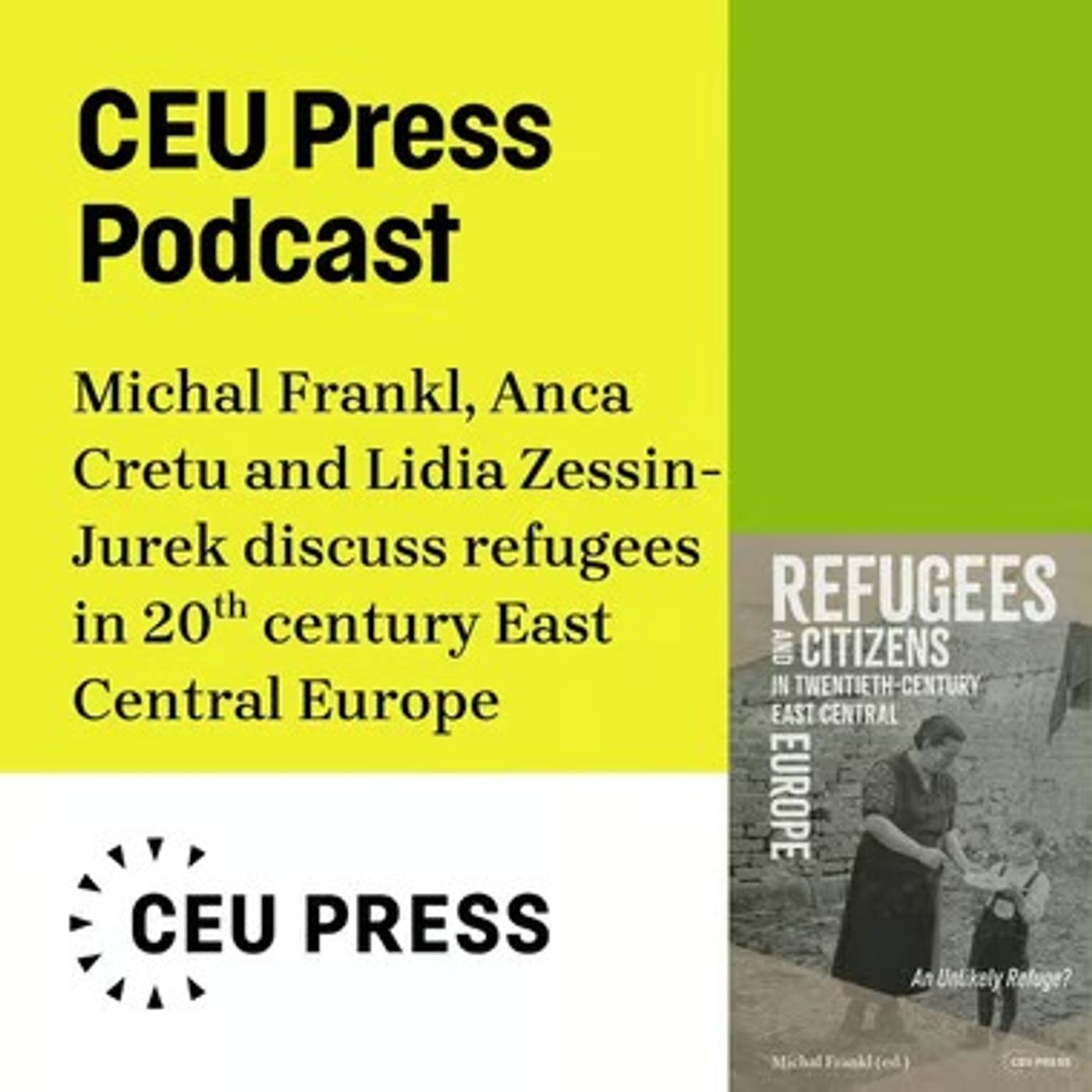
In this episode of the CEU Press Podcast host Andrea Talabér talked to Michal Frankl, Doina Anca Cretu and Lidia Zessin-Jurek about the new edited volume Refugees and Citizens in Twentieth-Century East Central Europe: An Unlikely Refuge? We discussed the reception of the ERC-project the volume is based on at a time of heightened narratives about refugees and the place of Central and Eastern Europe in the scholarship, reflecting on the current relevance of the project.
The Zotero bibliography for the project is openly available, please click here to access it.
You can purchase a c...
The Afterlife of a Fascist Murder: Giacomo Matteotti in Myth and Memory, 1924-2024 with Amy King (Cambridge UP, 2026)
In this episode, I speak with Dr Amy King of Bristol University about her book, The Afterlife of a Fascist Murder: Giacomo Matteotti in Myth and Memory, 1924–2024, published by Cambridge University Press in 2026.
The year 2024 marked a century since socialist leader Giacomo Matteotti's assassination. Widely commemorated in Italy, he's often remembered within a national narrative of antifascist resistance. But how was this narrative built and how has the far right responded? This Element traces the construction and mobilisation of Matteotti's memory over the last century, analysing the role of grief in the early antifascist movement, and identifying th...
Debarati Sanyal, "Arts of the Border: Fugitive Bodies at Europe’s Edges" (Fordham, 2025)
Arts of the Border: Fugitive Bodies at Europe’s Edges (Fordham, 2025) investigates the consequences of unfolding catastrophes across the world and the displacement they continue to produce. Through recent narratives and media representations of the refugee “crisis” at Europe’s edges, it tells a new story about those on the move, the technologies unleashed on them at borders, the racialized and colonial histories that inform these technologies, and the artistry with which migrants and allies bear witness to displacement. The book reorients us toward the creativity and movement of migrants themselves– their “arts of the border”—as well as toward the polit...
Robert Shum, "Democracy or Carbon Oligarchy?: Climate and Energy Politics between Crisis and Decarbonization" (Palgrave Macmillan, 2026)
Democracy or Carbon Oligarchy?: Climate and Energy Politics between Crisis and Decarbonization (Palgrave Macmillan, 2026) tackles a critical question. Why has the world struggled so much to coordinate policy to address climate change, despite political and scientific consensus? Despite landmark agreements and expanding knowledge, emissions have fallen unevenly and progress has repeatedly stalled or reversed. Democracy or Carbon Oligarchy? explains that failure by focusing on domestic politics: how institutions distribute power, how interest groups exploit “access points,” and why countries with similar wealth and technology diverge. Moving beyond arguments about mere political will, it situates energy and climate outcomes within the...
Ukrainian Men Fleeing Conscription: A Discussion with Writer Dan Storyev
Our conversation focuses on a groundbreaking article by Dan Storyev recently published in The Nation: “Millions of Ukrainian Men Are Fleeing a Cruel Conscription System.” Storyev was on the ground in Odesa to report firsthand for this piece, drawing on encounters with Ukrainian men in flight from the officers of the Ukrainian state agency, known as TCR, in charge of mobilizing fighting-age men for the war in Ukraine against Russia’s invading army. It’s an important story, yet one, as he told me, that few outlets in the Western press want to publish. And as we note, Russia also is...
Denialism: Polish Style
Holocaust distortion in Poland involves reshaping or minimizing facts about the Holocaust, often emphasizing Polish victimhood while obscuring instances of local collaboration, participation, or indifference. It appears in political rhetoric, memory laws, public commemorations, and attacks on critical scholarship. YIVO’s Poland vs. Holocaust History series examines these dynamics and situates the Polish case within a broader European context.
Elżbieta Janicka focuses on the case of the former German Nazi death camp Treblinka, the place of murder and (un)rest of nearly one million Jews from several European countries, the majority from Poland. While keeping in min...
Yulia Gradskova et al., "Good Mothers, Nations and Nationalisms: Cases from Lithuania, Russia and Sweden" (CEU Press, 2026)
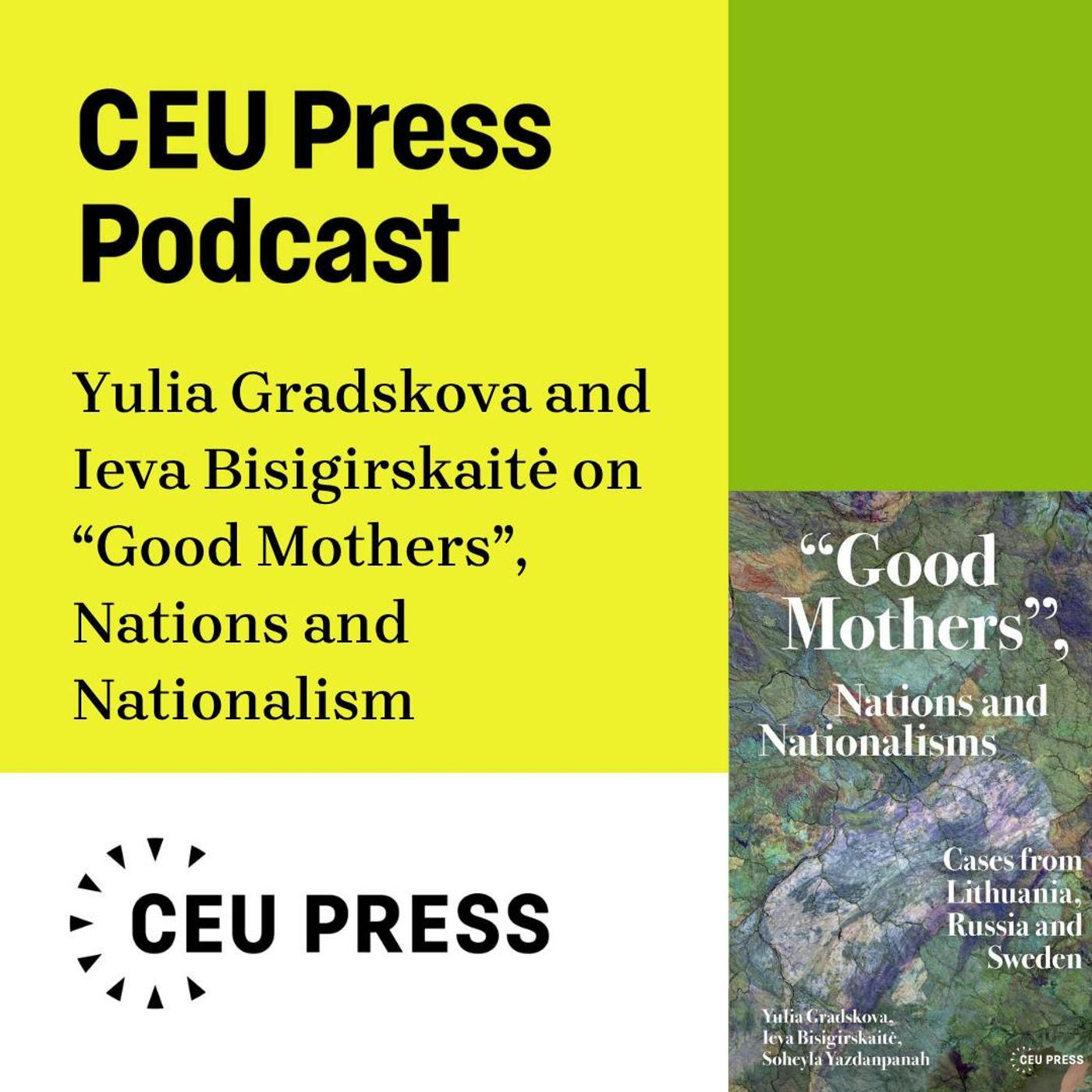
In this episode, host Andrea Talabér (CEU Press, 2026) talks with Yulia Gradskova and Ieva Bisigirskaitė, two of the three authors behind Good Mothers, Nations and Nationalisms: Cases from Lithuania, Russia and Sweden. Together with Soheyla Yazdanpanah, they explore what nationalists mean by "good mothers," demographic anxiety, and maternal activism in Lithuania, Russia and Sweden.
You can purchase a copy here.
The CEU Press Podcast delves into various aspects of the publishing process: from crafting a book proposal, finding a publisher, responding to peer review feedback on the manuscript, to the subsequent distribution, promotion and ma...
Bridget Hourican on Frank Callanan's "James Joyce: A Political Life" (Princeton UP, 2026)
The young James Joyce (1882–1941) was forged in the smithy of Irish political controversies, and he took into his European exile a depth of political insight unrivalled among his fellow modernists. In this biography of Joyce in his youth and early exile James Joyce: A Political Life (Princeton UP, 2026), acclaimed Irish historian and biographer Frank Callanan reveals a Joyce who is markedly more politically conscious, informed and complex than the Joyce of Richard Ellmann’s classic account. Written in a sparkling style and rich with historical insights, Callanan’s deeply researched biography is the first sustained account of how Joyce’s Irish and Eu...
Giulio Boccaletti, "The Environmental Republic: Why Citizens Will Save the World" (Princeton UP, 2026)
Republicanism is arguably the most powerful political idea in
history, an extraordinary feat of human imagination that balances
individual liberty with collective responsibility. The Environmental Republic: Why Citizens Will Save the World (Princeton
University Press, 2026) reclaims this idea as the path to sustaining
our life together on a changing planet, reframing our relationship to
the environment not as a constraint on liberty but as its republican
foundation.
Giulio Boccaletti argues that we must renew our commitment to freedom
and civic responsibility through popular sovereignty. He presents the
environmental republic as a necessary alternative to blind faith in
technocratic manageme...
Georgia Kernell, "Inside Parties: How Party Rules Shape Membership and Responsiveness" (Cambridge UP, 2025)
Inside Parties: How Party Rules Shape Membership and Responsiveness (Cambridge UP, 2025) by Georgia Kernell examines how party rules determine how parties select candidates, nominate leaders, and set policy goals. Most research on party organisation pays very little attention to what happens within political parties; this book addresses this gap by examining how internal party rules and procedures shape party membership and political responsiveness. Drawing on an original dataset of party statutes covering 65 political parties across 20 parliamentary democracies, the book offers one of the most comprehensive studies of party organisation to date. The book develops a formal model of party...
The Resurgence of War and the Collapse of Arms Control
How the nuclear guardrails were dismantled. What arms control actually did (risk management, predictability, geography), how it unravelled from the 2000s onward, and why its collapse matters more now as we see a resurgence of strategic instability and armed conflict.
Hosted by Simplecast, an AdsWizz company. See pcm.adswizz.com for information about our collection and use of personal data for advertising.
Anna Lively, "Revolutionary Connections: Russia and Ireland, 1905-1923" (Oxford UP, 2026)
Anna Lively is a historian of modern Ireland, Britain, and Russia. Awarded her PhD in History from the University of Edinburgh in 2022, she is currently a Leverhulme Early Career Fellow in History at the University of Strathclyde. Prior to this she held the Roy Foster Irish Government Research Fellowship in the History and Culture of Ireland at Hertford College, University of Oxford, and was a Teaching Fellow in Modern History at the University of Aberdeen. She has published in multiple journals on the centenary of the Russian Revolution of 1917 and on the Irish Save the Children Fund.
...
Mikuláš Pešta, "Student Internationalism and the Global Cold War: The International Union of Students in Socialist Prague" (Bloomsbury, 2026)
In this episode of the CEU Review of Books Podcast, I sat down with Mikuláš Pešta to talk about his new book, Student Internationalism and the Global Cold War: The International Union of Students in Socialist Prague (Bloomsbury, 2026). During our discussion we touched upon how the International Union of Students ended up being headquartered in Prague, the organisation's various activities, and the life of the Secretariat, amongst other topics.
You can purchase the book from Bloomsbury here. The book is also available Open Access here.
The CEU Review of Books Podcast Series explores the que...
Kurt Warner, "False Idols: How Diversion is Destroying Democracy" (Vernon Press, 2024)
False Idols: How Diversion is Destroying Democracy (Vernon Press, 2024) examines how modern forms of diversion shape civic life and weaken democratic responsibility. Drawing on the ancient Roman idea of “bread and circuses,” Kurt Warner explores how contemporary society is saturated with distractions that keep citizens focused on what is immediate, pleasurable, profitable, or spectacular, rather than on what is politically and socially meaningful.
The conversation introduces listeners to the book’s central concern: how celebrity culture, consumerism, economic pressures, sports, politics, art, music, literature, the internet, social media, and video games can become “false idols.” These forces do not mer...
Democratic Backsliding and Resistance: Poland’s Civil Society, Electoral Strategies, and Institutional Levers
This week on Democracy Dialogues, Frances Cayton speaks with four experts on Polish politics about the success of Poland’s opposition coalition in 2023, and the headwinds that democracy continues to face today.
What challenges do parties and civil society face in building pro-democracy electoral coalitions? If victorious, how do these challenges affect post-election governance and efforts at pursuing democratic renewal? This episode brings together politicians, political scientists, and civil society leaders who each played a critical role in the 2023 elections to examine what made Poland’s pro-democracy mobilization possible, the gains the 2023 coalition has achieved since entering powe...
Jonathan Schneer, "Nine Days in May: The General Strike Of 1926" (Oxford UP, 2026)
In May, 1926, nearly three million British workers downed tools to support nearly one million of their countrymen, miners whose employers meant to lengthen their working day and cut their pay. This General Strike brought the country to a grinding halt - which, according to Conservative Prime Minister Stanley Baldwin, represented a threat not merely to the nation but to the parliamentary system itself. For nine days, the world's best organized working class confronted the world's most powerful, and self-confident, government. And yet the outcome was never in doubt, for Britain's most important trade-union leaders thought as Baldwin did, although...
AI, Algocracy, and Democracy's Challenging Road Ahead with Andrew Sorota
Like many people, I've been following the developments of AI, testing out new models and following the deluge of news stories about the fight for supremacy. Much has been written about the existential and economic risks posed by AI, but the political implications of superintelligent systems have often been sidelined. In the United States and elsewhere, AI companies steam ahead with little regulation or oversight. Meanwhile, politicians appear flatfooted and unsure about the best way to integrate AI into the government to make democracies stronger and more responsive to the needs and will of the people. AI will undeniably...
Brexit Britain: 10 Years on from the Referendum
Anniversaries provide opportunities to take stock and reflect. It is now ten years since voters in the United Kingdom cast their ballots in a referendum on whether the UK should Leave or Remain in the European Union. The subsequent decade has seen much churn and change in British politics. Join Tim Haughton and guests Maria Sobolewska, Charlotte Galpin and Monika Brusenbauch Meislova for a discussion of the causes, process and consequences of that decision made on 23 June 2016.
Maria Sobolewska is Professor of Political Science at the University of Manchester. Among her many publications is the book, Brexitland, co...
Andrew Demshuk, "The Filthiest Village in Europe: Grassroots Ecology and the Collapse of East Germany" (Cornell UP, 2026)
The Filthiest Village in Europe: Grassroots Ecology and the Collapse of East Germany (Cornell University Press, 2026) traces how a community shrouded by "industrial fog," at the brink of gaping coal pits, became a symbol that galvanized grassroots ecology—campaigns by diverse local actors that exposed environmental and economic crises East Germany's political system could not resolve. Notoriously known by the late 1980s as "the filthiest village in Europe," Mölbis suffocated downwind from the massively polluting carbochemical Espenhain plant. Applying a myriad of private collections, interviews, and untapped archival sources, Andrew Demshuk reveals how pastors, parents, officials, inspectors, workers, and sp...
Damien Van Puyvelde, "The DGSE: A Concise History of France's Foreign Intelligence Service" (Georgetown UP, 2026)
France is a leading intelligence power, but we know very little about its premier intelligence agency: the Direction Générale de la Sécurité Extérieure (DGSE). Damien Van Puyvelde's latest book, The DGSE: A Concise History of France's Foreign Intelligence Service (Georgetown University Press, 2026), examines France's foreign intelligence service from its rebranding as the DGSE in 1982 to the present.
It covers the legacies of the Second World War, how decolonization and the Cold War shaped the organization, the organization's workforce and leadership, as well as public and (pop) cultural perceptions and representations of intelligence in France. The eme...
Why Elected Leaders Subvert Democracy
When we think about threats to democracy, we often imagine dramatic breakdowns—military coups, constitutional crises, or sudden collapses. But today, a common danger is slower and less visible: democratic erosion driven by elected leaders themselves. Across different regions, presidents and prime ministers are weakening institutions, undermining accountability, and reshaping the rules of the game from within. Why is this happening now, and why do voters sometimes tolerate it?
In this episode, CEDAR host Temitayo Odeyemi speaks with Susan Stokes about her article in the Journal of Democracy, “Why Elected Leaders Subvert Democracy,” and what it reveals about the c...
Carlos Martins, "Fascism: Beyond Hitler and Mussolini" (Desassossego, 2022)
Carlos Martins joins the New Books Network to discuss his book Fascism: Beyond Hitler and Mussolini (Desassossego, 2022) (in Portuguese Fascismos: Para Além de Hitler e Mussolini), a comparative study of fascist movements across Europe and beyond. Working from a rigorous definition of fascism based on its ideological content, Martins examines eight case studies, analysing these specific manifestations of fascism to identify what they had in common and what separated them.
In this conversation, we discuss the problem of defining fascism, the distinctions between fascism and populism and why Martins argues that not every dictatorship or radical right mov...
Inken Von Borzyskowski and Felicity Vabulas, "Exit from International Organizations: Costly Negotiation for Institutional Change” (Cambridge UP, 2025)
Why do states exit international organizations (IOs)? How often does exit from IOs – including voluntary withdrawal and forced suspension – occur? What are the effects of leaving IOs for the exiting state?
Despite the importance of membership in IOs, a broader understanding of exit across states, organizations, and time has been limited. Exit from International Organizations: Costly Negotiation for Institutional Change (Cambridge UP, 2025) addresses these lacunae through a theoretically grounded and empirically systematic study of IO exit. Von Borzyskowski and Vabulas argue that there is a common logic to IO exit, which helps explain both its causes and conseq...
Steffen Mau et al., "The Trigger Points: Inequality and Political Polarization in Contemporary Society" (Policy Press, 2026)
Today’s political debates are fiercely polarized. But looking beyond the headlines, The Trigger Points: Inequality and Political Polarization in Contemporary Society (Policy Press, 2026) shows that ordinary citizens hold much more nuanced, less divided views.
Drawing on rich survey data and group discussions, this work maps four major areas of conflict: migration, climate change, diversity, and economic justice.
Across these conflicts, most citizens take positions that are middle-of-the-road, contradictory, or undecided. It is only certain ‘trigger points' – like gendered pronouns or refugee admissions – that predictably ignite tensions and deep disagreement.
Political entrepreneurs know this and we...
Assessing Global Democratic Health Amidst a Growing Shadow of Autocracy
This week on Democracy Dialogues, host Maya Tudor speaks with two democracy experts at Carnegie Endowment for International Peace and Freedom House to understand the headlines from Freedom House’s 2026 Report, entitled the growing shadow of autocratization. We discuss the drivers behind the 20th consecutive year of global democratic decline and compare the similarities and differences between Freedom House and Varieties of Democracy reports. We conclude by anticipating what lies ahead, what our experts are looking to understand, and what everyday citizens can do to strengthen democracy.
Links:
Freedom in the World 2026
25 Years of...
The British General Election of 2024: A Conversation with Robert Ford and Paula Surridge
Why and how did Labour win the 2024 election? In The British General Election of 2024 Robert Ford, a Professor of Politics at the University of Manchester, Tim Bale, Professor of Politics at Queen Mary, University of London, Will Jennings, Professor of Politics at the University of Southampton, and Paula Surridge, Professor of Politics at the University of Bristol present a detailed analysis of the context, campaign and election result. Part of a long running series of books that offer definitive accounts of British elections, the book uses a range of methods, including examining of social, print and televisual media, fieldwork with indi...
Ida Susser, "The Yellow Vests and the Battle for Democracy: Taking to the Streets of Paris in the 21st Century" (Routledge, 2026)
Written under the shadow of growing authoritarianism in the United States and Europe, this book is an effort to understand resistance movements of the twenty-first century. It foregrounds the Yellow Vests to present an accurate and timely picture of a protest movement that baffled analysts and blurred the boundaries of left and right.
Comprehensively exploring the meaning of “les Gilets Jaunes triompheront” (the yellow vests will win), written on the Arc de Triomphe in 2018, The Yellow Vests and the Battle for Democracy details how people of all ages, many from the provinces and the urban periphery, rushed throug...
Radio ReOrient 14:4: The Coconut Trial with Marieha Hussain, hosted by Fatima Rajina and Stephen Lawrence Research Centre
In this episode, Dr Fatima Rajina is joined by Marieha Hussain to talk about her experience of the Coconuts trial. A case that saw the political activist being charged with, and eventually proven innocent of, a racially aggravated public order offence for showcasing a satirical placard labelling Rishi Sunak and Suella Braverman as “coconuts” prompting the fundamental question “Who has the right to police your language”?
In November 2023, Marieha was arrested for displaying a placard labelling prominent exponents of the then-Tory government as “coconuts” during a pro-Palestine protest. According to the charges put on her, the term coconut was...
Kristan Stoddart, "Russia's Hybrid Warfare Offensive Against the West" (de Gruyter, 2025)
Kristan Stoddart's Russia's Hybrid Warfare Offensive Against the West (de Gruyter, 2025) is a timely and systematic analysis of Russian hybrid warfare with a particular focus on Russian cyberespionage and cyberwarfare. It especially analyzes Russian policy from the election of President Vladmir Putin in 2000 to date.
It takes a long term, long lens, view of Russian policies and actions internationally and domestically, fundamentally questioning the relationship and boundaries between active measures, espionage, cyberespionage, and hybrid warfare.
The most up-to-date and systematic analysis of Russia’s hybrid warfare. Draws on a wide range of multi-disciplinary literature. Questions the boun...Audrey Borowski, "Leibniz in His World: The Making of a Savant" (Princeton UP, 2026)
Described by Voltaire as “perhaps a man of the most universal learning in Europe,” Gottfried Wilhelm Leibniz (1646–1716) is often portrayed as a rationalist and philosopher who was wholly detached from the worldly concerns of his fellow men. Leibniz in His World: The Making of a Savant (Princeton UP, 2026) provides a groundbreaking reassessment of Leibniz, telling the story of his trials and tribulations as an aspiring scientist and courtier navigating the learned and courtly circles of early modern Europe and the Republic of Letters.
Drawing on extensive correspondence by Leibniz and many leading figures of the age, Audrey Borowski paints a n...
Donald Sassoon, "Revolutions: A New History" (Verso Books, 2025)
Revolutions: A New History (Verso Books, 2025) is a sparkling account of political upheaval and the power of history. We think of revolutions in terms of fleeting events, such as the fall of the Bastille or the storming of the Winter Palace. In reality, they take decades to burn out, if they ever do.
Historian Donald Sassoon takes the long view of some of the most famous upheavals: the English Civil War, the American War of Independence, the national uprisings that unified Italy and Germany, and the French, Russian and Chinese revolutions. This is a history rich in irony an...
Katharina Wiedlack, "Under Western Eyes: Vulnerable Minorities and the Russian State in New Cold War Cultures" (Academic Studies Press, 2025)
Under Western Eyes: Vulnerable Minorities and the Russian State in New Cold War Cultures (Academic Studies Press, 2025) examines the New Cold War between Anglophone Western and Russian media, focusing on its coverage of LGBTIQ+ topics and representations of Russian femininity, masculinity, racial and gender diversity, and disability. It interrogates how the Anglophone media constructs images of vulnerable bodies and groups in Russia, juxtaposing them with the vengeful state and the powerful figure of Putin. These media discourses delineate and unify liberal values as American and Western and contrast them with "backward" Russian values. Paradoxically, in its endeavor to accentuate Amer...
Jasper Bernes, "The Future of Revolution: Communist Prospects from the Paris Commune to the George Floyd Uprising" (Verso Books, 2025)
How might a twenty-first-century revolution against class society succeed?
Communism comes from the future, but its hopes haunt our past. Reading revolutionary history from the Paris Commune to the George Floyd Uprising by the light of communist theory, from Marx to C. L. R. James, The Future of Revolution: Communist Prospects from the Paris Commune to the George Floyd Uprising (Verso Books, 2025) illuminates the possibilities for overcoming class society in the twenty-first century.
When Marx wrote that the Paris Commune of 1871 showed that “the working class cannot simply lay hold of the ready-made state machinery, and wield it for...
Marta Lorimer, "Europe As Ideological Resource: European Integration and Far Right Legitimation in France and Italy" (Oxford UP, 2024)
How did the far right go from illegitimate fringe to contender for public office, and did Europe have anything to do with it? Europe As Ideological Resource: European Integration and Far Right Legitimation in France and Italy (Oxford UP, 2024) argues that European integration functioned as an ideological resource for far right parties looking for legitimation because it enabled them to refashion their political message in a more acceptable form, while maintaining the allegiance of their existing supporters.
Drawing on the qualitative analysis of over 400 documents produced by the Movimento Sociale Italiano/Alleanza Nazionale in Italy (1978-2009) and the Ras...
Mark Pennington, "Foucault and Liberal Political Economy: Power, Knowledge, and Freedom" (Oxford UP, 2025)
Foucault and Liberal Political Economy: Power, Knowledge, and Freedom by Mark Pennington
This highly original and innovative book is the first to comprehensively engage the ideas of the French social theorist and philosopher Michel Foucault from within the tradition of liberal political economy. Divided into two parts the book commences by demonstrating important commonalities between Foucault's ideas and those of a neglected 'post-modern' stream in liberal political and economic thought. These ideas draw on a social theory emphasising a culturally situated individualism; a philosophy of science highly critical of socio-economic 'scientism' and 'expert rule'; and an understanding of...
