Series 7 Whisperer

The Series 7 Whisperer is the voice in your head you wish you had while studying. Hosted by a retired NYSE trader and FINRA principal with 37 years on the Street, this podcast cuts through the noise to deliver the raw, real, and testable truths behind the Series 7 exam. No fluff. No filler. Just the stuff that gets you paid. Whether you’re cramming before test day or grinding through options, suitability, and regs, this is your shortcut to passing with swagger.
Series 63,65,66 Exam: Ethics and Prohibited Activities

Send us Fan Mail
Ethics & Prohibited Activities: What You Need to Know for Your Securities Exams
What's unethical, what's prohibited, and how do you recognize the difference on exam day?
In this episode of Series 7 Whisperer®, we explore the ethical responsibilities, prohibited practices, and regulatory standards tested on the SIE, Series 7, Series 63, Series 65, and Series 66 exams.
From misrepresentation and churning to conflicts of interest, discretionary trading, and fiduciary duties, we focus on understanding the concepts rather than simply memorizing definitions.
Because passing these exams isn't about knowing a...
Series 7 Exam Prep: Taxes cheat sheet

Send us Fan Mail
Taxes on the Series 7 exam don't have to be complicated. The problem is that tax questions show up everywhere — stocks, bonds, mutual funds, options, retirement accounts, and even wash sales.
In this episode, the Series 7 Whisperer breaks down the tax concepts you actually need to know to pass the Series 7 exam. No unnecessary CPA-level details, no memorizing endless tax brackets — just the rules, shortcuts, and calculations that matter on test day.
What we cover:
Ordinary income vs. capital gainsShort-term vs. long-term capital gainsQualified and nonq...Series 65 and Series 66 Exam: Offer and Sale Jurisdiction

Send us Fan Mail
State Jurisdiction Explained | Series 63, Series 65 & Series 66 Exam Prep
When does a state have jurisdiction over a securities transaction? Does it matter where the customer lives, where the agent is located, or where an offer is accepted?
If you're studying for the Series 63, Series 65, or Series 66 NASAA exam, understanding state jurisdiction under the Uniform Securities Act of 1956 is critical.
In this episode of Blue Collar Finance, we break down Section 414 of the Uniform Securities Act (USA), including offers to buy, offers to...
Series 7 Exam Prep: All About Order Types

Send us Fan Mail
the mechanics of secondary market trading, outlining how order tickets transition from entry and execution to clearing. Broker-dealers operate either as brokers earning commissions or as dealers/market makers profiting from spreads, markups, and markdowns. Trading venues range from traditional physical locations like the NYSE, which relies on Designated Market Makers (DMMs) to maintain liquidity, to dealer-to-dealer networks such as Nasdaq and various Alternative Trading Systems. The text also explains specialized order types (including market, limit, and stop orders...
FORM ADV:Series 65 and Series 66 Exam

Send us Fan Mail
Form ADV serves as the primary registration document utilized by investment advisors, structured into three distinct parts alongside specific schedules to inform both regulators and clients. Part 1 focuses on regulatory data, where Part 1A gathers general firm facts for both federal and state authorities, while Part 1B collects supplementary information specifically mandated for state-registered entities. Part 2 functions as the client brochure, dividing information between Part 2A, which details the overarching advisory business and its operational practices, and Part 2...
SIE Exam BEATS: Preferred Stock

Send us Fan Mail
Preferred stock shows up all over the Series 7, and it can feel more complicated than it really is.
In this episode, we make it smaller.
We cover the preferred stock concepts you need to know for the exam, including:
• Preferred stock vs. common stock vs. bonds
• Fixed dividends and $100 par value
• Current yield
• Dividend priority and liquidation priority
• Cumulative vs. noncumulative preferred
• Dividends in arrears
• Participating preferred
• Adjustable-rate preferred
• Convertible preferred
• Callable preferred
• Conversion ratio and conversion value
• Call risk...
SIE Exam Beat: Bonds( Debt)

Send us Fan Mail
Bond Fundamentals — learn it while you move.
Bonds show up everywhere on the SIE and Series 7, and memorizing a couple of definitions isn't enough. In this episode of SIE Exam Beats, we're going deep on the bond concepts you actually need to understand for the exam — using music, repetition, examples, and the hooks that make this stuff stick.
We cover par value, coupon rates, bond prices, premiums and discounts, current yield, yield to maturity, accrued interest, interest-rate risk, credit risk, callable and convertible bonds...
SIE Exam: Rich People Buy Munis

Send us Fan Mail
educational guide to municipal bonds, focusing on why they are attractive investments for individuals in high tax brackets. It highlights the tax-advantaged nature of these securities, noting that interest is typically exempt from federal taxes and sometimes state and local taxes as well. The material distinguishes between General Obligation (GO) bonds, which are supported by taxpayer funds, and revenue bonds, which rely on income from specific projects like toll roads. Key analytical concepts are introduced, including the feasibility...
Series7 Exam:Communications and Filing Guidelines

Send us Fan Mail
regulatory framework established by FINRA for governing how financial firms communicate with the public. It distinguishes between retail, institutional, and correspondence categories, outlining specific pre-filing and post-use submission timelines based on the type of investment product and the firm's membership tenure. Key requirements include mandatory approval by a qualified principal for most retail materials to ensure compliance with industry standards. The documentation also lists various filing exceptions, such as for prospectuses or previously approved templates, while offering...
Balance Sheet vs Income Statement: Series 7 and Series 65 Exam

Send us Fan Mail
financial statement and ratio analysis for both academic study and professional licensing. One source provides a specialized guide for the Series 7 exam, emphasizing that students should focus on the relationships between accounts and basic liquidity ratios rather than memorizing complex formulas. It highlights that the test prioritizes the ability to recognize financial strength or weakness to make suitable investment recommendations. The second source offers a broader corporate perspective, detailing how balance sheets, income statements, and cash flow statements serve as vital tools for...
SIE Exam Beat: Common Stock Deep Dive

Send us Fan Mail
Study for your securities exam while you move.
This podcast turns the SIE, Series 7, Series 63, Series 65, Series 66, and other securities exam concepts into songs, rhythms, hooks, and repetition designed to make the material stick.
Put it on at the gym. Walk the dog. Hit the treadmill. Drive to work. Instead of finding another hour to sit at a desk, use the time you're already moving to reinforce what you're studying.
These aren't just cute mnemonic songs. We deep dive into the actual material — co...
Corporate Bonds ( BEATS) CAN THEY PAY?
Send us Fan Mail
Support the show
📚 About the Podcast
Real-world finance explained the way exams and real life actually test it.
Ideal for the SIE, Series 7, Series 65/66, and anyone who wants to actually understand money—not just memorize buzzwords.
⚠️ Disclosure
This podcast is for educational purposes only and is not a recommendation to buy or sell any security. Opinions expressed are solely those of the host.
🚀 Go Deeper
Live classes, tutoring, practice questions, and bonus content:
👉 Website / Classes: https://series7exam.org...
Series 65 Exam: Cybersecurity Beats ( Series 66 Exam )

Send us Fan Mail
he five core functions of the NASAA cybersecurity framework, summarized by the acronym I-P-D-R-R. This educational mnemonic guides financial professionals through the essential stages of risk management, beginning with the identification of digital assets and potential vulnerabilities. The framework then moves into protection through preventative safeguards like encryption and detection via continuous system monitoring to spot active threats. When a security breach occurs, the protocol dictates an immediate response to contain damage, followed by a recovery phase...
Series 7 Exam prep: Variable Annuities

Send us Fan Mail
outlines the fundamental structure and regulatory components of variable life insurance and annuity contracts as covered in the Series 7 exam. It examines the unique insurance features, such as death benefits and living riders, alongside the mechanics of separate accounts and their investment performance. The text details the valuation process, explaining how accumulation and annuitization units determine the financial worth of a policy. Additionally, it highlights the purchasing requirements, fee structures, and various payout elections available to investors during the annuitization phase. F...
Series 7 Exam prep : Mutual Funds, Closed End Funds and ETFs ( SIE Exam also )

Send us Fan Mail
details the core concepts surrounding packaged investment products as outlined in the Series 7 exam curriculum. It explores the foundational structures of investment companies, specifically contrasting the operational mechanics of open-end and closed-end funds. The text enumerates various fund objectives, such as growth and income, while explaining technical aspects like net asset value (NAV) and diverse fee structures. Furthermore, it covers essential sales practices and redemption procedures that govern how these assets are bought and sold...
Series 7 Exam Prep: All About Equities
Send us Fan Mail
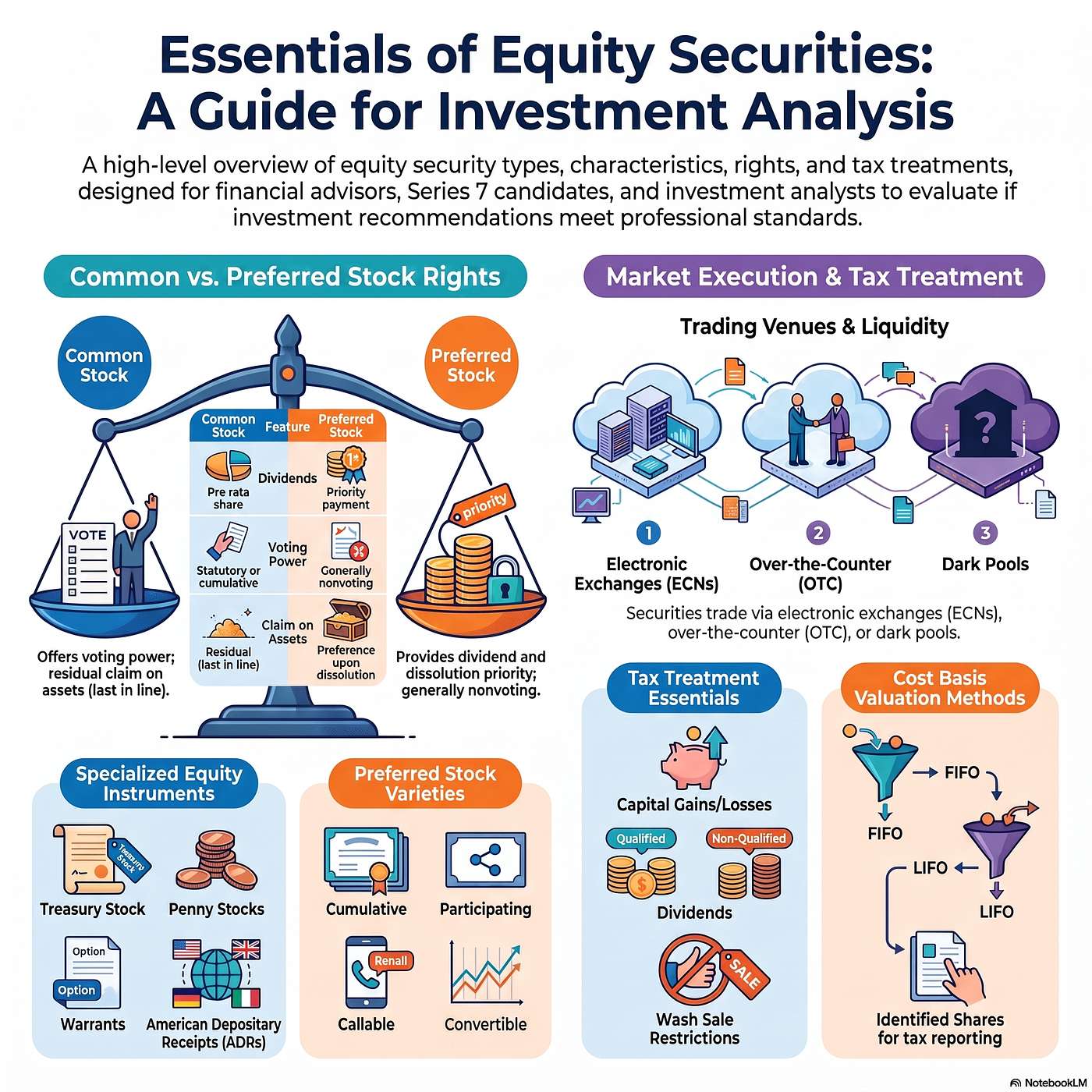
This comprehensive guide outlines the essential knowledge required for evaluating equity securities and ensuring investment choices align with regulatory standards. It details the fundamental characteristics of common and preferred stocks, covering specific investor rights such as voting power, dividend claims, and liquidation preferences. The text further explores various market instruments, including warrants, rights, and foreign securities like American Depositary Receipts. Additionally, it examines the operational landscape of trading, ranging from traditional electronic exchanges to private dark pools. Finally, the source provides an extensive overview of <...
Series 65 Exam ( Types of Corporations ) Series 66 Exam also
Send us Fan Mail
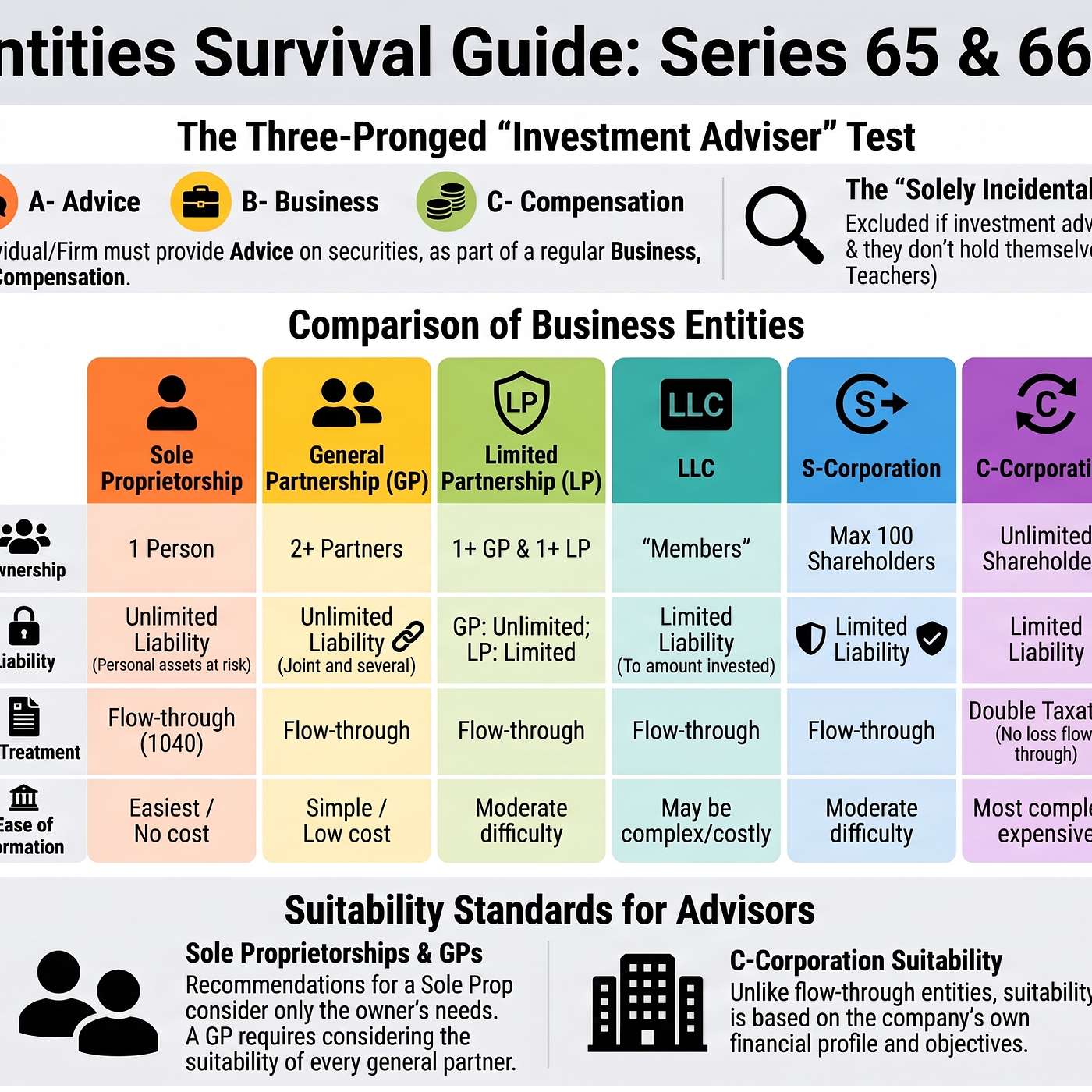
a comprehensive comparison of legal business structures, detailing the unique characteristics of entities like C corporations, S corporations, LLCs, and partnerships. They explain critical distinctions regarding owner liability, specifically contrasting the limited protection of shareholders and members with the unlimited personal risk faced by sole proprietors and general partners. The materials also highlight taxation frameworks, differentiating between double taxation at the corporate level and pass-through (flow-through) treatment, where profits and losses are reported on individual returns. Beyond...
Series 65 Exam: Per Stirpes vs Per Capita ( Series 66 Exam also )
Send us Fan Mail
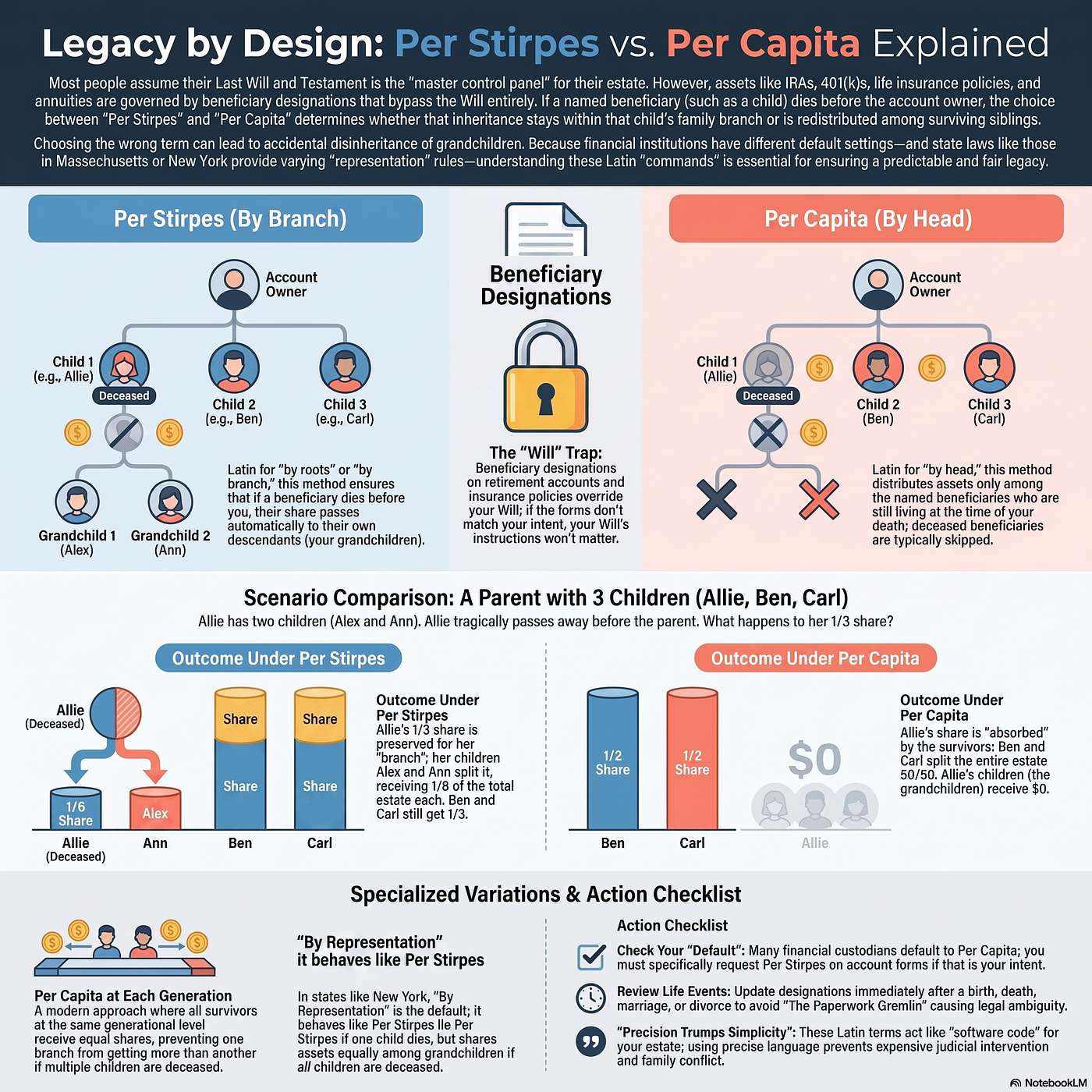
The difference between these two distribution methods comes down to how the "class" of beneficiaries is defined, which radically changes who is included in the final headcount (since per capita translates to "by head").
Here is the breakdown of how each designation works:
"To My Children, Per Capita"
Who is included: The beneficiary class is strictly confined to your immediate, first-generation children.
How it works: The estate is divided equally only among your children who outlive you.
<...
Series 79 Function 1.2 part 2 Essential Financial Ratios and Valuation Metrics for Corporate Transactions

Send us Fan Mail
a comprehensive outline of key financial metrics and ratios utilized in corporate advisory services, including mergers and acquisitions (M&As), restructurings, and equity or debt transactions. It categorizes these critical data points into five main areas:
Liquidity: Metrics that measure a company's cash flow and working capital, such as the current ratio, quick ratio (acid test), debt-to-capital, and the cash collection cycle.
Profitability: Indicators of a company's ability to generate earnings, including EBITDA, earnings per share (EPS), return on equity (ROE), return on assets (ROA...
Series 79 Function 1.1 Analysis and Evaluation of Data

Send us Fan Mail
Function 1.2: Analysis and Evaluation of Data covers several essential topics that would make a great foundation for your podcast:
Financial Analysis & Modeling: Analyzing individual companies, comparable companies, and specific industry sectors, as well as building spreadsheets and financial models using basic accounting and statistical concepts.
The Balance Sheet: Breaking down assets (such as cash, marketable securities, inventory, PP&E, and goodwill), liabilities (like short-term debt, accounts payable, and long-term debt), and stockholders' equity/net worth (including preferred/common stock and retained earnings).
Series 79 Function 1.1 Collection of Data

Send us Fan Mail
to help you prepare for the Series 79 exam, here is a breakdown of the core concepts from the provided bullet points, organized into key areas of investment banking responsibilities:
1. Data Collection and Valuation Analysis A major part of the role involves gathering and analyzing data to value companies and understand the market:
Information Gathering: You must collect financial, performance, and transaction data from a variety of sources, including commercial databases, regulatory filings, company websites, and media.
Market and Company Analysis: This...
Series 63 Exam Cheat Sheet: Registration and Regulations ( Series 65 and Series 66 Exam )

Send us Fan Mail
comprehensive guide for individuals preparing for the Series 63, 65, and 66 exams. The content details the specific registration requirements and legal definitions for broker-dealers, investment advisors, and their representatives. It highlights critical distinctions, such as how broker-dealers focus on transaction execution while investment advisors provide compensated advice. The source also clarifies complex regulatory jurisdictional rules, explaining when firms must register with the SEC versus individual states. Finally, the material provides practical test-taking strategies, including a "cheat sheet"...
Series 65 and Series 66 Exam : Yield Curve

Send us Fan Mail
This Series 65 study guide focuses on the yield curve as a primary indicator of economic health and its impact on fixed-income securities. It identifies the three main curve shapes—normal, inverted, and flat—highlighting that an inverted curve is a historically reliable predictor of a recession. The material clarifies essential financial principles, such as the inverse relationship between bond prices and interest rates and how duration dictates price volatility. Additionally, it outlines how Federal Reserve policies...
Series 65 and Series 66 Exam: Time Value of Money

Send us Fan Mail
the fundamental principles of the time value of money, focusing specifically on the concepts of future value and net present value. They explain that an asset's worth changes over time because current capital can be invested to earn simple or compound interest. Educational materials from Wikipedia and BYU detail how these calculations assist in personal finance planning, such as retirement saving and evaluating investment "sacrifices." Complementary video transcripts demonstrate practical applications, such as using Excel functions to determine if a project's...
SIE Exam : Prohibited Activities

Send us Fan Mail
comprehensive overview of the Securities Industry Essentials (SIE) exam, detailing its structure, content, and the professional standards required of candidates. These sources outline critical regulatory frameworks managed by FINRA and the SEC, focusing on prohibited market activities such as insider trading, front running, and churning. They further define the permitted roles of registered representatives, established gift and compensation limits, and the strict protocols for maintaining outside business activities. Additionally, the materials provide practical study strategies and personal insights from...
Series 7 Exam and Series 65 Exam : Current Ratio explained

Send us Fan Mail
the concept of short-term liquidity, which measures a firm's capacity to settle its immediate financial debts. It defines current assets as resources like cash or inventory that will be utilized or sold within a single year, while current liabilities represent the obligations due in that same timeframe. To assess financial health, analysts utilize the current ratio, a formula that divides these assets by the liabilities to see if a company can cover its bills. A result above one typically suggests a stable financial...
Series 65 and Series 66 Exam: RISK( Standard Deviation,Beta and MPT)

Send us Fan Mail
comprehensive framework for understanding investment analysis, risk management, and the regulatory requirements for financial professionals. They contrast critical performance metrics, such as time-weighted returns which isolate asset performance and dollar-weighted returns which account for investor cash flows. The text further explains that standard deviation captures total volatility for concentrated holdings, whereas beta is the superior measure for assessing a security's impact on a diversified portfolio. Central to these concepts is Modern Portfolio Theory, which advocates for using <...
Series 65 Math: Concepts over Calculations

Send us Fan Mail
Episode Summary
Ever stared down a brutal math question on the Series 65 or 66 exam, sweating bullets, with nothing but a cheap, plastic four-function calculator in your hand? You are not alone.
In this deep dive, we reveal why that basic calculator is actually your secret weapon. We pull back the curtain on how to completely demystify the math questions on your FINRA and NASAA licensing exams. The secret? Conceptual understanding over rote calculation. The test writers aren't testing your ability to run complex polynomial equations; they want...
Why smart people fail the SIE Exam and Series 7 Exam
Send us Fan Mail
🎙️ Podcast Episode Topics — Cognitive Biases That Hurt Test-Takers
Dunning-Kruger Effect — fake confidence before the exam Self-Serving Bias — blaming the test instead of fixing weaknesses Confirmation Bias — studying what feels comfortable Overconfidence Bias — mistaking familiarity for mastery Planning Fallacy — unrealistic study timelines IKEA Effect — overvaluing your notes and spreadsheets Google/GPT Effect — outsourcing memory instead of learning Cryptomnesia — confusing recognition with understanding Transfer Appropriate Processing — failing when wording changes Zeigarnik Effect — why unfinished concepts stick in your brain State-Based Learning — your test brain vs. your study brain Law of Triviality — wasting time on low-value study tasks Attentional Bia...Is GameStop really gonna buy eBay?

Send us Fan Mail
GameStop just did something insane.
A $12 billion company made an unsolicited bid to buy eBay for $56 billion.
No call.
No warning.
Straight to a public offer.
In this episode, we break down:
What a hostile takeover actually is (and why this qualifies)The financing problem nobody can ignoreWhy the market is basically saying “yeah… probably not happening”And the real play here — because this might not be about buying eBay at allThis is one of those deals where the numbers don’t make...
Trusts and Joint Accounts ( Series 65 and Series 66 Exam )

Send us Fan Mail
Trusts, Estates & Joint Accounts | Series 65 and Series 66 Exam Prep
Everything you need on trusts, estates, and joint accounts for the Series 65 (Uniform Investment Adviser Law Examination) and Series 66 (Uniform Combined State Law Examination). This topic isn't a huge percentage of the exam, but it's easy points if you know the patterns NASAA likes to test.
What this video covers:
Joint account types — JTWROS (Joint Tenants with Rights of Survivorship), Tenants in Common, Tenants by the Entirety, and community property. The survivor question and ho...
Efficient Market Hypothesis (Series 65 and Series 66)

Send us Fan Mail
Support the show
📚 About the Podcast
Real-world finance explained the way exams and real life actually test it.
Ideal for the SIE, Series 7, Series 65/66, and anyone who wants to actually understand money—not just memorize buzzwords.
⚠️ Disclosure
This podcast is for educational purposes only and is not a recommendation to buy or sell any security. Opinions expressed are solely those of the host.
🚀 Go Deeper
Live classes, tutoring, practice questions, and bonus content:
👉 Website / Classes: https://series7exam.org...
SIE Exam Prep ( Market mechanics) Options,Mutual Funds,Economics,Order types

Send us Fan Mail
Support the show
📚 About the Podcast
Real-world finance explained the way exams and real life actually test it.
Ideal for the SIE, Series 7, Series 65/66, and anyone who wants to actually understand money—not just memorize buzzwords.
⚠️ Disclosure
This podcast is for educational purposes only and is not a recommendation to buy or sell any security. Opinions expressed are solely those of the host.
🚀 Go Deeper
Live classes, tutoring, practice questions, and bonus content:
👉 Website / Classes: https://series7exam.org...
Series 7 Exam: Customer Accounts ( SIE Exam also )

Send us Fan Mail
Support the show
📚 About the Podcast
Real-world finance explained the way exams and real life actually test it.
Ideal for the SIE, Series 7, Series 65/66, and anyone who wants to actually understand money—not just memorize buzzwords.
⚠️ Disclosure
This podcast is for educational purposes only and is not a recommendation to buy or sell any security. Opinions expressed are solely those of the host.
🚀 Go Deeper
Live classes, tutoring, practice questions, and bonus content:
👉 Website / Classes: https://series7exam.org...
A Guide to Equity Securities

Send us Fan Mail
Equity securities represent ownership interests in a corporation, offering a range of risk and reward profiles suited to different investment objectives. Common stock serves as the primary vehicle for capital appreciation and corporate governance, though it carries the highest risk and the lowest priority in liquidation. Preferred stock functions as a hybrid instrument, providing consistent dividend income and higher claim priority, similar to debt instruments.
Short-term and long-term opportunities are facilitated through rights and warrants, which allow for the purchase of shares under specific conditions—rights protecting existing ownership from dilution an...
What AI Really Means for Finance Careers (No Hype)
Send us Fan Mail
Artificial intelligence isn’t “ending finance jobs.”
That headline is lazy — and wrong.
What AI is actually doing is stripping out the parts of finance roles that were never worth a human salary, while putting more pressure (and upside) on judgment, client work, risk decisions, and real thinking.
In this episode, we break down — without hype or fear-mongering — what AI is actually changing across finance careers, including:
Wealth management and financial advisorsClient-facing associates and sales assistantsSales & trading desksInvestment banking analysts and associatesEntry-level roles and career switchersW...
Series 7 Exam Prep: All About Bonds
Send us Fan Mail
a comprehensive study guide for the Series 7 exam, focusing on the technical and regulatory nuances of debt securities. They contrast the structures of corporate, municipal, and government bonds, detailing how interest is calculated and how secondary market transactions are settled. Specific attention is given to accrued interest methodologies, such as the 30/360 and actual/365 systems, which determine the payments owed between buyers and sellers. The documents also outline the legal protections and tax implications unique to general obligation and r...
Securities Acts Explained for SIE Exam
Send us Fan Mail
he provided text outlines the fundamental legal frameworks governing the American financial industry, specifically focusing on the Securities Act of 1933 and the Securities Exchange Act of 1934. The 1933 Act establishes protocols for new investment offerings, requiring companies to provide full transparency through registration statements and prospectuses to protect the public from fraud. In contrast, the 1934 Act regulates the secondary market, overseeing the ongoing trading of existing stocks and the conduct of broker-dealers and self-regulatory organizations. Additional...
Series 7 Exam Prep:529 Plans.. Absolutely Testable
Send us Fan Mail
529 plans show up on the Series 7 more than people expect — and most students miss points because of tax timing, not definitions.
In this episode, we do a deep dive on 529 College Savings Plans for the Series 7 exam, including:
• How 529 plans are taxed
• Contribution rules and 5-year gift tax averaging
• Qualified vs nonqualified withdrawals
• State vs federal tax treatment
• What a registered representative must disclose when a client uses an out-of-state 529
• The calendar year vs academic year trap that causes penalties on the exam
Key takeaway f...
Open End Funds vs Closed End Funds:A casual conversation
Send us Fan Mail
Open-End vs. Closed-End Funds: The Real Difference (Without the Fluff)Let’s clear something up — not all funds are created equal. You’ve probably heard of mutual funds and closed-end funds, and maybe someone even told you they’re “basically the same.” They’re not. Not even close.
Here’s the no-BS breakdown.
1. Open-End Funds: The Mutual Fund You Actually KnowThis is your classic mutual fund. It’s “open” because new shares can be created or redeemed every day. You invest directly with the fund company, not through the market.
Pric...
