Divided Argument
An unscheduled, unpredictable Supreme Court podcast. Hosted by Will Baude and Dan Epps. In partnership with SCOTUSblog.
You Should See the Other Guy

Divided Argument — S7E1: Summary & Highlights
One-line summary (Beamly)
Season 7 opens with a Court busy not deciding: an Alito recusal, a quorum lost to four book deals, and a stern Purcell per curiam for Missouri.
Show notes
Season 7 opens after a long delay, a dead sound mixer, and a host who punched himself in the face, so we start with the things the Court didn't decide. Justice Alito's late recusal from Suncor Energy v. County Commissioners of Boulder County and the four book deals that cost the Court a quorum in BM...
Shoe of Damocles
We're back after a break, and the August interim docket handed us two per curiam standing rulings. In Trump v. California, the Court stayed the injunction against the mail-ballot executive order because the states' injuries were too hypothetical, even as the Postal Service's final rule has already been enjoined and is already back at the Court. In National Park Service v. National Trust for Historic Preservation, the Court let the ballroom construction continue because a historic preservationist's aesthetic injury is "mere offense," which leaves us asking why a crocodile counts and the White House doesn't. We work through ripeness...
A Thriving Atrocities Practice

After following up on Justice Alito's summer interview, the new birthright-citizenship executive orders, and the Court's record-low approval numbers, we devote the episode to Cisco Systems v. Doe, the Falun Gong surveillance case that closes the door Sosa v. Alvarez-Machain left open for new Alien Tort Statute claims. We try to build a theory of the ATS from first principles — Section 9 of the Judiciary Act of 1789, the law of nations, and the Marbois affair — before running through two decades of the Court narrowing the statute. Then we ask what to make of "door closing" as a phenomenon, from Edwards v. V...
Very Civilized Orangutans
We squeeze in one more episode before Will's vacation, tying the single-season record in the process. The mailbag then demands a reckoning on whether Magneto's powers are really limited to ferrous metals, along with the origins of the S tier and the truth-value of conditional predictions. The main event is Hunter v. United States, which holds that a plea bargain's appeal waiver is unenforceable when enforcing it would work a "miscarriage of justice." We try to figure out where that rule could possibly come from — contract law? Rule 11? the supervisory power? procedural common law? — and why an opinion this law...
Ice by Magneto
We're back — maybe getting a little too scheduled — with one opinion on the docket: West Virginia v. B.P.J. and Little v. Hecox, where the Court held that states may limit girls' and women's sports teams to biological sex without violation Equal Protection or Title IX. First, though, Will collects on a two-year-old prediction when the Court grants Jouppi v. Alaska, an Institute for Justice case about a five-figure airplane forfeited over a six-pack of beer. On the main event, we work through how the opinions are written (no pronouns, no "Lindsay"), what the litigants' Title IX concession did...
The Based Direction

We're back from vacation and chipping away at the summer backlog. Before the substance: listeners weigh in on our AI-generated cover art, Claude's new prediction scorecard grades our respective forecasting records, and Justices Kagan and Barrett take the Court's budget request — and some docket-terminology talk — to Congress. Then we spend the rest of the show on T.M. v. University of Maryland Medical System Corporation, in which the Rooker-Feldman doctrine, pronounced dead in the Green Bag two decades ago, proves alive enough to reach state-court judgments still on appeal. We try to figure out what the doctrine actually is, whet...
Norway-Sweden Worshippers

We picked two immigration decisions from the same day over the transgender-sports case because — Dan’s protests notwithstanding — that’s where the interesting law is. In Mullin v. Doe the Court lets the administration terminate temporary protected status for Haiti and Syria, holding the statute’s no-judicial-review bar swallows the procedural challenges and that the equal-protection claim fails on the merits — with a genuinely odd move: skipping the jurisdictional question the way Steel Co. says you can’t. In Mullin v. Al Otro Lado a fight about asylum-metering collapses onto a single preposition — whether a migrant stopped at the border “arrives...
Smart Microwave

After a quick check on the Nina Totenberg embargo kerfuffle and one more revelation from Justice Thomas's memoir, we devote the episode to Chatrie v. United States, the Court's first major Fourth Amendment decision in years. We trace how the geofence-warrant ruling builds on — and goes beyond — Katz, United States v. Jones, and Carpenter v. United States, and what's left of the third-party doctrine and the mosaic theory. Will explains the positive law model of the Fourth Amendment; Dan tries to claim Justice Gorsuch's separate opinion for his general-law approach. We close with the dissents, the advisory-opinion objection, and whet...
Weird Islands
It's the last opinion day of the term, and the big one landed: Trump v. Barbara, the birthright-citizenship case. We read the majority as the rare easy case and spend most of the episode on why the four dissents each end up somewhere different — and trying to figure out exactly where they actually land. Along the way: a bogus Nina Totenberg story, a Landor GVR that might quietly unsettle a chunk of Spending Clause criminal law, and whether the professors who defended the order deserve the "legal scholarship police."
Highlights
[00:00:27] The bogus Nina Totenberg wire st...
Always Already

The big opinions are coming fast and furious as the Term ends. This episode, we take on two related cases from the penultimate opinion drop day: Trump v. Slaughter, which overrules Humphrey's Executor and clears away for-cause protection for the independent agencies, alongside its interim-docket companion Trump v. Cook, where the very same logic somehow spares the Federal Reserve. The big question: if the President can fire an FTC commissioner at will, what actually makes the Fed different — is "history" doing the work, or is the Court just saving the bond markets? Along the way: Heidegger's "always already," whether th...
Mechanical / Animal

We're in triage mode as the Court clears its end-of-term backlog. We run through the week's opinion dump before focusing on two cases that look unrelated but turn on the same question: when may a state rewrite background property law to limit a constitutional right? In Wolford v. Lopez, the Court strikes down Hawaii's rule requiring a property owner's express consent before a firearm may be carried onto otherwise-public premises. Then to Pung v. Isabella County, a takings case asking whether a homeowner whose property is sold for back taxes is owed only the sale proceeds or full fair-market...
Alcoholic Originalism

The big opinions are starting to drop, and we're doing our best to keep pace. We first discuss Landor v. Louisiana Department of Corrections, which concerns religious liberty, the scope of Congress's power to create remedies against individuals under the Spending Clause, and whether there's any redress if government officials literally throw your rights into a trash can. We then turn to United States v. Hemani, where the Court found that a federal law barring gun possession by unlawful drug users violated the Second Amendment and revealed that some of the Justices are surprisingly open-minded about marijuana's...
Watch Snobs

We open with the usual grab bag—the "foot fault" pun buried in a Justice Thomas opinion, reading Justice Alito's clerk-hiring tea leaves, and a detour into the metaphysics of conditional resignations and whether you can be confirmed to a vacancy that doesn't exist yet. Then to the merits: Keathley v. Buddy Ayers Construction, a 9-0 judicial-estoppel case that lets us ask where the doctrine even came from (Tennessee, 1857, apparently), and Abouammo v. United States, the venue case about a former Twitter employee who fabricated a document while the FBI sat downstairs. The venue talk wanders, happily, into the Ye...
Impregnable Citadel of Technicality
After puzzling over an interesting follow-up question about Pitchford v. Cain, we unpack a summary vacatur in Whitton v. Dixon. We then spend a while breaking down the latest developments in Allen v. Milligan line, in which we discuss the future of the Purcell principle and whether the Court should be unusually attentive to public appearances in election cases. We finish with Sripetch v. Jarkesy, where the Court rejects a requirement that the SEC prove victims suffered pecuniary loss before seeking disgorgement, with specific attention to the interesting Seventh Amendment question raised in Justice Thomas's concurrence.
Key...
Smooth Stone in the River

The Court has been busy, and we somehow manage to cover a number of developments with unpredictable efficiency. We talk about the Court's latest summary reversal on the "party presentation principle"; Justice Kavanaugh's vindication of his law journal student note in Pitchford v. Cain; Rutherford and Fernandez, two related cases about the intersection of compassionate release and habeas; and the DIG in Hamm v. Smith, a case about capital punishment and intellectual disability. Along the way, we also get into backlash against a certain SCOTUS advocate's TED talk and further Alabama redistricting fallout.
Key Topics<...
Ninja Court Packing
We are joined by guest co-host Professor Pam Karlan at the American Law Institute Annual Meeting for the last live show of season 6. We work through a busy stretch of the interim docket: the Alabama GVR in Allen v. Caster and what Callais has done to Section 2; the denied stay in the Virginia redistricting fight, Scott v. McDougle; and the mifepristone cases, Danco and GenBioPro v. Louisiana, where Thomas rides the Comstock Act alone and Alito takes it personally. Then a turn to executive power and the term's looming merits decisions—birthright citizenship, the Federal Reserve, Humphrey's Executor—before audi...
Majordoma
The Court’s latest Voting Rights Act decision, Louisiana v. Callais, narrows Section 2 in a way that could reshape redistricting, weaken majority-minority districts, and intensify the fight over how race and partisanship interact in elections. We unpack what the Court said, what it quietly overruled, and why the reasoning matters far beyond Louisiana.
We walk through the statutory text, the long-running collision between the Voting Rights Act and the Court’s racial gerrymandering cases, and the practical consequences for future election-law litigation. Along the way, we debate whether this is best understood as a textual decision, a cons...
Even Eve-ier
A deep dive into the latest Supreme Court news, a couple of unusual shadow docket rulings, and a cross-ideological merits decision that raises classic questions about federal power, preemption, and how much weight lower courts should give to context.
We open with reporting on leaked internal Supreme Court memoranda related to the 2016 stay of the Clean Power Plan, including what the documents may reveal, why the leak itself is so unusual, and whether timing and incomplete records change the story. We also discuss Justice Sotomayor’s public apology after comments about Justice Kavanaugh, and what that moment sa...
Backup backup backup backup argument

We recap and reflect on the oral arguments in Trump v. Barbara (the birthright citizenship case) and then analyze the Court's recent decision in Chiles v. Salazar, about the First Amendment limits on Colorado's conversion therapy ban. We also confront the taboo question: Are judicial opinions too long?
Jezebel Shouting
We're live at WashU Law's Admitted Students Day! After catching up on some shadow docket activity, we dig into Olivier v. City of Brandon, the Court's unanimous March 2026 decision by Justice Kagan. A Mississippi street preacher pleads no-contest to violating an amphitheater protest-zone ordinance, pays his $304 fine, then sues under §1983 to stop future enforcement — and the Fifth Circuit says the puzzling Heck v. Humphrey rule bars the whole thing. We work through why Heck is stranger than it first appears, what the Court got right in resolving the circuit split, and what the decision reveals about the ongoing mess at...
A Subversive Mission

We announce an exciting new partnership with SCOTUSblog and introduce the show to new listeners. We then return to the mysterious origins of the Chief Justice's "no, no, a thousand times no," debate the Court's new policy designed to maintain secrecy, and then take a close look at Galette v. New Jersey Transit Corporation, a sovereign immunity decision in which the Court may, or may not, have paid attention to Will's amicus brief.
Cruel and Unusual and Stupid
It's our live show at the University of Chicago! Hosted by the University of Chicago Federalist Society, we discuss this week's big shadow-docket rulings about gender transitions in California Schools (Mirabelli v. Bonta) and redistricting in New York (Malliotakis v. Williams), and also break down the recent merits decision about the right to counsel when a defendant is testifying (Villareal v. Texas).
Betty Boop or Shakespeare

With unpredictable timeliness, we have a quasi-emergency episode on the 170-page tariffs decision, Learning Resources, Inc. v. Trump. Come for the in-the-weeds legal analysis, stay for the deep dive into the origins of the phrase "no, no, a thousand times no."
Ayn Rand Graffiti
We're back for another live show at the Northwestern Pritzker School of Law, hosted by the Northwestern Federalist Society! We discuss the term's two Second Amendment arguments -- first recapping the oral argument in Wolford v. Lopez, featuring Hawaii's law about getting consent to bear arms on private property; and then previewing the oral argument in United States v. Hemani, about the ban on possession of guns by drug users.
Bok Choy

With shocking and uncharacteristic efficiency, we manage to discuss three merits opinions and one orders list dissent in only 47 minutes. Specifically, we revisit Coney Island Auto Parts Unlimited, Inc. v. Burton (time limits for moving to vacate void judgments) and break down Berk v. Choy (an Erie doctrine puzzle), and Ellingburg v. United States (criminal restitution and the Ex Post Facto Clause), while also managing to discuss Justice Jackson's broadside against the Court's practice of "martinization."
Lake Shrimp

We didn't get the tariffs decision this week, but we discuss two of the opinions we did get -- Bost v. Illinois Board of Elections, a decision about standing and election law, and Case v. Montana, a rare Fourth Amendment case -- in a remarkably efficient episode (after a brief detour into Grok's jurisprudence and the announcement of a major gift to the Constitutional Law Institute).
The Marshal and the Margarine
We're back with the first episode of the new year, breaking down the interim docket opinion/order in Trump v. Illinois, the national guard case, after first warming up with new Erie scholarship, state criminal jurisdiction over federal officers, and some recent online discourse.
Non-Cake Physical Object

We're back to break down a month's worth of shadow docket activity -- three recent summary reversals, plus the stay in the Texas gerrymandering case (Abbott v. LULAC). We also discuss the launch of the SCOTUSblog "interim docket blog."
Counter-Counter-Counter-Designations

Will and Dan record a rare live show in an unusual venue: the Salamander Resort in Middleburg, Virginia, at the annual attorney retreat for trial boutique Wilkinson Stekloff. Dan teaches Will some of the new lingo he's learned from the firm's trial experts before a deep dive into civil procedure. First, we dig into the recently argued Coney Island Auto Parts Unlimited v. Burton, which presents a seemingly easy legal question and harder questions about SCOTUS advocacy and ethics. Then we look back at last Term's LabCorp v. Davis, which the Court DIG'd but which raises some fundamental questions...
Proximity Mines in the Facility

After a predictably unpredictable set of detours through Latin grammar, parenting philosophies, and 90s video games, we catch up on the latest shadow (interim?) docket activity and recap the oral argument in the tariffs cases.
Crazy Half-Drunk Unreliable Research Assistant

Divided Argument is in its sixth season! Our first episode of the term focuses, of course, on the latest developments on the shadow docket. These include several grants of interim relief to the Trump administration, as well as some dissents from the denial of certiorari. But first, an update on Dan's travel schedule and ChatGPT usage, and an important correction to our previous episode.
Proust or Plato
For the season finale, we're joined by Yale law professor Justin Driver to talk about his new book, "The Fall of Affirmative Action: Race, the Supreme Court, and the Future of Higher Education." We discuss the conservative cases for and against affirmative action, the post-SFFA world of university admissions, the promise and limits of colorblindness, and the effects of admissions policies on students' sense of belonging.
Byzantine Wall

We extend our record-breaking run with a discussion of the Court's two big recent emergency docket rulings: Noem v. Vasquez Perdomo and NIH v. American Public Health Association.
Bedrock Con Law 101

We're joined by Michigan law professor Richard Primus to talk about his new book, "The Oldest Constitutional Question: Enumerated and Federal Power." Richard describes one of the the most widespread beliefs about constitutional law -- that the federal government is one of limited, enumerated powers -- and why he thinks it is actually wrong. Along the way, we discuss methods of constitutional interpretation, the relationship between the official story of the law and legal practice, and wrestle with the surprisingly hard question of how many congressional powers are listed in the Constitution.
Originalism Hulk

Continuing our long slog through the end-of-Term opinion dump, it's fraud day! We dig into Kousisis v. United States and Thompson v. United States, two interesting federal criminal law puzzles.
The Country of the Future

We finally circle back to the two big structural constitutional law cases from the last day of the term. First is Kennedy v. Braidwood Management, which upheld the appointment structure of the U.S. Preventative Services Task Force under the Affordable Care Act. Then is FCC v. Consumers' Research, which upheld the universal-service contribution scheme against a pair of non-delegation challenges. Our second-longest episode of the season.
The Thunder Docket
Acting with unpredictable alacrity and unpredictable brevity, we break down the Supreme Court's recent interim order in Trump v. Boyle, and discuss what it means for the unitary executive, and for the shadow docket. We also debate the best name for the Court's emergency/interim orders docket.
Snake-Charmer-Specific
Moving with shockingly unpredictable efficiency, we respond to feedback, debate which of us is more composting-friendly, catch up on the emergency docket, and chip away at our end-of-Term backlog by digging into Diamond Alternative Energy v. EPA.
Didactic and Inculcatory

We look at the final orders list before summer break, and then continue to work through last month's opinions, this time with an extended analysis of two decisions about children and culture wars -- Mahmoud v. Taylor (religious objections to LGBTQ+-inclusive books) and Free Speech Coalition v. Paxton (age verification for accessing online pornography).
Schrödinger's Innocence Right
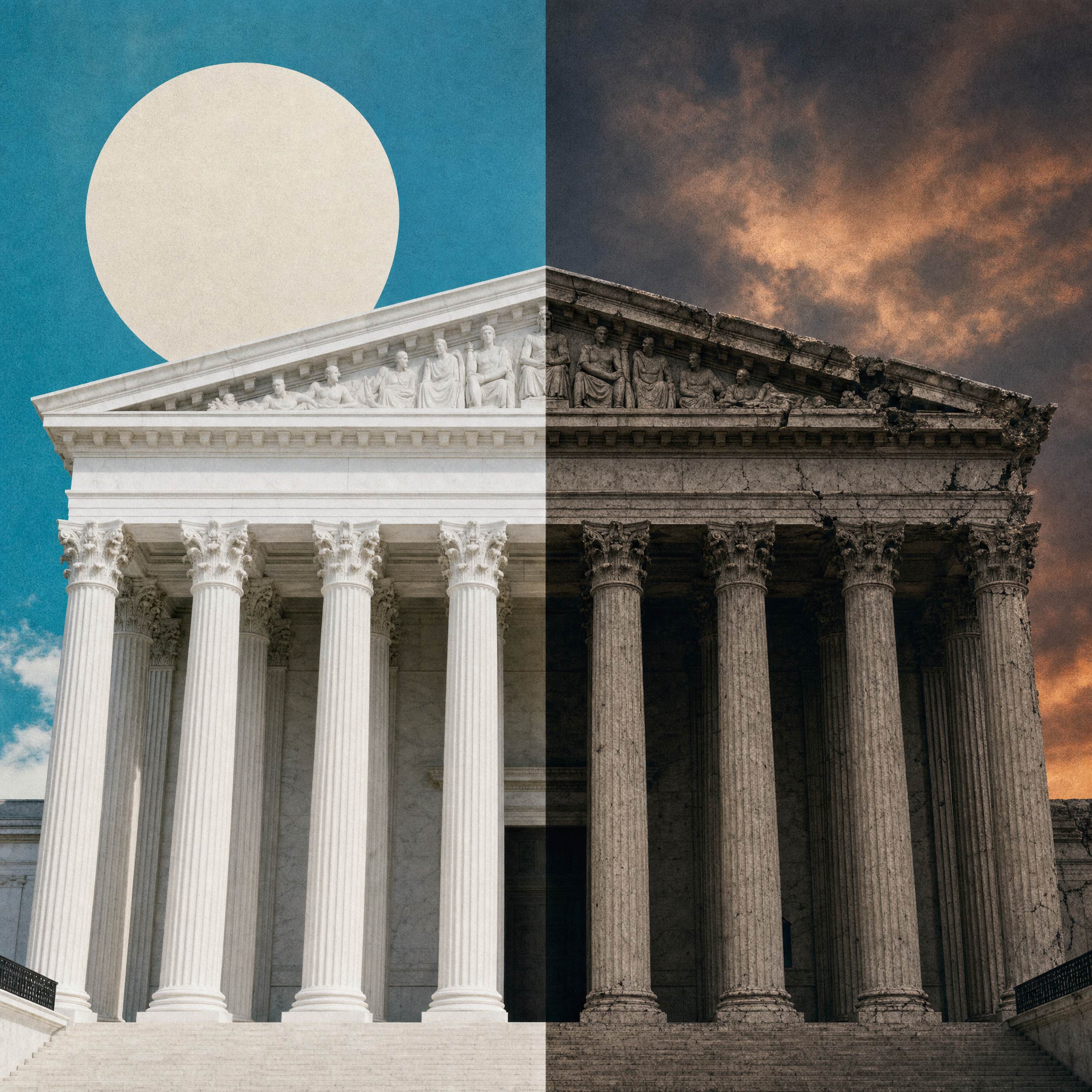
We talk a bit more about Trump v. CASA, revisit the usage of "general," answer some voicemails, and then turn to Gutierrez v. Saenz, a procedural tangle about whether a death row inmate can sue a state prosecutor over access to DNA testing.
