Sound Investing

Weekly podcasts with Paul Merriman. Strategic planning for investing at every stage of life.
Important Research on Adding Value and Profitablity to Your Portfolio
This week I want to look at what the first ten months of 2026 can teach us about how we invest — and why broad diversification keeps looking like the smartest seat in the house.
I start with a Ben Carlson piece from November 1. If you’ve been picking individual tech and AI stocks lately, it has felt like a bloodbath: Google down more than 30% from its highs, Intel off 54%, Netflix down more than 50%, and a long list of others in the penalty box. And yet the S&P 500 is still up almost 12% on the year, with two-thirds of stoc...
Finding an Hourly Advisor from 30,000 feet
Aloha from Oahu! I recorded this one from our hotel room in Hawaii, where my wife and I came to celebrate our two birthdays — three days apart, if not the same year. I promised Zan I’d only work from four to seven each morning on this trip, and this was the one podcast I wasn’t willing to miss.
It kicks off something I’ve wanted to do for a long time: an honest, practical look at one of the biggest forks in the road a do-it-yourself investor ever faces — whether to manage your money yourself or hire so...
The Two Biggest Paydays of My Life
As Paul turned 83 last week, he recorded this podcast in his studio office surrounded by piles of articles and notes for future recordings and a good deal of gratitude. He says this may be his favorite podcast he's ever made.
He starts with the two biggest paydays of his life. The first was December 31, 2012, the day he sold his part of the firm he'd started in 1983 and walked into retirement with a promise to his wife that he'd never work for money again. The second happened in the last 48 hours, and not a dollar changed hands. He...
Office Hours: Teachers Questions Answered
In this special office-hours session, Albert and I answer the questions teachers have been sending in across our four NGPF classroom sessions — more than 500 educators strong.
We move fast and cover a lot of ground:
1. How a young person can open a first investment account (and why $1 is all it takes to start at Fidelity) 02:36
2. My favorite books on saving, investing and index funds 10:58
3. The best free websites and videos for teachers and students 12:51
4. How to make inflation real in the classroom — yes, the bubble-gum story 19:19
5. Why asset classes like small-cap valu...
The $5 Million Pay off for a Financially Literate High School Graduate

WATCH THE VIDEO
This is the fourth of five presentations I recorded for Next Gen Personal Finance (NGPF.org) and am sharing with Sound Investing listeners.
I titled this one “The $5 Million Payoff for a Financially Literate High School Graduate” — but I could have called it the $42 million payoff, and by the end you’ll see the math that makes it believable. I walk through the single biggest decision of all (stocks vs. bonds), 100 years of market history, why the first five years of investing matter most, and how low costs, low taxes, and automati...
The Inside Story About Diversification
Harry Markowitz called diversification "the only free lunch in finance." In this session, part of Paul's series for Next Gen Personal Finance educators, Paul Merriman explains what that means in practice, and why a well-diversified portfolio can help investors stay the course through good markets and bad.
Paul covers the history and math behind diversification, from Don Quixote's "don't put all your eggs in one basket" to Warren Buffett, Charlie Munger, and Sir John Templeton. He explains the three kinds of risk investors face (company, market, and asset class), and shows how the "lost decade" of 2000–2009 hit S...
The #1 Reason to Use Index Funds
Watch the video here.
This is the second of five presentations Paul recorded for Next Generation Personal Finance (NGPF.org), whose free curriculum reaches some 150,000 teachers. The sessions weren't open to the public, but NGPF has allowed Paul to share each one with Sound Investing listeners.
The subject is index funds, and Paul starts where the story starts: John Bogle, 1976, and a fund launch that nearly got cancelled before it opened.
From there he looks at what the evidence actually says about active management over 20 years, why most investors never hear about the...
The Math and the History of Investing
WATCH THE VIDEO
Want to build a multi-million-dollar retirement portfolio without gambling on single stocks? This is the first session of the four-part series I recorded for the teachers of Next Gen Personal Finance — and I’m sharing it here with you. In it, I break down the timeless principles, the math and the market history every long-term investor needs to know.
WHAT YOU’LL LEARN IN THIS EPISODE
• The Math of Compounding [01:43] — how finding an extra 0.5% to 1% in returns — or starting just five years earlier — can add millions to your lifetime...
Get Out While You Can or Stay the Course

Paul opens with news of a new opportunity to reach young investors: a five-part series for Next Generation Personal Finance (NGPF.org), available to some 150,000 teachers who use NGPF's free curriculum. Topics include the math and history of investing, the case for index funds, the inside story on diversification, the $5 million payoff for a financially literate high school graduate, and a teacher Q&A session. Each presentation will be shared with Sound Investing listeners the following week.
Then Paul turns to two listener questions that go to the heart of how people actually experience the market.
<...The Investing Myths That Cost a Fortune
WATCH THE VIDEO
It was a pleasure to be invited back on System Trader with Jack Lempart. Here is a list of the main topics we covered:
CHAPTERS
0:53 • My own biggest mistake
3:15 • Why “the stock market is a casino” is exactly backwards
6:48 • “I don’t have enough money to start” — what $100 a month actually becomes
9:33 • A $20 bet with my 13-year-old grandson
13:04 • How much intelligence does successful investing really require?
15:31 • The Mensa Investment Club: buy low, sell lower
16:24 • Three books for the psychological hurdles
17:38 • “It’s a bad time to invest right now” — the myth...
Paul and Chris Follow-Up: The Rick Ferri Small-Cap Value Debate
Paul and Chris reflect on Paul’s recent discussion with Rick Ferri. Paul adds information he wished he’d included, and Chris reacts to Paul and Rick’s positions. Together, they discuss the behavioral, trust, and performance benefits and trade-offs of seeking meaningful diversification by adding Small-Cap Value to a portfolio.
CHAPTERS
00:00:00 – Intro
00:02:50 – Chris’ 30k Foot View
00:06:16 – Mid-caps?
00:10:40 – Tot. Mkt. vs. S&P 500
00:20:15 – Trust and Change
00:25:45 – Table G1b
00:28:50 – VT vs. AVGE
00:42:20 – Dollar-Cost-Averaging
00:52:00 – Paul’s Grandson’s Question
00:53:08 – Gold funds
00:59:40 – Travel plans
01:02:20 – Outro
Watch the video on YouTube
T...
Paul Merriman and Rick Ferri: A Conversation Decades in the Making
Watch the video here.
Paul sits down with Rick Ferri — not for a debate, but for the kind of honest conversation two people can only have after spending their careers chasing the same goal from different directions.
Rick makes the case against tilting: the small cap premium largely disappeared once the research went public around 1980, and he believes value stopped working around 2006. Paul counters with Table G1b, which shows the results of blending small cap value and the S&P 500 in 10% increments from 1970 through 2025 — returns alongside the worst drawdowns each combination had to survive. Then...
Preparing for an upcoming debate with Rick Ferri: Total Market portfolios
This Friday I'm sitting down with my friend Rick Ferri for a debate that I think matters a great deal, even though — or maybe because — Rick and I agree on almost everything. We both believe in diversification, low costs, index funds, ignoring predictions, and staying the course. Where we part ways is what happens after that.
Rick's case is that you should simply own the whole market. A total stock market index fund gives you thousands of companies at an extraordinarily low cost, and adding complexity rarely pays. My case is that the academic research — Fama, French, and de...
Finding the Perfect Advisor, a Battle Over Words and VT vs. AVGE
Paul returns from three days at the Garrett Planning Network retreat with a lesson that has almost nothing to do with investments — and everything to do with getting your money's worth from professional advice.
Garrett advisors work by the hour, a business model Paul believes eliminates the conflicts of interest built into assets-under-management relationships. For $1,000 to $8,000, he's convinced most families can get extraordinary value from five to ten hours with a thoughtful, trained hourly planner. But there's a catch: the value of those hours depends almost entirely on your willingness to tell the truth. Inspired by a Se...
AVGV, Truth Tellers, AI and Finding Your Why
Paul discusses his upcoming trip to Minneapolis to address almost 100 hourly financial planners at the Garrett Planning Network annual retreat — then shows, in real time, how he uses AI alongside the Truth Tellers. This example is prompted by a Ben Felix video arguing that most people save without knowing their real “why.” Paul asked ChatGPT to explore the question and shares the full AI response, which includes the six steps to creating your “why” — from “dream before you calculate” to purpose → plan → portfolio.
In the second part of this podcast he responds to the many listeners who have asked: build th...
Stuff Happens: Perspective From Ben Carlson's Risk and Reward
The hardest part of investing isn't choosing funds — it's building a set of beliefs strong enough to keep you disciplined when the market, the news, and your own emotions all conspire to pull you off course.
In this episode, Paul sets aside the usual fine-tuning tables and turns to one of his favorite books, Ben Carlson's Risk and Reward. Table by table, Ben makes the same point in a dozen different ways: the bad stuff is normal, it's happened before, and it will happen again. The goal isn't to avoid it — it's to expect it, so you can...
Is it possible that factor investing won't work?
A longtime listener wrote in after watching a Ben Felix video making the point that factor investing may not beat the S&P 500 by the end of an investor’s lifetime — and could even do worse. His question was simple: is factor investing really worth the effort?
Paul’s answer turned out to be two answers, so he’s splitting it into two episodes. This week is about the thinking. Next week is about the evidence — including new data Daryl Bahls just sent over.
Paul also tries something new: using AI to canvas the writings of the Tru...
Back from the Baltic and 12 of your questions
Paul returns from a two-week Baltic cruise refreshed and ready to dig into the numbers. He opens with a 12-month performance review of the recommended portfolios at Avantis, DFA and Vanguard — Avantis averaged 31.1% across the 10 equity asset classes in the Ultimate Buy and Hold, versus 27.7% at DFA and 26% at Vanguard — and explains why the non-traditional index funds keep outperforming traditional cap-weighted indexes.
Paul also revisits Ben Carlson’s look at the ARK Innovation ETF (ARKK), which grew to $30 billion under management before falling 65% while the S&P 500 gained more than 60% — a costly lesson in performance chasing, with an estim...
They're Back... Talking Real Money - Investing Talk
I joined my longtime friend Tom Cock for a special edition of Talking Real Money — a wide-ranging conversation about the evolution of indexing, the proposed changes to the S&P 500, and why investors should understand both the strengths and limitations of traditional index funds. I explain why firms like Dimensional Fund Advisors and Avantis Investors use a more flexible, evidence-based approach than traditional indexing, and how academic research has reshaped portfolio construction over the past several decades.
We also explore lessons from market history, including the importance of understanding major bear markets, determining appropriate risk levels, and bu...
Ben Carlson and Paul Merriman on Full Disclosure

Paul Merriman joins host Roben Farzad on Full Disclosure for a rare conversation alongside Ben Carlson, director of institutional asset management at Ritholtz Wealth and author of the new book Risk and Reward: How to Handle Market Volatility and Build Long-Term Wealth. Roben called it a “truth teller tandem” — the first time these two have sat down together — and the result is an hour of warm, candid, data-grounded talk about how individual investors can actually succeed.
The conversation opens with a great question: does a century of S&P 500 history mean anything when index funds didn’t even exist...
Evidence-Based Investing, Index Funds & Staying the Course
I recently sat down with Steve Chen on his Boldin Your Money podcast for a wide-ranging conversation about evidence-based investing — and why it matters more than ever in a world of speculation, hype, and constant financial noise. We covered my early days as a stockbroker in the 1960s, the psychology that trips investors up in downturns, how low-cost index funds transformed personal finance, factor investing and small-cap value, and why younger investors are being pulled toward gambling-like behavior through apps, crypto, and prediction markets. Whether you're just starting out or planning for retirement, I think you'll find it time we...
Paul & Chris Tackle 10 of your Investing Questions
Paul and Chris answer 10 listener questions in one hour — covering asset allocation, investor behavior, funds, indexes, and fund management. They also dig into Daryl Bahls' hot-off-the-press alternative portfolio analysis.
CHAPTERS
00:00 — Intro
01:11 — Funds vs. their indexes
06:04 — Which asset can I drop?
10:50 — Buy and hold for a lifetime?
16:04 — Tracking errors
20:24 — How many years to trust a strategy?
27:05 — The impact of 10% cash
28:18 — What's a "good enough" return?
31:57 — The new worldwide 4-fund portfolio
42:29 — Too old for small-cap value?
44:56 — Avantis and DFA
48:27 — AVES for emerging markets value
54:04 — Outro
LINKS & FILES
Sound Inv...
Mike Piper- Bainbridge Financial Literacy Series 2026
In Session 3 of the 2026 Bainbridge Community Foundation Spring Financial Education Series, Paul sits down with Mike Piper — CPA, Personal Financial Specialist, and the voice behind the Oblivious Investor blog and the free Open Social Security calculator — for one of the warmest, most practical conversations of the series. Mike has a rare gift: taking the topics that intimidate most investors and making them feel obvious. Over the course of the hour, he and Paul work through the handful of decisions that genuinely shape a retirement.
Mike opens with a quietly radical idea: if you've prepared well, "more than enou...
Automating Your Portfolio: M1 Finance vs. Fidelity Basket Portfolios
In the final episode of the 2026 Boot Camp series, Paul Merriman sits down with Chris Pedersen and Daryl Bahls to tackle the last fork in the road every investor faces: how to and how much automation to use. After all the boot camp decisions — stocks versus bonds, which equity asset classes, how much fixed income, how to handle contributions and withdrawals — the final question is how much of the day-to-day management you should hand off to a tool, and which tool is right for you.
Chris walks through how M1 Finance “pies” let buy-and-hold investors put their portfoli...
Bill Bernstein: 50 Years of Investing Wisdom
In this interview from the 2026 Bainbridge Community Foundation Annual Financial Education Series, Paul sits down with Bill Bernstein — neurologist, financial historian, and author of The Four Pillars of Investing and If You Can — for a wide-ranging conversation drawn from 50-plus years of investing experience.
Bill explains why you're only rewarded for taking risk in well-regulated markets (and why crypto doesn't qualify), how today's market echoes the late 1990s, why the "reverse glide path" makes sense the older you get, and what the Bessembinder research really tells us about the cost of trying to pick winners. Paul and Bill...
Boot Camp #9 - 2 Funds for Life and Target-Date Funds
Chris and Paul explain what target-date funds are and do, and how to augment them with some small-cap value to get the broad diversification benefits of the other Sound Investing portfolios.
They describe several approaches and tools investors can use to determine what might be best for them.
CHAPTERS
00:00 Intro
03:03 Target-Date Funds
07:00 Glide Paths
15:17 TDF Backtesting
19:55 TDF Weaknesses
26:20 "Easy" 2FFL
34:46 "Moderate" 2FFL
37:48 "Aggressive" 2FFL
41:00 Customizer
52:15 Calculator
61:07 Books
66:00 Outro<...
Q&A With Chris Pedersen and Daryl Bahls: Thinking Through Your Portfolio Choices
Paul sits down with Chris Pedersen and Daryl Bahls for the first Q&A session in months — and this one is built around the questions readers and listeners ask most often. Chris and Daryl share what they're working on next (Best-in-Class ETF updates, Target Date Fund work, telltale charts, risk-adjusted return analysis), Paul talks about a smarter way to use AI for the questions outside our wheelhouse, and the team works through six reader questions about portfolio design — from combining model portfolios to choosing between fund families.
If you've ever wondered whether your portfolio is "right," this conv...
2026 Best in Class ETF Portfolios
Paul and Chris introduce the new Avantis and DFA Best-in-Class fund family recommendations and talk about the shift away from evaluating and recommending à la carte choices from multiple fund providers.
They emphasize that the quality and breadth of the offerings from Avantis and DFAhave reached a point where it's better and more sustainable to recommend these fund families than to continually change recommendations among funds that are increasingly close unexpected performance.
Best in Class ETF recommendations https://www.paulmerriman.com/best-in-class-recommendations
Portfolio Configurator https://lookerstudio.google.com/u/0/reporting/a941a5d4...
Christine Benz: Practical Retirement Planning from Morningstar's Top Expert
This special two-part session opens with Paul Merriman solo — paying tribute to Tim Ranzetta of Next Generation Personal Finance, sharing the latest numbers on state-mandated financial literacy, and walking through Daryl Bahls' quilt charts to show annual earnings invested in the S&P 500, large-cap value, small-cap blend, and small-cap value since 1928.Then Paul sits down with Christine Benz — Morningstar's Director of Personal Finance and Retirement Planning, and author of How to Retire: 20 Lessons for a Happy, Successful, and Wealthy Retirement — for a wide-ranging conversation on how to actually make a retirement portfolio last.Christine lays out her five-step plan for an...
Larry Swedroe: The Evidence-Based Rules Every Investor Needs to Know | Bainbridge Financial Literacy Series 2026
Paul Merriman sits down with Larry Swedroe — author of 22 books and one of the most respected voices in evidence-based investing — for a conversation that covers everything from the five factors that actually matter to why Bitcoin might go to zero.
Larry explains why judging your investment decisions by their outcomes is one of the most dangerous mistakes you can make, lays out the academic criteria he uses to separate real factor premiums from data mining, and reveals that he's made only three tactical moves in 30 years of investing. He and Paul use three eye-opening slides to show why cha...
PlanVision: Low Cost Flat-Fee Financial Planning for Do-It-Yourself Investors

Paul Merriman sits down with Mark Zoril, founder of PlanVision, in the first episode of a new series spotlighting affordable financial planning options for do-it-yourself investors.
Mark built PlanVision in 2012 around a simple premise: investing isn't as complicated as the financial services industry makes it seem, and technology makes it possible to deliver thoughtful, unbiased financial advice at a price almost anyone can afford.
In this episode you'll learn:
What you get for $489 in the first year — including access to the eMoney financial planning platform and one-on-one advisor sessionsHow the $8/month ongoing subscription works, an...Paul Merriman on Managing $1.6 Billion But Never His Own Money
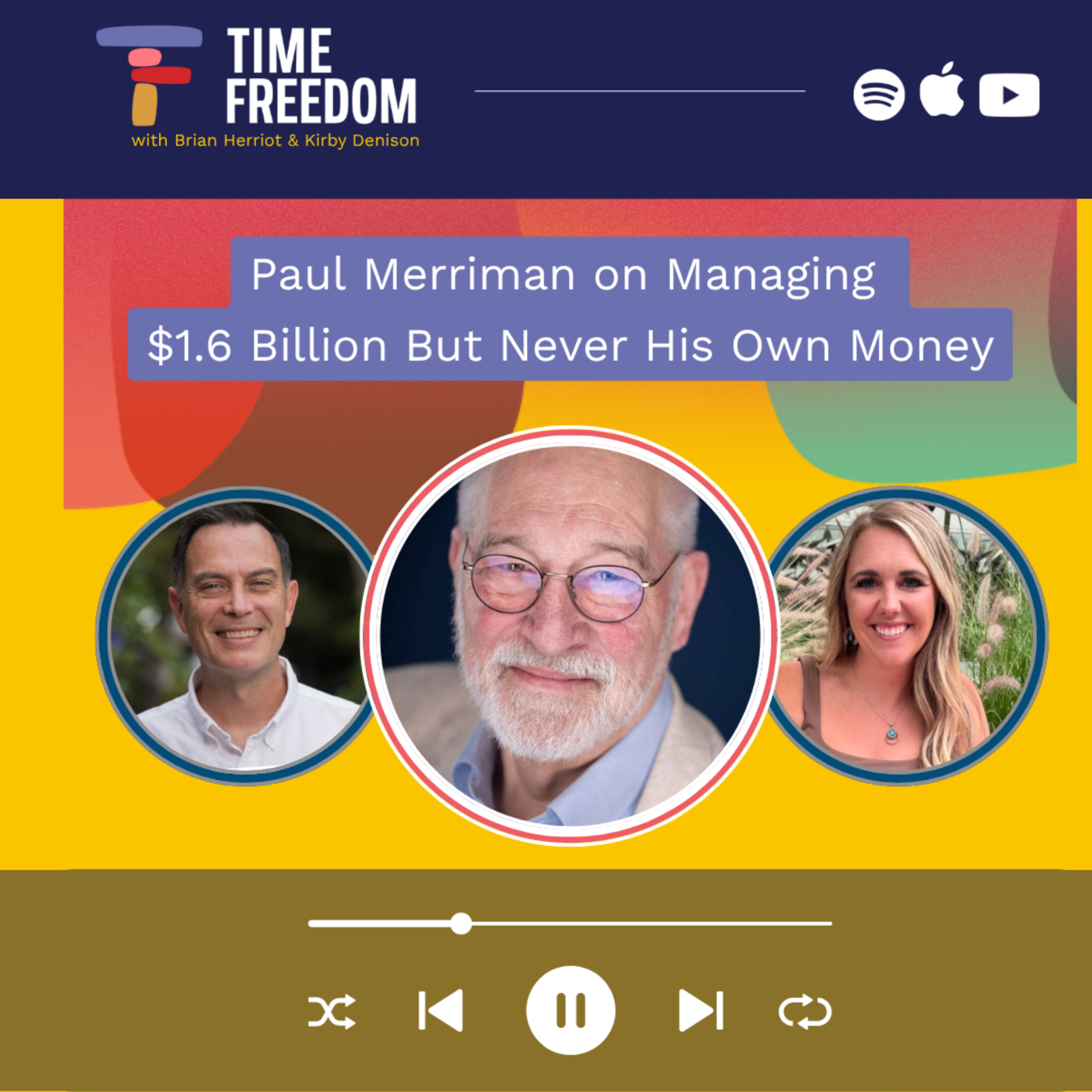
At 82 years old, I still work. Not because I have to, but because I want to.
I joined Brian Herriot and Kirby Denison on “The Time Freedom Podcast” to talk about exactly that. But we ended up covering a lot more than I expected.
Here's something that might surprise you: I managed money for thousands of people over 30 years and built a firm to $1.6 billion under management. And I have never once managed my own money.
Why? Because I know myself too well. When the market drops, I would second-guess everything. I'd probably hesi...
Q & A Deep Dive
Q&A Highlights
How does a 4-fund portfolio compare to a 10-fund portfolio?What is the best way to invest for a child’s future?
Is it too late to use a diversified strategy like the 10-fund portfolio at age 50?
Can I create and test my own custom portfolio using your tools?
How should I invest during periods of inflation or uncertainty?
What are some recommended fund options available at Schwab?
Is a portfolio combining large-cap value and small-cap blend a good approach?
Are there good alternatives to intermediate-term bonds?
Wh...
DFA & Avantis ETFs: Building the Ultimate Lifetime Equity Strategy
Paul Merriman is dedicated to helping do-it-yourself investors build portfolios they can stick with for life. In this episode, he shares what he believes is the closest thing to a perfect long-term equity strategy he's ever seen.
Paul traces the evolution of index investing — from John Bogle's cap-weighted S&P 500 funds to the academic research of Fama and French, whose factor-based work showed that small cap value, large cap value, and other equity asset classes have historically outperformed the broad market over time.
For years, the best factor-based funds from Dimensional Fund Advisors (DFA) were on...
Flexible Retirement Withdrawals: Why Taking Less Can Give You More
In this episode, we explore how flexible (variable) withdrawal strategies can strengthen your retirement plan—and why fixed, inflation-adjusted withdrawals may increase risk over time.
Using detailed distribution tables—including Table F1.3 (flexible withdrawals) and comparisons to
Table D1.3 (fixed withdrawals)—Paul walks through real historical outcomes across decades to show how adjusting withdrawals based on market performance can improve long-term results.
You’ll learn:
Fixed vs. flexible withdrawal strategies
Insights from Tables F1.3, F1.4 vs. D1.3, D1.4
How flexibility helps defend against bear markets
The role of di...
Boot Camp #6 Fixed Distributions
In Boot Camp #6, Paul Merriman walks through real historical data starting in 1970 to test what happens when retirees withdraw 3%, 4%, or 5% from a $1 million portfolio — adjusted for inflation — across some of the toughest market conditions in history.
This episode covers:
The difference between retiring with “enough” and “more than enough”
How inflation quietly turns $30,000 into $130,000+ over 30 years
What happens if you retire into a bear market
Why 1% more in withdrawals can cost millions
S&P 500 vs. a globally diversified four-fund strategy
How diversification impacts lifetime income and legacy o...
2026 Boot Camp #5 Fixed Contributions
In Boot Camp #5 of 10, Paul delivers what he believes is the most important session in the series—especially for new and early investors (teens, 20s, 30s, and anyone just getting started).
Instead of treating investing like speculation, Paul reframes it as building—or buying—a business over decades.
Using clear, data-driven tables and “fine-tuning” comparisons, he walks through a simple, repeatable plan: start with $1,000 per year (about $83.33/month), increase contributions by 3% annually, and stay invested for 40+ years. You’ll see how long-term outcomes change based on asset allocation (100% stocks vs. 60/40 stocks and bonds), and why diversification can m...
Bootcamp #4 |Fine-Tuning Your Asset Allocation for Retirement & Long-Term Growth
How much should you really have in stocks vs. bonds — and what happens when the market turns south with a vengence?
In Boot Camp #4, we break down the fine-tuning asset allocation tables that show exactly how different combinations of equities and bonds have performed from 1970 through 2025. This episode goes beyond average returns and dives into what investing actually feels like during the worst 3-month, 12-month, and 60-month market declines.
You’ll learn:
Why equities have historically dominated bonds for long-term retirement investing
How the S&P 500 compares to diversified strategies like the Fou...
Bootcamp #3 | How to Choose the Right Portfolio (Returns, Risk & Diversification)
Welcome to Bootcamp #3 of the Sound Investing Series with Paul Merriman — where real investing data meets practical long-term strategy. 📈 In this session, Paul breaks down the performance of diversified portfolios vs. the S&P 500 using decades of historical data going back to 1970. You’ll learn how different combinations of equity asset classes have performed in good markets, bad markets, and everything in between.
📊 What You’ll Learn in This Video:
• A deep dive into the Sound Investing Portfolios and how they work for DIY investors
• Historical returns of 2-, 4- and multi-fund strategies compared to the S&P 500
• Why...
Boot Camp #2: The Ultimate Buy & Hold Portfolio

In this second session of our 10-part Boot Camp series, we dive into the piece that’s helped shape decades of investing decisions: The Ultimate Buy & Hold Portfolio.
For nearly 30 years, this research—co-created with the late Rich Buck—has explored a simple but powerful question: What happens when you go beyond the S&P 500 and build a lifetime portfolio across 10 equity asset classes?
Starting with data back to 1970, we walk through the math of compounding, diversification, and disciplined rebalancing. You’ll see how adding small amounts of large value, small cap, REITs, international equities, and emer...