Look at the Book

Look at the Book is John Piper's ongoing series of 8-12 minute videos to help you learn to read the Bible for yourself.
1 Corinthians 2:6–10, Part 3: Crucifying the Lord of Glory, They Fulfilled the Wisdom of God

The rulers of this age mistook Jesus, so they crucified him — and ushered him into new glories he shares with his saints.
1 Corinthians 2:6–10, Part 2: Before Time, God Was Planning Our Glory

When this world fell into sin, God didn’t scramble for a backup plan. He had planned from all eternity to rescue a people through the work of his Son.
1 Corinthians 2:6–10, Part 1: Don’t Be Impressed with the Wisdom and Power of This Age

Why should we refuse to get sucked in by the empty promises of this world? Because this age is passing away; nothing it offers will eternally satisfy.
1 Corinthians 2:1–5, Part 3: What Is the Demonstration of the Spirit and Power?

How did Paul demonstrate the power of the Spirit in his ministry? By preaching in weakness, Paul showed a faith that boasts only in Christ crucified.
1 Corinthians 2:1–5, Part 2: The Crucified Christ and the Trembling Apostle

Paul relates everything to Christ crucified, including his own ability to preach. How else could he promote faith that boasts in God’s power?
1 Corinthians 2:1–5, Part 1: How Do You Speak So That People Trust God and Not You?

Paul could have come to the Corinthian church with oratorical skill and philosophical wisdom, but he chose not to. Why?
1 Corinthians 1:26–31, Part 2: Boasting in Man Ends — Boasting in Christ Is Forever

Our union with Christ grants us every blessing of the Christian life and voids any pride we could take in our own strength. How could we boast in anything but God?
1 Corinthians 1:26–31, Part 1: Why Do Christians Come into Being from Nothing?

Did God choose us for our connections, influence, or intelligence? No, God saves in a way that abolishes all human boasting.
1 Corinthians 1:18–25, Part 5: Links in the Chain from Cross to Corinth

Paul builds his case for unity in the Corinthian church by piling seven arguments on top of one another. How do those arguments fit together?
1 Corinthians 1:18–25, Part 4: Philosophy and Oratory Are Powerless to Pay for Sin

Eloquence and cleverness cannot deliver us from God’s wrath. Only the death of Christ on behalf of sinners can turn condemnation into justification.
1 Corinthians 1:18–25, Part 3: The Glorious Call of God to Dead Hearts

Why does the same gospel message offend some and delight others? Because the message of Christ crucified lands only on those whom God has called.
1 Corinthians 1:18–25, Part 2: God’s Wisdom Prevents the Knowledge of God by Wisdom

In wisdom, God hides his plan of salvation from the self-proclaimed wise of this age. In grace, he reveals the power of the cross to those he calls.
1 Corinthians 1:18–25, Part 1: Don’t Change the Gospel to Please the Proud

What makes Paul so unwilling to add eloquence to the word of the cross? The apparent folly of the cross proves its actual power to those who are saved.
1 Corinthians 1:13–17, Part 4: Does Divine Inspiration of Scripture Mean Divine Dictation?

Paul was taught by the Holy Spirit — but does that mean God told him exactly what to write? God preserved his truth through Paul’s personality.
1 Corinthians 1:13–17, Part 3: Shameful Cross vs. Proud Eloquence

As Paul discipled the Corinthian church, he never intended to be their celebrity pastor. He aimed at something far greater: preaching a powerful cross.
1 Corinthians 1:13–17, Part 2: Why God Kept Paul from Baptizing

When Paul looked back on his work of establishing the Corinthian church, he thanked God for keeping him from baptizing too many believers. Why?
1 Corinthians 1:13–17, Part 1: Antidote to Disharmony: Christ’s Unity, Christ’s Death, Christ’s Name
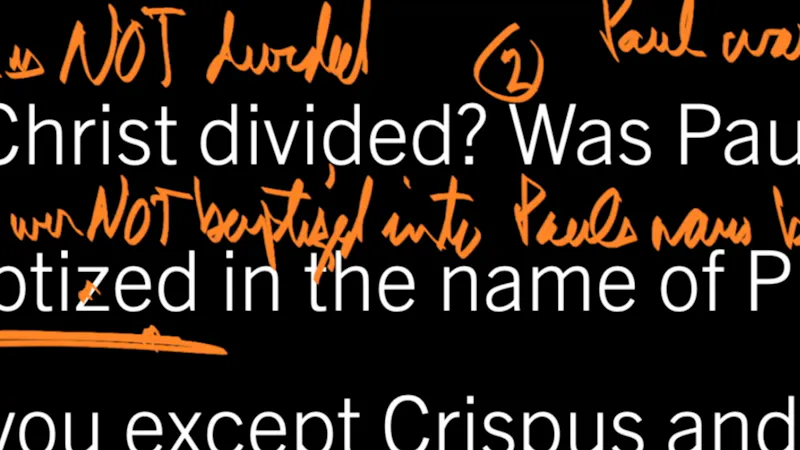
In the face of church factions, Paul exhorts members of Christ’s body to focus on the unique work Jesus has done through his death and resurrection.
The Miracle Alternative to Factions in the Church: 1 Corinthians 1:10–12

The Corinthian believers tried to split into fan clubs, but they never belonged to their favorite teachers. In Christ, their teachers belonged to them.
God Will See to It That We Arrive Guiltless at Christ’s Coming: 1 Corinthians 1:4–9, Part 6

How can we know that God will keep us until the end? Because his faithfulness links his call to our final glorification with unbreakable power.
How Can Our Waiting for the Coming of Jesus Be Sure? 1 Corinthians 1:4–9, Part 5

In this age, the Christian life is a waiting life. But we wait full of confidence that Christ will return and bring us into our eternal home.
How Rich Are Christians? 1 Corinthians 1:4–9, Part 4

How do the Corinthian church’s riches in word and knowledge serve to confirm the testimony of Christ? Their beautiful speech shows a beautiful Savior.
What Is God’s Grace? 1 Corinthians 1:4–9, Part 3

Grace is God’s favor toward us, his power for us, and his gifts to us. What kind of response does this stunning display of God’s goodness call for?
Why Was Paul Such a Thankful Man? 1 Corinthians 1:4–9, Part 2

Paul’s supernatural gratitude came from his wholehearted love for God and his work among the Corinthian church. How can we become thankful like him?
Why We Can Wait Confidently for the Appearing of Christ: 1 Corinthians 1:4–9, Part 1

Why should Christians wait confidently to the end? Because not only has God equipped us with many gifts, but he will preserve us in his faithfulness.
Christian, You Belong to Believers in Every Place: 1 Corinthians 1:1–3, Part 6

Because God calls all Christians, all Christians call on God. Our one Lord and one confession unite us with all believers across time and space.
Consider Your Calling, Christians! 1 Corinthians 1:1–3, Part 5

When we became Christians, what happened to us? By calling us from darkness to light, God gave us an everlasting reason to boast in Jesus Christ.
What Does It Mean to Be Sanctified in Christ Jesus? 1 Corinthians 1:1–3, Part 4

Before launching into his first letter to the Corinthians, Paul describes this local church as sanctified. What does that mean, for them and for us?
In What Sense Is the Church God’s Church? 1 Corinthians 1:1–3, Part 3

How did a church come to exist in the carnal, immoral, idolatrous city of Corinth, and why did Paul love it enough to write it a letter?
What Does the Name ‘Christ Jesus’ Mean? 1 Corinthians 1:1–3, Part 2

Sometimes we can hear a name so often that we forget what it was originally meant to communicate. What does Paul mean by “Christ”?
Understanding Paul Is Understanding the Word of God: 1 Corinthians 1:1–3, Part 1

When Paul writes to the Corinthians, he writes as a man who once persecuted the church, who then encountered Christ, and who now writes the words of God.
The Heart of the Matter: Fearless Love from True Faith: Philemon 1–25

When Philemon walks away from Paul’s letter, what kind of response does Paul want to see — mere compliance or a heart full of faith in God’s promises?
Fellow Workers Full of Grace for Philemon: Philemon 23–25, Part 2

What do Mark, Aristarchus, Demas, and Luke have to do with Philemon and his runaway slave? Paul shows Philemon what gospel-shaped friendships look like.
Epaphras: Founder, Pastor, Prisoner, Greeter: Philemon 23–25, Part 1

Alongside all the other ways Paul encourages Philemon to love, he also adds greetings from Epaphras, a man Philemon would have deeply respected.
Paul’s Paradoxical Way of Being Refreshed: Philemon 18–22

In seeking a welcome for the runaway slave, Onesimus, Paul banks on his history with Philemon, and risks his own resources, modeling radical Christian love.
Can We Always Know the Purposes of Providence? Philemon 15–17, Part 3

Reading God’s providence rightly takes great faith in the power and wisdom of God, and communicating it kindly takes great humility. Paul displays both.
How the New Testament Transformed Slavery: Philemon 15–17, Part 2

While the New Testament never explicitly abolishes slavery, it is full of teachings and commands that revolutionized the master-slave relationship.
Receive Onesimus No Longer as a Slave but as a Brother: Philemon 15–17, Part 1

Paul wanted Philemon to welcome Onesimus back — but did it matter how? Paul’s radical reasoning has big implications for Onesimus’s status as a slave.
How to Motivate Without Commanding: Philemon 8–14, Part 4

Although Paul refuses to command Philemon, he strengthens his appeal with seven personal reasons why his dear friend should receive Onesimus like a brother.
Does Commanding Ever Serve Love? Philemon 8–14, Part 3

Jesus commanded us to love one another, but Paul seems to imply that commanding diminishes love. So, which does love prefer — commands or appeals?
Why Does Not Commanding Serve Love? Philemon 8–14, Part 2

Paul knows what he wants Philemon to do, but he chooses not to command it. Why? He wants something deeper than rote obedience: genuine love.