Field Notes on Music Teaching & Learning

This podcast is a collection of creative ideas, practical strategies, and thoughtful observations from the field of music teaching and learning. Music educator Ashley Danyew will dive into topics like how we learn, developing musicianship, time management, teaching sequences, planning tools and strategies, the art of teaching, practicing, and the creative process, and share personal stories from her own experiences and observations. You’ll find creative and pedagogically-sound teaching tips; fresh, new approaches you can use in your teaching; and insight into a few tried-and-true systems and creative processes designed to help you do your best work.
101 - Listening with Our Eyes, Seeing with Our Ears
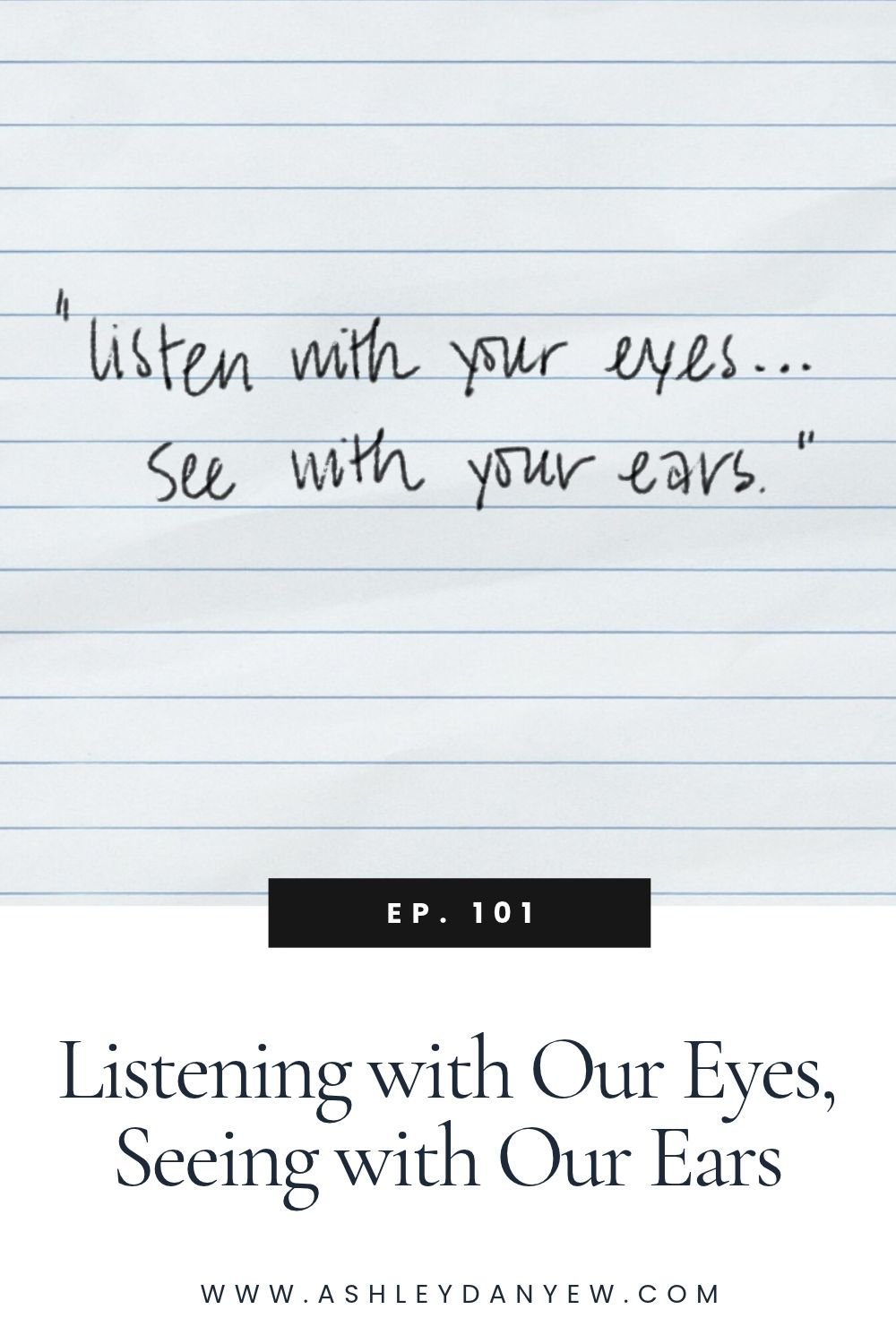
It was Thursday.
My 2nd-grade student stood at the piano next to me, his hand on the white keys in the upper register. We were improvising in a minor key—coming up with patterns and musical ideas. He spontaneously played C-B-A, and it caught his attention.
“My ears were looking, but not my eyes!” he said with pride and amazement, tipping his ear toward the keys. His sandy brown hair fell across his blue eyes as he replayed the pattern.
I love moments like this in teaching. That glimpse of wonder, a flash of joy...
100 - When Stella the Steinway Turned 100
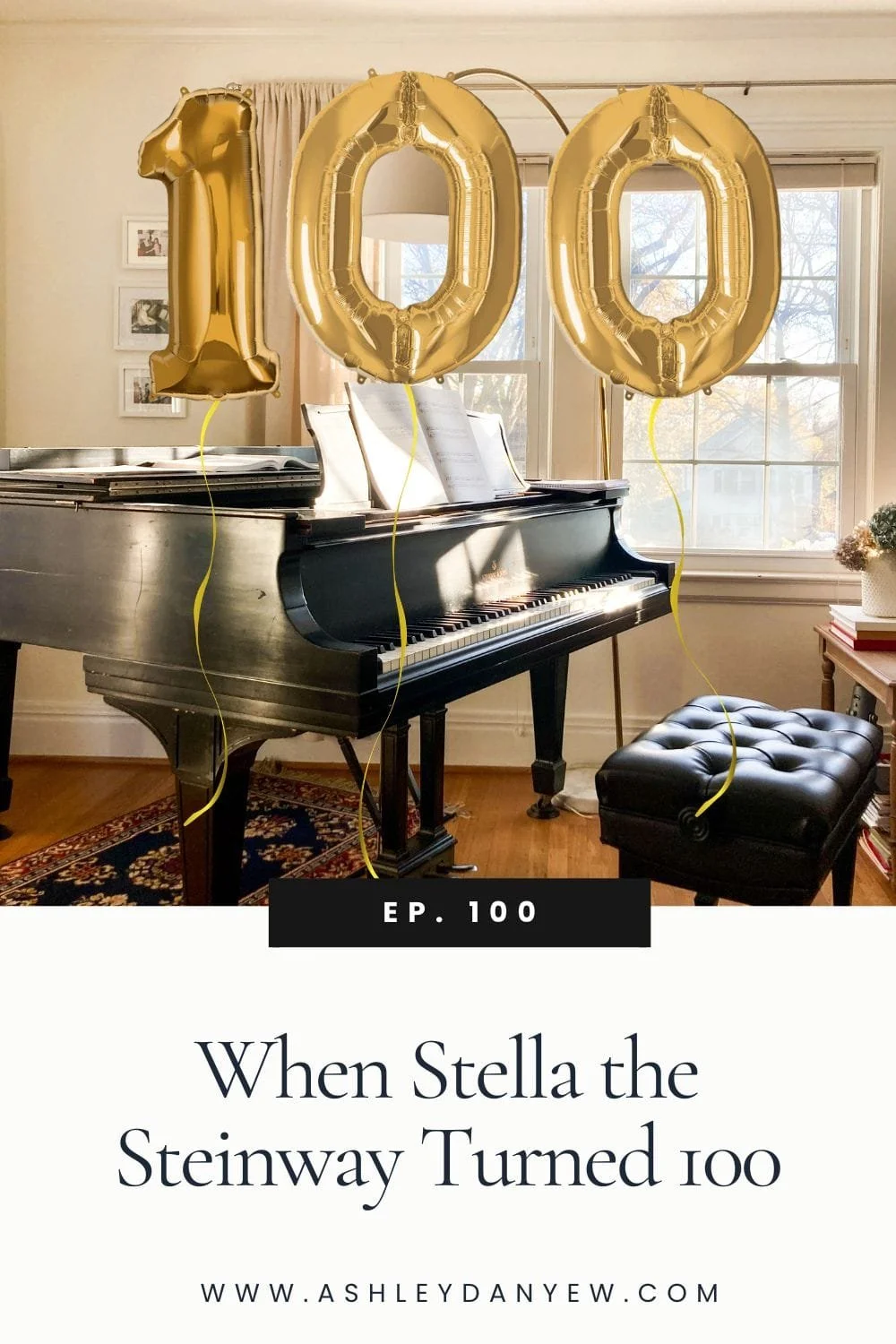
I named my piano Stella the Steinway. The name came to me one summer night during the pandemic, in a Zoom lesson with Annabelle, a curious, imaginative 8-year-old.
I have owned Stella, a 1922 Model O Steinway, for 11 years. Her previous owner was a classical pianist and teacher who crated and moved the piano across the Atlantic when she came to the States. (There’s a cosmetic crack along the flat side of the cabinet and around the tail that we think was from this excursion.)
In 2022, I thought of a unique way to celebrate the pi...
099 - My Bach Year
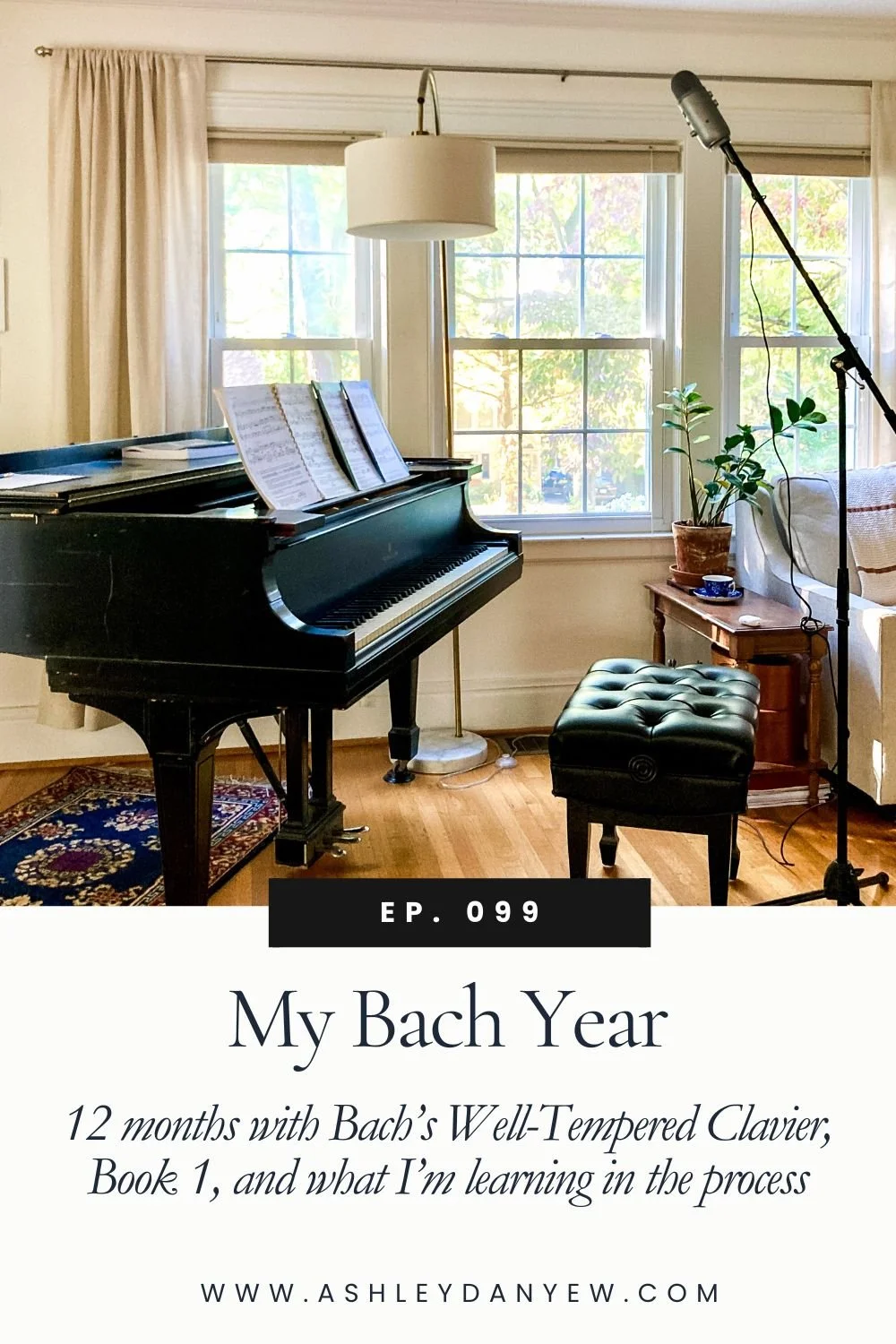
It started with an aspiration: “I want to get back into regular practicing,” I said to Steve one day. “But without a performance commitment, it’s hard to justify the time. What’s the point?” “There doesn’t need to be a point,” he said simply. “Do it for you. I think you’d enjoy it.”
In that moment, I gave myself permission to start: A recommitment, a new routine, an artistic practice.
But what would I play? Almost immediately, I thought of Bach’s Well-Tempered Clavier. I played a few of the preludes and fugues from Book 1 in high...
098 - Five Ways I'm Applying Slow Productivity to My Studio

Earlier this year, I reread Cal Newport's Slow Productivity: The Lost Art of Accomplishment Without Burnout for the Musician & Co. Book Club.
One of the things I really enjoy about Cal's books is how well-researched they are. The three principles he outlines in this book are informed and enriched by writings, studies, and historical insights.
Cal addresses two main questions in this book: 1) How do we accomplish meaningful work without burnout? and 2) Can we take a slow approach to productivity?
I’ve spent some time thinking about what this looks like in self-employment, bu...
097 - 24 Ways to Use Piano Safari Sight-Reading Cards in Your Teaching
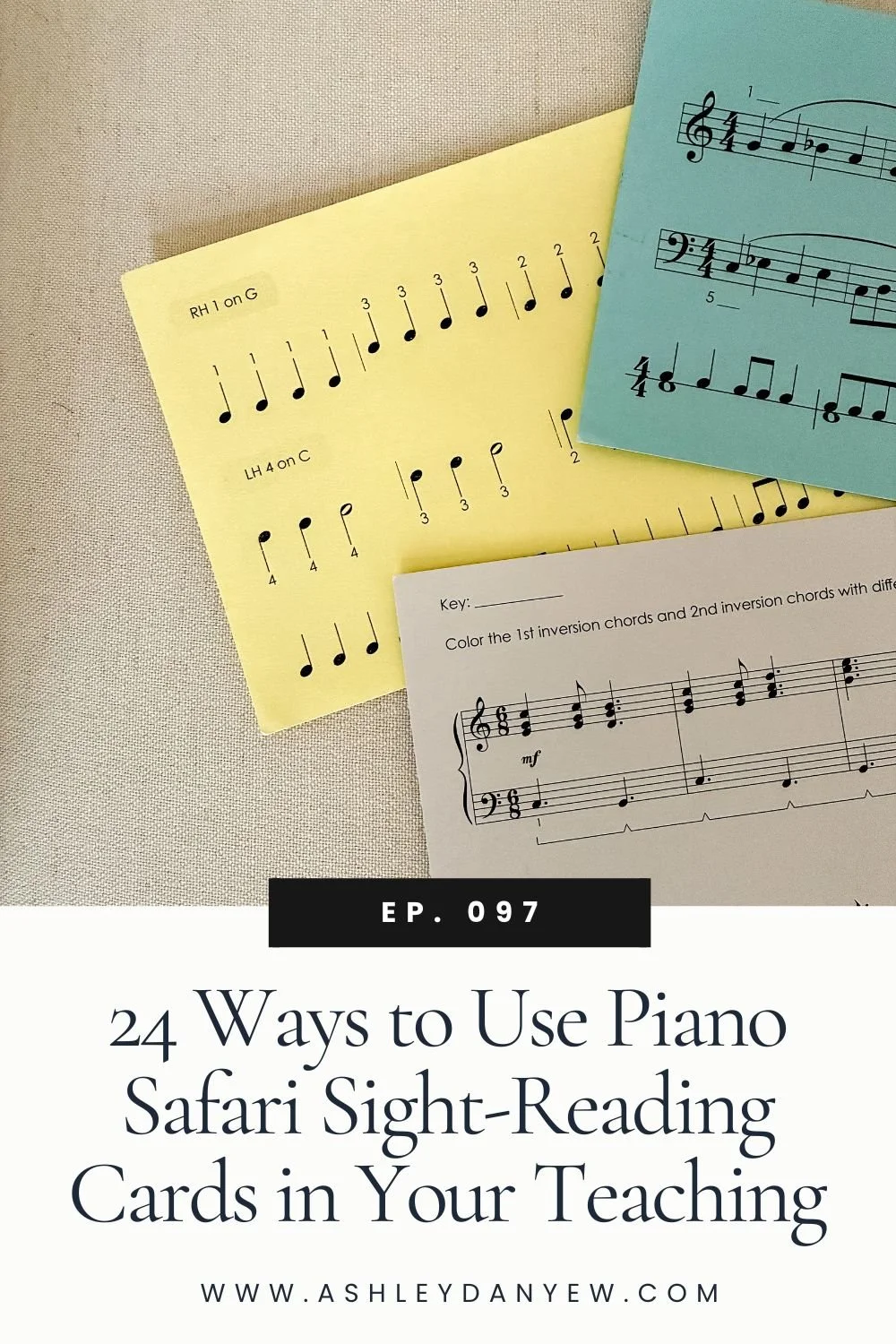
I started using Piano Safari in my studio five years ago. There are a lot of things I like about the curriculum and pedagogical approach, but one of my favorite resources is their correlated sight-reading cards.
Piano Safari has three levels of sight-reading cards available, corresponding with the three levels of their method book series. Each pack includes 80-98 unique cards (depending on the level), divided into color-coded units for easy organization. Each card includes 1-2 sight-reading examples and a rhythmic-reading example.
Level 1 starts with off-staff notation, moving to staff notation beginning on Treble G...
How I Use Assessment in My Studio

Assessment is a process of measuring, evaluating, and documenting learning.
Measuring a student’s progress in the studio provides an opportunity for reflection, evaluation, and deeper understanding as we consider with our students what they know and can explain or demonstrate.
This informs our teaching, curriculum planning, and repertoire choices. In turn, it also helps students develop a diverse set of musicianship skills, including technique, performance, aural skills, sight-reading, and musical creativity.
In this episode, we’ll talk about how to plan an assessment for your studio, including defining assessment criteria and choosing meas...
Schubert vs. Richter: A Studio Class Listening Project
In a recent class with three intermediate students (8th-11th grade), we compared the music of Franz Schubert and Max Richter. Schubert was a prolific Austrian composer, writing at the end of the Classical period and the beginning of the Romantic period. During his brief life, he wrote over 1,500 works. He was known for his storytelling abilities: long, singing lines, dramatic mood swings, an improvisatory style that seems to wander at times, and emotional intensity.
Max Richter is a contemporary German-born pianist and composer known for blending classical techniques with electronic, ambient, and minimalist styles. He names...
The Curious Mind of Pianist Josef Hofmann

What does it look like to be a musician who is also an inventor—someone whose curiosity about how things work shapes the way he approaches his instrument? Pianist Josef Hofmann spent his entire career exploring that, and his story is worth knowing.
This year marks the 150th anniversary of Hofmann's birth. He was a Polish-American pianist, born in 1876, and considered by many—including Sergei Rachmaninoff—to be the greatest pianist of the 20th century. And yet, despite his many musical achievements, including a fifty-year performing career, 100 compositions, commercial recordings, a signature tone, and enviable technical precision, he doe...
What We're Doing for Informances This Year

March in my studio means one thing: informance season. We spend 10 to 12 weeks getting ready—learning and analyzing music, practicing demonstrations, preparing to talk to the audience. And this year, I knew from the start that the theme was going to require a little more planning than usual.
If you’re new around here, I define a musical informance as an informal, informational performance that integrates education and experience. It’s an opportunity for students to share what and how they’re learning and invite parents and audience members into the music-making process.
I started hosting...
Beauty, Artistry, and Intention (A Tribute to Marvin Blickenstaff)

At the end of January, we lost a wonderful musician, teacher, and pedagogue, Marvin Blickenstaff. You’ve probably heard me talk about Marvin on the podcast before—he had a profound impact on my teaching.
With a career spanning over six decades, Marvin dedicated himself to serving piano students and teachers worldwide. He valued deep emotional expression at the keyboard and a human connection through the music. He once said, “The only reason that music exists is to express who we are and how we feel.”
Today, I’m sharing some of the most important things I l...
Seven Black Composers in the Piano Teaching Repertoire

February is Black History Month—a time to honor and celebrate the contributions of African Americans. As a music teacher, this prompts me to pause and evaluate what I’m teaching, but also why. I ask questions like:
How much diversity is present in my students’ method books and repertoire?
Which pieces should we skip due to their complicated history?
How can I make more thoughtful, informed choices about the music I put in front of my students—choices that are pedagogically sound and historically responsible?
This year, I want to focus mo...
Nine Supplemental Books for Elementary and Early Intermediate Piano Students

It’s my last week of teaching for the year, and I've been reflecting on the supplemental books that have been most successful with my elementary and early intermediate students this year. The new year can be a great time to start fresh: with new repertoire, new technical routines, or new creative challenges for our students.
As we prepare for the Spring semester and look forward to lessons resuming in January, I want to share nine collections I’ve been using with my students this year. Some are etudes based on specific technical patterns, others are solo repe...
The Science of Practicing

One of the things I love about teaching is that we can draw on many disciplines to make our work better—art, psychology, learning theories, and even neuroscience. Recently, I’ve been reading about what brain research can tell us about practicing and how we learn, and it’s fascinating.
Welcome back to our 2-part series on practicing.
In part 1, we talked about the art of practicing. I shared what I’m learning from Madeline Bruser’s book, The Art of Practicing, and how I’m carrying these concepts and strategies into my practice sessions and studio.<...
The Art of Practicing

This fall, I read two books about practicing: The first is Madeline Bruser’s, The Art of Practicing: A Guide to Making Music from the Heart. The second is Molly Gebrian’s 2024 release, Learn Faster, Perform Better: A Musician's Guide to the Neuroscience of Practicing.
Art and science. Because practicing requires both.
This is part 1 of a 2-part series about practicing and what I’m learning and applying from both books.
In this episode, part 1, we’ll talk about the art of practicing. I’ll share what I’m learning from Madeline Bruser’s book and how...
9 Creative Lesson Activities You Can Do with a Broken Arm

It was about this time last year when I got a panicked email from a parent: “Jack broke his left wrist this week. What does this mean for piano? He’s in a cast.”
Has this ever happened to you? Some parents may assume that lessons need to be paused during this time. I mean, they can’t play with only one hand… or can they?
The answer is yes, and there’s more and more one-handed repertoire available. With a broken foot, we can focus on repertoire that doesn’t use the pedal, or they can learn...
Teaching Keyboard Skills to Students of All Ages

Learning to play the piano isn’t just about learning repertoire pieces. It’s about developing a set of keyboard skills that lets you make music anywhere, with anyone, in any style. Technique, performance, and sight-reading are part of it, but so are harmonization, transposition, chord knowledge, and voice-leading. It’s more than the ability to perform what’s on the page; it’s understanding how the music is made.
In this episode, I’ll share why keyboard skills matter for students of all ages and a few strategies I’m using in my studio to build them into less...
Everyone Can Improvise (+ 3 Examples From My Studio)
When I was in grad school, I took an elective class on Improvisation. I remember shuffling into the 3rd-floor classroom that first day, pulling a blue chair into the semicircle like everyone else, unfolding the desk and preparing to take notes.
Everyone was quiet. There was a palpable uncertainty among the group—all classical musicians by training. When had we ever been asked to improvise? No one wanted to be put on the spot.
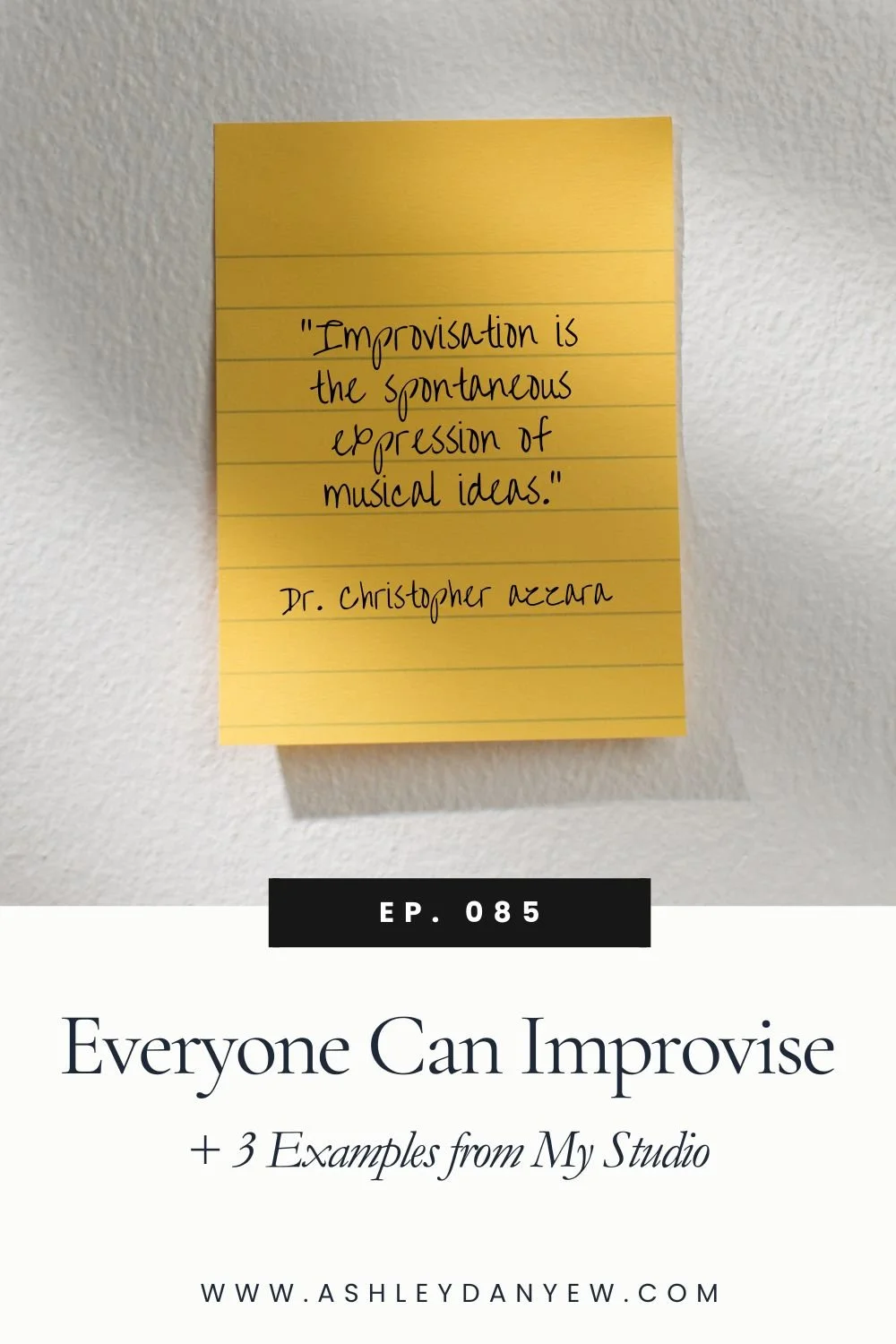
We started by talking about where to start with improvisation. “Improvisation is something we can all do,” our professor, Dr. Christopher Azzara...
Recital Recap & Year-End Reflection

Earlier this month, I hosted my 14th studio piano recital. There’s always so much that goes into planning and preparing for an event like this:
Choosing repertoire
Booking the venue
Polishing memory
Emailing parents
Practicing “piano bows”
Coordinating with the facilities manager and the piano tuner
Borrowing percussion instruments from the music teacher
Scheduling duet and ensemble rehearsals
Finalizing and printing programs
Planning a reception
We spend months learning the music and practicing performing. What happens if you play a wrong note or miss a key ch...
Bernstein & Bill Evans: Inside My Recent Intermediate Studio Class

It starts simply. Two blocked jazz chords with I-V in the bass. And then the vocalist comes in:
“Twenty-four hours can go so fast. You look around, the day has passed…”
This is Leonard Bernstein’s song “Some Other Time” with lyrics by Betty Comden and Adolph Green, written for the 1944 musical, On the Town. It’s about three sailors on 24-hour leave in New York City who meet three women before leaving for war. Four characters perform this song (in the stage version), hoping to catch up some other time, but knowing they may never see each...
What Art Is Teaching Me About Music

Some of you may not know this about me, but I’m a musician and an artist.
I always loved art as a kid—from finger painting in my blue smock at my Little Tikes easel to coloring and tracing to the pastel class I took one summer. For a while, my answer to the question, “What do you want to be when you grow up?” was “An artist or illustrator.”
Music was always there, too—singing and playing the piano, learning letter names as I learned the alphabet, and later, accompanying, teaching, performing, and arranging.
...Celebrating Women in Music Month

March is Women’s History Month and by extension, Women in Music Month—an opportunity to acknowledge and celebrate women’s contributions to our field.
As a teacher, I love finding ways to honor and celebrate things like this with my students. A few years ago, we did a studio-wide blues composition project (see Ep. 045) during the month of February, Black History Month.
Then, there was the year I created a 4-week study unit for one of my high school students focused on women composers. In Ep. 057, I talked about the composers and scores we were p...
14 Ways to Practice Away From Your Instrument

When you think about practicing, what do you picture?
Maybe you think about your instrument in the living room or your favorite practice room at school. Maybe you picture your studio with morning light streaking across the floor or in the evening with a few lamps casting a cozy glow.
Certainly, practicing happens in all of these spaces. But it can also happen at your desk, in the car, at the breakfast table, on a walk, in a carrel at the library, or in a classroom where no instrument is present.
How? Because pr...
From Technique to Musical Identity - Six Things I’m Focusing on in Lessons

The Spring semester can be busy. With extra performances, we end up focusing more on performance skills—starting and finishing well, lifting hands back to our laps, how to practice performing at home, bowing, and memorization strategies.
But as you know, there’s so much more that happens in a music lesson—so much more that we’re teaching and cultivating in our students. It’s not just about performance or mastery or checking things off. It’s about developing musicianship—developing musicians—and helping them develop the skills and creativity and confidence they need to continue making music thr...
The Days of Auld Lang Syne

It’s the middle of December, which means you’re probably caught up in the rush of holiday performances, concerts, and recitals, studio classes, parties, and general busyness as we wrap up the year. Your to-do list is long, but the days are short, and you’re doing your best to stay on top of it all.
But as busy as this time of year is, it can also be a time to pause and reflect. To embrace the quiet and stillness that comes with the first snowfall or sitting in the living room late at night or ear...
A New Approach to Teaching Group Classes

I have a love/hate relationship with studio classes.
I love the idea of them, and I love being able to offer them to my students. But I’ve never found a structure or approach that works.
At the school where I teach, I’m limited to a classroom with a single piano, which means students have to take turns or do activities that don’t involve an instrument.
In addition, having a group of 6-8 students in a room together for 45-60 minutes (again, with one instrument) was challenging. It’s difficult to keep e...
7 Things to Carry Into the New School Year

It’s my second full week of teaching. I know some of you have been back to school and lessons for a month now, but I’m still getting my bearings, adjusting to a new schedule, organizing studio classes, and setting my intentions for the year.
This is not a formal practice, but it’s something I sort of subconsciously do to mark the beginning of the new teaching year. I ask myself a few questions:
- “What do I want this year to look like?”
- “What do I want my students to experience?”...
What I'm Working on This Summer

I don’t know about you, but this summer is going by very quickly. I know some of you may be going back to school this week or preparing to go back in a few weeks; here in New York, we still have a little summer left, as we don’t start back until after Labor Day.
But regardless, it’s quick.
At the beginning of the summer, I made a list of 5 things I wanted to work on outside of teaching. In this episode, I’ll share what was on that list, how it’s going so...
What a First Piano Lesson Looks Like

Last week, I taught a brand-new beginner her very first piano lesson.
Cora is 5 1/2 and is quite mature for her age. She is the youngest of three—her two older brothers also study with me. In fact, the oldest started with me when he was 5, a few weeks after Cora was born, so it’s kind of a full-circle moment.
I have a list of 12 things I like to get through in the first lesson. Twelve activities may sound like a lot for a 30-minute lesson, but at this age, we move pretty quickly.
I’...
How to Prepare for a Consult with a Prospective Student

The interview process for finding a music teacher goes both ways:
The teacher is interviewing the student and family to assess musical, physical, and emotional readiness; determine if the student (and parents) have the same goals for musical study; and evaluate whether or not they'd be a good fit in the studio. We talked about this in the last episode, Ep. 072 - The Case for Consultations in the Music Studio. So, go back and listen to that, if you missed it.
At the same time, the student (and often the parents) are interviewing the teacher...
The Case for Consultations in the Music Studio

Years ago, I received an email from a piano teacher asking about initial consultations and interviews.
“What do you do? What questions do you ask? How long should it be? What materials do you give them?” These are great questions!
Here are some of the reasons I offer consultations to prospective families in my studio:
1. They give you an opportunity to meet prospective students (and their parents) face-to-face before either of you commit to lessons.
2. For students who are transferring from another teacher, it's important to see what music they're currently work...
3 Things I Learned From Hosting a Musical Informance

Welcome to another episode of the Field Notes on Music Teaching & Learning podcast. Today’s episode is part 3 of a series I’ve been working on this spring all about how to plan and organize a musical informance.
I first mentioned the idea of a musical informance in Ep. 068. An informance is basically an informal performance or an informational performance where you share insight into the music and the learning process with the audience. In Ep. 068, I shared a few examples of musicians who exemplified this model of education and engagement in the past, talked about what sepa...
The 3-Month Recital Plan

The birds are chirping, the first Spring flowers are popping up in the front yard, and Rory, my dog, insists on laying in the middle of the daffodil bed whenever the sun is out.
These are my seasonal cues that it's time to start planning for our annual end-of-year studio recital.
As the title of this episode suggests, I usually spend 3-4 months planning all the details of this event, helping my students prepare, and communicating with parents and families so they know what to expect.
Last year, I wrote down my recital-planning...
A Musical Informance to Celebrate the Solar Eclipse

I did a poll on Instagram recently to see if any of my music teacher friends had ever hosted a musical informance. A few said "yes," a few said "no," but a surprising number of respondents chose the third option: "What's an informance?"
An informance is basically an informal performance or as Eastman professor Dave Headlam describes, "A performance for the information age." (source: Oxford Handbook of Public Music Theory)
There's a teaching component and a performing component, and depending on how you structure it, a conversational or interactive component.
In Ep. 068, I...
How to Plan a Musical Informance

This year, Rochester, NY is in the path of the total solar eclipse. There are lots of special events happening in town—the orchestra is performing a special concert, the science museum is hosting a festival, and the schools are giving everyone the day off to experience this historical event.
As I looked ahead at this year, I thought it might be fun to plan a special event of our own to mark this occasion in the studio. Maybe special repertoire? An incentive program?
Then I thought about the informances the performing ensembles at my sc...
Six Things I'm Documenting in the Studio

"It feels almost like if we don't document it, did it happen? And I need proof that it did."
I was listening to an interview with Erin Napier of Home Town on Southern Living's Biscuits and Jam podcast recently and this statement stayed with me.
"A major part of my personality is documenting," she said, and I nodded to myself.
In this episode, I'm sharing what I've learned about the art and practice of documentation, six things I'm documenting in the studio lately, practical resources I use to track and organize this data...
A Winter Improvisation Prompt for Elementary Piano Students

Do you improvise with your students?
If you have a classical background like I do, you may not consider yourself an improviser, but researchers and educators Christopher Azzara and Richard Grunow remind us that "we are [all] born improvisers, as evidenced by our behavior in early childhood." (source)
In their series, Developing Musicianship Through Improvisation, they define improvisation as "the spontaneous expression of meaningful musical ideas." It doesn't mean making things up in the moment; it means making meaningful choices, sequencing patterns, snippets, and ideas from a vast vocabulary of musical material, as I talked...
How to Build a Musical Vocabulary Using Tonal Pattern Cards

I received an email from a listener recently, a piano teacher in North Carolina. She had purchased a set of my tonal pattern cards and was looking for ideas and suggestions for how to incorporate them into her teaching this year.
This prompted me to sit down and think through the importance of building a musical vocabulary (rhythm and tonal), how we learn to read music, and creative ways to engage our students through listening, pattern recognition, matching, imitating, and improvising using a basic set of tonal pattern cards.
In this episode, you'll learn about...
How I Plan a Year of Student Repertoire

Last week, I posted a reel on Instagram of my annual planning process for my studio. At the end of the summer, I pull out all my books, curriculum charts, and other planning notes and spend several hours making repertoire plans for each of my students.
There are lots of ways to go about this—it takes time to try things and hone in on a process that makes sense to you, helps you feel organized and prepared, and works for your studio.
Today, I'll share a little more insight into my long-term planning process. I...
When the Teacher Becomes the Student

"I found this piece that I'd like to learn," one of my high school students said to me in a lesson earlier this summer. He carefully laid out the pages of the score of Alexander Scriabin's Prelude in C Major, Op. 11, No. 1 that he'd downloaded from IMSLP.
"I have a question about it, though," he said turning toward the score. "How do you count this?"
He pointed at the first line written in flowing quintuplets straddling the barlines. I leaned in to take a closer look. My student is very mathematically-minded, so we talked about...
The A-Ha Moments in Music Teaching

You know those moments when something just *clicks*? When something suddenly makes sense to you that was confusing before or you make a new connection or you realize you're able to do something you didn't know you could do.
Sometimes we call these a-ha moments or breakthroughs. These are some of my favorite things to observe in my studio: when a student recognizes a new musical concept, makes a new connection, or can do something independently that they couldn't do without help before.
I've been looking back through my journal notes for the 2022-23 school...
