The California Appellate Law Podcast

An appellate law podcast for trial lawyers. Appellate specialists Jeff Lewis and Tim Kowal discuss timely trial tips and the latest cases and news coming from the California Court of Appeal and California Supreme Court.
ClioCon 2026 Tim's DIY AI tools
he opportunities AI offers to delegate law-office tasks have exploded. What can you hand off to AI today?
Jeff reports from ClioCon 2026 in Boston, where the message shifted from last year's warning that AI is coming for lawyers' jobs to delegating to it responsibly, the way a solo hands tasks to a paralegal. He covers Clio's push into "judiciary-grade AI," Clio Phones, drafting in Clio Work, Clio Docket, and integrated e-filing.
Then Tim walks through the tools he has built on Claude and Notion since February: an appendix builder, a record selector that triages the...
ADU damages, doxing, and juror misconduct
California law requires cities to approve ADU permits ministerially, without discretionary review. When a city takes three years instead, can the homeowner sue for damages?
In Jeff's win in Shi v. City of Palos Verdes Estates, the Second District, Division Four, said yes. The court held that the ministerial-approval duty in Government Code section 66317 protects the permit applicant, so a homeowner who alleges the city sat on his application states a damages claim under section 815.6.
We also cover Luna v. Top Dawg Entertainment, where two plaintiffs sued a record label as Jane Doe and Jane...
Human-only is not the gold standard: Josie Petrick on AI legal tools

Everyone agrees AI should never replace attorney judgment. But what does “judgment” mean?
Josie Petrick offers a different approach, which she calls “layered review.” A certified appellate specialist who also serves as Chief of AI Products at BriefCatch and builds her own legal tech, Josie notes that human-only work is no panacea, either. Lawyers misquote and overstate too, especially on deadline. So whatever the tool, review should be layered: AI tools, attorney ideas, woven together.
Among other tools, Josie built a California Supreme Court civil case tracker to spot amicus opportunities, then wrote for 14 law professo...
Two Dismissals, One Escape: The Courts Redraw the Procedural Map
Dismiss a case twice in federal court—no problem, you can still file in California.
But dismiss a case in state court, and it’s gone forever.
Tim & Jeff cover these two holdings of the California Supreme Court, issued two weeks apart. The first in Doe v. Marysville Joint Unified School District, held that the two-dismissal rule in federal court does not apply in state court. Then in Maniago v. Desert Cardiology Consultants' Medical Group, the Court held that a voluntary dismissal with prejudice ended an action entirely despite the plaintiff's stated intent to preserve appe...
Appellate AI with John Stobart

If someone is going to make #AppellateTikTok a thing, it’s John Stobart. John is a certified appellate specialist who shares practical guidance on responsible AI use for lawyers through short videos on TikTok and at stobart.ai. John walks Tim and Jeff through how he actually uses Claude in an appellate practice, and where he draws the line between using AI and delegating to it.
We cover concrete workflows: how John built a verified case law corpus and a five-year brief bank to control what sources the AI can draw from, how he uses the Claude Wo...
Students at the Lectern: Training Law Students by Letting Them Practice

Law students won a Ninth Circuit appeal on a broader theory than they argued. Now it’s en banc, and they have to defend the result, not the reasoning, in front of the judge who wrote the opinion.
The case is King v. Villegas, and the students are from the Pepperdine Ninth Circuit Advocacy Clinic, co-directed by Rebecca Powell and Curt Cutting of Horvitz & Levy. Becca and Curt joined us on the California Appellate Law Podcast to talk about it.
Clinic students aren’t mere research assistants—they’re lead counsel on real appeals, from the firs...
Press Record: How Courts Are Already Rewriting Appeal Rights Under FVAP
Tim Kowal and Jeff Lewis discuss Family Violence Appellate Project v. Superior Court, the California Supreme Court's unanimous August 2026 decision holding that an indigent litigant unable to find or afford a court reporter is entitled to an electronic recording, and that the trial court has a ministerial duty to press record. The court reached that result through the common law in forma pauperis doctrine rather than constitutional grounds, which means the right runs in every civil case type.
And less than a month later, the Third District applied the same access-to-courts reasoning in Guzman v. Superior Court...
No Associates, No Apologies: How CALG Flattened the Pyramid
Ben Feuer, chair of Complex Appellate Litigation Group, joins Tim and Jeff to discuss how CALG built a successful appellate firm by rejecting the traditional law firm pyramid entirely.
CALG hires no associates and pays attorneys a percentage of billings rather than a fixed salary. The result is a firm composed almost entirely of seasoned appellate specialists, including former career court staff attorneys, retired justices, and senior big-firm laterals. Feuer explains what draws these lawyers to the model, how the firm structures collaboration without hierarchy, and what a former chief deputy clerk of the Ninth Circuit brings...
2,000 Opinions Later: Justice Willhite on What Wins Appeals
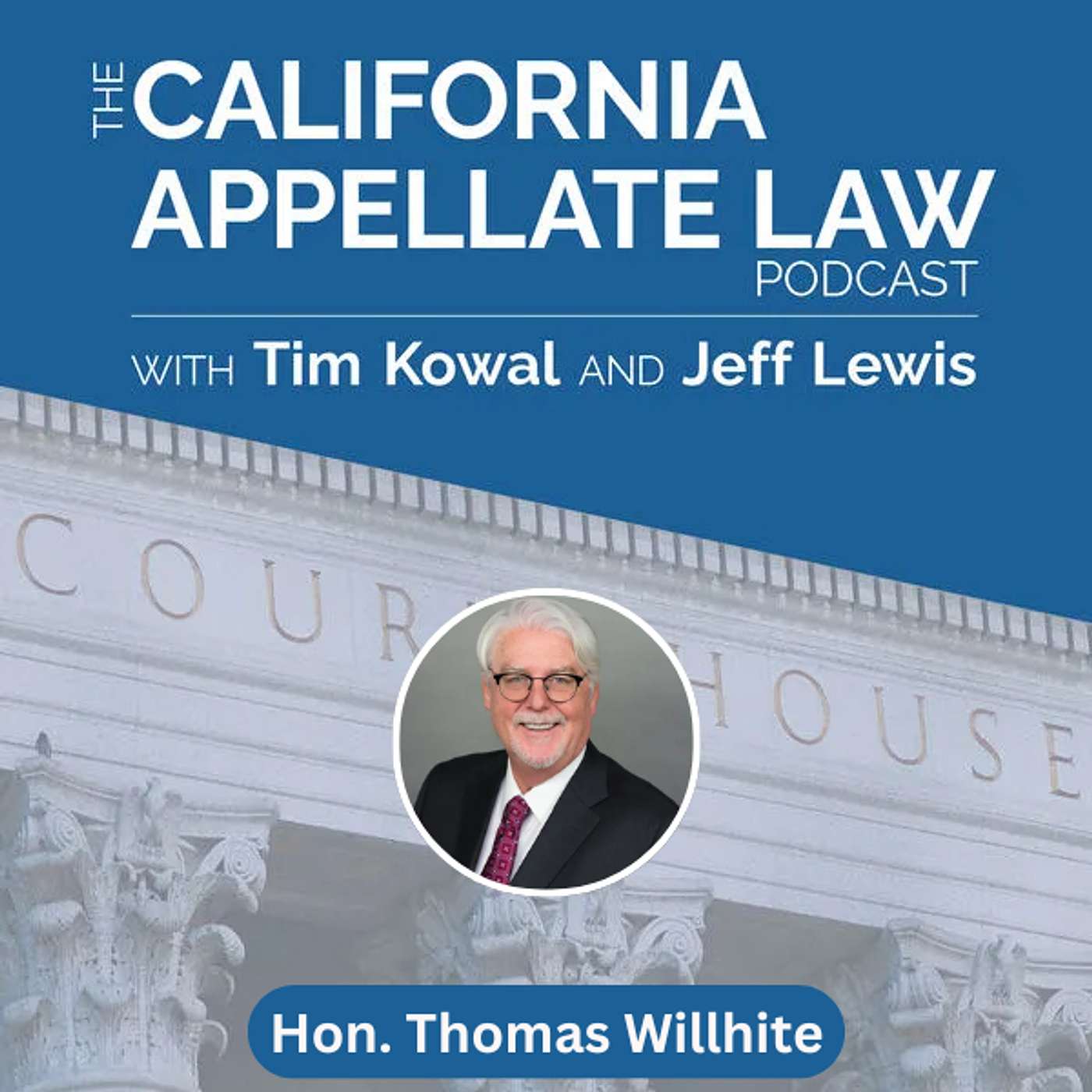
Retired Associate Justice Thomas L. Willhite Jr. of the California Court of Appeal, Second District, Division Four, joins Tim Kowal and Jeff Lewis to discuss nearly four decades in the legal system, from coordinating capital appeals at the California Attorney General's office to authoring roughly 2,000 appellate opinions. He serves as a mediator, arbitrator, and appellate consultant at ADR Services, Inc. since retiring from the bench in 2023.
Justice Willhite offers candid, experience-grounded guidance on appellate briefing and oral argument. And as a legal lecturer and consultant in Italy, Justice Willhite offers some striking comparative law contrasts.
Are...Voluntary Dismissal, Involuntary Consequences: Maniago and the End of the Expedited-Appeal Shortcut
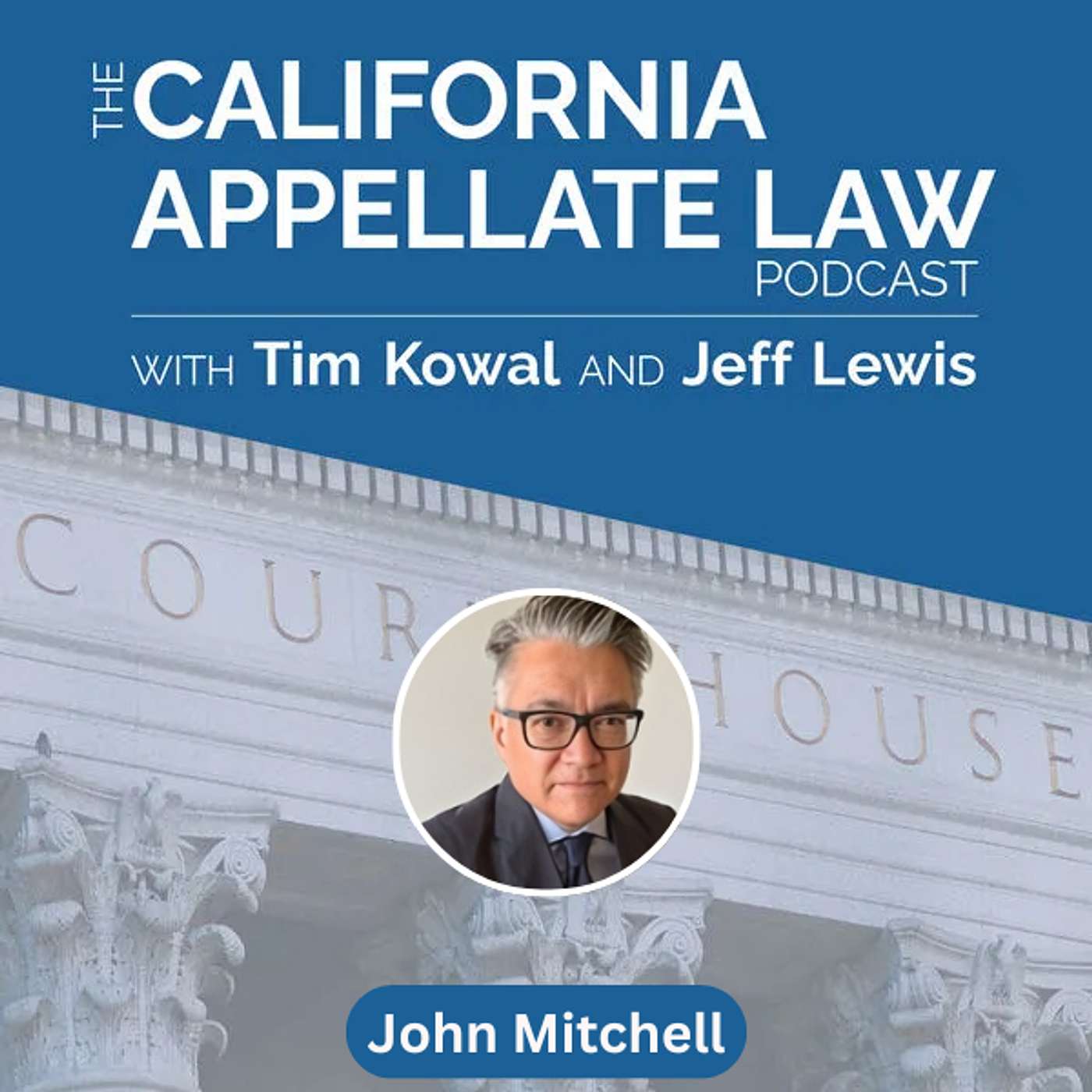
John Mitch Mitchell joins Tim Kowal to unpack Maniago v. Desert Cardiology Consultants’ Medical Group, a July 2026 California Supreme Court decision that shuts down a procedural shortcut California litigators have been relying on for years. Mitchell, who represented the plaintiffs on appeal, offers a candid, behind-the-scenes look at how a carefully planned litigation strategy turned into a cautionary tale.
The story starts with a surgical technologist who was exposed to HIV during a cardiac procedure and sued on several different theories. After the trial court sustained a demurrer on most of the claims, Mitchell dismissed the remaining cl...
750 Tenants, One Nudist Colony, and a Draining Anti-SLAPP: Fran Campbell on California's Hottest Landlord-Tenant Battles
Why do tenants' rights cases end up on appeal—and what happens when the Ellis Act gets weaponized? Tenants' rights appellate attorney Fran Campbell joins Jeff Lewis as a guest host while Tim Kowal is on vacation, sharing hard-won insight from landlord-tenant litigation, mobile home park law, and the appellate front lines of California's housing crisis.
Key points:
The Ellis Act and Barrington Plaza: Campbell's firm challenged Douglas Emmett's attempt to invoke the Ellis Act to remove roughly 750 tenants, raising a statutory interpretation question under Gov. Code § 7060.7.Supersedeas strategy: Collecting rent fro...Fine and Punishment: How cities punish short-term vacation rentals
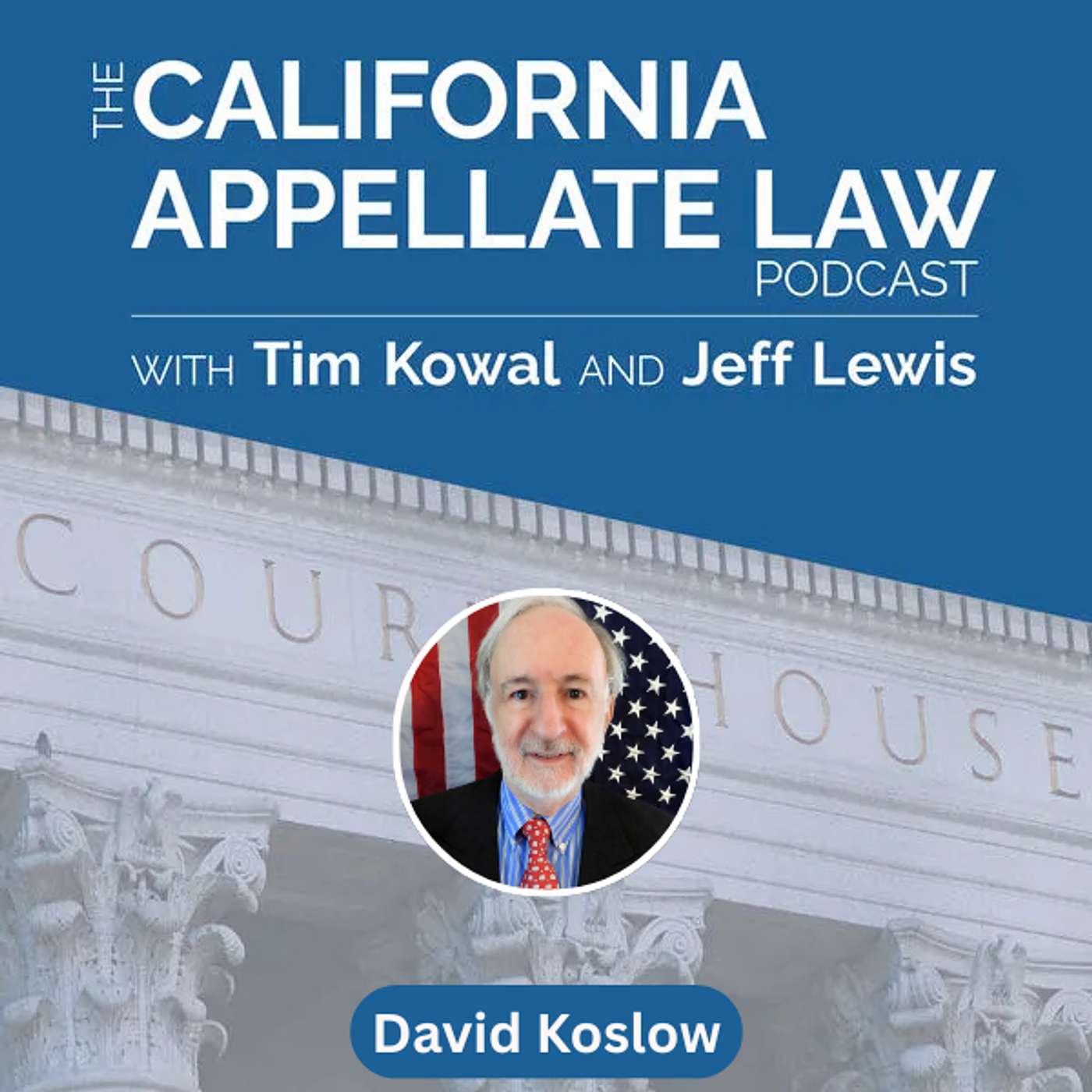
One California city has been quietly collecting $5,000-per-incident fines from short-term vacation rental owners. And if the regime is struck down, the city may owe half a million dollars back.
Former constitutional law attorney David Koslow joins Tim Kowal and Jeff Lewis to break down two Appellate Division challenges that expose a structural flaw in how cities administer and collect STVR fines, and why SEC v. Jarkesy may be the tool that finally pries these cases open.
Key points:
The $1,000 cap hiding in plain sight: Government Code §36901 sets a default $1,000 c...Palma, Alt Writs, and the OSC: Reading the Tea Leaves After Your Petition Lands with Judge Fay

Why do writ petitions so often fail? Judge Tom Fay covers the technical writ rules that attorneys often overlook. In part 2 of our conversation with former lead writs attorney at the Santa Ana Court of Appeal, Judge Fay covers the CRC 8.486 and local rule requirements for your writ petition, the available remedies for a writ petition—Palma notice, alternative writ, or OSC—and the underappreciated complexity of supersedeas.
Key points:
STAY REQUESTED must be on the cover—in bold, all caps: This single line triggers immediate routing to writ staff.Palma, alternative writ, OSC ea...59 Days Is Not an Emergency: Newly Minted Judge Fay Decodes Writ Triage

Tom Fay spent years as the lead civil writs attorney for California's 4th District, Division 3, processing every emergency petition that crossed the court's threshold. Effective June 29, 2026, he's now Judge Tom Fay of the Orange County Superior Court. We caught Judge Fay between appointments for an inside look at what actually happens when your writ petition hits the clerk's desk—and what separates the petitions that get a panel's attention from those that don't.
Key points:
Help the court triage: The first question isn't the merits—it's “when is the next hearing and what happens if we...How Lisa McCall Appeals Family Law Orders—and Gets Them Published

One of just 12 California lawyers dual-certified in both family and appellate law, Lisa McCall has an unusually clear view of how family trial work plays out on appeal. Lisa shares the record‑killing mistakes family lawyers often make.
And with 14 published opinions, Lisa shares about publish-worthy issues and her work on the amicus committee at the Association of Certified Family Law Specialists to clarify the law.
We also discuss recent changes to domestic violence laws, and to the statement of decision procedures.
Key points:
Statements of decision: Request early....Rules to Speak By: John Snow on the Rules—Not Mere Tips—of Oral Advocacy

John Snow, Director of Legal and Trial Training at the Los Angeles City Attorney's Office and author of Rules to Speak By (Carolina Academic Press, 2026), joins Tim Kowal and Jeff Lewis to discuss what it actually takes to be an effective oral advocate. Snow has tried more than 30 cases to completion in state and federal court and spent years designing trial training programs for lawyers at the LA City Attorney's Office, experience that grounds every practical lesson in the book.
Snow argues that oral advocacy is a rule-governed discipline, not a natural talent, and that the lawyers...
What Judges Actually Notice: 20 Years on the LASC Bench with Hon. Stuart Rice

Drawing on 20 years observing attorney behavior, Hon. Stuart M. Rice (ret.) now at JAMS, speaks freely. This episode is a rare candid debrief from the other side of the bench.
Key topics:
What incivility actually costs you in court: Judge Rice served on the statewide civility task force and watched uncivil conduct for two decades. His diagnosis: it's not the screamer at deposition—it's the subtler patterns that quietly erode a lawyer's credibility with the bench.The task force secured a new oath provision requiring lawyers admitted since 2014 to attest to treating ot...Papering Judges After J.O.: Update your 170.6 software
Does your office have a blank 170.6 form ready to go for a certain judge? Stop doing that. A 170.6 peremptory challenge is no longer automatic: the California Supreme Court now authorizes courts to look behind your 170.6. The touchstone is whether your 170.6 is based on a genuine belief of prejudice—or mere grievance.
But first, a $3 million sanctions order against Quinn Emanuel in a big‑pharma advertising case, where an expert obtained key clinical data before it was disclosed and the firm failed to correct the record. The Northern District of California called out firm culture, and ordering the atto...
Copyright Troll Slayer: How Morgan Pietz Exposed the Prenda Law Fraud Machine

The fall of copyright troll Prenda Law is, according to the ABA Journal, "part of legal folklore." We talk with the attorney who kicked over the first domino, Morgan Pietz.
Prenda Law was the copyright trolling operation that filed approximately 20,000 abusive BitTorrent lawsuits targeting anonymous defendants for alleged pornography downloads. Morgan's work on that case resulted in criminal prosecutions and a now-famous sanctions order by Judge Otis Wright, called the Star Trek order (e.g., though the plaintiffs "boldly probe the outskirts of law, the only enterprise they resemble is RICO").
Morgan discusses how the...
Humans Get Humans (Better Than Electronic Recordings): Stephanie Leslie
Everyone is watching Family Violence Appellate Project v. Superior Court (S288176) to see if the California Supreme Court is going to strike down the ban on electronic recording of court proceedings. There is a steady drumbeat in favor, including the Los Angeles County Superior Court and other courts.
But are we missing a perspective?
Stephanie Leslie is the immediate past president of the California Deposition Reporters Association and co-founder of Regal Court Reporting. She explains why certified shorthand reporters remain the gold standard for the verbatim record—and why replacing them with electronic recording could be...
Rescue Missions & Reality Checks: Fmr. CJ Cantil-Sakauye on What Makes the Supreme Court Take Your Case

The Honorable Tani Cantil-Sakauye led the state judiciary through the Great Recession's budget crisis, bail reform advocacy, and the COVID-19 pandemic. Now she has three new roles: President and CEO of the Public Policy Institute of California, a neutral at ADR Services, and a founding voice of the Alliance of Former Chief Justices.
CJ Cantil-Sakauye talks with Tim Kowal and Jeff Lewis about what actually gets petitions for review granted. If the Supreme Court’s job is not to correct errors, then what is it?
The justices look for issues that surface conflict, systemic mischief, or ot...Jeremy Rosen on Building Horvitz & Levy's San Francisco Office and the Art of Appellate Brief Writing

In addition to having more than 100 published opinions and close to 100 oral arguments to his name, Jeremy B. Rosen is the managing partner of the Horvitz & Levy LLP San Francisco office. Jeremy is also nationally recognized for his First Amendment and anti-SLAPP work. Jeremy joins Jeff and Tim on the California Appellate Law Podcast to discuss:
How does Horvitz & Levy sustain a practice that produces hundreds of high-quality appellate briefs annually while maintaining a clear institutional philosophy on drafting, editing, and oral advocacy?Part of the answer: Jeremy explains the firm's two-person brief model: one lead lawyer reads...The Workhorse Justice: Ming Chin on Prolific Opinion Writing, DNA Evidence, and the Art of Mediation

Justice Ming Chin wrote more majority opinions in his first decade on the California Supreme Court than any colleague—then retired to discover that mediation feels a lot like his first judicial assignment in family law, where the goal was bringing people together rather than telling them what to do.
Justice Ming’s biggest pet peeve as a mediator: attorneys who won’t share their briefs.
Justice Ming also shares:
What makes a good petition for review? Hint: think about Justice Broussard saying "if I get one more piece of paper, I'm going to scream...The End of Hallucinated Cases: Ross Guberman's RealityCheck Arrives
Legal writing authority Ross Guberman has been busy absorbing AI tools into his popular BriefCatch and now-related suite of writing tools. Ross returns to discuss how BriefCatch cousin app RealityCheck uses a traditional authority base plus AI power to ruthlessly search and destroy hallucinations in your briefs.
Who else is using RealityCheck? Courts. So let RealityCheck find hallucinations for you before it does for the court.
Ross also talks about the exciting and perilous AI age. Will AI make lawyering less human? Only if, says Ross, you equate “human” with rescheduling meetings over email.
To...
April Fool's Legal Myths: From "One Phone Call" to Dual-Citizenship
The law is riddled with things "everybody knows" that aren't actually true. In this April Fool's-themed episode, Tim Kowal and Jeff Lewis discuss several legal myths, half-truths, and courtroom fictions—from rules of evidence to constitutional assumptions to a Scopes Monkey Trial mythology that is more Hollywood script than record.
Key points:
Miranda warnings aren't in the Constitution—but they're constitutionally required anyway: The specific warnings don't appear in constitutional text; they're a prophylactic rule. Yet they're binding—even Congress can’t touch them.Dual citizenship was never authorized—it emerged by acciden...From BigLaw to Boutiques: David Lat on Trump, VanDyke, and the Art of Oral Argument
David Lat—founder of Above the Law and author and host of Original Jurisdiction blog and podcast—explains what these stories reveal about a legal profession navigating ideological warfare, economic disruption, and the enduring craft of persuasion.
Paul Clement delivered what SCOTUSblog called "a master class in oral argument" in Trump v. Cook. Lat dissects what made it a master class—by listening for the bench's emotional temperature, pivoting through backup arguments without undercutting his primary position, and admitting to Justice Alito that his framing was "heads I win, tails you lose."
Key points:
...The Myth of the Rule of Law in Nude Female Korean Spas
Two explosive First Amendment cases from the Ninth Circuit show how culture-war flashpoints are reshaping speech doctrine and judicial decorum.
In B.B. v. Capistrano Unified, the court held that elementary students have enforceable free speech rights under Tinker, vacating summary judgment after a first grader was disciplined for giving a classmate a pro-BLM drawing.
Meanwhile, in Olympus Spa v. Armstrong, a divided panel upheld Washington's requirement that a women-only Korean spa admit pre-operative transgender women, prompting Judge VanDyke to open his dissent with "This is a case about swinging dicks," drawing a rebuke from 28 ju...
CA Trans Law Stay in SCOTUS, and AI Sanctions in SCOCA
Justice Kagan has more words about the emergency docket, aka shadow docket. This one is about the 9th Circuit panel injunction of California’s law requiring school officials not to share with parents when their children present as trans. The Supreme Court keeps the injunction in effect.
And on the fee award front, big firms don’t automatically get a lodestar boost.
Plus, a debrief from oral argument in the Scientology AI sanctions case—where the court said nothing about the sanctions at all.
The shadow docket is now a routine appellate strategy: Mir...The AI-Work Product Split, & Deadbeat-Dad Deals=Unenforceable
Three paradoxes feature in this episode:
Paradox 1: You must disclose a bankruptcy stay to the Court of Appeal. What about a bankruptcy that does not create a stay?
Answer: Yes, the disclose-bk-stay rule also means disclose a bk non-stay.
Paradox 2: Deadbeat dad owes $500k. He settles and agrees to pay $250k. How much does he owe?
Answer: Still $500k.
Paradox 3: District court 1 rules AI work product is protected because, among other things, no court has ruled otherwise.
District court 2 then rules otherwise.
Key points:<...
California's Appellate Chaos and a Proposed Fix

In Part 2 of our conversation with Michael Shipley, Tim and Jeff dig into the real-world fallout of California's no-horizontal-stare-decisis rule — and the structural fix Shipley has been developing to address it.
Shipley walks Tim and Jeff through his proposed "mini-en banc" transfer mechanism — a way for the California Supreme Court to empower a designated Court of Appeal panel to issue statewide-binding precedent on conflicting issues without consuming the Supreme Court's own docket. No constitutional amendment required. The fix is already structurally available. The question is whether anyone has the will to use it.
Key points:
California's No-Horizontal-Stare-Decisis Rule: How an Accident Became Law

California is the largest common-law jurisdiction where appellate courts don't follow each other—and it happened by accident. In Part 1 of this two-part episode, Michael Shipley explains how Bernard Witkin’s treatise reflections on case dicta became binding law, why the federal circuit model works differently, and what the rule costs practitioners and trial judges every day.
Key points:
The Witkin origin story: No California Supreme Court decision actually establishes the no-horizontal-stare-decisis rule. It developed through dicta, then appeared in Witkin's first edition—which courts then cited as authority.The federal contrast matters for fo...The Hallucination Trap: How to Use AI in Legal Practice Without Losing $10,000
In the first half of their conversation with James Mixon, Managing Attorney at California's Second District Court of Appeal, Tim Kowal and Jeff Lewis ask what is healthy AI use, and unhealthy use? To help organize—yes! To replace judgment—no! Tip: When an attorney does not read AI output before filing a brief, expect sanctions.
James draws on his role on the judicial branch AI Task Force and his monthly Daily Journal AI column to provide a practical roadmap for responsible AI use—from crafting effective prompts to avoiding the automation bias that has led to attorn...
The Ethics and Philosophy of AI in Legal Practice

Is your AI training data biased? And is using AI-generated reasoning plagiarism?
James Mixon, Managing Attorney at California's Second District Court of Appeal, covers troubling topics on how lawyers should, and should not, use AI. In this second part of Tim and Jeff’s conversation, James discusses how we can detect and counteract bias baked into training data. And what happens when trial judges unknowingly sign orders containing fabricated cases?
Key points:
Legal reasoning isn't “creative” work—it's problem-solving: When we use words to solve problems, it should not be consider...A Supreme Lemon: Michelle Fonseca on used-car consumer protections after Rodriguez

Lemon Law lawyer Michelle Fonseca-Kamana discusses the seismic shifts in California lemon law—from the Supreme Court's decision in Rodriguez v. FCA US LLC (October 31, 2024) 17 Cal.5th 189 that effectively eliminated most used car claims, to the explosion in case filings (from 4,500 in 2015 to over 22,000 in 2023), to new legislative reforms under AB 1755 and SB 26 that impose strict timelines and mandatory pre-suit notice requirements.
Michelle also shares how she pivoted from in-person networking to social media marketing during the pandemic, built a practice around one-way fee-shifting statutes, and navigates the asymmetric litigation battlefield against billion-dollar manufacturers.
Highlights:
...Federal contempt is broader than Cal. contempt, & PAGA victory becomes a “smoldering ruin”
You have to literally disobey an order in California to be held in contempt. But federal courts are a little more touchy-feely: they will find a contempt for violating the “spirit” of their orders. Tim and Jeff compare the Ninth Circuit's contempt finding against Apple in the Epic Games dispute, and a state litigant who got around a visitation-time order but without violating the letter of the order, so no contempt.
Meanwhile, a CEQA plaintiff that won at the Court of Appeal—only to be reversed by emergency legislation and the Supreme Court—learned the hard way that "pr...
New Civ Pro Rules for 2026
California’s New Legal Rules for 2026: AI, Photo Proof of Service, and Simpler Statements of Decision
New statutes and court rules taking effect in 2026 and 2027 will change how California lawyers serve papers, preserve appellate issues, and disclose their use of artificial intelligence. Appellate attorneys Tim Kowal and Jeff Lewis focus on what actually matters in practice—what to fix now, and where the new traps are likely to appear.
The big changes:
AI in the Courts: Rule of Court 10.430 requires courts to either ban AI use by judicial officers and research attorneys or adopt a fo...$25K for a Malicious Anti-SLAPP & Other Bad-Lawyering Sanctions
AI-sanctions might get eyeballs, but the bigger sanctions are still for plain old bad lawyering. Jeff also raises this ethical and pragmatic question: who defends the lawyer when sanctions threaten the client? Should counsel facing an OSC retain separate counsel for the sanctions component to avoid divided attention and better protect client interests? What if the costs of independent counsel are likely to exceed the sanction?
$25K for using Anti-SLAPP as a litigation weapon. A bare-bones anti-SLAPP was amplified by record emails suggesting the strategy was to inflict cost and pain rather than win on the...Media immunity and civil bounty hunters
A scandalous Netflix documentary called an unconventional sex-based therapy business an “orgasm cult,” all based on a sole source whose account has several flaws. But the Court of Appeal dismissed the defamation case on anti-SLAPP grounds. Tim and Jeff discuss whether any California defamation case against a media company could survive the one-two punch of anti-SLAPP and NY Times v. Sullivan. They also discuss California’s unique approach to standing—it’s not jurisdictional, it’s purely pragmatic.
Anti-SLAPP meets documentary defamation: OneTaste Inc. v. Netflix illustrates how courts evaluate actual malice when the plaintiff is treated as a...Why AI Cites Really Bother the Courts
Want to know why bad AI cites really bother the courts? Jeff and Tim discuss two recent fake-AI-cites cases imposing sanctions and State Bar referrals, and draw this conclusion: It’s not that AI is bad at law—in one of these cases, the court noted that none of the AI mistakes even went in the direction of helping the offending party. Rather, the problem is that AI is just bad at citing and quoting the law. And the courts are super-protective against our legal canon becoming polluted with hallucinations.
Blame game backfires: In Shayan v. Shakib, appellant’s coun...Pronouns at the Supreme Court & AI Arbitrators
The California Supreme Court’s long-awaited "Taking Offense" decision on gender pronouns in elder care facilities introduces a new “captive audience” exception to the First Amendment. Tim worries this new judicial carve out may creep to other forums; Jeff is unperturbed. Tim also shares insights from the Federalist Society National Conference, before examining a significant appellate-fee ruling.
Taking Offense v. State (Cal., Nov. 6, 2025, No. S270535) **holds that advocacy groups lack taxpayer standing under CCP §526a to challenge state laws, but still issued 100+ pages addressing the merits through a "captive audience" framework.Captive audience concerns: Tim highlights potenti...