New Books in Western European Studies
This podcast is a channel on the New Books Network. The New Books Network is an academic audio library dedicated to public education. In each episode you will hear scholars discuss their recently published research with another expert in their field. Discover our 150+ channels and browse our 28,000+ episodes on our website: newbooksnetwork.com Subscribe to our free weekly Substack newsletter to get informative, engaging content straight to your inbox: https://newbooksnetwork.substack.com/ Follow us on Instagram and Bluesky to learn about more our latest interviews: @newbooksnetwork Support our show by becoming a premium member! https://newbooksnetwork.supportingcast.fm/european-studies
Fascists of the World, Unite?: A History of Fascist Internationalism in the 1930s with Martin Kristoffer Hamre (de Gruyter Oldenbourg, 2025)
Fascists of the World, Unite?: A History of Fascist Internationalism in the 1930s (de Gruyter Oldenbourg, 2025) analyzes the ideas and forms of international cooperation between Fascist Italy, Nazi Germany, and fascist movements from Denmark, Norway, Sweden, Switzerland, Ireland, and Britain. The study examines how fascists attempted to unite across borders by forming international organizations and networks, hosting conferences and exhibitions, disseminating multilingual publications, and exchanging propaganda. Their transnational cooperation was fuelled by shared ideas of ultranationalism, anti-liberalism, anti-communism, antisemitism, racism, white supremacism, and Europeanism. The book argues that fascist internationalism, marked by contradictions, limitations, and an Italo-German rivalry, emerged...
Governing Islam in Austria and Germany, with Farid Hafez
In this episode, hosts Claudia Radiven and Amina Easat-Daas were joined by Farid Hafez to discuss his most recently published book Governing Islam in Austria and Germany: From Colonial Times to the Present (Oxford UP, 2026). Hafez’s recent work centres on the comparative analysis of the Austro-Hungarian rule in Bosnia-Herzegovina and the German rule in Tanzania, Togo and Cameroon, and in particular their respective treatment of Muslims in each case to then in turn shed light on the current governing of Muslimness in both. Farid Hafez is an assistant professor in International Relations at William and Mary, and also a...
Racism and Antiracism in Divided Germany with Michelle Lynn Kahn and Lauren Stokes (Cornell UP, 2026)
Racism and Antiracism in Divided Germany (Cornell UP, 2026) addresses how racism expresses itself and what it means to be antiracist by tracing the history of racism and antiracist activism in East, West, and unified Germany. As far-right extremism surges in Germany today, Germans from across the political spectrum are increasingly grappling with the presence of racism in a country that is still coming to terms with its Nazi past. However, these public discussions are not always historically informed, and racism in Germany is often dismissed as a fringe phenomenon rather than part of mainstream society
The contributions...
Europe in the Eleventh Century: Beyond Revolution and Reform with Charles West (Oxford UP, 2025)
Eleventh-century Europe was diverse and fast-changing. Historians have often debated this change through two sets of competing arguments, one about the shifting role of the Church and the Papacy, and the other about the rise of castellan lords and a proliferation in violence. Yet these arguments about 'Church Reform' and 'Feudal Revolution' only really apply to one part of Europe, the Latin West.
Europe in the Eleventh Century: Beyond Revolution and Reform (Oxford University Press, 2025) by Professor Charles West takes its cue from contemporary perceptions of Europe, and includes Byzantium (or East Rome) and Muslim al-Andalus in scop...
The Technocratic International: Experts and the Making of a World from Nowhere with Jan Eijking (Oxford UP, 2026)
Most international organisations today-from the Intergovernmental Panel on Climate Change to the World Health Organisation-present themselves as technical institutions separate from political concerns. And yet they are frequently accused, whether by the public or by governments, of hiding behind this technocratic veil only to privilege a few rich and powerful nations. Experts appear as guardians of stability and protectors of an unequal status quo. Scholars of International Relations (IR) and international law have illuminated the production and contestation of expertise. But its historical emergence and distinctiveness remain under-explored. The Technocratic International: Experts and the Making of a World from N...
Down and Out in Utopia: Unemployment as Moral Education in Norway with Kelly McKowen (U Toronto Press, 2026)
Imagine that you have just lost your job. You wonder: “Who or what can I depend on now?” The answer, it turns out, varies significantly depending on where you live. In Norway, a small European social democracy, you would almost certainly turn to the country’s comprehensive public welfare system. With a work history, you could be eligible for two years of unemployment benefits that replace upwards of 62% of your previous salary. Meanwhile, you would not be too worried about covering other major expenses: annual out-of-pocket healthcare costs are capped at a few hundred dollars, parents receive monthly payments per ch...
Think of England: Nation, People, and Race in the English Imagination with Paul Kléber Monod (Cambridge UP, 2026)
What is the basis of English national identity? How has this changed over time, and what is its future? Tracing the history of English identity over more than 2,000 years, Think of England: Nation, People, and Race in the English Imagination (Cambridge UP, 2026) explores how being English has been understood as belonging to a nation, a people, or a race. Paul Kléber Monod examines the ancient and medieval inventions of a British and ethnic Anglo-Saxon identity, before documenting the violent creation of an English ethnic state within Britain, and the later extension of that imperial power into the wider worl...
Arthur der Weduwen, "The Last Invasion of England: 1688 and the Dutch Armada" (Princeton UP, 2026)
In popular accounts of the Glorious Revolution of 1688, the autocratic Catholic King James II was ousted by his subjects and replaced by his Protestant daughter Mary Stuart, wife of James’s nephew, the Dutch William III of Orange. Devoted to her husband, Mary would not accept the crown alone, and so William and Mary were crowned together, securing a smooth dynastic succession. The Last Invasion of England: 1688 and the Dutch Armada (Princeton UP, 2026) recounts the forgotten campaign that carried William and his army to English shores and led directly to James’s fall, bringing a revolutionary age vividly to life...
An Unchosen People: Jewish Political Reckoning in Interwar Poland
The story of Polish Jewry, pre-Holocaust Europe’s largest Jewish community, is often told as one of creativity and contestation. In his new book, An Unchosen People: Jewish Political Reckoning in Interwar Poland, University of Chicago professor Kenneth B. Moss traces instead a complex and painful story of Polish Jewish reckoning with diasporic vulnerability, nationalism’s terrible potencies, Zionism’s promises, and the necessity of choice. Moss examines the works of Polish Jewry’s most searching thinkers as they confronted political irrationality, state crisis, and the limits of resistance. He reconstructs the desperate creativity of activists seeking to counter despair...
Tom Trier, "Blue Sea, Black Gold, Red Banner: The South Caucasus and Scandinavia, 1880s–1920s" (Northern Illinois UP, 2026)
Blue Sea, Black Gold, Red Banner: The South Caucasus and Scandinavia, 1880s–1920s (Northern Illinois University Press, 2026) tells the story of the historical connections between two geographically distant and culturally distinct regions on the edges of Europe: Scandinavia and the South Caucasus. From the late nineteenth century, maritime trade fostered new commercial links and consular relations. Scandinavian merchants, particularly in Batumi and Baku, played key roles. The discovery of oil along the Caspian Sea shores attracted Scandinavian entrepreneurs, notably the Swedish Nobel family, helping to develop Baku into a booming industrial hub.
Tom Trier focuses on the year...
Educating for an Uncertain Future in Interwar Poland
In the two decades between the First and Second World Wars, Jewish parents in Poland faced a proliferation of choices when it came to educating their children. Each choice offered a vision of what future Polish Jews desired, what they expected, and the gap between the two. State schools taught in Polish (sometimes with a schedule to accommodate traditional religious observance), secularist Yiddish schools with strong ties to Jewish socialism and the labor movement, Hebraist schools promoting political and cultural Zionism, and religious schools that retained--or innovated upon--traditionalist educational models reflected different opinions for what Jewish children in interwar...
John Davie, "Greek To Us: The Fascinating Ancient Greek That Shapes Our World" (Bloomsbury, 2026)
Ancient Greek lives on in our culture in surprising ways. Sometimes funny - the word for an actor, hupokrites, gives us 'hypocrite'; sometimes beautiful - an astronaut is literally a sailor of the skies. And that's before we get to the myths which gave us our Achilles heel or our Midas Touch. And what about crocodile tears, which comes from the Greek's belief that crocodiles cried while eating their victims!
Greek To Us: The Fascinating Ancient Greek That Shapes Our World (Bloomsbury, 2026) is a learned but always entertaining journey through the world of the Ancient Greeks, their extr...
Chenchen Zhang, "Easting the West: Theorizing the Postliberal Conjuncture from China" (Oxford UP, 2026)
With commentary on the emergence of a ‘multipolar’ world, of transatlantic rifts and the rise of ‘middle powers’ ubiquitous, tales of the decline of something called ‘the West’ seem to be everywhere. Yet the meanings the idea of ‘the West’ acquires in spaces beyond it tell us at least as much about the state of the world as portents of its demise.
Based on a combination of cultural analysis of historical writings and—most strikingly—deep immersion in often very spicy Chinese social media fora, Chenchen Zhang’s new book Easting the West: Theorizing the Postliberal Conjuncture from China (Oxford Univer...
A.J.A. Woods, "The Cultural Marxism Conspiracy: Why the Right Blames the Frankfurt School for the Decline of the West" (Verso, 2026)
The Cultural Marxism Conspiracy: Why the Right Blames the Frankfurt School for the Decline of the West (Verso Books, 2026) is the definitive history of a dangerous right-wing conspiracy theory.
“Cultural Marxism” is one of the far right’s favorite buzzwords. But despite its currency, the meaning and origins of the term are rarely investigated. This book uncovers the bizarre story of the cult leaders, right-wing intellectuals, and White House officials who believe a coterie of left-wing scholars and students is plotting to undermine Western civilization. Drawing on years of archival research and using the tools of critical theory, A...
Claudia Kreklau, "The Making of Modern Eating: How the German Middle Class Forged the Way We Eat, 1780–1910" (Berghahn, 2026)
Nineteenth-century Germany invented the way we eat. Women experimenting in households, French chefs fleeing guillotines, and one of the most rapidly evolving food industries in the world forged recognizably modern eating practices between 1780 and 1910. While central Europeans merely aimed to survive long winters, experiment with translated recipes and curious ingredients from abroad, and embrace the conveniences of industrial life, their consumption habits and cooking practices created a new product landscape. Throughout this transitional era of history, individuals visibly communicated their self-understandings through food.
The Making of Modern Eating: How the German Middle Class Forged the Way We Ea...
Roderick Beaton, "Europe: A New History" (Allen Lane, 2026)
What do we talk about when we talk about Europe? Is it defined by geography? Or is it politics, or shared culture? In Europe: A New History (Allen Lane, 2026), award-winning historian Roderick Beaton tells the story of Europe as never before—as the history of an idea, and a collective identity.
Since its dramatic birth in ancient Greece, 'Europe' has been defined, and redefined, by its people. Through this powerful lens, and with the narrative drive and scope of a novelist, Beaton deftly surveys Europe’s major historical developments: the rise and fall of Rome; the explosion of Chris...
Jon Mackenzie, "The Spectre of Pep: How Guardiola Haunts Modern Football Tactics" (Seven Dials, 2026)
The Spectre of Pep: How Guardiola Haunts Modern Football Tactics (Seven Dials, 2026) by Jon Mackenzie
A spectre is haunting European football. Watch almost any game, no matter the level, and you will notice it. From inverted full backs to extreme high lines, the tactical threads of the match will eventually converge onto a singular point: Pep Guardiola.
For some though, his near total dominance has come at the cost of the game itself, with modern football's protagonists caught between acknowledging Guardiola's greatness and wanting to evolve the sport beyond him. In The Spectre of Pep, ac...
Sarah Ellen Zarrow, "Displays of Belonging: Polish Jewish Collecting and Museums, 1891–1941" (Cornell UP, 2025.)
Displays of Belonging: Polish Jewish Collecting and Museums, 1891–1941 (Cornell UP, 2025.) illuminates the lives and work of Polish Jewish collectors and museologists, who sought to preserve the treasures of the Jewish past while demonstrating Jewish belonging on Polish soil. As Jews comfortable in the Polish language and within Polish artistic and academic society, they saw themselves as intermediaries between less-integrated Jews and the Polish cultural elite.
At the turn of the century, Jewish ethnographers and museum creators staked their claim to belonging to the civic nation though the display of Jewish folk art, fine art, and Judaica. After th...
Yulia Gradskova et al., "Good Mothers, Nations and Nationalisms: Cases from Lithuania, Russia and Sweden" (CEU Press, 2026)
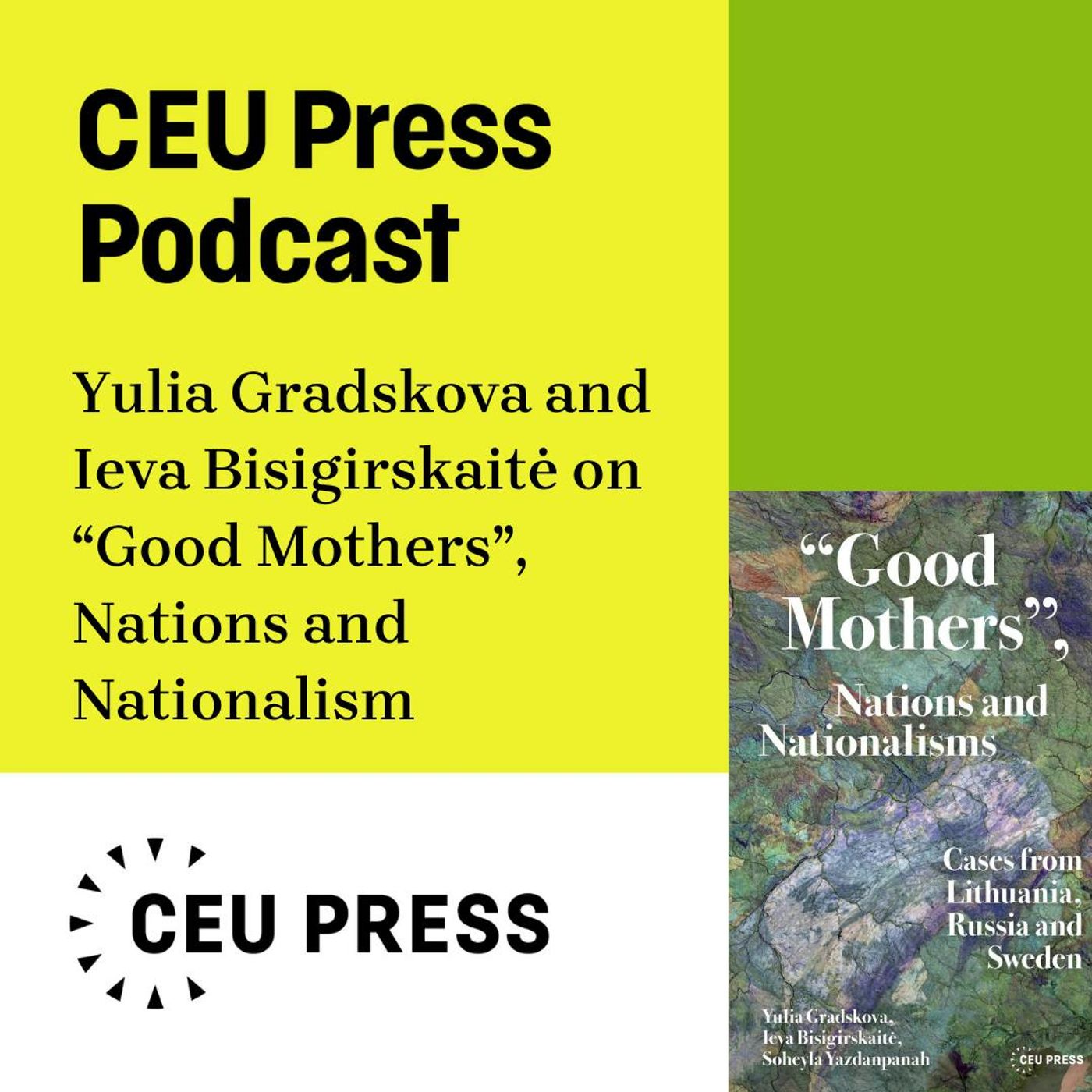
In this episode, host Andrea Talabér (CEU Press, 2026) talks with Yulia Gradskova and Ieva Bisigirskaitė, two of the three authors behind Good Mothers, Nations and Nationalisms: Cases from Lithuania, Russia and Sweden. Together with Soheyla Yazdanpanah, they explore what nationalists mean by "good mothers," demographic anxiety, and maternal activism in Lithuania, Russia and Sweden.
You can purchase a copy here.
The CEU Press Podcast delves into various aspects of the publishing process: from crafting a book proposal, finding a publisher, responding to peer review feedback on the manuscript, to the subsequent distribution, promotion and ma...
Steven Veerapen, "Overlord: A New History of the Life and Reign of Henry VIII" (Simon & Schuster, 2026
Henry VIII is England’s most famous king. He is simultaneously the virtuous Renaissance prince gone wrong, the psychopathic, paranoid tyrant, the religious disruptor and the much-married glutton.
Overlord: The Life and Reign of Henry VIII (Birlinn, 2026) is a groundbreaking study of Henry’s life examines and destroys many of the long-repeated myths about this complex monarch: he was not particularly gluttonous, not particularly prudish, and not particularly messy in his religious changes. Nor did he see himself as simply King of England. Drawing on archival sources from across the British Isles, Dr. Steven Veerapen reveals how Henr...
Laura Jockusch on Jewish Revenge after the Holocaust (JP)
After a great human-wrought tragedy, how are victims and their kin made right? What does it mean to take revenge, to exact vengeance, to seek redress, to go vigilante in seeking justice? What counts as the proper or sufficient retaliation or retribution--and what can or should be left to the impartial third-person mechanisms of a justice system?
To ask about those troubling topics from a new angle, Brandeis University's Laura Jockusch (author, previously, of Collect and Record and Jewish Honor Courts) has written about Jewish revenge on genocide perpetrators in her searching, and shocking Jewish Revenge and...
Katie Barclay, "The Kiss: A History of Passion and Power" (Reaktion Books, 2025)
The Kiss: A History of Passion and Power (Reaktion, 2026) by Professor Katie Barclay tells the surprising history of our most intimate gesture: the kiss. Richly illustrated, it explores a millennium of kisses, asking how and why the kiss has retained its power over the centuries, and what it might mean today. From the furtive kisses of fated lovers Heloise and Abelard to The Godfather’s ‘kiss of death’, Professor Barclay shows how the kiss can be romantic, peaceful, transgressive, intimate, erotic and more. There are kisses that are bad ideas, dangerous kisses and funny ones. New kisses are invented and ol...
Andrew N. Buchanan and Ruth Lawlor eds., "The Greater Second World War: Global Perspectives" (Cornell UP, 2025)
Andrew Buchanan and Ruth Lawlor, The Greater Second World War: Global Perspectives (Cornell University Press, 2025)
This ambitious edited collection encourages readers to think in bigger ways about the global Second World War. That includes a wider frame in space and time, but also a larger geopolitical perspective of the war as a world-system crisis and an expanded social perspective on who fought the war and why. A team of international scholars take on this task in chapters ranging from the global alliance system and colonial mobilization to studies of particular cities and dockyards.
In a wide...
Patrick Nunn, "Whispers from Celtic Seas: The True Meanings of Ancient Stories from Northwest Europe" (Reaktion, 2026)
What if the legends of submerged cities, land-making witches and sea-crossing bishops are not mere inventions but echoes of real events? Whispers from Celtic Seas: The True Meanings of Ancient Stories from Northwest Europe (Reaktion Books, 2026) by Professor Patrick Nunn at the University of the Sunshine Coast in Australia revisits coastal traditions from the Celtic fringes of northwest Europe, showing how they preserve memories of dramatic environmental change—floods, land loss and shifting shorelines—carried forward through oral storytelling for generations. Drawing on cutting-edge geological and archaeological research, this book recasts these tales not as fantasy, but as historical test...
Elisabeth van Houts, "Empress Matilda: Queen of the Romans, Ruler of the English" (Yale UP, 2026)
Born in 1102, Empress Matilda combined the blood of two dynasties: the house of Wessex and their conquerors, the dukes of Normandy. As a widowed German empress, she was named as heir successor by her father, Henry I. But, after his death in 1135, Matilda’s place on the English throne was usurped by her cousin, Stephen of Blois. Civil war followed, and she ruled the south-west of England in opposition.
In Empress Matilda: Queen of the Romans, Ruler of the English (Yale University Press, 2026), Professor Elisabeth van Houts explores the remarkable life of medieval England’s only queen regn...
Mikuláš Pešta, "Student Internationalism and the Global Cold War: The International Union of Students in Socialist Prague" (Bloomsbury, 2026)

In this episode of the CEU Review of Books Podcast, I sat down with Mikuláš Pešta to talk about his new book, Student Internationalism and the Global Cold War: The International Union of Students in Socialist Prague (Bloomsbury, 2026). During our discussion we touched upon how the International Union of Students ended up being headquartered in Prague, the organisation's various activities, and the life of the Secretariat, amongst other topics.
You can purchase the book from Bloomsbury here. The book is also available Open Access here.
The CEU Review of Books Podcast Series explores the que...
Martin Shaw, "The New Age of Genocide: Intellectual and Political Challenges After Gaza" (Agenda Publishing, 2025)
The Israeli destruction of Gaza has returned the idea of genocide to the center of world politics, with sharp conflicts between the protesters and lawyers who invoke it and the governments and media that deny it. The New Age of Genocide: Intellectual and Political Challenges After Gaza (Agenda Publishing, 2025), by the foremost sociological theorist of genocide, Martin Shaw, defends the idea against thinkers who have questioned it, and argues that it is essential to the understanding of mass atrocities. It maintains that Gaza has opened a new age in which the West not only fails to prevent, but also partic...
Lucy D. Curzon, "Art and Citizenship in Conflict: British Women War Artists, 1939–45" (Manchester UP, 2025)
Art and Citizenship in Conflict: British Women War Artists, 1939-45 (Manchester UP, 2026) by Dr. Lucy Curzon examines the work of women war artists in order to highlight the complexity of citizenship and gender in Britain during the Second World War.
Evelyn Dunbar, Mary Kessell, Ethel Gabain, Stella Schmolle, and Laura Knight, among others, were commissioned by the War Artists' Advisory Committee (WAAC) to document the millions of women who took up sometimes unconventional roles-in agriculture, the auxiliary services, and manufacturing, among others-to support the British war effort. Indeed, their prints, drawings, and paintings were part of a...
Sarah Kaminsky, "The Forger of Paris" (Doppelhouse Press, 2025)
The Forger of Paris (Doppelhouse Press, 2025) presents Adolfo Kaminsky’s biography in its only authorized edition, expanded with photographs from Kaminsky's 2019 exhibition at the Museum of Jewish Art and History in Paris and accompanied by essays from MAHJ director Paul Salmona and National Jewish Book Award winner Deborah Dash Moore.
"This necessary book provides unforgettable insights into hidden worlds of the Jews, intellectuals, and partisans who fought back.... has a thriller dimension that outshines even the best undercover fiction." — Jewish Book Council
At seventeen, Adolfo Kaminsky had narrowly escaped deportation to Auschwitz and was recruited to join...
Thomas Smith, "The Fifth Crusade: A History of the Epic Campaign to Conquer Egypt" (Yale UP, 2026)
In 1217, the crusader states were in a highly fragile condition. The Fourth Crusade had failed, and Jerusalem had not been recovered. The crusaders now set their sights on Egypt. If the breadbasket of the Mediterranean could be conquered, long-term Christian control of the Holy Land could be ensured. Led by the rulers of Hungary and Austria, and backed by the Knights Templar and Hospitaller, the Fifth Crusade was launched.
In The Fifth Crusade: A History of the Epic Campaign to Conquer Egypt(Yale University Press, 2026), Dr. Thomas Smith tells the gripping story of the crusade for Egypt. Lo...
Rod Phillips, "Cats: A History" (Johns Hopkins UP, 2026)
For more than 10,000 years, cats have prowled at the edges of human life. But, starting only a few decades ago, hundreds of millions of them became pets. In Cats: A History (Johns Hopkins University Press, 2026), Professor Rod Phillips shares a sweeping cultural and social history of felines, tracing their shifting place across societies and centuries, from ancient Egypt's revered hunters to Europe's suspected familiars of witches and from shipboard rodent controllers to cherished internet icons.
Professor Phillips illustrates how cats have always occupied spaces both familiar and mysterious and how their perceived independence and disruptive nature—and thei...
A. G. Hopkins, "The Land Where Nothing Works: How Britain Lost the Plot" (Princeton UP, 2026)
What has happened to Britain? As drivers on its roads can attest, it is the pothole capital of Europe. Once-beautiful towns now feature peeling paint, weeds, and broken railings. Public services are no longer fit for purpose. A malaise seems to infect every aspect of British life: its economy, polity, social order, sense of well-being, domestic regional relationships, and place in the world. In The Land Where Nothing Works: How Britain Lost the Plot (Princeton University Press, 2026), the distinguished historian A. G. Hopkins offers an explanation, tracing Britain’s current problems to decisions made in the 1980s that abandoned its...
Roberta J. Magnusson, "Urban Infrastructure in Medieval England: Sustainability and Resilience" (Johns Hopkins UP, 2026)
In the bustling market towns and growing cities of medieval England between 1200 and 1600, public works were the lifelines of urban society. In Urban Infrastructure in Medieval England: Sustainability and Resilience (Johns Hopkins University Press, 2026), Dr. Roberta J. Magnusson offers the first comprehensive study of how medieval towns built, financed, and sustained their defenses, bridges, streets, water systems, and harbors.
Dr. Magnusson reveals how even modest communities, like the Warwickshire town of Atherstone, boldly pursued projects that reshaped their futures. Grants of tolls and taxes funded paving initiatives, bridge repairs, and fortified walls, while enterprising lords and abbots sp...
Bjørn Berge, "Smell: The Tale of a Fading Sense" (Reaktion Books, 2026)
The sense of smell is often linked to the dark, the antisocial, the primitive—the very opposite of modernity and progress. Today we live in an almost odorless world, where everything is reduced to images. Yet smell plays a vital role in how we relate to others and our surroundings, forming our experiences and our memories. Tracing a history of smell from the first ancient cities, through medieval plagues and the Industrial Revolution to the present day, Smell: The Tale of a Fading Sense (Reaktion, 2026) is a tribute to the sense of smell in all its beauty and disgust. Al...
Chinese EVs: From Nordic Streets to Central Asian Hubs
Can Europe afford to stand back as China rewrites the global electric vehicle (EV) ecosystem? In this episode, Julie Yu-Wen Chen at the University of Helsinki talks to United Nations Senior Adviser Matthew Gray for Europe and Central Asia Markets, who discusses the rapid international expansion of Chinese EVs. The conversation highlights how Chinese brands have moved beyond public buses to growing passenger car markets in the Nordic region and Central Asia through superior technology, lower price points, and patient policy.
While European markets face limited model availability due to protectionism and strategic caution, Central Asian nations...
Jeremy D. Popkin, "The First Emancipation: The Forgotten History of Abolition in Revolutionary France" (Princeton UP, 2026)
The First Emancipation: The Forgotten History of Abolition in Revolutionary France (Princeton UP, 2026) is a dramatic account of how slavery and race profoundly influenced the course of the French Revolution and had a central impact on the lives of key leaders, including Mirabeau, Robespierre, Toussaint Louverture, and Napoleon. Acclaimed historian Jeremy D. Popkin brings this often-forgotten story to life, highlighting the arguments put forward by French abolitionists and their opponents and the profound repercussions of the first abolition of slavery in a Western empire.
When the French revolutionaries passed the Declaration of the Rights of Man and Citizen in 1...
Cleo Nisse, "Venetian Canvas and the Transformation of Painting" (Princeton UP, 2026)
Between
the fifteenth and early seventeenth centuries, European painting
underwent a profound transformation as artists increasingly painted on
canvas instead of wood or walls. Nowhere was more important to this
shift than Venice, where painters experimented with canvas with
remarkable creativity and innovation. In Venetian Canvas and the Transformation of Painting (Princeton
University Press, 2026), Dr. Cleo Nisse investigates why Venetian
artists adopted canvas and how it revolutionized their art between 1400
and 1600.
Intertwining approaches from art history and art
conservation, and
featuring stunning new photographs that show details as never before,
the book presents groundbreaking research based on...
Charles J. Stivale, "Unfolding the Deleuze Seminars, 1970–1987: Summaries and Commentary" (Edinburgh UP, 2025)
From the inside flap:
“A rich resource of Deleuze’s research that is unavailable in his published writing
Includes summaries of 216 seminar sessions available in transcripts and recordings Summaries are based on research for the Deleuze Seminars project (co-directed by Charles J. Stivale and Daniel W. Smith), where full transcripts and translations, to which readers will have access for simultaneous or subsequent consultation, have been developed by an international team of scholar-translators Alongside summaries, an attached critical apparatus provides references to corresponding links within Deleuze’s writings, seminars, and other sources to facilitate additional researchThe te...
Catherine Fletcher, "The Firearm Revolution: From Renaissance Italy to the European Empires" (Princeton UP, 2026)
In Renaissance Italy, the gun was not only a tool of war but also a desirable object, a luxury item carried at court. Guns were in use on the battlefield by 1440; later in that century Leonardo da Vinci sketched a design for a faster-firing, more portable handgun that could be hidden beneath a cloak. As the gun proliferated in society, it became both a means of self-defence and a threat to civic order. In The Firearm Revolution: From Renaissance Italy to the European Empires (Princeton University Press, 2026), historian Catherine Fletcher explores the emergence of firearms in Renaissance Italy and bey...
European Jews in the 21st Century
What is the status of Jews in Europe in the 21st century? How do they maintain vital communities? Do they desire to remain in Europe? To remain Jewish? Where are the trendlines headed? A mere 0.1% of Europe's population is Jewish. Proportionally, this figure is at its lowest since the turn of the first millennium. European Jews' numbers have continued to decline even after the Holocaust. Once a major center of world Jewry, Europe often goes largely unmentioned in conversations about the global Jewish community.
K., the European Jewish Review, is a new magazine founded in March 2021 to...
