The Scuba Gear Lab

The Scuba Gear Lab applies Consumer Reports-style testing to life-support dive equipment, publishing spec-driven comparisons that prioritize safety and performance over marketing claims. Our mission is to give divers the technical data and failure analysis they need to make confident, high-stakes purchasing decisions, as well as educate every diver -- from students to professionals -- about the gear their life depends on.
Understanding BCD Lift Capacity: Weight Requirements and Buoyancy Ratings Explained

BCD lift capacity is one of the most overlooked safety factors in scuba diving, yet it determines whether you can stay afloat in an emergency, assist a distressed buddy, or even comfortably rest at the surface after a tiring dive. In this episode, you'll learn exactly how lift capacity works, how to calculate what you actually need for your specific diving configuration, and why matching your BCD to your gear setup isn't just about comfort—it's about staying safe underwater.
• BCD lift capacity is the maximum positive buoyancy your bladder generates when fully inflated, and you need 10 to 1...
How to Properly Fit and Adjust Your Scuba BCD for Maximum Comfort

BCD fit is one of those things most divers get wrong for months or even years without realizing it. In this episode, you'll learn the exact step-by-step process to properly fit and adjust your scuba BCD for maximum comfort, better buoyancy control, and less fatigue underwater. Whether you own your gear or rent, these techniques will transform how your BCD feels on every dive.
• Always adjust shoulder straps first, before touching any other strap—they set the foundation for how the entire BCD hangs on your body and distributes tank weight.
• Your waist strap should sit on...
BCD Pre-Dive Safety Checklist: Complete Buoyancy Compensator Inspection Guide
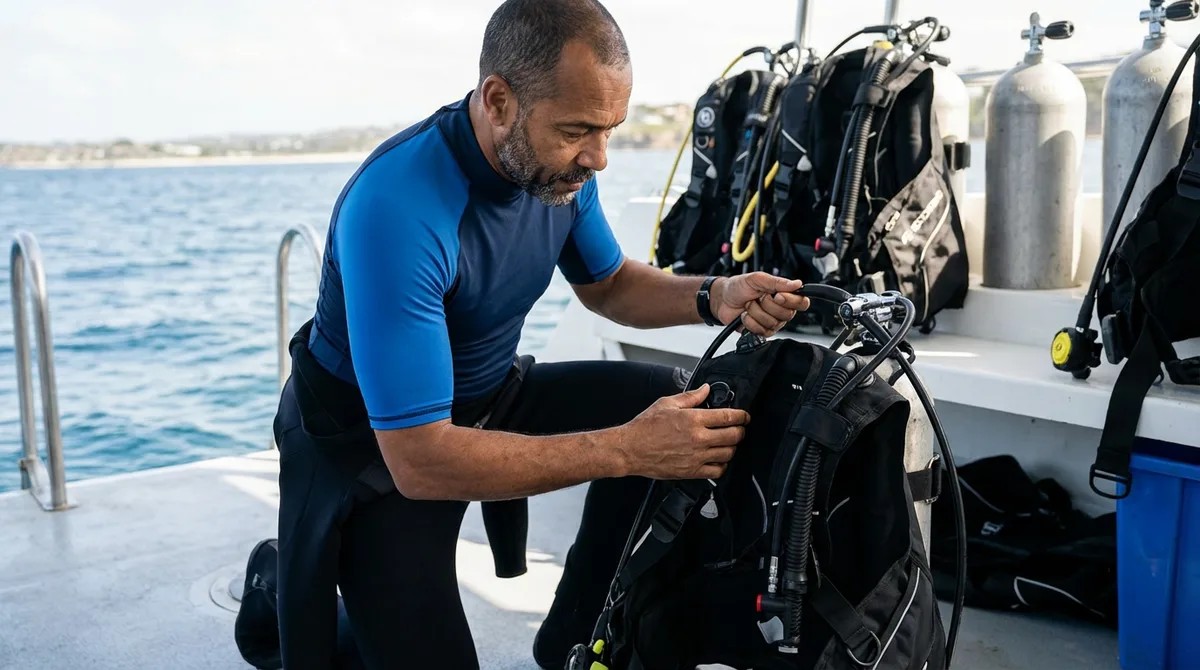
Most divers skip the BCD pre-dive check, and that's exactly when things go wrong: stuck inflator buttons, failed dump valves, and slow leaks that show up at depth. In this episode, you'll learn the complete buoyancy compensator inspection protocol that catches problems while you're still on the surface, before they become underwater emergencies.
• You'll learn how to perform a complete visual inspection that identifies bladder damage, UV-degraded straps, and corroded hardware before you pressurize your BCD.
• You'll discover the exact inflator system tests that catch stuck buttons, leaking connections, and failed oral inflation backups that caus...
What Is a Buoyancy Compensator Device: BCD Components and Function Explained
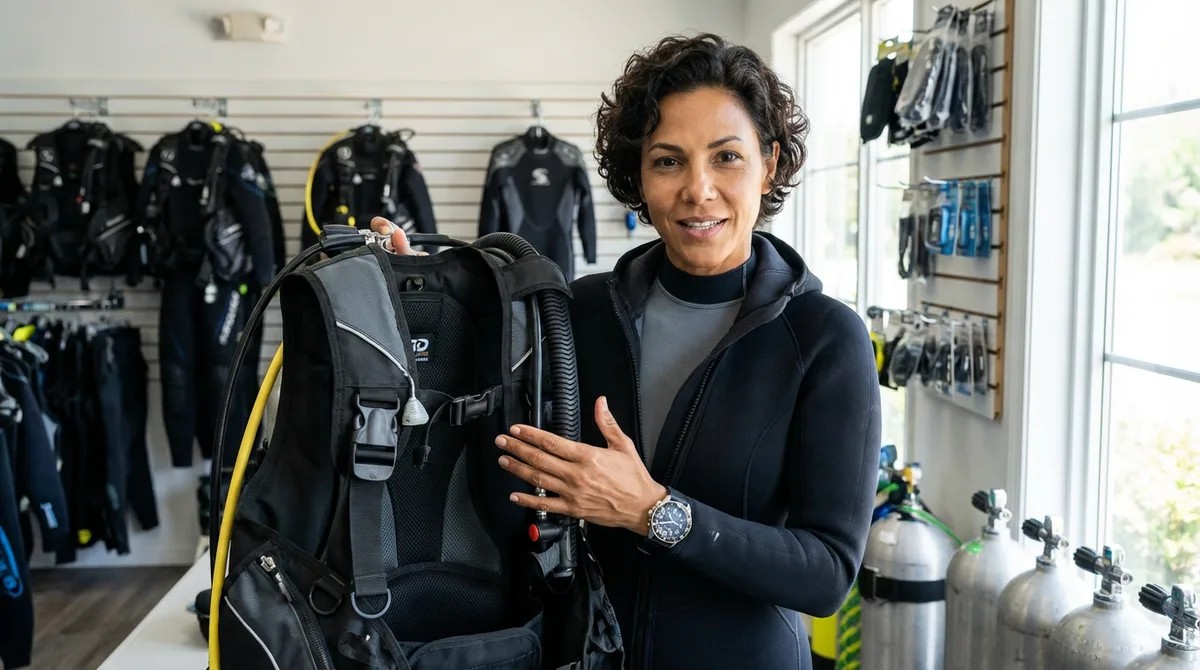
You'll learn what a buoyancy compensator device actually does beyond just holding your tank, how it controls your position underwater, and why mastering it transforms your diving from survival mode to confident exploration. We cover the mechanics, the different BCD types, and the real world skills that keep you safe and in control at any depth.
• A buoyancy compensator device controls your position in the water by adding or releasing air, allowing you to achieve neutral buoyancy at depth, float at the surface, and make controlled ascents and descents.
• As you ascend, the air in your...
How to Choose a Buoyancy Compensator: Matching BCD Features to Your Dive Profile

Choosing the wrong buoyancy compensator can ruin your diving experience—fighting bad trim, dealing with jammed weight pockets, or running out of lift when you need it most. In this episode, you'll learn the exact decision framework to match BCD features to your actual dive profile, covering lift capacity calculations, style selection, fit evaluation, and material quality so you invest in the right BC the first time.
• Calculate your required lift capacity by adding up the weight of all negative gear plus a 25-30% safety margin—most recreational divers need 25-35 pounds depending on exposure protection and tank t...
Best Travel BCDs Under 5 Pounds for 2026

Traveling with dive gear shouldn't mean paying baggage fees that cost more than another dive day. In this episode, we cover the best travel BCDs under five pounds for 2026—gear that's light enough to keep you under airline weight limits but durable enough to last hundreds of dives. You'll learn what actually matters when choosing a lightweight BCD and which models deliver real performance without the compromises.
• Manufacturers often understate BCD weight by excluding integrated weight systems, D-rings, and inflator assemblies, so always look for "complete assembly" dry weight specs and expect up to twelve ounces more than...
Jacket BCD vs Back Inflate BCD: Which Is Better for Your Diving Style?

After four decades of watching divers wrestle with buoyancy compensators, Ray Hollister breaks down the jacket BCD versus back inflate debate with real-world performance data. You'll learn which design matches your actual diving style, not the one you imagine, and why surface stability, underwater trim, and travel considerations should drive your decision more than marketing hype.
• Jacket BCDs excel at surface stability and keep you vertical with minimal effort, making them ideal for boat diving with long surface intervals, while back inflate BCDs push you face-forward and require constant finning to stay upright.
• Back inflate BCDs...
Best Buoyancy Control Devices for Beginner Divers in 2026

Choosing your first buoyancy control device can feel overwhelming when you're staring at dozens of options and conflicting advice. In this episode, Camila Reyes breaks down exactly what beginner divers need to know about BCDs, from understanding jacket versus back-inflate designs to finding the right lift capacity and fit for your body and diving style.
• Jacket-style BCDs keep you upright and stable at the surface, making them ideal for beginners still building water confidence, while back-inflate models help with horizontal trim but can tip you forward on the surface.
• Integrated weight pockets distribute weight more comf...
Scuba Buoyancy Compensators: Complete Guide to BCDs for Every Diver
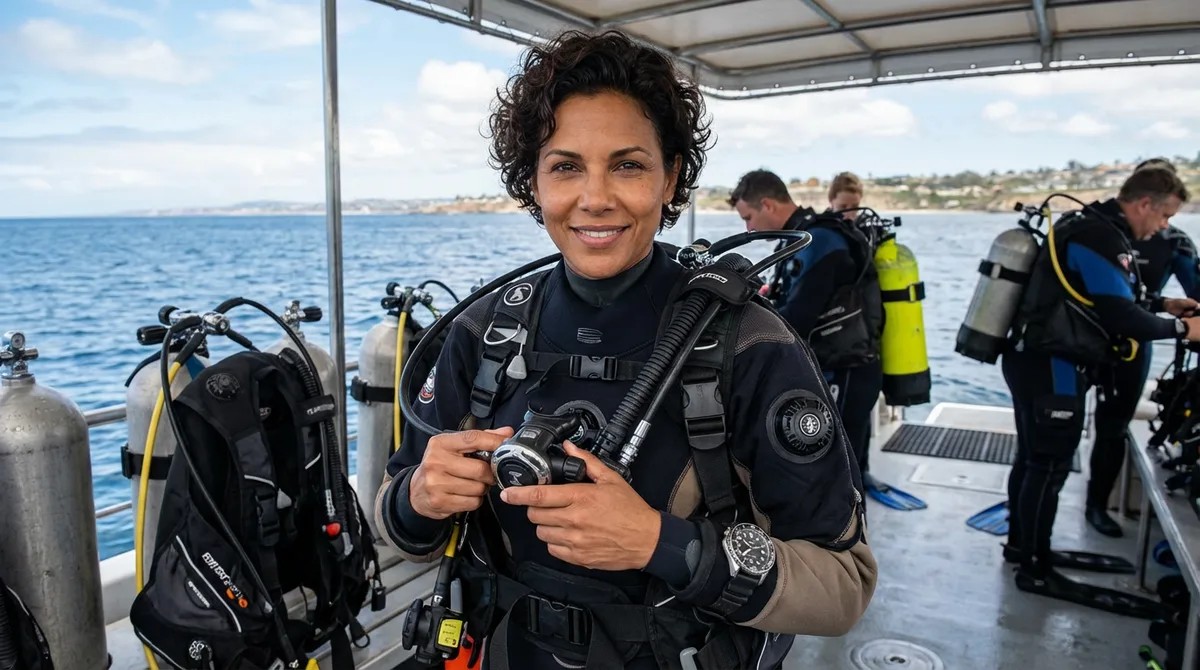
Your buoyancy compensator is way more than just a tank holder, and choosing the wrong one can make every dive miserable. In this episode, we break down everything you need to know about scuba BCDs, from how they actually work to choosing the right type for your diving style, plus the maintenance mistakes that'll cost you money and safety.
• Jacket-style BCDs are easier for beginners and provide upright surface flotation, while back-inflate BCDs offer better streamlining and horizontal positioning underwater, making them popular for underwater photography.
• Lift capacity needs vary significantly based on your diving cond...
Dive Computer Maintenance Checklist: Battery, O-Rings, and Calibration
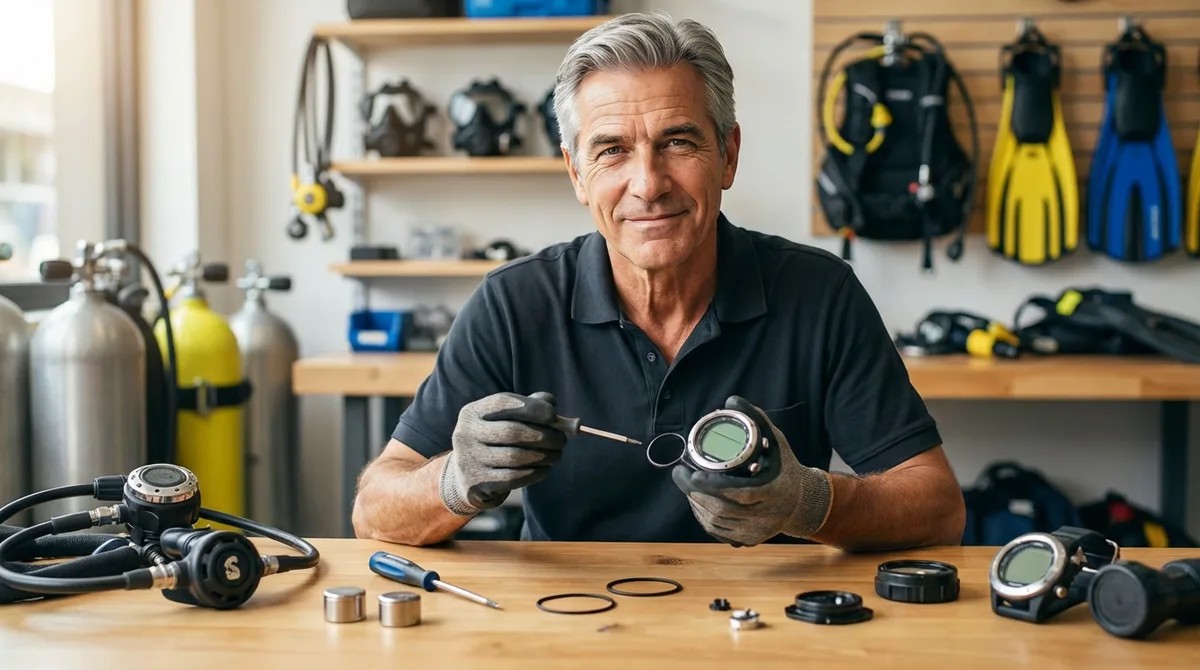
Your dive computer is doing critical decompression math every second you're underwater, yet most divers treat maintenance like an afterthought until something fails. In this episode, Ray Hollister walks you through a complete dive computer maintenance checklist covering battery replacement schedules, o-ring inspection and replacement, sensor calibration, software updates, and the physical care habits that keep your computer reliable for years.
• Replace user-serviceable batteries annually or every 100-150 dives, and always replace the battery compartment o-ring every single time you open it, even if the battery is fine.
• Inspect all o-rings every six months under good...
Pre-Dive Computer Checklist: Setup and Safety Verification
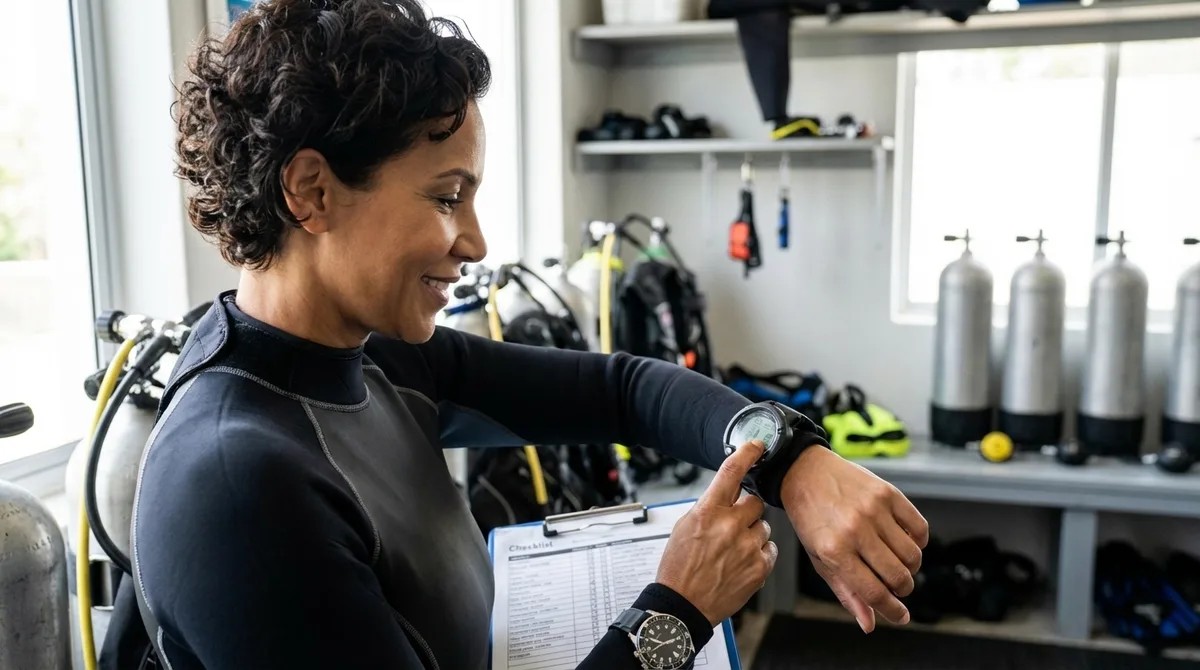
A malfunctioning dive computer at 60 feet can turn a great dive into a stressful emergency, and most failures trace back to rushed pre-dive setup. In this episode, you'll learn the step-by-step checklist for verifying your dive computer before every dive—from battery and display checks to gas configuration, altitude settings, and alarm verification—so you can dive with confidence instead of second-guessing your equipment underwater.
• Always verify your dive computer battery is above 30 percent before diving, test all display segments and buttons for responsiveness, and check for any condensation inside the screen that indicates seal failure.
• Se...
Dive Computer Algorithms Explained: Understanding Decompression Models

Ever wondered what's actually happening behind the screen of your dive computer while you're underwater? Most divers trust their computer without understanding the algorithm that's calculating nitrogen absorption, off-gassing rates, and decompression limits in real time. In this episode, you'll learn how dive computer algorithms work, why different computers give different no-deco limits, and how understanding these models can make you a safer, smarter diver.
• Dive computer algorithms track nitrogen absorption across multiple tissue compartments that load and off-gas at different rates, using models like Bühlmann, RGBM, DSAT, and VPM to calculate your no-deco limits in rea...
How to Choose a Dive Computer: Selection Guide

Choosing your first dive computer can feel overwhelming when you're staring at spec sheets and trying to decode features you don't understand yet. In this episode, Camila Reyes walks you through how to choose a dive computer that matches your actual diving style, budget, and experience level—covering everything from form factor and algorithms to air integration and long-term costs. Whether you're a brand-new Open Water diver or getting serious about logging more hours underwater, this guide helps you avoid common mistakes and focus on what actually matters.
• Wrist-mounted computers are the most versatile choice for most dive...
Best Budget Dive Computers Under $500

Dive computers don't have to cost more than your entire gear setup. In this episode, Camila Reyes breaks down the best budget dive computers under five hundred dollars, sharing what actually matters based on three years of diving affordable gear and watching what works for real recreational divers. You'll learn which features are worth paying for and which ones you can skip until you're ready for technical diving.
• The three-hundred-to-five-hundred-dollar range offers the best value for recreational divers, with the Shearwater Peregrine leading at four hundred fifty dollars and the Suunto Zoop Novo being the most reliable op...
Suunto vs Shearwater Dive Computers: Which Is Better?

Choosing between a Suunto and a Shearwater dive computer can feel overwhelming, but the decision comes down to how you dive and what you need from your gear. In this episode, Ray Hollister breaks down the real differences—algorithm philosophy, display readability, build quality, user interface, battery life, and cost—so you can make the right call based on your diving goals, not marketing hype.
• Shearwater dive computers offer full gradient factor control and customizable decompression algorithms, while Suunto uses a more conservative, fixed algorithm that can limit bottom time on repetitive and multi-day dives.
• Shearwat...
Best Dive Computer Watches: Top Wrist-Mounted Models

Dive computer watches have evolved from bulky console-mounted bricks to sleek wrist instruments, but not all of them are worth your money. In this episode, Ray Hollister draws on four decades of diving experience to break down the best wrist-mounted dive computers across every price range—from budget-friendly options for beginners to technical computers built for serious divers who demand precision and reliability.
• The Shearwater Peregrine offers the best balance of affordability, readability, and reliability for most recreational divers, with a brilliant color screen readable at 100 feet and a proven Bühlmann algorithm.
• Conservative algorithms like RG...
Dive Computers: Complete Guide to Scuba Diving Computers

Dive computers are the most significant safety advancement in recreational diving history, tracking your actual nitrogen loading in real time and giving you more accurate bottom time than tables ever could. In this episode, Ray Hollister draws on over 40 years and 8,000 dives to explain how dive computers work, why they matter for every level of diver, and how to choose the right one for your diving style.
• Dive computers track your actual multi-level dive profile and typically give you 15 to 25 percent more no-decompression time compared to planning the same dive with tables, which can add up to ho...
DIN vs Yoke Regulator Connection: Which Valve Type Should You Choose?

Choosing between DIN and yoke regulator connections affects more than just how your reg attaches to a tank—it impacts your safety, travel flexibility, and which types of diving you can realistically pursue. In this episode, you'll learn the mechanical differences between these two valve systems, how to evaluate which one fits your actual diving habits, and what you need to know about tank availability, conversion costs, and real-world performance before you make the investment.
• Yoke connections offer universal availability and simplicity, making them ideal for recreational vacation divers, while DIN connections provide superior security and protected o-ri...
What is Intermediate Pressure in Scuba Regulators: Understanding IP Settings and Performance

Your regulator breathes fine in the pool but feels restrictive at 80 feet. The culprit is usually something most divers never learn about: intermediate pressure. In this episode, you'll learn what regulator intermediate pressure actually is, how it affects your breathing underwater, why it drifts over time, and how to recognize when it's causing problems before they become serious.
• Intermediate pressure is the reduced air pressure between your first and second stages, typically 130 to 145 PSI above ambient water pressure, and it directly affects breathing resistance and freeflow risk at depth.
• Low intermediate pressure causes harder breathing espe...
Best Cold Water Scuba Regulators: 6 Top-Rated Models for Ice and Drysuit Diving

If you've ever wondered why some scuba regulators fail catastrophically in cold water while others work flawlessly under ice, this episode breaks down exactly what makes a regulator cold-water capable and reviews six top-rated models for ice and drysuit diving. You'll learn what environmental sealing actually does, why metal construction matters, and which specific certifications to look for when your regulator becomes genuine life-support equipment in sub-40-degree water.
• Environmental sealing of the first stage is the single most critical feature for preventing freezing-induced freeflow, reducing freeflow rates by 15 to 20 times compared to unsealed designs in identical co...
How to Service a Scuba Regulator: Complete Maintenance Guide and Schedule
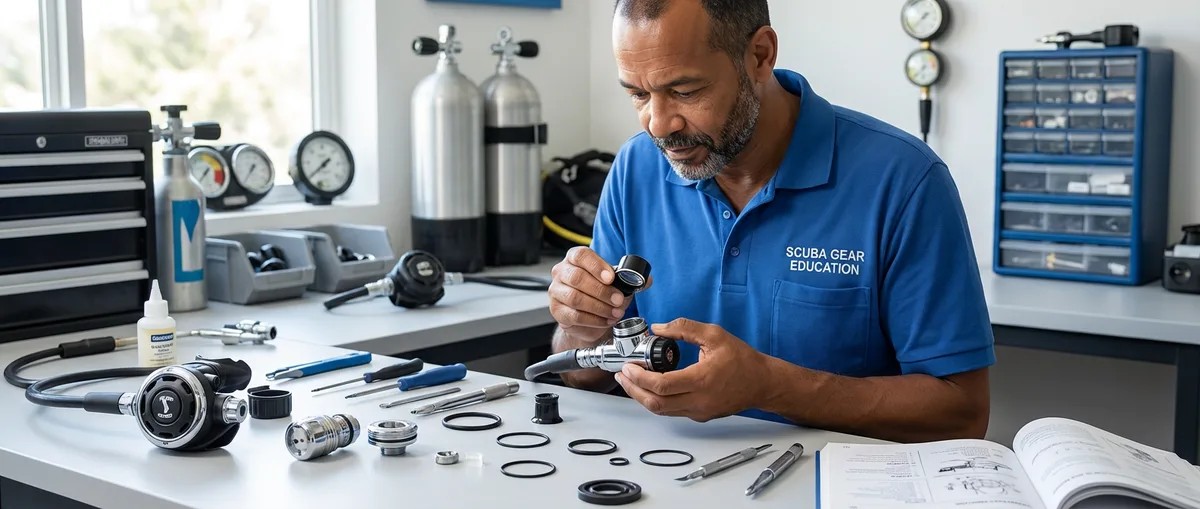
Most recreational divers shouldn't be servicing their own regulators—but understanding what happens during that annual teardown can save your dive or even your life. In this episode, Marcus Okafor walks through the complete regulator service process, from pre-service documentation to final pressure testing, explaining what certified technicians actually do, why generic O-ring kits can be dangerous, and which maintenance tasks you can safely handle yourself versus what requires factory training.
• Regulators should be serviced annually or every 100 dives, but cold-water and technical diving regulators require annual service regardless of dive count, while well-maintained warm-water regs may safe...
The Complete Guide to Scuba Regulators: How They Work, What to Look For, and How to Choose

Your scuba regulator is the only piece of equipment standing between you and drowning, yet most new divers treat it like an afterthought. In this episode, you'll learn exactly how regulators work, what separates high-performance breathing systems from mediocre ones, and how to match a regulator to your specific diving conditions — from warm tropical reefs to cold technical environments.
• A scuba regulator reduces high-pressure tank air through two stages: the first stage drops pressure from 3,000+ PSI to intermediate pressure (135-145 PSI above ambient), and the second stage delivers breathable air on demand at ambient pressure.
• High-p...
Best Scuba Regulators for Beginners: Top 7 Picks for New Divers in 2026
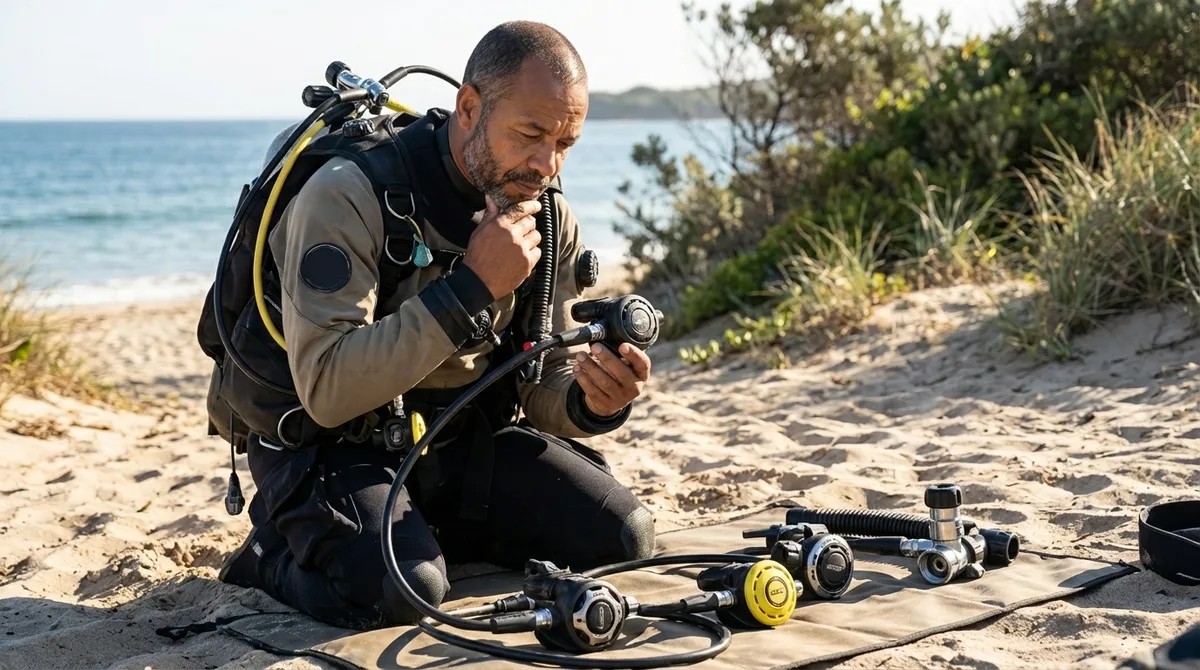
Choosing your first scuba regulator can feel overwhelming, but it doesn't have to be. In this episode, we break down exactly what beginners should look for in a regulator, cut through the marketing jargon, and review seven top models that deliver reliable performance without breaking the bank. You'll learn which features actually matter, which ones are just hype, and how to choose a regulator that'll serve you well for years to come.
• Balanced regulators maintain consistent breathing performance as your tank empties, making them worth the modest price increase over unbalanced models for most beginners.
• Even...


