Where The Wild Thoughts Are
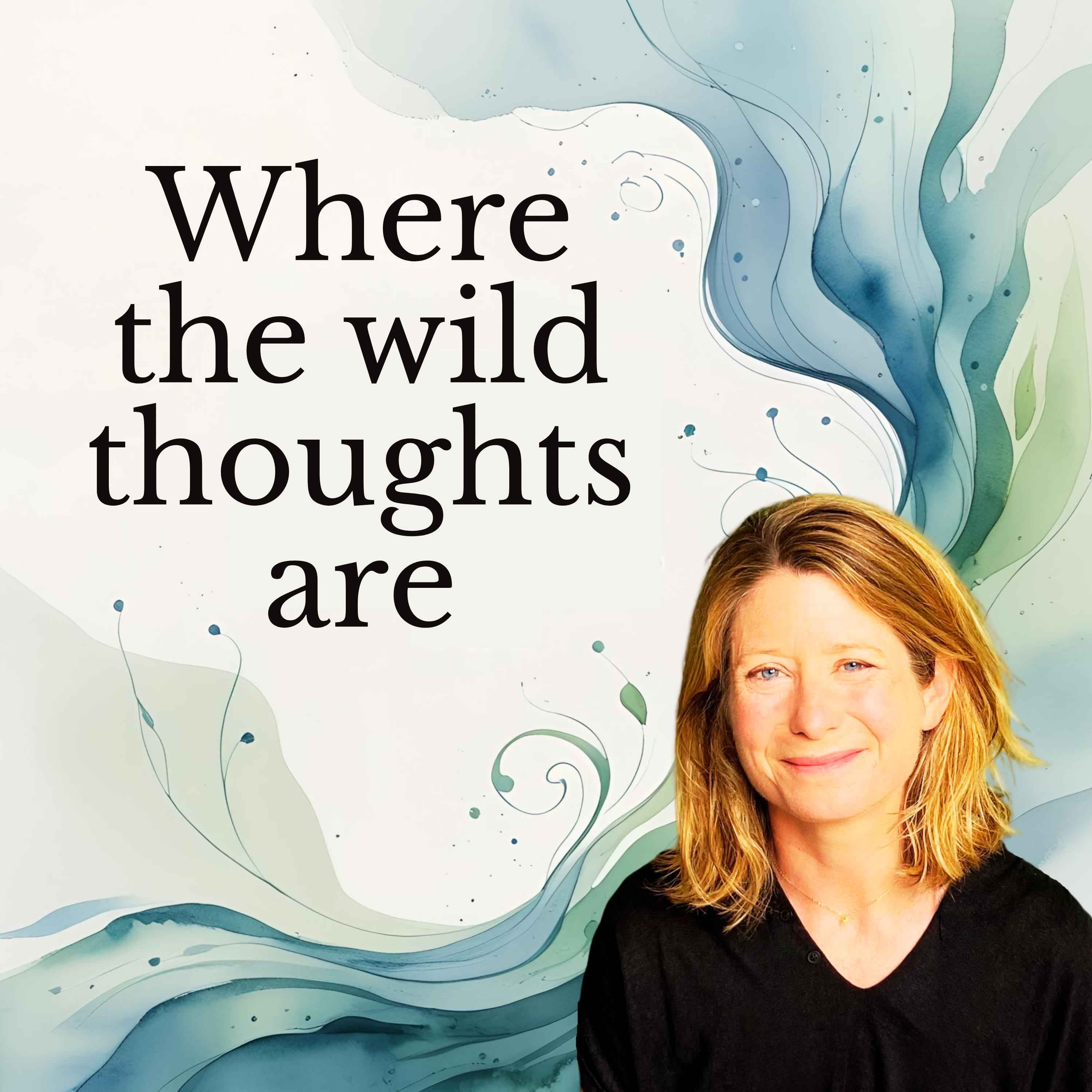
We’re talking about science. But not just any science...Each episode, journalist Jo Marchant meets researchers who are doing things differently: challenging our assumptions, stretching our minds, and changing how we see the world.We’ll be pushing boundaries from cosmology and quantum physics to neuroscience, archaeology, ecology… Jo’s guests are asking deep questions, chasing outrageous dreams, and exploring the world in completely new ways.As well as learning about their pioneering ideas, we’ll hear their personal stories: what inspires their leaps of imagination; how they keep going despite the obstacles; the importance of thinking differently; and why we nee...
What is 'Now'?
Exciting news: I have a new book coming out! It’s called In Search of Now: the science and mystery of the present moment, and I’d love to share some of the ideas in it with you, so here is a one-off special episode to ask: What is Now?
The present moment has always fascinated me because on the one hand it’s all around us: everything we do, everything we are. We feel that Now is where we meet the world, where stuff happens, where we feel, think, choose, act. But physicists can’t find it anywhe...
End of season special
Since September we've met 16 scientists, in fields from neuroscience and quantum physics to archaeology and ecology, who are asking wild questions, exploring the world in different ways, wondering what if the world isn't how we thought. They've all been surprising, brilliant and creative in different ways: for me, each chat has been like a glimpse into a fascinating, hidden world.
To finish the season, this week's episode is a bit different. I've asked my lovely producer, Julian Mayers (who also happens to be a cosmologist), to join me for a look back over some of our favourite...
Can we hear the secret life of ponds?
What happens if we let go of our expectations about nature – all the things we think it is, or isn’t, or should be – and just… listen?
Our guide into the unknown this week is award-winning sound artist and ecologist David de la Haye. I first met him at this year’s New Scientist Live in London: I was giving a talk about the science of awe and David came up to me afterwards to tell me about the awe he finds though his work with sound. Essentially he puts hydrophones into the water and records the submerged...
How does the moon shape biology?
People have long told stories about the moon’s power, from werewolves shapeshifting by the moon, to the belief that drinking water soaked with moonlight could help women conceive. And monthly rhythms appear across nature, from corals and cacti to gorillas.
But while there's lots of research showing that the daily cycles of the sun are crucial for biology, scientists have largely ignored the role of the moon – or dismissed it as pseudoscience, particularly in humans. That’s partly because there hasn’t been a convincing mechanism for how the moon might influence life on Earth - which is...
Can slow AI make us more human?
How does using AI change who we are? Last week on Where the Wild Thoughts Are, we talked about freeing AIs to have their own creative ideas and express their own realities. This week we’re flipping that theme, with philosopher Caterina Moruzzi of Edinburgh College of Art, to explore how people and AIs work together, and what that relationship does to us as humans.
There’s evidence that when we use AI chatbots to effortlessly generate pretty much anything we want – an essay, poem, painting – that may erode our own ability to think and create. Even if...
Can AI reveal its true self through art?
Can an AI have wild thoughts? Are machines capable of true creativity, true art, of going beyond the training and the prompts we give them in order to explore new worlds?
My guest this week is Simon Colton of Queen Mary, University of London. He’s a professor of computational creativity who has been working towards this goal for decades, and he thinks the answer is yes… but only if we give AIs the freedom to choose what they create and to use their own experiences as inspiration.
It’s an interesting approach that i...
What was Einstein's 'cosmic religion'?
Thinkers don’t come much wilder than Albert Einstein. His out-of-the-box physics transformed how we think about the universe: with his famous equation E=mc2 he showed that energy and matter are one and the same; through his theory of relativity he joined space and time into one malleable fabric that can morph according to your point of view.
But we’re talking about a very different side to Einstein. My guest is Kieran Fox, a physician and neuroscientist at the University of California, San Francisco, all-round spiritual explorer, and author of a fascinating book called I am a...
What happens when consciousness meets chaos?
Standing waves and resonant frequencies appear everywhere in the world around us, from musical notes and swaying bridges to electron orbits and animal coats. This week's guest, neuroscientist Selen Atasoy, wondered if they could also be found in the brain.
Her work has led to a new way to understand different states of consciousness -- from anaesthesia through our normal waking state to meditation and psychedelics. She explains how changes in our awareness reflect a shifting balance between order and chaos, and why psychedelics may tune the brain closer to a critical point of maximum complexity.<...
What awakened at Göbekli Tepe?
Steady your nerves and light up your torches, because this week we’re clambering into the deep, dark Neolithic underworld with archaeologist Jens Notroff.
Jens, of the German Archaeological Institute, has spent years excavating one of the world’s most fascinating and mysterious prehistoric sites – Göbekli Tepe in southeastern Turkey. This is a series of circular stone enclosures, featuring giant T-shaped figures and carvings of fearsome predators – and possibly also once decorated with human skulls. It’s sometimes described as “the world’s first temple”, and according to conventional thinking, it shouldn’t exist.
That’s becaus...
Can life transcend physics?
We’re talking about life, the universe and everything – literally!
My guest is cosmologist Marina Cortês of the University of Lisbon. Marina trained as a dancer before helping to shake up cosmology with some revolutionary ideas about the nature of time. As if that wasn’t enough – she’s now using the tools of theoretical physics to investigate the significance of life in the universe, in a new field that she and her colleagues call biocosmology.
Marina’s work goes against many of the normal assumptions of physics. Put simply, you could see t...
Why do placebos work?
Placebo effects are not about expectation, or positive thinking, and you don’t have to believe you’re taking a real drug to feel better. In fact, they are not in your mind at all, but your body.
This is what self-confessed ‘deviant’ Ted Kaptchuk wants you to know, after conducting decades of research that has shocked the medical establishment and turned upside down conventional thinking about placebos.
I’ve been a fan of Ted’s work ever since we first met in 2014, when I was researching my book Cure: A journey into the science of mind over...
Can we talk to whales?
We're diving into the world of whales - as well as dolphins and other cetaceans - with biologist and filmmaker Tom Mustill, author of the fascinating book How to Speak Whale. I first learned about Tom’s work in 2023 when I attended a talk he gave at the British Library, and he began with the story of how on a kayaking trip he was almost crushed by a breaching humpback whale.
After that experience, and the discovery that the whale may actually have saved his life by twisting in the air to avoid him, Tom bec...
Can we sense magnetic fields?
We're digging into how living creatures – including us – sense and respond to magnetic fields with quantum biologist Margaret Ahmad of the University of Sorbonne in Paris.
For decades, biologists knew about striking examples of species apparently navigating by Earth’s magnetic field, from monarch butterflies to loggerhead turtles to racing pigeons. Yet for years, many physicists said any ‘magnetosense’ was impossible, insisting the Earth’s field is far too weak to affect any biological processes within living cells. And yet, life really had found a way, and Margaret was one of the key researchers who showed how.<...
How do you read a library turned to ash?
We're delving into one of the ancient world's biggest mysteries: the Herculaneum scrolls. Computer scientist Brent Seales of the University of Kentucky talks about a journey that has taken him from Mars to Beowulf to the Dead Sea and beyond. AI has been key to finally reading what's inside the scrolls -- but this is a story about human ingenuity, and what it takes to make an impossible dream come true.
The Herculaneum scrolls are hundreds of Greek and Latin papyri, buried by the Vesuvius eruption in 79 AD and dug up in the 1700s. The s...
Can epilepsy reveal the secrets of perception?
We’re exploring the secrets of bliss – with neurologist and epilepsy specialist Fabienne Picard of the Medical School of Geneva.
Fabienne became fascinated by a rare condition called “ecstatic seizure” after reading the work of 19th century Russian novelist Fyodor Dostoevsky. He used his own experiences with epilepsy as inspiration, in particular a profound and intriguing feeling that would strike him just before the seizure itself. He wrote about how, for a few moments, all of his doubts and anxieties disappeared, and the world felt perfectly vivid and clear.
“I feel entirely in h...
Is there life on Venus?
In the search for alien life, we don’t always hear much about Venus. There’s a lot of effort going into detecting possible signs of life on Mars, and looking for potentially habitable planets beyond our solar system. Venus seems a crazy place to look for aliens: its surface is burning hot, hot enough to melt lead; and it has clouds made of concentrated acid. But could a very different kind of life from ours be living in those cloud droplets?
My guest is astronomer Jane Greaves, from the University of Cardiff. A few years...
What if there are no laws of physics?
When physicists investigate the very smallest components of reality – atoms and subatomic particles – they famously find all sorts of things that make no sense. Particles can apparently be in different places at once, and they have different properties depending on how we measure them. Spooky effects seem to act instantaneously, across vast distances. The decisions we make can even alter journeys that particles have already made.
Researchers have come up with different interpretations for what these weird results might mean. Maybe mysterious waves we can’t measure are guiding the course of the entire universe. Or mayb...
Can plants think?
In this first episode of Where the Wild Thoughts Are, I chat to Paco Calvo, prof of cognitive science from the University of Murcia in Spain. He’s author of the fascinating Planta sapiens: Unmasking Plant Intelligence, and he researches the neurobiology of plants. From bean plants searching out supports to climb up, to parasitic vines chasing down prey, to slow-growing oak trees, Paco is convinced that not only are plants showing intelligent behaviour, they’re sentient, awake, aware.
Perhaps you’re convinced that of course plants aren’t thinking! But is that based on evidence...
Where The Wild Thoughts Are - Coming soon
Listen to some clips from Jo Marchant's new science podcast in which she interviews scientists who are asking deep questions, chasing outrageous dreams, and exploring the world in completely new ways.
Hosted on Acast. See acast.com/privacy for more information.


