Dementia Researcher Blogs
Dementia Researcher blogs are written and then narrated by the authors. Through this podcast channel, we share the narrations, so you can listen back where ever you get your podcasts, as well as on our website - careers, research and your science. Brought to you by www.dementiaresearcher.nihr.ac.uk - everything you need, all in one place.
Fiona Hartley - Celebrating Scottish Research

Fiona Hartley narrates her blog written for Dementia Researcher.
Fiona Hartley cared for her mum, who had Alzheimer’s disease, and is now a member of Partners in Research, the patient and public involvement group of the NHS Research Scotland Neuroprogressive and Dementia Network.
In this narrated guest blog she reflects on the Celebrating Scottish Research conference in Stirling. Researchers, clinicians and people with lived experience met there on an equal footing. She explains what co-production means in practice, and how her group reviews studies and now runs its own co-research. She also covers the ta...
Dr Yvonne Couch - Why Research Culture Needs More Than Good Intentions

Dr Yvonne Couch narrates her blog written for Dementia Researcher.
Research culture is a phrase that turns up in every strategy document, but what does it actually mean?
In this narrated bonus blog, Yvonne takes her cue from an organisational psychology podcast. She asks why ideas of culture borrowed from the corporate world sit awkwardly in research, where there is no product and no single “top”. She sets out a framework of purpose, principles and practices, and looks at the trade-offs any culture has to accept. She then asks what happens when principles clash, such as w...
Lesley Cousland - Care Home Research: Getting the Balance Right

Lesley Cousland narrates her blog written for Dementia Researcher.
When eight research requests landed on care homes at around the same time, the team at ENRICH Scotland stopped to take stock. Each study made sense on its own, so what did they add up to for a busy home?
In this blog Lesley looks at that question from three sides: the researcher chasing a recruitment target, the organisation passing requests along, and the care home deciding whether it has room to say yes. She considers what makes taking part worthwhile for a home, why “not no...
Rahul Sidhu & Prisha Sharma - From Research to Clinical

Rahul Sidhu & Prisha Sharma narrate this blog written for Dementia Researcher.
What changes when you stop studying neurological disease through experiments and start seeing what it does to people’s lives? Two researchers who started in the same place and ended up on different paths put that question to each other. One is still at the bench, working on preclinical models. The other moved through research into patient‑facing work with people living with brain injury and dementia. They talk about what surprised them, where the lab and clinic meet more than you’d expect, and what anyone...
Beccy Owen - Beyond the Lab Bubble: Why PhD Teamwork Matters

Beccy Owen narrates her blog written for Dementia Researcher.
PhD life can shrink to the size of a lab bench. In this blog Beccy describes two experiences that took her well beyond it. The first was a week of kayaking, climbing and gorge walking in the Lake District with her doctoral training partnership. The second was a day explaining her research to Formula 1 fans while volunteering for Race Against Dementia at Silverstone. Between them, they changed how she thinks about teamwork, collaboration and communicating science. She makes the case that difference is what makes a team work...
Dr Connor Richardson - Does Rugby Cause Dementia? A Player-Epidemiologist's View

Dr Connor Richardson narrates his blog written for Dementia Researcher.
An epidemiologist who still plays amateur rugby takes a hard look at the evidence linking the sport to dementia. Connor, sets the Scottish study of former internationals against a much larger New Zealand cohort and asks why their results differ so widely. The answer runs through how dementia gets recorded, why fit athletes live long enough to be diagnosed, and the difference between relative and absolute risk. He closes with what the research does and does not say about club players, and which changes to the game...
Bernie McInally - Pandas, dementia and why we need to reach Early Career Researchers

Bernie McInally narrates his blog written for Dementia Researcher.
A panda study that leaves out every panda in a zoo would be laughed out of peer review. Yet for years dementia research has done something very similar with care homes, where a large share of people living with dementia actually live.
This blog looks at the warnings new researchers hear before they ever walk through a care home door: recruitment, ethics, capacity, busy staff, worried families. It asks whether those are reasons to stay away or simply parts of the job to plan for. Expect...
Dr Chloe Fawns-Ritchie - When research becomes your reality: dementia and cancer

Dr Chloe Fawns-Ritchie narrates her blog written for Dementia Researcher.
What happens when the health conditions you study for a living arrive in your own family?
Chloe, researches why people age differently, and here she tells the story of her mum's dementia, diagnosed at 61. A heart attack followed, and then a late-found, advanced bowel cancer. The diagnosis took 18 months. Along the way came a screening test scored above the cut-off because it was administered wrongly.
Later, dementia care and cancer care rarely seemed to speak to each other. The account shows how multimorbidity...
Dr Yvonne Couch - Understanding Changes to UKRI Funding Strategy

Dr Yvonne Couch narrates her blog written for Dementia Researcher.
UKRI is changing how it assesses grants. The plans include fewer and longer awards, distributed peer review, triage by institutions before bids reach the funder, interviews for some awards, and a trial of AI-assisted assessment.
In this blog Yvonne, weighs up what that means for researchers. Longer grants could bring real stability and more ambitious science. But the researchers caught between early-career schemes and programme grants may find the door narrower than ever. Drawing on Claartje Vinkenburg's work on "selling science", Yvonne argues that every...
Emily Spencer - From Dreading My Thesis to Loving Writing

Emily Spencer narrates her blog written for Dementia Researcher.
Plenty of PhD students would say writing is the part they dread most, and Emily said exactly that at her PhD interview. With submission now in sight, she describes how the thing she feared became the part of the job she enjoys most. Perfectionism, an inner critic with firm opinions and the pull of everything else competing for headspace all play a part. So does the unexpected help that came from returning after maternity leave with far less time to spare. She wrote it in the final hour...
Dr Clíona Farrell - Forty years of dementia progress; how many more to go?

Dr Clíona Farrell narrates her blog written for Dementia Researcher.
In 1986 Carol Jennings, a teacher from Coventry, answered an appeal in the Alzheimer's Society newsletter with a letter and a hand-drawn family tree. Her family went on to reveal the London mutation in the APP gene, and forty years of Alzheimer's research grew from it, reaching the first disease-modifying treatments shortly before Carol's own death from the disease in 2024.
In this blog Clíona, reports from a UCL200 screening of the BBC documentary The Jennings vs Alzheimer's and the panel that followed. The panel wa...
Dr Becky Carlyle - How not to lose the plot when you lose a postdoc

Dr Becky Carlyle narrates her blog written for Dementia Researcher.
Every good lab trains people who then leave it, and in this blog Becky writes about what that costs the person left behind.
The first half is practical: why no one is truly irreplaceable, how record keeping and an electronic lab notebook keep critical knowledge out of a single person's head, and why an offboarding protocol has to start months before the last afternoon.
The second half is about the part of the job nobody puts in the induction pack. By the time...
Beccy Owen - 10 Things My PhD Has Taught Me So Far

Beccy Owne narrates her blog written for Dementia Researcher.
Beccy, a PhD student at the University of Warwick studying how tau disrupts ion channels in Alzheimer's disease, is nearly halfway through her PhD and looks back at what it has taught her away from the bench. She explains why research runs on a much longer clock than undergraduate or master's projects, why not knowing the answer is the whole point, and how a flash talk given two weeks into her studies changed how she handles new challenges in and out of the lab. She also covers keeping...
Jacqui Kerr - Returning to My Roots: Visiting a Memory Café

Jacqui Kerr narrates her blog written for Dementia Researcher.
Jacqui manages a research network. Most days that means teams, partnerships and delivery pathways. Then she drove north to a memory café in a rural Scottish town, sat down with a cuppa, and found herself back in the job she trained for in 2000. She had come to talk about research opportunities. What she got instead was a roomful of people asking how to take part, what would be expected of them, and whether living miles from a study site would count them out. Nobody was put off. She w...
Rahul Sidhu - My Grandad’s Story: Why I Became a Neuroscientist

Rahul Sidhu narrates his blog written for Dementia Researcher.
Rahul is a regular Dementia Researcher blogger, usually writing about life as a PhD student and his work on heart disease and dementia. This time he goes back further, to his grandad, who lived with vascular dementia through Rahul's teenage years and died in 2019. Rahul describes the man his grandad was before dementia, a doctor who survived Partition and rebuilt his life in England, then walks through how the disease changed him, the family's decision to move him into a nursing home, and the stigma around dementia that...
Dr Yvonne Couch - Brain Drain: The Controversy Around Glymphatics

Dr Yvonne Couch narrates her blog written for Dementia Researcher.
Yvonne got pulled into an accidental group chat argument with colleagues about whether the brain's glymphatic system actually exists, and it escalated into a full blown journal club debate.
In this blog she walks through the case for it: how the lymphatic system works everywhere else in the body, why the brain's tightly packed vasculature makes a proper lymphatic network hard to picture, and how a 2012 paper from Maiken Nedergaard's group tied two older observations together into the modern glymphatic hypothesis. She then sets out...
Dr Emma Law - pTau217 Blood Test for Alzheimer's: What the FDA Clearance Means

Dr Emma Law narrates her blog written for Dementia Researcher.
The FDA has cleared Roche's Elecsys pTau217 blood test to help identify amyloid pathology in people aged 55 and over who are already showing signs of cognitive decline. Most of the attention has gone to what that means for diagnosis and for access to new treatments. In this blog, Emma takes a different angle, asking what it changes for the people who design and deliver dementia studies. Her view is that a clearance like this reshapes the economics of recruitment, opens up questions about the earliest stages of...
Dr Ajantha Abey - More Research Habits I Wish I'd Started Earlier in My PhD

Dr Ajantha Abey narrates his blog written for Dementia Researcher.
In part one, Ajantha covered the practical lab-hacks: experiment numbering, file naming, reference managers and spreadsheets. This time he moves up a level, to the habits that sit around the experiments rather than inside them. He makes the case for recording why you made a decision and not just what you did, keeping every half-formed idea in one running list, building relationships with colleagues long before you need a protocol or a reference, going to small local meetings from the very start, saying yes to teaching, outreach...
Dr Connor Richardson - We're Still Not Counting LGBT People in Dementia Research

Dr Connor Richardson narrates his blog written for Dementia Researcher.
Connor works in dementia epidemiology, so when he wondered whether LGBT people face a higher risk of dementia, he assumed the answer was sitting in a paper somewhere waiting to be looked up. It mostly isn't. There is one large study with a marginal signal, a second with an outcome that may not measure what we want it to, and a third that finds nothing at all. Connor walks through what each one can and cannot tell us, then arrives at the reason they disagree, which turns...
Professor Louise Serpell - Getting a Grant Funded: A View from the Panel

Professor Louise Serpell narrates her blog written for Dementia Researcher.
What does a grant panel member actually notice when they open your application? This blog walks through a grant from the reviewer's side of the desk, covering the short summary, the lay summary, the case for support, and the often underexplained art of justifying your costings. It also covers what happens once a decision is close: responding to reviewers' comments and getting through the interview. Practical, panel-tested advice for anyone about to submit.
https://www.dementiaresearcher.nihr.ac.uk/blog-getting-a-grant-funded-a-view-from-the-panel/
--
...
Beccy Owen - Giving Your First Seminar: What I Learned

Beccy Owen narrates her blog written for Dementia Researcher.
What if the thing you've been dreading since day one of your PhD turns out to be the best week of work you do all year? A seminar isn't an exam, and the audience isn't waiting to catch you out. In this blog, Beccy talks through what actually made the difference: pulling a year of scattered experiments into one place, working out the story before opening PowerPoint, stripping the text off her slides, and practising until she was sick of the sound of her own voice. There's also...
Harriet Greene - The PhD Comfort Zone

Harriet Greene narrates her blog written for Dementia Researcher.
Eighteen months into a PhD, everything clicks. The experiments run themselves, the walk to work has a coffee stop, and the days start blurring together. Harriet Greene knows exactly why that happens, and it worried her enough to do something about it.
In this blog she talks about swapping Oxford for the University of Salamanca for three weeks, working on glioblastoma through a FENS Early-Career Training Programme internship, reading a Spanish dictionary on repeat because nobody in the lab spoke English, and building the first research...
Dr Emma Law - GCP Training: Do We Really Need Regular Refreshers?
Dr Emma Law narrates her blog written for Dementia Researcher.
Every two years, Emma has to sit her GCP update. Every two years she wonders whether it is actually necessary. This time she decided to find out properly, and the trail led back through the Nuremberg Code to the reason those rules exist at all. Along the way she picked up some things that had changed since her last refresher, including new terminology, a much wider definition of source data, and a list of the ways data gets compromised on a study without anyone meaning to. Whether...
Professor Frank Gunn-Moore - An Academic career, then and now

Professor Frank Gunn-Moore narrates his blog written for Dementia Researcher.
Forty years of a research career, told through the three gambles that shaped it. Frank starts with an admission that surprises people: he is known for dementia research and holds no qualification in it. What he does have is a first year at Edinburgh covering biology, chemistry, physics and maths, a Cambridge PhD building roughly 200 plasmids from scratch with no kits, and a willingness to move fields when the opportunity looked better than the plan. Gamble one took him to Bristol to work on a neurotrophic factor...
Dr Becky Carlyle - Building Labs Where It's Safe to Fail

Dr Becky Carlyle narrates her blog written for Dementia Researcher.
Failure in academia gets treated here as a structural problem before it gets treated as a personal one. The starting point is that this is one of very few careers where a run of setbacks can genuinely end the job, so the emotional weight attached to ordinary professional rejection is not a resilience deficit, it is a symptom of the environment. From there the focus shifts to what group leaders can actually do. Being open enough about small mistakes that they get discussed rather than hidden.
<...Emma & Sue Williams - A what? A Public Advisor Researcher? You may well ask…

Emma Williams and Sue Williams discuss their work.
Emma and Sue have a job title that stops conversations. Public Advisor Researcher. They did not know what it meant when they applied, and two years on they are still explaining it to other people, including to public advisors who now think they have gone over to the other side. Both came to it through caring, Emma for her Mam who had frontotemporal dementia, Sue for her father and later for a close friend. Now they write topic guides, recruit participants, run interviews and work on the analysis, while...
Emily Spencer - Overcoming Academic Conference Presentation Anxiety

Emily Spencer narrates her blog written for Dementia Researcher.
With her her viva date set and every working hour going into her thesis, Emily has also just returned to conference season for the first time since her maternity leave in 2023. At the International Psychogeriatric Association Congress in the Netherlands she gave an oral presentation on her conversation analytic study of advance care planning conversations between GPs, people with dementia, and their carers. In this blog she works through the layers of worry that came before it: pitching a niche method to a general audience, trusting the tech...
Adam Smith - Good Research Still Needs an Audience

Adam Smith narrates his blog written for Dementia Researcher.
Publishing the paper is not the finish line, it is where the work of being read actually starts. Adam looks at what happens to research once it lands in a journal, why some of it gets noticed and a lot of it does not, and what researchers can do about that without turning themselves into a personal brand. There are some uncomfortable observations along the way about conference talks, LinkedIn, and the phrase "raising awareness", plus a couple of figures from Dementia Researcher's own channels that even he...
Dr Yvonne Couch - Pedagogy For Gen Z

Dr Yvonne Couch narrates her blog written for Dementia Researcher.
Do we actually need to teach Gen Z differently, or do they just need to grow up a bit? Yvonne read a Times Higher Ed article that annoyed her enough to annoy several colleagues with it, and this blog is what came out. She is not convinced by shorter lectures with cliffhangers. She is much more interested in what happens when you hand third years a hypothetical million pounds and ask them what they would do with it. Along the way she tests one of her own...
Dr Lindsey Sinclair - What Sport Can Teach Science

Dr Lindsey Sinclair narrates her blog written for Dementia Researcher.
Is time invested in something really time wasted if you don't win? A comment overheard at a rowing regatta set Lindsey thinking about what sport has given her career in science, beyond callouses and a dodgy shoulder. A former school sport hater turned qualified coach, Lindsey maps the anatomy of a 2000m race onto the life of a research project, from crew selection to the final push for the line, and makes the case that some of the most useful research skills are learned nowhere near a...
Rahul Sidhu - Weightlifting and Creatine on Brain Health

Rahul Sidhu narrates his blog written for Dementia Researcher.
Does lifting weights actually protect your brain, and is creatine the brain supplement the gym world thinks it is? Rahul goes through what the evidence really supports, from insulin sensitivity and inflammation to blood flow, which happens to be his own PhD specialism. He is even-handed about creatine too: promising in the lab, far shakier once you get to human trials. Worth a read before you order another tub.
https://www.dementiaresearcher.nihr.ac.uk/blog-weightlifting-and-creatine-on-brain-health/
--
Rahul Sidhu is a PhD st...
Dr Ajantha Abey - Research Habits I Wish I’d Started Earlier in My PhD

Dr Ajantha Abey narrates his blog written for Dementia Researcher.
There are already about a thousand blogs telling you to pace yourself and embrace failure. This is not one of them. Ajantha has written up the unglamorous systems he either set up early in his PhD and still thanks his past self for, or wishes he had. Experiment numbering. File names that actually tell you something. One place for every note. A reference manager with tags that earn their keep. Figures made as you go rather than in a panic at the end. Plus a spreadsheet he...
Dr Clíona Farrell - An Alzheimer’s Cabaret

Dr Clíona Farrell narrates her blog written for Dementia Researcher.
After a long week at AAIC in London, Clíona swapped the conference hall for the Bloomsbury Theatre and a one-woman cabaret called Unforgettable. It tells the story of Tamara, who lost her father to familial young-onset Alzheimer's at 45, and who lives with a 50% chance of carrying the same mutation. What Clíona expected to be an evening of tears turned out to be funny, dynamic and strange in the best way, with a bubble machine, a lit-up hula hoop and a family horse among the cas...
Dr Connor Richardson - Small Vessel Disease: A Quiet Driver of Dementia

Dr Connor Richardson narrates his blog written for Dementia Researcher.
Ask most people what causes dementia, and they will reach for amyloid and tau. But there is another contributor sitting behind almost half of all cases worldwide, and it rarely gets the attention its scale deserves. Connor introduces cerebral small vessel disease: what it does to the tiny vessels deep in the brain, why it so often travels alongside Alzheimer's rather than on its own, and what recent imaging work suggests about spotting the people most at risk before decline sets in. There is a hopeful thread...
Professor Louise Serpell - Football, CTE and the Science Protecting Future Players

Professor Louise Serpell narrates her blog written for Dementia Researcher.
As excitement builds around the 2026 World Cup final, Louise examines the darker side of the beautiful game: the relationship between repetitive head impacts, chronic traumatic encephalopathy and dementia. She explains what distinguishes CTE from Alzheimer’s disease, explores progress towards diagnosis and treatment, and considers how changes to the rules of sport could protect future generations.
https://www.dementiaresearcher.nihr.ac.uk/blog-football-cte-and-the-science-protecting-future-players/
--
Professor Louise Serpell is an Emerita Professor of Biochemistry at the University of Sussex. Her research focuses on...
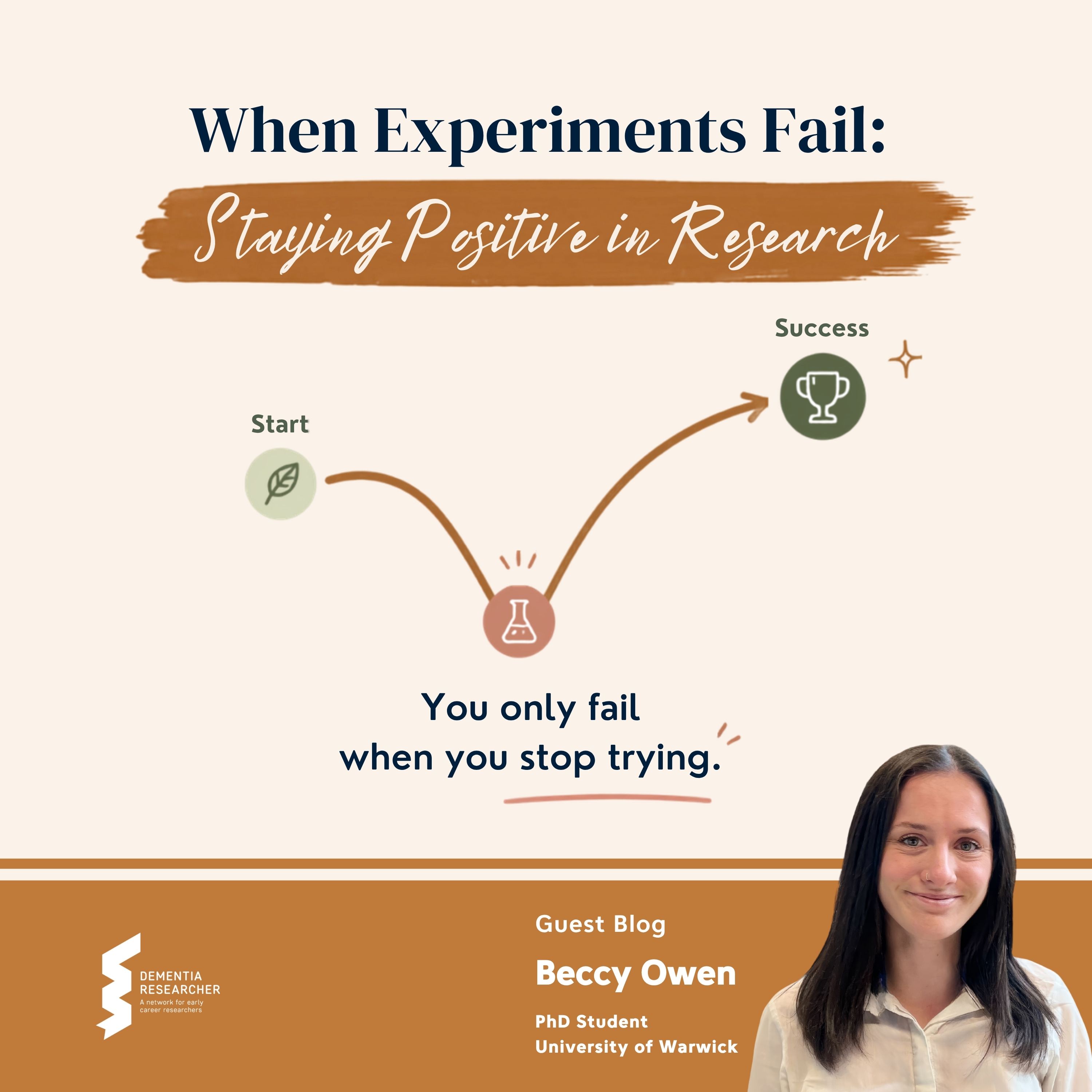
Beccy Owen - When Experiments Fail: Staying Positive in Research
Beccy Owen narrates her blog written for Dementia Researcher.
Every researcher knows the sinking feeling of an experiment failing after days, weeks or months of effort. In this blog Beccy talks about how she has learnt to stop letting failed experiments dictate her mood, and why they do not make you a bad scientist. She shares the best advice she has been given, from a lab manager who told her not to let a bad result follow her home, to knowing when to stop and re-evaluate rather than keep going down a dead end. Along the way...
Harriet Greene - How I Found My Way into Dementia Research: Give to Gain

Harriet Greene narrates her blog written for Dementia Researcher.
Harriet wrote her first essay on Alzheimer's at 15. What followed was not a tidy line to Oxford. She missed medicine by one mark, took her insurance place in Neuroscience at Queen Mary, topped her cohort's dissertation grades, then packed a backpack for a tiny island off Bali to learn to dive. A broken arm in Australia sent her home, a summer as a divemaster in Corfu taught her more than she expected, and somewhere between the dive boat and the papers she kept reading, she realised she missed...
Professor Frank Gunn-Moore: Do Cats, Dogs and Dolphins Get Dementia Too?
Professor Frank Gunn-Moore narrates his blog written for Dementia Researcher.
In this blog, Frank asks whether dementia is really unique to humans. Starting with the story of his cat Cardhu, and moving through research on dogs, dolphins, whales and other long-lived species, he explores what animal biology can teach us about memory, ageing, Alzheimer’s pathology and why some species may be more vulnerable, or more protected, than others.
https://www.dementiaresearcher.nihr.ac.uk/blog-do-cats-dogs-and-dolphins-get-dementia-too/
--
Professor Frank Gunn-Moore is an academic and researcher in neurodegeneration and dementia research at th...
Dr Sam Moxon - Why Some Ideas Never Get a Chance

Dr Sam Moxon narrates his blog written for Dementia Researcher.
You develop something genuinely different, cost it, build the team, submit it feeling confident, and then the rejection lands. In this blog, Dr Sam Moxon sits with the researchers who keep watching their most original ideas fall at the panel while safer, more familiar work sails through. He asks a question the field tends to avoid: are our funders too risk averse to back the ideas that might actually change things, and what does that caution do to the people early in their careers who cannot afford...
Dr Becky Carlyle - How I Started My Own Lecture Course
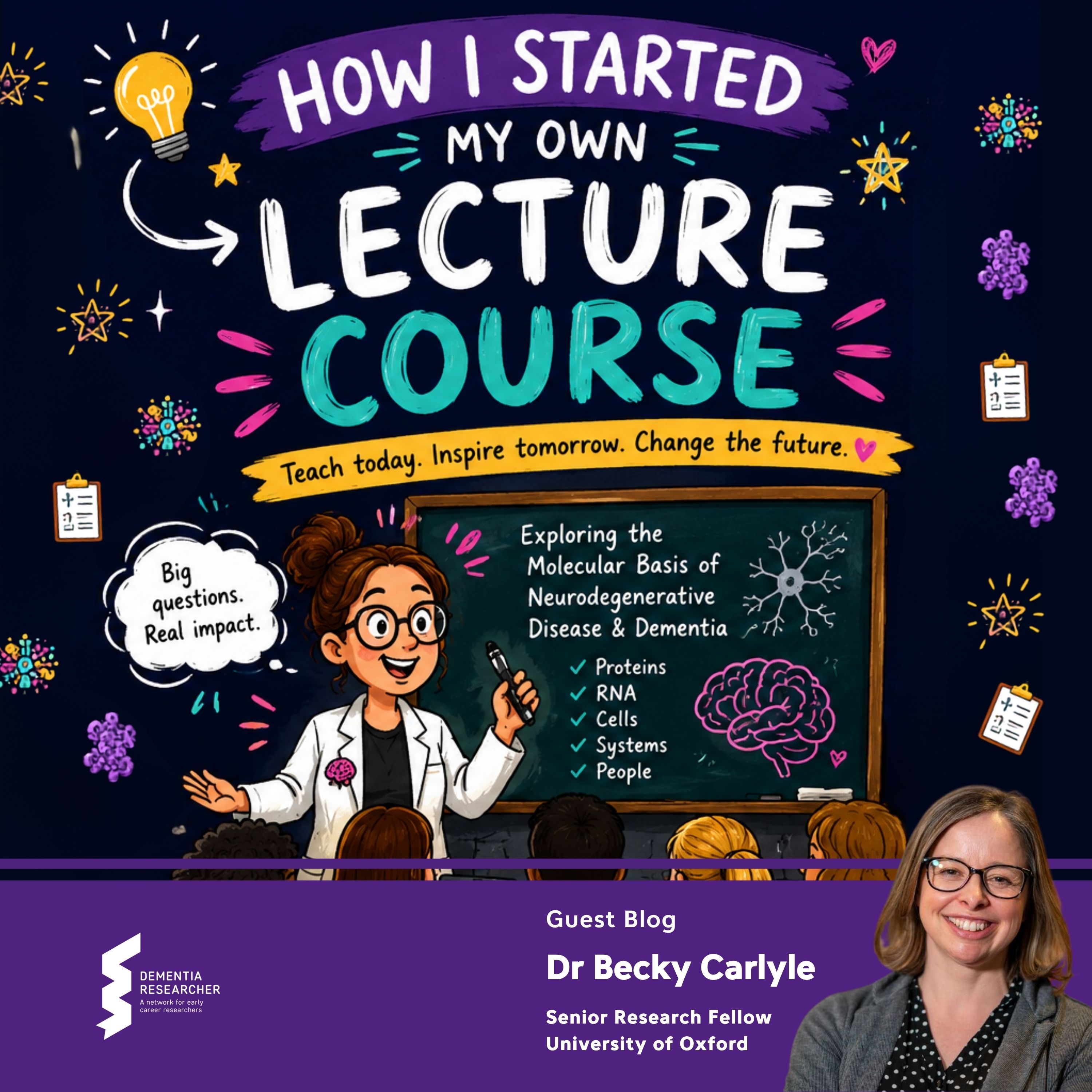
Dr Becky Carlyle narrates her blog written for Dementia Researcher.
In this blog, Becky reflects on creating a new lecture course for second year biomedical scientists, built around the molecular basis of neurodegenerative disease and dementia. She explains how teaching current research, from diagnosis and biomarkers to proteins, RNA, models, trials and uncertainty, helped students connect scientific discovery with the real challenges of dementia. The blog also offers practical advice for anyone thinking of building a course of their own, including teaching what you know, checking what students have already covered, giving clear handouts, designing fair exam...