The Moos Room™
Hosted by members of the University of Minnesota Extension Beef and Dairy Teams, The Moos Room discusses relevant topics to help beef and dairy producers be more successful. The information is evidence-based and presented as an informal conversation between the hosts and guests.
Episode 363 - What Can AI Tell You About Your Dairy? - UMN Extension's The Moos Room
Can AI turn mountains of dairy data into practical management insights? This episode explores how tools like ChatGPT can analyze bulk tank records, DHI reports, and milking-parlor data. Using examples from conventional and organic herds, we discuss how AI can reveal production and milk-quality trends, identify cows driving somatic cell count, highlight reproductive concerns, and uncover parlor-efficiency problems. AI cannot replace farmers, advisers, or Extension expertise—and its results should always be verified—but it can save hours of spreadsheet work and help dairy managers focus on the issues that need attention.
Questions, comments, scathing rebuttals? -> themo...
Episode 362 - Age at First Calving: Why 22 to 23 Months Pays - UMN Extension's The Moos Room
What is the ideal age at first calving for Holstein heifers? Brad examines a Zoetis study of nearly 130,000 cows from 74 dairy herds. Although heifers calving at 26 months produced slightly more projected first-lactation milk, those calving around 23 months produced more cumulative milk through two lactations, remained in the herd longer, and generated greater modeled net income.
Replacement risk increased substantially as calving age rose, reaching about 35% for heifers calving at 27 months compared with 17% at 21 months. By 27 months, modeled net income was approximately $650 lower than for the 23-month group because the small milk-production advantage did not offset additional rearing...
Episode 361 - Why Routine Hoof Trimming Pays: Preventing Lameness in Dairy Cows - UMN Extension's The Moos Room
Lameness can quietly reduce milk production, cow welfare, and dairy farm profitability. In this episode of The Moos Room, we examine how a difficult, wet spring prompted our dairy to make routine hoof trimming a priority for both its grazing and confinement herds.
Since 2019, every cow—including lactating and dry cows—has been trimmed twice a year, with hoof problems carefully recorded. The results have been substantial: the percentage of cows with hoof issues declined from 15.6% during the first whole-herd trimming to just 2–3% during the past two spring trimmings. Thin soles and toe ulcers have nearly disappeared, white...
Episode 360 - Working With the Dairy Cow’s Biological Clock - UMN Extension's The Moos Room
After a busy week showing dairy cattle at the county fair, Brad explores research on the dairy cow’s 12-month biological clock. Using data from 332 Western U.S. dairy herds, the study examined how region, breed, housing, organic management, and BST use influence seasonal patterns in milk production, components, dry matter intake, and feed efficiency.
Despite differences among herds, annual rhythms remained remarkably consistent: milk components peaked in winter, dry matter intake peaked in February, and milk production generally peaked in spring. The findings suggest producers and nutritionists should compare herd performance across seasons—not just from one...
Episode 359 - New Calf Health and Fertility Traits: What Dairy Producers Need to Know - UMN Extension's The Moos Room
This episode previews new U.S. dairy genetic evaluations scheduled for release by the Council on Dairy Cattle Breeding on August 11, 2026.
Two new calf-health traits will measure genetic resistance to diarrhea and respiratory disease in Holsteins and Jerseys. Positive predicted transmitting abilities indicate greater resistance. Although these traits have relatively low heritability, they may help producers gradually improve calf health, reduce treatment costs, and avoid the long-term productivity losses associated with early-life illness. Continued, accurate recording of calf health events will be essential for strengthening these evaluations
.
The episode also explains revisions to several...
Episode 358 - Footbath Management: What Dairy Farms May Be Missing - UMN Extension's The Moos Room
After sharing how recent heat stress caused an average milk loss of four pounds per cow in his herd, Brad turns his attention to lameness and footbath management. He examines a study of approximately 250 Canadian dairy farms to explore how footbaths are being used, where management gaps exist, and what the future of hoof-health programs may look like.
Most farms sent lactating cows through a footbath one or two times per week, commonly after milking. Copper sulfate was the most widely used product, but Brad discusses its potential to accumulate in soil and affect crop production. He...
Episode 357 - From Calf to Carcass: Early Nutrition for Beef-on-Dairy Success - UMN Extension's The Moos Room
Beef-on-dairy calves continue to bring strong prices, but producing calves that perform well from birth through harvest requires careful decisions about genetics and nutrition. In this episode, we look at current Minnesota calf markets, the factors influencing beef sire selection and recent research exploring how early feeding programs affect the long-term performance of Angus-Holstein calves.
A University of Minnesota study compared conventional 20:20 milk replacer with a higher-energy 24:24 formulation. Calves receiving the 24:24 milk replacer had greater starter intake, faster weight and frame growth, and improved feed efficiency through eight weeks of age. The results suggest that supplying more...
Episode 356 - Heat Stress and Water Intake in Dairy Cows - UMN Extension's The Moos Room
This episode examines how heat stress affects water intake in dairy cows—and why farms must prepare their watering systems for increasingly hot weather.
A review of studies from 1985–2024 found that Holstein cows producing roughly 65–70 pounds of milk averaged about 24 gallons of water per day under thermoneutral conditions. During heat stress, intake increased by approximately 10 liters, or 2–3 gallons, per cow per day. Each one-unit increase in the temperature-humidity index was associated with another 1.5 liters of water intake. Although heat-stressed cows produce less milk, they drink more because the additional water supports evaporative cooling and body-temperature regulation.
Data f...
Episode 355 - How Breed (Holstein and Crossbred) Influences Heifer Feed Intake and Emissions- UMN Extension's The Moos Room
Brad shares preliminary results from a University of Minnesota study examining feed intake, methane emissions, and feeding behavior in Holstein and crossbred dairy heifers. Using precision feeders, methane-monitoring equipment, and activity sensors, the research team compared Holsteins with ProCROSS and GrazeCross heifers.
The early findings show that methane production generally increased with feed intake. Smaller GrazeCross heifers consumed less feed and produced less methane and carbon dioxide, while ProCROSS heifers had the highest feed intake. However, methane produced per unit of dry matter intake did not differ significantly among the breed groups.
Brad also discusses...
Episode 354 - Hot Calves, Lower Gains: Rethinking Summer Calf Care - UMN Extension's The Moos Room
Brad takes a closer look at heat stress in dairy calves and cows. This episode highlights several recent studies on how temperature-humidity index affects calf behavior, lying time, respiration rates, shade use, and growth performance.
Brad discusses research from the University of Guelph, The Ohio State University, and Mississippi State showing that heat-stressed calves spend less time lying down, stand more often, breathe harder, and may gain less weight when shade is not provided. He also reviews a Texas A&M study using precision livestock technology to monitor drinking behavior, rumen temperature, and heat stress responses in...
Episode 353 - Calf Research Roundup: Colostrum, Beef-on-Dairy, and Weaning Insights - UMN Extension's The Moos Room
Back from the ADSA annual meeting in Milwaukee, Brad shares highlights from several calf-focused dairy studies. This episode covers new research on colostrum management for beef-on-dairy crossbred calves, including how feeding practices differ between retained dairy heifers, beef-on-dairy calves, and calves not kept on farm.
Brad also reviews a study comparing fixed-age weaning with starter-intake-based weaning in Holstein and Angus-Holstein calves, plus new work using ear tag sensors to track calf behavior, rumination, eating, and activity through 150 days of age. The episode wraps up with research from the University of Florida on colostrum yield, quality, and genetics...
Episode 352 - Somatic Cell Count Genetics and Heifer Feed Efficiency - UMN Extension's The Moos Rom
Brad shares two studies He presented at the American Dairy Science Association annual meeting. First, he examines records from more than 150,000 lactations to compare genetic predictions for somatic cell score and clinical mastitis. The results suggest that PTA for somatic cell score is more useful for predicting and ranking cows by observed somatic cell count than PTA for mastitis.
He also discusses a study comparing Holstein and crossbred heifers for feed intake, methane emissions, rumination, and feeding behavior. Although methane produced per kilogram of feed was similar across breed groups, smaller crossbred heifers consumed four to five...
Episode 351 - High Oleic Soybeans: A New Tool for Dairy Rations? - UMN Extension's The Moos Room
Brad discusses what he learned about high oleic soybeans at the Four State Dairy Management and Nutrition Conference in La Crosse, Wisconsin. High oleic soybeans are gaining attention in dairy nutrition because they can provide both rumen undegradable protein and a more rumen-friendly fat source, potentially reducing the need for purchased protein and fat supplements.
The episode covers how high oleic beans differ from conventional soybeans, why roasting quality matters, and how measures like protein dispersibility index help determine whether beans are under- or over-processed. Brad also reviews feeding rates, farm case studies showing milk fat and...
Episode 350 - New World Screwworm Returns to the U.S.: What Farmers Need to Know - UMN Extension's The Moos Room
A case of New World screwworm was recently identified in a three-month-old calf in Zavala County, Texas, near the Texas-Mexico border. In this episode, Brad breaks down what New World screwworm is, why it matters to livestock producers, and what signs to watch for in cattle and other animals. He explains how the larvae infest live tissue, how the pest spreads, and why early detection, reporting, quarantine, and treatment are key to preventing further spread.
The episode also clears up common myths, including whether screwworm spreads animal-to-animal or person-to-person, whether whole herds must be culled, and whether...
Episode 349 - Can Pasture-Raised Heifers Outperform Confinement Heifers? - UMN Extension's The Moos Room
Brad discusses new research comparing dairy heifers raised on pasture versus in confinement, focusing on studies from Wisconsin and Minnesota. Both studies found that pasture-raised heifers were slightly lighter and gained less before calving, but they reached calving at a similar age and showed advantages after freshening. Pasture-raised animals had higher dry matter intake, fewer health issues in the Minnesota study, and stronger first-lactation milk production, especially under rotational grazing systems.
Brad also highlights the economic upside: pasture systems reduced heifer feed costs and, in the Wisconsin study, improved income over feed cost during lactation. The episode...
Episode 348 - Holstein Classification and Crossbreeding Lessons from Minnesota Dairy Research - UMN Extension's The Moos Room
Brad shares updates from the University of Minnesota Morris dairy herd, including cows heading out to spring pasture, a recent Holstein classification, and highlights from several high-scoring cows. He then revisits University of Minnesota crossbreeding research comparing Holsteins with Viking Red and Montbéliarde crosses. The results show that crossbred cows often had better fertility, lower health treatment costs, improved survival to later lactations, and higher daily profitability, even when milk volume was sometimes lower than Holsteins. Brad also connects these findings to current beef-on-dairy calf research showing health advantages from crossbreeding, especially fewer scours and digestive problems.
...
Episode 347 - Heat Stress Starts Earlier Than We Think: Using Cow Sensors to Stay Ahead - UMN Extension's The Moos Room
In this episode of The Moos Room, Brad discusses spring pasture challenges in western Minnesota, including dry conditions, temperature swings, and slowed grass growth. With summer heat on the horizon, the focus shifts to heat stress in dairy cows and how precision technologies, especially internal bolus sensors, can help farmers identify problems earlier.
Brad shares observations from cows monitored with Smaxtec boluses, including rumination, internal body temperature, and water intake data. He also reviews research from the University of Minnesota herd showing that rumination may start dropping at lower temperature-humidity index levels than traditional industry thresholds suggest...
Episode 346 - FerAppease for Dairy Cows and Calves: Can Reducing Stress Improve Pregnancy Rates and Growth? - UMN Extension's The Moos Room
Brad takes a closer look at FerAppease, a synthetic analog of the maternal bovine appeasing substance that is gaining attention in both the dairy and beef industries. He explains how the product is designed to reduce stress in cattle during events like breeding, weaning, dehorning, transportation, calving, and dry-off.
The episode highlights recent research in lactating Holstein cows showing that applying FerAppease at the time of artificial insemination increased pregnancy per AI from 47.7% in control cows to 60.2% in treated cows. Brad also walks through the potential economics, estimating a strong return on investment when improved pregnancy rates...
Episode 345 - Virtual Fencing for Grazing Cattle: Costs, Training, and Practical Tips - UMN Extension's The Moos Room
Virtual fencing is gaining attention in livestock production, and this episode breaks down what dairy producers need to know before trying it. Brad explains how virtual fencing uses GPS-enabled collars or ear tags, audio cues, and electrical cues to manage grazing animals within digital boundaries. He also shares lessons from training heifers with virtual fence collars, including the adjustment period, the importance of using a physical fence during training, and how animals typically learn the system within about a week.
The episode also compares several virtual fencing systems available to U.S. producers, including Vence, Gallagher, Halter...
Episode 344 - Salmonella Dublin: The Hidden Threat in Dairy-Beef Systems - UMN Extension's The Moos Room
This episode highlights new research on Salmonella Dublin in dairy-beef systems and what it means for calf health and farm management.
The disease is a major threat to young calves, causing severe illness and high mortality, while often spreading silently through carrier animals and contaminated environments. New PCR testing shows the pathogen is far more common than traditional methods suggest.
Key risk factors include frequent introduction of new calves, mixing animals post-weaning, and human movement (boots, equipment) spreading contamination between areas.
Bottom line: Salmonella Dublin isn’t random—it reflects management. Strong biosecurity, bette...
Episode 343 - The Hidden Cost of Cow Health: Why It Pays to Look Beyond ‘Sick or Not - UMN Extension's The Moos Room
Spring may be slow to arrive in Minnesota, but research season is heating up. In this episode of The Moos Room, Brad revisits a large Minnesota-based study exploring the true cost of health events in dairy cows—and why tracking cost, not just disease incidence, could transform genetic selection and farm profitability.
Using data from thousands of Holstein cows across multiple herds, the team found that health costs are heavily concentrated in the first 30 days of lactation, when cows face metabolic stress from calving and high milk production. However, issues like lameness and mastitis continue to accumulate co...
Episode 342 - Cows, Kilowatts, and Cool-Season Grasses: What Grows Best Under Solar? - UMN Extension's The Moos Room
This episode of The Moos Room dives into new research on agrivoltaics—specifically how forages perform when grown under solar panels in grazing systems. Brad shares results from a recent study evaluating multiple grass and legume species across different solar array designs compared to a traditional pasture.
Overall, forage production depended heavily on species and shade level. Cool-season grasses like meadow fescue and orchardgrass performed well under solar panels, sometimes even producing more biomass than in open pasture. In contrast, warm-season species like sorghum-sudangrass struggled under shaded conditions. Legumes such as red clover maintained strong performance and co...
Episode 341 - Stop Mastitis Before It Starts: Pre-Calving Training That Works - UMN Extension's The Moos Room
In this episode of The Moos Room, Brad shares insights from a recent study at the University of Minnesota Morris dairy focused on reducing mastitis and improving behavior in first-lactation heifers. The research tested a simple, low-labor strategy: bringing heifers into the parlor once per week for three weeks before calving, gently acclimating them, and applying a 1% iodine teat dip. Results showed that trained heifers were calmer, easier to milk, and significantly less likely to kick during milking, improving both animal welfare and milker safety. While overall clinical mastitis rates did not differ, the treatment notably reduced Staphylococcus aureus i...
Episode 340 - Beef-on-Dairy Boom: Why Crossbred Calves Are Winning - UMN Extension's The Moos Room
Spring calving is underway in Minnesota, and with it comes renewed focus on the booming beef-on-dairy market. In this episode, Brad dives into current calf prices—highlighting the strong premium for beef-cross calves—and breaks down new research comparing Holstein and beef × dairy calves under the same management.
Across studies from Canada and Brazil, crossbred calves consistently showed advantages: lower rates of diarrhea, fewer treatment interventions, improved starter intake, and greater feed efficiency. While respiratory disease incidence was similar, crossbreds recovered faster and required fewer treatments. By 84 days, crossbred calves were heavier and more efficient to raise, reinfo...
Episode 339- Horn Fly Vaccines: What We Learned from a Summer Study - UMN Extension's The Moos Room
On this spring episode of The Moos Room, Brad dives into the seasonal return of flies and shares results from a recent horn fly vaccine study conducted at the University of Minnesota’s WCROC. Horn flies—common in pasture-based systems—cause significant irritation, blood loss, and production losses in cattle, and their rapid life cycle makes them difficult to control, especially with increasing insecticide resistance.
The study evaluated a Medgene horn fly vaccine designed to disrupt the fly’s ability to take a blood meal, ultimately reducing reproduction. Researchers vaccinated about half of the cows and heifers across o...
Episode 338 - Dairy by the Numbers: Production, Breeds, and Herd Size - UMN Extension's The Moos Room
Brad shares a spring dairy update and breaks down newly released national performance metrics from the Council on Dairy Cattle Breeding, offering a snapshot of what the U.S. dairy herd looks like today. He also touches on a major industry headline—Zoetis’ planned acquisition of Neogen’s animal genomics business—and what that could mean for dairy genetics going forward.
A big part of the episode focuses on the red-hot calf market, especially for beef-on-dairy crosses. Brad highlights eye-popping prices from Minnesota sale barns, where Holstein bull calves and beef-cross calves are bringing in far more than pro...
Episode 337 - Bucket or Nipple: What’s the Best Way to Feed Calves? - UMN Extension's The Moos Room
Brad explores a recent study comparing two common calf-feeding methods: open buckets and nipple buckets. While most U.S. dairies rely on open buckets because they allow calves to drink quickly and reduce chore time, the research looked at how these systems affect calf growth, digestion, and behavior.
The study followed individually housed calves fed six liters of milk per day until weaning at eight weeks. Calves fed with open buckets finished their milk much faster, often in under two minutes, while nipple-fed calves took about five minutes because the system mimics natural suckling. Despite the difference...
Episode 336 - Heat, Herd Size and Cow Factors: Understanding SCC in Organic Herds - UMN Extension's The Moos Room
Brad shares results from a large national research project examining somatic cell count (SCC) and mastitis risk in U.S. organic dairy herds, using more than 2 million DHI test-day records from 430 farms across 31 states. The discussion highlights how SCC is influenced by multiple factors, including cow age, stage of lactation, milk production, breed, season, region, and herd size. Older cows, early-lactation animals, and lower-producing cows were most likely to have elevated SCC, while heat stress—especially during summer months—and larger herd size significantly increased risk. Because organic systems cannot rely on antibiotics, Brad emphasizes prevention strategies such as impro...
Episode 335 - What the Necropsy Revealed: Hidden Heart Issues and Citrobacter Abortions
In this solo episode, Brad shares a few recent herd-health case studies from his dairy, highlighting the value of diagnostics and transparency.
He walks through two calf losses—one at 60 days old and another at 9 months. Both animals had been treated for common issues but continued to decline. Necropsies revealed severe heart abnormalities in each case (thin, underdeveloped ventricles), pointing toward possible genetic or nutritional causes. The takeaway: without a necropsy, these would have remained unexplained losses.
Brad also discusses a recent abortion in a dry cow. Diagnostic testing ruled out BVD and IBR and id...
Episode 334- The Cow of the Future: Built for Producers, Powered by Precision - UMN Extension's The Moos Room
Emily and Brad re-record this episode of The Moos Room after a technical glitch wiped out Emily’s audio—and dive into a big question: What does the dairy cow of the future look like?
Inspired by a recent Journal of Dairy Science paper, they move beyond the classic Holstein vs. Jersey debate to discuss a more balanced vision. Instead of selecting for maximum milk at all costs, the future cow will prioritize resilience, fertility, longevity, feed efficiency, and environmental sustainability.
They explore how genomics must be paired with real-world performance data (phenotypes), how...
Episode 333 - Beef on Dairy in a Hot Market: Calf Prices, Cattle Numbers, and Sire Selection - UMN Extension's The Moos Room
Calf prices are making headlines, and in this episode Emily and Brad are joined by UMN Extension beef educator Melissa Runck to talk through what today’s hot beef and beef-on-dairy markets mean for producers.
They discuss why newborn beef-cross calves are bringing record prices, how that cash can help dairy farms when milk prices are low, and what the latest Cattle on Feed report tells us about declining inventories and producers’ reluctance to keep heifers as replacements. The group then dives into beef-on-dairy sire selection, emphasizing realistic goals over the search for a “perfect” bull, the importan...
Episode 332 - From Herd Counts to Cow Scratches: What’s Changing in Midwest Dairies - UMN Extension's The Moos Room
On a warm-for-February day in Minnesota, Brad dives into two topics shaping today’s dairy landscape: changing dairy herd demographics in the Upper Midwest and new research on dairy cow preferences for grooming brushes.
The episode opens with a look at dairy farm numbers in Minnesota, where the state has lost nearly 37% of its dairy farms since 2019—dropping from 2,567 to just 1,622 operations. Brad breaks down herd size distribution, showing Minnesota remains dominated by small herds (especially 50–100 cows), even as the number of very large herds continues to grow. He also highlights where dairy farms are concentrated geographically, with S...
Episode 331 - Why I Use the Bulls I Do: Fertility, Polled Genetics, and Outcross Thinking - UMN Extension's The Moos Room
Brad checks in from a brutally cold stretch in western Minnesota (30–40°F below zero), noting the cows are handling it well and somatic cell counts tend to run low in the extreme cold. He then walks listeners through how he thinks about sire selection in his research herd—mostly Holsteins, plus Jerseys and a few “colored breeds” like Norwegian Red, Montbéliarde, and Normande.
His selection philosophy is clear: he starts with Net Merit, but he doesn’t blindly follow it. Brad says he doesn’t chase milk pounds, and he wishes the major indexes put more emphasis on fe...
Episode 330 - Circadian Rhythms in Dairy Cows: What Sensor Data Reveals About Welfare - UMN Extension's The Moos Room
In this solo episode of The Moos Room, Brad shares “hot off the press” research on circadian rhythms in dairy cows and what long-term sensor data can tell us about cow welfare. Drawing from a study presented at the International Precision Dairy Farming Conference in New Zealand, the episode explores how daily and seasonal behavior patterns—such as eating, rumination, activity, and rest—are shaped by environment, management, and breed.
Using more than 10 years of CowManager sensor data from the University of Minnesota research herd, Brad walks through how different breeds (Holsteins, crossbreds, graze-cross cows, and 1964 Holstein genetics...
Episode 329 - Winter Mastitis Management: Don’t Let the Cold Catch You Off Guard - UMN Extension's The Moos Room
In this solo “Emily Show” episode of The Moos Room, Emily takes a timely look at mastitis management during the winter months. While mastitis and high somatic cell counts are often associated with summer heat and humidity, Emily reminds listeners that cold weather brings its own risks and requires just as much attention to udder health.
She begins by emphasizing the foundation of mastitis prevention: clean, dry bedding, cow comfort, and good ventilation. These basics reduce stress on cows and limit bacterial exposure, which is especially important when winter conditions can lead to damp or dirty housing.
Episode 328 - Working Smarter, Not Longer: What Great Dairy Managers Do Differently - UMN Extension's The Moos Room
In the first episode of 2026, Emily and Brad kick off a New Year’s “resolution” to record more episodes together and dive into one of their favorite themes: management. The conversation is sparked by a German case study Brad found that followed 10 German dairy herd managers (average ~600 cows; range 200–1,200) for three weeks, tracking their work minute-by-minute to see how managers spend time—and what actually drives herd performance.
The key concept is “controlling activities,” defined as proactive checks and analysis (not just reacting and “putting out fires”). They break these into three categories: animal controls (pen walks, fresh/sick cow mon...
Episode 327 - Closing Out 2025: Reflections, Research, and What’s Ahead for The Moos Room - UMN Extension's The Moos Room
In the final episode of 2025, Emily and Brad reflect on another big year for The Moos Room, marking more than 300 episodes since launching in 2019. They look back on key 2025 topics, including real-world dairy case studies from the Morris Research Dairy, health and safety conversations, emerging disease issues, beef markets, virtual fencing, and growing interest in agrivoltaics.
Brad highlights the value of openly sharing on-farm challenges—from calf health issues to nutrition troubleshooting—so listeners can learn alongside the research process. Emily shares how 2025 deepened her understanding of virtual fencing, renewable energy in agriculture, and farm safety, while cont...
Episode 326 - A Holiday Reminder: Boundaries Are Self-Care - UMN Extension's The Moos Room
In this short solo episode of The Moos Room, Emily takes the mic to talk about managing holiday stress through setting healthy boundaries. With the holidays approaching, Emily shares practical guidance on navigating family dynamics, uncomfortable conversations, and competing demands on time and energy.
She outlines three simple steps for setting boundaries—being clear and direct, stating what you need, and accepting any discomfort that may follow—and walks through real-world examples such as saying no, redirecting conversations, asking for time, and stepping away when needed. Emily emphasizes that boundaries can be temporary or permanent, and that sett...
Episode 325 - Calf Transport: Why Early-Life Management Matters More Than Miles - UMN Extension's The Moos Room
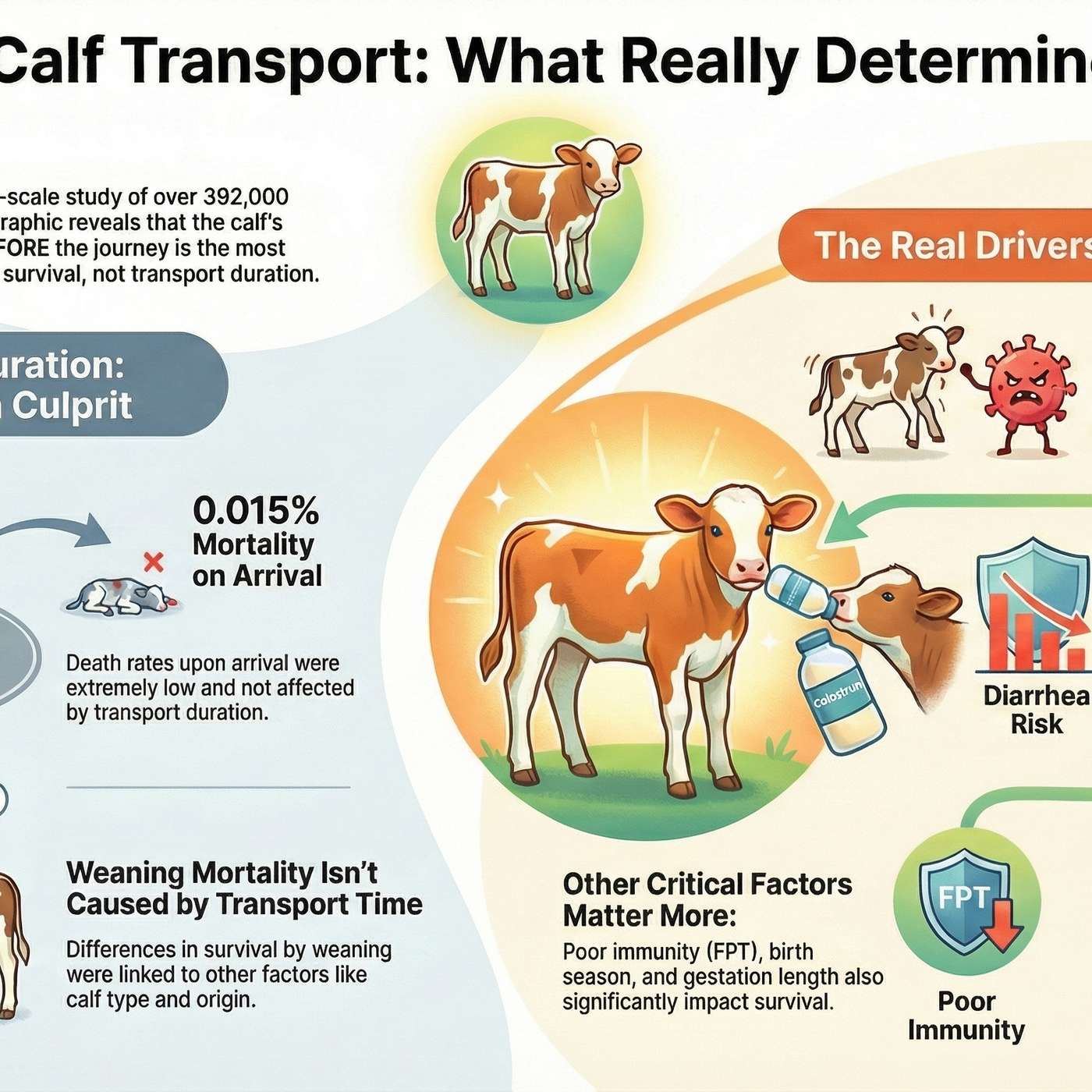
In this episode of The Moos Room, Brad dives into a landmark new study examining the effects of short- and long-distance transport on the health, survival, and growth of pre-weaned dairy and dairy–beef crossbred calves. Drawing on data from nearly 392,000 calves across multiple farms and transport durations (ranging from 30 minutes to 24 hours), the study challenges common assumptions about calf transport. Surprisingly, mortality upon arrival was extremely low and unaffected by transport length. Differences in mortality by weaning (60 days) were also modest and, importantly, were driven far more by early-life factors than by time spent on the truck.
...
Episode 324 - A New Vet in Town: Dr. Angie Joins the Moos Crew - UMN Extension's The Moos Room
In this episode, Brad and Emily welcome a special guest: Dr. Angie Varnum, the University of Minnesota Extension’s new livestock veterinarian. After some banter about Minnesota winters—and a classic round of The Moos Room’s “super-secret” cattle breed questions—the crew dives into Angie’s unique path to Extension.
Angie shares how she went from growing up in suburban Maple Grove to studying Spanish education, teaching in schools, and eventually being inspired to pursue veterinary medicine. Her training and work took her across the western U.S., where she gained experience in beef and dairy systems before...
